
Факторы риска развития стеноза коронарных артерий у больных ревматоидным артритом
Журнал: Научно-практическая ревматология @journal-rsp
Рубрика: Оригинальные исследования
Статья в выпуске: 6 т.55, 2017 года.
Бесплатный доступ
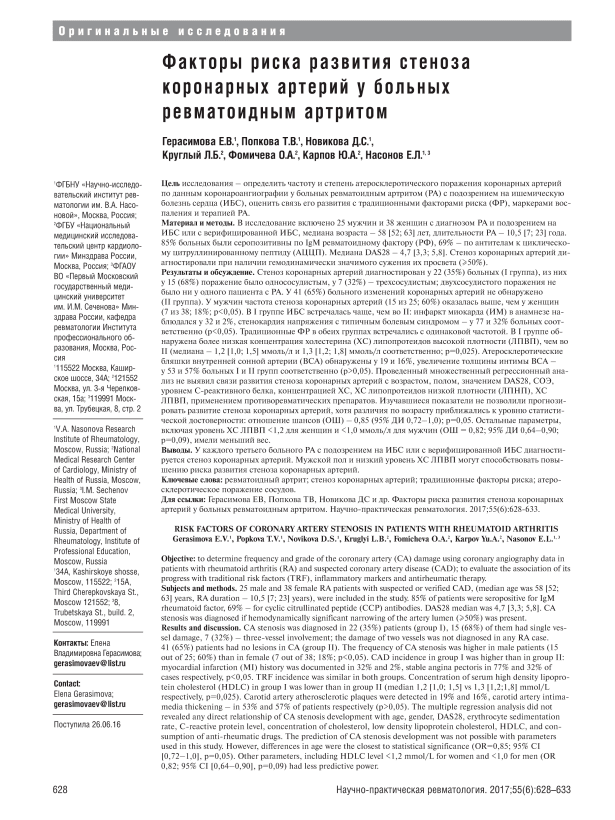
Цель исследования - определить частоту и степень атеросклеротического поражения коронарных артерий по данным коронароангиографии у больных ревматоидным артритом (РА) с подозрением на ишемическую болезнь сердца (ИБС), оценить связь его развития с традиционными факторами риска (ФР), маркерами воспаления и терапией РА. Материал и методы. В исследование включено 25 мужчин и 38 женщин с диагнозом РА и подозрением на ИБС или с верифицированной ИБС, медиана возраста - 58 [52; 63] лет, длительности РА - 10,5 [7; 23] года. 85% больных были серопозитивны по IgM ревматоидному фактору (РФ), 69% - по антителам к циклическому цитруллинированному пептиду (АЦЦП). Медиана DAS28 - 4,7 [3,3; 5,8]. Стеноз коронарных артерий диагностировали при наличии гемодинамически значимого сужения их просвета (>50%). Результаты и обсуждение. Стеноз коронарных артерий диагностирован у 22 (35%) больных (I группа), из них у 15 (68%) поражение было однососудистым, у 7 (32%) - трехсосудистым; двухсосудистого поражения не было ни у одного пациента с РА. У 41 (65%) больного изменений коронарных артерий не обнаружено (II группа). У мужчин частота стеноза коронарных артерий (15 из 25; 60%) оказалась выше, чем у женщин (7 из 38; 18%; р0,05). Проведенный множественный регрессионный анализ не выявил связи развития стеноза коронарных артерий с возрастом, полом, значением DAS28, СОЭ, уровнем С-реактивного белка, концентрацией ХС, ХС липопротеидов низкой плотности (ЛПНП), ХС ЛПВП, применением противоревматических препаратов. Изучавшиеся показатели не позволили прогнозировать развитие стеноза коронарных артерий, хотя различия по возрасту приближались к уровню статистической достоверности: отношение шансов (ОШ) - 0,85 (95% ДИ 0,72-1,0); р=0,05. Остальные параметры, включая уровень ХС ЛПВП
Похожие статьи в разделе Патология сердечно-сосудистой системы. Сердечно-сосудистые заболевания
Короткий адрес: https://sciup.org/14945873
IDS: 14945873 | DOI: 10.14412/1995-4484-2017-628-633
Risk factors of coronary artery stenosis in patients with rheumatoid arthritis
Objective: to determine frequency and grade of the coronary artery (CA) damage using coronary angiography data in patients with rheumatoid arthritis (RA) and suspected coronary artery disease (CAD); to evaluate the association of its progress with traditional risk factors (TRF), inflammatory markers and antirheumatic therapy. Subjects and methods. 25 male and 38 female RA patients with suspected or verified CAD, (median age was 58 [52; 63] years, RA duration - 10,5 [7; 23] years), were included in the study. 85% of patients were seropositive for IgM rheumatoid factor, 69% - for cyclic citrullinated peptide (CCP) antibodies. DAS28 median was 4,7 [3,3; 5,8]. CA stenosis was diagnosed if hemodynamically significant narrowing of the artery lumen (>50%) was present. Results and discussion. CA stenosis was diagnosed in 22 (35%) patients (group I), 15 (68%) of them had single vessel damage, 7 (32%) - three-vessel involvement; the damage of two vessels was not diagnosed in any RA case. 41 (65%) patients had no lesions in CA (group II). The frequency of CA stenosis was higher in male patients (15 out of 25; 60%) than in female (7 out of 38; 18%; p0,05). The multiple regression analysis did not revealed any direct relationship of CA stenosis development with age, gender, DAS28, erythrocyte sedimentation rate, C-reactive protein level, concentration of cholesterol, low density lipoprotein cholesterol, HDLC, and consumption of anti-rheumatic drugs. The prediction of CA stenosis development was not possible with parameters used in this study. However, differences in age were the closest to statistical significance (0R=0,85; 95% CI [0,72-1,0], p=0,05). Other parameters, including HDLC level
Список литературы Факторы риска развития стеноза коронарных артерий у больных ревматоидным артритом
- Насонов ЕЛ, Каратеев ДЕ, Балабанова РМ. Ревматоидный артрит. В кн.: Насонов ЕЛ, Насонова ВА, редакторы. Ревматология. Национальное руководство. Москва: ГЭОТАР-Медиа; 2008. С. 290-331
- Yazdanyar A, Wasko MC, Kraemer KL, Ward MM. Perioperative all-cause mortality and cardiovascular events in patients with rheumatoid arthritis: comparison with unaffected controls and persons with diabetes mellitus. Arthritis Rheum. 2012 Aug; 64(8): 2429-37 DOI: 10.1002/art.34428
- Ranganath VK, Maranian P, Elashoff DA, et al. Comorbidities are associated with poorer outcomes in community patients with rheumatoid arthritis. Rheumatology (Oxford). 2013 0ct; 52(10): 1809-17. Epub 2013 Jun 27 DOI: 10.1093/rheumatology/ket224
- Semb AG, Kvien TK, Aastveit AH. Lipids, myocardial infarction and ischaemic stroke in patients with rheumatoid arthritis in the Apolipoprotein-related Mortality RISk (AMORIS) Study. Ann Rheum Dis. 2010; 69: 1996-2001 DOI: 10.1136/ard.2009.126128
- Boyer JF, Gourraud PA, Cantagrel A, et al. Traditional cardiovascular risk factors in rheumatoid arthritis: a meta-analysis. Joint Bone Spine. 2011; 78: 179-83 DOI: 10.1016/j.jbspin.2010.07.016
- Avina-Zubieta JA, Thomas J, Sadatsafavi M, et al. Risk of incident cardiovascular events in patients with rheumatoid arthritis: a metaanalysis of observational studies. Ann Rheum Dis. 2012 Sep; 71(9): 1524-9 DOI: 10.1136/annrheumdis-2011-200726
- Maradit-Kremers H, Crowson CS, Nicola PJ, et al. Increased unrecognized coronary heart disease and sudden deaths in rheumatoid arthritis: a population-based cohort study. Arthritis Rheum. 2005 Feb; 52(2): 402-11 DOI: 10.1002/art.20853
- Koivuniemi R, Paimela L, Suomalainen R, Leirisalo-Repo M. Cardiovascular diseases in patients with rheumatoid arthritis. Scand J Rheumatol. 2013; 42(2): 131-5. Epub 2012 Dec 18 DOI: 10.3109/03009742.2012.723747
- Holmqvist ME, Wedren S, Jacobsson LT, et al. Rapid increase in myocardial infarction risk following diagnosis of rheumatoid arthritis amongst patients diagnosed between 1995 and 2006. J Intern Med. 2010 Dec; 268(6): 578-85 DOI: 10.1111/j.1365-2796.2010.02260.x
- Rollefstad S, Ikdahl E, Hisdal J, et al. Association of Chest Pain and Risk of Cardiovascular Disease with Coronary Atherosclerosis in Patients with Inflammatory Joint Diseases. Front Med (Lausanne). 2015 Nov 10; 2: 80. eCollection 2015 DOI: 10.3389/fmed.2015.00080
- Aubry MC, Maradit-Kremers H, Reinalda MS, et al. Differences in atherosclerotic coronary heart disease between subjects with and without rheumatoid arthritis. J Rheumatol. 2007 May; 34(5): 937-42. Epub 2007 Mar 15.
- Karpouzas GA, Malpeso J, Choi TY, et al. Prevalence, extent and composition of coronary plaque in patients with rheumatoid arthritis without symptoms or prior diagnosis of coronary artery disease. Ann Rheum Dis. 2014 0ct; 73(10): 1797-804. Epub 2013 Jul 25 DOI: 10.1136/annrheumdis-2013-203617
- Mason JC, Libby P. Cardiovascular disease in patients with chronic inflammation: mechanisms underlying premature cardiovascular events in rheumatologic conditions. Eur Heart J. 2015 Feb 21; 36(8): 482-9c. Epub 2014 Nov 27 DOI: 10.1093/eurheartj/ehu403
- Ostrom MP, Gopal A, Ahmadi N, et al. Mortality incidence and the severity of coronary atherosclerosis assessed by computed tomography angiography. J Am Coll Cardiol. 2008 Oct 14; 52(16): 1335-43 DOI: 10.1016/j.jacc.2008.07.027
- Min JK, Dunning A, Lin FY, et al. Age-and sex-related differences in all-cause mortality risk based on coronary computed tomography angiography findings results from the International Multicenter CONFIRM (Coronary CT Angiography Evaluation for Clinical Outcomes: An International Multicenter Registry) of 23,854 patients without known coronary artery disease. J Am Coll Cardiol. 2011 Aug 16; 58(8): 849-60 DOI: 10.1016/j.jacc.2011.02.074
- Emond M, Mock MB, Davis KB, et al. Long-term survival of medically treated patients in the Coronary Artery Surgery Study (CASS) Registry. Circulation. 1994 Dec; 90(6): 2645-57 DOI: 10.1161/01.CIR.90.6.2645
- Ni H, Coady S, Rosamond W, et al. Trends from 1987 to 2004 in sudden death due to coronary heart disease: the atherosclerosis risk in communities (ARIC) study. Am Heart J. 2009; 157: 46-52 DOI: 10.1016/j.ahj.2008.08.016
- Sidney S, Rosamond WD, Howard VJ, Luepker RV. The «heart disease and stroke statistics -2013 update» and the need for a national cardiovascular surveillance system. Circulation. 2013; 127: 21 DOI: 10.1161/CIRCULATIONAHA.112.155911
- Go AS, Mozaffarian D, Roger VL, et al. American Heart Association Statistics Committee and Stroke Statistics Subcommittee Heart disease and stroke statistics -2014 update: a report from the American heart association. Circulation. 2014; 129: e28-292 DOI: 10.1161/01.cir.0000442015.53336.12
- Anand SS, Yusuf S, Vuksan V, et al. Differences in risk factors, atherosclerosis, and cardiovascular disease between ethnic groups in Canada: the Study of Health Assessment and Risk in Ethnic groups (SHARE). Lancet. 2000 Jul 22; 356(9226): 279-84 DOI: 10.1016/S0140-6736(00)02502-2
- Chang CC, Chang ML, Huang CH, et al. Carotid intima-media thickness and plaque occurrence in predicting stable angiographic coronary artery disease. Clin Interv Aging. 2013; 8: 1283-8. Epub 2013 Sep 25 DOI: 10.2147/CIA.S49166
- Asztalos BF, Collins D, Cupples LA, et al. Value of high density lipoprotein (HDL) subpopulations in predicting recurrent cardiovascular events in the veteran's affairs HDL Intervention trial. Aterioscler Throm Vasc Biol. 2005; 25: 2185-21 DOI: 10.1161/01.ATV.0000183727.90611.4f
- Lamon-Fava S, Herrington DM, Reboussin DM, et al. Plasma levels of HDL subpopulations and remnant lipoproteins predict the extent of angiographically-defined coronary artery disease in postmenopausal women. Arterioscler Thromb Vasc Biol. 2008; 28: 575-9 DOI: 10.1161/ATVBAHA.107.157123
- Watanabe H, Soderlund S, Soro-Paavonen A, et al. Decreased high-density lipoprotein (HDL) particle size, prebeta-, and large HDL subspecies concentration in Finnish low-HDL families: relationship with intima-media thickness. Arterioscler Thromb Vasc Biol. 2006; 26: 897-902 DOI: 10.1161/01.ATV.0000209577.04246.c0
- Williams PT, Feldman DE. Prospective study of coronary heart disease vs. HDL2, HDL3, and other lipoproteins in Gofman's Livermore Cohort. Atherosclerosis. 2011 Jan; 214(1): 196-202 DOI: 10.1016/j.atherosclerosis.2010.10.024
- Superko HR, Pendyala L, Williams PT, et al. High-density lipoprotein subclasses and their relationship to cardiovascular disease. J Clin Lipidol. 2012 Nov-Dec; 6(6): 496-523. Epub 2012 Mar 23 DOI: 10.1016/j.jacl.2012.03.001
- Arts E, Fransen J, Lemmers H, et al. High-density lipoprotein cholesterol subfractions HDL2 and HDL3 are reduced in women with rheumatoid arthritis and may augment the cardiovascular risk of women with RA: a cross-sectional study. Arthritis Res Ther. 2012 May 14; 14(3): R116 DOI: 10.1186/ar3842
- Charles-Schoeman C, Watanabe J, Lee YY, et al. Abnormal function of high-density lipoprotein is associated with poor disease control and an altered protein cargo in rheumatoid arthritis. Arthritis Rheum. 2009 Oct; 60(10): 2870-9 DOI: 10.1002/art.24802
- Charles-Schoeman C, Lee YY, Grijalva V, et al. Cholesterol efflux by high density lipoproteins is impaired in patients with active rheumatoid arthritis. Ann Rheum Dis. 2012 Jul; 71(7): 1157-62 DOI: 10.1136/annrheumdis-2011-200493
- Удачкина ЕВ, Новикова ДС, Попкова ТВ и др. Динамика липидных параметров крови у больных ранним ревматоидным артритом на фоне противоревматической терапии, проводимой по принципу «Лечение до достижения цели» (по данным 18-месячного наблюдения) Научно-практическая ревматология. 2016; 54(2): 164-70
- Van Lenten BJ, Hama SY, de Beer FC, et al. Anti-inflammatory HDL becomes pro-inflammatory during the acute phase response. Loss of protective effect of HDL against LDL oxidation in aortic wall cell cocultures. J Clin Invest. 1995 Dec; 96(6): 2758-67 DOI: 10.1172/JCI118345
- Van Lenten BJ, Wagner AC, Nayak DP, et al. High-density lipoprotein loses its anti-inflammatory properties during acute influenza a infection. Circulation. 2001 May 8; 103(18): 2283-8 DOI: 10.1161/01.CIR.103.18.2283
