
Feedback from Students on Career Opportunities in Tourism: A Cognitive Research Approach
Journal: International Journal of Cognitive Research in Science, Engineering and Education @ijcrsee
Section: Articles
Article in issue: 1 vol.14, 2026.
Free access
In order to learn different techniques of tourism, students acquire different knowledge and skills, but also develop critical opinions, seek more and more information and knowledge from different perspectives. The demands of the labor market, together with the competences acquired during studies, foster students’ critical thinking. Through providing feedback, students’ opinions can serve as confirmation of the effectiveness of acquiring empirical and practical knowledge in higher education institutions. The aim of this study is to investigate opinions and expectations of students of Faculty of Hotel Management and Tourism about employment opportunities in the tourism industry, after completing their formal education. The authors conducted a quantitative study analyzing the responses of two groups of students (first-year students and fourth-year students) of the University of Kragujevac, Faculty of Hotel Management and Tourism in Vrnjačka Banja, Serbia. The results indicate that students primarily value employment opportunities in tourism when they involve managerial or leadership positions. Furthermore, while some students express readiness to accept any tourism-related job after graduation, they also advise prospective students to carefully reconsider pursuing higher education in tourism. The results will be very useful for universities (deans, administrators, and other) and future creators of the educational policy of the subject research, but also of wider scope.
Similar articles in the section Management
Short address: https://sciup.org/170212430
IDS: 170212430 | UDC: 005.412:338.48(497.11); 378.147::338.48(497.11) | DOI: 10.23947/2334-8496-2026-14-1-065-075
Text of the scientific article Feedback from Students on Career Opportunities in Tourism: A Cognitive Research Approach
Higher education and the social relationships of teaching and administrative staff with students can be understood as „calculated instrumental exchanges, whereby, in exchange for the fee they pay, students expect to receive an education designed to ensure they have the knowledge, skills and innovative capabilities required by businesses and the economy in the competitive global market place” ( Leach, 2019, p. 155 ). The key concept of higher education is certainly the creation of employment opportunities and employment is the main expectation that students have from university education ( Cheng at al., 2022 ; Gorgodze et al., 2020 ; Khan and Hemsley-Brown, 2024 ). Also, the perception of employment opportunities after graduation is one of the key factors influencing students’ satisfaction during their studies, as well as the likelihood that they will recommend their higher education institution to others ( Khan and Hemsley-Brown, 2024 ). Despite all the above, the authors of this study share the opinion of Leach (2019) that higher education is “more than the instrumental ‘value for money’ meeting of the needs of business and the economy “, as well as that one of its most valuable characteristics is giving purpose and meaning to people “to envisage, plan and manage their career journeys in a complex world of work and contested employment relationships” ( Leach, 2019 ).

© 2026 by the authors. This article is an open access article distributed under the terms and conditions of the Creative Commons Attribution (CC BY) license .
tremely important, especially if higher education institutions want to attract young people and if they strive to create teaching programs in accordance with the demands and expectations of young people and trends in the labor market ( Gorgodze et al., 2020 ). In modern higher education, receiving feedback from students is standard practice for teachers around the world and this feedback can effectively contribute to the design of higher education and teaching policies ( Flodén, 2017 ; Wijesundara, 2015 ). Many higher education institutions prepare reports on the quality and self-evaluation of the institution ( Zou et al., 2012 ). Such reviews are created as an implication for quality assessment within the activity and focus on students’ learning experiences, their achievements and feedback. Therefore, university teachers have the task of balancing all the factors that affect the teaching process, in order to achieve inviting feedback, all with the aim of effective and quality education system.
This paper focuses on feedback from students of the University of Kragujevac, Faculty of Hotel Management and Tourism in Vrnjačka Banja. The Faculty of Hotel Management and Tourism consists of 2 study programs of undergraduate academic studies: study program Hospitality and Tourism and study program Gastronomic Management. The faculty has 724 active students who attend studies in the Serbian language. Furthermore, undergraduate, master’s and doctoral academic studies are available to students. The Faculty of Hotel Management and Tourism in Vrnjačka Banja is part of the University of Kragujevac, which is the fourth largest state university in the Republic of Serbia. The reason for choosing the subject institution for the analysis is because it is the only state faculty for tourism in the Republic of Serbia ( Faculty of Hotel Management and Tourism in Vrnjačka Banja, 2025 ). The opinions of first-year students were defined as the experimental group, while the control group was the opinion of 4th-year students. The findings of the research relate to general questions about quality and future employment in tourism, and those related to accepting jobs after graduation and advice to younger generations regarding choosing tourism as a future career are the most important.
The paper is composed of several chapters that follow. First, the study begins with the introductory part of the paper, followed by the theoretical framework of previous findings in the field of cognitive research of students, especially focusing on tourism students. Subsequently, the applied methodology is outlined. The results obtained after an extensive analysis were presented and analyzed through a discussion and a conclusion at the end of the paper.
Theoretical background
Career opportunities in Tourism
Tourism remains one of the world’s most important industries and a significant source of employment. In 2024, the travel and tourism sector supported an estimated 357 million jobs, representing approximately 10% of total global employment, or approximately one in ten jobs worldwide ( World Travel and Tourism Council, 2024 ). This number is expected to increase to approximately 449 million jobs by 2034, indicating continued strong growth in the sector and its increasing importance to the global economy ( World Travel and Tourism Council, 2024 ).
The tourism industry is considered one of the main sectors in which human resources and highly qualified professionals with advanced skills play a very important role ( Nakipova et al., 2021 ; Stacey, 2015 ; Tfaily, 2018 ; Ganie and Dar, 2020 ). As a labor-intensive sector, tourism relies heavily on human capital, which makes aspects such as job quality, education, and skills particularly significant ( Grobelna and Dolot, 2018 ). These factors are primarily addressed through education and training, which play a key role in preparing future professionals to meet the dynamic requirements of the industry. Therefore, professional education is highly important for employment process and future career opportunities, in particular taking into account the significant expression of internationalization in this industry ( Ladkin, 2006 ; Chinasa and Ozgit, 2024 ; Hjalager and Andersen, 2001 ). In this regard, the employment process in tourism industry begins during higher education, and even earlier ( Baum and Szivas 2008 ).
At the global level, there is a wide range of hospitality and tourism programs that contribute both to graduates’ professional development and to the tourism industry as a whole. Ideally, each student is expected to acquire sufficient knowledge and skills to successfully enter the labor market. However, previous research has shown that the reality is often different, with graduates facing significant employment-related challenges (Chuang and Dellmann-Jenkins, 2010). Given that students and recent graduates are at similar life stages, earlier studies have examined their attitudes from the perspective of career advancement expectations, academic adjustment, and professional growth (Schoffstall et al., 2017). Through practical training and direct exposure to real-world job settings, students have developed a variety of impressions about the hospitality and tourism industry—ranging from the potential satisfaction they expect such work to bring, to how they perceive interpersonal relations within these sectors—which in turn influences their motivation to pursue employment in these fields after graduation (Liu et al., 2022).
This makes it particularly relevant to compare the views of students at the beginning of their studies with those in their final years, when they are closer to entering the job market. Earlier research indicates that students tend to be more interested in managerial positions within the tourism industry ( Ross, 1993 ), yet they also tend to remain in the industry only in the short term. This creates a challenge for tourism employers, as the industry faces a persistent problem of knowledge leakage ( Bednarska and Olszewski, 2013 ). Such findings underscore the importance of investigating students’ perceptions of their future employment in the tourism sector.
Including Generation Z in the Feedback Process in the Tourism Industry
Involving Generation Z students in providing feedback to high education institutions about their educational experiences and perceptions of the employment and industry can offer valuable insights for aligning academic programs with labor market needs and students’ requirements for acquiring knowledge and career advancement ( Gormally et al., 2014 ; Morris et al., 2021 ; Matejić and Milenković, 2025 ). This is particularly significant in the Republic of Serbia, where the education system has experienced considerable turbulence in 2025 ( Cvetković et al., 2025 ). For feedback to be truly useful and to help educators improve their teaching, it is essential that those providing feedback possess a certain level of subject knowledge and content understanding. Equally important is the willingness of instructors and institutions to actively seek, interpret, and apply such feedback to better align curricula with industry expectations and enhance students’ career readiness ( Gormally et al., 2014 ). Greater attention should also be devoted to providing written feedback, which students perceive as the most useful and valuable part of the learning process ( Hyland, 2013 ).
Exploring the attitudes of Generation Z toward employment in this labor-intensive sector is of growing interest, given that this generation is characterized by high levels of digital literacy and frequent technology use ( Grobelna et al., 2023 ). Based on systematic literature review, Barhate and Dirani (2022) found that intrinsic (careers based on Gen Z’s attitudes, self-perception, relationships and motivations) and extrinsic factors (Gen Z’s closest environment, family and organizations) determine Gen Z’s career aspirations. Also, the authors concluded that Gen Z has “well-defined career expectations and career development plans” ( Barhate and Dirani, p. 139 ). A group of authors ( Belle et al., 2022 ) indicates that the positive mental attitude and development of the individual, i.e. graduating college students, which can be further increased through student practice, prevents the emergence of anxiety related to employment. Leach (2019) makes a controversial contribution to this research field, emphasizing “the flawed assumptions about student expectations, engagement and satisfaction, which fail to acknowledge the positive life-changing impact the higher education experience can have on students and in their work”. Additionally, he points out that the processes of understanding students’ careers and employment are cognitive and emotional, and that only with the building of a sense of professional identity, employment in the current value system can bring a sense of well-being for the individual ( Leach, 2019 ).
Numerous researches on this topic were also carried out in the tourism sector. Research indicates that Generation Z tends to view the tourism industry through a lens of multiple negative factors, including social constraints, lack of work-life balance, long hours, and heavy workloads. Employment is often described as stressful, exhausting, and seasonal, with low wages that do not ensure a satisfactory standard of living and limited opportunities for career advancement and professional development ( Goh and Baum, 2021 ). At the same time, other studies show that Generation Z students still perceive tourism as an exciting industry that offers opportunities for travel, despite challenges such as dealing with people, long working hours, and potential health and safety issues ( Goh and Lee, 2018 ).
A review of research in China of hospitality and tourism students’ career goals and expectations reveals several recurring themes. These include general perceptions of future career success, expectations related to the nature of work, long-term professional objectives, as well as the knowledge and skills that students have—or have not—acquired during their studies (Lu and Adler, 2009).
Many authors examined hospitality and tourism students’ perceptions related to employment opportunities before and after completing their studies. Findings vary, but a notable trend suggests that graduates often express more negative attitudes toward employment in the tourism sector than students at the beginning of their studies. For example, Barron and Maxwell (1993) found that first-year students had more positive attitudes toward employment compared to senior undergraduates. Extensive research was presented by Kusluvan and Kusluvan (2000) , who explored employment attitudes toward tourism among three groups: high school students in tourism and hospitality, current industry employees, and university students majoring in tourism and hospitality. Building on this, Moyo and Özgit (2022) highlighted differences between students who are early in their studies and those nearing graduation or already employed. Their findings suggest that first-year students tend to be well-informed, highly motivated, and optimistic about working in the tourism industry, whereas final-year students express greater concern about their ability to adapt to real-world challenges. Following this approach, the present study also compares these two groups—those just beginning their tourism education and those completing their studies and actively seeking employment—to better understand how attitudes shift throughout the academic journey.
While existing studies have provided valuable insights into students’ attitudes toward careers in tourism, there remains a need for more context-specific research that explores how perceptions evolve during the course of academic study—especially in regions undergoing educational and labor market transitions, such as Serbia. This paper seeks to address this gap by comparing the attitudes and perceptions of first-year and final-year tourism students by applying a cognitive research approach.
Materials and Methods
Sample and Participants
The study involved a total of 137 undergraduate students enrolled at the Department of Hotel Management and Tourism, Faculty of Hotel Management and Tourism in Vrnjačka Banja, Serbia. The sample consisted of 79 first-year students and 58 fourth-year students. Data were collected across two academic years: 2023/2024 (n = 79) and 2024/2025 (n = 58). All first-year participants were enrolled in the course Principles of Tourism and Hospitality, while fourth-year participants attended the Cultural Tourism course. In addition, all students had completed at least one mandatory internship during the academic year in which they participated in the study, ensuring that respondents had some level of practical exposure to the tourism and hospitality industry.
Table 1. The structure of tourism/hospitality education at Faculty of Hotel Management and Tourism in Vrnjačka Banja
|
Level |
Study program |
Number of students (2024/2025) |
Duration |
Outcome |
|
Hospitality and tourism |
451 |
4 years |
Bachelor’s Degree |
|
|
Undergraduate level |
Gastronomic management |
116 |
4 years |
Bachelor’s Degree |
|
Health Tourism |
44 |
4 years |
Bachelor’s Degree |
|
|
Management in tourism |
38 |
1 years |
M.sc. Degree |
|
|
Management in |
30 |
1 years |
||
|
Postgraduate |
the Hospitality |
M.sc. Degree |
||
|
level |
hotel industry Health Tourism |
24 |
1 years |
M.sc. Degree |
|
Hospitality and tourism |
21 |
3 years |
Ph.D. Degree |
Data Collection Procedure
During the 2023/2024 academic year, 79 first-year students participated in the study. At the final class of the Principles of Tourism and Hospitality course, students were provided with practical information about the study and informed about the expectations for participation. They were given a period of seven days to complete and return the questionnaire. In the 2024/2025 academic year, 58 fourth-year students participated in the study during the summer semester. These students had completed the majority of their courses, undertaken three internships, or were in the process of completing their final thesis. Similarly, they were given seven days to submit the completed questionnaire. All responses were collected anonymously to ensure confidentiality and encourage honest feedback.
Study Description
For data collection, the authors employed a survey research method, which Goodfellow (2023) describes as significant in the social sciences because “surveys can provide evidence for good practice, knowledge, behaviors, and attitudes.” To this end, a semi-structured questionnaire was developed. Although the questionnaire included a large number of items, only a specific subset was used in this study ( Paraušić et al., 2025 ). The questions were adapted and refined based on findings from previous research ( Kusluvan and Kusluvan, 2000 ; El-Houshy, 2014 ; Sadikoglu and Oktay, 2017 ). The final version of the questionnaire was created after correcting unclear or ambiguous items. Data were collected by distributing the questionnaire to participants, who were asked to complete it. To facilitate easier collection and processing of responses, the questionnaire was also administered online via Google Forms. The online survey was conducted from November 2023 to May 2025, resulting in a final sample size of 137 students.
Research Question
The central research question of this study is: “Are there differences in perceptions of future employment in tourism sector between two groups of students: experimental (first year students) and control group (fourth year students)“. It is anticipated that students during studies will gain deeper insights into career opportunities in tourism, develop more critical and reflective attitudes toward future employment, and better understand both the challenges and advantages of working in the tourism sector.
Variables
To address the research question, two groups of participants were included in the study. The opinions of first-year students were defined as the experimental group, while the fourth-year students served as the control group. A Likert scale was used for assessing respondents’ perceptions, with scores ranging from 1 to 5 (1 = strongly disagree; 5 = strongly agree). In addition to the Likert-scale variables, categorical variables were included to examine various factors related to employment and directly assess students’ attitudes toward careers in the tourism industry. These variables were selected based on a comprehensive review of the literature, ensuring that they capture relevant aspects of students’ expectations, career motivations, and perceptions of industry realities.
Results and Discussions
We used 5 criteria for the research (Table 2) and for each criteria the scale of the number of points was created for each level within each criterion (a typical five-level Likert item, with marks 1-Strongly disagree, 2-Disagree, 3- Neither agree nor disagree, 4-Agree, 5-Strongly agree). Based on all those five criteria, the total number of points for this student research was calculated. Since the total number of points scored by the students for the five criteria mentioned, did not have a normal distribution, the nonparametric Mann-Whitney test was used to compare the results of the experimental (first year students) and control groups (forth year students).
Table 2. Student results for every criterion in research
|
Criteria |
Testing group |
Students, No. |
Medians |
Mean rank |
Sum of ranks |
Mann-Whitney U Test |
|
|
Z |
P (2-tailed) |
||||||
|
I believe that the draw- |
Experimental |
79 |
3.00 |
67.19 |
5308,00 |
-0.658 |
0.512 |
|
backs of working in tourism outweigh the benefits |
Control |
58 |
3.00 |
71.47 |
4145,00 |
||
|
I would do any work in the |
Experimental |
79 |
4.00 |
74.82 |
5911,00 |
-2.060 |
0.039 |
|
tourism sector |
Control |
58 |
3.00 |
61.07 |
3542,00 |
||
|
I would do jobs outside |
Experimental |
79 |
2.00 |
70.79 |
5592,00 |
-0.665 |
0.506 |
|
the tourism sector |
Control |
58 |
1.00 |
66.56 |
3860,00 |
||
|
I would only take on managerial roles in the |
Experimental |
79 |
3.00 |
78.29 |
6185,00 |
-3.306 |
0.010 |
|
tourism sector |
Control |
58 |
2.00 |
56.34 |
3268,00 |
||
|
Recommendation for |
Experimental |
79 |
2.00 |
62.66 |
4950.50 |
-2.279 |
0.023 |
|
studies in the field of tourism |
Control |
58 |
2.00 |
77.63 |
4502.50 |
||
The first aspect of the research that was evaluated was “I believe that the drawbacks of working in tourism outweigh the benefits”. Looking at Table 1, as the medians of the given characteristics for both groups are equal to 3.00, we can conclude that more than half of the students in both groups had the maximum number of evaluations. Anyway the number evaluation “I believe that the drawbacks of working in tourism outweigh the benefits” is not statistically significantly different for the students of the experimental group and the control group.
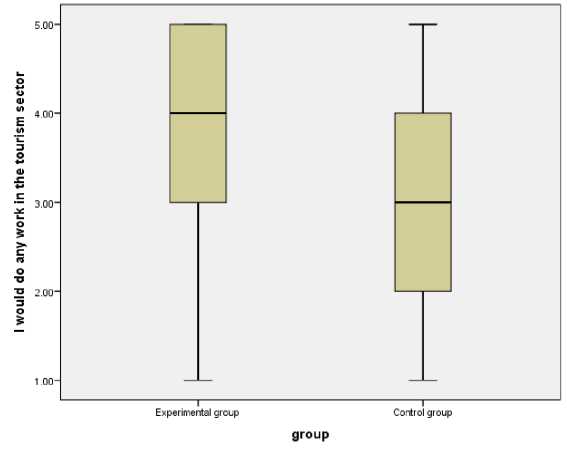
Figure 1. Researh marks evaluation
Another aspect that was valued in research was related to “I would do any work in the tourism sector”. With the appropriate statistical analysis, it was established that there statistically significant differences in the answers of students in the control and experimental groups in the case “I would do any work in the tourism sector“ (W=-2.060, p=0.039) (see Fig 1. And Table 1.).
There are no significant differences in the students’ results regarding the third criterion “I would do jobs outside the tourism sector”, (Z=-0.665, p=0.506).
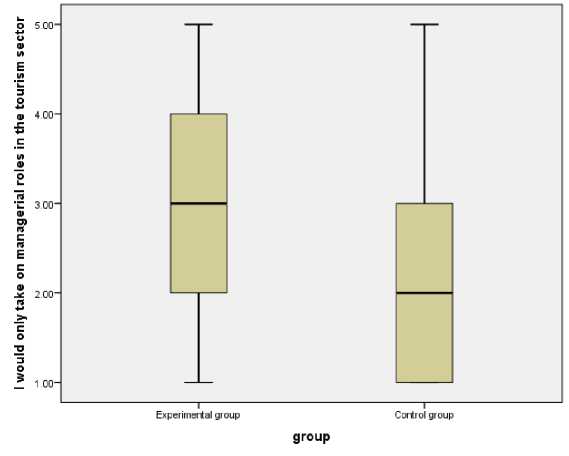
Figure 2. Researh marks evaluation
The next criterion considered during this student research was related to the “I would only take on managerial roles in the tourism sector“. The results of the statistical analysis, i.e., the Mann-Whitney test, support the fact that the distribution of the number of evaluations of students in the experimental group and the number of points of students in the control group is statistically significantly different (Z=-3.306, p=0.01) (see Fig 2. and Table 1.). The box-plot (Fig. 2) illustrates differences between the experimental and the control regarding this statement. The median value for first-year students is around 3 (Neither agree nor disagree), while for fourth-year students it is 2 (Disagree). This suggests that younger students tend to be more neutral or moderately agree that managerial positions are imperative (only acceptable options) in the tourism sector, whereas older students are more skeptical of this statement. Moreover, the wider interquartile range in the first-year group indicates greater variability in their responses, while the fourth-year students show a more consistent pattern of disagreement.
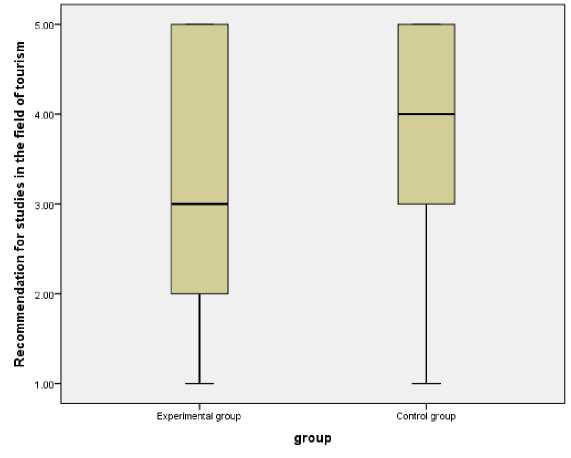
Figure 3. Researh marks evaluation
The last criterion is “Recommendation for studies in the field of tourism“. These differences were confirmed with the Mann-Whitney test, so we can conclude that the differences in students’ future recommendation is statistically significant (Z=-2.279, p=0.023) in favor of the experimental group (Table1 and Fig 3.). The results, presented in the boxplot, indicate a difference in attitudes between the two groups regarding the statement: “I would strongly recommend studies in the field of tourism.” First-year students showed a median response of 4 (neutral), with a wider spread of answers, while fourth-year students had a median of 3 (agree), suggesting a more favorable attitude toward recommending tourism studies. This may imply that with more years of study, students develop a more positive perception of the field. If confirmed by statistical significance, these results point to the importance of academic experience in shaping students’ views about the value of tourism education. The difference between the groups was statistically significant (p < 0.05), indicating that study level has a measurable influence on students’ attitudes.
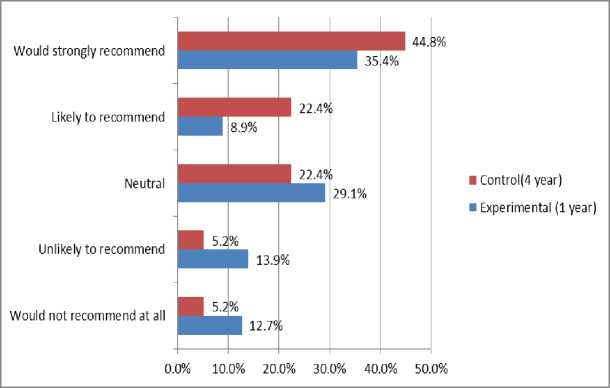
Figure 4. Recommendation for studies in the field of tourism
The distribution of grades in percentages for the variable “Recommendation for studies in the field of tourism” for the control and experimental groups are given in the Figure 4. In addition to the boxplot analysis, a detailed comparison of frequencies for each response level on the Likert scale (Figure 4) provides further insight into differences between first-year (experimental group) and fourth-year students (control group). The data show that 44.8% of fourth-year students stated they would strongly recommend tourism studies, compared to 35.4% of first-year students. Furthermore, 22.4% of fourth-year students selected likely to recommend, whereas only 8.9% of first-year students chose this option. On the other hand, first-year students showed higher percentages in the negative categories: 13.9% were unlikely to recommend and 12.7% would not recommend at all, compared to only 5.2% in both categories among fourth-year students. These findings suggest a clear trend: students with more academic experience in tourism (fourthyear students) are generally more inclined to recommend tourism studies to others, whereas first-year students show more hesitation or uncertainty. This shift may reflect increased familiarity with the field, better understanding of career opportunities, or greater confidence in the quality and relevance of the program.
Conclusions
The Mann–Whitney U test results indicated significant differences between the experimental (first-year) and control (fourth-year) groups regarding students’ perceptions of work in tourism. The most pronounced difference was observed for the criterion “Only managerial jobs” (Z = –3.306, p = 0.01), where first-year students (median = 3) expressed higher agreement compared to fourth-year students (median = 2). This result suggests that as students advance through their studies, they develop a more critical and realistic view of managerial opportunities in the tourism sector. Overall, the findings highlight a transition from more idealistic perceptions among freshmen to a more pragmatic understanding among senior students. Also, fourth-year students have a more favorable attitude toward recommending tourism studies in relation to the group of first-year students (the difference between the groups was statistically significant, p < 0.05). This may imply that with more years of study, students develop a more positive perception of the field.
The study was conducted on a relatively limited sample of students from a single higher education institution, which may restrict the generalizability of the results. Future studies should include a larger and more diverse sample, encompassing students from different universities and countries, to enable cross- cultural comparisons.
The results underline the importance of aligning tourism education with labor market realities. Strengthening cooperation between universities and the tourism industry, as well as integrating more experiential learning components, could help bridge the gap between academic expectations and professional realities.
Acknowledgements
This research is supported by the Ministry of Science, Technological Development and Innovation of the Republic of Serbia by the Decision on the scientific research funding for teaching staff at the accredited higher education institutions in 2026 (No. 451-03-34/2026-03/200375 of February 5, 2026)
Funding
This research did not receive any specific grant from funding agencies in the public, commercial, or not-for-profit sectors.
Conflict of interests
The authors declare no conflict of interest.
Data availability statement
The original contributions presented in the study are included in the article/supplementary material, further inquiries can be directed to the corresponding author/s.
Institutional Review Board Statement
Not applicable.
Author Contributions
Conceptualization, D.P. N.V. and V.P.; methodology, D.P. N.V. software, D.P.; formal analysis, D.P. N.V. and T.E.C.; writing—original draft preparation, D.P. and N.V..; writing—review and editing, D.P. N.V.. and V.P. All authors have read and agreed to the published version of the manuscript.
