
Foreign language learning in non-linguistic universities as the key to professional culture formation
Journal: Service Plus @servis-plus
Section: Образование, воспитание и просвещение
Article in issue: 1 т.18, 2024.
Free access
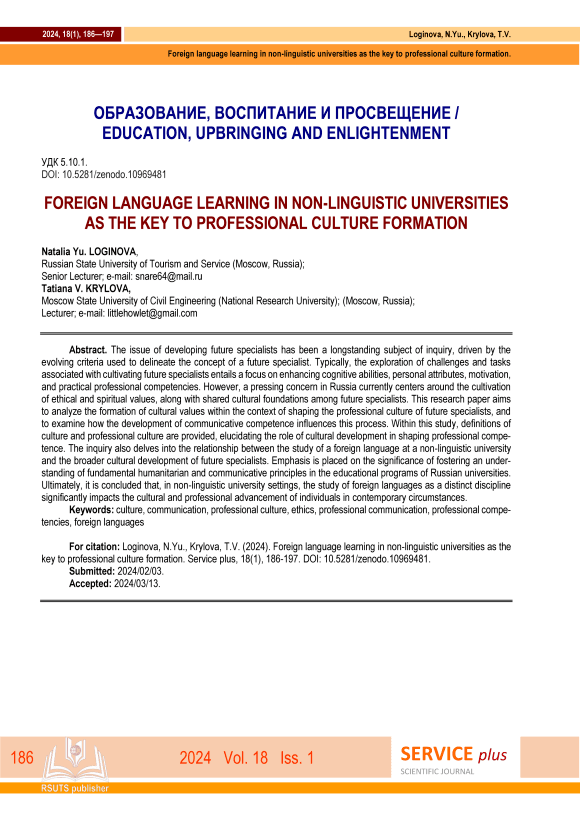
The issue of developing future specialists has been a longstanding subject of inquiry, driven by the evolving criteria used to delineate the concept of a future specialist. Typically, the exploration of challenges and tasks associated with cultivating future specialists entails a focus on enhancing cognitive abilities, personal attributes, motivation, and practical professional competencies. However, a pressing concern in Russia currently centers around the cultivation of ethical and spiritual values, along with shared cultural foundations among future specialists. This research paper aims to analyze the formation of cultural values within the context of shaping the professional culture of future specialists, and to examine how the development of communicative competence influences this process. Within this study, definitions of culture and professional culture are provided, elucidating the role of cultural development in shaping professional competence. The inquiry also delves into the relationship between the study of a foreign language at a non-linguistic university and the broader cultural development of future specialists. Emphasis is placed on the significance of fostering an understanding of fundamental humanitarian and communicative principles in the educational programs of Russian universities. Ultimately, it is concluded that, in non-linguistic university settings, the study of foreign languages as a distinct discipline significantly impacts the cultural and professional advancement of individuals in contemporary circumstances.
Similar articles in the section Mathematics. Natural sciences
Short address: https://sciup.org/140305366
IDS: 140305366 | UDC: 5.10.1. | DOI: 10.5281/zenodo.10969481
Изучение иностранного языка в неязыковых вузах как ключевой фактор формирования профессиональной культуры
Проблема формирования будущих специалистов является предметом изучения на протяжении длительного времени. Это обусловлено постоянно изменяющимися требованиями к определению концепции будущего специалиста. Как правило, при рассмотрении проблем и задач, связанных с формированием будущих специалистов, внимание акцентируется на развитии когнитивных способностей, личных качеств, мотивации и практических профессиональных навыков. Тем не менее, в настоящее время в России остро стоит вопрос о проблеме формировании этических и духовных ценностей и общих культурных основ у будущих специалистов. В данной статье объектом исследования является анализ процесса формирования культурных ценностей в рамках формирования профессиональной культуры будущего специалиста и влияние развития коммуникативной компетенции на данный процесс. В рамках данного исследования дается определение культуры, профессиональной культуры и определяется место культурного развития личности в процессе формирования профессиональной компетенции. Ставится вопрос о взаимосвязи между изучением иностранного языка в неязыковом вузе и общим культурным развитием будущего специалиста, подчеркивается важность развития понимания основных гуманитарных и коммуникативных основ в рамках образовательных программ российских вузов. Определяется, что в неязыковых вузах изучение иностранных языков как отдельной дисциплины оказывает наиболее глубокое влияние на культурное и профессиональное развитие личности в современных условиях.
References Foreign language learning in non-linguistic universities as the key to professional culture formation
- Batyshev, S.Ya. (1997). Professionalnaya pedagogika [Professional Pedagogy]. Moscow: Professional Education. (In Russ.)
- Borodavkin, S.V. (2004). Gumanizm v kulture i kultura v gumanizme [Humanism in culture and culture in humanism]. Moscow: Voprosy philosophii. (In Russ.)
- Flier, A.Ya. (1999). Kultura kak smysl istorii: Obshchestvennye nauki i sovremennost [Culture as the Meaning of History: Social Sciences and Modernity]. Moscow: Culture. (In Russ.)
- Kagan, M.S. (1993). Obshchaya harakteristika kultury, ee stroeniya i funkcij [General characteristics of culture, its structure and functions]. In: Vvedenie v teoriyu hudozhestvennoj kultury [Introduction to the theory of artistic culture]. St. Petersburg: St. Petersburg University. (In Russ.)
- Karhanova, S.A. (2007). Faktory professionalnoj uspeshnosti specialista [Factors of professional success of a specialist]. SGU. (In Russ.)
- Kurguzov, V.L. (2000). Gumanitarnaya kultura: teoreticheskoe obosnovanie fenomena i problemy funkcionirovaniya v tekhnicheskom vuze. [Humanitarian culture: theoretical substantiation of the phenomenon and problems of functioning in a technical university]. Ulan-Ude: VSGTU Publishing House. (In Russ.)
- Likhachev, D.S. (2000). Russkaya kultura [Russian culture]. Moscow: Art. (In Russ.)
- Persikova, T.N. (2002). Mezhkulturnaya kommunikaciya i korporativnaya kultura [Intercultural Communication and Corporate Culture]. Moscow: Logos. (In Russ.)
- Rybak, M.V., (2021). English teaching theory and methodology for the higher education. Service plus, 15(4), 55-65. DOI: 10.24412/2413-693X-2021-4-55-65
- Rybak, M.V., Grigoryan, M.I. (2023). The impact of the ICT usage in a foreign language learning on cultural assimbilative processes of the country. Service plus, 17(2), 162-170. DOI: 10.5281/zenodo.8238050.
- Sadokhin, A.P. (2005). Vvedenie v teoriyu mezhkulturnoj kommunikacii [Introduction to the Theory of Intercultural Communication]. Moscow: Higher School. (In Russ.)
- Schweitzer, A.D., Nikolsky, L.B. (1978). Vvedenie v sociolingvistiku: uchebnoe posobie. [Introduction to Sociolinguistics: textbook]. Moscow: Nauka. (In Russ.)
- Silyaeva, E.G. (1994). Moralnye cennosti i lichnost [Moral values and personality]. Moscow: MGU. (In Russ.)
- Vyzhletsov, G.P. (1996). Aksiologiya kultury [Axiology of Culture]. St. Petersburg: St. Petersburg University. (In Russ.)
- Weisgerber, I. L. (1993). Rodnoj yazyk i formirovanie duha [Native language and the formation of the spirit]. Moscow: Moscow University. (In Russ.)
- Zapesotsky, A.S. (1996). Gumanitarnaya kultura i gumanitarnoe obrazovanie [Humanitarian culture and humanitarian education]. St. Petersburg: IGUP. (In Russ.)
