
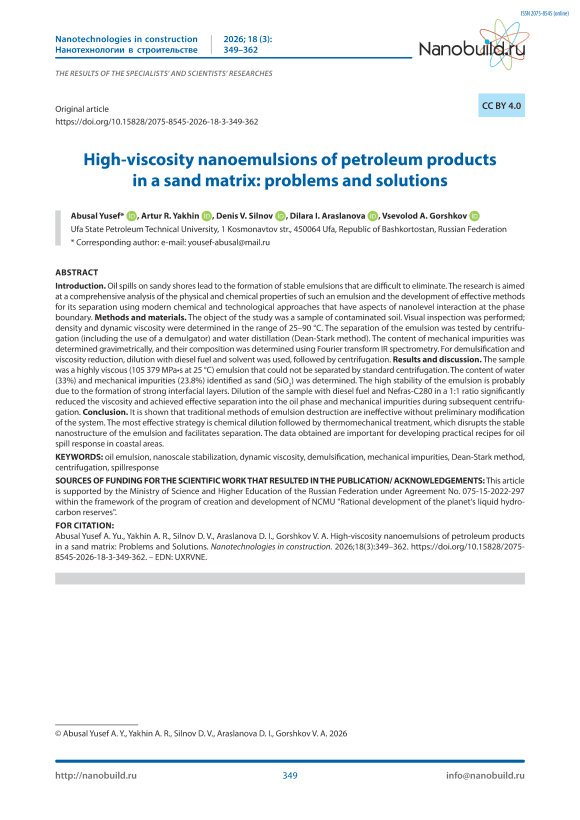
High-viscosity nanoemulsions of petroleum products in a sand matrix: problems and solutions
Journal: Nanotechnologies in Construction: A Scientific Internet-Journal @nanobuild-en
Section: The results of the specialists’ and scientists’ researches
Article in issue: 3 Vol.18, 2026.
Free access
Introduction. Oil spills on sandy shores lead to the formation of stable emulsions that are difficult to eliminate. The research is aimed at a comprehensive analysis of the physical and chemical properties of such an emulsion and the development of effective methods for its separation using modern chemical and technological approaches that have aspects of nanolevel interaction at the phase boundary. Methods and materials. The object of the study was a sample of contaminated soil. Visual inspection was performed; density and dynamic viscosity were determined in the range of 25–90 °C. The separation of the emulsion was tested by centrifugation (including the use of a demulgator) and water distillation (Dean-Stark method). The content of mechanical impurities was determined gravimetrically, and their composition was determined using Fourier transform IR spectrometry. For demulsification and viscosity reduction, dilution with diesel fuel and solvent was used, followed by centrifugation. Results and discussion. The sample was a highly viscous (105 379 MPa•s at 25 °C) emulsion that could not be separated by standard centrifugation. The content of water (33%) and mechanical impurities (23.8%) identified as sand (SiO2) was determined. The high stability of the emulsion is probably due to the formation of strong interfacial layers. Dilution of the sample with diesel fuel and Nefras-C280 in a 1:1 ratio significantly reduced the viscosity and achieved effective separation into the oil phase and mechanical impurities during subsequent centrifugation. Conclusion. It is shown that traditional methods of emulsion destruction are ineffective without preliminary modification of the system. The most effective strategy is chemical dilution followed by thermomechanical treatment, which disrupts the stable nanostructure of the emulsion and facilitates separation. The data obtained are important for developing practical recipes for oil spill response in coastal areas.
Similar articles in the section Public health engineering. Water. Sanitation. Illuminating engineering
Short address: https://sciup.org/142248069
IDS: 142248069 | DOI: 10.15828/2075-8545-2026-18-3-349-362
