
Impact of zinc stress on antioxidant enzyme dynamics in soybean
Journal: Journal of Stress Physiology and Biochemistry @jspb
Article in issue: 2 т.22, 2026.
Free access
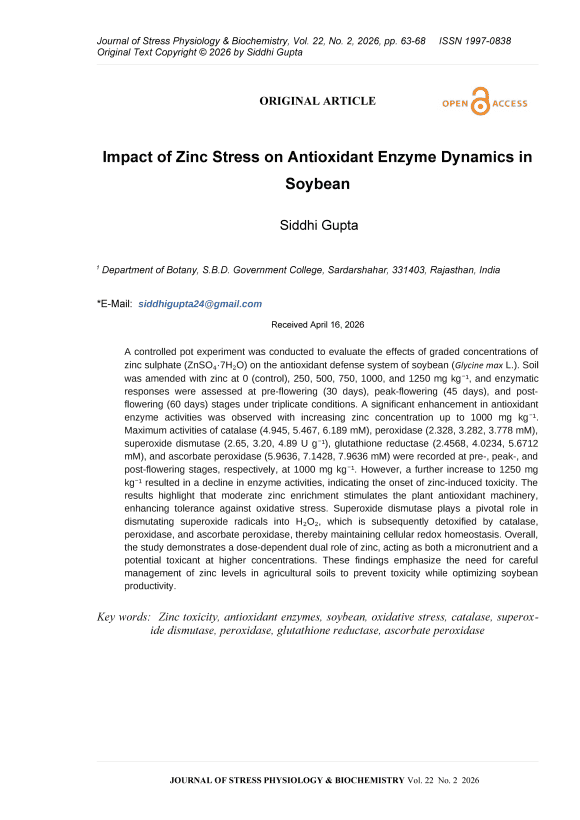
A controlled pot experiment was conducted to evaluate the effects of graded concentrations of zinc sulphate (ZnSO₄·7H₂O) on the antioxidant defense system of soybean (Glycine max L.). Soil was amended with zinc at 0 (control), 250, 500, 750, 1000, and 1250 mg kg⁻№, and enzymatic responses were assessed at pre-flowering (30 days), peak-flowering (45 days), and post-flowering (60 days) stages under triplicate conditions. A significant enhancement in antioxidant enzyme activities was observed with increasing zinc concentration up to 1000 mg kg⁻№. Maximum activities of catalase (4.945, 5.467, 6.189 mM), peroxidase (2.328, 3.282, 3.778 mM), superoxide dismutase (2.65, 3.20, 4.89 U g⁻№), glutathione reductase (2.4568, 4.0234, 5.6712 mM), and ascorbate peroxidase (5.9636, 7.1428, 7.9636 mM) were recorded at pre-, peak-, and post-flowering stages, respectively, at 1000 mg kg⁻№. However, a further increase to 1250 mg kg⁻№ resulted in a decline in enzyme activities, indicating the onset of zinc-induced toxicity. The results highlight that moderate zinc enrichment stimulates the plant antioxidant machinery, enhancing tolerance against oxidative stress. Superoxide dismutase plays a pivotal role in dismutating superoxide radicals into H₂O₂, which is subsequently detoxified by catalase, peroxidase, and ascorbate peroxidase, thereby maintaining cellular redox homeostasis. Overall, the study demonstrates a dose-dependent dual role of zinc, acting as both a micronutrient and a potential toxicant at higher concentrations. These findings emphasize the need for careful management of zinc levels in agricultural soils to prevent toxicity while optimizing soybean productivity.
Short address: https://sciup.org/143186143
IDS: 143186143
Text of the scientific article Impact of zinc stress on antioxidant enzyme dynamics in soybean
Soybean (Glycine max L. Merr.), widely recognized as the “miracle crop”, is an essential component of global agriculture due to its high nutritional value and economic importance. It serves as a major source of vegetable oil and protein, containing approximately 20% oil and 40% protein, thereby surpassing most staple crops such as rice, wheat, and maize in protein content. This unique composition makes soybean a critical crop for addressing global food and nutritional security. However, soybean productivity is increasingly challenged by adverse environmental conditions, including high temperature, intense solar radiation, elevated evaporation rates, and frequent drought stress. These abiotic stresses significantly impair plant growth, development, and yield (Jones et al , 2024). In addition to climatic constraints, the growing problem of soil contamination due to industrial effluents has emerged as a serious threat to sustainable agriculture. Such contamination often introduces heavy metals into agricultural soils, leading to their accumulation and toxicity in plants. Zinc (Zn) is an essential micronutrient required for numerous physiological and biochemical processes in plants, including enzyme activation, protein synthesis, and regulation of growth and development (Makdoh et al., 2025). Despite its indispensable role, zinc exhibits a dual nature depending on its concentration in the soil. While optimal levels enhance plant growth and stress tolerance, excessive accumulation leads to phytotoxicity, resulting in inhibited root and shoot growth, disruption of metabolic processes, and reduced crop productivity (Gupta et al., 2024). Heavy metal stress, including excess zinc, is known to induce the generation of reactive oxygen species (ROS), which cause oxidative damage to lipids, proteins, and nucleic acids. To mitigate such damage, plants have evolved a sophisticated antioxidant defense system comprising key enzymes such as superoxide dismutase (SOD), catalase (CAT), peroxidase (POX), glutathione reductase (GR), and ascorbate peroxidase (APX). These enzymes function synergistically to detoxify ROS and maintain cellular redox homeostasis (Tian et al , 2025). Notably, moderate zinc levels have been reported to enhance antioxidant enzyme activities, thereby improving plant tolerance to stress, whereas excessive zinc disrupts this balance and leads to oxidative injury (Wang et al., 2026). In this context, understanding the concentration-dependent effects of zinc on plant physiological responses is crucial for optimizing crop productivity under stress conditions. Therefore, the present study aims to investigate the impact of varying concentrations of zinc on the antioxidant enzyme system in soybean (Glycine max L. Merr.), providing insights into its adaptive responses to zinc-induced oxidative stress and contributing to sustainable soil and crop management strategies.
MATERIALS AND METHODS
Plant Material and Treatment
The present investigation was conducted using zinc sulphate (ZnSO₄·7H₂O) at graded concentrations of 0 (control), 250, 500, 750, 1000, and 1250 mg kg ⁻ ¹ of soil. Certified seeds of soybean ( Glycine max L. Merr.) variety JS-95-60 were procured from the Agricultural Research Station, Kota, Rajasthan.
Pot Experiment
The experiment was carried out during April in the greenhouse of the Department of Botany, University of Rajasthan. Earthen pots (30 cm height × 25 cm diameter) were filled with 4 kg of garden soil and arranged in a randomized design to minimize environmental variability. Zinc sulphate was thoroughly mixed into the soil at the desired concentrations, while untreated pots served as controls. Surface-sterilized seeds (0.1% HgCl₂) were thoroughly rinsed with distilled water and sown at a depth of 2 cm. Uniform plant density was maintained in each pot, and irrigation was provided on alternate days. Each treatment was replicated three times. Sampling was performed at three growth stages: pre-flowering (30 days), peak-flowering (45 days), and post-flowering (60 days) for biochemical analyses.
Antioxidant Enzyme Assays
Catalase (CAT) Activity
Catalase activity was determined by monitoring the decomposition of H₂O₂ at 240 nm following Chandlee and Scandalios (1984). Fresh leaf tissue (0.2 g) was homogenized in 5 ml phosphate buffer (pH 7.0) and centrifuged at 10,000 rpm for 20 min at 4 °C. The reaction mixture consisted of 0.2 ml enzyme extract, 0.5 ml phosphate buffer, and 0.1 ml of 3% H₂O₂. The decrease in absorbance was recorded, and enzyme activity was calculated using an extinction coefficient of 39.4 mM⁻¹ cm⁻¹, expressed as µmol min⁻¹ g⁻¹ fresh weight.
Peroxidase (POX) Activity
Peroxidase activity was estimated based on the oxidation of pyrogallol at 420 nm following Chance and Maehly (1955). Leaf tissue (0.2 g) was homogenized in phosphate buffer and centrifuged at 10,000 rpm for 20 min at 4 °C. The reaction mixture contained phosphate buffer, pyrogallol, H₂O₂, and enzyme extract. The increase in absorbance was measured, and activity was calculated using an extinction coefficient of 2.8 mM ⁻ ¹ cm ⁻ ¹, expressed as µmol min ⁻ ¹ g ⁻ ¹ fresh weight.
Ascorbate Peroxidase (APX) Activity
APX activity was assayed by measuring the decline in absorbance at 290 nm due to ascorbate oxidation, following Nakano and Asada (1981). Leaf tissue (0.5 g) was homogenized in phosphate buffer (pH 7.0) and centrifuged at 10,000 rpm for 20 min at 4 °C. The reaction mixture contained ascorbate, H₂O₂, EDTA, and enzyme extract. Enzyme activity was calculated using an extinction coefficient of 2.8 mM ⁻ ¹ cm ⁻ ¹ and expressed as µmol min ⁻ ¹ g ⁻ ¹ fresh weight.
Glutathione Reductase (GR) Activity
GR activity was determined following Foyer and Halliwell (1976). Leaf tissue (0.5 g) was homogenized in phosphate buffer (pH 7.0) and centrifuged at 10,000 rpm for 20 min at 4 °C. The reaction mixture consisted of phosphate buffer, oxidized glutathione (GSSG), NADPH, and enzyme extract. The decrease in absorbance at 340 nm due to NADPH oxidation was recorded. Activity was calculated using an extinction coefficient of 6.2 mM ⁻ ¹ cm ⁻ ¹ and expressed as µmol min ⁻ ¹ g ⁻ ¹ fresh weight.
Superoxide Dismutase (SOD) Activity
SOD activity was assayed according to Beauchamp and Fridovich (1971) by measuring the inhibition of photochemical reduction of nitro-blue tetrazolium (NBT). Leaf tissue (1 g) was homogenized in phosphate buffer (pH 7.8) and centrifuged at 10,000 rpm for 20 min at 4 °C. The reaction mixture contained methionine, NBT, EDTA, phosphate buffer, Na₂CO₃, enzyme extract, and riboflavin. After illumination for 15 min, absorbance was recorded at
560 nm. One unit of SOD activity was defined as the amount of enzyme causing 50% inhibition of NBT reduction and expressed as units g ⁻ ¹ protein.
Statistical Analysis
All experimental data were expressed as mean ± standard error (SE) of three replicates. Statistical analysis was performed using SPSS (version 25.0) and Microsoft Excel 2016. Differences among treatments were evaluated using analysis of variance (ANOVA), and significance was determined at appropriate probability levels.
RESULTS AND DISCUSSION
The present study demonstrated a clear concentrationdependent response of antioxidant enzymes in soybean ( Glycine max L. Merr.) under zinc (Zn) stress across different growth stages. A consistent trend was observed for catalase (CAT), peroxidase (POX), ascorbate peroxidase (APX), glutathione reductase (GR), and superoxide dismutase (SOD) where activities increased progressively with Zn concentration up to 1000 mg kg ⁻ ¹, followed by a decline at 1250 mg kg ⁻ ¹. This pattern indicates a stimulatory effect of moderate Zn levels and inhibitory effects at higher concentrations due to toxicity .This is widely reported in recent nanoparticle and micronutrient stress studies (Zeeshan et al. , 2024 Bhuvana et al , 2026)
Enzymatic defense under zinc stress
Heavy metal stress, including excess Zn, is known to induce overproduction of reactive oxygen species (ROS), such as superoxide radicals and hydrogen peroxide, leading to oxidative damage to lipids, proteins, and cellular structures (Hou et al , 2025: amer et al 2021). Plants respond to this oxidative imbalance by activating an efficient antioxidant defense system comprising enzymatic components like SOD, CAT, POX, APX, and GR, which collectively maintain redox homeostasis (Al-Zahrani et al. , 2022: Hassan et al. , 2022).
In the present investigation, SOD activity increased significantly with Zn concentration, reaching maximum values of 2.65, 3.20, and 4.89 U g⁻¹ at pre-, peak-, and post-flowering stages, respectively, at 1000 mg kg⁻¹. SOD acts as the first line of defense by catalyzing the dismutation of superoxide radicals into H₂O₂, thereby reducing oxidative stress. Similar enhancement of SOD activity under Zn stress has been reported in soybean and other crops, indicating its critical role in stress tolerance (Yaghoubian et al , 2021). However, the decline at the highest Zn level suggests enzyme inhibition due to excessive ROS accumulation (table 1).
Catalase activity showed a marked increase across all growth stages, reaching peak values of 4.945, 5.467, and 6.189 mM, respectively, at 1000 mg kg ⁻ ¹ Zn. CAT plays a crucial role in decomposing H₂O₂ into water and oxygen, thus preventing cellular damage. A similar dose-dependent CAT activation followed by inhibition at higher Zn levels was documented in soybean leaves treated with ZnO nanoparticles (0–200 mg L ⁻ ¹ Zn) compared with bulk ZnSO₄ application (Shirvani-Naghani et al. , 2024) (table 2)
Peroxidase (POX) activity also increased significantly, with maximum values of 2.328, 3.282, and 3.778 mM across the respective growth stages. POX has a higher affinity for H₂O₂ and is involved in the scavenging of reactive oxygen intermediates and peroxy radicals. The enhanced POX activity suggests its involvement in adaptive responses to Zn-induced stress, which is consistent with earlier findings demonstrating that Zn application enhances antioxidant enzyme activities and mitigates oxidative damage (Hassan et al , 2022) (table 2)
Among the enzymes studied, Ascorbate Peroxidase
(APX) exhibited comparatively higher activity, reaching 5.9636, 7.1428, and 7.9636 mM at pre-, peak-, and postflowering stages, respectively. APX is a key component of the ascorbate–glutathione cycle and plays a central role in H₂O₂ detoxification due to its high substrate affinity. Recent studies have shown that Zn supplementation enhances APX activity and strengthens the antioxidant defense system, thereby improving stress tolerance in soybean (Al-Zahrani et al , 2022) (table 3).
Glutathione reductase (GR) activity also increased significantly with Zn concentration, reaching maximum values of 2.4568, 4.0234, and 5.6712 mM at 1000 mg kg ⁻ ¹. GR is essential for maintaining the reduced glutathione (GSH) pool, which is critical for detoxification of ROS through the ascorbate–glutathione cycle. The enhanced GR activity observed in this study indicates improved redox regulation and detoxification capacity under Zn stress. Similar findings have been reported where Zn application stimulated glutathione-mediated antioxidant defense and improved stress tolerance in soybean (Al-Zahrani et al , 2022) (table 3).
Enzyme activities were consistently higher at the postflowering stage compared to earlier stages, indicating that antioxidant defense mechanisms intensify with plant maturity. This may be attributed to increased metabolic activity and higher sensitivity to oxidative stress during later developmental stages.
Table 1. Impact of zinc on Superoxide dismutase (Units/gm protein) in Glycine max
|
Treatment |
Pre-flowering |
Peak-flowering |
Post-flowering |
|
Control |
0.13±0.008 |
0.34±0.016 |
0.50±0.05 |
|
250 |
0.17±0.009 a |
0.72±0.061 a |
1.40±0.22 a |
|
500 |
0.52±0.032 a |
1.1±0.11 b |
2.12±0.27 c |
|
750 |
1.87±0.16 c |
2.98±0.16 c |
3.94±0.32 c |
|
1000 |
2.65±0.31 c |
3.2±0.28 c |
4.89±0.41 c |
|
1250 |
2.08±0.23 c |
2.86±0.32 c |
3.46±0.28 c |
Values were expressed as mean± SEM, Significance level: ap ≤ 0.1, bp ≤ 0.05, cp ≤ 0.01
Table 2. Impact of zinc on Catalase and Peroxidase ( µmol min ⁻ ¹ g ⁻ ¹ FW ) in Glycine max
|
Treatment |
Pre-flowering |
Peak-flowering |
Post-flowering |
|||
|
Catalase |
Peroxidase |
Catalase |
Peroxidase |
Catalase |
Peroxidase |
|
|
Control |
0.796±0.051 |
0.092±0.007 |
1.183±0.26 |
0.186±0.040 |
1.492±0.31 |
0.186±0.041 |
|
250 |
1.392±0.28 a |
0.934±0.052 a |
2.068±0.30 a |
1.832±0.20 b |
3.576±0.35 a |
2.248±0.26 c |
|
500 |
3.012±0.33 c |
1.316±0.26 a |
3.134±0.28 b |
2.318±0.16 c |
4.032±0.32 b |
2.960±0.23 c |
|
750 |
4.232±0.35 c |
2.032±0.29 c |
5.032±0.36 c |
2.846±0.22 c |
7.121±0.31 c |
3.310±0.30 c |
|
1000 |
4.945±0.41 c |
2.954±0.26 c |
5.467±0.35 c |
3.712±0.33 c |
6.189±0.49 c |
4.596±0.36 c |
|
1250 |
4.797±0.47 c |
2.328±0.42 c |
5.389±0.34 c |
3.282±0.41 c |
6.092±0.28 c |
3.778±0.32 c |
Values were expressed as mean± SEM, Significance level: ap ≤ 0.1, bp ≤ 0.05, cp ≤ 0.01
Table 3. Impact of zinc on Ascorbate Peroxidase (APX) and Glutathione Reductase (GR) ( µmol min ⁻ ¹ g ⁻ ¹ FW ) in Glycine max
|
Treatment |
Pre-flowering |
Peak-flowering |
Post-flowering |
|||
|
APX |
GR |
APX |
GR |
APX |
GR |
|
|
Control |
0.116±0.028 |
0.210±0.028 |
0.228±0.06 |
0.314±0.06 |
0.826±0.021 |
0.284±0.021 |
|
250 |
1.5572±0.32 a |
1.0456±0.25 a |
2.4504±0.34 b |
1.9884±0.25 b |
3.5572±0.29 b |
1.2334±0.16 a |
|
500 |
2.3920±0.31 c |
1.2446±0.30 b |
3.6284±0.47 c |
2.0134±0.29 c |
4.392±0.32 c |
2.0113±0.26 a |
|
750 |
4.8844±0.42 c |
1.8662±0.26 c |
5.6368±0.41 c |
3.7234±0.29 c |
6.8844±0.46 c |
2.924±0.38 c |
|
1000 |
5.9636±0.35 c |
2.4568±0.25 c |
7.1428±0.32 c |
4.0234±0.25 c |
7.9636±0.38 c |
3.5428±0.28 c |
|
1250 |
5.364±0.33 c |
2.2324±0.28 c |
7.0668±0.26 c |
4.2314±0.32 c |
7.364±0.61 c |
3.3884±0.23 c |
Values were expressed as mean± SEM, Significance level: ap ≤ 0.1, bp ≤ 0.05, cp ≤ 0.01
CONCLUSION
The present study clearly demonstrates that zinc exerts a concentration-dependent effect on the antioxidant defense system of soybean ( Glycine max L. Merr.). Moderate zinc levels (up to 1000 mg kg ⁻ ¹) significantly enhanced the activities of key antioxidant enzymes, including SOD, CAT, POX, APX, and GR, indicating an efficient activation of the plant’s defense mechanism against oxidative stress. However, further increase in zinc concentration (1250 mg kg ⁻ ¹) led to a decline in enzyme activities, suggesting the onset of phytotoxicity and disruption of cellular homeostasis. The coordinated action of antioxidant enzymes highlights their crucial role in maintaining redox balance under zinc-induced stress conditions. These findings emphasize the dual role of zinc as both an essential micronutrient and a potential toxicant at higher concentrations. Therefore, maintaining optimal zinc levels in soil is critical for enhancing stress tolerance and ensuring sustainable soybean productivity. The study provides valuable insights for nutrient management strategies and mitigation of heavy metal stress in crop systems.
CONFLICTS OF INTEREST
Author declare no conflict of interest.
