
Integrating AI and Digital Twins into Costume Design
Journal: Bulletin of Science and Practice @bulletennauki
Section: Технические науки
Article in issue: 9 т.12, 2026.
Free access
This study presents a retrospective bibliometric analysis of publications in the Russian Science Citation Index (RSCI) database to examine the features of and underexplored areas in the use of artificial intelligence (AI) technologies and digital twins (DT) in costume design. In accordance with the PRISMA protocol, 247 relevant articles were selected and analyzed using descriptive, bibliometric, and substantive methods. Interest in AI increased from 2017, and DT development began in 2018. The leading journals were the "Journal of Clothing Science" and "Proceedings of Higher Educational Institutions. Textile Industry Technology," and the main authors were M.I. Alibekova and V.E. Kuzmichev. A four-stage chronology of AI evolution, from expert CAD systems to generative networks and Industry 5.0, and a five-stage classification of DTs, from static 3D models to "soft" twins and intelligent production lines that reduce defects by 22%, have been established. A five-level infographic has been developed to integrate AI and DT into costume design, with AI serving as a cognitive source and DT as a virtual body. The results provide an applied basis for introducing digital tools across all stages of the garment life cycle during the transition of enterprises to Industry 5.0.
Short address: https://sciup.org/14139014
IDS: 14139014 | UDC: 687.02 | DOI: 10.33619/2414-2948/130/18
Интеграция искусственного интеллекта и цифровых двойников в проектирование костюма
Целью исследования является ретроспективный библиометрический анализ публикаций в базе данных «Российский индекс научного цитирования» (РИНЦ) для изучения особенностей и малоизученных направлений в области применения технологий искусственного интеллекта (ИИ) и цифровых двойников (ЦД) при проектировании костюма. В соответствии с протоколом PRISMA выбрано 247 релевантных статей, которые проанализированы описательным, библиометрическим и содержательным методами анализа. Выявлен рост интереса к ИИ с 2017 года и развитие ЦД с 2018 года. Определены ведущие журналы («Костюмология», «Известия вузов. Технология текстильной промышленности») и основные авторы (М. И. Алибекова, В. Е. Кузьмичев). Сформирована четырехэтапная хронология эволюции ИИ (от экспертных систем САПР до генеративных сетей и Индустрии 5.0) и пятиэтапная классификация ЦД (от статичных 3D-моделей до «мягкотельных» двойников и интеллектуальных производственных линий, снижающих брак на 22%). Разработана пятиуровневая инфографика интеграции ИИ и ЦД при проектировании костюма, где ИИ является когнитивным источником, а ЦД — виртуальным телом. Результаты работы служат прикладной основой для внедрения цифровых инструментов на всех стадиях жизненного цикла швейных изделий при переходе предприятий к концепции Индустрии 5.0.
Text of the scientific article Integrating AI and Digital Twins into Costume Design
Бюллетень науки и практики / Bulletin of Science and Practice
UDC 687.02
In the "National Development Framework of the Kyrgyz Republic until 2030," one of the vectors of development is "Industrialisation," in which the key tasks are the introduction of modern digital technologies to increase the productivity of industrial sectors [1]. In light industry, this process is manifested as the integration of digital twin technologies and artificial intelligence systems [2]. A digital twin (DT) is a virtual copy of a real object that contains millions of points with coordinates (X, Y, Z) and reproduces the object's external surface and physical behavior in a digital environment [3]. Digital twin technology uses information from network sensors (IoT) and complex simulations, which allows for real-time monitoring of physical objects and predictive analytics without stopping production. At the same time, the digital twin is considered the basis of "smart manufacturing" [4, 5]. It allows changes to be simulated and validated in a virtual environment before implementation on a real production line. The introduction of digital twins is seen as a strategic tool for operational efficiency, cost reduction, and environmental sustainability. Artificial intelligence (AI) is defined not just as a single technology, but as a complex field of computer science and a powerful driver of the modernization of the entire production chain [6]. AI is a computer system capable of mimicking human thought processes to make accurate decisions, using large amounts of data from IoT sensors for data analytics and logistics optimization. AI can also serve as a cognitive core that processes data from a high-fidelity simulation model (DT) to make operational decisions [7, 8].
It is especially interesting to study the integration of DT and AI into the process of designing a modern suit. Digital twins enable the creation of high-precision virtual prototypes that account for the physical and mechanical properties of materials and the anatomical features of the figure [9–12]. At the same time, artificial intelligence and neural network algorithms are becoming indispensable tools for analyzing fashion trends, driving data-driven design, and optimizing design solutions [13, 14]. In this regard, a comprehensive bibliometric analysis of theoretical developments and scientific research in the RSCI database is relevant, as it fully reflects the specifics and dynamics of scientific research in the light industry, mainly in Russian. The purpose of this work is to conduct a retrospective bibliometric analysis of publication activity in the RSCI database to identify patterns and vulnerabilities in the digitalization of suit design, as well as understudied issues and the main participants in integrating digital twins and artificial intelligence into the costume design process.
The bibliometric review was carried out according to the PRISMA methodology [15, 16], as presented in Figure 1. For the study, 247 relevant articles were selected from the RSCI database as of March 31, 2026, using the keywords "digital twin" and "artificial intelligence" related to the topic light industry."
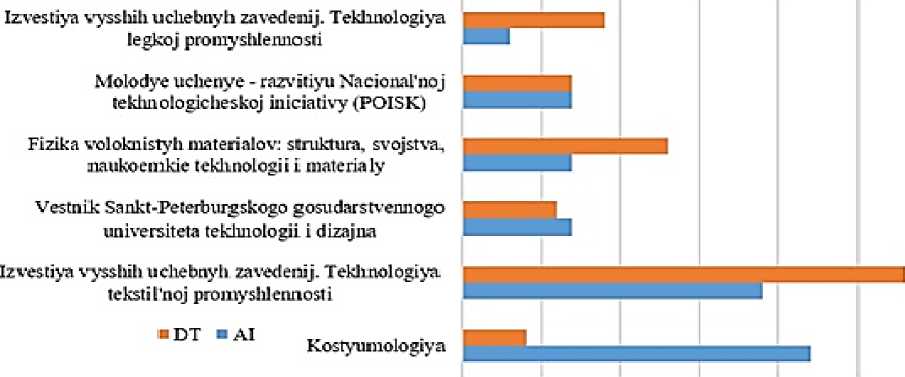
To interpret the results, descriptive, bibliometric, and substantive analyses were used, and the results are presented in tables and graphs created in MS Excel. Table 2 shows the dynamics of publications by year, with interest in AI research clearly increasing since 2017 and peaking in 2025. Figure 3 presents the scientific journals in which most papers on AI and DT in the clothing industry were published. Most AI publications appear in the journal "Journal of Clothing Science," while DT papers appear in "Proceedings of Higher Educational Institutions.
Textile Industry Technology," which is the leading journal publishing innovative results in the light industry.
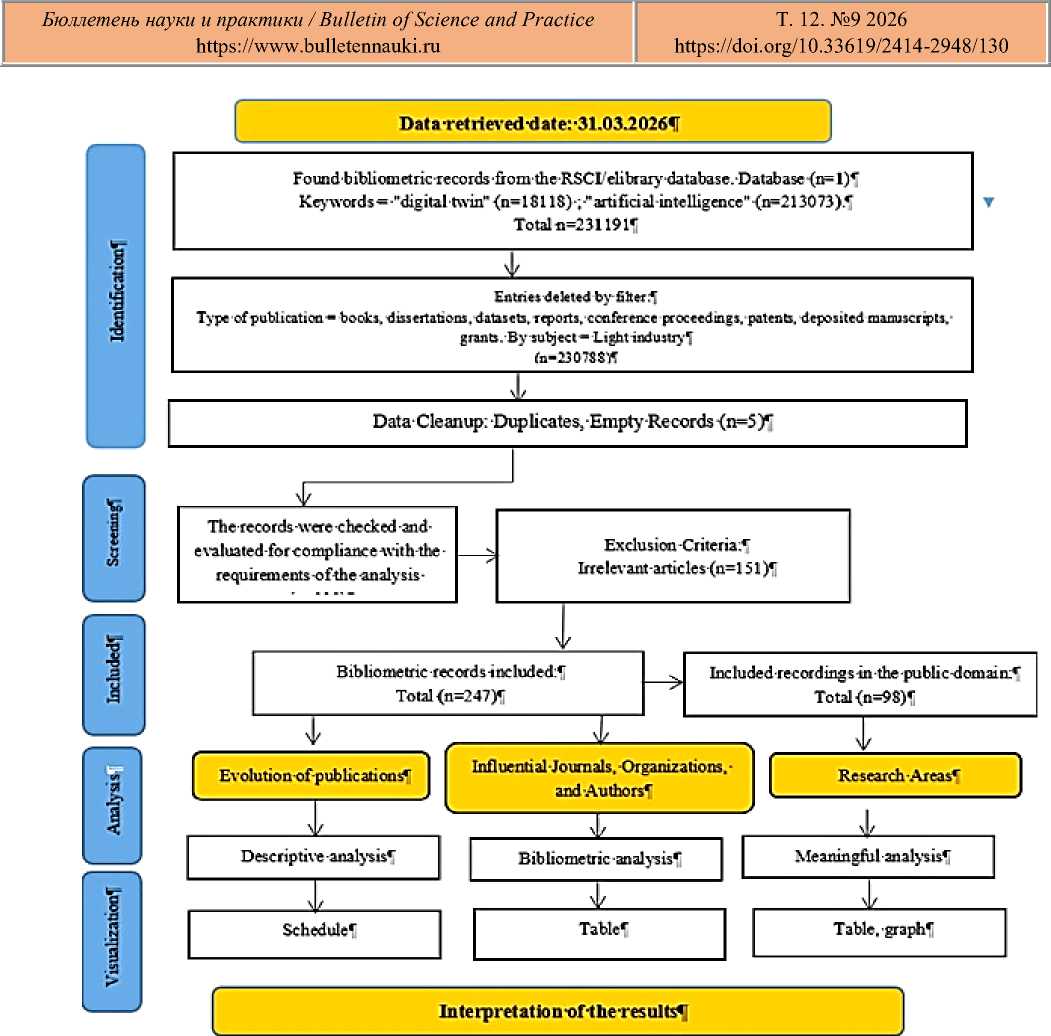
Figure 1. Flowchart for the selection of publications according to the PRISMA methodology
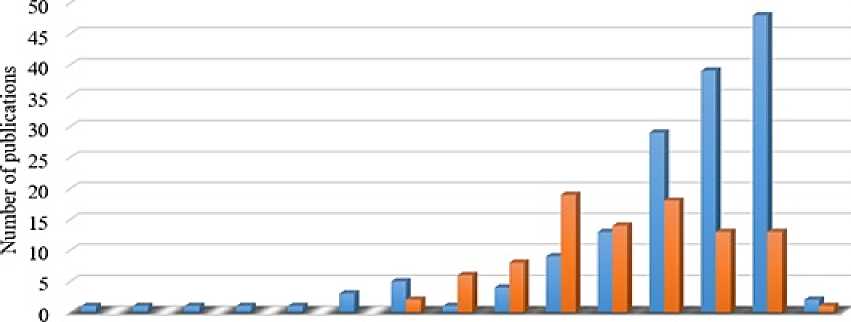
2005 2009 2012 2014 2016 2017 2018 2019 2020 2021 2022 2023 2024 2025 2026
■ Al «DT
Figure 2. Dynamics of publication activity in the field of AI and DT in the RSCI
О 3 10 IS 20 25
Number of publications.
Figure 3. Leading scientific journals with publications in the field of AI and DT
Tables 1 and 2 present the most influential authors involved in AI and DT research. Thus, the leaders in AI are Alibekova Mariyat Ismailovna (Russian State University named after A.N. Kosygin), and in DT, Kuzmichev Viktor Evgenievich (Ivanovo State Polytechnic University).
TOP 4 AUTHORS IN THE FIELD OF AI IN THE LIGHT INDUSTRY
TOP 5 AUTHORS IN THE FIELD OF DT IN THE LIGHT INDUSTRY
Table 1
|
Author |
Number of AI articles |
Place of work |
Total number of publications in the RSCI |
Hirsch index without considering selfcitation |
|
Alibekova Mariyat Ismailovna |
8 |
Kosygin Russian State University |
476 |
13 |
|
Derzhavina Anna Dmitrievna |
6 |
St. Petersburg State University of Aerospace Instrumentation |
18 |
3 |
|
Belgorodsky Valery Savelievich |
5 |
Kosygin Russian State University |
324 |
23 |
|
Andreeva Elena Georgievna |
4 |
Kosygin Russian State University |
780 |
22 |
Table 2
|
Author |
Number of articles on the DT |
Place of work |
Total number of publications in the RSCI |
Hirsch index without considering self-citation |
|
Kuzmichev Viktor Evgenievich |
25 |
Ivanovo State Polytechnic University |
426 |
13 |
|
Guseva Marina Anatolyevna |
10 |
Kosygin Russian State University |
573 |
17 |
|
Andreeva Elena Georgievna |
8 |
Kosygin Russian State University |
780 |
22 |
|
Moskvin Alexey Yurievich |
8 |
St. Petersburg State University of Industrial Technologies and Design |
200 |
7 |
|
Ali Kurmanzhan kyzy |
5 |
Kosygin Russian State University |
56 |
4 |
To build a chronology of the development of research issues in AI and DT, 98 relevant openaccess articles with the highest citation counts were selected. The analysis was carried out using the experimental AI service NotebookLM [6] for fashion design research. The analysis showed that the chronology of research on artificial intelligence systems in the light industry (Table 3) comprises four stages. In the first stage, AI was considered an "intelligent tool" [17], contributing to the creation of expert systems for forming an industrial assortment and implementing intelligent procedures in integrated CAD systems [18,19].
Table 3
CHRONOLOGY OF AI SYSTEMS RESEARCH
|
Stage / Period |
Definition |
Key technologies |
Differences |
|
I. Automation and Expert Systems (2005– 2015) |
AI as a tool add-on for formalizing expert knowledge and automating routine design calculations in CAD. |
Knowledge bases, logical algorithms for choosing patterns, expert decisionmaking systems. |
Rigid rules-oriented; lack of ability to learn; AI only speeds up the selection of predetermined options. |
|
II. Machine Learning and Flaw Detection (2016–2021) |
AI as an analytical Convolutional neural system capable of networks (CNN), support independently identifying vector method (SVM), patterns in data for object Kohonen maps, computer classification and quality vision (CV). control. |
Moving from "rules" to "patterns"; working with 2D images to detect defects; requires large training samples. |
|
|
III. Cognitive CoAuthorship and Synthesis (2022–2024) |
AI as a "co-author" or intellectual agent that creatively synthesizes new forms, ornaments, and design concepts. |
Diffusion models Projects are probabilistic and (Midjourney, DALL-E, creative; AI generates ideas Kandinsky), GAN, Prompt that are beyond the reach of Engineering, multimodal human imagination; and a models (Hailuo, Udio). focus on aesthetic variability. |
|
|
IV. Institutionalization and Industry 5.0 (2025–2026+) |
AI as a regulated ecosystem that integrates operational efficiency with legal responsibility and ethical standards. |
Big Data analytics (CRM), Focus on the social and legal predictive demand field and responsibility; hyper analytics, blockchain for personalization of consumer intellectual property experience; implementation of protection, anonymization ethical codes in the code of algorithms. algorithms. |
|
In the second stage, research focuses on automating fabric quality control and sorting using computer vision [20–22], the concept of "co-authorship" between human and machine in generative design [23], and the use of AI in manufacturing recruitment [24].
The third stage is characterized by the introduction of diffusion models and deep learning to generate meaning: the synthesis of unique clothing collections based on cultural codes on platforms such as Midjourney, DALL-E, and Kandinsky [13, 14].
The central element of working with diffusion models is a prompt, a specific natural-language query that serves as a technical specification for AI. Diffusion models act as a powerful tool for "serendipity" (intuitive perspicacity), enabling the discovery of "non-trivial artistic solutions that go beyond classical methods." They can generate hundreds of design options in minutes, reducing the time required for the conceptualization stage by 80–90%. These models also allow historical drawings and images to be "revived" and turned into photorealistic references. Furthermore, AI can generate unique prints and seamless patterns that can be applied to CLO 3D digital scans [8, 25].
The fourth stage addresses the legal recognition that AI does not replace the designer but provides "superpowers" to analyze trends and manage individual consumer styles [26–29].
It also examines the procedural liability of light industry companies in international arbitration regarding decisions made by AI algorithms [30–32].
This analysis of sources identified differences in research across the stages of development of digital twin technologies in costume design, allowing them to be categorized into five key stages (Table 4).
Table 4
DIFFERENCES IN RESEARCH BY STAGES OF DEVELOPMENT OF DT TECHNOLOGIES
|
Stage of development (period) |
Definition |
Key technologies |
Differences |
|
I. Origin and Theory (2002– 2012) |
A virtual representation of a physical object or process. |
Basic 3D modeling, initial computer-aided design (CAD) systems. |
High degree of abstraction; focus on the aerospace and automotive industries; in the light industry, there are only the first attempts to digitize typical figures. |
|
II. Applied Anthropometry (2013–2018) |
Methodology for designing the outer uniform of clothing based on 3D scanning. |
Mass 3D scanning (Size ITALY project), second-generation CAD technology. |
Transition from theory to practice; focus on obtaining up-to-date measurement data of the population to clarify size grids. |
|
III. Standardization and specialization (2019–2021) |
A software object that describes the product at all stages of the life cycle (GOST R 57700.37–2021). |
NURBS modeling, spline surfaces, creation of soft body (MDT) and solid state (TDT) twins. |
Formation of national standards of the Russian Federation; division of models into rigid (for typical figures) and deformable (for compression clothing). |
|
IV. Digital Fashion and Complex Systems (20222023) |
"Digital suit" as a virtual UV transformation, product for self- parametric generation expression and (Grasshopper), CLO3D, sustainable production. visualization of complex textured surfaces (fur). |
Digitization of cultural heritage (historical costumes); the entry of the DT into the service sector (cosplay, NFT, virtual fittings in retail). |
|
|
V. Smart Manufacturing (2024–2025) |
Integrated production line model driven by real-time data. |
Artificial Intelligence Transition to "Smart (AI), Machine Vision, IoT Manufacturing"; DT is used to Sensors, Predictive optimize the nesting of natural Analytics. materials and compensate for systematic distortions in 3D scanning. |
|
The DT is considered not a living system, but a static three-dimensional model. At the same time, the main task is to transfer the concept of the "digital twin," introduced by M. Greaves in 2002 [33], from aerospace to the light industry. Researchers focused on developing digitized imaging techniques and improving virtual mannequins for typical figures [34]. Work was also carried out on mathematical modeling of heat transfer in the "man-clothing-environment" system [35].
At the second stage of development, there comes the realization that typical mannequins do not reflect the population's real morphology. In 2013, the first studies were conducted in Italy to obtain up-to-date dimensional features using mass 3D scanning [36]. Methodologies for designing clothes based on "scanatars" are being developed. The digital twin has become a tool for applied anthropometry, allowing one to account for physical features at the design stage. Researchers began to combine virtual images of typical and individual figures to improve the "fit" [35, 37].
During this period, the design of virtual systems "female figure-dress" with human-oriented content began [38]; computer reconstruction of historical items and men's historical costumes is actively developing [39, 40]; studies are being carried out on the effect of compression sportswear on the human condition [41, 42].
At the beginning of the third stage, a database of scanned full-height male figures was created and registered [43]; initial work was carried out to obtain the DT of men's costumes from historical images [44].
At the stage of standardization and specialization of models, the world's first standard, GOST R 57700.37–2021, was approved, providing a clear definition of the product's DT. During this period, research was divided into the design of solid-state (TDT) models for typical figures and soft (MDT) models for modeling tissue compression in compression clothing [12, 45].
Early research on the introduction of virtual fitting technologies in retail was also initiated [43, 46].
At the fourth stage, the GOST 170037-2022 standard was introduced, defining the concept of "digital clothing" [47].
Simultaneously, complex, multi-layered systems (historical costumes, theatrical complexes) were digitized, and research was conducted on the upcycling and digital redesign of fur products [48].
Works in 2023 systematized the concepts of "digital look" and "digital suit" [49]; DTs were developed for thematic photo shoots and cosplay to extend the life cycle of clothing [50]; DT shells for corpulent figures were generated [51]; and methods for shaping the DT for low-volume and tight-fitting clothing were developed.
At the beginning of the modern stage, DT technology has been used to improve the testing of textile materials in virtual environments [52, 53], to utilize a new drapability coefficient to predict garment shape, and to investigate the properties of eco-friendly fabrics. This stage is characterized by a transition to intelligent manufacturing based on the integration of artificial intelligence, machine vision, and the Internet of Things. Furthermore, this period is marked by the shift toward Industry 5.0 and human-centric production using "Human DTs." It has been proven that the use of DT on production lines has reduced defect rates by 22% and energy consumption by 17% [34].
Figure 4. Based on the analysis, a five-level infographic was compiled to visualize the process of integrating AI and DT into the design of a modern suit, where AI acts as a "cognitive core" that generates meanings and analyzes data, and DT acts as a "virtual body" that provides physical reliability and simulation testing of design hypotheses.
Level 5. Sustainable Development and Lifecycle Ethics
/ Institutionalization of the process within PLM systems, protection of rights
Л Я regarding "hybrid creativity," and achievement of environmental sustainability.
Л Level 4. Simulation-based design
/ Virtual fitting and crease detection using computer vision to eliminate defects
/ " prior to sewing.
Level 3. Digital Materials Science
Al-based textile recognition from photos and digitization of physical-mechanical fabric properties (stiffness, drape) for simulation.
Level 2. Digital body context (human digital twin)
Creation of a "scanatar" via 3D scanning and Al-driven anthropometric point correction for an ideal fit.
Level 1. Conceptualization and AI Co-creation
Using LLMs (GPT) for concept development and diffusion models (Midjourney, DALL-E 3) for generating visual sketches.
Figure 4. Infographics of the process of integrating AI and DT into the design of a modern suit
Conclusions
The retrospective bibliometric analysis clearly confirms that the integration of artificial intelligence and digital twins transforms suit design into a high-tech, flexible, and environmentally friendly ecosystem of smart manufacturing. The results of the systematization of scientific publications indicate the inevitable transition of the industry to the principles of Industry 5.0, where AI serves as the cognitive core and DT acts as an accurate simulator of physical processes. Based on the identified gaps in the studied RSCI database, it is advisable to direct future scientific research toward a detailed examination of legal responsibility and ethical standards in the use of hybrid humanmachine creativity. A promising vector for further work is also the creation of end-to-end intelligent systems capable of automatically adjusting the technological process in real time based on a continuous flow of data from IoT sensors. Future research should focus on improving "human digital twins" and integrating them with advanced digital materials science techniques to ensure absolute accuracy in virtual fitting.
