
Intercultural communication and the formation of professional culture in the post globalization era through the example of the Market Leader coursebook
Free access
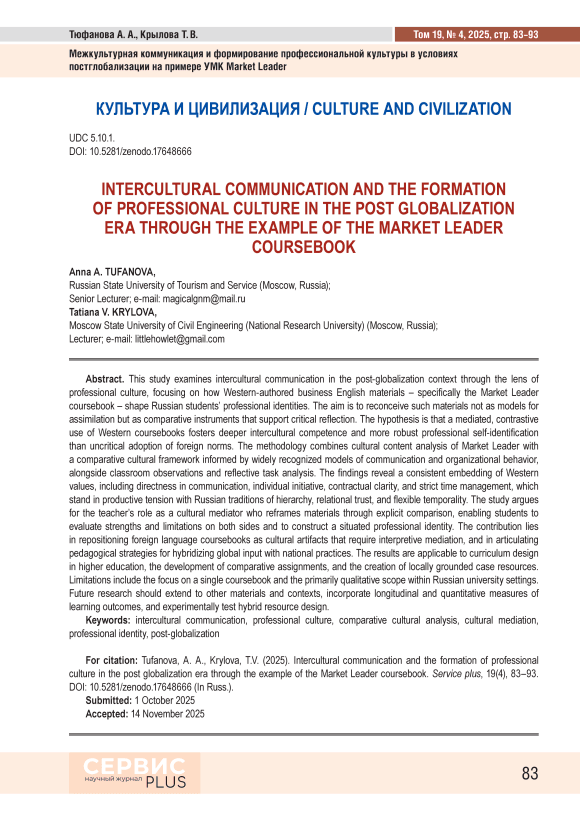
This study examines intercultural communication in the post-globalization context through the lens of professional culture, focusing on how Western- authored business English materials – specifi cally the Market Leader coursebook – shape Russian students’ professional identities. The aim is to reconceive such materials not as models for assimilation but as comparative instruments that support critical refl ection. The hypothesis is that a mediated, contrastive use of Western coursebooks fosters deeper intercultural competence and more robust professional self-identifi cation than uncritical adoption of foreign norms. The methodology combines cultural content analysis of Market Leader with a comparative cultural framework informed by widely recognized models of communication and organizational behavior, alongside classroom observations and refl ective task analysis. The fi ndings reveal a consistent embedding of Western values, including directness in communication, individual initiative, contractual clarity, and strict time management, which stand in productive tension with Russian traditions of hierarchy, relational trust, and fl exible temporality. The study argues for the teacher’s role as a cultural mediator who reframes materials through explicit comparison, enabling students to evaluate strengths and limitations on both sides and to construct a situated professional identity. The contribution lies in repositioning foreign language coursebooks as cultural artifacts that require interpretive mediation, and in articulating pedagogical strategies for hybridizing global input with national practices. The results are applicable to curriculum design in higher education, the development of comparative assignments, and the creation of locally grounded case resources. Limitations include the focus on a single coursebook and the primarily qualitative scope within Russian university settings. Future research should extend to other materials and contexts, incorporate longitudinal and quantitative measures of learning outcomes, and experimentally test hybrid resource design.
Similar articles in the section Mathematics. Natural sciences

Short address: https://sciup.org/140313703
IDS: 140313703 | UDC: 5.10.1. | DOI: 10.5281/zenodo.17648666
Межкультурная коммуникация и формирование профессиональной культуры в условиях постглобализации на примере УМК Market Leader
В исследовании рассматривается межкультурная коммуникация в условиях постглобализации через призму профессиональной культуры, с акцентом на то, как западные учебные материалы по бизнесанглийскому – в частности, курс Market Leader – влияют на формирование профессиональной идентичности российских студентов. Цель заключается в переосмыслении подобных материалов не как эталонных моделей для усвоения, а как сравнительных инструментов, поддерживающих критическое осмысление. Гипотеза состоит в том, что опосредованное, контрастивное использование западных учебников способствует более глубокой межкультурной компетентности и более устойчивой профессиональной самоидентификации, чем некритическое перенятие чужих норм. Методология включает культурный контентанализ Market Leader, сопоставительный культурологический подход на основе признанных моделей коммуникации и организационного поведения, а также наблюдения аудиторной практики и анализ рефлексивных заданий. Результаты выявляют устойчивое встраивание западных ценностей – прямоты в общении, индивидуальной инициативы, договорной ясности и строгого управления временем, – находящихся в продуктивном напряжении с российскими традициями иерархичности, доверительных связей и временной гибкости. Обосновывается роль преподавателя как культурного медиатора, который через явное сопоставление помогает студентам оценивать сильные и слабые стороны обеих традиций и выстраивать собственную, контекстуально укорененную профессиональную культуру. Научный вклад заключается в переосмыслении языкового учебника как культурного артефакта, требующего интерпретирующего посредничества, и в предложении педагогических стратегий гибридизации глобального материала с национальными практиками. Практическая применимость охватывает проектирование учебных планов, сравнительные задания и разработку локально релевантных кейсов. Ограничения связаны с фокусом на одном УМК и преимущественно качественным характером данных в российских вузах. Перспективы исследований включают анализ иных материалов и контекстов, лонгитюдные и количественные оценки результатов, а также экспериментальную проверку гибридных ресурсов.
Text of the scientific article Intercultural communication and the formation of professional culture in the post globalization era through the example of the Market Leader coursebook
The twenty-first century was once heralded as the century of globalization, a time when the fabric of the world would be woven into a single tapestry of interconnected economies, cultures, and languages. Yet, as the second quarter of the century unfolds, that fabric appears frayed, and in certain places, deliberately unstitched. States increasingly reclaim their right to a distinct cultural and political trajectory, while the ideology of globalization loses the unquestioned appeal it held only decades ago.
Nevertheless, the collapse of grand narratives about global unification has not diminished the importance of languages – particularly English – as vehicles of communication across borders. On the contrary, the paradox of the post-globalization era lies in the growing need for intercultural dialogue precisely at the time when national priorities, cultural specificities, and professional identities assert themselves most vigorously. Universities continue to employ Western-authored textbooks, not only because of their linguistic reliability but also because they encapsulate the cultural realities of professional communication in global business environments.
This paradox is acutely felt in Russian higher education, where students are expected to acquire foreign languages not merely as linguistic codes but as instruments for participating in professional exchanges. Among the widely used teaching resources, the Market Leader coursebook series occupies a central place [3]. Its content reflects the discursive practices of Western business communities, their professional culture, and, often, their implicit value systems. For Russian students, however, these representations may function less as a mirror to be emulated than as a lens through which their own cultural norms can be critically refracted.
This article sets out to examine how students step into the currents of intercultural communication at a moment when the once-celebrated tide of globalization is visibly receding. The use of Western textbooks, particularly Market Leader, is not to be understood as an act of unquestioning adoption, as though they were blueprints to be copied without reflection. Rather, they should be approached as mirrors and counterpoints, instruments that allow students to see the foreign and the familiar side by side. In this juxtaposition lies the possibility of something more valuable than imitation:
the slow and deliberate construction of a professional identity that is sharpened by exposure to international norms yet firmly rooted in national cultural realities.
Although Market Leader has already been discussed in Russian-language pedagogy, existing treatments largely approach it as a vehicle for communicative skills or as a scaffold for low-proficiency cohorts rather than as a cultural artifact to be read and mediated. O. B. Timokhina offers methodological guidance for the Upper-Intermediate syllabus with attention to task design and language outcomes [11], while S. D. Stepina and N. A. Miryugina describe the use of the coursebook with A1–A2 students, focusing on adaptation, sequencing, and motivational effects [10]. These contributions are valuable for classroom practice, yet they leave underexamined the cultural coding of the materials and the teacher’s role in reframing them under conditions of post-globalization. The present study addresses that gap by treating Market Leader not as a template to be imitated but as a shaped cultural object whose assumptions can be made explicit, set alongside Russian professional practices, and used to support the deliberate construction of professional identity.
Methodologically, the study relies on a cultural analysis of educational content, drawing upon theories of intercultural communication, professional identity, and cultural coding as developed by scholars such as Hofstede, Hall, and Trompenaars. At the same time, it integrates a pragmatic dimension: observations of classroom practice and the challenges faced by students when confronted with foreign cultural frameworks.
The Concept of Intercultural Communication and Its Evolution in the Post-Globalization Era
Intercultural communication has long been defined as the exchange of messages between individuals of different cultural backgrounds, with the aim of achieving mutual understanding across linguistic, social, and symbolic boundaries [1]. In the classical literature of the late twentieth century, it was often viewed through the optimistic lens of globalization: cultural diversity was not a challenge but a resource, and the task of education was to prepare students to function seamlessly in an increasingly homogeneous global environment.
Yet, as global integration falters, intercultural communication itself acquires new contours. Instead of being a unidirectional process of adaptation to a dominant “global” culture – often equated with Western norms – it now manifests as a dialogic, sometimes conflictual negotiation between cultural perspectives. In the post-globalization context, communication is no longer about assimilation but about positioning: each actor participates in the exchange while retaining awareness of their own cultural heritage.
For the educational sphere, this implies a crucial methodological shift. Students should not be guided to imitate the communicative styles of Western professionals uncritically, but rather to understand them, evaluate them, and learn to respond from their own culturally informed standpoint. In other words, inter-cultural communication in today’s classrooms is less about merging into a global village and more about navigating the complex borderlands between local and foreign practices.
Professional culture, often defined as the constellation of values, norms, and behaviors governing conduct within a specific occupational domain, may appear universal at first glance. Management, finance, or marketing share technical vocabulary and procedural routines across nations. Yet, beneath this surface uniformity lie deeply ingrained cultural assumptions. Leadership styles, decision-making processes, and even the etiquette of meetings are conditioned by the broader cultural context in which professionals are socialized.
For Russia, professional culture is historically shaped by traditions of collectivism, respect for hierarchy, and a tendency to view professional relationships through the prism of personal trust. By contrast, Western business culture – particularly as portrayed in textbooks like Market Leader – privileges individual initiative, contractual clarity, and efficiency as paramount values. These contrasts are not classroom ornaments to be admired and set aside; they shape the inner cartography by which young professionals locate themselves in the world of work. Through them, students decide whether they are speaking as guests or hosts, whether the language of contracts and presentations is a dialect they borrow for a time or a tongue they will claim as their own [2]. In that quiet reckoning, loyalty to national traditions is not discarded but weighed against the practical demands of international exchange, and the balance achieved there determines how they step into interviews, meetings, and negotiations beyond the university walls.
Professional culture, then, is not detachable from national identity like a label peeled from a bottle. It is the sedimented memory of a society – its habits of trust, its sense of time, its rituals of consent – translated into the grammar of professional action. To study it is to read the palimpsest where collective experience has been written over with the ink of offices and boardrooms, without quite effacing the older script beneath. For Russian educators, this entails presenting Western professional culture not as the horizon toward which all must travel, but as one landscape among several, to be mapped and compared rather than revered as a standard beyond question.
Such mapping requires lenses capable of bringing hidden structures into focus. The analysis of a coursebook like Market Leader is most revealing when it is conducted with theoretical instruments that make cultural coding visible in texts, tasks, and scenarios. The dimensional models associated with Geert Hofstede help to disclose how assumptions about authority, risk, and individual agency are built into examples and cases; Edward Hall’s attention to context clarifies why a preference for explicitness, brevity, and direct speech is treated as professional virtue; and the dilemmas articulated by Fons Trompenaars illuminate the quiet tug-of-war between universal rules and particular loyalties, between achievement conferred by results and status acknowledged by role [12]. Read together rather than as isolated doctrines, these perspectives allow educators to see the coursebook not as neutral pedagogy but as a shaped cultural object, whose contours can be traced, questioned, and set alongside Russian professional practice for deliberate comparison [14].
Hofstede’s cultural dimensions (e.g., individualism vs. collectivism, power distance, uncertainty avoidance) allow us to interpret how professional behaviors are framed in coursebook examples. A case study emphasizing assertive leadership may reflect low power distance and individualism, traits characteristic of Anglo-American culture.
Hall’s concepts of high- and low-context communication shed light on the implicit or explicit modes of interaction in business discourse. The prominence of direct, unambiguous language in Market Leader mirrors the low-context orientation of Western communication, which may clash with Russian students’ comfort with indirectness and contextual nuance [4].
Trompenaars’ model emphasizes dilemmas such as universalism versus particularism, achievement versus ascription. These dichotomies help explain why Western texts highlight contractual obligations and measurable success, whereas Russian practice may still value relational ties and status recognition.
Globalization and Its Crisis in the Educational Context
When globalization was still celebrated as the inevitable trajectory of human history, foreign language education was conceived as a straightforward bridge toward a world of shared values and standardized practices [2]. The image of the “global professional” implied fluency in English, mobility across borders, and adaptability to what was assumed to be a universally valid professional culture. In classrooms across Russia and beyond, textbooks written in the West were eagerly adopted as authentic guides to this imagined future. English was not only a tool of communication but a passport to global participation, and coursebooks were viewed as reliable maps leading into this wider world.
This vision has grown fragile. Over the past decade, geopolitical shocks have shifted like tectonic plates, bringing to the surface protectionist reflexes and a forthright reassertion of state sovereignty; together they have reordered the cultural terrain. The grand narrative of globalization – once traced as a smooth, unbroken arc – now splinters into rival scripts that overlap, diverge, and contend for authority. Nations increasingly seek to reclaim their own distinctive models of development, and educational policies begin to reflect the need for professionals who are not only globally competent but also locally grounded. For language pedagogy, this creates a fundamental tension. The very textbooks that provide students with access to international professional discourse also embed cultural assumptions that may be distant from, or even at odds with, domestic practices.
English remains the lingua franca of international communication, yet the context in which it is taught has shifted. No longer is it sufficient to prepare students to adapt passively to foreign models. Instead, the educational task is to equip them to navigate a dual reality. On the one hand, they must understand and operate within the frameworks of Western professional culture as represented in textbooks such as Market Leader. On the other hand, they must preserve and articulate their own professional identity shaped by Russian traditions and expectations. The bridge metaphor, once used to describe language learning, now requires revision. The bridge is not an invitation to abandon one’s side of the river but a vantage point from which both shores can be observed, compared, and critically assessed.
This dual imperative intensifies the role of in-tercultural competence. In an era when national trajectories diverge, the ability to compare cultural codes becomes more vital than the ability to imitate them. Students cannot be prepared for international professional communication by memorizing scripts of behavior alone; they must learn to perceive the implicit values embedded in communicative patterns. They must also be able to articulate the differences between those values and the norms familiar in their own environment. If earlier decades stressed adaptation, today’s pedagogical challenge is critical differentiation.
The crisis of globalization in education thus manifests itself as a contradiction. There is a persistent demand for international communication, but there is also a strong emphasis on national cultural continuity. Students are encouraged to engage with Western professional discourses because these still dominate international markets, yet at the same time they are expected to remain representatives of their own cultural heritage. The question is not whether globalization has ended but how its crisis reshapes the function of foreign language education [2]. No longer does intercultural education aspire to mint cosmopolitans who dissolve into a homogenized cultural field. Its task, rather, is to form specialists who keep their footing within a distinct cultural paradigm while learning to read, interpret, and negotiate with the paradigms of others. Such formation joins firmness of identity with translational competence – the ability to make one’s own norms intelligible even as one engages foreign codes without capitulation.
The Market Leader Coursebook and the Representation of Western Professional Culture
Across Russia and well beyond, the Market Leader coursebook has taken on an almost canonical presence in business English classrooms [3]. Its attraction lies in a distinctive blend of authentic linguistic input, closely curated case narratives, and a deliberate alignment with the communicative routines of international commerce. Yet this pragmatic architecture carries more than grammar and lexis. Beneath the utilitarian surface runs a coherent cultural storyline – one that frames how professionals ought to speak, decide, and value outcomes – and it merits sustained, critical attention [4]. It does not simply teach vocabulary or grammar; it projects a vision of how professionals interact, how organizations function, and what values define success in the modern business world.
A domestic methodological conversation around Market Leader already exists, though it has tended to privilege linguistic fluency and classroom logistics over cultural interpretation. In practical terms, O. B. Timokhi-na’s recommendations for the Upper-Intermediate level emphasize communicative outcomes and lexical development [11], whereas the account by S. D. Stepina and N. A. Miryugina details implementation for beginner cohorts, with attention to scaffolding and pacing [10]. Read together, these studies assume the coursebook to be a neutral container of authentic language. By contrast, the analysis advanced here reads Market Leader as a culturally contoured artifact: it traces the values embedded in its cases and tasks, identifies where they press against Russian professional habits, and proposes forms of pedagogical mediation – comparative reframing, double enactment of tasks, and locally anchored cases – that convert exposure into critical competence.
The very structure of Market Leader conveys an ideological dimension. The modular organization of the textbook is oriented around themes central to the Western business imagination: leadership, competition, negotiation, corporate strategy, entrepreneurship. Each unit situates language learning within a professional scenario that assumes a particular understanding of the corporate environment. Students are not only asked to master expressions for meetings or presentations, they are also subtly guided into a worldview where professional life is constructed through notions of efficiency, individual performance, and the pursuit of measurable goals.
The case studies included in the course often highlight stories of companies and leaders that embody principles of assertiveness, innovation, and risk-taking. Such narratives reflect cultural preferences for individual initiative and low tolerance for hierarchical distance. In contrast to the Russian tradition, where authority and collective consensus retain significant weight, these materials promote a culture in which leadership is earned through demonstrable achievement and where negotiation is framed as a contest of persuasive skills rather than as a process embedded in long-term personal relationships [12].
Even the linguistic choices within the course signal the underlying cultural code. Instructions emphasize clarity, brevity, and directness, consistent with the low-context communication styles identified by Edward Hall. Students are encouraged to avoid ambiguity, to “get to the point,” and to express disagreement openly but politely. These recommendations align with Anglo-American business etiquette but can feel dissonant to students accustomed to more implicit modes of communication where meaning is often conveyed through context, tone, or non-verbal cues.
Time, as represented in the course materials, is another dimension that reflects Western cultural assumptions. Deadlines, punctuality, and strict scheduling are foregrounded as unquestionable professional norms. In Russian professional culture, while deadlines are acknowledged, flexibility and adaptation often take precedence over rigid adherence to schedules. This divergence may produce subtle yet important tensions in the learning process, as students internalize foreign expectations about time management that may not seamlessly integrate into their domestic professional practices [5].
The cultural representation in Market Leader is thus not neutral. It communicates a set of assumptions about how professionals should speak, behave, and organize their work. For Russian students, the real hazard is not in meeting foreign patterns but in mistaking them for the air everyone breathes, treating the particular as though it were the universal.
The coursebook, if taken at face value, gently but insistently presents the Western professional script as the default stage upon which business must always be played out. Without the teacher’s hand to slow the pace and tilt the mirror, that relativity vanishes, and imitation replaces inquiry. The challenge of education, then, is not a matter of rejection but of reframing: turning the classroom into a workshop where cultural stories are opened, weighed, and measured against Russian professional traditions. It is only within this deliberate act of comparison that students can learn to value the strengths of the Western model while also perceiving, with equal clarity, the dignity and legitimacy of their own.
Comparative Analysis: Russia and the West
The question of professional culture across national boundaries is never confined to the abstractions of theory; it unfolds in the grain of everyday experience. It can be seen in the way meetings are opened, in the weight accorded to silence, in the authority of a signature or the hesitation before it is given. Such matters may look trivial when laid out in isolation, but together they weave the lived texture of professional life, reminding us that culture does not float above practice – it inhabits it.
When Russian students encounter Western-authored materials such as Market Leader, they step into a world that both resembles and diverges from their own expectations of professional life. To understand the nature of this encounter, it is necessary to place side by side the cultural logics of Russia and the West, examining how they interpret leadership, communication, and collective work.
One of the most visible contrasts emerges in the domain of leadership. Western business discourse, particularly in Anglo-American traditions, tends to emphasize leadership as a function of individual initiative and vision. Leaders are expected to articulate a clear strategy, inspire their teams through personal charisma, and demonstrate their competence through achievements that can be measured and rewarded. This approach is consistent with Hofstede’s notion of low power distance, where authority must be justified by performance rather than by position alone.
In Russia, professional culture has long carried the imprint of hierarchy, where authority is not merely acknowledged but often treated as an inherent quality of the position itself. The leader, in this tradition, is imagined less as a solitary innovator and more as a guardian of balance, entrusted with responsibility and the stability of the collective. Charismatic figures certainly emerge, but beneath their charisma lies the unspoken assumption that the final word rests with those higher in rank. Such expectations are not easily set aside, for they are woven into the deeper fabric of organizational life.
When Russian students encounter Market Leader and its tales of Western managers who overturn convention to implement bold new practices, the response is rarely uniform. Admiration mingles with doubt, as the daring of such leaders appeals to creativity yet raises questions about loyalty and respect for structure. What appears, in a Western frame, as a triumph of initiative may, through Russian eyes, resemble a breach of order. The classroom thus becomes a place where these two readings meet, collide, and demand interpretation. The discussion that follows in the classroom thus becomes a cultural negotiation: students weigh the value of innovation against the risks of destabilizing authority, a calculation that reflects their own cultural background.
Communication styles provide another fertile ground for comparison. In Western professional culture, directness is often celebrated as a sign of honesty, efficiency, and professionalism [9]. Meetings are structured around clear agendas, participants are encouraged to express their opinions openly, and disagreements are ideally resolved through explicit negotiation. Russian communication, by contrast, often operates in a higher-context mode, where much is implied rather than stated outright, and where relationships play a central role in shaping what can be said and how [14]. A Western manager might interpret Russian indirectness as evasiveness, while a Russian professional might perceive Western bluntness as rudeness or lack of tact. In the classroom, students quickly recognize that the textbook’s dialogues favor the latter model. Exercises emphasize making proposals, declining offers, or negotiating conditions in ways that presuppose comfort with open confrontation. For many students, practicing these dialogues requires not only linguistic adaptation but also psychological adjustment to a foreign interactional style.
Decision-making processes further reveal cultural divergence. Western business discourse frequently highlights the value of rapid decision-making supported by data and individual accountability. A manager is expected to analyze information, take a stance, and assume responsibility for the outcome. Russian practice, by contrast, has historically leaned toward collective deliberation and the cultivation of consensus within a team or hierarchical structure. Even when a decision is formally made by a superior, the process often involves extended consultation and attention to relational dynamics. This tendency can be linked to the cultural preference for collectivism and a cautious attitude toward uncertainty. When students encounter Market Leader scenarios where decisions are made swiftly and risks are embraced, they may find the approach both stimulating and alien. The exercise becomes an opportunity to discuss not only the language of decision-making but also the cultural meaning of decisiveness itself [2].
The dimension of teamwork also illustrates the interplay between cultural expectations. Western textbooks often describe teams as dynamic groups of equals, where roles are negotiated and leadership can be fluid depending on expertise. The implicit assumption is that authority emerges situationally and that professional collaboration is based on meritocratic principles. Russian students, however, are accustomed to environments where team structures are more rigid, where responsibilities are allocated from above, and where respect for established roles outweighs the fluidity of situational authority. As they work through Market Leader activities that encourage brainstorming or peer-to-peer feedback, students sometimes experience a subtle discomfort. The very idea of questioning a peer’s contribution or openly challenging a superior’s suggestion can conflict with ingrained cultural norms.
These divergences are not merely academic curiosities but pedagogical challenges. If unaddressed, they risk creating what might be called a “hidden curriculum,” where students learn not only a foreign language but also an implicit hierarchy of cultural values in which the Western model appears superior by default [4]. The risk is that students come to see their own professional traditions as backward or inadequate, rather than as alternative strategies shaped by different historical and cultural contexts. Without critical commentary, the textbook unintentionally fosters cultural asymmetry.
To counterbalance this effect, instructors must foreground the comparative dimension. For example, a role-play exercise on negotiating a contract can be reframed to invite students to perform it twice: once following the Western script provided by the textbook, and once according to Russian professional norms. The subsequent discussion can highlight not only linguistic differences but also the contrasting values of directness versus indirectness, speed versus caution, contractual clarity versus personal trust. In this way, the classroom becomes a laboratory of cultural reflection rather than a site of one-sided assimilation.
Another example arises in the treatment of time. In Market Leader punctuality and tightly sequenced schedules are presented less as preferences than as moral imperatives, the calendar doubling as a code of conduct and the clock as an exacting supervisor. Russian students often inhabit a different temporal regime, one in which time is elastic rather than mechanical: deadlines are real, yet their observance is calibrated against context, relationships, and the evolving texture of events. When learners are invited to place these chronologies side by side, they begin to see time management not as a universal axiom but as a culturally situated choice – a grammar of pacing and priority. Such explicit comparison helps them fashion a professional identity that can read both dials, acknowledging international expectations while remaining attentive to domestic practices and their underlying ethos [5].
In the end, comparative inquiry does not erect a ladder of superiority; it opens a landscape. Russian and Western professional cultures unfold not as higher and lower, but as adjacent fields with their own internal logics, each capable of productive use in the right conditions. As students trace contrasts in leadership, communication, decision-making, and teamwork, they learn to navigate a broader cultural cartography, orienting themselves by multiple sets of coordinates rather than a single compass, and acquiring the practical wisdom to choose routes that fit the terrain they must cross. They discover that professional culture is neither universal nor fixed but shaped by the values and histories of particular societies [5].
What emerges from such discoveries is the outline of a different kind of intercultural competence, one that resists the temptation to dissolve national identity into the bland smoothness of global uniformity [6]. Instead, it cultivates professionals who can stand with confidence inside their own cultural house while still keeping the doors and windows open to the voices of others, ready to listen, argue, and negotiate across thresholds.
The Role of the Teacher as Cultural Mediator
Within this intricate web of cultural crossings, the teacher’s role extends far beyond that of a linguistic instructor. The teacher becomes a mediator between entire worlds, interpreting the codes of one culture while guarding the integrity of another. The task before the teacher is not to pass out foreign blueprints as if they were sacred diagrams, but to mount them in a frame that discloses their conditional origins – the choices, histories, and assumptions that made them look inevitable. When a Western-authored coursebook is treated as an unquestionable template, students risk losing contact with the ground they stand on, mistaking borrowed scaffolding for the architecture of their own house [13]. Once the relativity of the design is made visible – once its load-bearing assumptions are named and set alongside alternatives – the classroom stops being a hall of mirrors and becomes a chamber of inquiry. There, cultures are not absorbed by osmosis but examined, weighed, and placed in dialogue, so that understanding is built rather than merely inherited.
Perspectives and Practical Recommendations
The wider challenge of teaching intercultural communication in the age after globalization is precisely this balancing act: to preserve authenticity without sacrificing adaptation, and to enable students to see foreign models not as commands but as choices to be weighed in relation to their own traditions. Western textbooks such as Market Leader remain valuable precisely because they expose students to the realities of global professional discourse. Yet, they must be supplemented with strategies that anchor this exposure in the students’ own cultural context.
One effective approach is to design assignments that require explicit comparison between Russian and Western practices. One practical way to make comparison tangible is to restage a familiar scene on a different stage. After students complete a negotiation roleplay as scripted in the textbook, they can be invited to run the same encounter again under the constraints and expectations of a Russian professional setting, attending to differences in tone, sequencing, and the distribution of initiative.
The doubleness of the exercise slows the movement from language to habit; it interrupts the reflex to internalize foreign norms by making their contingency audible. A complementary approach is to place locally resonant case studies alongside the imported ones, so that examples drawn from Russian companies, leaders, and organizational practices speak back to global templates. Read in parallel rather than in isolation, these cases allow students to locate themselves within two narrative arcs at once – the international and the national – and to see how professional meaning shifts when the backdrop changes.
Such pedagogical work depends on a classroom climate where argument is welcomed and assent is earned rather than assumed. When students are encouraged to weigh the payoffs and liabilities of competing cultural strategies, professional culture ceases to look like a single paved road and begins to resemble a network of routes, some straight, some winding, each suited to particular terrain. In this space, the teacher extends the conversation beyond the borders of the coursebook, bringing in articles that complicate easy conclusions, films that render practice visible, and guest voices that carry different institutional memories [8]. The aim is not to declare Western models out of bounds but to weave them into a broader fabric of in-tercultural competence in which no thread claims the whole pattern, and where strength comes from the interlacing.
Looking ahead, Russian higher education stands to gain from hybrid resources that braid international authenticity with critical commentary rooted in local realities. Materials designed in this spirit would let students step into global conversations without losing their footing on home ground, granting them the poise to face outward while remaining anchored in their own professional identity. The result is not a compromise that pleases no one, but a capacious pedagogy in which comparison becomes a method of construction, and intercultural competence is built as much by reflection as by exposure. The post-globalization era does not require isolation from the world but demands a more careful negotiation of cultural boundaries, where foreign models are studied critically and selectively integrated.
Conclusion
The decline of globalization has not erased the need for intercultural communication; rather, it has made the task of navigating cultural differences even more urgent. English remains the key medium of international exchange, and textbooks like Market Leader continue to shape how students imagine professional life beyond their borders. Yet the cultural codes embedded in these materials must not be taken as universal standards. They represent one tradition of professional conduct, deeply rooted in Western values, but not the only legitimate one.
The responsibility of educators in this context is profound. They must ensure that students do not see Western professional culture as an unquestionable ideal but as a point of comparison, a mirror in which their own cultural traditions can be reflected and reinterpreted. By encouraging critical analysis and comparative reflection, teachers help students to construct their own professional identities – identities that are globally competent but nationally grounded.
Thus, the purpose of intercultural education in the post-globalization era is not assimilation but differentiation. Students should leave the classroom not as replicas of a foreign professional model but as specialists capable of navigating multiple cultural environments with discernment. In this lies the true value of intercultural communication today: not the erasure of differences but the cultivation of professionals who can engage with them intelligently, respectfully, and creatively.
