
Intercultural competencies of hospitality industry professionals and protocol services as a «soft power» tool
Journal: Services in Russia and Abroad @service-rusjournal
Section: Туризм: российский и международный опыт
Article in issue: 4 (119), 2025.
Free access
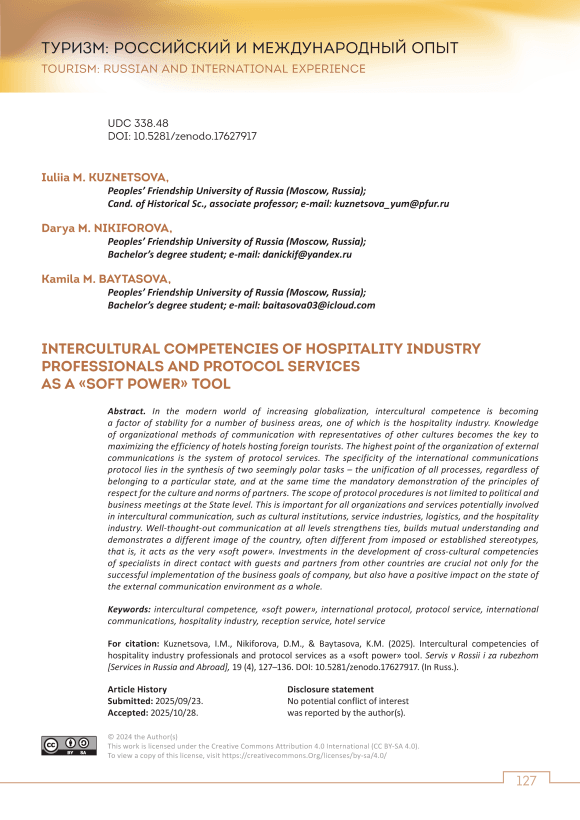
In the modern world of increasing globalization, intercultural competence is becoming a factor of stability for a number of business areas, one of which is the hospitality industry. Knowledge of organizational methods of communication with representatives of other cultures becomes the key to maximizing the efficiency of hotels hosting foreign tourists. The highest point of the organization of external communications is the system of protocol services. The specificity of the international communications protocol lies in the synthesis of two seemingly polar tasks – the unification of all processes, regardless of belonging to a particular state, and at the same time the mandatory demonstration of the principles of respect for the culture and norms of partners. The scope of protocol procedures is not limited to political and business meetings at the State level. This is important for all organizations and services potentially involved in intercultural communication, such as cultural institutions, service industries, logistics, and the hospitality industry. Well-thought-out communication at all levels strengthens ties, builds mutual understanding and demonstrates a different image of the country, often different from imposed or established stereotypes, that is, it acts as the very «soft power». Investments in the development of cross- cultural competencies of specialists in direct contact with guests and partners from other countries are crucial not only for the successful implementation of the business goals of company, but also have a positive impact on the state of the external communication environment as a whole.
Similar articles in the section Production and services according to economic sectors
Short address: https://sciup.org/140313786
IDS: 140313786 | UDC: 338.48 | DOI: 10.5281/zenodo.17627917
Межкультурные компетенции специалистов индустрии гостеприим- ства и протокольных служб как инструмент «мягкой силы»
В современном мире растущей глобализации межкультурная компетентность становится фактором стабильности для ряда сфер бизнеса, одной из которых является индустрия гостеприимства. Знание организационных методов общения с представителями других культур становится ключом к максимизации эффективности работы отелей, принимающих иностранных туристов.Высшей точкой организации внешних коммуникаций является система протокольных служб. Специфика международного коммуникационного протокола заключается в синтезе двух, казалось бы, полярных задач – унификации всех процессов, независимо от принадлежности к тому или иному государству, и в то же время обязательной демонстрации принципов уважения культуры и норм партнеров.Сфера применения протокольных процедур не ограничивается политическими и деловыми встречами на государственном уровне. Это важно для всех организаций и служб, потенциально вовлеченных в межкультурную коммуникацию, таких как учреждения культуры, сферы обслуживания, логистики и гостиничного бизнеса. Хорошо продуманная коммуникация на всех уровнях укрепляет связи, выстраивает взаимопонимание и демонстрирует иной имидж страны, часто отличный от навязанных или устоявшихся стереотипов, то есть выступает в роли той самой «мягкой силы». Инвестиции в развитие межкультурных компетенций специалистов, вовлеченных в непосредственный контакт с гостями и партнерами из других стран, имеют решающее значение не только для успешной реализации бизнесцелей компании, но и оказывают положительное влияние на состояние внешней коммуникационной среды в целом.
Text of the scientific article Intercultural competencies of hospitality industry professionals and protocol services as a «soft power» tool
To view a copy of this license, visit
Статья принята к публикации: 28.10.2025.
In a world that is increasingly globalized, and the current geopolitical situation is characterized by a change of established vectors, the importance of intercultural competence has increased dramatically.[10] Images and stereotypes, formed naturally, are beginning to be exacerbated through not always objective sources of mass international communications, and often direct propaganda aimed at forming an unfavorable image of the country and its citizens.
The purpose of this ar^ cle is to try to determine the actual place of intercultural competence of employees of hotel enterprises services in the creation and correlation of the general impression and perception of the image of Russia and Russians in the eyes of foreign guests. The hypothesis is that the current state of geopolitical tension actively affects the general perception of the image of the country, however, the demonstration of the level of competence in communications with guests by the receiving party, can lay a qualitatively new impression. We will try to consider the following components: the established stereotypes, such as coldness, indifference, isolation and closedness, as well as epithets imposed now in the international information field, reflecting the lack of friendliness and flexibility in relationships and, as a counterbalance, the demonstration by hotel industry professionals of a high level of intercultural communication, contributing to the formation of positive impressions of foreign guests.
The complexity of the tasks is to get away from the formal, accepted in the hospitality system standards, which, of course, will be perceived by guests as artificial, not reflecting sincere friendliness. Therefore, it is proposed to consider the possibilities of increasing the intercultural competence of hotel employees in a comparative analysis with standard diplomatic protocols [13] and to find forms of demonstrating an informalized approach to create a qualitatively new positive perception of Russia by guests from other countries.
The ability to understand and navigate the complex nuances of different customs, traditions and communication styles is no longer something to be recommended, the need to demonstrate respect and readiness for dialog is coming to the fore. At the same time, the very topic of studying the processes of organization of intercultural communications is in constant development, it is just like any cultural and social environment is subject to trends and is not a constant. [1]
Addressing the issues of intercultural competencies requires a more attentive approach also from the position of competitiveness, since tourism business is highly dependent on the effectiveness of communication and interaction with customers from different cultural environments. In this regard, it is possible to highlight several key aspects that emphasize the importance of this competence [8]:
Forming a first impression
The first impression tourists get of a country is often formed already after arriving at the hotel. Hotel staff who have a high level of intercultural competence can respond quickly and correctly to the different expectations and requests of hotel guests without difficulty. Understanding of cultural aspects, such as communication manner, service style and peculiarities of perception, for example, contributes to the creation of a favorable atmosphere, which has a positive impact on the overall impression of our country. [7]
Improved service quality
Given the diversity of cultural norms and traditions, training employees in intercultural competence offers many benefits and makes the image of the company more pleasant. This can include factors such as awareness of how to properly communicate with foreign guests and how to react in non-standard situations. Employees who can adapt their communication style create a more comfortable environment and show professionalism and respect to guests. This is evident in such things as greeting, tone of communication, and consideration of religious and gastronomic preferences [12].
Addressing language and cultural barriers
Intercultural competence includes not only knowledge of foreign languages, but also understanding of cultural aspects of communication. Highly qualified employees who understand the importance of cultural and linguistic aspects are able to work with conflicts and misunderstandings, which affects the improvement of the image of hotel enterprises, as well as favorably affects the development of the country as a whole [2].
Creating a «cultural bridge»
Hotel employees are a kind of «cultural bridge» between Russia and foreign tourists. Understanding local traditions and the ability to share them with guests can leave tourists with a positive impression of the country. Thus, the intercultural competence of employees contributes not only to their professional growth, but also to cultural exchange, which significantly enriches the experience of stay of foreign clients [7].
Forming a positive image of Russia
The hospitality industry can play an important role in shaping a positive image of a country. Employees who are competent and knowledgeable about national attractions, traditions and customs offer cultural events and attractions for tourists to visit, which contributes to a more meaningful perception of Russia as a country with a rich culture and history and makes repeat visits by tourists possible.
Thus, despite the problematic situation with geopolitical pressure, intercultural communication contributes to a positive perception and improvement in the evaluation of the image of the country as a whole. Let us consider the key aspects of practical realization of the principles described above:
-
1. Creating a positive first impression. A foreign tourist’s first interaction with Russia usually begins through hotel staff, tourist services, and guides. If these stages of communication are conducted positively and with understanding, it creates a positive first impression in the guests. The ability of employees to take into account cultural peculiarities (for example, specific perception of time, communication and personal space) demonstrates professionalism,
-
2. Eliminating stereotypes and prejudice. Intercultural communication helps to break stereotypes that foreigners may have. However, employees and locals, demonstrating openness, friendliness and knowledge about the culture of guests and tourists, dispel stereotypes of this kind and make the image positive, it gives an opportunity to make the attitude towards Russia more loyal. Thus, communication plays an important role in building a positive image of the country beyond borders.
-
3. Improving cultural perception. Synthesis of cultures begins where the host demonstrates both respect for the specificity of the guests and willingness to demonstrate its own uniqueness. The use of traditions, local festivals, and paraphernalia can attract guests and give them a chance to feel involved in the unique atmosphere of the country [3]. Such friendly involvement in the culture of Russia, taking into account the national specifics of the guest, gives the best effect.
-
4. Emotional connection and experience. Emotions play an important role not only in the perception of the image of a person, but also in the perception of the image of the country. Due to the fact that the guest experiences positive emotions, a deep emotional connection with Russia is built, and also experiencing positive emotions makes guests more attached [14]. Such moments not only form a positive impression, but also serve as a certain way of promoton, because with a pleasant experience with the company, the client shares the impression with friends and acquaintances, which can interest and attract new guests.
and therefore plays a significant role in forming an impression of the country [13]. These seemingly small factors can be decisive and it is important for employees to recognize this.
For a competent perception of the processes to which this article is devoted, it is necessary to define the basic concepts, the first of which is in-tercultural competence – a set of skills that gives the ability to interact and understand people of different cultures and nationalities [6]. This term appeared in science in 1970 and immediately accumulated a whole range of issues and problems that require versatile attention. Since the seventies, the number of scientific works began to grow, where intercultural competences were considered, their goals and prospects of realization were described. In the context of research, this topic is considered as a set of analytical and strategic abilities [22]. The modern concept has not transformed too much and explains the term «intercultural competence» as a set of skills and knowledge that help a person to interact with interlocutors belonging to another culture. It is worth noting that communication can be understood not just as informal communication between individuals, but also as interaction between partners in a professional environment.
It should be noted that understanding intercul-tural competence is not just communication skills, but also the ability to be a tolerant, attentive interlocutor. To master this skill, it is also necessary to have communicative skills, because intercultural competence is realized through communication. Knowledge of languages also plays an important role, because representatives of other cultures can interact in another language. And also, psychological skills, empathy, which allows you to tune in to a person, to feel at what point they are uncomfortable in communication [4].
To the full extent of building communications through the principle of awareness of cultural preferences, is realized in the system of protocol organization, therefore, it is proposed to consider the possibilities of increasing the intercultural competence of employees of hotel enterprises in a comparative analysis with standard diplomatic protocols.
Protocol, in the context of international communications is a set of rules and standards that determine the way of organizing the transfer of information and establishing contacts between the participants of the meeting [9]. The protocol allows both to formalize communication and to give it maximum opportunities to implement the goals and objectives that the participants of the meeting set for themselves. The main goal is to create a comfortable environment for all stakeholders. In other words, a protocol is our prior agreement on the external conditions of communication in order to maximize the effectiveness of its internal content. Protocol service – a structural subdivision in companies, government and corporate organizations, implementing the application of basic principles of external communications in the format of official meetings with the participation of the first persons of these organizations [11].
A high level of intercultural competence is a must for international protocol practitioners. Protocol officers and diplomats often act as representatives of their countries in foreign policy communications, where a thorough understanding of local customs and traditions can be the difference between successful diplomacy and diplomatic fi-ascoes [19]. This knowledge not only facilitates respectful exchanges, but also paves the way for smoother negotiations and cooperation between countries.
The quality of intercultural competence in an international protocol is actually its content and becomes the key to building a partnership. As American motivational author Brian Tracy said: «Communication is a skill that can be learned. It’s like riding a bicycle or typing. If you’re willing to work at it, you can quickly improve the quality of every area of your life» [24]. Different cultures demonstrate unique approaches to expressing agreement, disagreement, and respect. If these differences are overlooked, it can lead to serious misunderstandings or worse, diplomatic and other conflicts.
It is necessary to highlight the impact factors of intercultural competence in the implementation of communication protocol:
-
1. Improving the effectiveness of communication. Intercultural communication enhances the quality of communication. For example, while some cultures value directness in dialog, others may prefer a more covert and nuanced style of communication.
-
2. Nurturing mutual respect. One of the most encompassing outcomes of developed inter-cultural communication competencies is identifying points of mutual respect and actually demonstrating it. Nurturing mutual respect is an important aspect of intercultural communication that helps to strengthen ties between
peoples and creates an atmosphere of trust and understanding [21]. Identifying points of mutual respect can manifest itself in various forms and at all levels of interacton. Consider examples:
-
• Emotonal Intelligence. Managers and employees with high levels of emotonal intelligence are more likely to notce nonverbal cues and cultural differences that affect communicaton. For example, direct eye contact may be perceived as a sign of trust in some cultures, while in others it may be seen as a sign of aggression. By respectng these differences, a team can improve com-municaton and avoid misunderstandings.
-
• Ways of conflict resoluton. When conflict arises between employees from different countries, it is important to take into account the communicaton styles of each culture. For example, in some cases, direct disagreement may be considered normal, while in others it may be undesirable. A willingness to adapt and find solutons that accommodate different styles promotes mutual respect.
-
• Cultural traditons and customs are taken into account. In an internatonal company with employees from different countries, superiors organize cultural days where employees can present their cultures, tra-ditons, cuisine and art. This event shows respect for diversity and makes each employee feel valued.
-
• These processes are realized through the ceremonial significance of certain rituals in the host country. A protocol officer who takes the initatve to learn and partcipate in local customs is likely to be positvely received by internatonal colleagues [24]. Such mutual respect lays the foundaton for strengthened alliances, enhanced joint efforts and fruitful diplomatc conversatons.
-
• Conflict resoluton and negotaton. Misunderstandings based on cultural differences often lead to conflict situatons. Professionals who understand cultural dynamics can approach disputes with greater empathy
and understanding, thereby facilitatng mutually beneficial solutons. In negotatons, understanding cultural preferences for compromise and decision making is paramount. Some cultures may prioritze relatonship building before business discussions begin, while others may lean toward a more concrete approach from the outset [12]. By tailoring negotaton strategies to these cultural sensitvites, protocol officers can greatly increase the likelihood of reaching favorable agreements.
Certainly, this is not the full range of impact areas of intercultural competencies in the format of implementaton of communicaton protocols. These are basic, generalizing detailed task complexes. The main actual issue in the study of inter-cultural competencies is the problems of their formaton and development. Let us consider the key ones:
-
a) Limited language skills: language barriers are a major weakness in intercultural competence. It can negatvely affect interactons with people from different cultures. Even if one has knowledge of intercultural competence, without language skills, building relatonships will be a challenge.
-
b) Limited percepton of other cultures: some people cannot perceive other points of view and have a closed-minded attitude towards acceptng new informaton. This factor limits personal growth and can have a negatve impact on communicaton. The main danger here lies in formalizing the demonstraton of the removal of the intercultural barrier, which is always felt by the other party and can often be more offensive and painful.
-
c) Cultural conflicts: communicators consciously disregard even existng competencies. Due to different cultural backgrounds, there is a possibility of misinterpretng the behavior and customs of representatves of other cultures. This can have a negatve impact on the percepton of the other person.
-
d) Rapidly evolving global cultural dynamics: contnuing educaton and professional
development are vital for people working in interna^ onal communica^ on systems to stay abreast of emerging cultural trends and shi^s. This commitment to lifelong learning serves not only to improve intercultural competencies but also to enhance the ability of professionals to effec^vely navigate the increasingly intricate tapestry of global cultural landscapes.
In conclusion, intercultural competencies are an integral part of the structure of services that realize interna^onal contacts. Their role in enhancing the effec^ veness of communica^ on, fostering mutual respect and successfully resolving conflicts is indispensable in an era of global interconnectedness. As our world con^ nues to diversify, inves^ ng in the development of these competencies is not just beneficial – it is an absolute necessity for hospitality companies dealing with interna^onal guests. By enhancing their intercultural competence, these professionals can make a significant contribu^on to bridging cultural differences, thus contribu^ng to a more harmonious and coopera^ve interna^onal community, and in the current environment of external challenges for Russia, become an important element in the process of building a posi^ve image.
