
Ivan Savenkov’s Finds from Neolithic Burials on the Bazaikha River and the Age of Siberian Rock Art
Журнал: Archaeology, Ethnology & Anthropology of Eurasia @journal-aeae-en
Рубрика: Paleoenvironment, the stone age
Статья в выпуске: 3 т.53, 2025 года.
Бесплатный доступ
This study examines objects of portable art such as realistic three-dimensional figurines of elks and an anthropomorphic figurine, carved from elk antler, which were found by Ivan Savenkov in 1885 during his excavations of burial VI at Bazaikha, near Krasnoyarsk, in the mouth of the eponymous river. This burial, like others at the same site, yielded also stone and bone artifacts of Neolithic appearance. This unusual sample is one of the main arguments favoring the Neolithic age of numerous examples of Siberian rock art (elks and other animals rendered in the so-called Angara style). The Neolithic attribution of figurines and stylistically similar petroglyphs is problematic largely because the Bazaikha sample has not yet been analyzed by modern methods or even documented or fully published. Here, an overview of the sample, based on available archival and literary records, is given, and the possibility of comparing figurines and petroglyphs is discussed with reference to the «Angara style». I propose to select from the heterogeneous array of representations those actually showing stylistic parallels with the Bazaikha figurines. Two avenues of further research are mentioned: a focus on the Bazaikha sample (archival studies, 3D documentation, cataloging, radiocarbon dating, etc.), and a revision of the notion of «Angara style» in rock art based on modern views and facts.
Короткий адрес: https://sciup.org/145147546
IDS: 145147546 | DOI: 10.17746/1563-0110.2025.53.3.074-084
Текст научной статьи Ivan Savenkov’s Finds from Neolithic Burials on the Bazaikha River and the Age of Siberian Rock Art
Siberian rock art contains a lot of images that are attributed by many scholars to the Neolithic. Relatively realistic (with distinctive stylization) elk figures, carved and painted on rocks of the Yenisei, Angara, Lena, and other areas, are considered the most typical. Neolithic attribution is based on indirect evidence; the most important is the stylistic similarity of rock images with objects of portable art from the Neolithic (or presumably considered as such) sites of Siberia and the entirety of Northern Eurasia. A key role in the identification was played by a collection of artifacts discovered by Ivan Savenkov in 1885
in the burials near the village of Bazaikha at the mouth of the Bazaikha River, the tributary of the Yenisei, in the vicinity of Krasnoyarsk. Realistic 3D images of elk, masterfully carved from antler, and an anthropomorphic figurine were particularly important. Various accompanying goods helped Savenkov to suggest the Neolithic age for the burials; he also noticed a stylistic similarity between these figurines and some of those from the Middle Yenisei region. In further studies, these findings were of great importance for identifying the Neolithic stratum in the rock art of Siberia. However, not all scholars accepted the Neolithic age of the Bazaikha burials, and even more controversial was the attribution of
the corresponding rock art to the “Angara style” or “Angara figurative tradition” (Podolsky, 1973; Sher, 1980: 186–190; Kovtun, 2001: 48–55; Ponomareva, 2016; and others). Generally, these are two separate and pertinent research areas, yet they are closely related to each other. This article makes it possible to discuss only some aspects of these problems. It intends to describe the available material evidence gathered by Savenkov at Bazaikha; using it as example, to discuss the possibility of correlating portable art and rock art; to identify precisely those representations from the heterogeneous array of rock art in the Angara style, which can be correlated with figurines from Bazaikha; and to outline the prospects for further research in each of these areas.
Evidence gathered by Ivan Savenkov at Bazaikha
This unique collection was associated with equally unique circumstances. It is hard to imagine that the most interesting, rare material evidence, obtained 140 years ago and analyzed in numerous publications, has still not been documented and studied by current research methods, and has not been published according to modern standards. The evidence and documentation have not been lost, and are kept in museums*. It appears that apart from photographs taken in the 19th century (FO NA IIMK RAN. Q 393-1, 393-2; RO NA IIMK RAN. F. 1, D. 156, fol. 59), the only available images of the artifacts were published in the mid-20th century (Okladnikov, 1950: Fig. 90; 1957: Fig. 5, 12, 13; 1966: Fig. 35, 36; 1971: Fig. 108, 109). Therefore, after Ivan Savenkov, the originals must have been studied only by A.P. Okladnikov. The manuscripts of Savenkov “Journal of Archaeological Excursions and Excavations of 1885” and “Bazaikha Site of the Stone Age” (Archive of the Minusinsk Museum of Local History. Inv. 3, D. 89, 124) have not been fully deciphered and published. Nevertheless, information about this site, photographs, and drawings of the artifacts are present in archives and in the literature, which allows us to provide a preliminary description of this evidence.
Ivan Timofeevich Savenkov (1846–1914) made a significant contribution to Russian science and culture in many fields (to learn more about him, see (Vdovin, Makarov, Maizik, 2024)), including archaeology. He is especially well-known as a researcher of the Stone Age and rock art of the Yenisei region. In the vicinity of Krasnoyarsk, Savenkov discovered the first Paleolithic site in the region (Afontova Gora) and Neolithic burials (Bazaikha). He found the first burial with the relevant goods in the Bor locality near the village of Bazaikha in 1883 while collecting surface finds on sand dunes, which marked the beginning of Savenkov’s work as an archaeologist (Auerbach, 1929: 176). In subsequent years, the collection of materials continued, and the evidence of various periods also yielded Neolithic finds. In 1885, with the assistance of the East Siberian Department of the Russian Geographical Society, five more flat graves were excavated. Two of them contained incomplete skeletons without burial goods, while two others contained complete skeletons; the deceased were buried in the extended position on their backs with their heads to the west, and were accompanied by stone and bone items, and animal teeth. The most interesting was burial VI, containing parts of a human skeleton, stone and bone artifacts, and a unique set of five figurines carved of elk antler (Fig. 1, 2).
In 1892, at the International Anthropological Congress in Moscow, Ivan Savenkov made a report “On the Neolithic Remains Found in the Yenisei Governorate (Eastern Siberia) on the Banks of the Yenisei River, near the Mouths of the Bazaikha and Chadobets Rivers” and demonstrated his finds, which provoked great interest. The text of the report with the ground plan of burial VI, a drawing, and a photograph of some of the finds were published (Savenkov, 1893) (for its Russian translation, see (Savenkov, 2003)). A delegate to the Congress, Baron de Baye, delighted with the discoveries of Ivan Savenkov, soon made a report about them at the Academy of Sciences in Paris (Baye, 1894). Thus, the finds from Bazaikha became famous in Europe; but Savenkov felt that in his homeland, his discovery remained undervalued (Auerbach, 1929: 181–185). By 1912, he had prepared a detailed manuscript about the Bazaikha site, which remained an archival document (Archive of the Minusinsk Museum of Local History, Inv. 3, D. 124). N.K. Auerbach planned to edit Savenkov’s field
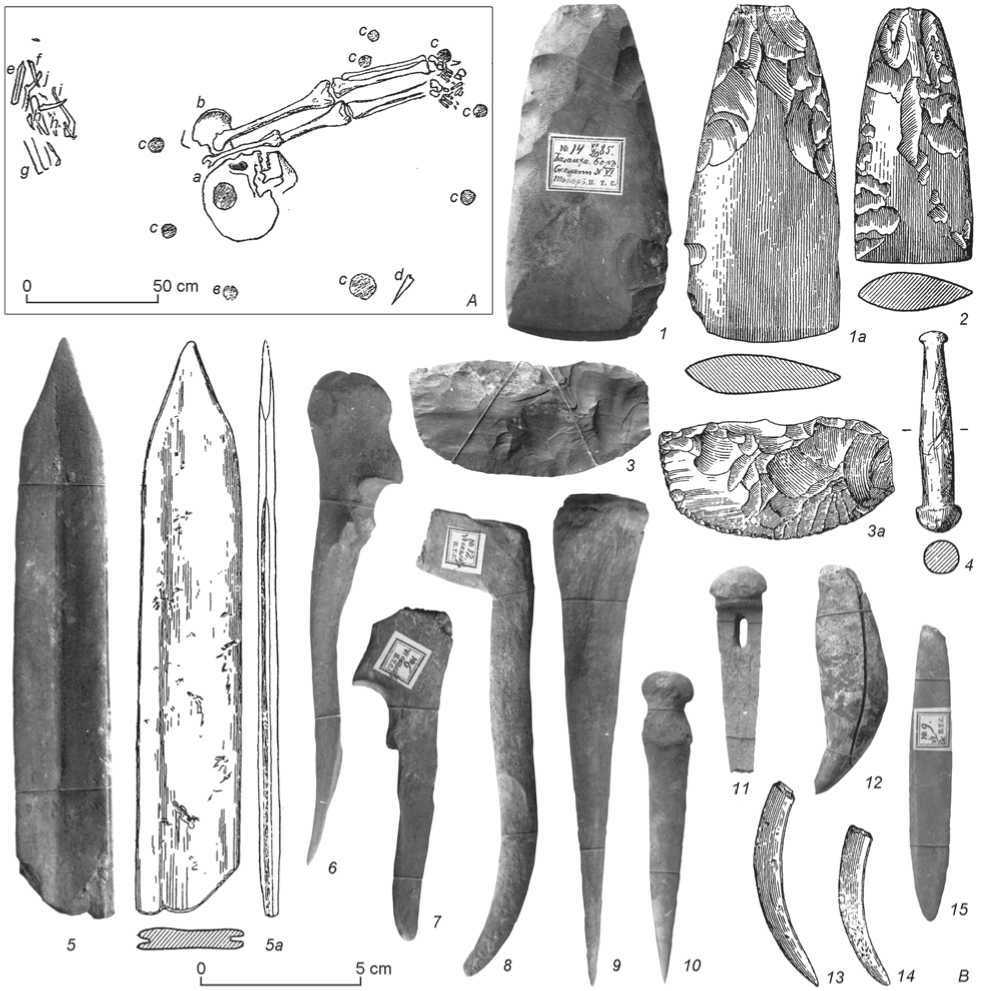
Fig. 1 . Ground plan of burial VI at Bazaikha (A ) and accompanying goods therefrom ( B ).
a – humerus and skull with a hole in the temporal area; b – pelvis, femurs, and shin bones; c – reddish-brown spots; d , e – bone spear-or dart-heads; f – bone dagger (?); g – polishing tools; h – animal figurines; i – various bone tools; k – piece of roe-deer antler. 1–4 , 15 – stone; 5–14 – bone.
A – after (Savenkov, 1893); B , 1 , 3 , 5 , 6–12 , 15 – after FO NA IIMK RAN, Q 393–2; B , 1a , 2 , 3a , 4 , 5a , 13 , 14 – after (Okladnikov, 1957).
journals with appendices containing cross-sections of the site, drawings of the burials, and sketches (1929: 177), but this was not done either.
Without dwelling on specific features of all the burials, we will give a brief description of burial VI by Ivan Savenkov. The surviving remains of the skeleton included the skull, with a hole in the temporal area, the pelvis next to it, and almost all the leg bones. At a distance of 70–80 cm from the skull, there were three quadrangular polishing tools made of yellow-brown sandstone, a polished axe or a chisel made of stone (gray chert), an end-scraper, an insert bone dagger, various bone tools possibly intended for making stone products, and figurines carved of elk antler: a fragment of a small idol with a bird’s beak, an ungulate with an open mouth, a female elk
(with a small hole for a strap), an elk calf, and a horse’s head* (Savenkov, 1893: 325–326). Regarding this unique set, Savenkov wrote the following: “The figures of wild animals are remarkable not only for their relative correctness of representation as a whole, but also for the precision of executing various details of the constitution of young and adult animals... These remains of primitive art undoubtedly belonged to hunters” (Ibid.: 328).
A.P. Okladnikov, who reviewed the collections of artifacts from all the burials excavated by Ivan Savenkov, as well as the evidence found in the deflated areas on the banks of the Bazaikha River (some of which could have originated from destroyed burials), identified several more items of portable art (Fig. 2, 6–9 ) (1957: Fig. 12, 13).
Problem of dating the Bazaikha burials
After analyzing the collection of artifacts he had gathered, Ivan Savenkov came to the following conclusion in the manuscript “Materials on Stone Age sites in the Vicinity of Krasnoyarsk”: “The Bazaikha site can be attributed to the first half of the Neolithic Stone Age, if we note the absence of
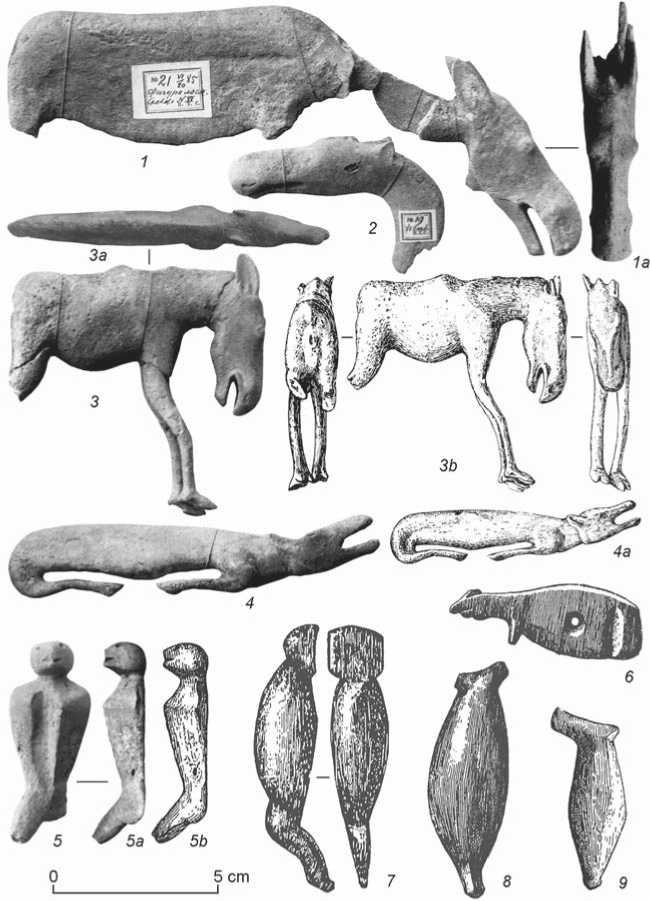
Fig. 2 . Portable art (finds by Ivan Savenkov) from burial VI at Bazaikha ( 1–5 ) and other burials, or from surface finds ( 6–9 ).
1–5 – antler (bone?); 6–9 – stone (agalmatolite).
1 , 2 , 3 , 4 , 5 – after FO NA IIMK RAN, Q 393–1; 1a , 3a , 5a – after RO NA IIMK RAN. F. 1, D. 156, fol. 59; 3b , 4a – after (Okladnikov, 1950); 5b , 6–9 – after (Okladnikov, 1957).
drilled tools and extremely small share of polished tools. On the other hand, the abundance of arrowheads, relatively artistic patterns on the shards of ancient clay pots... an amulet—an animal’s head—incline us to attribute the site not only to the Neolithic, but even to its end” (Archive of the Minusinsk Museum of Local History. Inv. 3, D. 124, fol. 5; cited after (Vdovin, Makarov, Maizik, 2024: 137)). He was particularly dubious about the copper celt found in one burial. The skeleton’s position was no different from those in other burials. Between the knee joints, there was a celt axe; on the thoracic vertebrae, a triangular flint arrowhead; under the leg bones, two end-scrapers and a “figurate fragment”; and on the humerus, an elongated cylindrical pebble (Savenkov, 1893: 324). Savenkov took into account the fact that evidence from different periods might have become mixed in the conditions of dune sites and sand blowing, and yet in his report at the Congress he designated the age of all the burials as the Final Neolithic– Initial Bronze (Copper) Age (Ibid.: 327). However, in the field journal, it was recorded that the burial with the celt axe was located above those with Neolithic goods (see (Vdovin, Makarov, Maizik, 2024: 137)).
The Neolithic dating of finds from Bazaikha (from burials and surface collections on sand dunes) was later substantiated by A.P. Okladnikov, who analyzed the Neolithic of the Middle Yenisei region in the context of parallels with the evidence from better-studied sites in the Baikal region, the Urals, and the northwest of the USSR (1957). He identified many parallels between the finds from the Yenisei and Baikal regions (categories and types of artifacts, stone type, pottery, portable art, etc.) and came to conclusion “that in the Serovo period (late 4th–3rd millennium BC), the Yenisei tribes were not only in close proximity, but also in close cultural ties with the population of the Baikal region” (Ibid.: 50)*. Many parallels were also found in the evidence of the Kitoy period, which Okladnikov considered to be Late Neolithic, thereby extending the dating of the Yenisei Neolithic to the 3rd–2nd millennium BC (Ibid.: 37). As far as the Bazaikha figurines are concerned, Okladnikov undoubtedly attributed them to the Neolithic and dated them to the 4th–3rd millennium BC (1971: 88–89). He strongly denied the doubts of some scholars regarding the copper (bronze?) celt axe being in a vague connection with the Bazaikha** burials (Okladnikov, 1957: 35). However, this did not put an end to the problem. The doubts remained, from a cautious “the belonging of the above-mentioned sculptures to the Neolithic is not indisputable” (Leontiev, 1978: 102) to a categorical “the facts confirm the correctness of attributing the elk figurines from the Bazaikha burials on the Yenisei to the Initial Bronze Age”
(Studzitskaya, 1987: 347). The arguments included not only the notorious celt axe, but also other considerations, such as the “bird-headedness” of the anthropomorphic figurine, as well as technological and iconographic features of elk images compared with portable art of the Bronze Age. Yet in the summary table in the same work, the Bazaikha figurines were attributed to the transitional period from the Neolithic to the Bronze Age (Ibid.: Fig. 137).
Currently, the concept of the development of the Baikal Neolithic has been dramatically revised thanks to radiocarbon dating and the determination of absolute dates. For example, the Kitoy complexes have been singled out as a separate culture and attributed not to the Late, but to the Early Neolithic, with dates of ca 7500–7000 cal BP (see (Berdnikov, 2018)). Without challenging the Baikal parallels noticed by Okladnikov, the dating of the finds from Bazaikha can be shifted to an earlier period. Moreover, over the past years, new sites have been studied in the adjacent territories; new artifacts (including portable art) related to the Neolithic have been discovered, and the dates have been established using the scientific methods (Polyakov, Smirnov, Fribus, 2022: 11–13). From the most recent finds, we can mention a highly artistic artifact from a sanctuary on the Tartas River (Novosibirsk Region)—a pommel carved of elk antler and shaped as an elk’s head, which was dated to the 7th millennium BC (Ranneneoliticheskoye svyatilishche..., 2023: Fig. 68: 67). We believe that this item is quite close to the heads of elk figurines from Bazaikha. At present, this similarity can only be seen on the available photographs, and 3D modeling would allow for the more accurate comparison of their stylistic and technological features.
However, most importantly, the problem of dating the objects of portable art from Bazaikha can now be solved by the radiocarbon method.
Bazaikha figurines and the issue of the “Angara style” in rock art
The same year that the Bazaikha burials were excavated, Ivan Savenkov made a large “excursion” along the banks of the Middle Yenisei River, searching for Stone Age sites and examining locations of rock art (1886). He found many sites with petroglyphs, sketched many compositions, and made descriptions. Later, this evidence formed the basis of his book, “On Ancient Monuments of Fine Art on the Yenisei River” (1910). Naturally, Savenkov immediately noticed the diversity in the style, technique, and subject matter of the petroglyphs, and therefore became interested in their chronological attribution. Allowing for the possibility of the great antiquity of the petroglyphs, Savenkov insightfully observed the similarity of some images on rocks with Bazaikha figurines: “Based on the general outline of some wild animals, outline of the head, open mouth, and many specific features of drawing, we allow ourselves to express a certainly hypothetical suggestion that the bone figurines of animals that we obtained this year during excavations of the Bazaikha site... may be contemporaneous with the most ancient Tuba, and some Kopeny and Trifonovo petroglyphs” (Savenkov, 1886: 54–55). That book included drawings of the Bazaikha figurines for comparison with the corresponding petroglyphs (Savenkov, 1910: Pl. I, III, IV, VI) (Fig. 3, a–f). The conventionality of the sketchy drawings does not make it possible to observe distinctive stylistic features of either the figurines or petroglyphs, but keep in mind that Savenkov had an opportunity to compare the originals. This was probably the first experience for Siberia in dating rock art using stylistic parallels with objects of portable art from the excavated sites. In any case, Savenkov was absolutely right in noting the similarity. It is enough to compare the copies (rubbings) with his sketches of the same compositions (cf. Fig. 3, b and h, c and g) and with photographs of the figurines. The “earliest Tuba” petroglyphs are those from the earliest layer of the Shalabolino rock art site, and precisely at this site in the Middle Yenisei region (see (Pyatkin, Martynov, 1985)) we find the greatest number of elk figures, stylistically comparable with those from Bazaikha; there are even anthropomorphic images resembling the Bazaikha ones (Fig. 3, h).
In many of his works, Okladnikov described zoological, processing, and artistic features of figurines from Bazaikha in detail (see, e.g., (Okladnikov, 1950: 280–282)). He regarded the evidence from that site to be important, not only for understanding the Yenisei Neolithic as a whole, but also as a basic factor in the chronological attribution of some groups of rock representations in various areas of Siberia: “Along with sculptural elk figures from Bazaikha described above, dated by their connection with the Neolithic artifacts of specific kind, flat images of these animals on the rocks known near the village of Shishkino and Vorobyovo, on the Upper Lena, as well as in a number of places on the Middle Lena, and on the Angara below and above Bratsk—in the area of Dolgy Porog and Kamenny Island—should be regarded as no less remarkable in their style and age. <...> These images clearly and distinctly stand out from all other Siberian petroglyphs by their special style and age” (Ibid.: 281) (Fig. 4). Okladnikov observed particularly close parallels on the rocks of Kamenny Islands of the Angara River: “Images on the rocks and sculptures from Bazaikha are sometimes almost identical; it seems sometimes that petroglyphs on the stone were pecked by the same hand that carved the sculptural figures from antler” (1971: 89).
The correlation of Bazaikha figurines with a specific group of elk images on the Angara rocks (and, accordingly, the attribution of the latter to the Neolithic) did not raise objections from most scholars. However, then followed the correlation of rock images of these animals in many other regions of Siberia, not with the Bazaikha figurines, but with elk figures in the Angara petroglyphs in general (as if already reliably dated), although not all of them were comparable with the Neolithic portable art of Bazaikha (and not only of that site). Thus, in the process of analyzing the Yenisei rock art, which contains a lot of images of elk and other animals showing remarkable resemblance to the Angara rock representations, the “Angara figurative tradition” (“Angara style”) was identified (Podolsky, 1973; Sher, 1980: 186–190). After that, this term spread to other areas of Siberia, and gradually almost any elk figures, at least in style little resembling the prototypes, began to be attributed to the Angara figurative tradition. This gave rise to discussions about dating the entire array of data, which had become heterogeneous and blurred, and which was united by the concept of the “Angara style”, and individual groups of images within it.
Perhaps the greatest number of problems in this matter was created by incorrect, but by then already traditional, comparison of the elk figures from Bazaikha with the images of these animals on the rocks of the Tom River. In order to prove the Neolithic dating, the elk figure with the lost hind legs at the Tutalskaya rock art site was correlated with an elk calf figurine from Bazaikha, whose hind legs were also lost and whose ears, similar to those appearing on the petroglyph, were added in the accompanying drawing. The elk head at the same site was correlated with the head of the Bazaikha figurine, separated from the body for greater similarity (Okladnikov, Martynov, 1972: Fig. on pp. 181, 183). In fact, numerous elk images on the Tom River rocks are distinguished by their original and recognizable style, and are similar to neither the Bazaikha figurines nor elk images on the Angara River rocks, which were correlated with
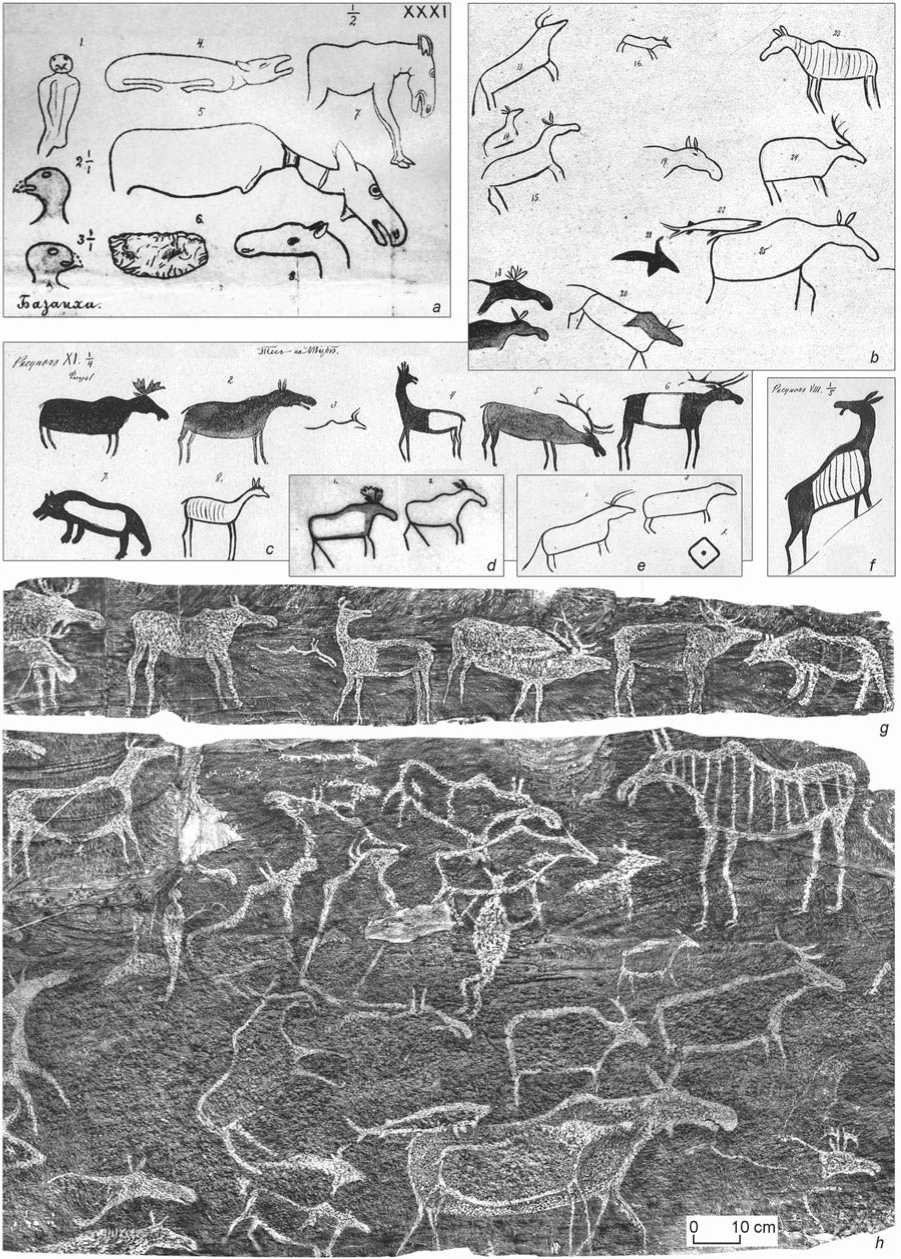
Fig. 3 . Finds from Bazaikha and rock art of the Yenisei region.
a – Bazaikha; b , c , f–h – Shalabolino rock art site; d , e – Trifonovo rock art site. a–f – drawings by Ivan Savenkov (after (Savenkov, 1910)); g , h – copies (rubbings) (Museum “Archaeology, Ethnography and Ecology of Siberia” at the Kemerovo State University, coll. 38, No. 4, 103).
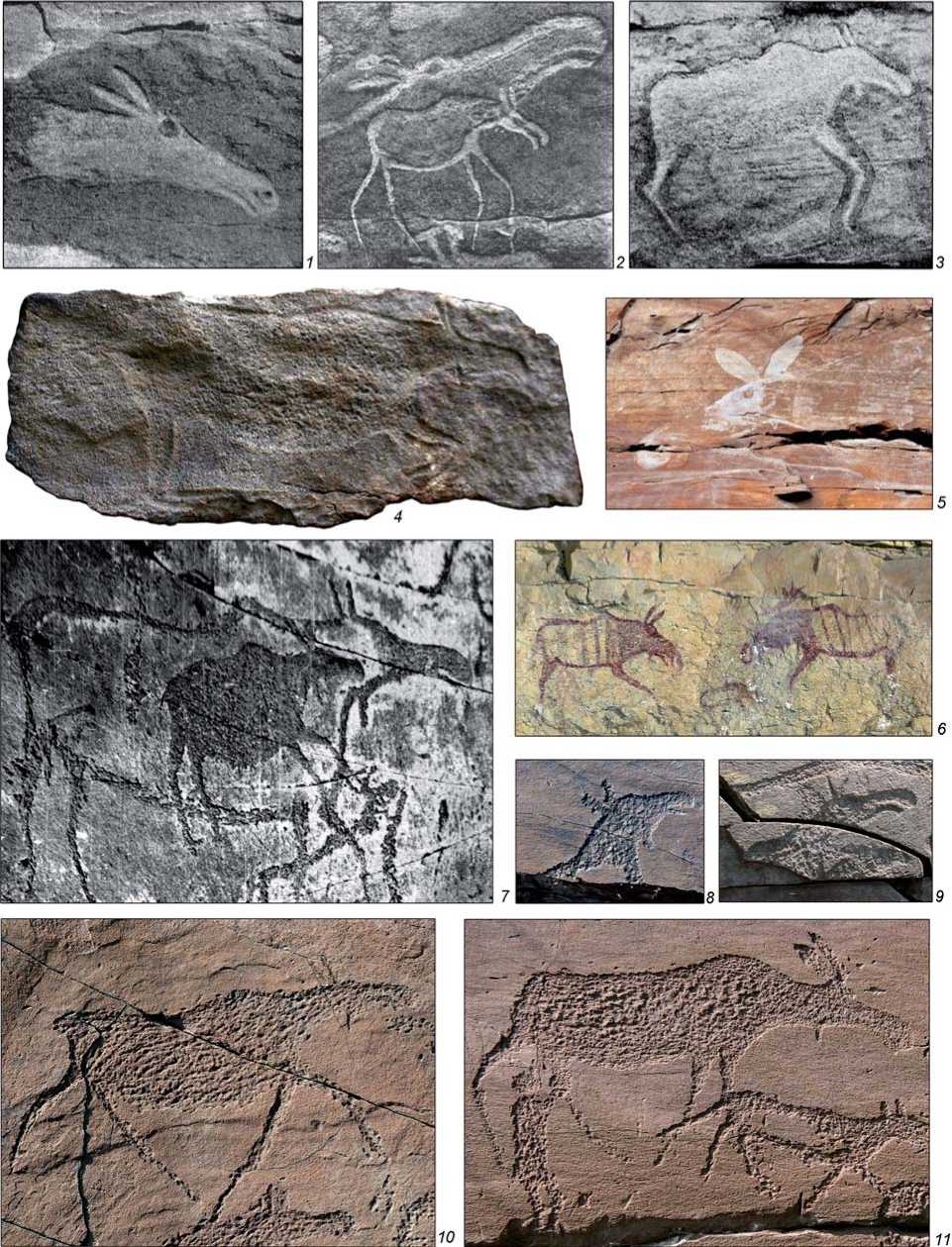
Fig. 4 . Siberian rock art comparable in style to finds from Bazaikha.
1–4 – Kamenny Islands, the Angara River; 5 – Shishkino rock art site, Upper Lena region; 6 – Toyon-Ary, Lower Lena region; 7 , 8 – Oglakhty, Middle Yenisei region; 9 , 10 – Ust-Tuba, Tuba; 11 – Shalabolino rock art site, Tuba.
1–3 – after: (Okladnikov, 1966); 4 , 5 , 8–11 – photo by E.A. Miklashevich; 6 – photo by N.S. Kiryanov; 7 – after: (Sher, 1980).
them by Okladnikov. Almost all scholars who wrote about the “Angara style” noted the originality of the Tom images. I.V. Kovtun even identified the “Tom” and “Tutalskaya” groups within the Angara figurative tradition and attributed them, along with others, to the Bronze Age (2001: 48–55). Their similarity with rare images of elk in the art of the Okunev culture (Bronze Age) of the Minusinsk Basin, which were also sometimes attributed to the “Angara style”, was also mentioned. However, the Okunev images are also different! Perhaps they, like the Tom ones, demonstrate similarity with some Angara figures of elk with legs spread out in rapid run, but they are definitely not like the Bazaikha figurines, except that both represent elk, and all, naturally, show species features—distinctive muzzle, hump on the back, etc.
The accumulated contradictions have triggered the need to revise the approach to rock art of the Angara tradition. I.A. Ponomareva, who quite rightly pointed out that this concept “remains not entirely clear, carried out a special study on this topic. Images are attributed to the Angara tradition more intuitively than on the basis of specific stylistic features”, and precisely this uncertainty prompts “discussions about chronology, development, and directions of the spread of this tradition” (Ponomareva, 2016: 70, 71). Her study was a successful attempt to “figure out” what the Angara style is (reviewing the points of view, clarifying the area of distribution, establishing internal dynamics of development of the style based on the analysis of palimpsests, etc.). The researcher came to conclusion that “this is an epochal phenomenon with Eastern Siberian roots, and the peak of its development fell to the Late Neolithic” (Ibid.: 77). In addition, the Tom style was finally separated from the Angara style as an independent tradition among the Bronze Age cultures (Ibid.: 77–78). It seems that this is the direction in which research should be continued to revise the concept of the “Angara style” in rock art based on modern concepts and data.
Going back to the collection from Bazaikha, we should say that the comparison of rock representations with portable art in terms of style is not only possible, but is one of the most important methods for indirect dating of rock art. Okladnikov’s correlation of some elk images on the Angara rocks (not all those that were attributed to the “Angara style” by his followers) with the Bazaikha figurines is a brilliant example of application of this method. We would also like to mention the meticulous study of Studzitskaya with comparative analysis of objects of portable art in the Baikal region (and other areas) and rock representations in the Angara style (1987, 2007). As far as the parallels to the Bazaikha figurines in the rock art of the Yenisei region are concerned, it seems necessary to narrow their circle significantly. Not all elk images in the Yenisei rock art can be correlated with these examples of portable art. In our opinion, the greatest similarity in style appears in the figures from Shalabolino, Oglakhty, Ust-Tuba, and other sites, similar to those shown in Fig. 3, g, h and 4, 7–11. The elk are depicted in calm poses, not running, not with lean bodies; the position of their necks and heads is similar to that of the Bazaikha figurines; the ears are often pressed back, and the eye, located high on the forehead line close to the ears, is always emphasized. The eyes of the Bazaikha figurines are shown in exactly the same way, but in volume. Actually, some petroglyphs contain a hint of relief in rendering the eye, nostril, and mouth line (see, e.g., Fig. 4, 1). One of the figures at the Shalabolino rock art site seems to be the most similar to the Bazaikha figurine (see Fig. 4, 11).
Conclusions
This article presents the main problems associated with the unique collection of artifacts from Bazaikha, which is of great importance both in terms of studying the Neolithic of the Middle Yenisei region and of attributing some groups of the earliest rock art in this region to the Neolithic. As we see it, the prospects for solving these problems may be associated with research in two areas.
The first area is a comprehensive study of the archaeological collection from Bazaikha, not only from the burials excavated by Ivan Savenkov, but also from rich surface finds. Presently, it is not a problem to apply well-developed methods of documentation and analysis (radiocarbon dating, petrography, traceological analysis, anthropology, etc.). Three-dimensional modeling will serve as a basis for cataloging, and simultaneously will provide great opportunities for stylistic and process analysis of the portable art and for the usual studies of all artifacts. Archival research aimed at searching for documents, deciphering the field journals and manuscripts of Ivan Savenkov, and clarifying information about the context of the finds, is also required.
The second area is a deeper study of the “Angara style” in Siberian rock art, and specifying the content of that term. The imagery usually attributed to the “Angara style” currently constitute an overly heterogeneous and “blurred” array. Moreover, it has long been obvious that the images included in that definition (various representations by various scholars) belong to various cultural and chronological groups (from the Neolithic to Bronze Age, not to mention various cultures from various areas). It is necessary to substantiate the division of this array into groups in accordance with style, iconography, and other criteria; revise outdated attributions of rock art imagery taking into account new chronological models that have recently appeared, sources for comparative analysis from excavated (that is, dated) sites, and new methods for dating objects of rock art. As far as the Middle Yenisei region is concerned, in addition to the above, it is especially important to update the corpus of sources for the earliest rock art as a whole, which involves field research, redocumentation of the known sites using modern methods, reconstruction of what has been lost based on archival data, etc. (Miklashevich, 2015). Only then will it be possible to define more clearly the features of the “Angara style” in Yenisei art, and to single out the exact group that is definitely similar in style to the figurines from Bazaikha, and, accordingly, to date it in the same way as these figurines.
Acknowledgments
