
Ivory Bead Ornaments from the Sungir Paleolithic Site
Журнал: Archaeology, Ethnology & Anthropology of Eurasia @journal-aeae-en
Рубрика: Paleoenvironment, the stone age
Статья в выпуске: 3 т.53, 2025 года.
Бесплатный доступ
This article presents the results of a study of composite ornaments made of ivory beads from burials of a man and two adolescents, discovered by O.N. Bader at Sungir, a site dating to the Final Early Upper Paleolithic (30–26 ka BP). The burials are excessively rich in such ornaments, which were made by stringing many beads on a sinew or thread made of organic material. Strings of beads preserved in burials and retaining the order of constituent elements were used as a source for identifying typologically meaningful forms of beads. Owing to the alternation of elements of various shapes or similar in form but made from different blanks, a specific rhythmic structure was generated. The composition of strings suggests that eight types of ivory bead were employed. Two main techniques of stringing were used: by isolating the central group of beads, and by arranging them in the order of size gradually decreasing from one end to the other. The search for cultural parallels has revealed that the principle of combining different types of beads to create strings was similar to that used at contemporaneous sites in southern Germany dating to the Final Aurignacian.
Короткий адрес: https://sciup.org/145147542
IDS: 145147542 | DOI: 10.17746/1563-0110.2025.53.3.036-044
Текст научной статьи Ivory Bead Ornaments from the Sungir Paleolithic Site
Mammoth ivory beads are small items of complicated standardized shape; these are among the most widespread types of personal ornaments frequently discovered during excavations of Upper Paleolithic sites in Northern Eurasia. Some Central and Eastern European sites yielded tens, hundreds, and even thousands of beads (Scheer, 1985; White, 1993; Eiszeitschmuck..., 2003; Khlopachev, 2006). Beads are usually found in cultural layers as individual finds or concentrations of scattered items. The features of bead occurrences in Paleolithic burials indicate that they were used as elements of composite ornaments, similarly to mollusk shells and animal teeth. At present, complete beaded ornaments made of large numbers of ivory beads, which retained their original position on various parts of human body, have been reported only from the Sungir Paleolithic site, which makes it a unique archaeological source.
Sungir: cultural, chronological, and archaeological context
The site of Sungir has been dated to the terminal stage of the Early Upper Paleolithic of Eastern and Central Europe. Currently, its absolute radiocarbon age is determined to be in the range of 30–26 ka BP (uncal) (Gavrilov, Kuzmin, Chechushkova, 2024). In Eastern Europe, this period is represented at the sites of the Aurignacian, Early Gravettian, Gorodtsovian, and Streletskian archaeological cultures. Sungir is roughly contemporaneous with the sites of the Final Aurignacian in Western and Central Europe, the Final Szeletian in Central Europe, and the Early Gravettian in Central and Southern Europe.
There are two main hypotheses regarding the cultural attribution of the Sungir site. O.N. Bader proposed to attribute Sungir to the Streletskian archaeological culture; some researchers argued attribution to the Aurignacian. The present authors believe that the Sungir site can be considered an Eastern European parallel to the Final Szeletian of Central Europe. This cultural-chronological assessment is in good agreement with modern data on the widespread distribution in Europe since 29–28 ka BP (uncal) of human burials containing mineral pigment (ocher), personal ornaments, and sometimes tools and weapons (for more details, see (Khlopachev, 2024; Gavrilov, Khlopachev, 2025)).
The burials in question were made in two grave-pits with two levels in each. The lower levels contained the main burials: grave 1—a man aged 45–55 years (S-1), grave 2—two adolescents laid in a line, head to head. The skeletal remains of one of them belonged to a boy aged 12–13 years (S-2), and the other skeleton to a girl (Poltoraus, Kulikov, Lebedeva, 2000) or a boy (Sikora et al., 2017) aged 7–10 years (S-3). The burial rite involved the use of red ocher powder, which was generously applied first to the grave floor and then to the bodies of the deceased in several layers. Part of the rite apparently included placing the remains of other people in the upper tier of the pits. Above the man’s burial, there was a skull, and above the adolescents’ burial, a poorly preserved skeleton without a skull (Bader, 1998: 32–37, 51–63). It was established that the main burials were associated with the middle level of the cultural layer, and the human remains located above them were associated with the lower part of the upper cultural stratum. Thus, the main burials can be dated to the range of 29–28 ka BP (uncal), and the upper ones about 26 ka BP (uncal) (Gavrilov, Kuzmin, Chechushkova, 2024).
The abundant accompanying bone offerings are a characteristic feature of the burials under consideration; these were noticeably more diverse in the paired burial, containing straighteners made of reindeer antlers, “bâtons de commandement”, fibula hairpins, ivory disks with radial incising, animal figurines, a human bone filled with ocher inside, and various weapons laid out in a certain order. A common feature of the funerary offerings of the man and the adolescents was a huge number of personal ornaments. Many of these retained their original position on the bodies of the deceased. The ornaments included flat stone pendants with holes at the ends, arctic fox fangs, rings, plate bracelets, and beads carved from mammoth tusk. Beads were the most common and largest category of finds (Bader, 1998: 85).
Mammoth ivory beads as archaeological source
The abundance of ivory beads at Sungir is unique and has no parallels in the Paleolithic of Europe. The beads were found in large quantities not only in the cultural layer, but also in the three closed archaeological complexes. Thousands of such finds were discovered in the burials, with many hundreds of beads retaining their original positions in the burial space. The drawings and photographs of cleared burials show rows of ivory beads located very close to one another. In scientific literature, these are designated by the term nizka (‘string’)—an ornament made by stringing beads on a cord. This method of making beaded ornaments is confirmed both by the position of the strung objects in relation to each other (Khlopachev, Bazilevich, 2024), and by the data of traceological analysis of a series of flat beads used to make strings with beads of other shapes. The localization of non-utilitarian wear exclusively on the narrow-end surfaces corresponds to the distribution of traces that appear precisely on beads tightly strung on a thread*.
The strings of ivory beads were located on the chest, back, head, legs, and arms of the buried. Unlike the beads that were located in dense, often severallayered clusters, being scattered composite ornaments, the remains of bead strings provide us with the information not only about their location on the body of the deceased, but also about their design features. In the publication of Sungir burials, Bader gives a lot of facts regarding the order of stringing the beads. For example, to make strings for decorating the outerwear of the man and children (Bader, 1998: 87–88, 92, 95) and the headdress of the young adolescent (Ibid.: 92), the artisans should have taken into account the shapes and sizes of individual beads. However, Bader identified not only the order of bead stringing; he paid great attention to the bead groups located in situ relative to the skeletal remains. These beads and their positions in the grave served as the main basis for the reconstruction of clothing of the ancient Sungir people (Ibid.: 103).
In 1978, Bader proposed the classification of ivory beads into three types (for more details, see (Khlopachev, Bazilevich, 2024)); it was based on the bead typology that he had elaborated earlier using materials from cultural layers but not from burials (1966). The typology was developed by the intuitive assessment of the geometrical shape of the ornaments, and the supposed methods of their attachment. The 1978 classification was made using the entire collection of beads from the site of Sungir, numbering about 10 thousand units. However, like the previous one, it did not consider the archaeological context of the ornaments in the burials for determining their morphological features. At the time of introducing the classification to the scientific community, Bader argued that none of the identified types of beads had any reliable direct cultural-chronological parallels in the Upper Paleolithic materials of Europe; the type of bead with cutouts he considered as the local cultural feature of Sungir (1978: 169–170).
We proposed the approach to identification of typologically significant forms of ivory beads based on the analysis of a large sample of the well-preserved bead strings from the burials of men and adolescents. It has shown that, on the one hand, the 1978 classification requires some adjustment; while on the other hand, the features of string manufacture provide completely new opportunities for studying the socio-communicative role of personal ornaments in the Old Stone Age.
Specifics of bead stringing
The studied sample consisted of 11,850 ivory beads (both complete and fragments) from the Sungir burials (S-1 – 2888 pcs., S-2 – 3753 pcs., S-3 – 5209 pcs.) and 308 ivory beads and blanks from the cultural layer*. Funerary offerings of the main burials did not contain bead blanks. Therefore, the study of unfinished products and small rods with traces of blank detachment, which were recovered from the cultural layer, was important for a better understanding of the specifics of bead shaping and for the reconstruction of the operation sequence. Ready-to-use beads from the cultural layer were used for comparison with the identified types of beads from the burials. In the studies of the materials from the burials, the main attention was paid to the analysis of shapes of beads in strings, which retained the original order along the entire length. Such beaded ornaments were recorded with all three buried individuals and consisted of transverse and longitudinal rows on the torsos, arms, legs, and heads of the deceased. On the basis of the positions of strings relative to the skeletal remains, the ornaments can be subdivided into four groups: 1) transverse strings located on the floor of the grave under the bones in the torso area and compositionally unrelated to the transverse rows of beads located on the chest of the buried individual; 2) strings tightly encircling the humerus, ulna, tibia, and skull; 3) transverse rows in the chest area, longitudinal rows on the bones of arms and legs (or along them), often lying on top of the strings of group 2; 4) transverse rows of beads located on the body above the strings of group 3.
The most complete, holistic idea of the specifics of making beaded ornaments was gained in the course of studying the strings of beads of groups 2–4 from the burial of a man, groups 1, 2, 4 and some strings of group 3 from the burial of adolescents. The strings of group 1 from the burial of a man, as well as those covering his skull, are not present in the SVSMR collection**. Assessment of the sequences of beads in the strings of group 3 from the burial of adolescents was somewhat difficult. In the process of casting the block of the burial sediments with cleared skeletons, some of the beads and fragments of the strings were removed together with the cast. During the subsequent documentation of the positions of beads in this burial, these were recorded separately. Notably, the arrangement of beads in the strings from the man’s burial was described in more detail. For example, in contrast to the adolescents’ burial, the multi-row bead strings covering the arms and legs were recorded by rows and separately for the finds on and under the bones.
Analysis of morphometric features of beads in the well-preserved composite ornaments showed that these were strung in a certain rhythmic pattern. In some cases, the sequence was an alternation of groups of beads of different types; in others, the sequence was of beads of the same type, but made from different blanks. Three main types of rhythmic alternation of beads (groups of beads) of different shapes were identified. All of the three alternations together were noted in the strings forming a triple transverse band located on the man’s chest. The upper string was composed of 86 beads, constituting a row of groups of massive beads, sub-rectangular in plan view (Fig. 1), with wide cutouts in the middle of opposite surfaces and biconical holes in the centers, separated by single large flattened beads of a rounded shape with a hole in the center, without cutouts (Fig. 2, 3, 5). The middle row consisted of 74 beads. This string, on the contrary, showed large groups of big rounded beads separated by single massive beads of sub-rectangular shape with cutouts. The lower string, which included 101 beads, was made up of the same beads, but showed a more complex rhythmic composition based on the alternation of both single beads of various types and groups of 3, 6, 10, and 20 one-type beads.
The strings were also made up entirely of the beads of the same shape. These could be flattened rounded beads without cutouts, as, e.g., in the first and second strings, which encircled the shin bones (in the upper part) of the man’s right leg. However,
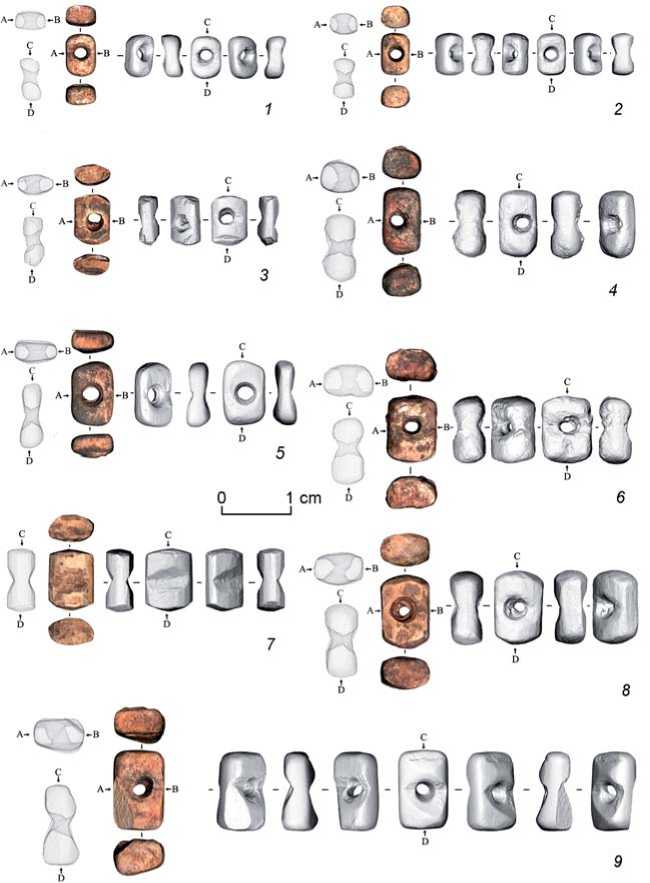
Fig. 1 . Robust ivory beads, sub-rectangular in plan view, with symmetrical cutouts in the opposite surfaces and biconical holes in the center. From the SVSMR collection.
1–3 , 6 – short; 4 , 5 , 8 – shortened; 7 – non-finished short; 9 – long. 1 – B-33898/4752; 2 – B-33898/4750; 3 – B-33897/78; 4 – B-33898/4787; 5 – B-33898/4788; 6 – B-33897/87; 7 – B-15304/12336; 8 – B-33898/4780; 9 – B-33898/4737.
more abundant are strings of beads with cutouts on the surfaces. Two of such strings formed the upper double band on the back of the older adolescent. These consisted of 28 (upper string) and 69 (lower string) beads measuring 0.6 × 0.5 × 0.3 cm. The composition showed rhythmically alternating groups of similar items made from different blanks—with a rounded (see Fig. 1, 2 , 4 ) or flattened-oval (see Fig. 1, 1 , 3 , 9 ) cross-section. The same pattern is revealed in the string of 27 beads encircling the ulna and radius (in the lower part) of the man’s left arm.
1 cm
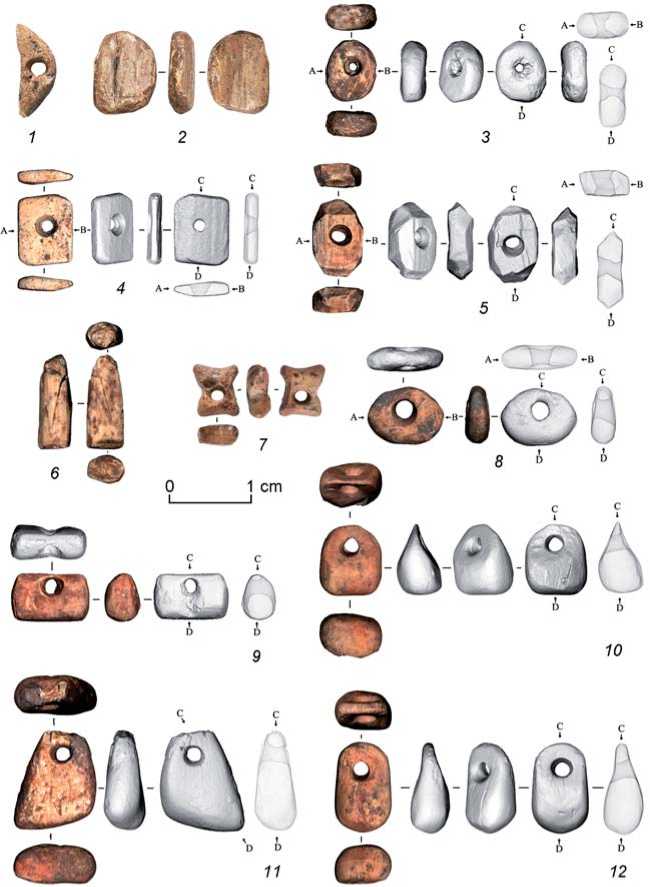
Fig. 2 . Elements of the mammoth tusk beaded ornaments . From the SVSMR collection .
1 – crescent-shaped bead; 2 – non-finished flat rounded bead; 3 , 5 – flattened rounded beads with holes in the centers; 4 – flat, thin, square-shaped bead with a hole in the center; 6 – small rod bearing traces of bead detachment at its end; 7 – bead in the form of lilac flower; 8 , 9 – pendant beads stylized as basket-shaped items; 10 , 12 – basket-shaped pendant beads; 11 – pendant bead imitating a rudimentary deer tooth. 1 – B-33898/2462; 2 – B-15304/12255; 3 – B-33897/83; 4 – B-33898/4745; 5 – B-33897/79; 6 – B-15304/12335; 7 – B-33898/8417; 8 – B-33898/4778;
9 – B-33897/100; 10 – B-33898/4725; 11 – В-33897/408; 12 – B-33898/4726.
If a string was constructed mainly of beads with cutouts, the ornament made of beads strung together could acquire a characteristic crisscrossing relief (Fig. 3, 2 , b ). Owing to the peculiar shape of the cutouts, the beads spontaneously turn and stand perpendicular to each other, cutout to cutout. This suggests that the cutout was a more significant feature for the classification of beads than was previously thought.
Furthermore, quite frequent were the constructions of strings based on dimensions of beads. These could be assembled from elements of the same type or those of various forms creating rhythmic compositions. The beads in the strings were arranged in such a way that their size gradually decreased from one end to the other. The largest beads had a size of 1.0 × 0.7 × 0.4 cm, and the smallest ones 0.5 × 0.4 × × 0.3 cm. Such compositions were most often noted in the strings that embraced the bones of arms and legs. This is for example the string of 116 elements on the lower part of the right leg’s tibia of a young adolescent. The rhythmic alternation of beads of various shapes here followed the same pattern as that in the upper string from a triple band located on the man’s chest.
In the burials, there are also strings made of beads of various sizes used for the creation of centric compositions, when a small group of small beads of the same shape was placed in the medial part of a composite ornament, and sequences of larger beads were arranged on either side of it. Such are the strings from the burial of an older adolescent. One of them lay on the right femur and consisted of 47 ivory beads and three arctic fox fangs. The middle part of the composition was formed by a group of alternating rather small beads with cutouts and rounded flat varieties; three very thin square beads with holes made by one- sided drilling were placed in the middle (see Fig. 2, 4). Arctic fox fangs were placed at the ends of the medial composition; groups of 13 large beads with cutouts followed on either side, ended with an arctic fox fang. The second string was located in the torso area and included 68 elements: nine small beads with cutouts and one flat rounded bead in the center, with 29 large beads on each side of this group. On one side, there
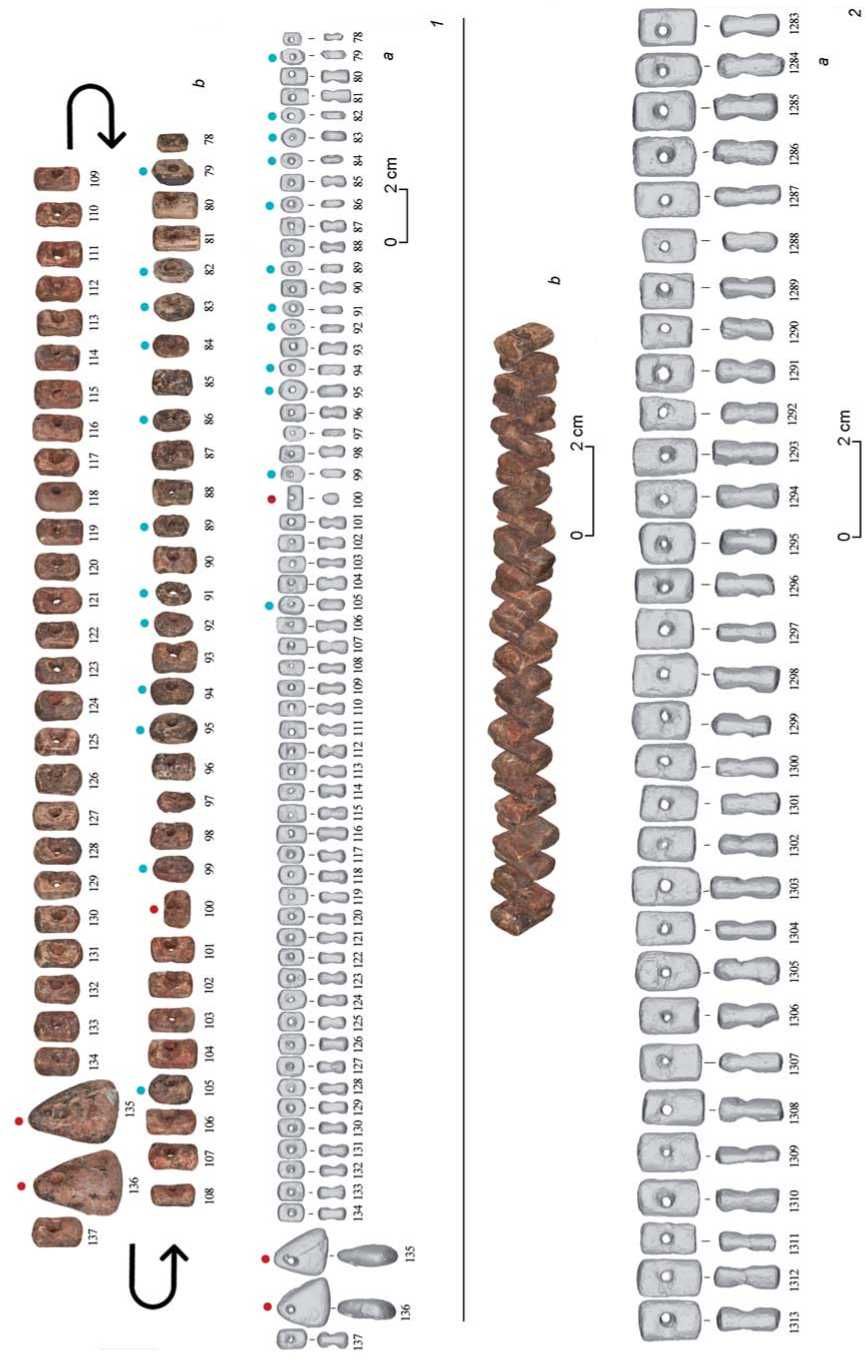
Fig. 3 . Ivory bead strings from the man’s burial.
1 – sequence of beads in the string lying along the right tibia and femoral bone: a – front and side view of the beads; b – position of beads in ¾ (blue dots mark rounded beads, red dots mark pendant beads imitating rudimentary deer teeth and those stylized as basket-shaped items). SVSMR collection: В-33897/78–137 ; 2 – sequence of beads in the string of the lower transversal row (upper layer): a – front and side view of the beads; b – reconstruction of the crisscrossing position of beads. SVSMR collection: B-33897/1283–1313 .
were only beads with cutouts, on the other, 27 beads with cutouts and two basket-shaped pendant beads, located in six and twelve beads from the central composition.
Pendant beads made of mammoth tusk and imitating a rudimentary tooth (tusk) of a deer (see Fig. 2, 11 ), or having a basket shape, were recorded in the strings of all the three buried individuals. These belonged to the ornaments located both on the torso and on the arms and legs of the deceased. The position of such pendant beads in the composition of the strings was apparently not accidental. This is confirmed by the revealed practice of using the simplest structural elements stylized as basket-shaped items.
Analysis of the string construction patterns has revealed a special design of their endings. The terminal element can be a bead of a large size or an individual shape, or a small group of beads including a non-standard item. The use of beads of an individual shape to complete a composite ornament was recorded twice—in burials S-2 and S-3. The string from the lower layer on the knee joint of the older adolescent ended with a bead in the form of a lilac flower (see Fig. 2, 7 ), and the terminal element in the string on the right humerus of the younger one was crescent-shaped (see Fig. 2, 1 ).
The purpose and meaning of such ornaments have not been determined so far. Undoubtedly, this is a separate topic for future research. At present, some principles underlying the construction of individual composite ornaments are gradually becoming clear. For example, the strings located on the left and right arms/legs of the buried man were composed in a mirrored fashion by the types of beads used. Another construction pattern of many strings involved the inclusion of both heavily tumbled beads (see Fig. 2, 4 ) and those with unworn traces of manufacture on the surface (see Fig. 1, 3 ; 2, 5 ; 3, 1 ).
Types of constituent elements of strings
The findings on the rhythmic nature of the alternation of beads (groups of beads) in the strings allowed us to determine the most typical morphometric features of their constituent elements. At present, eight types of ivory beads have been identified.
-
1. Robust beads with wide flattened cutouts in the middle of the opposing surfaces, often at an angle to the edge, bearing a biconical inclined hole in the center (see Fig. 1). This created the characteristic constriction on the item, clearly visible in side view (see Fig. 1;
-
2. Flattened beads, often rather robust, rounded or sub-oval in shape, with a biconical hole in the middle and without cutouts (see Fig. 2, 3 , 5). Such beads were made from small, heavily flattened (0.3–0.5 cm thick) rods with prepared surfaces.
-
3. Basket-shaped pendant beads (see Fig. 2, 10 , 12 )—short or slightly elongated items, with a thick rounded lower part and a bilaterally flattened opposite end, where a biconical hole was made. These were made from the blanks detached from a small robust bar with a sub-oval cross-section.
-
4. Pendant beads stylized as basket-shaped items (see Fig. 2, 8 , 9 ). These were fashioned on the same blanks as the beads with cutouts and flattened rounded beads sub-triangular in cross-section. A biconical hole was cut in the thin part of the blank, at the very edge. The location of the hole, the features of the edge design, and traces of wear suggest the use of these items as pendant beads.
-
5. Pendant beads imitating a rudimentary deer tooth (see Fig. 2, 11 ; 3, 1 )—the largest components of a string. The smallest of these are comparable to the largest pendant beads with a basket shape.
-
6. Flat and thin beads of a sub-square shape (0.65 × × 0.60 cm), with slightly rounded edges and a central hole usually made by one-sided drilling (see Fig. 2, 4 ). The beads’ thickness does not exceed 0.10–0.15 cm,
which indicates that these were manufactured on the same blanks as composite plate bracelets. The collection includes 77 such beads, 11 of which were parts of the string on the older adolescent (S-2), and 66 items were recovered from a cluster in sq. E-144/145 of excavation III, where beads of other types were also found. The cluster was found at the level of reference horizon 3, which corresponds to the middle part of the buried soil containing the cultural layer of the site (Stulova, 2021: 46, 48).
-
7. Crescent-shaped bead (see Fig. 2, 1 ).
-
8. Bead in the form of a lilac flower (see Fig. 2, 7 ).
3, 1 , a , 2 , a ). The ends of beads of this type have a rounded dome-shaped form; simple straight ends are less common. By proportions*, the beads can be subdivided into elongated (see Fig. 1, 9 ), shortened (see Fig. 1, 4 , 5 , 8 ) and short (almost square) (see Fig. 1, 1–3 , 6 ); by cross-section, into flattened-oval (see Fig. 1, 1 , 3 , 9 ) and rounded (see Fig. 1, 2 , 4 ); by size, into large (longer than 1.0 cm), medium (0.6–0.9 cm), and small (not exceeding 0.5 cm). A similar metric division is also applicable for beads of other types, with the exception of those imitating a rudimentary deer tooth. The latter beads were made of small rods, which were subjected to secondary working to derive a rounded or oval cross-section (see Fig. 2, 6 ). Drilling a hole (see Fig. 1, 7 ; 2, 2 ) and finishing the surface (see Fig. 1, 3 ; 2, 5 ) of beads of this type and others were carried out after detaching the blank from the rod.
Among the types of ornaments described above, basket-shaped beads are chronologically significant. By morphometric features and manufacturing technique, these are generally parallel to similar pendants of the Developed (Late) Aurignacian in Europe. The items showing a simplified stylization of this shape also resemble teardrop-shaped beads of the Early Gravettian. Parallels to them are reported from the layers transitional from the Aurignacian to the Early Gravettian (28–27 ka BP) in cave sites in southern Germany (Conard, 2003), which roughly correlates to the available dates for the main burials at Sungir. A certain similarity between the Early Upper Paleolithic ornaments from Germany and the Sungir artifacts is also illustrated by the combination of ivory beads of various types. At the Aurignacian sites of southern Germany, basket-shaped pendants were found together with numerous beads of a peculiar shape with holes at the ends, which is regarded by German researchers as a regional specific (Ibid.), as well as with rounded flat beads with a hole in the center (Ibid.; Scheer, 1985). The Sungir materials demonstrate a similar combination: they contain basket-shaped pendants, beads with cutouts, which are a distinctive feature of the site (Bader, 1978: 206), and flat rounded beads occurring at the Aurignacian sites of Eastern Europe, in particular at Kostenki 1 (layer III). The similarity of the set of ornaments from the Aurignacian layers of the sites in southern Germany and the Sungir collection is also manifested in the use of predator teeth.
Conclusions
The analysis of the composite ornaments made of ivory beads, retaining their original order in the graves of a man and adolescents at Sungir, has shown that these ornaments were created by stringing many individual elements onto a single base, which could have been either a sinew or a thread made of some organic materials. Eight types of bead were used for these ornaments: robust beads with cutouts, flattened rounded ones, flat thin subsquare ones, pendant basket-shaped beads, beads with a stylized basket (drop) shape, those imitating a rudimentary deer tooth, and beads of individual shapes—in the form of a crescent or a lilac flower. The elements on the string were not arranged randomly, but followed a certain sequence forming a stable rhythmic structure that was determined by the shapes of both the beads themselves and the bead blanks. Two main techniques of stringing have been identified: by isolating the central group of beads, and by arranging them in order of size, gradually decreasing from one end to the other.
Certain parallels in the pattern of combining ivory beads of various types in similar ornaments were revealed in the chronologically close materials from Final Aurignacian sites in southern Germany.
The present findings make it possible to consider the strings of ivory beads as a unique archaeological source, which provides significant information on cultural and chronological issues of the Upper Paleolithic in Europe, and the sign system of communication of Old Stone Age people in general.
Acknowledgements
This study was supported by the Russian Science Foundation, Project No. 24-28-00436 “Multipart Mammoth Tusk Adornments Found in the Burials of the Sungir Upper Paleolithic Settlement: Forms, Bead Manufacturing Technology, Beads Stringing Patterns, Cultural and Chronological Analogies” project/24-28-00436/). The authors express their deep gratitude to the members of the RSSDA Laboratory (Moscow) Y.M. Svoisky, E.V. Romanenko, A.N. Uralskaya, and E.S. Komakova for creating 3D-models of Sungir beads and software for their study, as well as for their assistance in preparing illustrations.
