
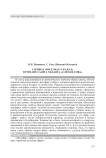
The Concept of “Mar-E Nag” in the Novel “The Blind Owl” by Sadegh Hedayat and Its Translation into English by Desmond Costello
Journal: Новый филологический вестник @slovorggu
Section: Зарубежные литературы
Article in issue: 1 (76), 2026.
Free access
The translation of symbols in literary works is a difficult task due to their deep rooting in the cultural and literary context. This article is devoted to the analysis of the transformations of the image of “mar-e nag” in Sadegh Hedayat’s novel, “The Blind Owl”, the key work of modern Persian literature, when translated into English by Desmond Costello. “Mar-e nag” is a neologism invented by Hedayat, which is designed to convey an important, deeply individual concept for the author. Costello translates all words containing the word “serpent” or “nag” as either “snake”, “serpent”, or “cobra”, with “cobra” being the most common. Like the symbolism of the nagas, the symbolism of the cobra is ambivalent. On the one hand, it is a symbol of eternal revival, protection, wealth, good luck, visionary wisdom, and fertility. On the other hand, due to the aggressiveness and deadliness of its poison, the cobra is identified with the demonic principle and is associated with danger, threat, and death. At the same time, the use of the image of a cobra in the translation cuts off an aspect of the image of the nagas, who are half-snakes and half-humans, that is important for the context of the novel. This is especially the quality indicating the dual nature, which is important for female characters. At the same time, the word “cobra” adds new connotations. “Cobra” in Persian culture is also the female name with associations with power and strength. The replacement of the Naga snake with a cobra has significantly smoothed out the mystical filling of the symbolic image of poisoned wine. The aspect related to spiritual improvement, the process of searching for the self is released, and put forward the Freudian interpretation of the snake as a phallic symbol, which is more understandable to Western cultures. The usage of the lexeme “serpent” evokes for the Western reader strong associations with the Holy Scriptures and the story of the fall of Adam and Eve. Thus, given the horizon of expectation for the modern English-language translation, it can be assumed that the image of the snake of Naga, which is replaced by the image of serpents, or cobras, acquires, first of all, associations with danger, evil, cunning, deceit, and sin, from which only divine protection can protect; servants of evil forces; deadly and threat-inspiring sacred horror; the watchman of secret places and treasures, a symbol of wisdom; and, possibly, in a symbolic way, the half-snake and half-dragon Uroboros, biting its tail, from Gnosticism and alchemy, embodied eternity, immortality, and eternal revival. These associations not only do not exhaust the symbolic potential of the image of the Naga snake in the novel but also lead the reader on the false trail, not allowing them to deeply penetrate into the intricacies of the symbolic canvas of “The Blind Owl”.
Similar articles in the section Theory of translation
Short address: https://sciup.org/149150699
IDS: 149150699 | DOI: 10.54770/20729316-2026-1-263
