
Lead-induced Oxidative Stress and Redox Homeostasis in Soybean
Journal: Journal of Stress Physiology and Biochemistry @jspb
Article in issue: 3 т.22, 2026.
Free access
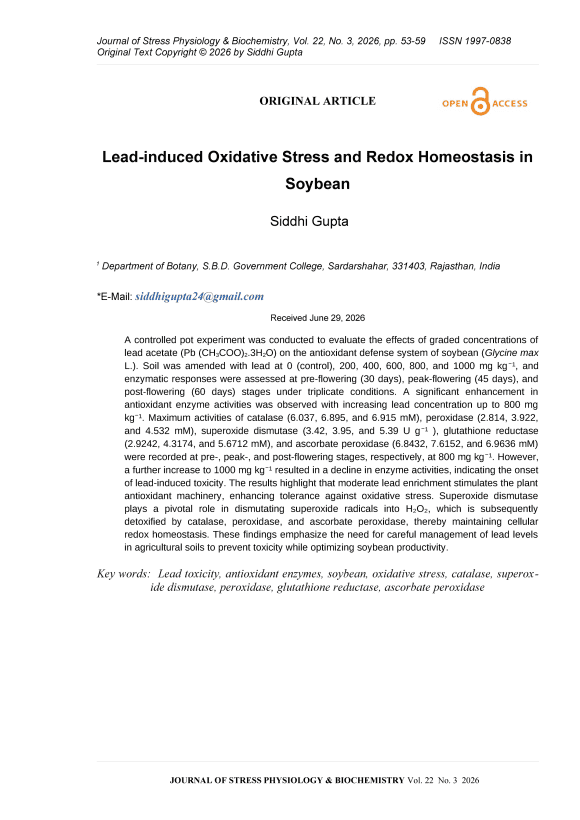
A controlled pot experiment was conducted to evaluate the effects of graded concentrations of lead acetate (Pb (CH3COO)2.3H2O) on the antioxidant defense system of soybean (Glycine max L.). Soil was amended with lead at 0 (control), 200, 400, 600, 800, and 1000 mg kg⁻№, and enzymatic responses were assessed at pre-flowering (30 days), peak-flowering (45 days), and post-flowering (60 days) stages under triplicate conditions. A significant enhancement in antioxidant enzyme activities was observed with increasing lead concentration up to 800 mg kg⁻№. Maximum activities of catalase (6.037, 6.895, and 6.915 mM), peroxidase (2.814, 3.922, and 4.532 mM), superoxide dismutase (3.42, 3.95, and 5.39 U g⁻№ ), glutathione reductase (2.9242, 4.3174, and 5.6712 mM), and ascorbate peroxidase (6.8432, 7.6152, and 6.9636 mM) were recorded at pre-, peak-, and post-flowering stages, respectively, at 800 mg kg⁻№. However, a further increase to 1000 mg kg⁻№ resulted in a decline in enzyme activities, indicating the onset of lead-induced toxicity. The results highlight that moderate lead enrichment stimulates the plant antioxidant machinery, enhancing tolerance against oxidative stress. Superoxide dismutase plays a pivotal role in dismutating superoxide radicals into H₂O₂, which is subsequently detoxified by catalase, peroxidase, and ascorbate peroxidase, thereby maintaining cellular redox homeostasis. These findings emphasize the need for careful management of lead levels in agricultural soils to prevent toxicity while optimizing soybean productivity.
Short address: https://sciup.org/143186155
IDS: 143186155
Text of the scientific article Lead-induced Oxidative Stress and Redox Homeostasis in Soybean
Heavy metal contamination of agricultural soils has become a major environmental challenge due to rapid industrialization, urbanization, and intensive agricultural practices. Among various toxic metals, lead (Pb) is one of the most hazardous pollutants because of its persistence, non-biodegradable nature, and high toxicity to living organisms. Elevated Pb levels in soil can disrupt plant growth, reduce crop productivity, and pose serious risks to food safety through its entry into the food chain (Gupta, 2024). Lead is readily absorbed by plant roots and interferes with several physiological and biochemical processes, including nutrient uptake, photosynthesis, water balance, and cellular metabolism. One of the primary consequences of Pb toxicity is the excessive generation of reactive oxygen species (ROS), such as superoxide radicals, hydrogen peroxide, and hydroxyl radicals. The accumulation of ROS causes oxidative stress, resulting in lipid peroxidation, protein degradation, membrane damage, and impaired cellular functions (Hussain et al. , 2023).
To mitigate oxidative damage, plants have evolved an efficient antioxidant defense system comprising enzymatic antioxidants such as superoxide dismutase (SOD), catalase (CAT), and peroxidase (POD). These enzymes play a crucial role in maintaining cellular redox homeostasis by scavenging excess ROS and protecting plant tissues from oxidative injury (Liu et al. , 2026). The efficiency of this antioxidant machinery is often considered a key indicator of plant tolerance to heavy metal stress (Hasanuzzaman et al. , 2020).
Soybean ( Glycine max L.) is one of the world's most important legume crops, valued for its high protein and oil content. However, its growth, productivity, and grain quality are adversely affected by heavy metal contamination, particularly Pb stress (Gupta, 2026). Although several studies have examined the effects of Pb on soybean growth and physiology, information regarding the dynamics of antioxidant enzyme responses at different developmental stages remains limited. Therefore, the present study aimed to investigate the impact of lead stress on antioxidant enzyme dynamics in soybean across different growth stages.
MATERIALS AND METHODS
Plant Material and Treatment
The present investigation was conducted using lead acetate ((Pb (CH 3 COO) 2 .3H 2 O)) at graded concentrations of 0 (control), 200, 400, 600, 800, and 1000 mg kg ⁻ ¹ of soil. Certified seeds of soybean ( Glycine max L. Merr.) variety JS-95-60 were procured from the Agricultural Research Station, Kota, Rajasthan.
Pot Experiment
The experiment was carried out during April in the greenhouse of the Department of Botany, University of Rajasthan. Earthen pots (30 cm height × 25 cm diameter) were filled with 4 kg of garden soil and arranged in a randomized design to minimize environmental variability. Lead acetate was thoroughly mixed into the soil at the desired concentrations, while untreated pots served as controls. Surface-sterilized seeds (0.1% HgCl₂) were thoroughly rinsed with distilled water and sown at a depth of 2 cm. Uniform plant density was maintained in each pot, and irrigation was provided on alternate days. Each treatment was replicated three times. Sampling was performed at three growth stages: pre-flowering (30 days), peak-flowering (45 days), and post-flowering (60 days) for biochemical analyses.
Antioxidant Enzyme AssaysCatalase (CAT) Activity
Catalase (CAT) activity was determined following Chandlee and Scandalios (1984) by monitoring the decline in absorbance of H₂O₂ at 240 nm. Enzyme activity was calculated using an extinction coefficient of 39.4 mM ⁻ ¹ cm ⁻ ¹ and expressed as µmol min ⁻ ¹ g ⁻ ¹ fresh weight.
Peroxidase (POX) Activity
Peroxidase (POD) activity was assayed following Chance and Maehly (1955) using pyrogallol as the substrate, and the increase in absorbance at 420 nm was recorded. Activity was expressed as µmol min ⁻ ¹ g ⁻ ¹ fresh weight using an extinction coefficient of 2.8 mM ⁻ ¹ cm ⁻ ¹.
Ascorbate Peroxidase (APX) Activity
APX activity was assayed following Nakano and Asada (1981) by measuring the oxidation of ascorbate at 290 nm. Activity was expressed as µmol min ⁻ ¹ g ⁻ ¹ fresh weight using an extinction coefficient of 2.8 mM ⁻ ¹ cm ⁻ ¹.
Glutathione Reductase (GR) Activity
GR activity was determined following Foyer and Halliwell (1976) by monitoring the oxidation of NADPH at 340 nm. Enzyme activity was calculated using an extinction coefficient of 6.2 mM ⁻ ¹ cm ⁻ ¹ and expressed as µmol min ⁻ ¹ g ⁻ ¹ fresh weight.
Superoxide Dismutase (SOD) Activity:
SOD activity was assayed according to Beauchamp and Fridovich (1971) based on the inhibition of photochemical reduction of nitro-blue tetrazolium (NBT) at 560 nm. One unit of SOD activity was defined as the amount of enzyme causing 50% inhibition of NBT reduction and was expressed as units g ⁻ ¹ protein.
Statistical Analysis
All experimental data were expressed as mean ± standard error (SE) of three replicates. Statistical analysis was performed using SPSS (version 25.0) and Microsoft Excel 2016. Differences among treatments were evaluated using analysis of variance (ANOVA), and significance was determined at appropriate probability levels.
RESULTS AND DISCUSSION
The present study reveals a clear, concentrationdependent modulation of antioxidant enzyme activities in soybean (Glycine max L. Merr.) under Pb stress, with a conserved pattern across growth stages. Activities of superoxide dismutase (SOD), catalase (CAT), peroxidase (POX), ascorbate peroxidase (APX), and glutathione reductase (GR) increased steadily with Pb concentration up to 800 mg kg⁻¹ and then declined at 1000 mg kg⁻¹. This biphasic response stimulation at moderate stress levels and inhibition at excessive exposure is consistent with reports in soybean and other crop species, where low-to-moderate heavy metal stress induces defense enzymes while very high concentrations cause enzyme inactivation or overwhelmed antioxidant systems (El-Sappah et al., 2024; Shivappa et al, 2025).
Antioxidant enzyme responses to lead stress:
Superoxide dismutase (SOD) constitutes the frontline enzymatic defense against superoxide radicals (O₂ ⁻ ) and showed significant increases in activity from 0.13 U g ⁻ ¹ protein in the control to maximum values of 3.42, 3.95, and 5.39 U g ⁻ ¹ at pre-, peak-, and postflowering stages, respectively, at 800 mg Pb kg ⁻ ¹ soil. The dismutation of O₂ ⁻ to H₂O₂ by SOD is the primary step in ROS detoxification, and its induction under Pb stress reflects heightened superoxide production associated with disrupted electron transport chains and NADPH oxidase activation (Gupta et al. , 2024; Mohamed et al. , 2025). The decline in SOD activity at 1000 mg kg ⁻ ¹ (4.69 to 4.99 U g ⁻ ¹ across stages) is consistent with reports of direct metal–enzyme interactions at high Pb concentrations that impair metalloenzyme functionality (Emamverdian et al. , 2015; Mansoor et al , 2023). Similar SOD induction patterns under Pb and other heavy metals have been reported in Pisum sativum , Jatropha curcas , cowpea, wheat, and various leguminous crops, reinforcing the universality of this response (Dias et al ,, 2019; Sadeghipour, 2016; Shu et al , 2014) (Table 1)
Catalase (CAT) activity reached peak values of 6.037, 6.895, and 6.915 µmol min⁻¹ g⁻¹ FW at pre-, peak-, and post-flowering stages, respectively, at 800 mg kg⁻¹ Pb. CAT's role in rapidly decomposing bulk H₂O₂ produced downstream of SOD activity into water and molecular oxygen is well established, and its induction under heavy metal stress is a conserved response across plant taxa (Nabiha et al., 2015). Peroxidase (POX) activity followed a parallel trend, reaching 2.814, 3.922, and 4.532 µmol min⁻¹ g⁻¹ FW across the corresponding stages at 800 mg kg⁻¹. POX serves as an auxiliary H₂O₂-scavenging enzyme particularly in the cell wall and apoplast, complementing CAT in the cytosol and peroxisomes (Emamverdian et al., 2015). The co-induction of both CAT and POX under Pb stress indicates compartmentalized and redundant H₂O₂ management strategies, as documented in durum wheat and rice under Pb and cadmium (Cd) exposure (Pandey et al., 2017) (Table 2).
APX exhibited comparatively higher activity than other enzymes, with values of 6.8432, 7.6152, and 6.9636 mM at pre-, peak-, and post-flowering stages, respectively. APX’s high substrate affinity makes it crucial for fine-scale H 2 O 2 detoxification in chloroplasts and cytosol, protecting photosynthetic machinery under Pb stress. The pronounced APX response aligns with studies that emphasize the centrality of the ascorbate– glutathione cycle in heavy-metal tolerance (Ramadan et al , 2025; Mansoor et al , 2023).GR activity also increased markedly, attaining 2.9242, 4.3174, and 5.6712 mM at 800 mg kg ⁻ ¹. Enhanced GR activity supports maintenance of the reduced glutathione (GSH) pool, which is essential for APX function and for direct chelation or sequestration of heavy metals. The concurrent rise in APX and GR indicates coordination of the ascorbate–glutathione pathway as a major adaptive mechanism against Pb-induced oxidative stress, consistent with mechanistic studies showing elevated GR and APX under metal exposure (Siddiqui, 2013; Paradiso et al , 2008) (Table 3)
Across all enzymes, activities were highest at the post-flowering stage, suggesting that antioxidant defenses intensify as plants mature. This pattern may result from increased metabolic rates, higher photosynthetic activity, and greater sensitivity of reproductive tissues to oxidative damage during later development. Comparable stage-dependent antioxidant elevation has been reported in legumes and other crops, where reproductive stages often exhibit heightened protective responses to abiotic stressors.
Mechanistic Interpretation and Threshold Implications
The observed biphasic enzyme responses can be mechanistically interpreted through two distinct phases: (1) an inducible defensive phase at low-to-moderate Pb concentrations (200–800 mg kg ⁻ ¹), during which ROS signals upregulate the expression of antioxidant enzyme genes via stress-responsive transcription factors such as MYB, WRKY, and AP2/ERF families; and (2) a decompensation phase at 1000 mg kg ⁻ ¹, where excessive Pb-induced ROS accumulation, direct metal binding to enzyme active sites, and depletion of reducing cofactors (NADPH, ascorbate, GSH) collectively suppress enzyme activity and compromise cellular redox homeostasis (Mohamed et al. , 2025; Emamverdian et al. , 2015). This threshold behavior has practical implications for crop management — it delineates physiological tolerance limits of soybean to Pb contamination and suggests that soil Pb levels must be maintained below 800 mg kg ⁻ ¹ to avoid irreversible antioxidant failure. These data are also directly relevant to phytoremediation potential, as soybean's sustained enzymatic capacity up to 800 mg kg ⁻ ¹ indicates moderate applicability as a phytoremediator of moderately contaminated soils (Ali and Gill, 2022; Mansoor et al. , 2023).
Table1. Impact of lead on Superoxide dismutase (Units/gm protein) in Glycine max
|
Treatment |
Pre-flowering |
Peak-flowering |
Post-flowering |
|
Control |
0.13±0.008 |
0.34±0.016 |
0.50±0.05 |
|
200 |
0.714±0.06 a |
0.72±0.061 a |
1.67±0.25 b |
|
400 |
1.402±0.17 b |
1.86±0.25 c |
2.49±0.23 c |
|
600 |
1.68±0.15 c |
2.08±0.23 c |
2.60±0.30 c |
|
800 |
3.42±0.25 c |
3.95±0.29 c |
5.39±0.28 c |
|
1000 |
4.69±0.32 c |
5.43±0.25 c |
4.99±0.44 c |
Values were expressed as mean± SEM, Significance level: ap ≤ 0.1, bp ≤ 0.05, cp ≤ 0.01
Table 2. Impact of lead on Catalase and Peroxidase ( µmol min ⁻ ¹ g ⁻ ¹ FW ) in Glycine max
|
Treatm ent |
Pre-flowering |
Peak-flowering |
Post-flowering |
|||
|
Catalase |
Peroxidase |
Catalase |
Peroxidase |
Catalase |
Peroxidase |
|
|
Control |
0.796±0.051 |
0.092±0.007 |
1.183±0.26 |
0.186±0.040 |
1.492±0.31 |
0.186±0.041 |
|
200 |
1.694±0.29 a |
1.210±0.29 a |
2.876±0.32 a |
2.178±0.38 b |
2.984±0.35 a |
2.334±0.26 c |
|
400 |
2.821±0.41 b |
1.432±0.28 a |
3.443±0.32 b |
2.437±0.23 c |
3.843±0.38 c |
3.886±0.38 c |
|
600 |
4.752±0.40 c |
2.228±0.24 b |
5.098±0.38 c |
3.219±0.20 c |
5.518±0.32 c |
4.024±0.25 c |
|
800 |
6.037±0.32 c |
2.814±0.31 c |
6.895±0.47 c |
3.922±0.22 c |
6.915±0.44 c |
4.532±0.29 c |
|
1000 |
5.961±0.41 c |
3.012±0.42 c |
6.543±0.42 c |
3.222±0.32 c |
6.514±0.48 c |
4.112±0.32 c |
Values were expressed as mean± SEM, Significance level: ap ≤ 0.1, bp ≤ 0.05, cp ≤ 0.01
Table 3. Impact of lead on Ascorbate Peroxidase (APX) and Glutathione Reductase (GR) (µmol min ⁻ ¹ g ⁻ ¹ FW ) in Glycine max
|
Treatm ent |
Pre-flowering |
Peak-flowering |
Post-flowering |
|||
|
APX |
GR |
APX |
GR |
APX |
GR |
|
|
Control |
0.116±0.028 |
0.210±0.028 |
0.228±0.06 |
0.314±0.06 |
0.826±0.021 |
0.284±0.021 |
|
200 |
2.0242±0.30 c |
1.2152±0.23 a |
2.6214±0.46 b |
2.4446±0.24 b |
2.7282±0.38 a |
2.8334±0.30 b |
|
400 |
3.8864±0.35 c |
1.422±0.38 b |
3.5372±0.30 c |
3.4136±0.23 c |
4.0242±0.33 b |
3.9122±0.28 c |
|
600 |
5.1264±0.38 c |
2.2316±0.35 c |
5.9328±0.41 c |
3.9142±0.29 c |
5.3724±0.32 c |
4.0254±0.25 c |
|
800 |
6.8432±0.29 c |
2.9242±0.22 c |
7.6152±0.28 c |
4.3174±0.30 c |
6.9636±0.30 c |
5.6712±0.29 c |
|
1000 |
6.4332±0.25 c |
2.4258±0.26 c |
7.3212±0.27 c |
4.1424±0.25 c |
7.5572±0.55 c |
5.5326±0.28 c |
Values were expressed as mean± SEM, Significance level: ap ≤ 0.1, bp ≤ 0.05, cp ≤ 0.01
CONCLUSIONS
The present study concluded that soybean responds to Pb stress with a coordinated upregulation of SOD, CAT, POX, APX, and GR up to 800 mg kg ⁻ ¹, indicating activation of both primary and ascorbate–glutathione antioxidant pathways; the decline at 1000 mg kg ⁻ ¹ marks a tipping point where oxidative damage and enzyme inhibition outweigh defense capacity. Moreover, higher enzyme activities during the post-flowering stage suggest that antioxidant capacity is developmentally regulated and becomes increasingly important during reproductive growth.
These findings align with current literature and help define physiological thresholds relevant for crop management and remediation strategy. Overall, the findings identify approximately 800 mg kg ⁻ ¹ Pb as a physiological threshold for soybean tolerance and demonstrate that antioxidant enzymes are reliable biochemical indicators of Pb-induced oxidative stress.
These insights improve our understanding of the mechanisms underlying Pb tolerance in soybean and provide a scientific basis for evaluating heavy metal tolerance and the potential use of soybean in the phytomanagement of moderately Pb-contaminated soils. CONFLICTS OF INTEREST
Author declare that he has no conflicts of interest.
