
Management of AI-driven business transformation as a factor in improving companies’ operational efficiency
Journal: Economics and Business: Theory and Practice @economyandbusiness
Article in issue: 7 (137), 2026.
Free access
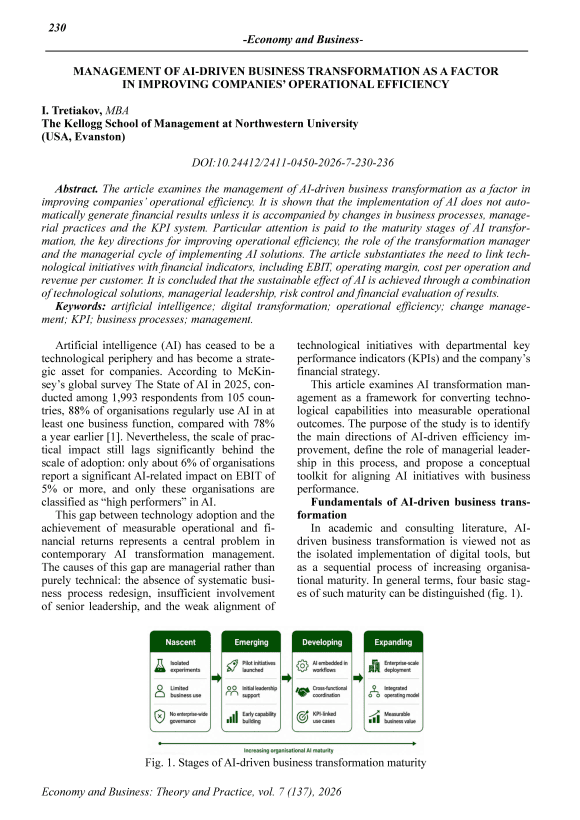
The article examines the management of AI-driven business transformation as a factor in improving companies’ operational efficiency. It is shown that the implementation of AI does not automatically generate financial results unless it is accompanied by changes in business processes, managerial practices and the KPI system. Particular attention is paid to the maturity stages of AI transformation, the key directions for improving operational efficiency, the role of the transformation manager and the managerial cycle of implementing AI solutions. The article substantiates the need to link technological initiatives with financial indicators, including EBIT, operating margin, cost per operation and revenue per customer. It is concluded that the sustainable effect of AI is achieved through a combination of technological solutions, managerial leadership, risk control and financial evaluation of results.
Short address: https://sciup.org/170214230
IDS: 170214230 | DOI: 10.24412/2411-0450-2026-7-230-236
Управление ИИ-трансформацией бизнеса как фактор повышения операционной эффективности компаний
В статье рассматривается управление ИИ-трансформацией бизнеса как фактор повышения операционной эффективности компаний. Показано, что внедрение ИИ не обеспечивает автоматического финансового результата без изменения бизнес-процессов, управленческих практик и системы KPI. Особое внимание уделено стадиям зрелости ИИтрансформации, основным направлениям повышения операционной эффективности, роли менеджера трансформации и управленческому циклу внедрения ИИ-решений. Обоснована необходимость связывать технологические инициативы с финансовыми показателями, включая EBIT, операционную маржу, стоимость операций и выручку на клиента. Сделан вывод, что устойчивый эффект ИИ достигается при сочетании технологических решений, управленческого лидерства, контроля рисков и финансовой оценки результатов.
