
Masks and Sculptured Human Heads in Early Neolithic Complexes of Northern Mesopotamia
Journal: Archaeology, Ethnology & Anthropology of Eurasia @journal-aeae-en
Section: Paleoenvironment, the stone age
Article in issue: 1 т.53, 2025.
Free access
This study focuses on sculptural representations of human heads and faces and related sources from Northern Mesopotamia, dating to the 10th to early 8th millennia BC. Consideration is given to archaeological context, placement relative to other ritually meaningful objects and complexes, and to material traces of actions performed with them. The distribution of masks and separate sculptural and relief images of the human head, in Northern Mesopotamia in the Pre-Pottery Neolithic (PPN), is determined in its western and central regions during the Late PPNA, Early and Middle PPNB periods. The tradition of manufacturing such objects, like the custom of burying or otherwise ritually manipulating separate human skulls, had been practiced in the Levant at least since the Upper Epi-Paleolithic. Many PPN masks and sculptured heads were found in contexts resembling those relating to human crania (and sometimes postcrania) in ritual complexes. Ritual actions with human skulls and sculptural representations of human heads were apparently based on similar religious beliefs broadly aimed at the wellbeing of the community, its security, stability, and reproduction.
Similar articles in the section Prehistory. Prehistoric remains, artefacts, antiquities
Short address: https://sciup.org/145147243
IDS: 145147243 | DOI: 10.17746/1563-0110.2025.53.1.034-043
Text of the scientific article Masks and Sculptured Human Heads in Early Neolithic Complexes of Northern Mesopotamia
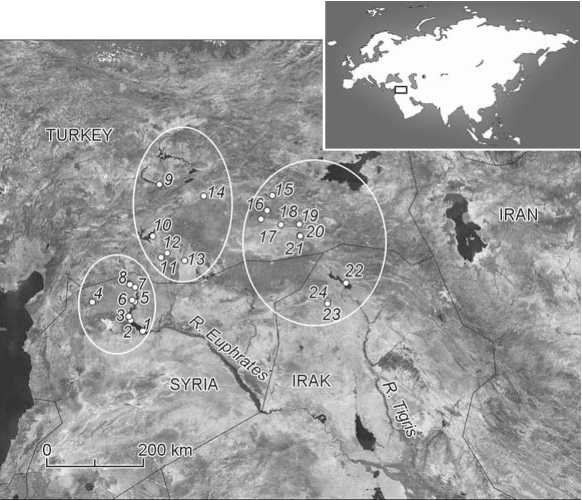
One of the important aspects in the early stages of the Neolithization process in the territory of West Asia was the so-called revolution of symbols (Cauvin, 1994). Numerous and expressive material evidence of this revolution was obtained during examination of sites in the Fertile Crescent and the adjacent areas in the second half of the 20th to 21st centuries (Kornienko, 2015c). With a great variety of shapes, sizes, materials, and technologies of symbol representations, a comprehensive study of sources makes it possible to identify stable motifs, plots, and themes that reflect some significant elements of the worldview of West Asian communities in their transition to the Neolithic way of life. This study focuses on the manifestations of the human head motif in the materials of the Early Neolithic sites of Northern Mesopotamia of the 10th to early 8th millennia BC* (Fig. 1). These materials
*Hereinafter, the dates are calibrated.
demonstrate a certain regional unity when compared to contemporary data of neighboring regions of West Asia*. At the same time, the analysis of material sources of Northern Mesopotamia has revealed local areas of closer cultural interaction in this region.
Sculptural representations of human heads in the Natufian data
Sculptural representations of human heads have already been known from the Natufian sites (ca 13,500– 11,700 BP). Three such items (two are made in a schematic manner, and one in a realistic manner) belong to the Early Natufian period, while the fourth item belongs to the Late Natufian (Grosman
Fig. 1. Location of the sites of the Final EpiPaleolithic (11th millennium BC) and Early Neolithic (10th–8th millennia BC) in Northern Mesopotamia.
1 – Abu Hureyra; 2 – Tell Mureybet; 3 – Sheikh Hassan; 4 – Tell Qaramel; 5 – Jerf el Ahmar; 6 – Tell Halula; 7 – Dja’de el-Mughara; 8 – Tell Abr-3; 9 – Cafer Höyük; 10 – Nevali Çori; 11 – Yeni Mahalle (§anliurfa); 12 - Gobekli Tepe; 13 - Karahan Tepe; 14 – Çayönü Tepesi; 15 – Hallan Çemi; 16 – Demirköy; 17 – Körtik Tepe; 18 – Hasankeyf Höyük; 19 – Gusir Höyük; 20 – Çemka Höyük; 21 – Boncuklu Tarla; 22 – Nemrik 9; 23 – Tell Maghzaliyah; 24 – Qermez Dere. The conventional boundaries of the western, central and eastern areas are shown.
Fig. 2. Sculptured human heads from the Levant and the western part of Northern Mesopotamia. 1 – from Nahal Ein Gev II (after (Grosman et al., 2017: Fig. 3); photo by Gabi Laron; 2 – from Tell Abr-3 (after (Yartah, 2013: Fig. 143)); 3 , 4 – from Jerf el Ahmar (after (Ibid.: Fig. 188, 10 , 11 )).
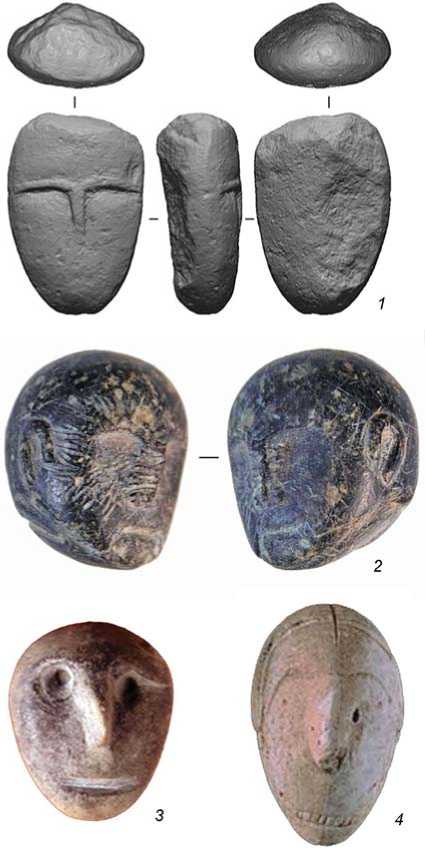
et al., 2017). The Late Natufian artifact, of about 12,000 years old, was found in Nahal Ein Gev II (Southern Levant, Israel). It is a polished limestone pebble measuring 9 × 6 cm with the carved relief of a human face (Fig. 2, 1 ). Polished flake-scars on the reverse side of the pebble suggest that this is a mask (Ibid.: 1). The facial features are rendered schematically. There are only connected lines of the eyebrows and nose shown by T-shaped relief (mouth, ears, and hair are missing; eyes are not worked out). However, the human face is quite recognizable. Interestingly, in the subsequent periods of the PrePottery Neolithic (PPN), this rather specific T-shaped design of facial features was reflected in the tradition of manufacture of various ritual objects—masks, images of human head in round sculpture and relief, as well as full-length human figures—in the territory of Southeastern Anatolia.
Human head motif in the symbolism of the Early Neolithic communities of Northern Mesopotamia: A review of sources
Materials from a number of sites in Northern Mesopotamia relating to the PPNA, Early and Middle PPNB, contain small masks, separate and broken off images of the human head in round sculpture, as well as large-scale analogs of the above-mentioned types of items. The vast majority of masks and sculptured human heads of various sizes are made of stone, mostly limestone; those made of clay and bone are extremely rare. All these images can be divided into three types according to the degree of detail elaboration: 1) conventional (without any details); 2) schematic or stylized (most often T-shaped facial features are depicted); 3) realistic (with details). The meaning of the human head motif in the symbolic system of the Early Neolithic communities of Northern Mesopotamia can be better understood judging by the contexts of finds, their location with regard to other ritual objects, and the recorded evidence of the corresponding activities. It is also useful to see how the human head motif appears according to different sources, and compare the available data.
At the site of Tell Abr-3, in the filling of ritually decorated building M10b (PPNA), among other numerous symbolically meaningful items, a miniature sculpture of a human head (about 4.5 cm high) was found (Fig. 2, 2 ). The sculpture was carved from chlorite in a realistic manner, with elaborate details of the face and ears (Yartah, 2013: 90–95). At the site of Jerf el Ahmar, two miniature sculptural masks (4.0 and 4.3 cm high) were discovered without a clear context, in the layers of the PPNA to PPNB transition period. The masks were made of stone in a realistic manner, with their human facial features represented in relief and engraving technique (one mask also shows teeth and hair) (Fig. 2, 3 , 4 ). Both masks are individual in their execution. The masks contained the remains of fastenings in the upper parts of their backs. The assumptions were made that the masks were elements of composite figurines (Stordeur, Abbès, 2002: 586–587, fig. 17, 2 , 3 ; Stordeur, 2015: Fig. 111, 1 , 2 ), and were attached to something (Dietrich O., Notroff, Dietrich L., 2018: 4–5).
No human burials were found at the investigated areas of the sites of Tell Abr-3 and Jerf el Ahmar. On extremely rare occasions, parts of human skeletons at these sites were found to be buried during construction or burial of public structures. For example, at Tell Abr-3, only arm bones were found. These were situated in partially anatomical position in ritually decorated structure M1a on the “reliquary platform”, which contained a complex of cult objects embedded into it (Yartah, 2013: 109, fig. 82). In the PPNA layers of Jerf el Ahmar, on the floor of a burnt public structure (EA 30), the skeleton of a decapitated young woman was found. In another similar structure (EA 7), at the bottom of a hole under one of the two main supporting pillars, two human skulls were discovered (Stordeur et al., 2001: 36–37). In general, during the Upper Epi-Paleolithic and Early
Neolithic, human remains and remains of certain animal species were widely used in the ritual practices of the Levant and Northern Mesopotamia. Skulls or their fragments occur in ritual context associated with structures, including those with special purposes, more frequently than other parts of the skeleton (Kornienko, 2012, 2015b, 2022b; Zinchenko, 2022).
The layer of phase IVB of Tell Mureibet (Early Middle PPNB) yielded a finely worked pendant in the form of a man’s head with a beard, made of dark-red polished stone (talc?), 24.6 mm high (Maréchal, Alarashi, 2008: 600, 617, fig. 19.7). In addition, also at the level of phase IVB, five human skulls were recorded close to each other, near red clay pedestals. One more skull (“skull 2”) was found in situ on a similar pedestal nearby (Chamel, 2014: 336–352, fig. 159).
The Early PPNB levels at the Çayönü Tepesi site contained two miniature images of a human head, or a zooanthropomorph. One of these is made of clay and has some defects, its dimensions being 2.8 × 3.4 × × 2.8 cm. The other is made of bone in a stylized manner, with disproportionately large round eyes. Its dimensions (2.8 × 3.1 × 0.4 cm) suggest that it is probably a mask. The context of these finds is not specified (Vor 12 000 Jahren..., 2007: 295, 300). It is also known that the filling of a symbolically decorated public Terrazzo Floor Building (the Middle PPNB) yielded a limestone slab (with a preserved length of 70 cm); one of its narrow sides bore a schematic relief image of a human head “as large as a plate” (Schirmer, 1983: 467; Erim-Ozdogan, 2011: Fig. 51). The facial features were depicted by T-shaped relief. The slab was found in the redeposited state, in the northwestern corner of the room; it had been left there before the ritual of burial of the Terrazzo Floor Building. At the same time, in the ritual context of the Çayönü Tepesi complex, the human head motif is broadly manifested in the funerary rite: in particular, in the materials of the Skull Building (Özbek, 1992; Le Mort et al., 2000: 40; Kornienko, 2015b: 45).
Miniature sculptures of human heads (up to 6 cm high) made of stone both in a schematic and a realistic manner, were found during the excavations of the Nevali Çori settlement, pertaining to the Middle PPNB period (Vor 12 000 Jahren..., 2007: 291–292, No. 105–109). Several such artifacts were found in house 6, the so-called workshop of the stonecutter and sculptor, in two pits located in different rooms of the structure (Hauptmann, 1999: 72). They had been buried together with fragments of limestone and fragments of other stone figurines (image of the head of a grinning predator and an L-shaped pillar). According to the researchers of the site, the miniature stone sculptures differ significantly, in the quality of details, from the clay sculptures found in the residential part of the settlement. As observed by H. Hauptmann, the limited motifs of the stone portable art representing animals, people (in many cases only their heads), and a pillar, correspond to the examples of large sculptures from Nevali Çori (Ibid.: 77). The miniature stone sculptural representations of human heads have parallels among the large-scale specimens from this site (Vor 12 000 Jahren..., 2007: 68, 70) and from other Early Neolithic sites in Northern Mesopotamia. The miniature stone mask discovered in Nevalı Çori in redeposited state (Ibid.: 292, No. 110; Schmidt, 2006: Abb. 18) is comparable to the large and miniature stone masks from Göbekli Tepe.
The burial complexes in the residential part of Nevali Çori suggest the spread of the custom of decapitation during the performance of secondary burials. For example, in house 2 (level 3), eight skulls (without mandibles) and other parts of skeletons of 12 individuals were discovered under the floor of northeastern room. A large number of human remains were also found under the floors of other dwellings, such as houses 21A and 21B (levels 1 and 2); one of the pits (house 21A) contained five skulls and some long skeletal bones. A single skull was found in the center of a rubble-filled pit in house 6 (level 3). Skeletons without skulls were also recorded in the Nevali Çori burials that had been made under the floors of dwelling buildings (Hauptmann, 1993: 57; 1999: 70–73).
The study of the Göbekli Tepe archaeological complex (PPNA and Middle PPNB) yielded a large number of round stone sculptures of human heads of various sizes, several stone masks, and one clay mask, which is rare for the sculptural images of that time. During surface cleaning prior to excavations, a massive limestone mask 42 cm high was found there (Dietrich O., Notroff, Dietrich L., 2018: Fig. 4). Its reverse side is slightly concave, with flake scars and pecked recesses. The mask may have been designed to be fixed to a wall or another support. The depiction of the face is schematic. The T-shaped relief shows the eyebrows and nose, the holes indicate the eyes, and the mouth is absent. The researchers of the site note that this manner of depicting a face is also typical of the Göbekli Tepe round sculptures representing anthropomorphs in full height. Thus, it can be argued that it is the human face that is depicted on the minimalist masks similar to that under discussion (Ibid.: 7). The second mask, made of limestone, is miniature, 5.7 cm high, with a clearly concave reverse side (Ibid.: Fig. 5). Facial features are rendered schematically. The eyebrows and nose are indicated by T-shaped relief, eyes by holes, and the mouth is absent. The mask was found in the upper layers of the filling in enclosure D, near eastern central pillar 18, at the level of the carved fox silhouette thereon. In the same area of this enclosure’s filling, 10 cm below, a fragmentarily preserved small mask made of burnt clay (1.3 × 0.7 cm), with a realistic image of a human face, was found (Dietrich O., Dietrich L., Notroff, 2018: 8–9, fig. 2). The prominent nose is finely worked out, through holes show the wide-open eyes, and a small hollow shows the mouth. The back of the mask is concave. Whether the item was intentionally burned remains unclear.
Two masks were made from a flint cortex. One of them, 4.7 cm high (Dietrich O., Notroff, Dietrich L., 2018: Fig. 6), was found within enclosure H, next to pillar 51, one of the two central pillars. The representation of facial features is schematic, but in a slightly different style than in the previous cases. The eyebrows and nose are shown by a V-shaped relief, the eyes are indicated by holes, and the mouth is absent. Six parallel curved chevrons engraved above the eyebrows may represent hair, headgear, tattoos, or scarification (Ibid.: 8, 10). Another mask, 4.5 cm high, was discovered near the eastern central pillar of enclosure C, at floor level. The facial features are shown by T-shaped relief (Ibid.: Fig. 7). According to the researchers of Göbekli Tepe, this frequently recorded technique of stylized representation of facial features on stone gives the impression of “statics and super-individuality” (Ibid.: 8–10). At the same time, each of these items is clearly different from the others in terms of size, representation features, color, and rock type.
Notably, all the masks found in Göbekli Tepe (except for one—a large-sized mask found in the redeposited state) come from the filling of large public structures of worship of level III, PPNA. The researchers of the site note that these finds should be dated with caution (Ibid.: 11), because the process of backfilling the rooms could have been continued also during the Early PPNB, in which case some older materials could have been used.
During the excavations at Göbekli Tepe, by 2018, in addition to the masks depicting human faces, a collection of 17 sculptural representations of human heads had been assembled*. These are mostly parts of full-figure sculptures of anthropomorphs. This is the largest group of finds described to date among the anthropomorphic images from the Pre-Pottery Neolithic sites. The items are made of limestone and have different sizes: from 4.0–4.6 to 22–46 cm (Şanliurfa müzesi..., 2017: 105, 137–141; Dietrich O., Notroff, Dietrich L., 2018: 11). Most of them depict human heads, conventionally or schematically, including the images with facial features shown by T-shaped relief. Only rare images are realistic. Several sculptured human heads were found in the redeposited state on the surface. Those found in situ come from the filling of public structures of worship of level III (PPNA), namely, enclosures C, D, and H. For example, two images of human heads in round sculpture (23 and 26 cm high) were found in enclosure D at floor level, near the western central pillar (Dietrich O., Notroff, Dietrich L., 2018: 12–13, fig. 9). Places of discovery of the round full-figure sculptures in Göbekli Tepe, both zoomorphic and anthropomorphic, suggest that the items found in situ had not been distributed randomly in the cultural layer (Becker et al., 2012: Fig. 21). Like the masks and sculptured heads from enclosures C, D, and H, the round full-figure sculptures were also thoughtfully placed, often near the pillars of structures and most often near the central pillars.
In enclosure D, on the redeposited slab found near central pillars and on pillar 47 included in the perimeter of walls, some relief compositions have preserved. Among their motifs, one is probably a human head depicted by a circle, separately from the body. The facial features in the circle engraved on the slab are rendered by standard T-shaped pattern of eyebrows and nose (Dietrich O., Notroff, Dietrich L., 2018: Fig. 9). In general, the materials of fillings of public structures of worship at Göbekli Tepe give reason to believe that the certain symbolic objects were specifically placed therein during the ritual of leaving those buildings before these were buried (Dietrich, 2016: 6; Dietrich O., Notroff, Dietrich L., 2018: 12).
O. Dietrich reports that most of the anthropomorphic sculptures at Göbekli Tepe have survived only in fragments. Of the 43 specimens, only nine have been determined to be complete (excluding minor damage). Heads are most abundant among the fragmented anthropomorphic sculptures. The large number of identified broken off sculptured heads and their spatial distribution speak in favor of the intentional separation of these parts from the figures for their subsequent placement in certain parts of the backfilled structures
(Dietrich, 2016: 5). The presented data closely echo the results of studies of the Göbekli Tepe materials by palaeoanthropologists. For a long time, no human burials were found at Göbekli Tepe. Nevertheless, by 2017, in addition to tools, sculptural images, a large number of fragmented animal bones and other objects, 691 fragments of human bones had also been identified in the filling of the structures of level III and Level II. Most of the fragments ( n =408) have belonged to skulls. There are three fragments of parietal bones with traces of scarification, including that with traces of perforation. Forty skull fragments show incisions due to separation of flesh from the bone. The signs of decapitation are represented by the cuts on two (out of seven detected) cervical vertebrae (Gresky, Haelm, Clare, 2017).
At Karahan Tepe, where the field research has been actively conducted since 2019, it has been confirmed that a complex of public structures of worship had functioned during the period from the Late PPNA to the Middle PPNB (Karul, 2021). At least 20 sculptural and relief images of human heads of all three types (conventional, schematic, and realistic) and of various sizes have been found so far. Some of these bear flake scars in the neck area. The full-figure anthropo- and zoomorphic sculptures have also been discovered, including those with broken off heads. A significant part of these finds is already on display at the Sanlıurfa Archaeology Museum. Let us dwell in more detail on one of the published specimens, which was recorded in situ along with other ritual objects.
The large-sized realistic sculptured human head in the form of high relief was carved from the limestone bedrock on the ridge of the western wall of structure AB during its construction. Eleven pillars were found in situ , in front of this sculptural object . Ten of them were carved from the limestone bedrock, like the whole structure itself (Fig. 3), and were shaped like a phallus (Ibid.: 24). The eleventh pillar was L-shaped, made of a limestone slab, and embedded in the floor. It seems to depict a bird.
The stone pestles/”scepters” of phallic shape and of Г-shape, sometimes with sculptured tops in the form of bird-, animal- or human head, stem from the earlier or contemporaneous to Karahan Tepe sites located mainly in the central and eastern parts of Northern Mesopotamia (Kornienko, 2022a: Fig. 2, 3). The combination of motifs of phallus and human/animal/bird head is known from the sculptural design of pillars in the central and western parts of the region (Kornienko, 2018). The sculptures of
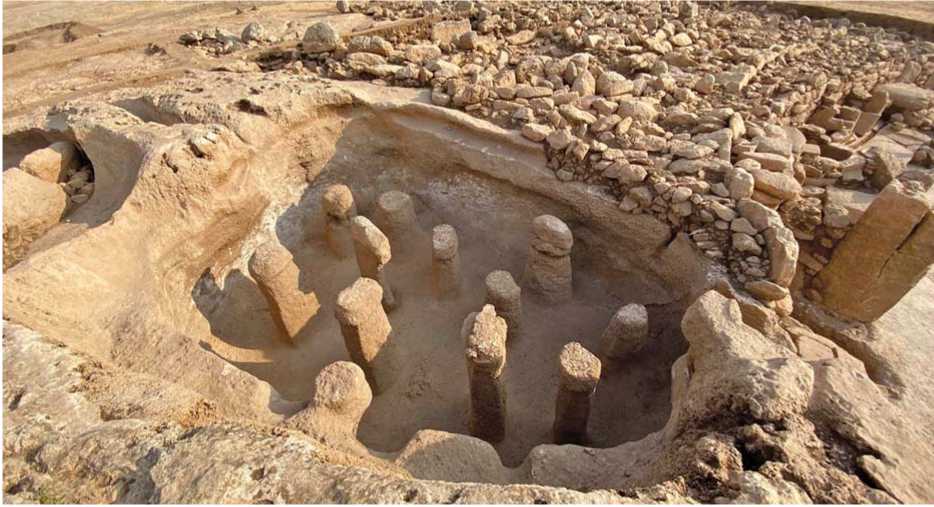
Fig. 3. Structure AB at Karahan Tepe. View from the west (after (Karul, 2021: Fig. 6))
that time from the central part of Northern Mesopotamia present compositions with a bird or animal motif combined with the depiction of a human head (Schmidt, 2006: Fig. 16; Vor 12,000 Jahren..., 2007: 70; Dietrich O., Notroff, Dietrich L., 2018: Fig. 10).
It is quite likely that the complex of expressive large-scale sculptural objects of structure AB at Karahan Tepe demonstrates the combination of images of the head, phallus, and bird/animal that was common for that time and region. The special role of the high-relief anthropomorphic head as a ritual object is emphasized by its extraordinary size (exceeding the usual size of a human head), elevated location, and uniqueness. The facial features in this remarkable sculptured human head are carefully worked out (Fig. 4). The nose and narrow slanting eyes were rendered partially by the T-shaped pattern. The cheekbones, mouth, and wide lower jaw with the elaborated chin are clearly shown. On the
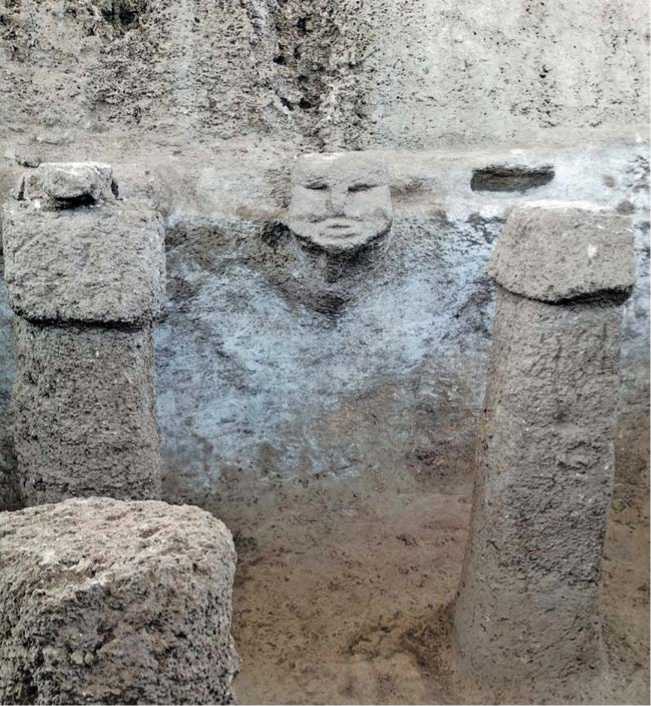
Fig. 4 . The phallus-shaped pillars and the sculptured human head carved in bedrock.
Karahan Tepe. Structure AB (after (Karul, 2021: Fig. 7)).
neck going into the wall, the Adam’s apple attracts attention. There can hardly be any doubt that this is the representation of a male head.
Concerning the spatial distribution of the Early Neolithic masks and images of the human head in round sculpture and relief discovered on the territory of Northern Mesopotamia, it can be noted that the sites of the eastern part of the region contained separate sculptures of the human head much more rarely than those in the central and western parts. One such rare image in the east of the Northern Mesopotamian region is the sculptured top of a polished stone rod from Nemrik-9, with realistically engraved human facial features (Kozlowski, 1997: Fig. 2). This top was not broken off.
A conventional sculptural representation of a human head was found at Hasankeyf Höyük, where the skeleton of one of the individuals buried in the extended position differed from the others by the absence of the skull. Instead, there was a sphereshaped clay item. This PPNA site, containing about 100 burials, showed no other cases of a skeleton missing the skull or a separate burial/exposure of skulls (Miyake, 2016: 34–36).
The eastern region of Northern Mesopotamia, as compared to central and western ones, did not reveal the widespread custom of decapitation in the Pre-Pottery Neolithic communities (Karul, 2011: 2–6, fig. 6, 7; Rosenberg, 2011: 82–83; Erdal, 2015; Soltysiak, Wiercinska, Kozlowski, 2015; Miyake, 2016: 34-36; Ozdogan, 2024: 53; and others). There are rare such cases, in particular those recorded from the sources of Qermez Dere (Watkins, 1992: 68) and Boncuklu Tarla (Koda§ et al., 2022: 82-83).
Conclusions
Having studied the data on the discovery of masks and images of the human head in round sculpture and relief in the Early Neolithic complexes of Northern Mesopotamia, we can note that their distribution has been mainly recorded in the western and central parts of the region, at the levels of the Late PPNA and the Early and Middle PPNB. The available materials suggest that the origins of the tradition of making such objects, as well as of the custom of separate burial of human skull/s or ritual use of skulls, were developed in the Upper Epi-Paleolithic in the Levant. Later, these traditions spread to the neighboring areas.
A miniature stone mask with the eyebrows and nose depicted by T-shaped relief comes from the Late Natufian strata of the southern Levantine settlement of Nahal Ein Gev II. In the Early Neolithic, this specific manner of representing facial features in round sculpture and relief images of human heads became widespread in the central part of Northern Mesopotamia.
There is still no information about the occurrence of any separate sculptured human heads in the eastern part of the Northern Mesopotamia*. Furthermore, the materials from the eastern part of Northern Mesopotamia do not show a widespread tradition of secondary burials with separation of skull from the skeleton, with separate burial, or with exhibition of skulls. They also do not show the existence of anthropomorphic images without heads nor the custom of breaking off the heads of anthropomorphic sculptures. In the western and central areas of the region, the evidence of such activities has been recorded at a number of the PPNA–Middle PPNB sites. The depiction of the human head by objects of different categories in various ritual practices was typical of the given areas in the specified period. The distribution of ritual objects associated with this motif has also been recorded in the sources from the Southern and Central Levant of the PrePottery Neolithic period (Cauvin, 1994: 154–155; Kornienko, 2012; Ben Zion, 2014; Dietrich O., Notroff, Dietrich L., 2018: 17). However, specific features of the design of such objects and the contexts of their location are somewhat different from those of the Northern Mesopotamia region, in some respects quite dramatically.
The available data from the western and central regions of Northern Mesopotamia do not allow us to trace any correlation between the place of discovery and the type of sculptural representation of the human head (mask, relief, or round sculpture; schematic or realistic). The noted variations of images sometimes occur in similar contexts: in construction sacrifices, in the filling and decoration of symbolically marked public buildings. The conventional representations of the human head were obviously created in the unplanned cases, or when there was not enough time for more careful manufacture of the object, like in the burial materials with a missing skull at Hasankeyf Höyük. In many instances, the circumstances of the discovery of masks, reliefs, and round sculptures of human heads are comparable to those of human skulls
(and sometimes other bones) in ritual complexes. Ritual actions with these objects seem to have had a common ideological basis broadly aimed at the wellbeing, stability, security, and reproduction of the community (Kornienko, 2012, 2015b).
The dominance of male symbols and images is a characteristic feature of the iconography of Northern Mesopotamia in the Pre-Pottery Neolithic (Hauptmann, 1999; Schmidt, 2006: 80, 97, 99, 113, 160, 185; Kornienko, 2015a; and others). When there are grounds for determining the sex of the depicted individual (as, for example, in the case of a pendant in the form of a man’s head with a beard from Mureybet), sculptural images represent men. Quite expressive is the interior decoration of structure AB at Karahan Tepe, with ten phallic and one Г-shaped pillars carved from limestone. These are located in front of the large high relief of a man’s head placed on the upper ridge of the western wall of the room. The composition made by relief and engraving on the front side of the bench of the large structure AA at Sayburç (Early PPNB, Southeastern Anatolia) is equally impressive. The mural about 70–90 cm high and 370 cm long contains five human and animal figures participating in the ritual/mythical scenes. Four of these are shown with erect phalluses (Ozdogan, 2024: 46, fig. 11). The most significant character of the composition seems to be a man holding his penis in his right hand (with his left hand placed on the abdomen). The fullface high-relief image distinguishes him from the others engraved in profile (Ibid.: 52, fig. 11, 12, 16). Noteworthy is the disproportionately large head of the character*. Given our knowledge of ritual objects of this region in the Early Neolithic, we can assume that this head is depicted as a large mask worn on the face.
The combination of the motifs of a phallus and a human or animal head is a very common and stable technique in the iconography of Northern Mesopotamia in the Pre-Pottery Neolithic. It has been repeatedly recorded in the design of monumental stelae and small pestles/“scepters” with the tops in the form of zoo- or anthropomorphic heads. Such objects of ritual practices, along with other sources, reflect the totemic views, male dominance in social life, and implementation of rites aimed at the reproduction, protection and prosperity of the community.
The idea of interdependence, inseparability of life and death is most minimalistically and concisely represented in many cultures precisely in the motif of a separated head—the upper and most semantically significant part of a body. This meaning (perhaps not the only one) is likely conveyed by the masks and sculptural representations of the human head found at the sites of Northern Mesopotamia of the Pre-Pottery Neolithic.
Acknowledgements
The author’s special thanks go to Dr. T. Yartah, Prof. L. Grosman, and Prof. N. Karul for the permission to use illustrations from their works in this article; to Prof. N. Karul also for the invitation and opportunity to work at Karahan Tepe in the 2020 and 2022 field seasons.
