
Mechanisms for ensuring fixed returns in trust management of resort real estate
Journal: Economics and Business: Theory and Practice @economyandbusiness
Article in issue: 4 (134), 2026.
Free access
The article examines mechanisms that secure fixed returns for investors in resort real estate under trust management structures. The study aims to systematise contractual and financial instruments that stabilise investor payouts under volatility typical for hospitality assets. The methodology relies on comparative analysis of hotel management and lease models, synthesis of academic research on reserve engineering and risk-transfer instruments, and analytical interpretation of contractual governance practices. The results identify a layered stabilisation architecture based on payout waterfalls, reserve funds, and guarantee mechanisms that reduce income variability. The findings may be applied in structuring resort real estate investment schemes and managing financial risks in hospitality projects.
Short address: https://sciup.org/170213378
IDS: 170213378 | DOI: 10.24412/2411-0450-2026-4-74-79
Механизмы обеспечения фиксированной доходности при доверительном управлении курортной недвижимостью
В статье рассматриваются механизмы, обеспечивающие фиксированную доходность инвесторов при использовании схем доверительного управления курортной недвижимостью. Цель исследования состоит в систематизации договорных и финансовых инструментов, стабилизирующих выплаты инвесторам в условиях волатильности, характерной для гостиничных активов. Методологическая база опирается на сравнительный анализ моделей гостиничного управления и аренды, синтез научных работ, посвящённых резервным механизмам и инструментам переноса риска, а равно на аналитическое осмысление практик договорного регулирования. Полученные результаты позволили выделить многоуровневую архитектуру стабилизации, основанную на каскадном распределении выплат, резервных фондах и гарантийных механизмах, снижающих изменчивость дохода. Выводы исследования применимы при конструировании инвестиционных схем в сфере курортной недвижимости и при управлении финансовыми рисками в гостиничных проектах.
Text of the scientific article Mechanisms for ensuring fixed returns in trust management of resort real estate
Resort real estate generates income streams that depend on occupancy, seasonality, pricing power, and macro-level uncertainty, complicating investors' expectations of stable distributions. Academic evidence on real estate returns indicates meaningful dispersion between income yields and total returns across property types and periods, reinforcing the structural tension between promised fixed payouts and realised market performance [4]. In hospitality, contract selection and governance determine how operational risk is allocated among owners, operators, and intermediaries, with management-versus-franchise choices affecting monitoring intensity, knowledge transfer, and incentive alignment [5]. Heightened uncertainty has been empirically linked to weaker hotel performance, thereby increasing the likelihood that a fixed-return promise will become underfunded unless explicit buffers are in place [7].
The purpose of the study is to identify and substantiate mechanisms that support fixed payouts within trust management of resort assets. The objectives are:
-
1) to classify contractual forms that shift or share operating risk while preserving predictable investor cash flows;
-
2) to specify funding structures that backstop guarantees through reserves, third-party risk transfer, and payout priority rules;
-
3) to formulate governance conditions that limit moral hazard and preserve asset quality under a fixed-return promise.
Novelty lies in combining hospitality contract design, reserve engineering, and guarantee instruments into a single operational blueprint tailored to resort mixed-use developments.
Materials and Methods
Materials were drawn from recent research and reviewed evidence on guaranteed payments, contract governance, and return volatility: B. Abramson [1] examined rent guarantee insurance as a structured tool for protecting promised rental payments; Baker & McKenzie [2] analyzed branded residence rental programme documentation and legal exposure, including securities-law triggers; Y. Cai [3] investigated real estate investment trust (REIT) return dynamics and noted how existing leases and revenue-linked clauses affect outcomes during shocks; D. Chambers [4] provided micro-level evidence on long-run real estate income yields and net total returns; M. Fernández-Barcala [5] compared hotel contract forms and explained why governance choice varies by segment and scale; D. Malhotra [6] evaluated downside risk and market sensitivity in hospitality REITs; E. Menicucci [7] quantified the link between economic policy uncertainty and hotel performance; T. Prillona [8] described hotel management contract clauses relevant for reserves, reporting, and insurance; A. Vij [9] re- ported that guaranteed rental payments increase investor participation in rental schemes; L. Waern [10] assessed turnover-based rent models and documented their return volatility trade-offs.
Methods applied: comparative analysis of operating models (lease vs management vs hybrid), analytical decomposition of cash-flow waterfalls, synthesis of literature on guarantees and reserve design, and qualitative contract-logic reasoning for risk allocation and governance.
Results
Fixed-return delivery in resort trust management rests on converting uncertain operating income into a contractual payment obligation supported by identifiable funding sources and enforceable governance. Two baseline routes dominate practice in the literature: (a) risk transfer via lease-type structures that obligate an operating counterparty to pay minimum rent, and (b) risk retention by the owner/trust with stabilisation through reserves, performance-linked controls, and external insurance overlays. Evidence from hotel contract research shows that governance choice depends on the monitoring needs of quality tiers and the intensity of tacit-knowledge enforcement; these features become financially material once distributions are pre-committed at a fixed level [5].
A trust-management setting typically interposes a fiduciary manager between investor capital and operating cash flows. Within such architecture, a fixed payout becomes credible only when its payment priority is contractually senior to discretionary cash uses and when shortfalls are prefunded or insurable. Academic work on hospitality investment vehicles highlights high downside sensitivity and crisis exposure in hospitality-linked portfolios, which supports the premise that fixed payout promises require structural buffers rather than reliance on average-cycle performance [6].
The first stabilisation layer is the contractual allocation of revenue risk. Turnover-linked rent models increase flexibility for operators during demand collapses yet raise cash-flow volatility for owners, undermining any rigid fixed payout unless complemented by reserves or guarantee capital [10]. Hence, for fixed-return products, turnover-based rent functions mainly as a supplementary component, while a minimum base rent (or owner-priority clause in management structures) serves as the anchor obligation. The logic is consistent with observations that performance shocks transmit into hotel outcomes through uncertainty channels, thereby reducing operating metrics and compressing distributable cash [7].
The second layer is reserve engineering. Hospitality management contract studies document the recurring use of replacement reserves and dedicated accounts tied to revenues for capital improvements, alongside reporting, budgeting, and insurance provisions that formalise control over cash use [8]. A fixed-return programme can repurpose this logic by establishing a distribution support reserve funded at acquisition and replenished from top-line receipts before operator profit participation. The reserve acts as a mechanical shock absorber: during high season, it accumulates; during low season, it smooths investor payouts.
The third layer is explicit guarantee funding through third parties or structured insurance. Rent guarantee insurance research models the product as an instrument that pays the landlord upon tenant non-payment, financed by premiums and eligibility rules; despite being developed for residential rental risk, the mechanism provides a transferable template for guaranteeing periodic cash flows under incomplete markets [1]. Empirical evidence from scheme design further indicates that guaranteed rental payments increase investor willingness to participate, reinforcing the investor-side rationale for paying the cost of guarantees when distribution certainty carries a pricing premium [9].
The fourth layer is the legal and compliance architecture, especially for mixed-use resort projects that combine hospitality operations with residential sales and rental programmes. Legal analysis of branded residence structures emphasises multi-document frameworks (service agreements, rental programme agreements, brand licences). It warns that rental programmes can expose to securities law in some jurisdictions, which directly affects product design, marketing language, disclosure, and reporting obligations [2]. For a fixed-return promise, this legal classification risk becomes economically material because enforcement actions or disclosure failures can disrupt operations, freeze distributions, or impose remediation costs.
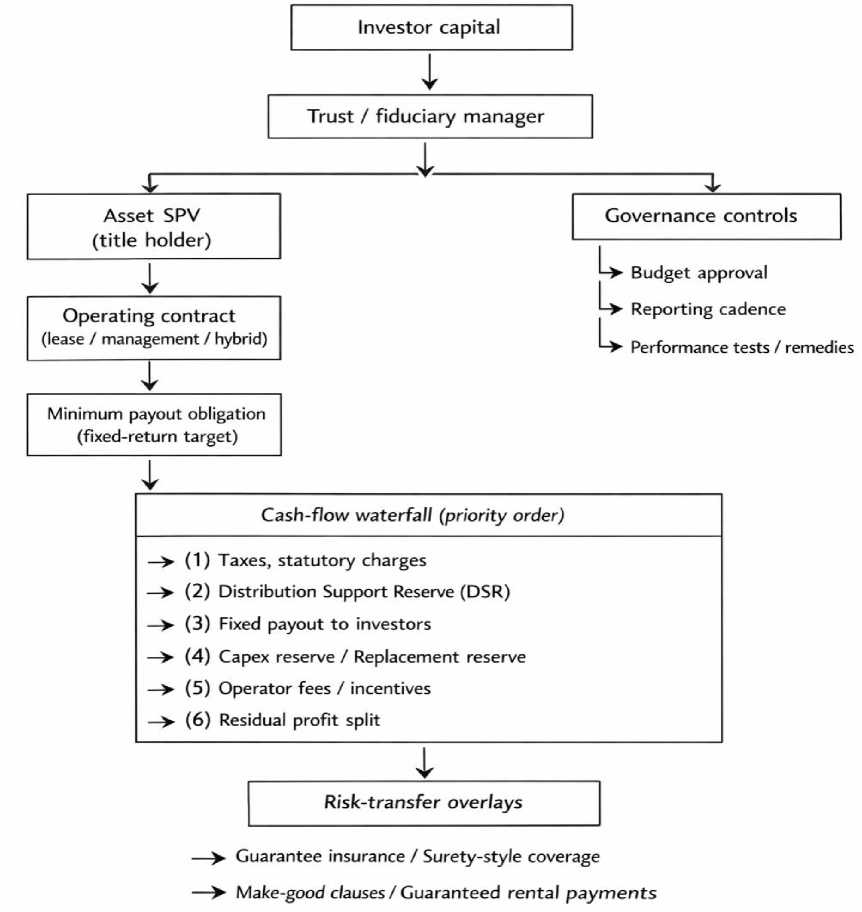
Fig. 1. Layered architecture for fixed-return delivery in resort trust management (synthesised from [1; 2; 8–10])
Operationally, the waterfall converts revenue volatility into a rule-based sequence that prioritises distribution stability over discretionary spending, while still preserving asset upkeep through capex reserves. This sequencing reduces payout variance but shifts residual volatility to operator incentives and sponsor residuals, which must be priced into the commercial terms. Evidence from REIT research under shock conditions indicates that lease structures and revenue-linked clauses influence outcomes, implying that contract design meaningfully affects how shocks are transmitted into investment returns [3].
Sustainability of a fixed-return promise depends on an explicit break-even condition: expected net operating income plus reserve draw capacity and external guarantee coverage, must exceed committed distributions across adverse scenarios. Hospitality REIT evidence on downside risk supports using conservative stress assumptions rather than average-cycle expectations when calibrating guarantee size and reserve funding [6]. This calibration is further justified by the empirical relationship between uncertainty and hotel performance, which motivates incorporating policy and macro volatility into the reserve sizing logic and covenant triggers.
Discussion
The interpretation of the results points to a taxonomy in which fixed-return assurance is not a single mechanism but a bundle of layered instruments. Table 1 consolidates the principal mechanisms, their contractual carriers, and the main risk-bearing party.
Table 1. Mechanisms that support fixed payouts in resort trust management [1; 2; 5; 8-10]
|
Mechanism |
Contractual carrier |
Primary funding source |
Main risk bearer after structuring |
Governance requirements |
|
Minimum base rent / fixed rent |
Lease/master lease |
Operator cash flows; sponsor support |
Operator (first- loss) |
Rent covenant, audit rights |
|
Revenue-linked rent with floors |
Hybrid rent clauses |
Top-line receipts with a minimum floor |
Shared |
Clear revenue definitions, verification |
|
Owner priority / performance-linked fees |
Management agreement structures |
NOI with priority waterfall |
Owner/trust |
Budgeting, reporting, approval rights |
|
Distribution support reserve |
Reserve account/escrow |
Initial funding + periodic topslicing |
Owner/trust (buffered) |
Funding rules, replenishment covenants |
|
Replacement / capex reserve |
Reserve account |
Fixed % of revenues |
Owner/trust |
Capex plan, draw controls |
|
Guaranteed rental payments / make-good |
Scheme guarantee clause |
Sponsor/operator guarantees capital |
Sponsor/operator |
Eligibility rules, enforcement triggers |
|
Insurance-style rent guarantee |
Insurance product/surety template |
Premiums + underwriting constraints |
Insurer (bounded) |
Eligibility, moral hazard controls |
|
Rental programme in branded residences |
Rental programme agreements |
Rental pool receipts |
Shared, plus legal exposure |
Disclosure, consumer/securities compliance |
Table 1 indicates that the economic meaning of a “fixed return” promise depends on who absorbs downside variance and which balance-sheet or insurance capacity backs the promise. Guarantee instruments designed for rental contracts should provide a formal risk-transfer template that addresses adverse selection and moral hazard, with these considerations reflected in eligibility, documentation, and pricing [1]. The legal structuring of rental programmes in branded residence settings introduces compliance constraints that can reshape the entire product architecture, including disclosure and documentation requirements [2].
Table 2 evaluates the main risk channels that threaten fixed payouts and links them to mitigation instruments grounded in the reviewed sources.
Table 2. Risk channels and mitigation instruments for fixed-return programmes [3; 5-8; 10]
|
Risk channel |
Transmission into payouts |
Contractual/financial mitigation |
Evidence anchor |
|
Demand shock, seasonality |
NOI falls below the fixed payout |
DSR sizing + floor rent + step-in rights |
Volatility trade-offs under revenue-based rent |
|
Policy/uncertainty shock |
Performance deterioration, weaker cash conversion |
Stress covenants, reserve triggers, conservative payout ratio |
EPU is negatively linked to hotel performance |
|
Operator moral hazard |
Under-reporting revenues, cost shifting |
Reporting cadence, audit rights, and budget approval |
Contract governance differences across forms; reporting clauses |
|
Capex underfunding |
Asset quality declines, ADR/occupancy erosion |
Replacement reserves, ringfenced capex accounts |
Replacement reserve practice in HM contracts |
|
Legal classification/disclosure risk |
Enforcement costs, distribution disruption |
Disclosure protocols, contract clarity on rental programmes |
Rental programme legal exposure |
|
Market sensitivity in hospitality-linked vehicles |
Higher downside risk than diversified benchmarks |
Conservative leverage, payout buffers, scenario analysis |
Downside sensitivity in hospitality REITs |
|
Shock propagation through lease structures |
Return response depends on lease rigidity |
Hybrid clauses, renegotiation triggers |
Lease/return interactions highlighted in REIT shock research |
The mapping in table 2 supports the interpretation that fixed-return programmes remain stable only when payout promises are subordinated to enforceable governance and to capital preserva- tion logic. Studies of hospitality-linked securities show elevated crisis sensitivity, which implies that fixed payouts require a clearly bounded payout ratio and ex ante shock capacity rather than reliance on post hoc renegotiation [6]. REIT evidence indicates that contract structures mediate shock transmission, strengthening the case for explicitly specifying floors, definitions, and verification rights in hospitality-adjacent assets.
Conclusion
Fixed returns in resort trust management are sustained through an integrated design that aligns contractual payout anchors with financial buffering mechanisms, calibrated risk transfer, and enforceable governance provisions. Contractual architecture establishes predictable cash-flow entitlements, while reserve structuring stabilises distributions without eroding long-term capital expenditure capacity. Selective use of risk-transfer instruments, applied only where pricing and coverage remain economically rational, complements internal safeguards. Governance clauses narrow informational gaps between parties and constrain opportunistic conduct, supporting the durability of payout commitments under stress. The analytical framework links contractual forms of fixed payouts with distribution priority logic, funding backstops, and compliance conditions that maintain operational and financial viability in adverse states. Empirical findings indicate heightened vulnerability of hospitality cash flows to uncertainty, which amplifies downside exposure for investment vehicles tied to hotel performance and necessitates conservative parameter setting. In mixed-use resort developments, feasibility hinges on precise legal structuring and stringent disclosure discipline, since crosssubsidisation risks and complexity of use rights materially influence the credibility of fixed-return arrangements.
