
Metal Production of Andronovo Communities and Farmers of Central Asia and Iran: Stages of Development and Search for Interactions
Journal: Archaeology, Ethnology & Anthropology of Eurasia @journal-aeae-en
Section: The metal ages and medieval period
Article in issue: 1 т.53, 2025.
Free access
The article examines late 3rd and 2nd millennia BC mining and metallurgy across vast territory of Central Eurasia, inhabited by Andronovo pastoralists and Central Asia farmers. We provide chronological framework for the emergence and evolution of mining techniques (exploitation of various horizons of the oxidation zone of volcanic massive sulfides, copper porphyry, skarn and copper sandstone deposits, the use of specialized mines), appearance of arsenic bronze, tin bronze, and iron. Despite local peculiarities, mining and metallurgy passed through similar consecutive developmental stages in Central Eurasia. Archaeological data suggest that in the Late Bronze Age, Andronovo communities settled southwards from the steppes of Northern Eurasia to Kazakhstan and Central Asia. They played a major role in the spread of tin bronze and the exploitation of tin mines in Central Asia in the first half of the 2nd millennium BC. So far, there is only indirect evidence of contacts between Andronovo communities and people of the Iranian Highlands. The most promising sites that may yield such evidence are those of the Bactria-Margiana Archaeological Complex in northeastern Iran. Mineralogical and geochemical research methods help to assess the technological features of metallurgy and to discover ore sources; however, the interaction between Bronze Age communities can be explored only through archaeological and typological studies of sites and artifacts.
Similar articles in the section Prehistory. Prehistoric remains, artefacts, antiquities
Short address: https://sciup.org/145147247
IDS: 145147247 | DOI: 10.17746/1563-0110.2025.53.1.074-082
Text of the scientific article Metal Production of Andronovo Communities and Farmers of Central Asia and Iran: Stages of Development and Search for Interactions
One of the most pressing issues relating to the Eurasian Late Bronze Age concerns the development of metallurgical practices of Indo-Iranian peoples across the wide area covered by their settlement. The advancement of ancient Indo-Iranian peoples from the East European Plain to the Southern Urals, as well as further south and east, is recorded by numerous archaeological, linguistic, and genetic data (Gimbutas, 1977; Kuzmina, 1994: 264–267; Narasimhan et al., 2019). During the Late Bronze Age (2nd millennium
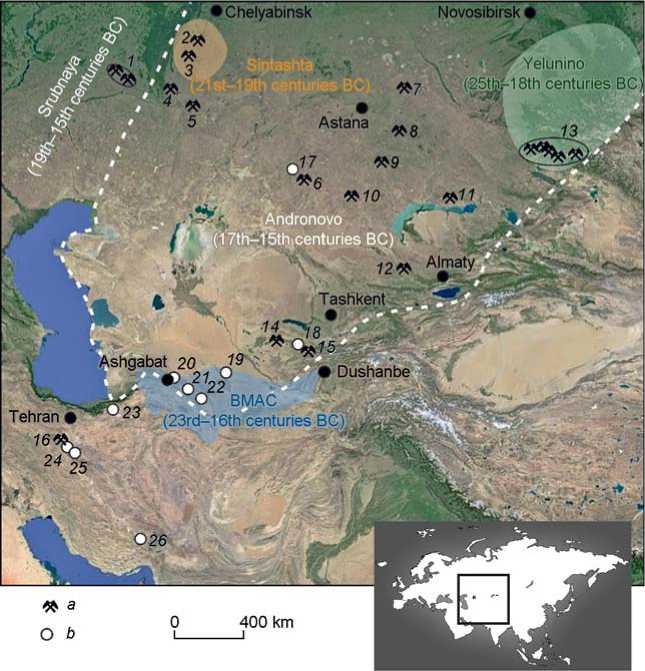
BC), the Andronovo people significantly expanded their area of settlement to the east as far as Altai and China, as well as south to Central and South Asia, including what is now Uzbekistan, Tajikistan, Turkmenistan, India, and Afghanistan (Kuzmina, 1994: 384–391; Chernykh, 2008) (Fig. 1).
There is evidence of trade and economic ties between the carriers of the northern steppe cultures (Sintashta, Andronovo), the Bactria-Margiana oasis civilizations, and the people of the northeastern territories of Iran (Bonora, 2021; Abdi, 2012). It is also advisable to search for the relationships in the
Fig. 1 . The layout of the areas of cultures and some sites mentioned in the article.
a – ancient mines and deposits: 1 – Kargaly ore field, 2 – Novotemirsky, 3 – Vorovskaya Yama, 4 – Ishkininsky, 5 – Elenovsky, 6 – Zhezkazgan, 7 – Bozshakol, 8 – Altyntobe, 9 – Uspenskoye, 10 – Kenkazgan, 11 – Sayak, 12 – Shatyrkol, 13 – Kalba-Narym deposits (Sn), 14 – Karnab (Sn), 15 – Mushiston (Cu, Sn), 16 – Veshnave; b – settlements: 17 – Taldysai, 18 – Tugai, 19 – Gonur-Depe, 20 – Anau, 21 – Namazga-Depe, 22 – Altyn-Depe, 23 – Tepe Gissar, 24 – Tepe Sialk, 25 – Arisman, 26 – Tepe Yahya.
field of metal production: there is an opinion that the incentive for the dispersal of steppe pastoralists of the Late Bronze Age could have been the search for a new mineral resource base (Kuzmina, 2000). This review focuses on the features of mining and metallurgy of the Andronovo communities, their predecessors and neighbours in the adjacent territories, as well as tracking their transformation in the southern direction. Information on
the development of copper deposits, ore types and alloys used is collected on the basis of published archaeological and analytical studies.
Features of Bronze Age mining and metallurgy in the Southern Urals
From the 4th to the 2nd millennium BC, the Southern Urals was a major mining and metallurgical region of Northern Eurasia (Chernykh, 1970: 37–49; 2008). The widespread use of metal products in the 4th millennium BC here was associated with Yamnaya (Pit Grave) communities (Degtyareva, Ryndina, 2019). The main ore base of the earliest ancient metallurgists in the region was the rich copper sandstone stratiform deposits of the Cis-Urals (Kargaly, 2002: 19–24). The primary minerals of the ore bodies of these nearsurface deposits probably consisted of the copper-rich secondary sulfides of chalcocite and covellite. The deposits were developed in the form of small quarries and mines (Ibid.: 25–33). The metal smelted by the Yamnaya communities is mainly represented by pure copper, less often by arsenic bronzes (Degtyareva, Ryndina, 2019).
There is evidence that at around the turn of the 3rd to 2nd millennia BC, the ores derived from these deposits were used by the Abashevo people, who manufactured predominantly arsenic bronze tools (Gorbunov, 2008; Degtyareva, 2009). Copper sandstones were developed most extensively during the Srubnaya (Timber Grave) period, in the 18th–15th centuries BC; in terms of the metal products composition, copper and tin bronze smelting dominated (Kargaly, 2004: 106–133).
The earliest metal items in the Southern TransUrals, recorded at the settlements of the Kysykul-Surtandy culture, date back to the 3rd millennium BC (Krizhevskaya, 1977: 96–99). However, the absence of metallurgical slag fragments dating to this period is explained by the use of native copper (Grigoriev, 2015: 65–94). Large-scale metal production in the Southern Trans-Urals began during the Sintashta period, i.e., around 2100–1900 BC. Oxidized copper ores of volcanic massive sulphide (VMS) and skarn deposits mined here were confined to ultramafic and volcanic rocks (Zaykov et al., 2005; Ankushev et al., 2021). Here, the development was presumably carried out by an open pit, i.e., the upper horizons of the oxidation zone were revealed by small open pits (Zaykov et al., 2005). The most common type of metal used in the Sintashta culture was arsenic copper and bronze, pure copper was less common (Degtyareva, 2009). At the turn of the 3rd to 2nd millennium BC, in the Southern Urals, single imported tin bronze items appeared, associated with the Seima-Turbino transcultural phenomenon (Marchenko et al., 2017).
Chronologically, the Sintashta communities are followed by the Petrovka population, whose relics are considered an early stage of the Alakul culture (Vinogradov, 2017). Analysis of primary ingots and metal products of the Petrovka culture of the Southern Trans-Urals indicates the dominance of pure copper, as well as the beginning of the widespread replacement of arsenic-based bronzes by tin bronze (Vinogradov, Degtyareva, Kuzminykh, 2013). In the Southern Urals, tin dopants were imported because of the complete lack of accessible tin deposits (Grigoriev, 2015: 475–476).
Later, during the 18th–16th centuries BC, the Southern Trans-Urals became a zone of interaction between the Srubnaya and Andronovo (Alakul) communities, which continued to exploit the same deposits as the Sintashta metallurgists, albeit working them by means of shaft mining (Ankusheva et al., 2022). Analysis of metallurgical slags and metal products shows the use of sulfide covellite-chalcocite ores (Avanesova, 1991: 73–83; Artemyev, Ankushev, 2019; Ankushev et al., 2021). The almost complete absence of traces of metal smelting from ores in unfortified Alakul settlements suggests the transfer of this type of activity to specialized settlements or mine workings (Grigoriev, 2015: 502–503; Ankusheva et al., 2022). The composition of metal of the Srubnaya-Alakul communities in the Southern Trans-Urals demonstrates the dominance of copper and tin bronze, often together with lead impurities (Tigeeva, Novikov, Shilov, 2016; Kulevchi VI..., 2020: 486–496).
In the Final Bronze Age (ca 15th–10th centuries BC), the Southern Trans-Urals was inhabited by Cherkaskul, Mezhovka, and Sargary-Alekseyevka communities, who left no evidence of metallurgical redistribution of ores in the settlements. While it is possible that they continued the exploitation of the same deposits, data supporting this hypothesis are sparse (Ankusheva et al., 2022). Metal composition of this period remains poorly investigated; copper and tin bronzes are predominant (Degtyareva, Vinogradov, Kuzminykh et al., 2019).
Bronze Age mining and metallurgy in the territory of Kazakhstan
In Eastern Kazakhstan, the Early-Middle Bronze Age is represented by Yelunino and Alkabek sites, where no evidence of metal smelting has been recorded, but items made of tin and arsenic bronze have been discovered (Merts, 2017: 211–217). At the turn of the 3rd–2nd millennia BC, the presence of the Sintashta and Petrovka population is noted on the territory of Northern Kazakhstan. The metal artifacts are similar to those found at the sites of the Southern Trans-Urals (Shevnina, Logvin, 2015: 131–139, 186–188).
The establishment of mining and metallurgy in Central Kazakhstan is associated with the southward dispersal of the Petrovka (Early Alakul) and Early Srubnaya populations during the first centuries of the 2nd millennium BC (Vinogradov, 2017; Taldysai..., 2020: 206–211). They began to actively develop oxidized (oxide-carbonate) and sulfide (chalcocitecovellite) copper sandstones ores of the Zhezkazgan ore field. Mine workings comprise quarries of various sizes and depths (Margulan, 1966: 266–268). Although the primary smelted metal was copper, arsenic bronze was also widely used. Tin bronze was less common (Taldysai..., 2020: 90). Conversely, in the metal of the Petrovka (Early Alakul) burial sites of Sary-Arka, tin bronze is more widespread than arsenic bronze (Degtyareva et al., 2020).
Later, the Andronovo community, which dispersed widely in Kazakhstan during the mid-2nd millennium BC, can be seen to have exploited various types of copper ores: VMS and copper porphyry deposits in Mugodzhary (Yuminov et al., 2013), copper sandstones of the Zhezkazgan-Ulytau (Margulan, 1979: 233–256), stratiform deposits in terrigenous strata (Altyntobe, Uspensky, Efimovskoye, Kenkazgan), copper porphyry deposits of Central (Bozshakol) and Southern Kazakhstan (Shatyrkol), skarn deposits (Sayak), and many others (Zhauymbaev, 1987; Berdenov, 2008; Agapov, Degtyareva, Kuzminykh, 2012). Of great importance was the development of tin deposits in the pegmatites of the Kalba and Narym ridges, which were the main source of tin for Northern Eurasia (Chernikov, 1960: 118–121). In the settlements of that period, metal artifacts made of copper and tin bronze predominated (Kuznetsova, Teplovodskaya, 1994: 73–84; Kalieva, Kolbina, Logvin, 2016).
In the Final Bronze Age, the development of the same deposits was continued by the Sargary-
Alekseyevka communities, who extracted copper and tin bronze (Agapov, Degtyareva, Kuzminykh, 2012; Degtyareva, Vinogradov, Kuzminykh et al., 2019). It was also at this time that iron metallurgy was born, as evidenced by the slags found at the Kent settlement in Central Kazakhstan, dating back to the 15th century BC (Ankushev et al., 2023).
Bronze Age mining and metallurgy in Central Asia
In Central Asia, metal production associated with the Anau culture appeared in the territory of Southern Turkmenistan in the late 5th–4th millennia BC (in the literature, this period is also referred to as Namazga I–III). At that time, there was only a metal processing centre here, which used imported ore, while all technologies were borrowed from West Asia (Ruzanov, 2013: 284). The next stage in the development of ancient metallurgy falls on the middle-late 3rd millennium BC (coinciding with the Namazga IV and V periods in Southern Turkmenistan). At this time, in Central Asia, independent local metallurgical centers were created, associated with the development of mines, and arsenic bronze appeared (Kuzmina, 1966: 88–90). Rare tin bronze items, which occurred in this region since the 23rd century BC, are associated with Iranian or Afghan sources (Ruzanov, 2013: 88–90).
In the 23rd–16th centuries BC, the vast territory of modern Turkmenistan, Southern Uzbekistan, Afghanistan, and northeastern Iran was occupied by the Oxus civilization (or the Bactria-Margiana Archaeological Complex, BMAC). The best-studied metal items are those from the administrative and religious center of Gonur-Depe; these are primarily made of copper-arsenic alloys, with fewer examples of pure copper and tin bronze (Kraus, 2021). The sources of local copper ore have not yet been definitively identified (Garner, 2021). Presumably, BMAC tin bronzes in the 3rd millennium BC originated from Iranian sources (Berger et al., 2023).
During the second quarter of the 2nd millennium BC, local sedentary farmers interacted with Andronovo communities, which led to the formation of polycultural sites (Avanesova, 2012). The earliest is the specialized metallurgists’ settlement of Tugai. Although the authors of the excavation studies attribute this settlement to the 23rd–20th centuries BC, its material complex has parallels in the Ural-Kazakhstan materials of the Petrovka (Early
Alakul) culture of the early 2nd millennium BC (Avanesova, 2015).
Local ore deposits of various types were widely developed: copper sandstones (Varzyk, Naukat), skarn (Tymsk mines), polymetallic (Vozrozhdennoye, Aktashkan) (Avanesova, 2012; Ruzanov, 2016). Ancient mines were developed by means of open pits and adits during different time periods; their exact dates are not available (Buryakov, Kasymov, Rostovtsev, 1973: 76–84). Mass bronze casting production appeared, and arsenic bronzes were replaced by tin bronzes (Kuzmina, 1966: 90–91). The most important stage of mining in Central Asia was the extraction of tin by Andronovo miners in the Zeravshan ridge deposits (Karnab, Lapas, Changalli, Mushiston), where ancient mines are recorded (Avanesova, 2012; Ruzanov, 2016, Berger et al., 2023).
Andronovo communities also adopted the Central Asian traditions of metalworking (tools and ornaments) (Kuzmina, 1966: 90–98). In the Aral Sea region, during the Late Bronze Age, the Tazabagyab culture was widespread, which was formed as a result of mixing of the local population with the incoming Andronovo communities. Copper and tin bronze artifacts found here were presumably made from local ores (Itina, 1977: 136–137).
Bronze Age mining and metallurgy in the Iranian Highlands
With the start of the Chalcolithic period in ancient Iran around 5500 BC, large-scale production of native copper tools began to spread; the first evidence of copper production from malachite and cuprite dates back to that time (Thornton, 2009; Thornton, Rehren, Pigott, 2009). One of the first dopants used in copper alloys was arsenic (Pigott, 2004). The use of sulfide copper ores and sulfoarsenides began ca 4th millenium BC (Emami, 2014). At the end of that millennium, metal-oriented centers emerged in Sialk, Hissar, and Arisman (Thornton, 2009). The beginning of the use of tin bronzes dates back to the turn of the 4th and 3rd millennia BC in Mesopotamia and Western Iran (regions of Khuzestan and Luristan). The appearance of copper-tin alloys in Luristan at around 3200–2800 BC is a surprising fact, since at many other sites in Iran the complete absence of tin is observed up until the end of the 3rd millennium BC (Ibid.). In the 3rd millennium BC, in Iran, arsenical bronze was widely used, probably obtained as a result of mixing copper and “speiss” FeAs3 (Thornton, Rehren, Pigott, 2009). Intense use of tin and tin bronze in Mesopotamia began in the mid-3rd millennium BC, and in Iran at the end of the 3rd millennium BC (Thornton, 2009). Afghan deposits (Drangiana) are considered the most likely source of tin (Pigott, 1999). During the Bronze Age, VMS, copper-porphyry, and skarn copper deposits were developed in the Iranian Highlands (Momenzadeh, 2004). A striking example of the development of VMS deposits is the ancient mine of Veshnaveh, revealing the evidence of extraction from various eras (Stöllner, Mireskandari, Roustaei, 2011).
The above overview is given in the infographic (Fig. 2). Taking into account the complexity of multicultural interactions of the Bronze Age communities, all geographic and chronological boundaries drawn are approximate. The different extents to which the materials have been studied also introduce a large error in the characterization. The review is based on both AMS and LSC dating, and in the absence of these, on the typological characteristics of culturally identifiable artifacts.
Evidence of interaction of the Andronovo communities with the population of the Iranian Highlands in terms of metallurgy
The Bronze Age technologies of mining and metallurgy in the territory of the Southern Urals, Kazakhstan, Central Asia, and the Iranian Highlands passed through the developmental stages typical of the entire Central Eurasian region. The most archaic forms of copper mining were limited to the search for native metal. Later, the upper horizons of the oxidation zone of copper deposits began to be mined in open pit workings. Finally, rich sulfide ores of the secondary enrichment zone started to be exploited using the shaft method. So far, there is no evidence of the massive use of chalcopyrite ores here. The order of changing various metals is similar: copper – arsenic bronze – tin bronze – iron. However, the onset and duration of these periods vary in different communities. One of the earliest attempts in obtaining arsenic bronze, which dates back to the second half of the 5th millennium BC, was recorded by the discovery of an awl in Tepe Yahya (Southern Iran) (Thornton, 2010). Despite this, the use of native copper did not give way to arsenic bronze for several more centuries. Tin bronzes, first appearing in Luristan only in the late 4th millennium, did not become widespread for another thousand years, too (Oudbashi, Emami, Davami, 2012). This long period of time was dominated by copper and arsenic bronzes.
There is evidence of relationships between the Andronovo communities with the Oxus civilization and the agricultural societies of Central Asia on the territory of modern Turkmenistan, Uzbekistan, Kyrgyzstan, and Tajikistan (Avanesova, 2012; Ruzanov, 2013: 89, 269, 273, 278; Bonora, 2021). Based on the typology and compositional features of the products, E.E. Kuzmina suggests the penetration of Andronovo metal into Central Asia, explaining the replacement of arsenic bronze by tin bronze by the expansion of Indo-Iranian peoples (1994: 141, 155). Other researchers believe that tin bronze appeared on the territory of Central Asia before the first contacts between farmers and pastoralists, at the end of the 3rd millennium BC, and was associated with Iranian imports and active trade and production ties (Ruzanov, 2013: 88–90; Biscione, Vahdati, 2021). However, the widespread mining of tin ores in Eastern Kazakhstan and Central Asia was associated exactly with the dispersal of Andronovo communities (Chernikov, 1960: 118–121; Berger et al., 2023).
Evidence of the direct influence of Central Asian and northeastern Iranian farmer cultures on the metal production of steppe cattle breeders remains rather scanty. For example, some Andronovo ornaments show similarities with more ancient items of the Southeastern Caspian region (Kuzmina, 1966: 84–85). During the excavations of the Deh Dumen cemetery (second half of the 3rd millennium BC) in Southwestern Iran, wide-necked bronze vessels of a type previously found in Luristan and Susa were discovered (Oudbashi, Naseri, Malekzadeh, 2016). Although the shape of these vessels is not similar to the local pottery, it resembles the Early Alakul vessels from Kazakhstan (Degtyareva, Kuzminykh, Loman et al., 2019).
Conclusions
Modern archaeological research proves pronounced contacts between steppe pastoral and agricultural communities of Central Asia. There were definitely trade connections between the Central Asian population and the inhabitants of the Iranian plateau in the Bronze Age. So far, no direct material evidence has been found of the mass dispersal of steppe products and technologies to the southwest beyond
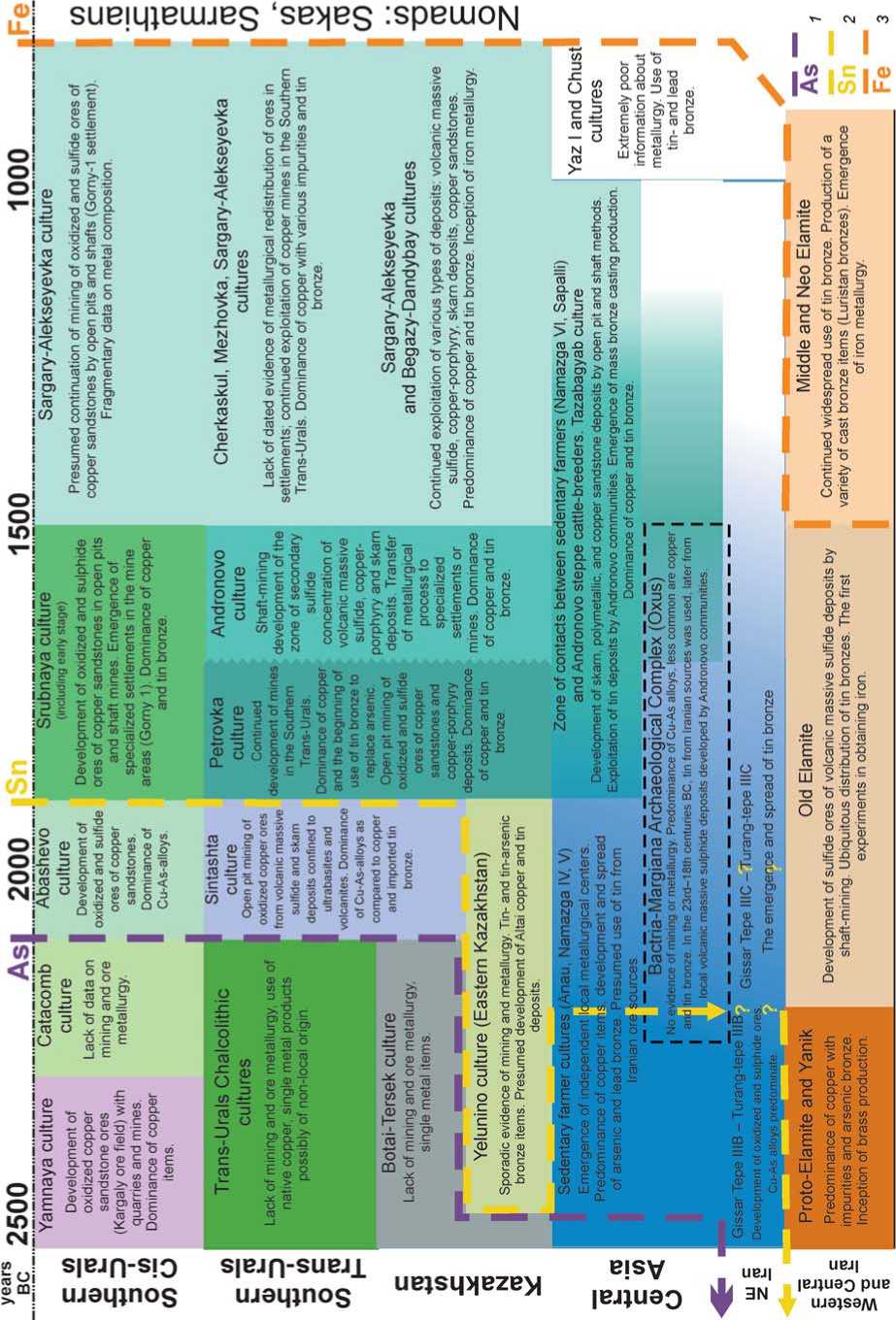
Fig. 2 . Features of mining and metallurgy of Central Eurasia in the second half of the 3rd–2nd millennia BC. 1 , 2 – distribution of arsenic bronze and tin bronze, respectively; 3 – distribution of iron.
the Kopetdag. The most promising sites to search for such evidence are the BMAC sites in northeastern Iran (Biscione, Vahdati, 2021). At archaeological sites of the second half of the 2nd millennium BC on the Jajrom plain in North Khorasan, molded ceramics with carved geometric ornamentation are found, which show parallels to decoration of vessels of steppe communities (Vahdati, 2020).
Analytical methods are likely to be of little help in studying the interaction of metallurgical technologies of northern cattle-breeding and southern agricultural Bronze Age societies. Only mass typological studies of the collections of metal products found in the territory of the Iranian Highlands, along with artifacts of other types, in particular ceramics, can help in solving this issue.
Acknowledgement
The study was carried out within the budget topic No. 125013101191-9 of the South Urals Federal Research Center of Mineralogy and Geoecology, Ural Branch, Russian Academy of Sciences, and supported by the Russian Foundation for Basic Research and the Iran National Science Foundation, Project No. 20-59-56007.
