
Method for evaluating self-healing in cement composites via permeability variation analysis
Journal: Construction of Unique Buildings and Structures @unistroy
Article in issue: 6 (120), 2025.
Free access
The research object is a novel method for evaluating the self-healing capacity of cementitious composites incorporating cementitious capillary crystalline waterproofing (CCCW) admixtures, specifically using cement paste and concrete specimens with artificially created through-channels simulating cracks. The research method involves preparing cylindrical specimens (26 mm diameter, 140 mm height) with a controlled 0.4 mm diameter axial channel formed by a removable polyamide-6 string, followed by qualitative (visual air bubble observation) and quantitative permeability assessments after 65 days of wet curing, employing the BB-2 vacuum device for air permeability and the UVF-6 installation for water penetration depth under pressure in accordance with GOST 12 730.5. The results demonstrate that specimens with the CCCW admixture (Krystaline Add1) exhibited significant self-healing, with specific compositions achieving a water resistance grade of W8 and partial or complete channel sealing.
Similar articles in the section Glass industry. Ceramics. Cement and concrete
Short address: https://sciup.org/143185615
IDS: 143185615 | DOI: 10.4123/CUBS.120.1
Метод оценки самовосстановления цементных композитов с помощью анализа изменения проницаемости.
Объектом исследования является новый метод оценки способности к самовосстановлению цементных композитов, содержащих цементные капиллярно-кристаллические гидроизоляционные добавки (ЦККГ), в частности, с использованием образцов цементной пасты и бетона с искусственно созданными сквозными каналами, имитирующими трещины. Метод исследования включает подготовку цилиндрических образцов (диаметр 26 мм, высота 140 мм) с контролируемым осевым каналом диаметром 0,4 мм, образованным съемной нитью из полиамида-6, с последующей качественной (визуальное наблюдение воздушных пузырьков) и количественной оценкой проницаемости после 65 дней влажного твердения с использованием вакуумного устройства ББ-2 для измерения воздухопроницаемости и установки УФФ-6 для измерения глубины проникновения воды под давлением в соответствии с ГОСТ 12 730.5. Результаты показывают, что образцы с добавкой ЦККГ (Кристалинная добавка 1) продемонстрировали значительное самовосстановление, при этом определенные составы достигли степени водостойкости W8 и частичной или полной герметизации каналов.
Text of the scientific article Method for evaluating self-healing in cement composites via permeability variation analysis
-
1 Introduction
Self-healing concrete has been observed in natural forms since the 19th century, with the first documented case of autogenous healing reported in 1836 by the French Academy of Sciences. However, active research into engineered self-healing mechanisms, such as the incorporation of capsules or bacteria, began in the early 1990s. The field gained momentum in the 2000s with developments in biobased and chemical healing agents, leading to exponential growth in studies from the 2010s onward [1]. The reviews [2] and [3] show that self-healing concrete can heal and reduce the need to locate and repair internal damage (e.g., cracks) without external intervention. The review [4] focuses on the technology of creating autonomous self-healing concrete using a biological crack-healing mechanism. The research methods consisted of four main stages: an analysis of previously conducted global studies; ecological and economic analyses; a discussion of the prospects and advantages of further studies; and conclusions. A total of 257 works from about 10 global databases were analyzed in this review [4].
The experimental investigation [5] assesses the influence of varying ratios of calcite and sand on the mechanical and microstructural characteristics of self-healing concrete, employing Hay Bacillus as a catalyst to initiate calcite precipitation. This study employs Hay Bacillus as a catalyst for initiating calcite precipitation within the concrete matrix. The experimental investigation assesses the influence of varying ratios of calcite and sand on the mechanical and microstructural characteristics of self-healing concrete. The results [6] show that the optimal type of bacteria was Bacillus subtilis, and that a 3% concentration of Bacillus subtilis can increase the beam's capacity by 20.2%.
The study [7] aimed to develop a self-healing concrete using low calcium fly ash and partially replaced recycled aggregate, resulting in decreased concrete strength.
A similar approach was employed for the in-situ crack-healing method of encapsulated rejuvenator technology to enhance the insufficient self-healing capability of asphalt concrete [8]. It was determined that the encapsulated rejuvenator was acceptable for mending asphalt mixes because it increased the healing temperature and duration, resulting in a healing index of up to 80% [9].
The large amount of data accumulated by various researchers on the self-healing of concrete can now be better studied using machine learning methods based on this data to predict the properties and design of self-healing concrete [10], as well as through fractal analysis [11].
In particular, a cementitious capillary-crystallization waterproofing material (also called CCCW) can serve as an efficient self-healing agent, effectively repairing damage in concrete structures and thereby extending their service life. The influence of the joint action of sulfate erosion and cementitious capillary crystalline waterproofing materials on the hydration products and properties of cement-based materials was reviewed in [12]. It was concluded that cementitious capillary crystalline waterproofing materials in clean water can heal 0.4–0.5 mm cracks in cement-based materials. At the same time, sulfate attack will reduce the healing degree of cementitious capillary crystalline waterproofing materials on cement-based materials. Under sulfate erosion, cementitious capillary crystalline waterproofing materials can heal 0.3 mm cracks in cement-based materials. Cementitious capillary crystalline waterproofing materials generate solids through the reaction of osmotic crystallization and hydration products, filling pores and refining the pore size of cement-based materials. Consequently, the pore structure is finned, and the impermeability of cement-based materials is improved. The water permeability of concrete coated with cementitious capillary crystalline waterproofing materials is 20.6% lower than that of concrete coated without such materials [13].
1.1 Methods for measuring the water permeability of concrete
In studies of self-healing concrete, various methods are used to assess its water permeability. The EN 12390-8 standard [14] determines concrete water tightness by measuring the depth of water penetration under pressure in hardened concrete. The method assesses the depth of water penetration under pressure in concrete specimens after exposure to controlled pressure. Specimens are subjected to a hydrostatic pressure of 0.5 MPa (5 bar) for 72 hours on one face. Water tightness is expressed in millimeters.
EN 12390-8 is used for concrete quality control in construction and differs from the Russian State Standard GOST 12730.5 [15], which grades water tightness by pressure without penetration.
In [16], the effectiveness of a specific crystalline waterproofing admixture in concrete, as a function of the water–binder ratio, was investigated. Water permeability and compressive strength were tested on hardened concrete specimens, and self-healing of cracks over time was observed. Cement paste and crystalline waterproofing admixture paste were prepared to clarify the results obtained on concrete specimens and to explain the mechanism of crystalline waterproofing admixture action. The microstructure of the cement paste samples was studied by scanning electron microscopy. Chemical analysis of selected areas was performed using SEM-EDS. X-Ray Diffractometer analysis was carried out on unhydrated samples of cement and crystalline waterproofing admixtures, and on hardened cement paste samples after 56 days of hydration. Fourier transform infrared spectroscopy of the unhydrated samples of cement and crystalline waterproofing admixtures, and the paste samples after 95 days, was recorded. The concrete specimens were cured for 28 days (as prescribed in the mentioned EN 12390-8 standard). It was concluded that the addition of crystalline waterproofing admixture improves the crack healing in concrete.
The self-healing behavior of engineered cementitious composites was evaluated by water impermeability, recovery of mechanical properties, and crack closure [17]. The test results showed that the recovery of mechanical properties and water impermeability in engineered cementitious composites was improved by directly adding a capillary crystalline waterproofing material. The cylindrical specimens for testing the recovery of impermeability were pre-cracked using a splitting test. The testing machine applied the load, and the pre-loaded process used displacement control at a rate of 0.75 mm/min. The pre-loading process was completed when the displacement reached about 5 mm. The specimens were then removed for self-healing tests. A water permeability test was performed before and after self-healing in three exposure environments. The specimens were placed in the PVC tube and sealed with glass glue to ensure that water entered only through the upper surface before the test. Then, the change of head height in a specific time interval was recorded. The water penetration test was performed on the identical pre-loaded specimens before and after self-healed curing to determine the recovery of impermeability Kuzminov, O.; Vatin,N.
Method for evaluating self-healing in cement composites via permeability variation analysis;
caused by cementitious capillary crystalline waterproofing materials and environments. The test setup and process for the water permeability test were similar to those in the relevant studies [18], [19].
The water absorption capacity of concrete panels and their self-healing process were studied by incorporating admixtures into the concrete or applying them to the surface [20]. Through permeability tests, water absorption by immersion and capillarity, after wet curing, the panels with crystalline admixtures applied superficially showed lower absorption capacity, followed by those without admixtures and by those with admixtures incorporated into the concrete, which showed greater absorption. Microscopy characterization was performed on the panels split in half; it was observed that the crystallization of the panels with superficial admixtures was more advanced than that of those with incorporated admixtures. The induced fissures did not reach full pore filling in either application type after curing. To verify the impermeability and self-healing effect in concrete panels, an experimental procedure was developed to induce fissures across the entire thickness of the panel. The thickness of the created artificial cracks was determined in accordance with NBR 6118:2014 [21], which limits the maximum permissible fissure dimension to 0.4 mm in reinforced concrete structural elements.
The test to determine the water permeability was performed using the Karsten tube. This test was carried out in accordance with NBR 14992:2003 standard [22], which specifies such verification for Portland cement-based mortars for grouting ceramic tiles. The Karsten tubes were placed on the concrete panels, and their lateral bases, which were in contact with the panels' faces, were sealed with polyurethane. Each tube was fixed 10 cm from the edges, with a 30 cm spacing between the tubes; thus, two tubes per panel. The Karsten tubes were filled with water to the predefined volume of 3.5 ml, and the level measurements were performed after 60, 120, 180, and 240 minutes. Each panel had two points of permeability measurement.
NBR 6118:2014 [21] and NBR 14992:2003 [22] are Brazilian national standards issued by ABNT, the Brazilian Association of Technical Standards (Associação Brasileira de Normas Técnicas). NBR 6118:2014 regulates the design of concrete and reinforced concrete structures. NBR 14992:2003 specifies requirements and test methods for Portland cement-based grouts used to fill joints between ceramic tiles on walls and floors. The standard covers properties such as water retention, consistency, compressive strength, adhesion, water absorption, and permeability for hardened grout.
In [23], the chemical composition of cementitious capillary crystalline waterproofing agents was developed by using the water penetration resistance test method. Five effective components were obtained: ethylenediaminetetraacetic acid, L-aspartic acid, sodium sulfate, sodium silicate, and nanosilica. The permeability experiments are conducted to demonstrate the effectiveness of the waterproofing agent components in resisting water permeation. Apparatus DY-HS16QZ-5F, China, was used to study impermeability. The apparatus operates by applying controlled hydraulic pressure to concrete samples and measuring the depth or rate of water ingress over a specified period.
In [24], the optimization of concrete mix design was achieved by employing microcapsules with a water-repellent agent core acting as a sealing agent and polyurethane as the shell material. The measurement of impermeability pressure is carried out according to the step-by-step compression test method in the Standard for test methods of long-term performance and durability of ordinary concrete (GB/T50082–2009) [25].
In [26] various doses of XYPEX-type cementitious capillary crystalline waterproofing materials and self-healing treatments via internal and external doping were administered of cement-based materials. The mechanical characteristics, mineral phases, and pore structures of the samples were characterized, and the self-healing process was assessed through strength tests and a series of microscopic analyses. The enhancement in specimen mechanical properties correlated with microstructure refinement, leading to increased hydration product generation, microcrack filling, and diminished macropore volume.
The Mercury Intrusion Porosimetry method, as described in ASTM D4404-10 [27], was used to evaluate porosity and pore-size distribution in concrete specimens, as in [28] and [29]. This method measures the volume and distribution of pores based on the apparent diameter of their entrances. Prior to testing, fully hydrated samples were dried in a vacuum desiccator for 7 days to ensure optimal test conditions [30]. ASTM D4404-10 is the Standard Test Method for Determination of Pore Volume and Pore Volume Distribution of Soil and Rock by Mercury Intrusion Porosimetry. The method measures pore volume and pore-size distribution by forcing mercury into sample voids under increasing pressure, covering pore-entry diameters from about 100 µm to 2.5 nm. Mercury serves as the probe liquid due to its non-wetting behavior with most solid surfaces, typically exhibiting a contact angle of 130–150°. This property requires applied pressure to intrude into pores, with smaller pores requiring higher pressure per the Washburn equation, enabling precise pore-size calculation from intrusion volume versus pressure. Kuzminov, O.; Vatin,N.
Method for evaluating self-healing in cement composites via permeability variation analysis;
Other liquids fail this role because they wet surfaces (contact angle near 0°), spontaneously filling large pores without pressure and preventing controlled intrusion into smaller ones. Mercury also offers chemical stability, low vapor pressure under test conditions, high density for accurate volumetrics, and access to a broad pore range (3 nm to 1000 µm) via pressures up to 400 MPa.
The impact of different mixing methods for cementitious capillary crystallization waterproofing material (including internal mixing, curing, and post-crack repair) on the multi-dimensional self-healing performance of concrete was investigated in [31]. The self-healing capacity of concrete was evaluated through water-pressure, freeze–thaw, mechanical-load, and crack-damage self-healing tests. The results show that the curing-type CCCW mixing method exhibited the best self-healing effect in repairing waterpressure, freeze–thaw, and load-induced damage. The internally mixed cementitious capillary crystallization waterproofing material method was also effective for repairing load damage in concrete. In contrast, the repair-type cementitious capillary crystallization waterproofing material mixing method demonstrated the weakest repair effect on this type of damage.
According to the permeability test requirements specified in standard [32], the test procedure was as follows. Before the first permeability test, the test specimens were dried, and their sides were sealed with wax and rosin. The specimens were then mounted on the concrete permeability tester (Schenck Weijie Instrument Equipment Co., Ltd., Beijing, China). Water pressure was increased by 0.1 MPa every 8 h, and water seepage at the top of the specimens was monitored in real time. The seepage pressure was recorded. When all specimens exhibited seepage, the test was concluded, and the seepage pressure of the third specimen was reduced by 0.1 MPa, which was recorded as the first permeability pressure of the concrete (28 days). The tested specimens were then demolded and cured. The second permeability pressure (56 days) was tested following the same procedure as the first.
1.2 Methods of creating artificial cracks or channels
The method of creating artificial cracks or channels using temporary inserts (plates, wires, or threads) is used in self-healing studies to ensure high-precision defect parameters (width and depth), which is difficult to achieve with conventional cleavage. The method of creating artificial cracks is the opposite of the method of creating cracks by compressive stress or tensile splitting of the test specimen. Below are examples of publications and method descriptions that have used this approach.
In [33], concrete samples were made by using ordinary Portland cement CEM I 52.5 N. Artificial cracks were introduced into concrete samples measuring 160 mm × 160 mm × 70 mm. A thin copper plate, 0.3 mm thick, was introduced into the fresh concrete paste to a depth of 10 mm or 20 mm. The plates were removed during demoulding after 24 h, resulting in prisms with a narrow groove on the upper surface, 10 mm or 20 mm deep and 0.3 mm wide.
In [34], the crack length was set at 20 mm, and the effects of self-healing of different cracks were investigated for different crack widths and depths. Cubic standard cement mortar specimens with an edge length of 40 mm were prepared. Concrete cracks were created using a thin pre-set steel plate of 0.5 mm, 1 mm, 2 mm, and 3 mm thickness, coated with lubricant. The plate was fixed vertically in the middle of the mold during concrete casting. After casting for three hours, the steel plate was slowly pulled vertically but not removed. After six hours of casting, the bridge-type steel piece was removed from the concrete specimen. In this study, concrete pre-set cracks with widths of 0.5 mm, 1 mm, 2 mm, 3 mm, and depths of 10 mm, 20 mm, and 30 mm were created. After curing the specimens in a standard curing room for 28 days, they were cleaned to ensure the prefabricated cracks remained intact, clean, and free of impurities and loose materials.
The fissures were induced in the panels by inserting two 0.4 mm-thick aluminum sheets, which were introduced into each panel shortly after concreting and removed after 48 hours of concreting, when their fluidity was not able to cause closure of the fissure [20]. The sheets were 0.4 mm thick.
1.3 The aim of the study
The analysis presented shows that various methods for measuring water permeability are used to assess the self-healing properties of concrete, including cementitious capillary crystallization, waterproofing materials, and other self-healing methods. These methods use both standard and proprietary methods. These proprietary methods allow one to determine relative water permeability compared to control samples not subjected to self-healing. Attention should be paid to the method of crack formation. Creating artificial cracks allows for the most accurate determination of the degree and nature of concrete self-healing. However, publications on the creation of artificial cracks are too limited to provide proven technologies for optimizing concrete self-healing parameters.
This study aims to develop a method for creating artificial cracks, in conjunction with a rapid, costeffective method for quantifying the decrease in concrete water permeability resulting from self-healing concrete.
2 Materials and Methods
2.1 Materials
Ordinary Portland cement and tap water at +20 °C were used to prepare the cement paste in this study. The tap water in St. Petersburg, Russian Federation, is supplied from the Neva River and undergoes multi-stage purification, including ultraviolet treatment, dosing with sodium hypochlorite, and activated carbon filtration. The chemical parameters are pH 7.5 (norm 6.5 to 9.5), total hardness 1.54 mg-eq per L (norm up to 7.0, soft water), chlorides 5.1 mg per L (norm up to 350), sulfates 42.0 mg per L (norm up to 500), mineralization 323 mg per L (norm up to 1000), iron 0.24 mg per L (norm up to 0.3), manganese 0.059 mg per L (norm up to 0.1). As a component in concrete preparation, such water is suitable according to Russian state standard GOST 23732-2011 [35] (low levels of harmful impurities, neutral pH, no excesses of salts).
2.2 Samples
Krystaline Add1 [36], [37] was used as a concrete additive. Krystaline Add1 is a cementitious capillary crystallization waterproofing admixture (also called CCCW) based on C-S-H (calcium silicate hydrate) material, designed to waterproof and enhance the durability of concrete by improving cement paste hydration. It forms insoluble gels and crystals that fill pores, capillaries, and microcracks, making the concrete impermeable to water while also acting as a plasticizer and set retarder, suitable for contact with water. The typical dosage is 1 kg per 1 m³ of concrete. It is added directly to the concrete or mortar mix for uniform distribution and is compatible with a wide range of concrete compositions, making it provenly effective across various projects. This additive maintains its self-healing properties throughout the concrete's service life. The manufacturer of the Krystaline Add1 concrete additive is Krystaline Technology S.A. The company's address is Calle Nicolás de Bussi, 52, 03203 Elche (Alicante), Spain.
The Composition 1 to one m3 was as follows: Portland cement CEM I 52.5N 1240 kg, water 612 kg, Krystaline Add1 1 kg, water/cement ratio 0.5.
The Composition 2 to one m3 was as follows: Portland cement CEM I 42.5R 313 kg, water 197 kg, sand 1989 kg, Krystaline Add1 1 kg, water/cement ratio 0.6.
The specimens were cement paste cylinders and concrete cylinders, both 26 mm in diameter and 140 mm in height. The testing site was St. Petersburg Polytechnic University, St. Petersburg, Russian Federation.
A defect in the form of a cylindrical channel simulating a crack was created along the cylinders' axes. The channel diameter was 0.4 mm. The defect was created using a smooth-surfaced cylindrical string made of polyamide-6. Figure 1 shows the overview of the samples.
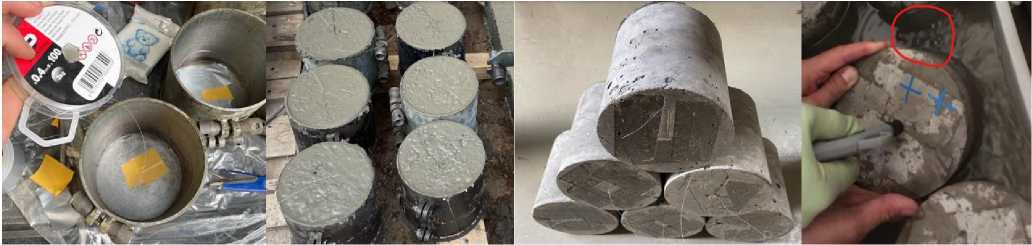
Fig. 1 - Testing samples
2.3 Test Methods
The testing site was St. Petersburg Polytechnic University, St. Petersburg, Russian Federation. The axial permeability of the specimens was assessed using both qualitative and quantitative methods. The lateral surfaces of the specimens were waterproofed and impermeable. Qualitative tests included visual observation of air and liquid passage through an artificial crack running through the specimen, such as the appearance of air bubbles in water or the recording of leaks. Quantitative measurements were conducted using specialized equipment. A BB-2 device and an electric compressor (capable of up to 400 kPa) were used to generate air pressure. The BB-2 device (often referred to as a device of the "AGAMA" type) is a portable laboratory and field instrument for rapid assessment of concrete water impermeability (permeability) using the vacuum method, based on measuring the air permeability of the surface layers. The manufacturer of the BB-2 device is Dorstroypribor, St. Petersburg, Russian Federation.
For water, a UVF-6 installation was used to determine the depth of water penetration under pressure. The UVF-6 installation is a laboratory test stand (equipment) designed for determining the water impermeability of concrete samples. It is primarily intended for tests using the "wet spot" method (observing the appearance of water on the upper surface of the sample as pressure is gradually increased) and for calculating the filtration coefficient, in accordance with the requirements of Russian state standard GOST 12730.5 [15]. The manufacturer of the UVF-6 installation is LLC "Kontros" (full name: LLC Engineering and Technical Center for Quality Control Means in Construction "Kontros"), Solnechnogorsk, Moscow Region, Russian Federation.
-
3 Results and Discussion
The six specimens for every composition were produced using formwork with a fixed string to create a through-channel. After production, stripping, and string removal, a qualitative air-permeability test was performed by observing the presence or absence of bubbles at the lower end of the immersed specimen while forcing air onto the upper end surface using a hand pump. The specimens were kept horizontally in water for 65 days, after which a qualitative air permeability test was performed, followed by a quantitative air permeability test using a BB-2 device and a quantitative test using a UVF-6 installation.
The six specimens with Composition 1 maintained full breathability throughout their lifespans (6 of 6 samples with bubbles), corresponding to a water resistance rating of W0.
Three of the six samples from Composition 2 became thoroughly breathable after 65 days, demonstrating a water resistance rating of W8.
Thus, the experimental results demonstrated that the use of an artificial crack in the form of a through cylindrical hole in cylindrical specimens enables the demonstration of the self-healing effect of a cementitious capillary crystallization waterproofing admixture, allowing both qualitative and quantitative determination of concrete permeability after the admixture's action. These results will enable the carrying out of larger-scale experiments, as detailed in the publication. [38].
-
4 Conclusions
The following conclusions follow from the obtained results.
-
1. A method for assessing the self-healing capacity of cementitious materials was developed and tested. This method is based on monitoring changes in permeability through artificially created holes of controlled diameter. This approach allows for the production of standardized samples with model cracks, ensuring high accuracy and reproducibility of results. The method was applied to samples of cement paste, mortar, and concrete, enabling a comprehensive assessment of the self-healing properties of these materials.
-
2. The methodology was successfully tested both in laboratory and field conditions. [38].
-
5 Fundings
Funding: This research was supported by a grant from the Russian Science Foundation No. 2444-20012, https://rscf.ru/en/project/24-44-20012/.
-
6 Conflict of Interests
The authors declare no conflict of interest.
