
Методология формирования и практические инструменты учебно-методических комплексов для подготовки кадров предприятий нефтехимического комплекса
Журнал: Informatics. Economics. Management - Информатика. Экономика. Управление.
Рубрика: Образование
Статья в выпуске: 5 (1), 2026 года.
Бесплатный доступ
Статья посвящена комплексному анализу процесса проектирования учебно-методических комплексов (УМК) для персонала, работающего на опасных объектах нефтехимического производства. Рассматриваются психолого-педагогические особенности обучения взрослых, занятых в условиях повышенного риска, и их влияние на выбор форм и методов образовательной деятельности. На основе синтеза теоретических положений андрагогики и обширного банка практических разработок представлена классификация и дана подробная характеристика интерактивных методов обучения: фронтальной, индивидуальной, парной и групповой работы. Особое внимание уделено методу кейсов как инструменту формирования профессионального мышления и навыков принятия решений в чрезвычайных ситуациях. Предложен структурированный подход к разработке УМК, включающий шаблон сценарного плана, обеспечивающий технологичность и воспроизводимость образовательного процесса. Материал иллюстрирован конкретными примерами заданий, адаптированных к реальным технологическим процессам и производственным ситуациям.
Похожие статьи в разделе Воспитание и обучение с учетом индивидуальных особенностей. Консультирование





Короткий адрес: https://sciup.org/14135120
IDS: 14135120 | DOI: 10.47813/2782-5280-2026-5-1-5039-5046
Текст статьи Методология формирования и практические инструменты учебно-методических комплексов для подготовки кадров предприятий нефтехимического комплекса
DOI:
The current stage of industrial development is characterized by the increasing complexity of technological processes, higher requirements for industrial safety, and the need for continuous professional development of personnel. Enterprises in the chemical, oil and gas, energy, and metallurgical industries belong to the category of hazardous petrochemical production facilities, where equipment operation involves the use of flammable liquids, combustible gases, toxic substances, as well as processes conducted at high temperatures and pressures. In such conditions, an error by an operator, technologist, or maintenance worker can lead to severe consequences: accidents, production shutdowns, threats to human life, and significant economic losses.
The traditional system of professional training, focused primarily on the transmission of theoretical knowledge, often proves insufficiently effective for an adult audience that already has practical work experience. As researchers in the field of andragogy rightly note [1-3], an adult learner is fundamentally different from a university student: they possess a formed worldview, professional experience, a high degree of responsibility, and, most importantly, a need for the immediate practical application of acquired knowledge. Ignoring these features leads to decreased motivation, a formal attitude towards learning, and, consequently, insufficient preparedness of personnel to act in emergency situations.
In this regard, there is an objective need to create a new generation of educational and methodological complexes that are focused not on mechanical memorization of information, but on the development of professional thinking, collective decision-making skills, and the ability to act under conditions of uncertainty. The development of such tools requires the creator (EMC developer) not only deep knowledge of the subject area but also mastery of modern pedagogical and andragogical approaches, an understanding of the psychology of the adult learner, and the ability to design an interactive educational environment.
MATERIALS AND METHODS
This study aims to synthesize the theoretical foundations and practical experience of creating EMCs for personnel at hazardous petrochemical production facilities. The material presented in the work is based on a synthesis of two sources: firstly, on theoretical principles examining key concepts of adult education, the taxonomy of educational goals, and the classification of work forms; secondly, on an extensive bank of practical developments, including scenarios for frontal sessions, individual tasks, exercises for pair and group work, as well as a set of educational cases as close as possible to real production situations.
The design of any training course must begin with a deep understanding of who its target audience is. In the case of personnel at hazardous petrochemical production facilities, we are dealing with people whose psychological profile differs significantly from that of full-time university or college students [4-5].
The first and perhaps most significant characteristic is responsibility. An adult, especially one employed in hazardous production, is accustomed to being accountable for the results of their work, the safety of colleagues, and the serviceability of equipment. This responsibility shapes a special attitude towards learning: it is perceived not as an abstract academic process, but as a tool for solving real production problems. The adult learner is characterized by a pragmatic attitude toward the learning process, manifested in an unwillingness to spend time studying theoretical material that has no obvious connection to practical activity. The criterion for the value of knowledge for this category of students is the possibility of its immediate application to work tasks in the short term.
The second crucial feature is the presence of life and professional experience. An experienced worker attending a refresher course already has their own worldview, their own ideas about how equipment works and how one should act in certain situations. This experience can be both positive and contain erroneous stereotypes. The task of the developer and instructor is not to ignore this experience or enter into confrontation with it, but to carefully integrate new knowledge into the existing cognitive structure. This requires special delicacy and the use of methods that allow the learner to independently arrive at new conclusions, drawing on their own experience.
The third characteristic is high demands on the quality of the material. An adult sent for training by an employer is extremely sensitive to "emptiness" in the content. They will not patiently listen to lengthy discussions irrelevant to the matter. Their tolerance for "information noise" is minimal. This means that the educational material must be as concentrated, structured, and free of fluff as possible.
Finally, the adult learner possesses a high degree of independence and a need for self-realization. They are not satisfied with the role of a passive listener. It is important for them to have the opportunity to express their opinion, propose their own solution, and share experiences with colleagues. An educational process built solely on the instructor's monologue is perceived as disrespectful and quickly demotivates.
From these psychological features, the key principles of organizing adult education emerge: principle of meaningful learning: the adult must understand why they are studying this material and how they can apply it; principle of independence: the learner must be given the opportunity to independently set goals, choose methods of work, and evaluate results; principle of practical orientation: theory must be inseparably linked with practice and illustrated with concrete production examples; principle of relying on experience: new material must be integrated into the context of the learner's existing professional experience [6-7].
One of the most productive models explaining the process of assimilating new experience by an adult is the learning cycle proposed by David Kolb (Fig. 1).
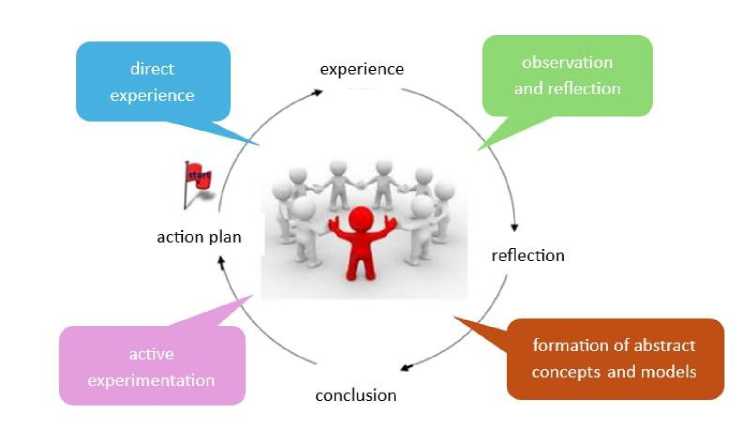
Figure 1. The Learning Cycle (D.Kolb)
The first stage is concrete experience. A person encounters a new situation, problem, or task. In the context of training personnel for hazardous petrochemical industries, this could be a simulation of an emergency, an analysis of a real incident, or even a demonstration of a physical process. It is important that this experience is emotionally charged and arouses cognitive interest.
The second stage, reflective observation, involves the learner's cognitive processing of the acquired experience. This phase is characterized by an analysis of the events that transpired, an inquiry into their underlying causes, and an examination of the factors that determined the outcome. To facilitate this analytical process, it is essential to establish an environment conducive to discussion, the exchange of perspectives, and the formulation of hypotheses. Within this framework, the instructor's role transitions from a purveyor of definitive answers to that of a facilitator who guides the reflective discourse.
The third stage is abstract conceptualization. Based on the analysis and reflection, general principles, patterns, and rules are formulated. This is precisely where introduction to theory occurs, but this theory is perceived not as something alien and externally imposed, but as a generalization and systematization of the learners' own observations and reflections. This stage can be implemented in the format of a mini-lecture, work with an educational text, or constructing a flowchart.
The fourth stage is active experimentation. The formulated concepts are tested in new conditions, applied to solve similar or more complex problems. This could involve solving a calculation problem, composing an algorithm of actions, or performing an exercise on a simulator. Successful application of new knowledge in practice reinforces it and completes the cycle, after which the process can be repeated at a new level of complexity.
The value of Kolb's model for developing EMCs lies in its provision of a clear structure for designing any educational session, whether a two-hour seminar or a multi-day course. A session built according to this cycle guarantees the passage of all necessary stages of assimilation: from the initial impression to conscious application.
To ensure the educational process is purposeful and measurable, it is necessary to clearly formulate what specific results we expect from learners. A powerful tool for this is Benjamin Bloom's taxonomy - a classification of levels of mastery of educational material [8-9].
According to the taxonomy, the cognitive process passes through six successive levels, from simple to complex:
-
1. Remembering: The learner can list, name, describe, define. For example, list the main types of shut-off and control valves or name the permissible operating parameters of a heat exchanger.
-
2. Understanding: The learner can explain, interpret, give an example. For example, explain why a hydraulic shock occurs when a valve is closed quickly.
-
3. Applying: The learner can calculate, solve, apply a rule. For example, calculate the reagent consumption for purifying a given volume of feedstock.
-
4. Analyzing: The learner can compare, contrast, identify causes. For example, analyze vibration diagnostics data and determine the likely cause of increased pump vibration.
-
5. Evaluating: The learner can argue, assess, make a judgment. For example, evaluate the economic efficiency and safety of applying different technological solutions.
-
6. Creating: The learner can develop, propose, plan. For example, develop a plan for eliminating an emergency situation or compile a pre-startup equipment checklist.
Different forms of work (frontal, individual, pair, group) contribute to varying degrees to achieving these levels of mastery. For instance, frontal work with interactive elements is most effective for forming knowledge and understanding. Individual work is well-suited for practicing application skills and conducting assessment. Pair work promotes deeper understanding through mutual explanation. Group work and case studies are optimal tools for developing skills in analysis, evaluation, and creation. Conscious use of Bloom's taxonomy allows the developer to accurately select teaching methods for specific didactic goals.
Analysis of theoretical principles and an extensive bank of practical developments allows us to identify four main formats for organizing educational interaction, each solving a specific range of tasks.
Frontal work in the traditional sense is often identified with a lecture - passive listening. However, the modern interpretation of this format, presented in the methodological materials, assumes a fundamentally different approach. Frontal work is understood as the interaction of the instructor with the entire study group as a single collective subject, in which the instructor presents the general content and manages cognitive activity, constantly involving learners in it.
The key difference between interactive frontal work and a traditional lecture lies in the presence of "feedback" and short interactive inserts. The instructor does not just broadcast but constantly addresses the group with questions, asks them to interpret graphs, suggests solving a short problem, or conducting a collective brainstorming session.
RESULTS
Analysis of practical developments allows us to identify several effective scenarios for using this format.
These examples show that frontal work in a modern EMC transforms from passive listening into active collective search and comprehension of information.
Individual work in the context of training personnel for hazardous petrochemical industries solves fundamentally different tasks than a simple "homework assignment." It is aimed at personalizing learning and creating products that have direct practical value for the worker.
The bank of individual tasks demonstrates a wide range of possibilities.
Diagnostic-type tasks allow the instructor to assess the real level of material comprehension, which can be masked during group work. A classic example is the "Equipment Anatomy" task, where the learner must label the main components of an assembly on unlabeled diagrams. Such a task instantly reveals gaps in knowledge of the device.
Tasks for forming basic skills aim at automating routine operations. An example is a task on calculating technological parameters. The learner must, using the educational material, study the dependencies and solve a specific problem. This exercise translates theoretical knowledge into the realm of practical skill.
Table 1. Effective Scenario
|
Scenario |
Goal |
Structure |
|
1: Interactive Lecture "Technological Chain" |
Forming a holistic vision of the production structure and interrelationships between units. |
The session begins with a demonstration of the general production scheme (15 minutes). This is followed by the "Assemble the Chain" interactive: a chaotic set of names of nodes and units appears on the screen, and the group collectively builds the correct technological sequence (15 minutes). The session concludes with a mini-quiz "Guess the Product," where based on descriptions or photos, one must name the product and the unit where it is produced (10 minutes). The instructor's role is to manage the process and supplement comments. |
|
2: Provocative Lecture "What will happen if...?" |
Deepening understanding of cause-and-effect relationships and awareness of the criticality of adhering to technological regimes. |
After a short blitz poll (10 minutes), the instructor sequentially displays short problematic scenarios on the screen: "Filter clogged, pressure drop off scale," "Water entered the system," "Reagent supply stopped." After each scenario, the group puts forward versions of what will happen in 5 minutes, in an hour. The instructor records versions on the board and only then demonstrates the real consequences (30 minutes). The session ends with the collective formulation of "golden rules" (5 minutes). |
|
3: Detective Lecture "In Search of the Cause" |
Developing analytical thinking and incident investigation skills. |
The instructor announces a problem (e.g., "an impurity was found in the product"). Then they sequentially present "clues": analysis data, instrument readings, entries in the operator's log. The group collectively analyzes each clue, answering the instructor's guiding questions (20 minutes). Based on the analysis, the group puts forward versions of the causes, discusses them, and votes for the main one. The instructor reveals the real cause from practice (15 minutes). |
From the perspective of andragogy, the most valuable are tasks for creating a personalized product (portfolio). By completing them, the worker creates a document that will remain with them after training and become a real working tool. "Memo on Hazardous Properties of Substances": The learner compiles a booklet systematizing information about physical properties, toxicity, MPC, and first aid measures. Such a booklet can be placed at the workplace. "Inspector's Checklist": The learner develops a detailed inspection route indicating checkpoints and a list of what and in what sequence needs to be checked. The result is a ready-made checklist for daily use. "Piping and Valve Album": The learner compiles an album of the main types of valves with photos, descriptions of purpose, and symbols on diagrams.
Creating such products not only reinforces knowledge but also fosters in the worker a responsible attitude towards their own safety and the quality of their work.
Pair work is one of the most underestimated but extremely effective training formats, especially in the context of training production personnel. It models real communication in a shift, the "mentor- trainee" dyad, or operator interaction when performing joint tasks.
The presented materials contain a wide range of pair work scenarios, which can be classified according to their didactic orientation.
Mutual Teaching. The "Diagnosis by Symptoms" exercise is structured as follows: one partner receives a card describing a malfunction and acts as a mentor, explaining possible causes and the procedure to the other. The second partner acts as the trainee, asking clarifying questions. Then they switch roles. The value of this method lies in the fact that, by explaining the material to another, a person is forced to systematize and structure their own knowledge, and the dialogue helps to identify and eliminate gaps in understanding.
Mutual Checking. The "Technological Calculator" exercise assumes that a pair receives a task to calculate a parameter and performs it. After the calculation, the results are compared with a neighboring pair. This not only reinforces the calculation skill but also teaches one to critically evaluate others' results and be responsible for one's own.
Joint Product Creation. The "Developing a Memo for a Newcomer" exercise asks a pair to create a visual flowchart or instruction for a complex technological process. Working on one sheet of paper, partners discuss what is primary and secondary, and how best to visualize hazards. In the process of this discussion, a deep synthesis of information occurs, and the result is a visual product that can be used to train others.
Modeling Paired Technological Operations. The "Safety Route" exercise asks a pair to find a safe route on a site's situational plan and describe potential hazards along the path. This models a real situation where two workers must coordinate their actions during a utilities inspection.
Work in small groups (4-7 people) is the most adequate format for solving complex, multi-variant problems close to real production situations. It is in such a composition that operational meetings, analysis of complex situations, and the development of collegial decisions occur in production.
Several types of tasks for this format can be identified.
Tasks for Analysis and Diagnosis. The "Emergency Situation" case asks a group to analyze a description of a problem, determine the cause, and develop a step-by-step action plan. The value of the work lies not so much in finding the only correct answer (which may not exist), but in the very process of discussion, the clash of opinions, the development of a consensus solution, and the distribution of roles.
Tasks for Creating Regulatory Documents. The "Checklist" exercise asks a group to compile a prestartup checklist for a specific unit. Then groups exchange checklists and evaluate their completeness. This task teaches a systematic approach and the understanding that missing even one inspection item can lead to an accident.
Tasks for Incident Investigation. The investigation case gives a group a description of a problem and requires them to analyze possible causes and develop a plan for operational actions and laboratory control. The result is an investigation report indicating the cause and corrective measures.
Tasks for Planning Repair Work. The case on organizing repairs immerses the group in a situation requiring planning work in a hazardous area. The group must describe the hazards, develop measures for preparing the work site, and fill out a permit-to-work template. This task updates knowledge of industrial safety requirements and teaches the documentation of responsible decisions.
A special place in the developed educational and methodological complex is occupied by the method of analyzing specific situations - the case study. As rightly noted in the methodological materials, it is the case study that allows the educational process to be brought as close as possible to reality, developing not memory but professional thinking, the ability to analyze and make decisions in emergency situations.
The fundamental difference between a case and a traditional educational task is that a task has one correct solution and one way to obtain it. A case, especially one built on real production events, is always multi-variant. It contains "noise" - redundant, and sometimes contradictory information, as happens in real life. The solution to a case is not on the surface; it requires analyzing various factors, assessing risks, forecasting consequences, and, most importantly, collegial discussion and choosing the optimal option from several possible ones.
DISCUSSION
In the context of training personnel for hazardous petrochemical production facilities, the value of case studies is difficult to overestimate. This method allows one to: simulate real production meetings and "post-mortems», teach how to work with incomplete and contradictory information, develop collective responsible decision-making skills, "experience" an emergency or abnormal situation without the slightest risk to production, people, or equipment.
A high-quality educational case intended for training personnel at hazardous petrochemical industries must have a clear structure, including the following elements. The Title should be catchy, memorable, and reflect the essence of the problem ("Chain Reaction," "Pressure at the Limit," "Decision in 30 Minutes"). The Learning Objective clearly formulates which specific competencies will be practiced during work on the case.
The Case Text (Situation) contains:
-
1. Introduction: place, time, persons involved.
-
2. Description of the incident/problem: what happened or is about to happen, what are the symptoms.
-
3. Context: working conditions (time of day, weather conditions, presence of management, scheduled deadlines).
-
4. Data for analysis: excerpts from logs, instrument readings, analysis results, excerpts from instructions.
The Task for Work contains specific questions that the group must answer during the analysis.
The Expected Result describes what the group should present as an outcome (algorithm of actions, memo, investigation report, completed permit-to-work).
The process of developing a case includes several stages: gathering material (from real incidents, investigation reports, interviews with experts), defining the didactic goal, constructing the situation (including creating "noise"), and preparing methodological recommendations for the instructor.
The introduction of interactive teaching methods requires a rethinking of the instructor's role. From a transmitter of ready-made knowledge, they transform into a facilitator which is an organizer of the educational process who creates conditions for the independent search and discovery of knowledge by learners [10-11].
The facilitator's role is especially important when organizing group work and analyzing cases. The instructor must be able to: ask leading questions that guide the discussion in the right direction; contrast different points of view to reveal the depth of the problem; create a psychologically comfortable atmosphere where learners are not afraid to express erroneous judgments; summarize and synthesize the results of the discussion, linking them to the theoretical material. Preparing instructors for this new role should become a separate direction in the corporate training system.
CONCLUSION
The development of educational and methodological complexes for personnel at hazardous petrochemical production facilities requires abandoning traditional "chalk-and-talk" pedagogy and transitioning to an andragogical model centered on the learner. The methodological toolkit presented in the article, from the interactive lecture to the complex multi-stage case, makes it possible to create an environment as close as possible to real production activities.
The practice of applying the developed materials shows that the use of interactive teaching methods allows for: increasing personnel motivation for learning due to its obvious practical orientation; forming in employees the skills of collective decision-making under conditions of incomplete information; ensuring deep assimilation of technological regulations and instructions through their practical application, rather than mechanical memorization; developing professional thinking and the ability to act adequately in emergency situations.
Further development of EMCs is seen in the direction of digitalization and creation of interactive simulators and simulations that will complement intellectual work with motor skills for managing technological processes in a virtual environment. However, as experience shows, no modern digital tools can replace the live discussion, debate, and collective search for truth that interactive teaching methods provide.
