
Microblade Production in the Sukhotino-4 Industry, Eastern Transbaikalia
Journal: Archaeology, Ethnology & Anthropology of Eurasia @journal-aeae-en
Section: Paleoenvironment, the stone age
Article in issue: 1 т.53, 2025.
Free access
We have analyzed microblade production at Sukhotino-4, a stratified site in the southern part of Chita, Eastern Transbaikalia, excavated in the 1970s and 1980s. Its lithic industry specialized in bifacial tools and, to a large extent, in microblades and tools made on them. The sample includes over 300 cores and their preforms intended for manufacturing microblades and found in eleven layers. On the basis of morphological and typological analyses, we reveal an absolute predominance of narrow-faced microcores, including wedge-shaped ones. Most microcores from all layers of Sukhotino-4 were made according to a standard scheme, which concerned all stages, from the choice of blanks to the use of the core. The analysis of metric parameters suggests that most microcores have a frontal height of 25–30 mm and a width of 9–11 mm. The predominance of a single standard in the preparation of blanks and in the utilization of cores allowed us to describe the Sukhotino type of narrow-faced microcores. Other types are represented by just a few specimens. Morphological and typological homogeneity of most microcores and bifacial tools from all layers, correlating with the Sartan glacial cooling, suggests that the Upper Paleolithic industry of Sukhotino-4 existed for a long time.
Similar articles in the section Prehistory. Prehistoric remains, artefacts, antiquities
Short address: https://sciup.org/145147242
IDS: 145147242 | DOI: 10.17746/1563-0110.2025.53.1.025-033
Text of the scientific article Microblade Production in the Sukhotino-4 Industry, Eastern Transbaikalia
Sukhotino-4 is one of the largest Stone Age sites in Eastern Transbaikalia, located on the southern outskirts of Chita (Fig. 1); the site was discovered in 1972 (Kirillov, 1973, 1986; Okladnikov, Kirillov, 1980: 41). The excavations continued intermittently until 1989 (Cherenshchikov, 1998: 4). A total of 11 cultural layers were excavated over various areas (Fig. 2) (Kirillov, 2003: 3). Until 1979, the first three layers were considered as a single culture-bearing horizon (Kasparov, 1986); the preliminary description of the Sukhotino-4 lithic industry was based on the materials from this joint layer (Okladnikov, Kirillov, 1980: 41–51). During the excavations of 1979, two other cultural layers were established; the top horizon was subdivided into layers 1–3, and the new layers were designated layer 4 and 5. Layers 6–11 were discovered in 1984 and assigned to the lower level (complex); their large-scale excavations were carried out in 1988 and 1989 (Cherenshchikov, 1998: 39). Throughout the entire period of research at Sukhotino-4, excavations were supervised by I.I. Kirillov.
In their monograph, A.P. Okladnikov and I.I. Kirillov gave the percentage of blades and microblades (7.7 %) in the collection from the first
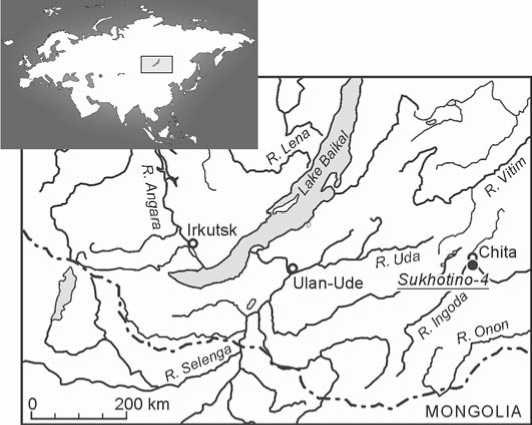
Fig. 1. Location of Sukhotino-4 in Eastern Transbaikalia.
joint layer ( n =15,300), and indicated the availability of cores for microblade production (1980: 45). These artifacts constitute a significant part of the Sukhotino-4 lithic industry, being the most typical feature of the collection.
The microblade cores from layers 6–11 were examined and classified by O.Y. Cherenshchikov in his dissertation; he proposed a detailed multi-level typological scheme (1998: 86–91), which revealed different stages of core reduction and modification. In our opinion, this classification is too complicated to be applied in case studies.
Microblade cores occur in all layers at Sukhotino-4, which is also typical of other sites in Transbaikalia and adjacent regions where developed microblade flaking was widely used. At the same time, there are some specific features in the morphology, typology, and preparation techniques of such cores in different areas and certain archaeological sites (Tashak, 2000; Tashak, Antonova, 2011; Ineshin, Tetenkin, 2010: 217, 218; Tetenkin, 2017). The differences may be due to both the chronology and the cultural specificity of each site. In this regard, a detailed analysis of microblade production in Sukhotino-4 industry is of undoubted interest.
Microblade cores
In describing the microblade flaking technique in Sukhotino-4 industry, several key factors should be mentioned. First, the vast majority of microblade
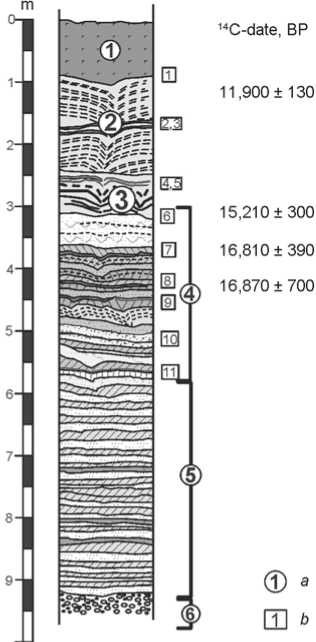
Fig. 2. Stratigraphic column of Sukhotino-4. a – lithological strata; b – culture-bearing layers.
cores were prepared and used according to a standard scheme, with minor deviations. Second, the materials from all the layers contain formally and typologically similar microcores. Third, the recovered artifacts demonstrate the use of a single raw material in microblade production. All this allows us to treat the entire set of microcores and their blanks recovered from various layers of Sukhotino-4 as a single whole.
Attributive analysis and determination of metric parameters involved 328 (more than 80 %) cores bearing negative scars from microblade removals, as well as several dozen blanks of microblade cores. The sample does not include uninformative, usually damaged, artifacts with single traces of microblade removals, cores modified into various tools, nor tools with negatives of microblade removals. Some of these are described separately. All the Sukhotino-4 layers are dominated by narrow-faced microcores (n=313), most of which are wedge-shaped (n=279). Other varieties are few in number: prismatic, conical, barrel-shaped cores and those with negatives of microblade removals on wide surfaces. Some of the heavily exhausted cores resemble cone-shaped nuclei, but they represent the terminal stage of narrow- faced core reduction. The large number of artifacts showing all stages of microblade flaking provides the opportunity to determine the main trends in microblade production. Narrow-faced microcores at Sukhotino-4 were prepared on flat rounded pebbles (more than 60 %), large flakes, flaggy stone pieces, and in some cases fragments of large bifacial tools. The preferred dimensions of the Sukhotino microcores have been established on the basis of the metric parameters of the cores and core blanks. The main measurements were made along three axes of the items under study: height—from the lower point in the distal part to the upper point in the striking platform zone; width— from one lateral face to another (maximum distance); depth—from the flaking surface to the remote point on the back surface (Fig. 3). Notably, a core is not an end product, and its metric parameters change in the course of utilization. However, the vast majority of narrowfaced cores in the Sukhotino-4 industry were prepared and utilized within the framework of the specified standards, and more than 90 % of all the items studied are carinated products, i.e. their long axis is parallel to the flaking surface. A certain proportionality of a core’s height and depth at the initial stage of reduction is less common. Cores with the long axis perpendicular to the flaking surface are few. Throughout the whole sequence of core utilization, starting from blanks till the exhausted cores, the least variable of the three measured parameters of the narrow-faced microcores is the flaking surface width. This value clearly represents the standard in core preparation. The largest number of cores are from 7 to 9 mm wide (n=197); the number of cores with smaller widths is significantly lower, and only 16 cores show the width in the range of 13–19 mm
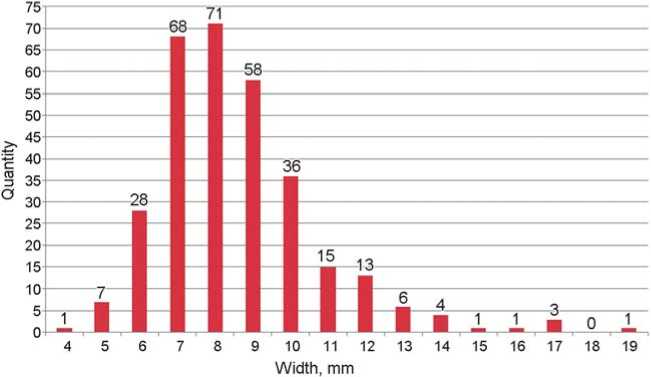
Fig. 4. Quantitative distribution of microblade cores by width.
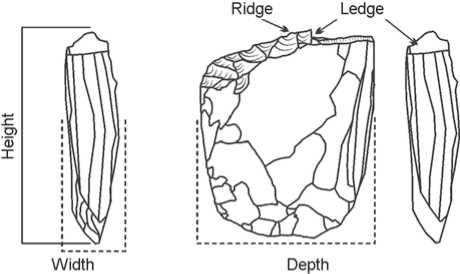
Fig. 3. Scheme of the typical Sukhotino-4 narrow-faced core at the initial stage of reduction.
(Fig. 4). The low variability of this parameter is due to the fact that the shape of the cores of the leading type was determined by special preparation, and the blanks before the reduction were bifaces and unifaces of oval, rounded, or angular shape (Fig. 5, 2 , 4–6 ). Bifaces were prepared on various raw pieces, but mostly on flat rounded pebbles of jasper-like rock of various shades of yellow, orange, and cream-brown (Fig. 5, 1 , 3 ). Various raw materials of a different color are less common. If the core blank was a primary flake, then its dorsal surface with a pebble cortex became the lateral edge of the core (Fig. 5, 7 ), with minimal preparation of the ridge and rear. Occasionally, lateral faces of the cores retained pebble cortex (Fig. 6, 1 ). Hence, the preforms of most cores, ready for reduction, were laterally flattened pieces whose width did not change during the utilization of the core. In most cases, a wedge was immediately formed. In some cores, the wedge was not prepared at the distal part (Fig. 6, 3 ). Notably, the flaking process often did not reach the zone where the lateral faces converged and formed a ridge. Moreover, flaking of at least one third of the cores was stopped right in the middle of the process. This suggests that most measurements of the width of nuclei are correct.
The second metric parameter— the height of the core—was changeable; however, it is unclear whether these changes were significant. In this respect, the shaping and reduction of striking platforms are especially indicative. First, many core preforms were prepared on bifaces and unifaces with faceted and ridged edges. One of the long edges was used as
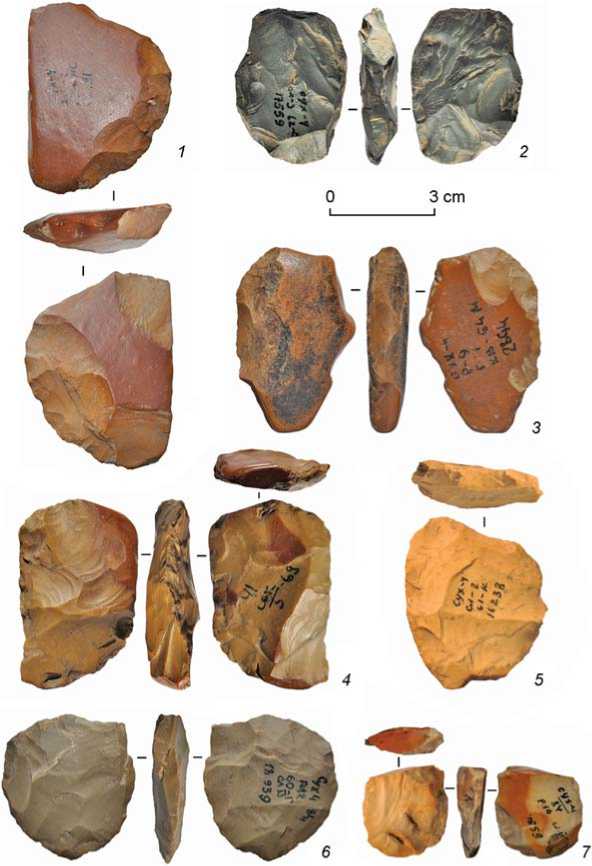
Fig. 5. Blanks of the narrow-faced microblade cores from the initial stage of preparation to test removals.
a flaking surface; the striking platform was fashioned on the short edge adjacent to the flaking surface at a right (or close to it) angle (Fig. 6, 2 ). In rare cases, in the most typical Sukhotino-4 narrow-faced cores, the lengths of the flaking surface and striking platform are similar, which implies a slight excess of the core depth over its height (Fig. 6, 8 ) at the initial stage of flaking. In a considerable number of cores, the margin area prepared to be the striking platform was bifacially retouched, resulting in the formation of a ridged edge along the central axis or with a deviation to one or another lateral face (Fig. 6, 4–6 , 8 ). At the next stage of striking-platform preparation, longitudinal flakes were removed from the flaking surface. The removals were short (microflakes)
and long (microblades) (Fig. 6, 2 , 5 ). Unlike the flaking surface, from which full-fledged microblades were removed, the striking platform was fashioned through short (from 1/4 to 2/3 of the edge length) microblade removals; however, negative scars of full-fledged microblades are also noted. Usually, there are one or two negative scars on striking platforms; three and more scars are less common. Additional lateral fine flaking was also used, most often in the cores >8 mm wide. The absolute majority of narrowfaced cores ( n =224) retained clear traces of the ridged edge that formed the area of the striking platform at an early stage of preparation; this feature is one of the distinctive elements of these cores (Fig. 6, 1 , 2 ). The ledge formed between the upper edge of the ridge and the surface of the striking platform rises no more than 3 mm (see Fig. 3). This observation shows that the decrease in the height of microblade cores fashioned according to the described sequence is not critical, and can be controlled. The described scheme of fashioning narrow-faced cores and the relevant morphology are the most typical of the Sukhotino-4 lithic industry; hence, we propose to designate it as the Sukhotino type.
Another technique of preparation of striking platforms was used on flat pebbles fashioned into microblade cores. When the surface and edges of such a pebble had been worked, a massive unprepared part in the area of the planned striking platform (see Fig. 5, 3) was reduced through a transverse blow. As a result, a depression was formed in the middle part of the striking platform (see Fig. 6, 7). Such depressions occur on 20 % of narrow-faced cores. The striking platform—the area between the depression and the flaking surface—was prepared according to the described scheme. The area between the depression and the back surface could be worked into a ridged edge or remained intact. In the process of core reduction, the percussion area, marking the transverse fragmentation, became invisible. Transverse fragmentation of blanks in the form of incompletely prepared pebbles or prepared bifaces sometimes resulted in the creation of a surface (either flat or slightly beveled to one of the lateral
Fig. 6. Narrow-faced microblade cores.
faces), which was used as a striking platform; but the additional fine working from the flaking surface was executed in all cases. Cores with the described design of striking platforms also belong to the Sukhotino type of microblade cores.
The distribution of narrow-faced cores by height also shows certain patterns (Fig. 7). The largest number of cores ( n =126) is in the range from 24 to 28 mm high. The ranges of 23–20 and 29–32 mm demonstrate a smooth decrease in the number of artifacts. The same analysis of microcore blanks ( n =72) has shown similar results: in the range from 24 to 29 mm, there was one artifact in each grade. The availability of such artifacts indicates that cores not exceeding 24– 29 mm high were produced intentionally, rather than emerging in the course of reduction of larger cores. Blanks from 45 to 55 mm do not have striking platforms nor ridged edges in place of future striking platforms, which implies a lower height of the utilized items.
The Sukhotino-4 collection of the narrow-faced wedge-shaped cores includes artifacts resembling the Yubetsu
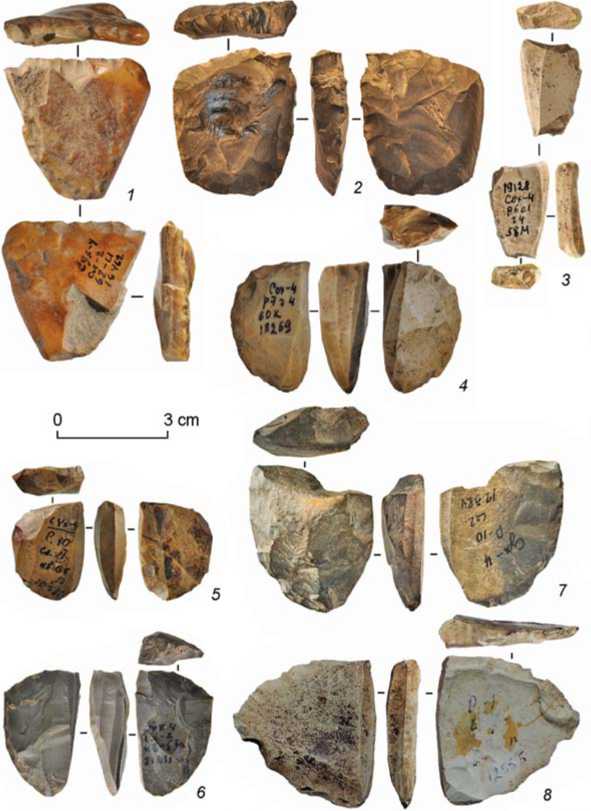
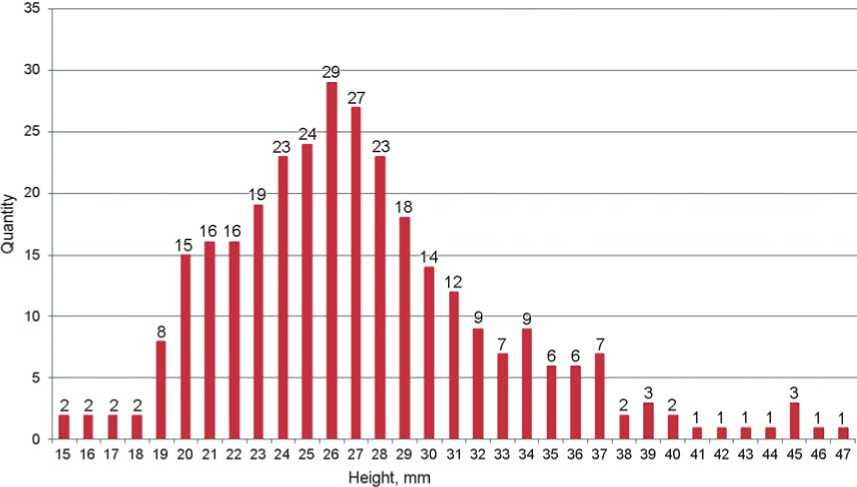
Fig. 7. Quantitative distribution of microblade cores by height.
cores ( n =9), in which the longitudinal axis is perpendicular to the flaking surface (Fig. 8, 1 , 3 ). These cores have planar striking platforms prepared and rejuvenated by longitudinal removals (possibly ski-shaped); sometimes, the frontal surface was additionally worked by fine flaking. Two cores are exceptions: one shows the elongated striking platform fashioned by a transverse breakage, rather than a longitudinal removal; the other has planar and short striking platform, and the sharp bevel to the back surface is carefully prepared similar to the ridge in the area of striking platform in the Sukhotino-type cores. Ten other artifacts with planar striking platforms have proportional height and depth ( n =5) or the depth is less than the height of the flaking surface ( n =5); half of these artifacts were fashioned on unifaces and pebbles, which excludes them from the Yubetsu list. Notably, the identification of Yubetsu cores in Sukhotino-4 is based only on the finished forms; it is hardly possible to trace the Yubetsu technique on the available materials at the site. A.P. Okladnikov and I.I. Kirillov described the “ski-shaped blades” that were removed from the planar platforms beveled towards back surfaces (1980: 45), but didn’t provide any drawings. To date, no ski-shaped spalls have been recorded among the lithic artifacts from Sukhotino-4. In this regard, the mass production of cores with
Ovs
3 cm j
Fig. 8. Narrow-faced microblade cores with planar striking platforms.
planar striking platforms prepared by the Yubetsu technique is questionable; moreover, there are quite few such cores in the Sukhotino-4 collection. Among these, only one is 9 mm wide, the others are from 10 to 14 mm and make up about 7.3 % of the narrowfaced cores included in the group of the specified range. Among all the cores with planar platforms, the share of cores 10–14 mm wide is over 50 %, i.e., most of them are considerably thicker than those of Sukhotino type. Notably, exactly the cores with flaking surfaces exceeding 10 mm in width show the traces of use-wear thinning. The Yubetsu-type cores have signs of fine flaking along the lateral edges from the side of the striking platform after its rejuvenation (Fig. 8, 1 ). In the cores with massive cross-section, occupying an intermediate position between narrow-faced and prismatic cores, the thinning was carried out from the side of the striking platform, flaking surface, and back surface (Fig. 8, 2 ). No thinning of the Sukhotino cores after the start of utilization was recorded. Planar platforms on the Sukhotino-type cores resulting from their poor preparation were identified on more than ten cores. Double-platform cores with two flaking surfaces of approximately the same height and depth represent a peculiar development of this trend. The striking platforms of such cores show negative scars of long removals similar to those on the flaking surface (Fig. 8, 4 ). The width of such cores, being some deviation from the Sukhotino standard, is 10–13 mm, but there are specimens 8 mm wide. Narrowfaced cores also demonstrate planar striking platforms fully or partially retaining pebble cortex ( n =14). Three such cores were prepared on large flakes with natural backs.
The collection includes two items fashioned on oblong fragments of large bifaces, one of which can be conventionally classified as a core (since it bears only a few negatives of small removals), and another artifact was subjected to microblade reduction (Fig. 8, 5). Similar bifaces in Sukhotino-4 were purposely prepared as tools— knives (Tashak, Kovychev, 2020). Both fragments were produced by transverse breakage of large bifaces—a technique of fashioning bifacially worked backed knives (Ibid.). In the two above-mentioned cases, the backs were modified into striking platforms without any additional trimming. Apparently, only few microblades were removed from the core, because the height of the flaking surface slightly exceeds 1 cm, and the shape of the biface’s fragment wasn’t significantly changed. Such items are reminiscent of burin-cores rather than full-fledged nuclei.
The collection of narrow-faced cores comprises those with two opposing flaking surfaces. Such cores were prepared through additional operations. Before splitting, the cores could have been intentionally shaped: for example, by flaking the lateral faces and creating a longitudinal ridge. Some artifacts show minimal preparation. For example, microblades were removed from an oblong pebble of a subsquare cross-section after preparation of the striking platform through fine flaking. The collection under consideration contains 17 such microblade cores. Noteworthy are several cores with wide flaking surfaces, resembling the most common narrowfaced cores. The difference is that in this case microblades were removed not from the narrow face, but from the wide plane, which is designated as the lateral surface, in the terminology of narrow-faced cores. In our opinion, the emergence of such cores is not accidental. In almost half of the narrow-faced cores ( n =99), the microblade flaking surface partially extends (the frontal surface facing the observer) to the right ( n =65), or left ( n =29) lateral face, or both ( n =5). Most likely, the frequent formation of “twisted” microblades during the flaking process shifted microblade flaking to the lateral faces. The negatives of these blades show that, for example, a removal, starting from the striking platform in the center of the flaking surface, gradually reached one of the lateral faces in the distal part. Subsequent removals of microblades were carried out with respect to this shift.
Artifacts with microblade negative scars
The Sukhotino-4 collection, apart from microcores, contains various other items bearing scars of microblade removals. In particular, end-scrapers are noteworthy. The artifacts were shaped by microblade flaking along longitudinal edges. In an end-scraper of about 3 cm long, lateral flakes are well correlated with the removals from cores. In smaller end-scrapers, the main purpose of the lateral microblade flakes is clear— they reduced the width of the “stem”.
The Sukhotino-4 lithic collection contains a large number of chisel-like tools, some of which were fashioned on microblade cores. For example, O.Y. Cherenshchikov identified 13 items of this kind in the materials from layers 7–10, and included these artifacts into groups of microcores (1998: 66, 75, 78, 80). Some of these tools bear bladelet negative scars on one of the wide surfaces, but no traces of microblade removals along the longitudinal edges, which would be diagnostic for the classification of these pieces as reshaped microblade cores. Nevertheless, microcores thinned through longitudinal removals were used as chisel-like tools. Also, some chisel-like implements show use-wear signs in the form of longitudinal microblade removals. The rear of one wedge-shaped core has a concave working edge of a planing tool.
In sum, in the Sukhotino-4 industry, microblade flaking was used not only for the production of microblades, but also for modeling during tool manufacture.
Discussion
The available series of radiocarbon dates of Barun-Alan-1 and Sukhotino-4—the two main sites of the Khengerekte-Sukhotino culture—suggests that this culture lasted throughout the Sartan glacial cooling. Judging by the date of level 7c at Barun-Alan-1, the origin of this culture can be assigned to the Late Karga interstadial (Tashak, 2020, 2023). The upper boundary of its existence is determined by the radiocarbon date of layer 1 at Sukhotino-4: 11,900 ± 130 BP (SOAN-841) (Okladnikov, Kirillov, 1980: 51), or 14,056–13,502 cal BP*. Sukhotino-4 layers 6–8 produced the following dates, respectively: 15,820 ± 300 (LE-3652), 16,810 ± 390 (LE-3647), and 16,870 ± 700 (LE-3653) BP (Lisitsyn, Svezhentsev, 1997). Their calibrated values are 19,895–18,338, 21,404–19,380, and 22,255– 18,909 BP. Layers 10 and 11 of Sukhotino-4 can be correlated with the lower part of level 7b at Barun-Alan-1, dated to 22,920 ± 140 BP (TKa-17114), or 27,604–26,986 cal BP (Tashak, 2020: 126). For the underlying level 7c, three dates are available: 24,096 ± 889 BP (NSKA-s572) – 30,375– 26,497 cal BP; 26,340 ± 1250 BP (LU-7836) – 34,051– 28,322 cal BP; 26,911 ± 975 BP (NSKA-s571) – 33,713–29,265 cal BP (Tashak, 2019).
Microblade production played a significant role in the Sukhotino-4 lithic industry. This production was based on a set of standard technical approaches that ensured the production of serial standard blanks and ready-to-split cores. Notably, this industry, belonging to the Khengerekte-Sukhotino culture, is distinctly based on bifacial flaking (Tashak, 2020). A significant portion of its tools such as knives, points, and chisellike implements are bifaces (Tashak, Kovychev, 2020). The standardization of the Sukhotino-type microcores is expressed in their shape (flat and vertically oriented), individual elements, and sizes. Other types account for less than 10 % of microblade cores. Distinct narrow-faced cores of the Yubetsu type are few. Despite the availability of various bifaces that could have been blanks for the production of such cores in layers 4–11, their stable occurrence is observed only in layers 1–3. The small number of the Yubetsu cores suggests that this technique was at the initial stage of its development and was not established in the Sukhotino-4 industry; also, this technique could have reflected an external influence that wasn’t accepted. The Yubetsu as one of the leading techniques was recorded in various areas of Transbaikalia and Northern Cisbaikalia, for example, at the site of Bolshoy Yakor-1, 650 km northeast of Sukhotino-4 (Ineshin, Tetenkin, 2010: 218; Tetenkin, Henry, Klementiev, 2017: 51). The most ancient cultural horizons of this site are chronologically similar to Sukhotino-4 layers 1–3. This technique is well represented in the materials of the Arshan-Khunduy site, which is located 470 km southwest of Sukhotino-4. At the same time, at other sites of the Khengerekte-Sukhotino culture (Tashak, 2020, 2023), Yubetsu cores and elements of their manufacture were not recorded.
Conclusions
The Sukhotino-4 microindustry is dominated by Sukhotino type cores. In the classic version, they were prepared on flat bifaces and unifaces, are vertically oriented along the long axis, and have striking platforms fashioned by short microblade removals. Most striking platforms retain traces of bifacially processed ridged edge. Microcores 24–30 mm high predominate, few specimens exceed 40 mm. The length of most microblades is 20–30 mm. Cores of the Sukhotino type have been recorded in all layers of Sukhotino-4, which suggests the long-term use of this technique, at least since the beginning of the Sartan cooling.
The closest to the Sukhotino cores, in terms of the morphology and design of striking platforms based on bifaces, are the Kovrizhka-type cores from the Lower Vitim; these were identified by A.V. Tetenkin in the materials from culture-bearing horizons 6 and 2B at Kovrizhka IV (2017). According to the results of radiocarbon dating, these horizons were formed ca 16–15 ka BP (Ibid.: 112, 113), which is close in time to cultural layer 6 of Sukhotino-4 and the top of level 7b of Barun-Alan-1.
Microblade cores of the Sukhotino type have also been recorded at other sites of the Khengerekte-Sukhotino culture (in Western and Eastern Transbaikalia). One core was found at the Khenger-Tyn-3 sanctuary (located 2 km southeast of Barun-Alan-1) (Tashak, 2005). Microblade cores, including those of the Sukhotino type, were found in all levels of layer 7 of Barun-Alan-1. Typical Sukhotino cores were reported from the stratified site of Dvortsy, 20 km northwest of Sukhotino-4, in the valley of the Kadalinka River; the Dvortsy materials have not yet been published.
Acknowledgement
