
Multi-class Financial Payment Fraud Detection via a CNN-CfC Hybrid Architecture with Explainable Feature Engineering
Journal: International Journal of Information Engineering and Electronic Business @ijieeb
Article in issue: 5 vol.18, 2026.
Free access
With the growing digitization of financial services, fraudulent activities in online transactions are becoming increasingly sophisticated and widespread. An automated and intelligent financial transaction fraud detection system is necessary to properly detect and categorize fraudulent incidents in order to address this challenge. The majority of previous research has been on using binary classification to identify fraudulent transactions. Previous efforts were often hindered by class imbalance, inadequate feature selection, suboptimal prediction accuracy, and insufficient hyperparameter tuning. This paper suggests a hybrid deep learning framework for multi-class financial fraud detection that combines Convolutional Neural Network (CNN) and Closed-form Continuous-time (CfC) models in order to handle these problems. By analyzing transactional and behavioral characteristics, the model is intended to categorize fraud situations into distinct groups, including Phishing, Account Takeover (ATO), Card Skimming, and No Fraud. The proposed CfC-CNN model was not only trained but also tested on a large transaction augmented dataset that was enhanced with contextual characteristics. This work uses the IBM financial fraud dataset and considers 5 million transactions. This work investigated four classes such as phishing, ATO, card skimming, and no fraud. Label encoding was used as a preprocessing method for the contextual and category information. The dataset was refined for best performance by feature selection using Chi-Square and the random search method for hyper parameter tweaking. The proposed CfC-CNN model achieved at least .03 percent accuracy gain and .49 percent F1 score gain over the compared previous works.
Short address: https://sciup.org/15020740
IDS: 15020740 | DOI: 10.5815/ijieeb.2026.05.03
Text of the scientific article Multi-class Financial Payment Fraud Detection via a CNN-CfC Hybrid Architecture with Explainable Feature Engineering
Published Online on October 8, 2026 by MECS Press
Unauthorized Financial payment fraud refers to the unethical or illegal activities that include the manipulation of payment systems, such as digital wallets, credit cards, or online banking, in order to steal money or private financial information. It addresses tactics like identity theft, phishing, card skimming, fraudulent transactions, and account takeovers. These scams often exploit vulnerabilities in payment systems, user behavior, or security protocols to cause financial losses for individuals, businesses, or financial institutions. Financial payment fraud typically happens during or soon after a financial transaction when a fraudster has unauthorized access to payment information or tampers with the transaction process [1]. The financial payment transaction fraud can happen in a number of circumstances, through fraudulent websites (phishing), card information stolen during online transactions, account takeovers using compromised credentials, and the use of social engineering or false identities to trick people or systems during money transfers.
Every year, financial payment fraud causes huge financial losses for people or countries. Financial fraud incidents rose more than 51 percent during the covid-19 era from 2020 to 2022. More than 28 billion US dollars were lost due to
This work is open access and licensed under the Creative Commons CC BY 4.0 License.
the credit card theft activities in 2020. In 2023, 24.26 billion (US dollar) in economic damages were caused by credit card fraud payments worldwide [2]. The decline in investor, depositor, and consumer confidence brought on by allegations of fraud leads to a decrease in participation in financial markets. In addition to the financial sector, the entire economy is affected by this erosion of trust.
Financial crimes have the potential to damage public trust in governments, financial systems, and other institutions by compromising their legitimacy. Fraud has far-reaching consequences in addition to financial losses. People, companies, governmental services, and even the environment are all significantly impacted. Victims frequently experience psychological trauma, and vulnerable groups such as the elderly or the poor are more likely to experience hardship. Financial fraud damages markets, erodes public trust, impairs government effectiveness, and can damage a nation's standing internationally.
Instead of just marking suspicious conduct as "fraud" or "not fraud," multi-class financial fraud detection classifies suspicious activity into distinct types (such as credit card fraud, money laundering, phishing, and insider trading). By enabling automated triage, reducing compliance risks, and stopping systematic revenue leakage, this focused strategy enhances business value. The key business values are precision-driven triage and cost optimization, targeted recovery and risk mitigation, advanced compliance and regulatory defense, and dynamic adaptation to fraud rings.
To reduce the financial payment fraud, the implementation of automated fraud detection systems must be a major priority for financial institutions. The previous works did not address multi class classification of financial fraud with ML and XAI. Compared with traditional techniques, automated systems using DL (deep learning) and AI swiftly spot odd patterns, dubious transactions, or known fraud indications. Automated systems can detect both established and new forms of fraud by analyzing data for subtle and non-linear relationships. XAI was created to solve interpretability issues that are common in ML-based fraud detection systems. Two techniques that offer interpretable features—SHAP and LIME—lessen the need for black box models and let financial analysts understand and validate the accurate classification of fraudulent scenarios [3].
Instead of focusing on multi-class financial fraud prediction, which includes Phishing, Account Takeover (ATO), Card Skimming, and No Fraud kinds, the existing research works on financial payment fraud prediction [4, 5, 6, 7, 8, 9, 10, 11] mostly concentrated on binary fraud categorization. The existing works [12, 13, 14, 15] did not investigate temporal modeling and feature interaction at the same time by using advanced deep learning methods. The work in [12] used random forest for binary financial fraud classification. The article in [13] used ANN for credit card fraud prediction. They also investigated binary classification problem. The work in [14] used CNN model for fraudulent UPI transaction identification. They did not investigate multiple financial fraud transactions. The authors in [15] used graph attention network for real time credit card fraud prediction. But their work is limited only for two types of financial transactions.
The accuracy of their financial payment transaction fraud prediction was insufficient. The class imbalance problems in the dataset, coupled with the development of appropriate dataset leveling and cross-validation procedures, were not resolved by the previous research. They failed to use explainable AI, hyper parameter tuning, preprocessing, and effective feature engineering. In order to address these issues, this study creates a hybrid deep learning framework based on the CfC-CNN model that can precisely detect and categorize different forms of financial payment fraud by examining payment natures and behavioral characteristics.
This paper addressed the limitations of binary fraud detection by transforming existing datasets into multi-class labeled data with expert validations. The following illustrates this paper's significant contributions: (i) Using behavioral and transactional patterns from the dataset, this work delivers a hybrid DL model that combines CNN (convolutional neural network) and CfC (Closed-form Continuous-time) method for multi-class financial payment transaction fraud prediction, including Phishing, Account Takeover (ATO), Card Skimming, and No Fraud.
(ii) Several data preparation methods, including label encoding, robust scalar for outlier mitigation, and SMOTE with class weighting approaches for dataset class imbalance issue mitigation, were applied in the proposed model. (iii) The proposed model used feature engineering with the Chi-Square approach to choose appropriate features for fraud prediction. Additionally, the suggested model used the random search method for cross-validation and hyper parameter tuning.
(iv) By comparing the performance (e.g., accuracy, recall) of the hybrid CfC-CNN model with those of conventional models (RNN, LSTM, CNN), this paper chooses an appropriate financial payment transaction fraud prediction model. This work investigated four types of financial fraud class (phishing, ATO, card skimming, and no fraud). In order to provide transparent and interpretable feature importance analysis, this article incorporates SHAP based explainable AI model (XAI).
2. Related Work
A review of relevant studies on several fraud detection techniques is given in Section two. The detailed explanation of the suggested methodology for categorizing fraud instances is presented in section three, including everything from dataset collecting to model building. In Section four, performance analysis is provided with results. Section five wraps up the article by outlining the main conclusions.
Along with their areas of expertise, related works on financial payment transaction fraud prediction are covered in this section. First, we will discuss the works related to traditional machine learning. Using the Sparkov dataset (555,719 transactions, 0.4% fraudulent), the authors in [7] applied basic Ml algorithms (e.g., DT, RF, LR) to balance data by reducing the majority class. With 96% accuracy and 98.9% AUC, RF outperformed DT and LR in their study and demonstrated that fraud frequently occurs in supermarket and shopping transactions. The authors in [8] selected the best characteristics from the Kaggle European dataset (284,807 transactions, 0.172% fraudulent) [9] using a genetic algorithm (GA) with RF. However, their AUC performance is below .95. The work in [10] demonstrated satisfactory AUC performance with unequal data by combining SMOTE with Bayes Minimum Risk and CatBoost on a real dataset.
Now we will discuss some works related to the use of DL models.
Fuzzy based FRNN model with LR were applied to the German and Australian datasets by the authors in [11]. The Australian dataset had an AUC of 0.8555 and detection rates of 84.90% and 76.30%, respectively. Notwithstanding their advantages, the previously stated approaches have serious drawbacks.
Adaptability to dynamic fraud patterns is limited by their dependence on static feature sets. The European dataset used in the majority of these studies contains a small number of features that don't seem to be enough to create a trustworthy model. In order to forecast financial fraud, the authors in [16] employed the LSTM approach on a genuine European dataset. Using the European and IEEE-CIS datasets, the work in [17] developed an LSTM-based system using SMOTE and PCA [18]. A four-layer stacked RNN was applied to the PaySim dataset (6 million transactions, unbalanced) by the authors in [20]. Deep CNNs [19] and stacked RNNs [20] are two examples of models whose computational complexity frequently makes them unsuitable for real-time deployment in extensive financial systems. Lightweight models that can operate on highly unbalanced datasets must therefore be introduced. Furthermore, these methods primarily concentrate on binary classification, ignoring multiclass frameworks that could distinguish between distinct types of fraud, which restricts their applicability to a variety of fraud scenarios. Their effectiveness is largely dependent on configurations unique to a given dataset, which makes it difficult to adjust to changing fraud trends in dynamic real-world settings.
In the following we will discuss some works based on the usage of different dataset.
Using the Vesta dataset, the authors in [21] developed a two-step model by fusing Adaboost with seven classical ML models. In [21], both the Adaboost and LightGBM methods were used for fraud transaction classification. On the European dataset, the authors in [22] combined LSTM with Adaboost and SMOTE-ENN. Using the ULB and Taiwan datasets, the authors in [23] used multiple classifiers for prediction such as Naive Bayes, ANN, and KNN. The system effectively handled unequal data through group voting, attaining 0.930 accuracy and 0.840 True Positive Rate (TPR). On the PaySim dataset [25], the authors of [24] investigated hybrid approaches, and a Stacking Classifier (RF + SVM with Logistic Regression) outperformed Linear SVC and NB in terms of accuracy. When identifying fraud in a diversified dataset with a variety of variables, hybrid models can be useful choices. The generalizability of the datasets used in the aforementioned articles, such as the Vesta and European datasets, is called into doubt because they contain a smaller number of transactions (a few hundred thousand) than the IBM synthetic dataset (24 million). The secret to striking a balance between speed and accuracy is selecting and modifying the appropriate algorithms.
In the following we have discussed the literature review based on class imbalance and SMOTE usage issue.
Currently, several single and hybrid techniques are employed to overcome the class imbalance issue of dataset. SMOTE with Adaboost was used on the European dataset in the work in [26]. The Sparkov dataset (1.2 million transactions, 0.579% fraudulent) was used by the authors in [27] to evaluate SMOTE+Tomek, random oversampling, and class weights. SMOTE+Tomek achieved good precision, recall, and an AUC-ROC of 0.9039 using Random Forest. On the European dataset, the authors in [28] employed undersampling techniques such as One-Sided Selection. A Deep Neural Network outperformed K-Nearest Neighbors, achieving 98.12% accuracy and 94.02% ROC-AUC. Higher performance was attained by the authors in [29] by employing SMOTE+ENN in a machine learning classifier for mobile money transfer fraud detection. An Autoencoder-LightGBM model outperformed resampling without resampling (MCC 0.8478), according to the authors in [30], indicating that certain deep learning models manage imbalance effectively in the absence of fake data. By concentrating on important data, feature selection and dimensionality reduction speed up and reduce noise in models. By choosing the best characteristics, the authors in [8] employed Genetic Algorithms with Random Forest on the European dataset, obtaining 99.98% accuracy and 0.95 AUC.
Now we will discuss the related works based on different feature selection method usage.
Using the IBM (24 million transactions, 0.12% fraudulent) [32] and Sparkov datasets [33], the authors in [31] used Chi-square, ANOVA, and Featurewiz. Stacked LSTM and CNN-LSTM achieved F-scores of 84% and 94%, respectively. In order for LSTM to reach 99% accuracy, the authors in [17] reduced the European dataset to 25 features and the IEEE-CIS dataset to 100 features using Recursive Feature Elimination and PCA. Using a Variational Autoencoder on the European dataset, the authors in [34] achieved an accuracy of 0.93, surpassing both SMOTE and GAN in terms of precision.
Performance is enhanced by the aforementioned feature selection methods, but crucial information may be lost, particularly in big datasets like IBM's, where PCA may mask significant features. A common way for addressing dataset imbalances is to use the SMOTE technique to preprocessed datasets prior to training. However, several previous studies have demonstrated poorer recall values in comparison to high precision and accuracy. For this reason, as we have covered in our suggested methodology, class weight balancing must be used in the model's post-training phase in addition to SMOTE during the pre-training phase.
Generalizability to big, highly imbalanced datasets, such as IBM's 24 million transaction corpus (0.12% fraudulent), is limited by the majority of current studies, which concentrate on smaller or moderately imbalanced datasets (e.g., European: 284,807 transactions, 0.17% fraudulent; IEEE-CIS: 3.4% fraudulent). Because of its size and sufficient number of fraud transactions, the IBM dataset which was examined in [35] and [31] is underutilized in comparison to datasets like Vesta or PaySim, providing a chance for additional research. Interestingly, previous research, such as that conducted on the IBM dataset, focuses mostly on binary classification (fraud vs. nonfraud), ignoring multiclass classification to differentiate between various fraud forms.
With sophisticated deep learning models on huge synthetic datasets like IBM's, GAN-based data augmentation shows potential, according to the authors in [36, 37], although it is still understudied. Despite their strength, transformer-based and hybrid deep learning frameworks frequently have limited real-time application and significant computational costs [31], [35]. Furthermore, preprocessing that is exclusive to a dataset limits its generalizability, emphasizing the need for frameworks that are more flexible. The proposed effort will use the IBM dataset's vast volume (24 million transactions, 0.12% fraudulent) and untapped potential to create a hybrid deep learning framework for multiclass financial payment transaction fraud detection in order to fill these gaps. The proposed framework will combine with advanced deep learning architectures (e.g., RNN, CfC, CNN) to mitigate extreme class imbalance and capture intricate temporal and feature level dependencies.
3. Proposed Financial Payment Fraud Prediction Scheme Using Hybrid Deep Learning
The entire process of creating our hybrid deep learning system for multi-class financial payment transaction fraud detection is described in this part.
-
3.1. System model
-
3.2. Data collection for financial payment fraud prediction
Figure 1 offers a graphic overview of the suggested process flowchart model, covering everything from dataset preparation to model training and assessment. A large-scale synthetic credit card transaction dataset is first gathered and prepared from IBM as part of the suggested methodology sequence. This is followed by preprocessing methods intended to clean, transform, and enrich the raw data with temporal and behavioral aspects. To provide robust model evaluation, special attention is paid to handling class imbalance utilizing SMOTE and class weighting in conjunction with stratified K-Fold cross-validation.
A number of DL models (e.g., CNN, RNN) and the more contemporary Closed-form Continuous-time (CfC) neural network, are then investigated after pertinent characteristics have been chosen using statistical testing. The best financial transaction fraud prediction model is chosen based on performance metric (e.g., accuracy and recall) value following the training and testing phases. The suitable model with the highest accuracy for predicting financial transaction fraud was chosen after testing several models. In order to efficiently learn both temporal (time-dependent) behavior and spatial (feature-level) patterns across transactions, the final suggested model integrates CNN and CfC. The CNN's capacity to identify local fraud-related feature combinations and the CfC's distinct advantage in continuous-time sequence modeling make this hybrid approach ideal for irregular transaction timings.
A synthetic binary-class credit card transaction dataset made available to the public on Kaggle by IBM was used in this study [32]. About 24 million transaction records made up the initial dataset, and each record included some essential information related to fraud (e.g., card information, amount, fraud type, location, error information, date). This effort randomly picked roughly 5 million transactions to create a reasonable and representative subset, making sure that every user was represented in the chosen range. We expanded the dataset by creating new domain-specific features that are suggestive of different kinds of fraud in order to convert it into a format that is appropriate for multi-class fraud classification, as shown in Figure 2.
The dataset distribution is displayed in Table 1. Device id, IP address, website link, website security, mail id, PIN, password changed, fallback to swipe, and a new target label are among the expanded feature set. Fraud Type divides fraud into several categories, such as Card Skimming, Phishing, Account Takeover (ATO), and No Fraud. To ensure accuracy and realism, the fraud classes were painstakingly identified with the assistance of domain experts and each of the recently added features was carefully chosen based on known fraud behavior patterns.
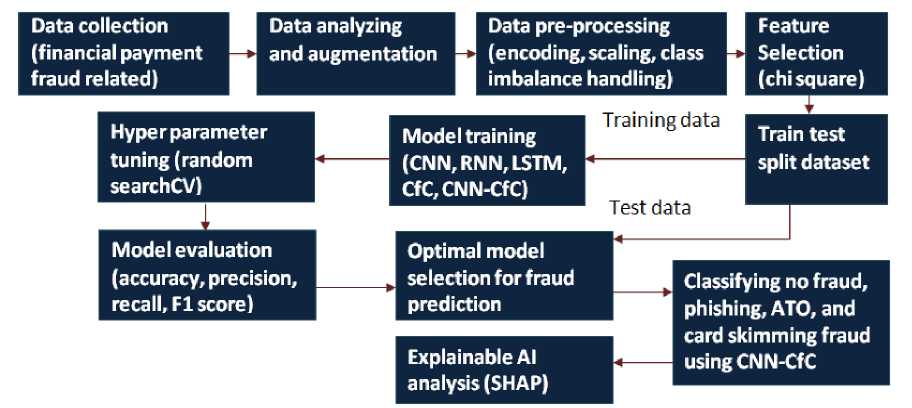
Fig. 1. Proposed Work Methodology for Hybrid Deep learning Based Financial Payment Fraud Prediction
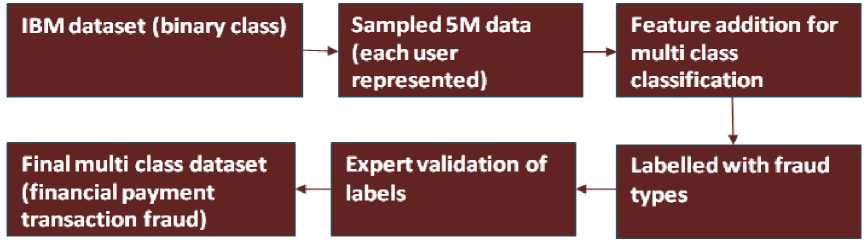
Fig. 2. Visual representation of Data Analyzing and Augmentation
Unusual device id and ip addresses, unsecured website security, and links delivered from a mail id are important signs of phishing fraud. Usually, a bogus email is used to trick customers into entering their login information on a phony website. Transactions are then conducted using new devices and IP addresses. The hallmark of account takeover fraud is a transaction from an odd device id and ip address that appears to be authentic. Even though the website may still be secure, a recent password changed indicator is a common signal for ATO. Before completing the transaction, the fraudster altered credentials after gaining access to the account, according to these patterns.
Card skimming fraud features include fallback to swipe and PIN use. These scams usually use stolen card information and frequently involve offline transactions made from locations distant from the user's typical activity patterns. They may also entail a series of quick purchases. This feature enhancement was essential since it allowed transactions to be categorized not just as fraudulent or not, but also by the type of fraud they were.
Three banking officials from Bangladesh bank and two university professors verified the labeling and the connection between the attributes and the fraud kinds. A fresh CSV file containing the enriched dataset was saved. 0.6071% of the 5M transactions in the sampled dataset were fraudulent. Table 1 shows the distribution of the fraud transactions after they were separated into three categories. All ensuing preprocessing and modeling procedures make use of this dataset. A glimpse of a dataset containing several fraud and non-fraud kinds is displayed in Table 2.
Table 1(a). Data distribution in the multiclass dataset (only fraud and non fraud distribution).
|
Types |
Percentage distribution |
|
No fraud |
99.3929% |
|
Fraud |
.6071% |
Table 1(b). Data distribution in the multiclass dataset (distribution of fraud types).
|
Types |
Percentage distribution |
|
ATO fraud |
31.5892% |
|
Card skimming |
38.3372% |
|
Phishing |
30.0736% |
Table 2(a). Dataset after feature addition (no fraud).
|
User |
Card |
Year |
Time |
Amount |
Use chip |
Merchant name |
Mer. city |
Mer. state |
Zip |
|
1034 |
1 |
2008 |
6.17 |
82 |
swip |
john |
Bean station |
tn |
37708 |
|
1549 |
1 |
2010 |
5.24 |
275 |
swip |
karim |
Ben salem |
pa |
19020 |
|
1600 |
2 |
2008 |
12.6 |
6 |
swip |
rahim |
Elgin |
tx |
78621 |
|
1122 |
0 |
2008 |
7.9 |
60 |
swip |
botham |
Urbandale |
ia |
50522 |
|
1394 |
1 |
2011 |
11.44 |
48 |
swip |
kalin |
Daily city |
ca |
94014 |
|
MCC |
Errors |
Device id, website, ip address, mail id |
PIN |
Password |
Fallback |
Is fraud |
Fraud type |
|
5311 |
Yes |
Not verified (NV) |
NV |
false |
false |
no |
No fraud |
|
4814 |
Yes |
NV |
NV |
false |
false |
no |
No fraud |
|
5411 |
Yes |
NV |
NV |
false |
false |
no |
No fraud |
|
5651 |
Yes |
NV |
NV |
false |
false |
no |
No fraud |
|
7538 |
Yes |
NV |
NV |
false |
false |
no |
No fraud |
Table 2(b). Dataset after feature addition (fraud types).
|
User |
Card |
Year |
Time |
Amount |
Use chip |
Merchant name |
Mer. city |
Mer. state |
Zip |
|
1932 |
2 |
2015 |
12.00 |
236 |
online |
butler |
online |
||
|
1111 |
5 |
2009 |
5.47 |
115 |
online |
mic |
online |
||
|
545 |
1 |
2010 |
12.12 |
6 |
online |
rohan |
online |
||
|
576 |
1 |
2018 |
17.25 |
3 |
chip |
ian |
rome |
italy |
07100 |
|
1680 |
3 |
2007 |
18.40 |
184 |
online |
totsky |
online |
|
MCC |
Errors |
Device id, website, ip add., mail id |
PIN |
Password |
Fallback |
Is fraud |
Fraud type |
|
5733 |
Yes |
Not verified (NV) |
NV |
false |
false |
Not applied |
phishing |
|
5311 |
Yes |
NV |
NV |
false |
false |
Not applied |
phishing |
|
4131 |
Yes |
NV |
NV |
true |
false |
Not applied |
ATO |
|
5812 |
Yes |
NV |
NV |
false |
false |
Not applied |
Card skimming |
|
5300 |
Yes |
NV |
NV |
true |
false |
Not applied |
ATO |
#clean amount
Print ('amount is already numeric, processing directly. )
df ['Amount'] = df ['Amount'].astype(float)
else:
Print ('amount is non numeric. Applying string cleaning.1)
df ['Amount'] = df [’Amount1].astype(str)
df ['Amount'] = df ['Amount'].replace f[\$]', ”, regex=true).astype (float)
df ['Amount'] = df ['Amount’].clip (lowemO)
Sextract hour and minute from time
If time in df.columns:
Fig. 3. Glimpse of preprocessing process.
-
3.3. Data cleaning and preprocessing
To transform unstructured records into structured inputs appropriate for a multi-class classification model, the dataset underwent a thorough preprocessing process. In this stage, conflicting data types were fixed and missing values were filled in. For instance, the currency symbols in the Amount column were cleaned up and converted to float format. Figure 3 illustrates how timestamp values in the Time column were transformed into distinct Hour and Minute features. Fig. 4 illustrates how Label Encoder was used to encode categorical data such as Merchant City, Merchant State, Errors?, Use Chip, device id, ip address, and website link. Figure 5 illustrates how binary properties like PIN, Password
Changed, and Fallback to Swipe were converted into numerical values (such as 1/0). The 'Use Chip' field was utilized to distinguish online transactions. During feature engineering, irrelevant features were eliminated. For instance, offline capabilities like Merchant State and PIN are deemed unnecessary for online purchases. Online features like device id and password changed were deemed unnecessary for transactions made with chips or swipes. By comparing each transaction's device ID and IP address with a history of the user's non-fraudulent transactions, the Unusual Device ID and Unusual IP Address features were produced (see Fig. 5). To lessen the impact of outliers, RobustScaler (see Fig. 6) was used on a subset of numerical features (e.g., Merchant City, State, device id, and website link). The final features added for prediction are shown in Table 3.
To train the classifier, the Fraud Type field was label-encoded into integer classifications. The multiclass arrangement included representations of four different types of fraud. The model can identify several forms of fraud, including phishing, account takeover, and card skimming, by utilizing both transactional characteristics and behavioral anomalies, thanks to its strong preprocessing pipeline. To make training and evaluation easier later on, the processed data was divided into distinct CSV files for fraud and non-fraud transaction types. In order to prepare a clean, consistent, and informative dataset for training a hybrid model that can effectively classify various forms of fraud, these preprocessing steps were crucial. Table 3, which also shows the steps that were taken, shows a sample of the preprocessed dataset.
#list of columns to encode using label encoder
Label encode _column=['Marchant city', 'Marchant state', 'Errors?', 'device_id', 'ipaddress', 'website_link'] Label_encoders= {}
For col in Label encode column:
df [с о IJ^ df [co I] .astype(str) .fi 11 na(’ -11)
le= LabelEncoder()
try:
missingjdx=le.transform([' ГЩО]
df [col ]= df [co I] ,where(df [co I]!=m issing i dx,-l ).asty pe(f I oat) except:
df [col] = df [col].astype (float) label_encoders[col]=le
-
Fig. 4. Using label encoder for categorical features.
unusual_devicejds= [] unusual lp_addresses= [] for idx, row in df.iterrows(): user=row['user']
d evi ce-ro w [' ra w_devi ce_i d' ] lp=row ['raw_ ip address'] knowndevices-userdevicehistory.get (user, set ()) known ips= userjphistory.get (user, set ()) unusualdevicejds.append (1 if device not in knowndevices else 0) unusual ip_addresses.append(l if ip not in known ips else 0) df ['unusualdevicejd'] = unusualdevicejds df['unusual ip address'] = unusual ip addresses df['unusual_devicejd'] = df['unusual_devicejd'].astype(float) df['unusualjp address'] = df['unusualjp address'].astype(float) print ('unusual device:' df ["unusual_devicejd']).value_counts () print ('unusualjp:' df ["unusualJp']).value_counts()
-
Fig. 5. Glimpse of feature extraction process.
scaler=RobustScaler()
-
Fig. 6. Using RobustScaler for handling outliers.
Table 3. Dataset and features after preprocessing step.
|
User |
Card |
Year |
Amount |
Use chip |
Merchant name |
Mer. city |
Mer. state |
Zip |
Mail id |
|
1932 |
2 |
2015 |
236 |
1 |
7E+18 |
.19 |
.70 |
-1 |
463 |
|
1111 |
5 |
2009 |
115 |
1 |
3E+18 |
.19 |
.70 |
-1 |
1609 |
|
545 |
1 |
2010 |
6 |
1 |
8E+18 |
.19 |
.70 |
-1 |
2124 |
|
576 |
1 |
2018 |
3 |
0 |
9E+18 |
.48 |
.33 |
-1 |
2124 |
|
1680 |
1 |
2007 |
184 |
1 |
1E+18 |
.19 |
.70 |
-1 |
2124 |
|
MCC |
Errors |
Device id, website, ip add., mail id |
PIN |
Password |
Fallback |
Unusual device |
IP address |
|
.45 |
21 |
-18007 |
1 |
0 |
-1 |
1 |
-20626 |
|
-.36 |
21 |
-17291 |
1 |
0 |
-1 |
1 |
-32109 |
|
-2.67 |
21 |
-15362 |
1 |
1 |
-1 |
1 |
-34647 |
|
.61 |
21 |
0 |
1 |
0 |
-1 |
0 |
0 |
|
.38 |
21 |
-11838 |
1 |
1 |
-1 |
1 |
-45582 |
|
Day |
Hour |
Minute |
Unusual ip |
Website link |
Website security |
Fraud type |
|
2 |
12 |
0 |
1 |
-992 |
1 |
phishing |
|
14 |
3 |
47 |
1 |
-873 |
1 |
phishing |
|
17 |
12 |
12 |
1 |
-202 |
0 |
ATO |
|
25 |
17 |
25 |
0 |
0 |
-1 |
Card skimming |
|
24 |
18 |
40 |
1 |
-190 |
0 |
ATO |
Table 4. Chi-square Feature Selection Results.
|
Feature name |
Chi square score |
Feature name |
Chi square score |
|
Website security |
1.029e+6 |
Use chip |
1.91e+3 |
|
Unusual ip address |
1.021e+6 |
hour |
1.37e+3 |
|
Unusual device id |
1.021e+6 |
card |
1.36e+3 |
|
Password changed |
9.20e+5 |
MCC |
7.48e+2 |
|
Fallback to swipe |
4.16e+5 |
Merchant city |
6.12e+2 |
|
Mail id |
2.84e+5 |
Month |
1.88e+2 |
|
zip |
7.34e+4 |
Year |
1.40e+2 |
|
amount |
2.25e+4 |
Minute |
4.96e+1 |
|
Merchant state |
2.18e+4 |
Day |
2.48e+1 |
|
User |
8.95e+3 |
Device id |
NaN |
|
Pin |
2.18e+3 |
Ip address |
Nan |
|
Website link |
NaN |
#Apply SMOTE with controlled oversampling
Sm ote=S M OTE (sa m p I i ng strategy=1 a uto', ra ndc m state=42)
Xtrainresam pled, y_train_resampled=smote.fit_resam pie (Xtrain, ytrain)
-
Fig. 7. Using Smote for handling imbalance.
#compi Ie with adjusted class weights
Class weight dict=(O:class weights [0], 1: class weights [1], 2: class weights [2], 3=class_weights [3])
-
Fig. 8. Snapshot for class weight determination source code.
Table 5. Calculated class weights for 4 classes.
|
Class |
Count |
Weight |
|
No fraud |
4871428 |
.34 |
|
Card skimming |
11408 |
3.12 |
|
ATO |
9200 |
2.45 |
|
Phishing |
8949 |
1.97 |
#10 folds for cross validation n_folds=10
skf=StratifiedKFold(n_splits=n_folds, shuffle=True, random_state=42) results=[]
-
Fig. 9. K-Fold cross validation for train-test split.
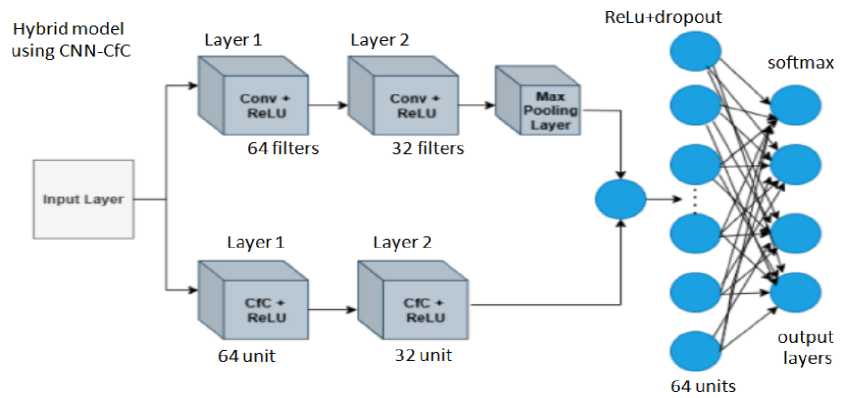
Fig. 10. Hybrid model using CNN-CfC (proposed model architecture).
Table 6. Optimized hyper-parameters for proposed CfC-CNN method after tuning with random search method.
|
Variables |
Value |
|
CfC unit 1 |
64 |
|
CfC unit 2 |
16 |
|
Drop out cfc 1 |
.3 |
|
Drop out cfc 2 |
.3 |
|
CNN filter 1, filter 2 |
64, 32 |
|
Dense unit, alpha |
64, .4 |
|
Gamma, learning rate |
1, .00023 |
Table 7. Performance Comparison of different models without feature selection.
|
Model |
Accuracy |
Precision |
Recall |
F1 score |
|
RNN |
99.82% |
99.49% |
95.48% |
97.28% |
|
LSTM |
99.84% |
99.67% |
96.05% |
97.72% |
|
CNN |
99.82% |
99.59% |
95.44% |
97.30% |
|
CfC |
99.83% |
99.15% |
96.27% |
97.61% |
|
Proposed CNN-CfC |
99.84% |
99.56% |
96.05% |
97.66% |
Table 8. Performance of Hybrid Model with Chi-square Feature selection.
|
Fraud class |
Precision |
Recall |
F1 score |
Overall accuracy |
|
ATO |
99.93% |
100% |
99.96% |
99.78% |
|
Card skimming |
99.18% |
84.93% |
91.50% |
99.76% |
|
No fraud |
99.86% |
99.99% |
99.92% |
99.80% |
|
phishing |
100% |
100% |
100% |
99.99% |
|
Macro avg. |
99.74% |
96.23% |
97.85% |
99.85% |
Fig. 11. Relative Testing Time.
True
testing time (second)
Confusion matrix of hybrid CNN-CfC model ( without feature selection)
АТО
О
О
О
card skimming -
з
О
no fraud
О
phishing
о
о
о
ATO
card skimming
no fraud
phishing
predicted
Fig. 12. Confusion Matrix of Hybrid CfC-CNN Model without Feature Selection.
Confusion matrix of hybrid CNN-CfC model (with chi-square feature selection)
ATO
О
о
True
card skimming
о
О
no fraud

О
phishing
о
о
ATO
card skimming
no fraud
phishing
predicted
Fig. 13. Confusion Matrix of Hybrid CfC-CNN Model with Chi-Square Feature Selection.
phishing
(AUO1)
ATO (AUC=1.0) card skimming (AUO.9813)
(AU 0.99)
false positive rate ^ с^( Square feature selection
Fig. 14. ROC-AUC Curves for Hybrid CfC-CNN Model.
-
3.4. Feature Selection, Class Distribution, and class imbalance handling
-
3.5. Model Architecture Design
This paper used the Chi-square feature selection method, which is depicted in Table 4, to choose the most pertinent characteristics for training. Following thorough analysis, we eliminated six additional features from the dataset. These elements were eliminated from the bottom according to their significance. Chi-Square feature selection is a statistical test used to ascertain whether a meaningful connection exists between categorical input features and a categorical target variable. It calculates the degree to which the observed frequency of values in each feature differs from the frequency that would be predicted in the absence of any link. Chi-square can be used to determine which categorical features in a fraud detection dataset are most likely to be linked to fraud.
It can determine the likelihood that Fraud Type is connected to Use Chip, Merchant State, or Fallback to Swipe. This paper employed SMOTE (see Fig. 7) and class weights assignment techniques (see Fig. 8) to overcome the class imbalance issue of the dataset. To guarantee balanced learning across all fraud categories, these techniques were carefully applied to the training data. SMOTE was incorporated to create fictitious situations for the minority fraud classes of card skimming, account takeover (ATO), and phishing. Since SMOTE generates fresh, realistic instances rather than merely repeating preexisting samples, it helps balance class representation without over fitting. This is in contrast to random oversampling. The reason this is so essential is that unbalanced datasets can make the model biased towards the majority class ("No Fraud"), which makes it harder to identify important but uncommon fraud situations. To further offset the imbalance, class weights were computed as shown in Table 5 and used during model prediction in addition to SMOTE.
These weights encourage the model to learn from underrepresented fraud types by giving minority classes greater weight when calculating losses. This work improved fraud detection performance across all classes by combining SMOTE and class weighting to ensure that the model learned properly from a balanced dataset ultimately maintaining sensitivity to actual class distributions.
To partition the dataset into both training sets and testing sets, this paper used stratified K-fold cross-validation (see Fig. 9). In particular, this paper used scikit-learn's Stratified KFold technique with 10 folds, which split the data into 10 groups. Nine subsets were pooled to create the training set, and one subset served as the test set for each iteration. To ensure that every subset was used for testing once, this procedure was carried out ten times. It is ensured that every stratified 10-Fold fold maintains the same class distribution as the original data.
This was especially important in our case because the data is very skewed, with some forms of fraud—like phishing, ATO, and card skimming—being much less frequent than no fraud. Our model was continually trained and validated on representative subsets by maintaining the class ratio in each fold, which increased the evaluation's dependability. Stratified K-Fold guarantees that the model learns to detect minority fraud types more successfully, prevents over fitting to the majority class, and lowers the chance of biased outcomes when compared to a straightforward initial train-test split. We carefully evaluated the efficacy of a number of deep learning models, including CNN, RNN, LSTM, and CfC, before deciding on optimal hybrid design [38].
The hybrid CfC + CNN model was shown to be the best choice after thorough testing with solo models (RNN, LSTM, CNN, and CfC) and rigorous comparisons with the previous research. This decision was based on the complementary capabilities of the two architectures: CNNs excel at extracting local spatial patterns from transactional features (like correlations between "Amount," "ZIP code," or "Website Security") through 1D convolutions, while CfC efficiently models temporal dynamics (like transaction sequences and behavioral changes over time) by solving differential equations in closed form. Compared to traditional RNNs or LSTMs, CfC enables faster and more dependable training by avoiding vanishing gradients and reducing computing overhead. The hybrid model had the highest macro-averaged F1-score, precision, and recall, outperforming both standalone models and earlier techniques. Furthermore, because CfC has a faster inference time (0.7× compared to RNN), the hybrid architecture was particularly well-suited for real-time financial transaction fraud detection, ensuring scalability and efficiency in practical deployments. Its accuracy, speed, and robustness solidified its selection as the best approach for classifying multi-class fraud. To improve fraud type detection, this paper used a hybrid deep learning architecture in this model, as illustrated in Fig. 10, which combines CNN and CfC Neural Network model.
The CNN branch is intended to record local feature interactions between transactional attributes, including devicerelated data, amount, ZIP code, and MCC. In order to concentrate on individual feature interactions, it employs two Conv1D layers with ReLU activation and a kernel size of 1. Dropout and global max pooling are then used to lower dimensionality and avoid over fitting. Concurrently, the CfC branch, functioning as a recurrent layer, processes transaction data over time steps to model sequential behavioral patterns. This allows for the detection of emerging fraud behaviors such as card skimming and account takeover (ATO).
To extract temporal relationships, two CfC layers with sigmoid activation and dropout are employed. To categorize the transaction into one of the fraud classes, the outputs from both branches are combined, run through a thick layer, and then passed through a softmax output. The readers may refer to reference [38] for more details on CfC state equation and time discretization formula. By utilizing both temporal and geographic variables, this hybrid technique enables the model to detect fraud with greater accuracy and context awareness.
-
3.6. Training Strategy and Hyperparameter Optimization
-
3.7. Experimental Results
Using Keras Tuner and the Random Search algorithm, a methodical hyper parameter tuning technique was used to maximize the performance of the suggested hybrid CfC and CNN architecture for multiclass fraud detection. Because Random Search is so effective at exploring complex parameter spaces, we employed it for the hyper parameter optimization of our hybrid CfC-CNN model.
The methodology proved ideal for our needs since it searches the search region intelligently without incurring the computational expense of exhaustive approaches. We were able to experiment with several combinations of important parameters, including learning rates, dropout rates, filters, and layer units. Because this method efficiently identified crucial characteristics (such learning rate and dropout) without spending time on less crucial ones, it performed better than others in regions where others would struggle. The Keras Tuner solution enabled parallel testing and seamless TensorFlow integration, ultimately yielding optimal configurations in significantly fewer trials.
Our final model architecture benefited from carefully selected parameters: a 0.3 dropout rate that prevented over fitting while maintaining model capacity; 64 CNN filters for effective spatial pattern recognition; and 64 and 16 units in CfC layers for balanced temporal processing. This paper used random search for hyper parameter tuning. The highest macro averaged values (e.g., precision, recall) indicate that the top-performing setup performed well on both major and minority fraud classes. Table 6 displays the optimized hyper parameters for the suggested approach.
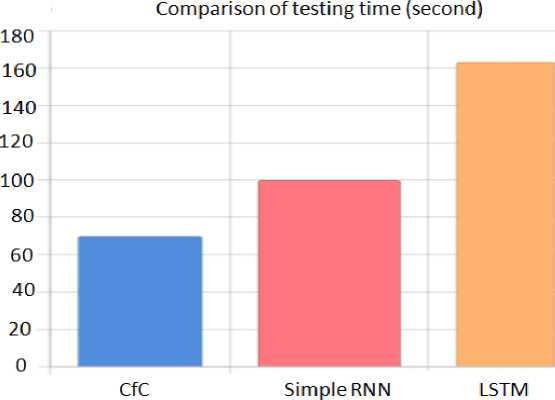
Our suggested hybrid deep learning model and conventional deep learning models are compared in Table 7, which shows how well each performs when no feature selection method is used. Because it outperformed the current methods in terms of accuracy score, precision score, recall score, and F1 score, the suggested CfC-CNN approach was chosen for financial fraud prediction. Figure 11 illustrates this. The CfC achieved a relative testing time of 0.7, which was significantly faster than the baseline RNN at 1.00. The LSTM, on the other hand, required 1.63 relative testing times. This suggests that the CfC is the more computationally faster network, followed by the RNN, and the LSTM is the slowest. The proposed hybrid CfC-CNN model with feature selection outperforms the traditional deep learning models (RNN, CNN, and CfC) in terms of precision value, recall value, and F1-score across all fraud classes, as shown in Table 8. With near-perfect scores for ATO and No Fraud and perfect precision and recall for Phishing, its macro-averaged AUPRC (0.9759) and overall accuracy (0.9985) were the highest. With an F1-score of 0.9174, CfC-CNN maintained its lead despite the difficulty of Card Skimming. Table 7 and 8 results were obtained using the same test sets.
CNN fared marginally poorer on Card Skimming than other traditional models, but it was competitive with 0.9982 accuracy and good F1-scores, particularly for ATO and Phishing. RNN's macro-averaged scores decreased because it had a lower recall (0.823) for Card Skimming but performed well in detecting Phishing and No Fraud. For ATO and Phishing, CfC alone demonstrated excellent results (0.9983 accuracy) with high precision and recall; however, the hybrid model exceeded it by a small margin. Although CfC is very good at accurately recording events and modeling temporal dynamics, it might not be able to understand local patterns in categorical transactional data.
However, CNNs are well-suited for detecting patterns from categorical data, such as patterns related to chip usage, PIN verification, and website security, because they employ filters across variables in a convolution operation. When CfC and CNN are combined, the hybrid architecture that results makes use of both models' advantages learning temporal irregularities and contextual feature interactions at the same time—and provides a more complete and efficient multi-class fraud detection solution than standalone architectures. Overall, generalization across fraud categories was greatly enhanced by combining CNN and CfC, proving the efficacy of the hybrid architecture for multiclass fraud detection without feature selection.
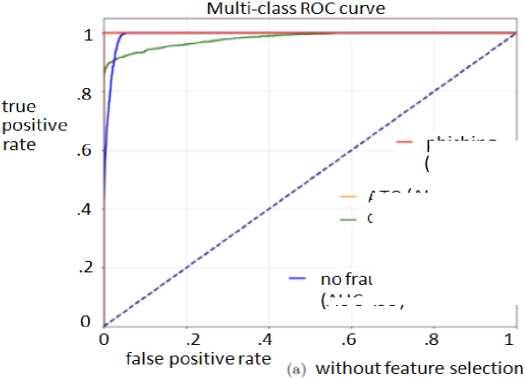
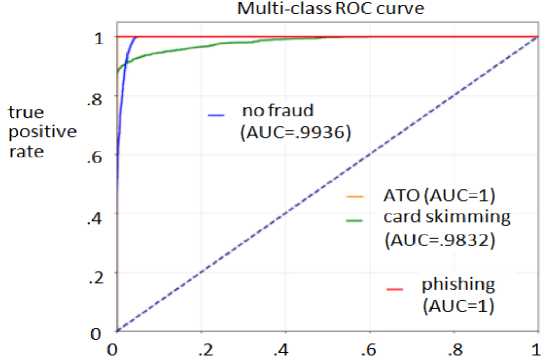
To examine the impact of feature selection technique, this paper used ROC curves and confusion matrices to perform error analysis both with and without the Chi-Square feature selection method. We were able to determine the top 17 most informative characteristics out of the initial 23 features using Chi-square selection without sacrificing the model's functionality. The confusion matrix result and ROC curve result for the hybrid CfC-CNN model without feature selection are shown in Figures 12 and 14 (a). Despite the model's high overall accuracy, 246 "Card Skimming" samples are incorrectly labeled as "No Fraud," most likely as a result of overlapping feature distributions.
The "No Fraud" class also exhibits minor misclassifications, with some samples predicted as "ATO" (4) and "Card Skimming" (18). However, with AUC scores of 1.0000 for both ATO and Phishing, 0.9813 for Card Skimming, and 0.9926 for No Fraud, the model exhibits strong discriminating. The outcomes following the use of Chi-Square feature selection are shown in Figures 13 and 14 (b). A small trade-off in memory for that class is indicated by the confusion matrix, which shows a slight increase in incorrectly classified "Card Skimming" cases (258). Nonetheless, the model maintains flawless classification for ATO and Phishing, and overall classification performance is still strong. The proposed model offers excellent generalization even with a smaller feature set, as confirmed by the slightly improved ROC-AUC scores for Card Skimming (0.9832) and No Fraud (0.9936). This comparative study shows that substantial feature dimensionality reduction (from 23 to 17 features) is possible without compromising performance when ChiSquare-based feature selection is incorporated into the CfC-CNN architecture. This maintains high classification accuracy across all fraud categories while simultaneously increasing interpretability and training efficiency.
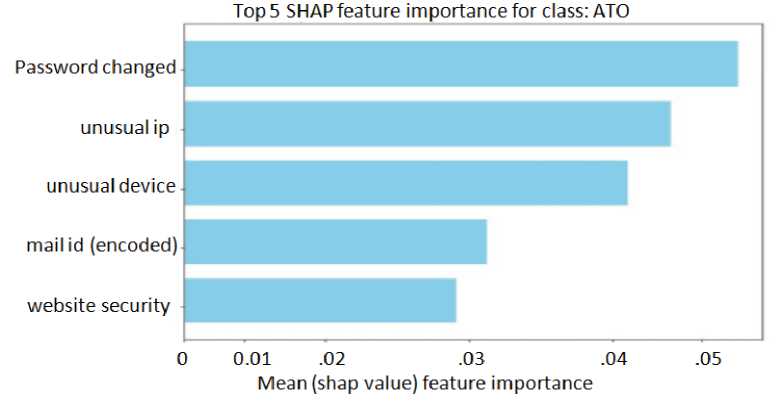
Fig. 15. SHAP bar plot Top 5 class ATO.
Top5 SHAPfeature imiportancefor class: card skimming
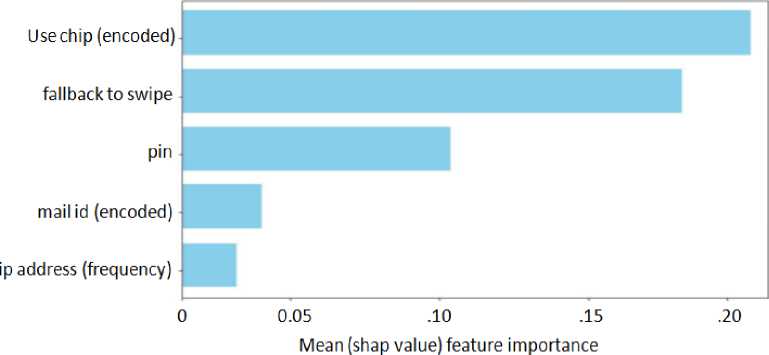
Fig. 16. SHAP bar plot Top 5 class Card Skimming.
Top 5 SHAPfeature importancefor class: phishing
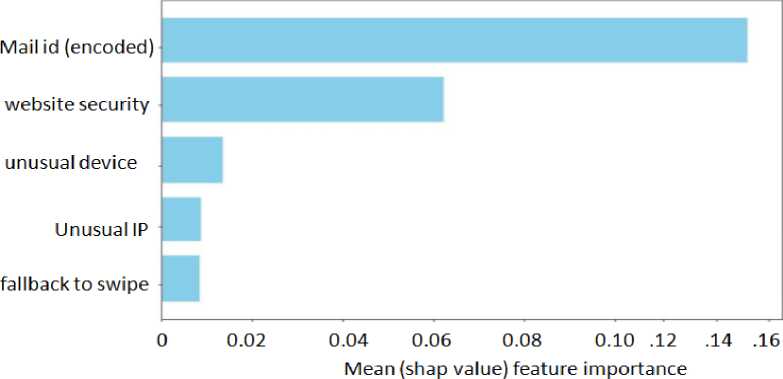
Fig. 17. SHAP bar plot Top 5 class Phishing.
Table 9. Comparison results with existing works.
|
Work name |
Accuracy |
Precision |
Recall |
F1-score |
McNemar tests T-statistic (%) |
McNemar tests p-value |
|
M. Lokanan et al., [29], random forest |
99.57% |
98.88% |
86.90% |
92.22% |
10 |
.420 |
|
E. Malik et al., [21], LGBM-adaboost |
99.82% |
99.38% |
95.57% |
97.26% |
05 |
.071 |
|
S. Farag et al.,[31], CNN-LSTM |
99.36% |
97.44% |
83.88% |
87.68% |
13 |
.830 |
|
Our Proposed Model, CfC-CNN |
99.85% |
99.74% |
96.23% |
97.85% |
04 |
.035 |
The most significant characteristics for ATO (Account Takeover) are "Password Changed," "Unusual IP," and "Unusual Device." This makes reasonable because ATO usually entails a password change and unusual login behavior from new devices or IP addresses. This notion is further supported by the existence of "Suspicious Mail" and encoded email addresses. The model for Card Skimming mostly depends on card usage features like "Use Chip (Encoded)," "Fallback to Swipe," and "PIN." This is in line with actual skimming assaults, where the physical way cards are used is crucial.
Due to transactional patterns, the features "IP Address (Frequency)" and "Mail ID" also exhibit a moderate level of relevance. "Mail ID (Encoded)" is the most important feature for phishing, followed by "Website Security," "Unusual Device," and "Unusual IP." This illustrates how phishing frequently targets consumers via hacked email addresses and unprotected websites, resulting in unusual access patterns from unidentified devices or locations. These revelations demonstrate that the model is not operating as a "black box," basing its judgments on characteristics that correspond to actual fraud. This interpretability enhances the model's credibility, validates its forecasts, and aids fraud analysts in comprehending the reasons behind the flagging of certain transactions. This work guaranteed accurate and transparent model predictions by utilizing SHAP for explainability. This is crucial for improving operational decision-making, regulatory compliance, and human monitoring in fraud prevention systems.
Table 10. Comparison results with existing works (accuracy after five independent runs).
|
Work name |
Accuracy (first run) |
Accuracy (2nd run) |
Accuracy (3rd run) |
Accuracy (4th run) |
Accuracy (fifth run) |
|
M. Lokanan et al., [29] |
.99570 ±.00001 |
.99570 ±.00002 |
.99570 ±.00003 |
.99570 ±.00003 |
.99570 ±.00004 |
|
E. Malik et al., [21] |
.99821±.00001 |
.99821±.00001 |
.99821±.00002 |
.99821±.00003 |
.99821±.00003 |
|
S. Farag et al.,[31] |
.99362±.00002 |
.99362±.00002 |
.99362±.00002 |
.99362±.00002 |
.99362±.00002 |
|
Our Proposed Model |
.99851±.00001 |
.99851±.00002 |
.99851±.00002 |
.99851±.00002 |
.99851±.00003 |
4. Comparison Results
This work used our multiclass fraud detection dataset to develop and test three models from recent research papers in order to assess the performance of our suggested hybrid CfC-CNN model. To guarantee a fair comparison, all models were trained and assessed in the same way. Table 9 shows that the proposed hybrid CfC-CNN method delivered better accuracy value and precision value than other compared papers. The proposed CfC-CNN based hybrid model achieves an improvement of at least .03 percent accuracy gain and .49 percent F1 score gain over existing works. The model from [29] did not employ feature selection, but it did apply 5-fold cross-validation with Min-Max normalization. The work in [21] selected key characteristics using the FeatureWiz technique. In the meanwhile, [31] employed Min-Max Scaler for normalization, One-Hot Encoding for categorical data, and SVM-RFE for feature selection.
This work tested these models on our dataset using our own feature engineering and preprocessing methodology to provide a fair comparison. It is evident from the findings that our hybrid CfC-CNN model performs better than the other three methods on all significant criteria. Interestingly, the model from [31], which was also evaluated on the IBM dataset, fared far worse than ours, demonstrating the potency of both our feature selection approach and our hybrid architecture. This comparison demonstrates that our customized preprocessing, in conjunction with CfC and CNN, provides better performance for multiclass fraud detection.
This research surpasses conventional fraud detection methods with four important breakthroughs. First, our multiclass technology provides financial institutions with targeted, actionable information by distinguishing between various fraud types, such as ATO, card skimming, and phishing. This contrasts with most previous studies [21, 29] that limit themselves to binary classification (fraud vs. non-fraud). Second, our robust feature engineering methodology integrates statistical rigor with domain expertise, in contrast to previous efforts [17, 31] that relied on arbitrary dimensionality reduction techniques. Table 10 shows the accuracy after five independent runs among all compared methods. To determine whether the proposed scheme's performance is statistically different from that of other existing works, Table 9 presents the McNemar's test p-value along with T-statistic values. The results indicated that the proposed CfC-CNN is best among all compared methods.
This work added behavior-validated features (such "Password Changed" and "Unusual IP") to the dataset and used Chi-Square selection to find the 17 most discriminative features. Third, we employ a dual-strategy approach to resolve class imbalance, combining class-weighted loss functions with SMOTE-based oversampling. This is a major improvement over approaches [21, 29] that rely solely on simple resampling. Fourth, our methodical hyper parameter optimization with Keras Tuner's Random Search produced an ideal model configuration, surpassing alternatives that were manually adjusted [21] or fixed-architecture [31].
The model's superiority is further demonstrated by its scalability and explain ability (as demonstrated by SHAP analysis), which effectively execute over 5 million transactions with low latency and preserve interpretability features that are conspicuously lacking in similar studies [29]. The higher performance metrics of our model across all evaluation criteria can be explained by these methodological developments taken together. To better understand how the hybrid CfC-CNN model makes its predictions, this paper employed SHAP (SHapley Additive exPlanations) based XAI technique. The relative contributions of each trait to the model's conclusions for different kinds of fraud are clarified by SHAP. The top five characteristics for the ATO, Card Skimming, and Phishing fraud classes are displayed in Figures 15, 16, and 17, respectively.
5. Conclusion
This paper presented a DL based comprehensive approach for multi-class financial payment transaction fraud prediction using both CNN and CfC techniques. The proposed work addressed several existing work limitations like lack of proper data preprocessing, imbalance issues, feature selection, and suitable prediction model selection with high accuracy value. Preprocessing methods like label encoding, RobustScaler for mitigating outliers, and SMOTE with class weighting to address extreme class imbalance were applied to the Kaggle dataset. The feature set was decreased from 23 to 17 using the Chi-Square feature selection method, which preserved good performance while enhancing interpretability and computing efficiency. Superior performance measures, such as an overall accuracy value of 99.85%, a macro-averaged F1 value of 97.85%, and nearly flawless precision and recall for Phishing and Account Takeover (ATO) fraud types, were attained by the hybrid CfC-CNN model after it was improved using Keras Tuner with Random Search. By achieving higher precision, recall, and F1-scores across all fraud classes, comparative study showed that the suggested CfC-CNN model performed better than both current frameworks from the literature and conventional models (RNN, LSTM, CNN, and CfC). According to comparison results, the proposed hybrid CfC-CNN model outperformed other existing works by achieving at least .03 percent accuracy gain. Maintaining strong performance with increased class imbalance, with little memory degradation for Card Skimming and flawless recall for ATO and Phishing, demonstrated the model's scalability. Memory usage, FLOPs, latency under load, or scalability performance analysis would be left for future works. Interpretable insights from SHAP-based explainable AI analysis confirmed that the model uses pertinent features that correspond with actual financial fraud patterns. Among other things, future research may focus on real-time financial transaction monitoring by using IoT and DL technologies, fraud pattern analysis based on LLM, quantum cryptography, and block chain-based fraud monitoring and prevention strategies. This work acknowledges the limitations of synthetic multi-class labels in a real world scenario deployment. In future we will try to identify clearly the potential failure scenarios of the model under real-world long-tail distributions and dynamic fraud patterns. This work will focus on cross-dataset generalization validation, online incremental learning mechanisms, and "federated privacy-preserving deployment in the future.
All the Declarations and StatementsAuthor Contributions Statement
Maeidah Rahman Jafrin – Conceptualization, software implementation, methodology design, proposed research ideas, constructed the overall framework, and supervised project execution.
Mahfuzul Hoq Chowdhury – Data curation, editing draft, handled data acquisition, dataset preprocessing, supervision, and implementing the research model.
All authors have read and agreed to the published version of the manuscript.
Conflict of Interest Statement
The authors declare no conflicts of interest.
Funding Declaration
The authors received no funding for this work.
Data Availability Statement
This study analyzed publicly available datasets (kaggle platform). The results obtained and datasets can be found here: “”, accessed on “30 June, 2025”.
Ethical Declarations
The authors should declare the following: Statements of ethical approval for studies involving human subjects and/or animals.
Acknowledgments
We sincerely thank the experts for their professional evaluation and valuable recommendations, which have contributed to improving the quality of the experiment and the reliability of its results.
Declaration of Generative AI in Scholarly Writing