
Multi-criteria optimization of properties of non-woven construction thermal insulation from wool fiber
Journal: Nanotechnologies in Construction: A Scientific Internet-Journal @nanobuild-en
Section: Manufacturing technology for building materials and products
Article in issue: 1 Vol.18, 2026.
Free access
Introduction. Currently, there are urgent issues of providing production facilities with domestic materials that are not inferior in quality to imported analogues. Materials for construction, including thermal insulation materials, are required for the building and restoration of damaged property and social facilities in the new regions of Russia. Sheep wool thermal insulators are environmentally friendly, easily recyclable and renewable. They should be treated with appropriate preparations at the finishing stage during production to ensure fire and bio-resistance. Materials and methods. A non-woven thermally bonded material composed of coarse and semi-coarse wool fibers and bicomponent polyester fiber as a binder was chosen as the object of research, which is a promising direction in the development of environmentally friendly and efficient thermo- and acoustic insulation materials. A key role in the formation of their operating ability is played a porous structure, in particular, the presence of a nanostructure – nanopores and channels. An experiment was conducted using the KONO-2 planning matrix, regression models of non-woven fabric properties were obtained. Optimization was performed for each model using MathCAD environment, then multi-criteria optimization was performed using the method of constructing a integrated efficiency indicator, an experiment was conducted to impart incombustibility and fire resistance to an optimal non-woven fabric sample. Results. A technology for producing volumetric non-woven thermal insulation sheets for construction purposes has been developed. Multi-criteria optimization has been performed to determine the sample with the best performance properties: increased breathability, strength, and sufficient stretchability. Conclusion. The results obtained confirm the applicability of using multicriteria optimization methods for the analysis of textile processes, the use of a complex dimensionless indicator made it possible to select optimal parameters for the production of non-woven construction thermal woolen insulation, ensuring compliance with the required performance characteristics according to the main indicators.
Similar articles in the section Building materials. Building components
Short address: https://sciup.org/142247066
IDS: 142247066 | DOI: 10.15828/2075-8545-2026-18-1-22-31
Text of the scientific article Multi-criteria optimization of properties of non-woven construction thermal insulation from wool fiber
Разумеев К.Э., Королева Н.А., Федорова Н.Е., Сичевой Д.В. Многокритериальная оптимизация свойств нетканого строительного утеплителя из шерстяных волокон. Нанотехнологии в строительстве. 2026;18(1):22–31. – EDN: LGNRBD.
Currently, there is an urgent need for the production of domestic materials that would not be inferior in quality to imported analogues.
Since February 2022, a large number of sanctions have been imposed on Russia regarding access to financial markets, technology, and the export-import of a wide range of goods. Sanctions show direct and indirect impact on the economic situation in the country in certain industries, including consumer goods manufacturing. Limited access to the raw materials base of the textile industry, semi-finished products, and limited supplies and technical support for the industry’s equipment contributed to curbing the development of production [1].
In the new regions of Russia, the construction and reconstruction of destroyed housing and social facilities is now actively underway, which requires a large amount of building materials, including thermal insulation. They provide thermal insulation for the winter months, lowering heating costs while improving indoor comfort. The thermal insulation also performs the function of acoustic
Nanotechnologies in construction 2026; 18 (1):
Нанотехнологии в строительстве 22–31
Nanob
MANUFACTURING TECHNOLOGY FOR BUILDING MATERIALS AND PRODUCTS
insulation, which is important for office premises and apartment buildings.
At this stage, according to the “Strategy for the Development of the Textile and Clothing Industry of the Russian Federation until 2035” [1], one of the key prospects for the sector is to support traditional textile production based on natural raw materials. This kind of support aims to preserve the existing industrial base while gradually reorienting it toward new objectives. Long-term success development, however, is possible upon parallel development in the production of blended textile materials using domestic chemical fibers.
In the presented research, the object of research is a non-woven material composed of wool fibers with the addition of bicomponent polyester fibers as a binder.
The application of building thermal insulation materials is quite extensive: insulation of walls, ceilings, floors, roofs, wall-to-roof abutments, facades, tanks, heat pipelines, sealing cracks and joints, etc. The choice of insulation depends on what kind of thermal insulation will be produced: external or internal. For external work, the insulation must be lasting and durable withstand mechanical stress, moisture, wind and temperature fluctuations, and for indoor works it must be well permeable to air, do not retain moisture inside, be environmentally friendly and non-flammable.
Non-woven building materials of wool fibers binded by bicomponent polyester fibers represent a promising direction in the development of environmentally friendly and efficient thermal and acoustic insulation materials. Nanoporous structure, in particular, the presence of nanopores and channels, plays a key role in the formation of their operating ability.
Since 2011, Professor G.E. Krichevsky has published a series of papers on the possibility and applicability of nanotechnology (as well as bio-, information, and cognitive technologies) in numerous branches of the textile and light industry [2–5], which, in our opinion, have not yet received either due appreciation or serious attention in the research papers of a new generation of academia.
The rapid development of technologies in the field of non-wovens production seems very promising. Among the research of Russian scientists and practitioners, monographs should be recognized as requiring attention [6–7].
Types of building thermal insulation materials are quite diverse [8] (Fig. 1). In shape, they can be in the form of plates, rolls, cord, bulk and sprayed, shaped. The structure distinguishes between bulk, cellular and fibrous heat insulators. Bulk or granular type products have a structure in the form of individual granules, these include perlite sand, expanded clay and various powder materials, they are used to insulate horizontal surfaces. The cellular structure is characterized by the presence of macropores inherent in polyurethane foam, foam, etc. Fiber-based insulation materials are the most promising. They can be made from organic or inorganic raw materials.
Inorganic insulation materials include mineral wool. Depending on the initial mineral substance, glass wool, stone or basalt wool and slag wool are distinguished. The key advantage of such thermal insulators in comparison with organic ones is excellent fire safety, resistance to mold and fungi. However, glass wool loses its characteristics faster when exposed to moisture, and also requires the use of personal protective equipment during installation. Slag wool is not suitable for housing construction, as it contains sulfur impurities harmful to humans. Among all mineral thermal insulation materials, stone wool is often the preferred choice. Beyond its primary use for insulating walls, floors, and pitched or flat roofs, it is also used in fire protecting structural elements such as steel columns, beams, air ducts, and reinforced concrete partitions.
Organic insulation materials are better suited for indoor finishing. These include materials based on waste from the woodworking industry (sawdust, shavings), waste paper (cellulose), wool, cork and other natural materials. Sheep wool heat insulators are environmentally friendly,
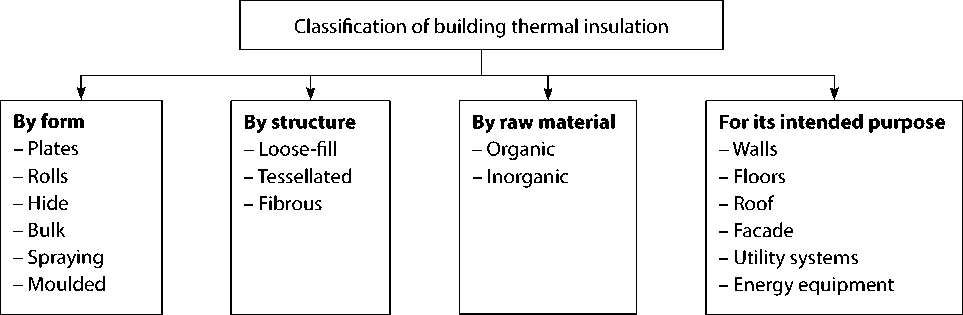
Fig. 1. Classification of building thermal insulation materials
Nanotechnologies in construction 2026; 18 (1):
Нанотехнологии в строительстве 22–31
Nanob
MANUFACTURING TECHNOLOGY FOR BUILDING MATERIALS AND PRODUCTS
easily recyclable and renewable [9]. To make them fire and bio-resistant, they should be treated with appropriate preparations at the finishing stage during production.
Today, in many countries there is an acute problem with the disposal of wool from meat breeds of sheep. Often, such wool is simply thrown away, due to the lack of recycling facilities in the immediate vicinity.
It is proposed to use wool from domestic meat and meat-wool sheep breeds, which, according to the modern wool classification [8], is mainly semi-coarse and coarse wool for the production of non-woven building insulation.
METHODOLOGY
The object of the study is a non-woven thermally bonded material made of wool fibers with the addition of bicomponent polyester fibers as a binder [11, 12].
Wool fiber has a unique structure [13], which is created by nature. Wool fibers are macroscopic objects; however, it should be noted that their defining structural elements exist at the nanoscale.
Sheep wool fiber has a complex multi-level structure. The natural nanostructure obtained as a result of evolution endows wool fiber with unique, valuable properties for humans.
Nanoscale fiber elements include: keratin fibrils (in particular: protofibrils and microfibrils of wool with a diameter of about 20 and 60–70 nm, respectively), strong, thread-like structures consisting of keratin proteins. They provide the fiber with mechanical strength and elasticity. Keratin intermediate filaments, as well as the interaction of nanoscale fibrils and an amorphous matrix, give wool a unique combination of strength and elasticity. The so-called scales (cuticle), the surface of these scales has a complex nanorelief, which significantly affects the adhesion of the fibers to each other and the hydrophobic properties.
The nanoporous structure of fibers is scientifically valuable and relevant to our research. There is a network of nanopores and channels inside the fiber, which allows wool to absorb and retain moisture, and also to be a good conductor for dye molecules during dyeing during processing.
This fiber has significant practical value in nanotechnology, both on its own and within formulation mixtures. Understanding the nanosize of wool makes it possible to create new materials by mimicking the structure of wool to create synthetic fibers with similar properties, nanoparticles can be embedded in fiber nanopores, creating textile fabrics with desired properties.
Due to their complex morphology, wool fibers exhibit a natural micro- and nanoporous structure. Pores contribute to air retention, providing high thermal insulation properties. In the process of forming a non-woven fabric, a developed system of pores of various sizes, including nanopores, is formed between wool and bicomponent polyester fibers. In the process of melting and crystallization of the polymer, nanopores can form in the structure of the binder, and the interfiber space increases. As a complement to the study, it is possible to create additional nanopores by modifying wool or polyester fibers.
The presence of nanopores affects the following properties of nonwoven building materials: thermal insulation, acoustic insulation, air permeability.
Furthermore, increased porosity – particularly nanoporosity – lowers the material’s density, resulting in a lighter and more practical product. Nanopores increase the surface area of the material, increasing its ability to sorption moisture and gases, which can be useful for regulating the indoor climate and purifying the air.
Nanopores filled with air significantly reduce the thermal conductivity of the material, since air is a poor heat conductor. An increase in the number of nanopores leads to an improvement in thermal insulation characteristics. The nanoporous structure helps to disperse sound waves, increasing the sound-absorbing properties of the material, also ensure sufficient air permeability of the material, regulating the humidity in the room and preventing condensation.
The KONO-2 planning matrix was used for the two-factor experiment, since it has good statistical characteristics and includes a small number of experiments. Processing the results of the experiment made it possible to obtain mathematical models of the dependence of the properties of the non-woven fabric on the surface density of the canvas ( X 1) and the proportion of insertion of bicomponent fibers ( X 2).
Intervals of varying factors were chosen, for the surface density of the canvas it was in volume terms from 150 to 350 g/m2, and for the share of insertion of bicomponent fibers from 20 to 40%. Let’s determine the values of the factors in the center of the interval
X цi = ( X нi + X вi ) / 2, (1)
where Xнi is lower value of the i- th factor in the interval of variation;
Xвi is upper value of the i- th factor in the interval of variation.
Then X 1 = (150 + 350)/2 = 250 g/m2, Xц2 = (20 + 40)/2 = 30%ц .
We will convert the natural values of the factors into coded ones:
xi = (Xi – Xцi) / Ii,(2)
where xi is coded value of the i- th factor;
Xi is the natural value of the i- th factor;
Ii is a measurement interval of changing the i- th factor.
Ii = (Xвi – Xнi) / 2.(3)
Nanotechnologies in construction 2026; 18 (1):
Нанотехнологии в строительстве 22–31
Nanob
MANUFACTURING TECHNOLOGY FOR BUILDING MATERIALS AND PRODUCTS
Then I 1 = (350 – 150)/2 = 100 g/m2, I 2 = (40 – 20)/2 = 10%.
According to formula (2), the correspondence of coded factors to natural values was obtained: the coded value of the factor equals to (–1) corresponds to the lower value of the factor in physical terms, (0) equals to the central value, (+ 1) equals to the upper value.
The KONO-2 planning matrix involves conducting experiments at points that combine all possible combinations of the lower, central, upper levels of the first and second factors. Since there are two factors, they have three levels of variation, the number of experiments will be early than nine. These points are shown in Figure 2 for coded values. The numbers are numbered in the order of conducting experiments.
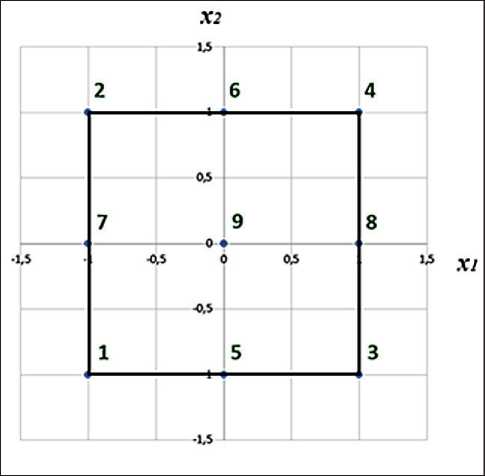
Fig. 2. Levels of factor variation for the KONO-2 planning matrix
RESULTS AND DISCUSSION
In accordance with the KONO-2 plan, nine samples of nonwoven fabrics were developed, their properties were studied, the results of experiments were processed [14] and mathematical models for five criteria [15, 16] were obtained, presented in Table 1. Following the KONO-2 plan, nine nonwoven fabric samples were developed and their properties studied. The processed experimental results [14] yielded mathematical models for five criteria [15, 16], presented in Table 1.
Building insulation should have increased breathability, which indicates a large number of pores and provides a good thermal insulation. Furthermore, the material must be strong and sufficiently elastic to prevent failure under deformation.
Each model was optimized using the MathCAD environment [14]. The values of the factors in the coded form are found (Table 2), at which the functions reach their maximum values, taking into account bilateral constraints –1 ≤ x 1 ≤ 1, –1 ≤ x 2 ≤ 1.
As can be seen from Table 2, the results of the calculations for each criterion separately showed different optimal points. Thus, we are faced with a multi-criteria task to determine the sample with the best performance properties.
Various methods exist for solving such problems, which fall into two groups. The first group involves transforming the multi-criteria problem into a single-criteria one, using different approaches: by identifying the main criterion, constructing a complex performance indicator, or consistently optimizing partial performance indicators. The methods of the second group find a solution to a multi-criteria problem by determining a set of compromise options. This group is based on the concept of Pareto-optimal solutions proposed by the Italian economist V. Pareto. [18].
Following the way to find a solution, we will choose the method of constructing a complex performance in-
Table 1. Mathematical models of nonwoven fabric properties
|
No. |
Property (optimization criterion) |
Regression models with coded factor values |
|
1 |
Breathability |
Q ( x 1 , x 2 ) = 87,6 - 23,0 x 1 - 6,3 x 2 + 18,7 x 2 - 3,3 x 2 2 + 0,3 x 1 x 2 |
|
2 |
Direct Breaking Load in the Longitudinal Direction |
Fl ( x 1 , x 2 ) = 100,70 - 3,78 x 1 + 51,50 x 2 + 21,78 x 12 - 2,72 x 2 2 - 26,42 x 1 x 2 |
|
3 |
Absolute breaking load in the transverse direction |
F„ ( x ., x ,) = 24,81 + 3,00 x . + 8,61 x , + 9,11 x 2 - 7,06 x ,2 - 10,33 x.x, B 1 2 1 2 1 2 12 |
|
4 |
Relative discontinuous elongation in the longitudinal direction |
sL ( x 1 , x 2 ) = 50,44 - 0,83 x 1 - 9,89 x 2 - 7,17 x 12 + 12,00 x 2 2 + 6,17 x 1 x 2 |
|
5 |
Relative tensile elongation in transverse direction |
sK ( x ,, x ) = 75,07 + 3,56 x, - 21,44 x - 3,11 x ,2 + 17,89 x 22 - 5,75 xx B 1 2 1 2 1 2 12 |
Nanotechnologies in construction 2026; 18 (1):
Нанотехнологии в строительстве 22–31
MANUFACTURING TECHNOLOGY FOR BUILDING MATERIALS AND PRODUCTS
Nanob
Table 2. Optimization results for each criterion
k
FC ( X ) = £ ^ j F ( X ) , (4)
i = 1
where cj are weight coefficients, the sign of which depends on the coincidence of the goals of optimization of partial performance indicators with the complex one (if the goals coincide, the sign is positive, if the goals do not coincide, the sign is negative);
Fj ( X ) is particular indicator.
The coefficients cj are dimensionless, for the task to be solved, equivalent values of coefficients are assumed for all partial indicators, i.e. cj = 0.2.
In our case, particular performance indicators have different dimensions. Therefore, in order to compose a function that characterizes a complex indicator, it is necessary to switch from Fj ( X ) to a dimensionless form Ψ j ( X ).
With known minimum Fj min and maximum Fj max values of particular efficiency indicators, the transformation into a dimensionless form is carried out according to the formula:
^ ( X ) = Fj ( X )- F j m^n . (5)
j jmax jmin
Incorporating expression (5) into the complex indicator (4) is in the following form:
k
F ( X ) = S С Л ; ( X ) . (6)
i = 1
The calculations were carried out in the MathCAD environment using built-in functions to perform optimization. The maximum values for each criterion were determined earlier (Table 2), it was necessary to find the minimum values of the criteria. The results are shown in Table 3.
Then the dimensionless form of particular indicators will take the form:
-
1. Breathability
-
2. Direct Breaking Load in the Longitudinal Direction
-
3. Absolute breaking load in the transverse direction
-
4. Relative discontinuous elongation in the longitudinal direction
-
5. Relative Tensile Elongation in Transverse Direction
T 1 ( x , x 2 ) = 0,268 - 0,374 x , - 0,102 x 2 + 0,304 x 2 - 0,054 x 22 + 0,005 x , x 2 .
T 2 ( x , x 2 ) = 0,374-0,023 x + 0,320 x 2 + 0,135 x 2 -0,017 x 2 2 -0,164 x 1 x 2 .
T 3 ( x , x 2 ) = 0,627 + 0,092 x 1 + 0,263 x 2 + 0,279 x 2 - 0,216 x 22 - 0,316 xx 2 .
T4( x 1 , x 2) = 0,333-0,024 x 1 -0,280 x 2 -0,200 x 2 + 0,340 x 22 + 0,175 x 1 x 2 .
T5( x 1 , x 2) = 0,174 + 0,065 x 1 -0,389 x 2 -0,056 x 2 + 0,325 x 22 - 0,104 x 1 x 2 .
The complex indicator in accordance with formula (6) and the values of the coefficients will take the following form:

. (7)
Table 3. Defining minimum values for each criterion
|
Criterion |
Minimum function value F j min |
Coded values factors for F j min |
|
|
x 1 |
x 2 |
||
|
Q, m3/min · m2 |
71.1 |
0.607 |
+1 |
|
FL , Н |
40.6 |
–0.520 |
–1 |
|
FB , Н |
4.3 |
–0.732 |
–1 |
|
ε L , % |
38.7 |
–1 |
0.669 |
|
ε B , % |
65.5 |
–1 |
0.439 |
Nanotechnologies in construction 2026; 18 (1):
Нанотехнологии в строительстве 22–31
Nanob
MANUFACTURING TECHNOLOGY FOR BUILDING MATERIALS AND PRODUCTS
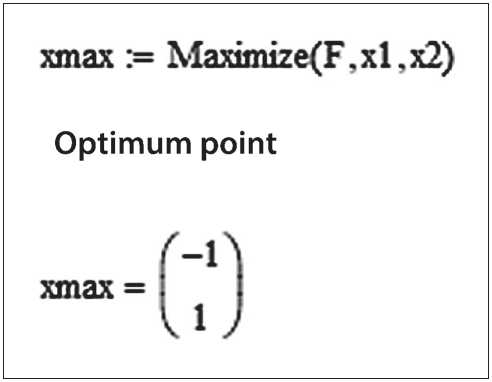
Fig. 3. Determination of the optimum point of a complex indicator
Now we optimize function (7) taking into account bilateral constraints –1 ≤ x 1 ≤ 1, –1 ≤ x 2 ≤ 1. Determination of the optimum point of a complex indicator was performed in the MathCAD environment using the Maximize function, the coordinates of this point were found (Fig. 3).
The equal level lines of the complex indicator function are shown in Figure 4.
Then the optimal value of the surface density in volume terms will be 150 g/m2, which corresponds to the lower level of the first factor, and the share of bicomponent fibers is 40%, which corresponds to the upper level of the second factor. At the same time, the considered properties of wool construction insulation will have the following values: Q = 119.4 m3/(min·m2), FL = 201.46 H, FB = 42.8 H, ε L = 40.15%, ε B = 70.6%.
The samples should be treated with appropriate preparations during the finishing phase of the production to make the samples fire-and bio- resistant.
In the research, an experiment was carried out to give non-flammability and fire resistance to the optimal sample of non-woven fabric, selected as a result of a preliminary optimization experiment.
As a product to give fire resistance, the flame retardant Foginol-2 was chosen, which is a mixture of water-soluble salts of anionic phosphorus-containing compounds. Fire tests were carried out according to the international standard FAR 25853, with the test specimen being placed vertically.
The results of the experiment showed that with any mode of applying a flame retardant to a three-dimen-
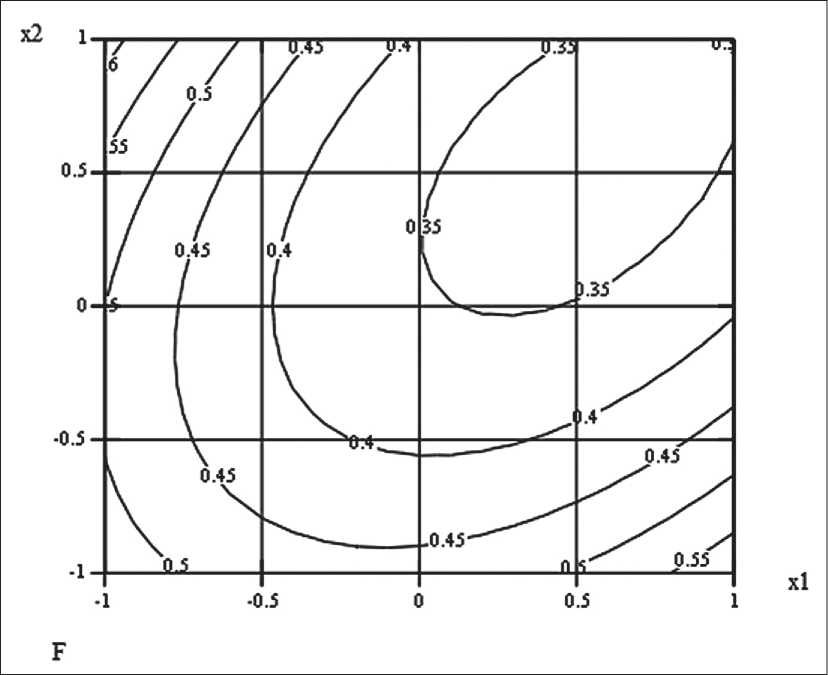
Fig. 4. Equal level lines
Nanotechnologies in construction 2026; 18 (1):
Нанотехнологии в строительстве 22–31
Nanob
MANUFACTURING TECHNOLOGY FOR BUILDING MATERIALS AND PRODUCTS
sional non-woven fabric, an increase in fire resistance and non-flammability is observed. Samples impregnated with flame retardant, in comparison with the untreated original sample, emit less flammable gases, there is no dropping, and the charring zone is smaller. When the combustion source is removed, the samples quickly self-extinguish.
Impregnation with a flame retardant creates a protective film on the fibers and in the structure of the nonwoven fabric, which prevents the combustion process: – reduce the likelihood of ignition of the non-woven fabric when a source of combustion occurs;
– significantly reduce the spread of fire;
– increase the time for safe evacuation from the fire site.
FINDINGS
A technology has been developed for the production of volume non-woven thermal insulation sheets for construction purposes. A fiber mixture consisting of woolen raw materials, coarse and semi-coarse domestic sheep wool and low-melting bicomponent polyester fiber was used as the raw material for the production of non-woven fabric.
A multi-criteria optimization was carried out to determine the sample with the best performance properties: increased breathability, strength and sufficient stretchability.
An experiment was conducted to insure incombustibility and fire resistance for an optimal sample of non-woven fabric. The results obtained confirm the applicability of using multicriteria optimization methods for the analysis of textile processes.
In particular, the use of an integral dimensionless indicator made it possible to select the optimal parameters for the production of non-woven structural thermal woolen insulation, ensuring compliance with the required performance characteristics in all five key indicators.
The study and optimization of the nanoporous structure of non-woven construction materials made of wool and bicomponent polyester fibers is an important way for the development of new materials with improved thermal and acoustic insulation properties that contribute to the creation of comfortable and environmentally safe housing.
CONCLUSION
Building thermal insulation materials are a crucial component of advance technologies. Research in the field of nanoporous non-woven building materials composed of wool and bicomponent polyester fibers opens up broad prospects for developing new materials with improved performance. A key focus lies in developing methods to monitor and control the formation of their nanoporous structure, thereby achieving an optimal balance of thermal and acoustic insulation properties. The use of environmentally friendly and renewable materials such as wool to create energy efficient and environmentally friendly building materials.
