
On Dating Archaeological Sites Evidencing Ferrous Metallurgy in the Southeastern Altai, based on Radiocarbon and Dendrochronological Analyses of Charcoal
Journal: Archaeology, Ethnology & Anthropology of Eurasia @journal-aeae-en
Section: The metal ages and medieval period
Article in issue: 2 т.53, 2025.
Free access
This study examines the use of charcoal for dating iron-smelting furnaces in the southeastern Altai. Problems with using radiocarbon analysis in this case are connected with the accuracy of assessing the calendar age. Another important reason why the age of furnaces is overestimated is the “old wood” effect. This effect cannot be avoided by making radiocarbon dating of thin tree trunks (branches) from slag or by using the youngest radiocarbon dates of samples from a single archaeological context. In the case of dendrochronological analysis, considering the age trend in individual series is also not a reliable criterion for determining closeness to the bark due to the long lifespan of trees in the southeastern Altai. Currently, the only way to avoid the “old wood” effect is to date samples with preserved bark, which are quite rare. Results of dendrochronological analysis demonstrate that conclusions drawn from the earliest dates for the same furnace are unreliable. Long tree-ring chronologies based on archaeological charcoal are more prospective for dating ferrous metallurgy sites in the region. The use of dendrochronological analysis minimizes the difficulties with interpreting radiocarbon dates.
Short address: https://sciup.org/145147495
IDS: 145147495 | DOI: 10.17746/1563-0110.2025.53.2.089-098
Text of the scientific article On Dating Archaeological Sites Evidencing Ferrous Metallurgy in the Southeastern Altai, based on Radiocarbon and Dendrochronological Analyses of Charcoal
Time is a key parameter in chronologically oriented scientific and archaeological disciplines. Events that are recorded in sediments, landforms, or artifacts give little information until they are arranged in chronological order. This fully applies to the dating of iron smelting sites in the southeastern part of the Russian Altai. Archaeological data and radiocarbon dating have helped to resolve this issue (Zinyakov, 1988; Agatova, Nepop, Korsakov, 2018; Vodyasov et al., 2020). Recently, the first encouraging results have also been obtained from dendrochronological analysis (Agatova et al., 2023; Myglan et al., 2024).
Concentration of a large number of bloomery furnaces in the region was caused by the availability of ore deposits and ore occurrences, as well as the proximity of necessary forests (Agatova, Nepop, Korsakov, 2018; Agatova et al., 2018, 2023). Fragments of charcoal discovered in the fore-furnace holes and furnace fillings have made it possible to use radiocarbon analysis for chronological attribution of ferrous metallurgy sites (Gutak, Rusanov, 2013; Agatova, Nepop, Korsakov, 2018; Agatova et al., 2023; Murakami et al., 2019; Vodyasov et al., 2020; Zaitseva, Vodyasov, 2023). Currently, over thirty 14C dates have been obtained for the furnaces from the Chuya-Kuraika metallurgical region (see review in (Agatova et al., 2023)). Approaches to their interpretation differ among research groups, which leads to significant differences in establishing the operating time of bloomery furnaces. Some studies (Agatova, Nepop, Korsakov, 2018; Agatova et al., 2023; Murakami et al., 2019) argue that furnaces of the Kosh-Agach type were made in the Old Turkic period (late 6th to the first half of the 10th century), while other works (Gutak, Rusanov, 2013; Vodyasov et al., 2020; Zaitseva, Vodyasov, 2023) suggest the earlier Xiongnu period.
This article introduces seven new radiocarbon AMS dates of charcoal from slags of furnace No. 4 at the Kuektanar site, and presents the results of their calibration using Bayesian statistics. In addition, some specific aspects of interpreting data from charcoal radiocarbon dating will be analyzed, including a discussion of the “old wood” effect, which is the main reason for giving erroneous earlier dates to archaeometallurgical sites. Further, the dendrochronological analysis of charcoal will be presented, demonstrating the vulnerability of conclusions derived from the “earliest” radiocarbon dates for a single furnace.
Study area, material, and methods
The archaeological ferrous metallurgy sites under discussion are located in the Chuya and Kuraika depressions in the southeastern Altai. The Chuya-Kuraika mining and metallurgical region was set off after the areal archaeometallurgical survey in the 1970s (Zinyakov, 1988). Twenty-nine sites were discovered in the depressions. Two types of bloomery furnaces were identified, including the most common box-shaped furnaces of the Kosh-Agach type and less common furnaces with a semicircular back wall (Ibid.: 31–49; Vodyasov, Zaitseva, 2020).
The age of the ferrous metallurgy sites in the Russian Altai is based on the time when the bloomery method of iron production was developed in the region. A number of artifacts similar to finds from archaeological assemblages in other parts of the Altai were discovered during excavations at the Kosh-Agach type furnaces (Gavrilova, 1965: 36–40, 61), which made it possible to attribute them to the Old Turkic period (Zinyakov, 1988: 49–52). Analysis of the typological features of bloomery furnaces revealed the similarity of individual structural elements with sites of the 6th–9th centuries AD in the Khakassia-Minusinsk Depression (Sunchugashev, 1975: 93–100) and furnaces of the Saltov type of the 8th–9th centuries AD (Afanasiev, Nikolaenko, 1982). This indicates that iron-smelting furnaces of the Kosh-Agach type in the southeastern Altai functioned in the Old Turkic period in the 6th–10th centuries AD (Zinyakov, 1988: 51).
For the chronological attribution of bloomery furnaces at the Kuektanar River mouth, charcoal from the slag collected by the current authors after excavations by N.M. Zinyakov and E.V. Vodyasov was analyzed. Two fragments from furnace No. 4, containing 91 and 112 annual rings, were used for radiocarbon AMS dating of rings from the central and peripheral parts of each of them. Individual AMS dates were obtained for three more fragments of charcoal from the same furnace. The samples were prepared at the Institute of Archaeology and Ethnography SB RAS (Novosibirsk) and were dated at the AMS Golden Valley radiocarbon laboratory (Novosibirsk, index GV).
Radiocarbon dating of different fragments of a single sample allowed the researchers to use the Bayesian statistical modeling of calendar age, taking into account the exact number of tree rings separating the dated fragments. Calibration of radiocarbon dates and Bayesian analysis were carried out in OxCal v.4.4.4 (Bronk Ramsey, 2021), using the IntCal20 calibration curve (Reimer et al., 2020). In addition to radiocarbon dating, the longest available floating 377-year tree-ring chronology based on charcoal (Myglan et al., 2024) was used for chronological attribution of iron smelting sites in the southeastern Altai.
Specific aspects of using charcoal for establishing the operating time of iron smelting furnaces
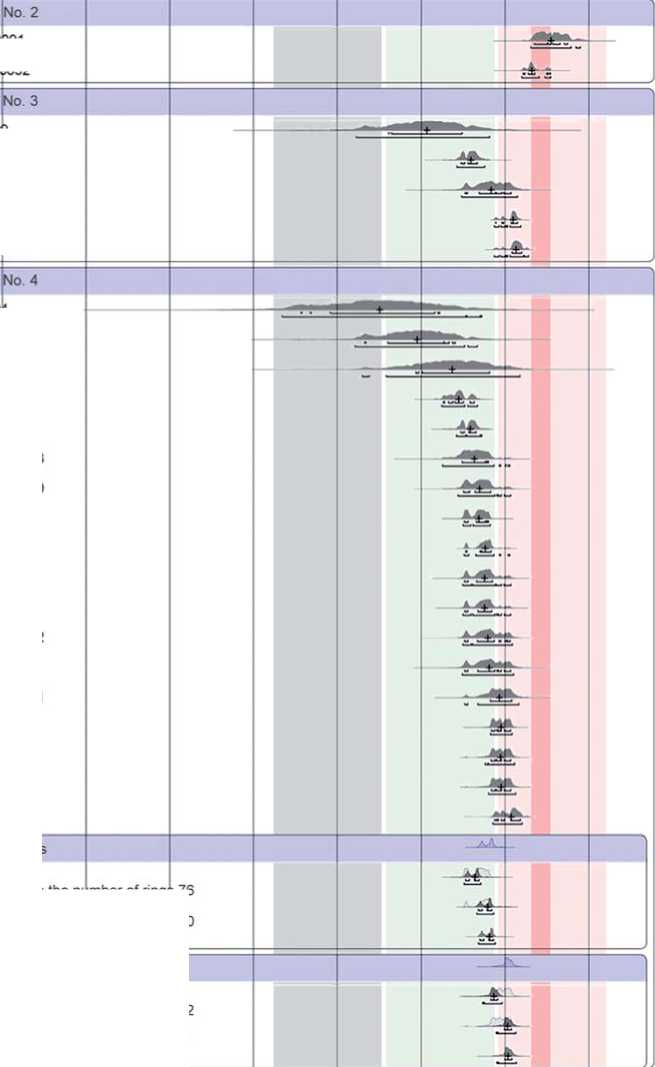
The most common method for charcoal dating is radiocarbon analysis. The main problem with its application in archaeology is the accuracy of dates, including those obtained by AMS. For example, for iron smelting furnaces at the Kuektanar River mouth, the smallest uncertainty of the calibrated (2σ) age was 130 years (sample Le-11825 (Vodyasov et al., 2020)), while the maximum uncertainty exceeded one thousand years (sample Le-11994 (Ibid.)), which is significantly longer than the archaeological periods under consideration and makes such a date unsuitable for chronological reconstructions (Fig. 1). It has been observed (Hendrickson, Hua, Pryce, 2013) that the use of charcoal extracted from large pieces of metallurgical slag makes it possible to work with organic material that was not exposed to the destructive effects of the external environment and contamination with young carbon. However, even this approach does not ensure acceptable dating accuracy.
The uncertainty of the obtained calendar age depends on the confidence interval which the radiocarbon date is calibrated with. Calibration at 1σ provides a 68 % probability of falling within the calculated time interval, which means that the reliability of age determination is 68 %. Calibration with a confidence interval of 2σ provides 95 % reliability, but gives a wider scatter of calendar dates. Some scholars prefer using calibration results with the confidence interval of 1σ when reconstructing archaeological events, because the range of the obtained calendar age often exceeds the duration of existence of the cultures in the southeastern Altai. For example, in a number of works (Vodyasov et al., 2020; Vodyasov, Zaitseva, 2020; Zaitseva, Vodyasov, 2023), despite the calibration carried out for both options, the narrower ranges of calendar age obtained with the confidence interval of 1σ were used in chronological reconstructions. This approach only creates the illusion of precision, since the reliability of age determinations in this case is only 68 %.
Another problem in chronological reconstructions based on charcoal (regardless of the dating method) is that the obtained date indicates the lifespan of the tree rather than the age of the event of interest, such as smelting. Moreover, in the case of radiocarbon analysis, it indicates the time of cessation of carbon exchange with the external environment in the cells of a specific dated annual ring or group of rings. The obtained age differs from the date of felling the tree and time of operation of the furnace, representing the terminus post quem for the age of the archaeological event.
A fragment of slightly carbonized larch bark was discovered in the filling of the working chamber in iron-smelting furnace No. 2 at the Kuektanar River mouth (Agatova, Nepop, Korsakov, 2018). Its age (radiocarbon AMS date NSKA-00832, Fig. 1) corresponds to the time of the tree felling, and with a high degree of probability, to the last smelting. Using this information to calibrate (2σ) the radiocarbon LSC date SOAN-9091 of charcoal fragments from the same furnace has made it possible to establish the time of the last smelting—between 655 and 765 AD, which is consistent with the Old Turkic period (Ibid.). To date, this is one of the most accurate reconstructions of the age of an archaeometallurgical object using the radiocarbon method. However, even in this case, its precision was 110 years. The use of Bayesian modeling for establishing the age of charcoal from furnace No. 4 insignificantly increased the precision to 101 years (GV-4638, GV-4639). The outer growth ring of the studied charcoal fragment was dated to 332–433 AD, but direct correlation of this interval with the functioning time of furnace No. 4 is hampered by another important circumstance—the “old wood” effect, or, as it was first designated by L.V. Firsov (1976: 41–44), the intrinsic age of the tree.
As has been repeatedly observed, it is the “old wood” effect that significantly affects the correctness of chronological reconstructions using wood and charcoal (Ibid.: 41–44; Schiffer, 1986; Agatova, Nepop, Korsakov, 2018; Kim et al., 2019; Zaitseva, Vodyasov, 2023; and others). Regardless of the dating method used, the number of peripheral rings that were lost during charcoal burning and smelting remains unknown. Generally, fragments of the oldest parts of the wood become concentrated in slags during metal production. Accordingly, there are fewer 14C dates of the younger outer rings
SOAN-9091
NSKA-00832
Furnace
Furnace
Le-11999
SOAN-5040
Le-11997
IAAA-171076
NSKA-00833
Furnace
Le-11994
Le-11992
Le-11993
GV-464
GV-4640
NTUAMS-5803
NTUAMS-5800
GV-4638
GV-4639
Le-1182B
Le-11995
NTUAMS-5802
Le-1199>
NTUAMS-5801
Le-11825
GV-4646
GV-464
GV-4642
Modelei I dates
Outer
Modelei I dates
Outer
GV-4646
Difference in the ni mber of rings 82
GV-46' 7
Differ! nee in the ni mber of rings 3
ring ring
GV-4638
Difference in the number of rings 76
GV-4639
Diffen nee in the ni mber of ring:; 10

"2500---- Ш----- ТВЙ----TBW-----SW
Year BC
501 VOOT
Year AD
Fig. 1 . Radiocarbon dates of archaeological charcoal from bloomery furnaces at the Kuektanar River mouth.
a – Scythian period (late 9th–3rd century BC); b – Xiongnu-Xianbei-Rouran period (2nd century BC–first half of the 5th century AD); c – Old Turkic period (late 5th–11th centuries AD); d – time of the last smelting for iron furnace No. 2, established by radiocarbon dating of a fragment of preserved bark (Agatova, Nepop, Korsakov, 2018).
in the sampling, but these are closer to the operation time of the furnaces. In the southeastern Altai and the adjacent areas of Tuva, the average age of living larches ranges from 325 to 500 years (Myglan et al., 2012; Bocharov, Savchuk, Dirks, 2014), which emphasizes the need to take the “old wood” effect into consideration.
Currently, several approaches to resolving this issue have been suggested in the scholarly literature. Some studies proposed obtaining a series of at least three 14C dates for the same object, the “youngest” of which would most accurately correspond to the true age (Vodyasov, Zaitseva, 2020; Zaitseva, Vodyasov, 2023). In addition, selecting charcoal fragments containing outer rings for dating was recommended, as well as the use of young trees and branches. Despite the obvious validity of this approach (obtaining numerous dates and subsequent consideration of the “youngest” of them in chronological reconstructions), it is difficult to use this in practice, which may be illustrated by the example of the floating tree-ring chronology for charcoal taken from the southeastern Altai bloomeries made by the current authors (Myglan et al., 2024). Its duration is 377 years; it contains 275 individual series (Fig. 2). In this case, 268 samples were selected from furnace No. 4. The last hundred years of this chronology are provided by 39 samples, and the last 77 years by only three samples. Thus, the probability of finding a sample in the entire sampling, which would not be more than one hundred years older than the youngest annual ring in the entire tree-ring chronology is 14 %, and not more than 77 years older is only 1 %.
Regardless of the dating method, the key problem, i.e. establishing the total number of lost peripheral rings, has not been solved. Only charcoal with the surviving ring under the bark makes it possible to eliminate this. Identification of such rings using dendrochronological methods and their selection for radiocarbon dating could have simplified the solution to the “old wood” problem (Agatova et al., 2023; Myglan et al., 2023). However, stabilization of growth of Larix sibirica Ledeb. in the modern environment of the Altai and Tuva highlands occurs at about 150 years after the start of tree growth, whereas the survival time of the tree can be over 450 years (Myglan et al., 2012). In addition, in harsh conditions, trees live longer (Büntgen et al., 2019). For example, the age of the oldest larches on the South Chuya Ridge framing the Chuya Depression reaches 700 years (Bocharov, Savchuk, Dirks, 2014). Thus, signs of growth stabilization found in charcoal samples do not provide reliable evidence for being close to the ring under the bark on their own (Agatova et al., 2023; Myglan et al., 2023).
This analysis allows for several conclusions. First, radiocarbon dating of several pieces of charcoal within a single archaeological context and consideration of the “youngest” dates in fact does not help us in solving the “old wood” problem, since the probability of finding a sample from the last (within the tree-ring chronology) hundred and even more so 70–50 years is negligible. Dating the overwhelming majority of samples would give us an age of wood far from the time of its felling and smelting. Therefore, obtaining a series of radiocarbon dates close in value, which was formed due to predominant preservation of charcoal from the inner part of the trunk, would not reduce the “old wood” effect, as E.V. Vodyasov and O.V. Zaitseva (2020) claimed. Second, the small thickness of the dated trunks/branches (?) cannot guarantee that the “youngest” dates were obtained because of the very significant (up to 500 years or more) lifespan of trees in the region under study. For the same reason, the identification of the rings under the bark using dendrochronological methods is problematic. Third, the precision of radiocarbon dating, comparable to the duration of cultural periods, does not allow for the reliable chronological attribution of iron smelting sites. It is the use of dendrochronological analysis that makes it possible to solve the problem of uncertainty of radiocarbon dates and minimize the “old wood” effect.
Age of the iron smelting furnaces at the Kuektanar River mouth
Let us dwell in more detail on the issue of chronological attribution of bloomery furnaces from the Kuektanar River mouth, where there are currently 25 determinations (see Fig. 1), taking into account seven new radiocarbon AMS dates obtained (see Table ) and the results of age modeling using Bayesian statistics.
In some studies, the authors reported that they were able to assess the “old wood” effect, use it in chronological reconstructions, and date the time of operation of furnace No. 4 to 244–500 AD, that is, to the Xiongnu period (Vodyasov et al., 2020: 10; Zaitseva, Vodyasov, 2023: 84). Even in addition to the new radiocarbon dates provided herein, the previously obtained 14 calibrated (2σ) dates for furnaces No. 2–4 at the Kuektanar River mouth partially cover the
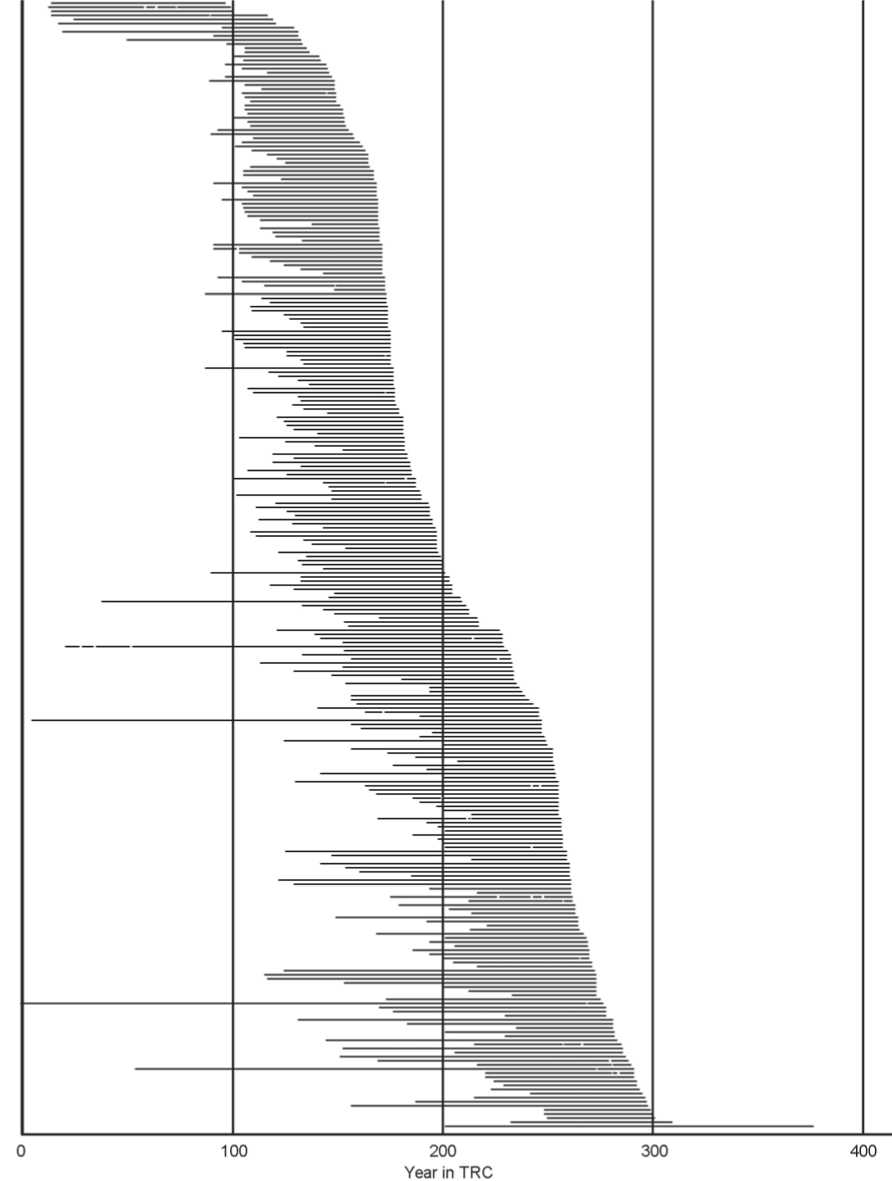
Fig. 2 . Sample content of the 377-year-old floating tree-ring chronology (TRC) based on charcoal from iron furnaces.
New radiocarbon dates for charcoal from iron smelting furnace No. 4 at the mouth of the Kuektanar River and the previously published dates for the central and peripheral parts of two charcoal fragments from the same furnace, discussed in this article
|
Lab code |
Description |
14С-age, years |
Calibrated date, years AD |
Bayesian modeling (2σ), years AD |
|
|
1σ |
2σ |
||||
|
NTUAMS-5800-1 * |
Heartwood, sample D = 13 cm |
1710 ± 60 |
335 ± 81 |
378 ± 158 |
– |
|
NTUAMS-5801-1 * |
Outer rings, sample D = 13 cm |
1614 ± 60 |
477 ± 64 |
402 ± 141 |
– |
|
NTUAMS-5803 * |
Heartwood, sample D = 5.5 cm |
1743 ± 69 |
324 ± 79 |
329 ± 201 |
– |
|
NTUAMS-5802 * |
Outer rings, sample D = 5.5 cm |
1666 ± 62 |
396 ± 136 |
397 ± 148 |
– |
|
GV-4638 |
Heartwood, rings No. 81–90 |
1720 ± 31 |
331 ± 72 |
331 ± 81 |
307 ± 51 |
|
GV-4639 |
Outer rings No. 5–14 |
1677 ± 31 |
342 ± 76 |
393 ± 137 |
383 ± 51 |
|
GV-4646 |
Heartwood, rings No. 80–90 |
1613 ± 39 |
476 ± 59 |
470 ± 88 |
425 ± 59 |
|
GV-4647 |
Outer rings No. 0–6 |
1607 ± 39 |
478 ± 59 |
484 ± 81 |
507 ± 59 |
|
GV-4641 |
Charcoal |
1825 ± 40 |
225 ± 93 |
230 ± 107 |
– |
|
GV-4640 |
" |
1784 ± 31 |
283 ± 46 |
286 ± 76 |
– |
|
GV-4642 |
" |
1597 ± 39 |
516 ± 77 |
516 ± 87 |
– |
*Previously published dates (Vodyasov et al., 2020).
Note . Dates GV-4638 and GV-4639 are for sample No. 1, GV-4646 and GV-4647 are for sample No. 2, and the remaining three dates are for three different samples.
6th century AD (see Fig. 1); this conclusion requires a more detailed analysis.
It would be worthwhile discussing their arguments in some detail. The works of E.V. Vodyasov and his co-authors (Vodyasov et al., 2020; Zaitseva, Vodyasov, 2023) contain the results of radiocarbon AMS dating of two charcoal fragments from furnace No. 4. For each sample, the age of inner and outer growth rings was established as 1710 ± 60 (NTUAMS-5800-1) and 1614 ± 60 (NTUAMS-5801-1) years for the first sample, and 1743 ± 69 (NTUAMS-5803) and 1666 ± 62 (NTUAMS-5802) years for the second sample. The number of growth rings in the fragments was not determined, but was based on the average values of uncalibrated radiocarbon dates. The authors concluded that the difference in age between the inner and outer rings of each sample was 96 (1710 minus 1614) and 77 (1743 minus 1666) years, respectively, indicating the lifespan of the tree. This difference was then added to the calibrated (1σ) age of the central rings of each fragment and the following conclusion was drawn: “Felling (of trees) for smelting most likely occurred before 500 AD and after 244 AD” (Vodyasov et al., 2020: 10; Zaitseva, Vodyasov, 2023: 84).
The incorrectness of such chronological reconstructions can be demonstrated. The conclusion that the lifetime of a tree corresponds to the difference between the average values of uncalibrated 14C dates with a precision of one year is fundamentally erroneous. This approach ignores the probabilistic nature of the radiocarbon age determination, which has a precision in this case of 120–138 years. With calibration (2σ), the range of possible values of the calendar age of the central/peripheral groups of rings increases to 281/315 years for the first sample and to 295/403 years for the second sample (see Table).
The incorrectness of this approach is also confirmed by the results of the radiocarbon dating made by the current authors of a charcoal fragment from the same furnace No. 4. The difference in the average values of the uncalibrated radiocarbon age of tree rings from the central (1613 ± 39, GV-4646) and peripheral (1607 ± 39, GV-4647) parts of the second sample was six years, while for the calibrated radiocarbon age it was 5 (1 σ) and 17 (2σ) years. However, as counting of real tree rings in the sample has shown, their dated groups were separated by an interval of eighty years. Bayesian modeling has made it possible to significantly reduce uncertainty in age estimates: the difference in the average values of the modeled ages was 82 years, and uncertainty (2σ) in the calendar age for each group of rings was 118 years (see the Table ).
Thus, each pair of dates—NTUAMS-5800-1 and NTUAMS-5801-1, NTUAMS-58003 and NTUAMS-5802—is statistically indistinguishable and unsuitable for determining the “old wood” effect, especially with the year resolution. In addition, the conclusion about tree felling in the range of 244–500 AD, that is, no later than the 5th century AD (Vodyasov et al., 2020: 10; Zaitseva, Vodyasov, 2023: 84), contradicts, among other things, the calibrated dates of the group of outer rings of these same charcoal fragments given by the same authors: 413–541 (1σ) and 261–542 (2σ) AD. In both cases, they end up being in the 6th century AD.
Analysis of all radiocarbon dates obtained for archaeometallurgical sites at the Kuektanar River mouth (see Fig. 1) provides an idea of the time when these bloomery furnaces were in operation. The dating of a unique find, i.e. a slightly carbonized piece of larch bark, and fragments of charcoal from the filling of the working chamber in furnace No. 2 revealed (with a confidence interval of 2σ) the time of the last smelting as being between 655 and 765 AD, corresponding to the Old Turkic period. Three “young” dates (out of five) obtained from charcoal fragments from furnace No. 3, when calibrated (2σ), confidently encompass the 6th century AD. Taking into account the “old wood” effect, this furnace could have functioned later. Even without taking into account the “old wood” effect, the analysis of all twenty dates for furnace No. 4, where a maximal amount of age determinations were obtained, does not exclude the 6th century AD from consideration of the time of its operation. Notably, 18 out of 25 radiocarbon dates for the sites at the Kuektanar River mouth, when calibrated with the confidence interval of 2σ, cover the Old Turkic period (see Fig. 1). Apparently, the furnaces of the Kosh-Agach type were built and repeatedly used precisely during this period (Agatova, Nepop, Korsakov, 2018; Agatova et al., 2018, 2023; Myglan et al., 2023, 2024).
Conclusions
The presence of numerous charcoal inclusions in metallurgical slag made it possible to use it for chronological attribution of ancient iron smelting furnaces. The most effective methods for this purpose were radiocarbon dating (primarily using the AMS technique) and dendrochronological analysis.
The main problem in using the radiocarbon method is low accuracy of the calibrated dates, while the “old wood” effect remains a fundamental problem with any dating method. The predominance of charcoal with central (earlier) trunk fragments in metallurgical slags impedes solving this problem through choosing the “youngest” of several radiocarbon dates in a single archaeological context. The analysis of the floating 377-year-old tree-ring chronology that was developed by the current authors has shown that the probability of encountering a young sample in the range of the last 100 and 77 years was 14 % and 1 %, respectively. Thus, radiocarbon dating of the most archaeological charcoals provides a deliberately earlier age, far from the time of felling of the trees and operation of the bloomery furnaces.
The significant (up to 400–450 years) lifespan of trees in the region hampers the use of dendro-chronological methods for identifying rings under the bark in charcoal fragments, as well as relying on 14C dates of charred fragments of thin trunks. Both of these strategies cannot ensure obtaining the “youngest” dates and do not make it possible to take into account the “old wood” effect.
Accuracy of age determinations obtained by calibrating the radiocarbon dates is at best comparable to the duration of cultural periods, which obscures reliable attribution of archaeological sites of iron smelting production in the southeastern Altai. The use of 14C dates calibrated with a confidence interval of 1σ creates an illusion of more accurate reconstructions, yet providing only a 68 % probability of determination of the age (as compared to 95 % in the case of calibration with the interval of 2σ).
The provided radiocarbon dates of charcoals from the furnaces of the Kosh-Agach type at the Kuektanar River mouth indicate that they most likely functioned in the Old Turkic period. Dating bark and growth rings under the bark is the only reliable way to avoid the impact of the “old wood” effect. Such a find from the filling of the working chamber in furnace No. 2 dates the last smelting in the furnace to the Old Turkic period. Even without considering the “old wood” effect, this period is confidently covered by three (out of five) calibrated (2σ) radiocarbon dates for furnace No. 3. All currently available dates of charcoal from that furnace do not exclude the 6th century AD from the probable operation time of furnace No. 4.
The construction of long tree-ring chronologies based on charcoal fragments is a more effective tool for chronological attribution of iron smelting sites. Dendrochronological analysis facilitates solving the problem of radiocarbon dating precision. Due to their length and inclusion of a large number of individual growth series, constructed tree-ring chronologies reduce the impact of the “old wood” effect.
The floating tree-ring chronologies developed by the current authors are currently among the longest tree-ring chronologies for charcoal worldwide. Further prospects for chronological attribution of ferrous metallurgy sites can be associated with continuing work on dendrochronological dating of archaeological charcoal from bloomeries and linking developed long tree-ring chronologies to the calendar time scale using wiggle matching.
Acknowledgment
This study was carried out under the state assignment of the Sobolev Institute of Geology and Mineralogy SB RAS No. 122041400214-9.
