
Plasma spheroidization of metal and ceramic powders
Journal: Siberian Aerospace Journal @vestnik-sibsau-en
Section: Technological processes and material science
Article in issue: 2 vol.27, 2026.
Free access
The paper presents the results of plasma spheroidization of metal and ceramic powders. The aim of the study was to conduct a comparative analysis of two methods for feeding powders into a plasma jet – under the nozzle section (plasma torch F-4) and along the axis of the plasma jet (plasma torch PM-1). Metallic (Cu, NiCr) and ceramic (Al2O3, ZrO2) powders were used as objects of research. To implement the spheroidization process, a specialized water-cooled reactor has been developed that provides controlled cooling of molten particles. Numerical modeling of thermal processes in the reactor confirmed the efficiency of the cooling system: the stationary thermal regime is established 286 seconds after the start of operation of the plasma torch, and the increase in the temperature of water in the reactor, measured experimentally, is consistent with the data obtained by calculation and is 5 °C. It has been established that the PM-1 plasma torch provides homogeneous and finely dispersed powders, however, when processing materials with a low melting point (copper), the powder begins to melt in the inlet channel of the plasma torch, settles on the walls of the nozzle and, over time, clogs it. Spheroidization with the supply of powder under the nozzle section makes it possible to process any materials, however, larger particles with a wide granulometric distribution are formed, especially when processing refractory powders. Based on a comprehensive analysis of the microstructure and granulometric composition of spheroidized powders, technological recommendations have been formulated for choosing the type of plasma torch depending on the required powder properties: the PM-1 plasma torch is preferred for obtaining homogeneous fine powders, and the F-4 plasma torch is preferred for processing low-melting materials and ensuring the maximum degree of spheroidization.
Short address: https://sciup.org/148333988
IDS: 148333988 | UDC: 621.762.2 | DOI: 10.31772/2712-8970-2026-27-2-342-353
Text of the scientific article Plasma spheroidization of metal and ceramic powders
In modern mechanical engineering, technological processes using powder materials are widely used, such as additive manufacturing, powder metallurgy, and coating [1–5]. They are based on metal and ceramic powders, loose materials consisting of many solid particles up to one millimeter in size. Ceramic powders are produced on the basis of oxides, nitrides, silicides and carbides of various metals (chromium, titanium, aluminum, etc.) and can be either single-component or complex mixtures. Their properties, including chemical resistance to alcohols, alkalis, and acids, are determined by their composition and particle size.
For additive technologies in the production of metal parts, an important property of the powder is fluidity [6; 7], i.e. the speed of its passage through a hole of a given diameter. This parameter affects the speed and uniformity of filling of the working chamber, ensures uniformity of the density of the future product and determines the overall productivity of the process. The shape of the particles is a factor determining the bulk density and fluidity of powder materials. Spherical particles provide more efficient packaging compared to irregularly shaped particles, which is confirmed by research in the field of additive technologies [8–10].
The method of obtaining spherical powders, which provides more than 90% of the total volume of their production, is melt dispersion [11]. The widespread use of this group of methods is due to high productivity, adaptability, relatively low capital and energy costs, environmental friendliness, and the ability to control the properties of the final product. The main methods of melt dispersion include gas, water, plasma, centrifugal, ultrasonic, and non-contact atomization [12].
Plasma spheroidization provides the highest heating temperature during dispersion. This method makes it possible to process any materials, including refractory and chemically active ones. In this case, spheroidization is carried out by spraying wire or powder in a stream of low-temperature plasma, in an environment of inert and reducing gases. The scheme of spherical particle formation during plasma spheroidization is shown in Fig. 1. Unlike gas spheroidization, this technology allows using not only wire, but also powders as raw materials, which makes it an effective tool for post-processing of powder materials. From a technical and economic point of view, the method of direct spraying of the melt into a volume of coolant (for example, into water or oil) or the use of forced irrigation systems is recognized as the most rational.
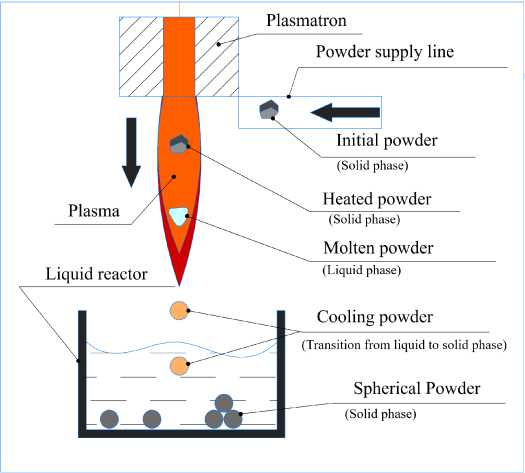
Fig. 1. Diagram of the spherical powder formation process
Рис. 1. Схема процесса образования сферического порошка
The shape of the resulting particles is most influenced by such parameters as the nature of the sprayed material, the time spent by the particles in the plasma jet, the distance from the nozzle section to the surface of the cooling medium, and the composition and properties of the cooling medium. Currently, there is no direct comparative data on the effect of the powder injection method into the plasma jet on particle morphology under controlled cooling conditions. In addition, for the successful implementation of the plasma spheroidization process, it is necessary to use a specialized reactor that provides a strictly controlled cooling regime for obtaining spherical powder.
The aim of the study is to conduct a comparative analysis of two methods of powder injection into a plasma jet – under the nozzle section (plasma torch F-4) and along the axis (plasma torch PM-1) and its spraying into a water-cooled reactor, to study the dispersed composition of metal and ceramic powders after processing, and to develop technological recommendations on plasma spheroidization modes.
Experiment (powder processing)
To conduct a comparative analysis of the two powder injection schemes, two plasma torches were used: the F-4 plasma torch manufactured by Sulzer Metco (currently Oerlikon Metco), in which the sprayed powder is fed under the nozzle section [13], and the PM–1 plasma torch developed by the authors [14; 15], whose feature is that the sprayed powder is fed coaxially to the plasma jet. Metal (NiCr, Cu) and ceramic (Al 2 O 3 , ZrO 2 ) powders were subjected to plasma spheroidization. The technological process of spheroidization is organized as follows. The plasma torch was connected to the reactor inlet flange with a pre-installed adapter using the KUKA robotic system. The duration of spraying for each material was 60 seconds. The technological modes of plasma torches during experimental studies are shown in Table 1.
Table 1
Technological modes of plasma spheroidization
|
Plasma-forming device |
F-4 |
PM-1 |
|
|
Material |
NiCr“I Cu“I Al2O3“I ZrO 2 |
NiCr Cu Al2O3 ZrO 2 |
|
|
Powder feed rate, l/min |
3 |
3 |
|
|
Current strength, A |
500 |
400 |
|
|
Voltage, V |
51 |
38 |
|
|
Power, W |
26 |
15 |
|
|
Gas supply speed, l/min |
Argon |
30 |
30 |
|
Hydrogen |
4 |
2 |
|
|
Temperature change of the liquid in the reactor, °C |
4–5 |
3–4 |
|
To implement the plasma spheroidization process, a cooling reactor was developed and manufactured during operation, a specialized device that provides controlled cooling of molten particles. The most effective technique involves direct dispersion of the melt into a volume of coolant (water or oil), which determines the design requirements: the ability to fill and drain the liquid, as well as corrosion resistance of the internal surfaces. In addition, for the removal of heat fluxes from the plasma jet and hot gases (T > 5000 K) it is necessary to equip the reactor with a hull cooling system.
Based on the analysis of the technological process, the following requirements for the reactor design are formulated:
-
1) the presence of a case cooling system;
-
2) increasing the internal volume and surface area for condensation of products in order to ensure a long continuous cycle of operation;
-
3) reducing operational complexity by implementing the following operations in a nondisassembled configuration: extracting the resulting powder, refueling and draining the coolant, creating and maintaining a neutral gas environment, and visually monitoring the processes inside the reactor;
-
4) versatility, which provides the possibility of alternating connection of two different types of plasma torches.
In accordance with these requirements, a schematic diagram of the reactor has been developed (Fig. 2), as well as options for equipping it with different plasma torches.
The reactor’s structural elements operating under conditions of high thermal loads and contact with water are made of corrosion-resistant high-alloy steel Х18Н10Т. The transition nodes for connecting plasma torches, experiencing local heating above 500 ° C, are made of heat-resistant ceramics.
To confirm the efficiency of the cooling system, numerical simulation was performed in the SolidWorks Flow Simulation environment. The model was presented in a simplified form, containing only components exposed to high temperature. The reactor's internal volume of 30 liters is filled with a model medium (water) that simulates the conditions of direct spraying into a liquid. It was assumed that the mass consumption of the powder was an order of magnitude lower than the consumption of the plasma-forming gas, so its effect on heat and mass transfer was not taken into account. The initial parameters and boundary conditions for the thermal calculation are presented in Table 2.
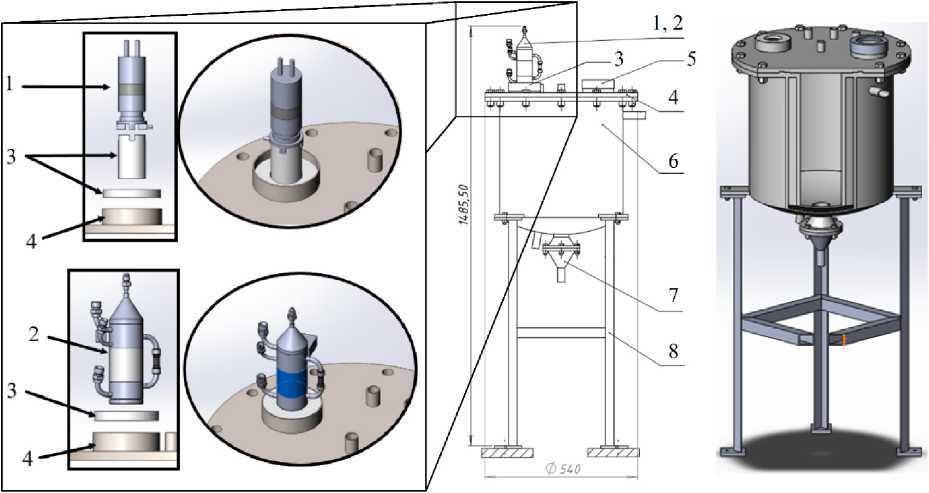
Fig. 2. Plasma spheroidization reactor with connection options for different plasma torches:
1 – plasma torch F-4; 2 – plasma torch PM-1; 3 – heat-resistant adapter; 4 – reactor cap; 5 – inlet flange;
6 – reactor vessel; 7 – drain channel; 8 – rack
Рис. 2. Реактор плазменной сфероидизации с вариантами подключения разных плазмотронов: 1 – плазмотрон F-4; 2 – плазмотрон ПМ-1; 3 – жаростойкий переходник; 4 – крышка реактора;
5 – вводной фланец; 6 – корпус реактора; 7 – сливой канал; 8 – стойка
Table 2
Initial parameters and boundary conditions for thermal calculation
|
Boundary conditions |
Design model of the reactor |
||
|
Designation |
Parameter |
Meaning |
c t 1 A D |
|
But |
Volumetric flow rate at the inlet Q, m3/s |
6.7·104 |
|
|
Pressure P, MPa |
1 |
||
|
Temperature T, °C |
15000 |
||
|
In |
Velocity in the x V direction, m/s |
0.1 |
|
|
Pressure P, MPa |
0.03 |
||
|
Temperature T, °C |
15 |
||
|
C, D |
Atmospheric pressure P, MPa |
0.101325 |
|
|
Ambient temperature T, °C |
20 |
||
|
Initial parameters |
|||
|
Body temperature T, °C |
15 |
||
|
Materials: |
|||
|
Housing Cover |
H18N10T |
||
|
Adapters |
Ceramics |
||
|
Filler |
Water, 30 liters |
||
The results of thermal modeling showed that the stationary thermal regime in the system is established 286 seconds after the start of the process. Based on the calculation results, the temperature distribution fields in the reactor structure and the time dependences of temperature changes at characteristic points are obtained (Fig. 3).
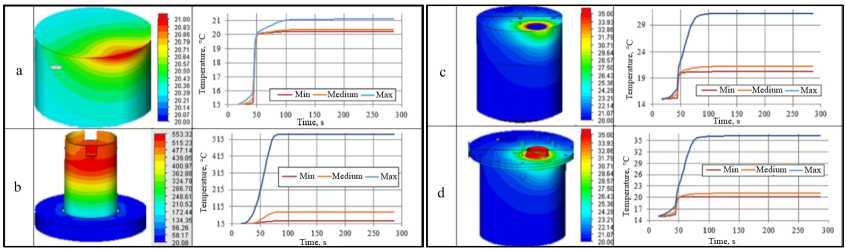
Fig. 3. Thermal plots and graphs of temperature versus time:
а – the liquid in the reactor; b – the ceramic adapter; c – the inner surface of the reactor; d – the outer surface of the reactor
Рис. 3. Термические эпюры и графики зависимости температур от времени:
а – жидкость в реакторе; b – керамический переходник;
c – внутренняя поверхность реактора; d – внешняя поверхность реактора
Experimental studies have shown that in 60 seconds of operation, the water temperature in the reactor increased by 4-6 °C, which correlates with the results of numerical modeling. After plasma treatment, the plasma torch was diverted away from the reactor, the cooled water with powder particles was drained through the lower flange and filtered to extract the dispersed material. The powder residues deposited on the walls and bottom of the reactor were collected mechanically. The resulting product was dried and classified according to its granulometric composition.
As a result of the experimental studies, a spherical powder of four materials was synthesized – NiCr, Cu, Al 2 O 3 and ZrO 2 . The obtained powders were subjected to a comprehensive analysis, including a study of the microstructure and particle size distribution. Metallographic analysis of the obtained samples was performed on a Neophot 32 microscope (Carl Zeiss, Germany).
Results and discussion
The external morphology of the powders after plasma treatment is shown in Fig. 4. The analysis of micrographs showed that metal powders (Cu and NiCr) formed spherical particles. At the same time, complete spheroidization was not achieved for ceramic materials (Al 2 O 3 и ZrO 2 ) with a significantly higher melting point. However, the observed effect of rounding the sharp edges and faces of the initial particles indicates the beginning of the melting process of their surface.
When working with low-melting materials, in particular with copper, and using the PM-1 plasma torch with axial powder supply, technological difficulties arose. The copper powder was subjected to premature melting directly in the plasma torch supply channel, without reaching the zone of the high-temperature plasma jet. This led to its melting and deposition on the inner surfaces of the nozzle, followed by the formation of large droplets. At the initial stage of the process, these droplets were carried into the reactor, forming spheres of abnormally large diameter (Fig. 5, a ). During further operation (over 30 seconds), the material clogs the nozzle and blocks the powder supply.
Unlike the PM-1, the F-4 side-feed plasma torch ensures stable operation with the same materials, since in this case the powder is injected into the peripheral plasma zone, bypassing the overheating zone in the plasma torch channel. As a result, a finely dispersed powder with a uniform spherical morphology was obtained (Fig. 5, b ), which indicates a more preferable nature of the interaction of particles with plasma in this configuration.
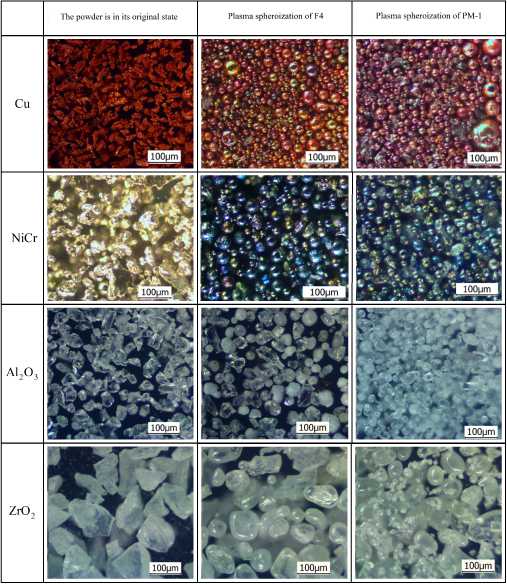
Fig. 4. External morphology of metallic and ceramic powders before and after plasma spheroidization
Рис. 4. Внешняя морфология металлических и керамических порошков до и после плазменной сфероидизации
The granulometric analysis was carried out by statistical processing of images obtained using optical microscopy. To construct particle size distribution functions in a CAD environment, a random sample was measured, including 300 spherical particles of each type of powder. Graphs of the granulometric distribution of powders obtained using various plasma torches are shown in Figs. 6 and 7.
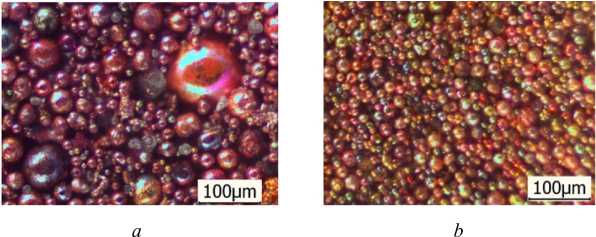
Fig. 5. The external morphology of spheroidized Cu powder: a – plasmatron PM-1; b – plasmatron F-4
Рис. 5. Внешняя морфология сфероидизированного порошка Cu: а – плазмотрон ПМ-1; b – плазмотрон F-4
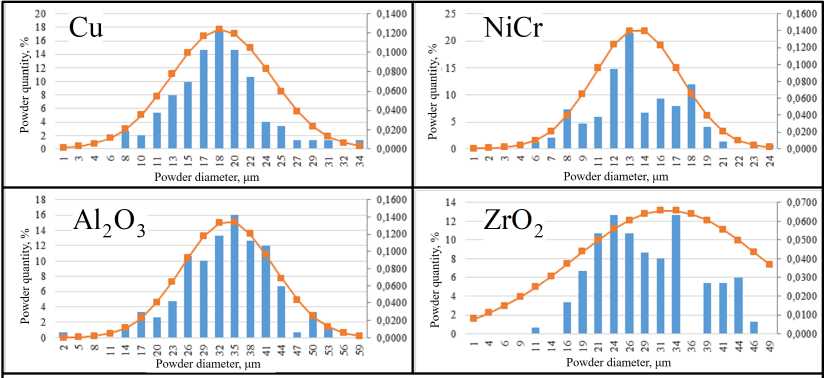
^■Frequency of hits in the interval И Theoretical probability of hitting the interval
Fig. 6. Granulometric distribution of powder particles during treatment with a PM-1 plasma torch
Рис. 6. Гранулометрическое распределение частиц порошка при обработке плазмотроном ПМ-1
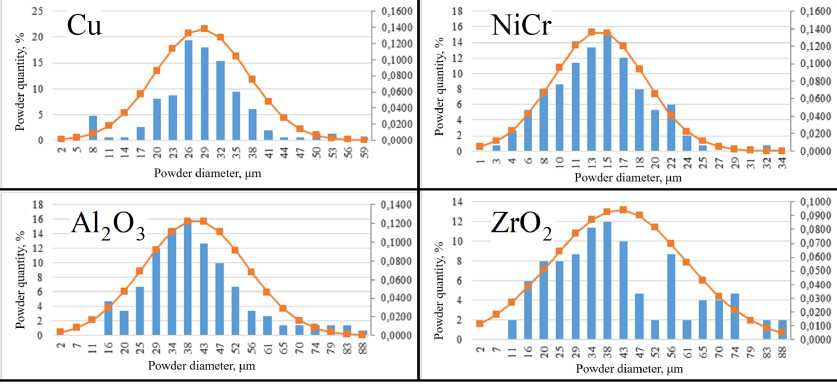
^■Frequency of hits in the interval И Theoretical probability of hitting the interval
Fig. 7. Granulometric distribution of powder particles during treatment with an F4 plasma torch
Рис. 7. Гранулометрическое распределение частиц порошка при обработке плазмотроном F-4
The analysis of the granulometric composition showed that in most cases the F-4 plasma torch forms larger particles compared to the PM-1 plasma torch. This is confirmed by the average values for Cu (28 versus 19 microns), Al 2 O 3 (40 versus 33 microns) and ZrO 2 (41 versus 32 microns). The exception was the NiCr alloy, for which the average dimensions obtained at both installations turned out to be almost identical (14 microns). The resulting increase in particle size when using the F-4 plasma torch can be explained by a less intense or less prolonged thermal effect, characteristic of a configuration with lateral powder supply under the nozzle section, which leads to less heating and, as a result, a decrease in the degree of dispersion and spheroidization.
An assessment of the uniformity of the granulometric composition by the value of the standard deviation showed that the F-4 plasma torch forms powders with a wider range of particle sizes for all materials studied, except NiCr. The most significant difference is observed for ceramic powders: for Al 2 O 3 , the standard deviation was 14.5 microns versus 8,8 microns for PM-1, and for ZrO 2 , it was 19.0 microns versus 10.1 microns, respectively. Even for NiCr, where the average sizes matched, the spread when using F-4 is slightly higher (5.1 versus 3.5 microns). This fact indicates that the process in the F-
-
4 side-feed plasma torch is less controlled and reproducible in terms of achieving a narrow fractional composition, while the PM-1 axial feed plasma torch provides a more stable and uniform result.
The analysis of the asymmetry and kurtosis of the distributions showed that most of the obtained powders are characterized by positive asymmetry, which is typical for spraying processes. However, abnormally high values of asymmetry (3.0) and kurtosis (14.6) were found for the ZrO2 powder obtained on the PM-1 plasma torch. This indicates a strongly island-like distribution with a pronounced concentration of particles in the mode region (17 microns) and an extended «tail» towards large fractions. For the remaining materials, the distribution patterns obtained on both plasma torches turned out to be closer to normal or moderately high-density. Thus, in some cases, the PM-1 plasma torch (ZrO 2 ) forms significantly deviating distributions from the normal one, while the F-4 plasma torch provides more predictable and close to the normal law shapes of distribution curves.
A comparison of different classes of materials showed that ceramic powders (Al 2 O 3 , ZrO 2 ) are characterized by a much wider range of particle sizes, which is especially pronounced when using the F-4 plasma torch. This fact correlates with the results of microscopic analysis confirming incomplete spheroidization and a wide range of morphology of ceramic particles. In contrast, metallic powders (Cu, NiCr) exhibit significantly narrower granulometric distributions, which is consistent with their complete spheroidization and predictable behavior in the plasma flow.
Based on the analysis, the following conclusions can be formulated: the PM-1 plasma torch (with axial feed) provides higher uniformity and reproducibility of the granulometric composition, allowing fine powders to be obtained, but its use for low-melting materials is technologically limited due to the risk of nozzle blockage. The F-4 plasma torch (with side feed under the jet section) is more versatile and stable when working with low-melting metals, but larger particles with a wide range of sizes are formed during the spheroidization process, which is especially typical for refractory ceramics. Thus, the choice of the type of plasma torch should be determined by the target requirements for the characteristics of the finished product: to obtain homogeneous fine powders, the PM-1 plasma torch is preferred, and to ensure the maximum degree of spheroidization and processing of materials with a low melting point, the F–4 plasma torch is preferred.
Conclusion
The design of a water-cooled reactor for plasma spheroidization, providing controlled heat removal conditions, has been developed and tested. As part of a comparative study of two powder injection schemes – axial (PM-1 plasma torch) and lateral plasma jet (F-4 plasma torch) – for metallic (Cu, NiCr) and ceramic (Al2O3, ZrO2) powders, the following basic patterns have been established.
The PM-1 plasma torch ensures the formation of more homogeneous fine particles due to the coaxial interaction of the powder with the plasma stream. However, its use for materials with a low melting point (Cu) is technologically limited due to clogging of the feed channel. In turn, the F-4 plasma torch allows processing any materials, but leads to the formation of larger particles with a wide granulometric distribution, which is especially pronounced for refractory ceramics.
The efficiency of spheroidization shows a direct correlation with the melting point of the material: for metals, almost complete spheroidization was achieved, whereas for oxide ceramics, the process was mainly limited to melting the surface layer and rounding the particles. Experimental data on the thermal regime of the reactor confirmed the results of numerical simulation.
Thus, the choice of the technological scheme should be carried out taking into account the target properties of the final product: for the production of small fractions, an axial feed (PM-1 plasma torch) is preferable, for the processing of low–melting materials, a lateral feed under the jet section (F-4 plasma torch). The results obtained allow a reasonable approach to optimizing the modes of plasma spheroidization of powders for applications in additive technologies and powder metallurgy.
