
Public Opinion Monitoring of the State of the Russian Society
Journal: Economic and Social Changes: Facts, Trends, Forecast @volnc-esc-en
Section: Monitoring studies
Article in issue: 2 т.19, 2026.
Free access
Short address: https://sciup.org/147253873
IDS: 147253873 | DOI: 10.15838/esc.2026.2.104.14
Text of the article Public Opinion Monitoring of the State of the Russian Society
Source: VCIOM. Available at:
Source: Levada-Center*. Available at:
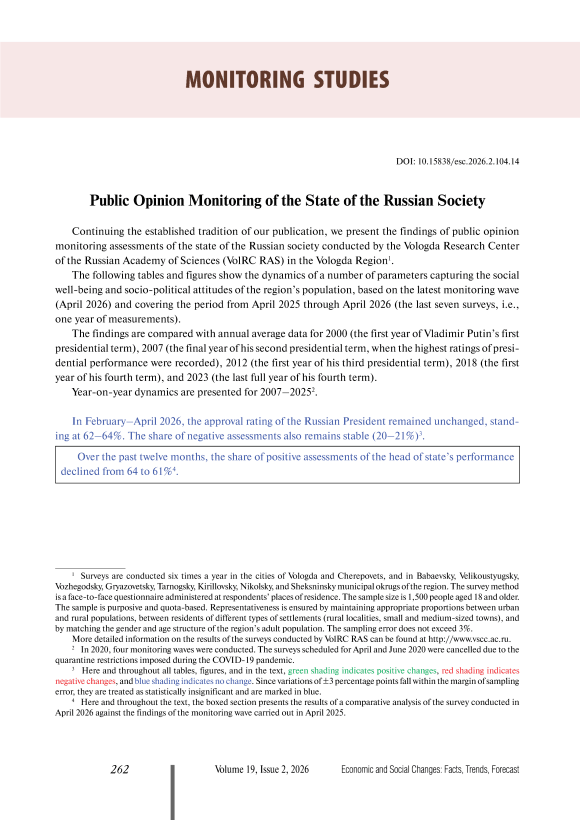
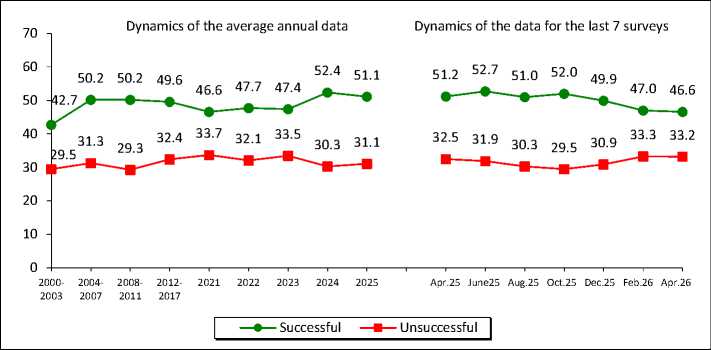
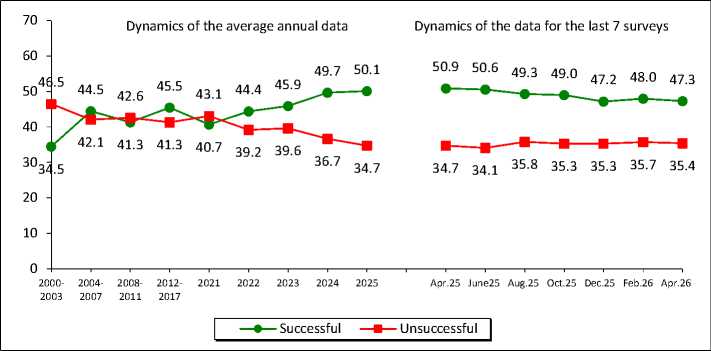
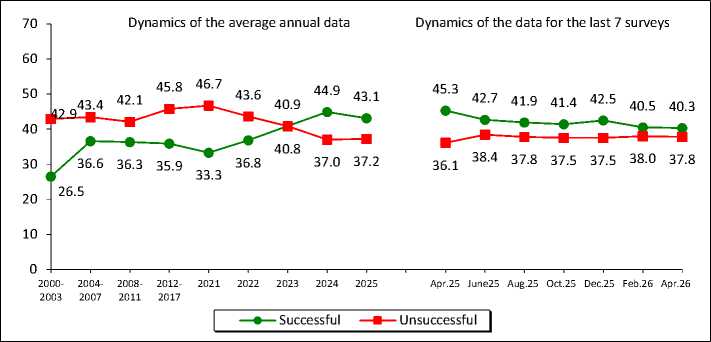
In your opinion, how successful is the RF President in handling challenging issues? (% of respondents; VolRC RAS data)
The share of the region’s residents who view the head of state’s actions to strengthen Russia’s international standing as successful remained at the same level over the past two months – 47%. The proportion of people holding the opposite view also remained unchanged (33%).
In April 2026, compared with April 2025, the share of positive assessments of the head of state’s performance in strengthening the country’s international position decreased from 51 to 46% (by 5 p.p.).
Strengthening Russia’s international standing
|
Response |
Dynamics (+/-), Apr. 2026 to |
|
|
Apr. 2025 |
Feb. 2026 |
|
|
Successful |
-5 |
0 |
|
Unsuccessful |
+1 |
0 |
Between February and April 2026, the share of positive assessments by the region’s residents of the Russian President’s efforts to maintain order in the country remained unchanged at 47–48%. The share of negative assessments also stayed at the previous level (35%).
Over the past twelve months, the proportion of positive assessments declined from 51% to 47% (by 4 p.p.).
Maintaining order in the country
|
Response |
Dynamics (+/-), Apr. 2026 to |
|
|
Apr. 2025 |
Feb. 2026 |
|
|
Successful |
-4 |
-1 |
|
Unsuccessful |
+1 |
0 |
In April 2026, compared with February 2026, the share of the region’s residents who positively assess the Russian President’s performance in protecting democracy and strengthening citizens’ freedoms did not change, nor did the share of negative assessments.
Over the year of measurements, the share of those approving of the head of state’s work in protecting democracy and strengthening citizens’ freedoms decreased from 45 to 40%.
Protecting democracy and strengthening citizens’ freedoms
|
Response |
Dynamics (+/-), Apr. 2026 to |
|
|
Apr. 2025 |
Feb. 2026 |
|
|
Successful |
-5 |
0 |
|
Unsuccessful |
+2 |
0 |
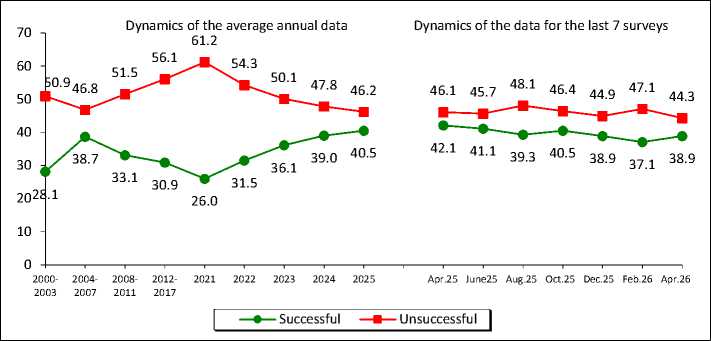
The share of positive assessments of the Russian President’s success in addressing the problems of economic recovery and improving citizens’ well-being did not change significantly between February and April 2026.
From April 2025 to April 2026, the proportion of positive assessments of the head of state’s performance in tackling economic issues declined slightly – by 3 p.p., from 42 to 39%.
Economic recovery and improving citizens’ well-being
|
Response |
Dynamics (+/-), Apr. 2026 to |
|
|
Apr. 2025 |
Feb. 2026 |
|
|
Successful |
-3 |
+2 |
|
Unsuccessful |
-2 |
-3 |
The structure of residents’ party-political preferences remains stable. The share of people whose interests are represented by the United Russia party stood at 36%, the Communist Party of the Russian Federation (CPRF) and the Liberal Democratic Party of Russia (LDPR) each at 8–9%, the Just Russia party at 3–4%, and New People at 2%.
Over the past twelve months, the level of support for United Russia decreased from 41% to 36%. At the same time, the share of respondents who believe that none of the parties represents their interests rose by 4 p.p. – from 28 to 32%.
Which party expresses your interests? (% of respondents; VolRC RAS data)
|
Party |
Dynamics of the average annual data |
Dynamics of the data for the last 7 surveys |
Dynamics (+/-), Apr. 2026 to |
|||||||||||||||||||
|
CO оз E о CD 00 CO ОС CD |
§ |
CD |
CO CD 03 E о CD CO CO ОС CD |
CO |
CM |
co CO E a CD CO CO DC CD |
C\J |
C\J |
CD -э |
О |
о О |
CD DC |
CD |
CD u_ |
||||||||
|
United Russia |
31.1 |
33.4 |
29.1 |
35.4 |
38.0 |
37.9 |
31.5 |
49.8 |
31.7 |
35.2 |
39.5 |
42.9 |
40.3 |
40.5 |
41.6 |
41.2 |
40.5 |
38.1 |
36.1 |
35.7 |
-5 |
0 |
|
CPRF |
10.3 |
16.8 |
10.6 |
8.3 |
14.2 |
9.2 |
8.4 |
18.9 |
9.3 |
10.1 |
9.6 |
8.9 |
9.6 |
8.0 |
9.1 |
11.5 |
10.5 |
9.7 |
9.2 |
8.1 |
0 |
-1 |
|
LDPR |
7.8 |
15.4 |
7.8 |
10.4 |
21.9 |
9.6 |
9.5 |
7.6 |
9.9 |
7.3 |
7.0 |
7.1 |
8.2 |
7.1 |
9.4 |
8.7 |
7.8 |
8.6 |
8.9 |
7.9 |
+1 |
-1 |
|
Just Russia – Patriots for the Truth |
5.6 |
27.2 |
6.6 |
4.2 |
10.8 |
2.9 |
4.7 |
7.5 |
4.7 |
4.9 |
4.4 |
3.5 |
3.5 |
2.9 |
3.9 |
4.2 |
3.4 |
4.1 |
3.1 |
4.3 |
+1 |
+1 |
|
New People* |
– |
– |
– |
– |
– |
– |
– |
5.3 |
2.3 |
1.5 |
1.9 |
2.0 |
2.5 |
3.0 |
2.5 |
1.8 |
2.2 |
2.5 |
2.4 |
2.3 |
-1 |
0 |
|
Other |
1.9 |
– |
2.1 |
0.3 |
– |
0.7 |
0.5 |
– |
0.2 |
0.3 |
0.1 |
0.2 |
0.1 |
0.0 |
0.1 |
0.1 |
0.1 |
0.2 |
0.2 |
0.2 |
0 |
0 |
|
None |
29.4 |
– |
31.3 |
29.4 |
– |
28.5 |
34.2 |
– |
33.9 |
30.6 |
26.5 |
25.2 |
25.8 |
27.7 |
24.9 |
23.3 |
24.3 |
26.1 |
29.1 |
31.5 |
+4 |
+2 |
|
Difficult to answer |
13.2 |
– |
11.7 |
12.0 |
– |
11.2 |
11.1 |
– |
10.0 |
10.1 |
11.1 |
10.3 |
10.0 |
10.8 |
8.5 |
9.2 |
11.3 |
10.7 |
11.0 |
9.8 |
-1 |
-1 |
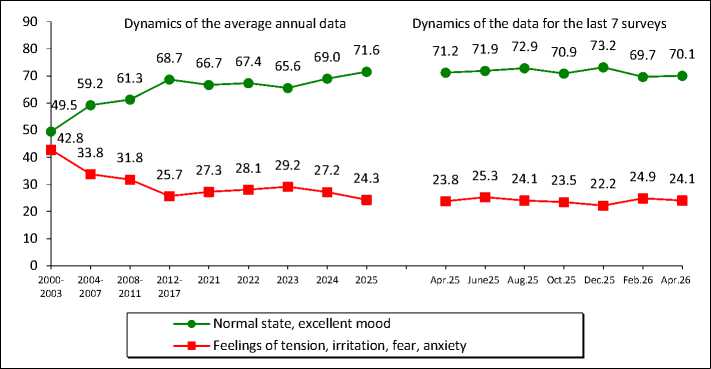
Estimation of social condition (% of respondents; VolRC RAS data)
In February–April 2026, the share of positive assessments of social mood stood at 70%; the share of negative assessments was 24–25%.
Between April 2025 and April 2026, the share of people experiencing positive and neutral feelings (“normal state, excellent mood”) remained virtually unchanged at 71–70%. The share of those experiencing negative emotions (“tension, irritation, fear, anxiety”) remained at the level of 24%.
Social mood
|
Response |
Dynamics (+/-), Apr. 2026 to |
|
|
Apr. 2025 |
Feb. 2026 |
|
|
Normal state, excellent mood |
-1 |
0 |
|
Feelings of tension, irritation, fear, anxiety |
0 |
-1 |
The reserve of patience remains at a consistently high level: 81% of the region’s residents stated in February–April 2026 that “things are not so bad and it is possible to live”. The share of those who believe that “it is no longer possible to endure” their desperate situation stood at 12%.
In April 2026, compared with April 2025, no significant changes are observed in the reserve of patience indicator.
Reserve of patience
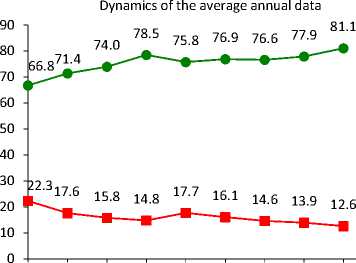
2000- 2004- 2008- 2012- 2021 2022 2023 2024 2025
2003 2007 2011 2017
Dynamics of the data for the last 7 surveys
79.6 80.4 79.9 83.5 83.4 81.1 80.6
14.0 11.9 12.9 12.1 10.1 11.9 11.6

—•— Things are not so bad, and it is possible to live; life is hard but bearable
— ■ — It is no longer possible to endure our desperate situation
Apr.25 June25 Aug.25 Oct.25 Dec.25 Feb.26 Apr.26
|
Response |
Dynamics (+/-), Apr. 2026 to |
|
|
Apr. 2025 |
Feb. 2026 |
|
|
Things are not so bad, and it is possible to live; life is hard but bearable |
+1 |
-1 |
|
It is no longer possible to endure our desperate situation |
-2 |
0 |
As in February, in April 2026 the share of the region’s residents who subjectively identify themselves as belonging to the “middle-income” category stood at 47%. The share of those identifying as “poor and destitute” also remained unchanged (37–38%).
In April 2026, compared with April 2025, the share of those considering themselves “poor and destitute” decreased by 3 p.p. (from 40 to 37%).
Social self-identification
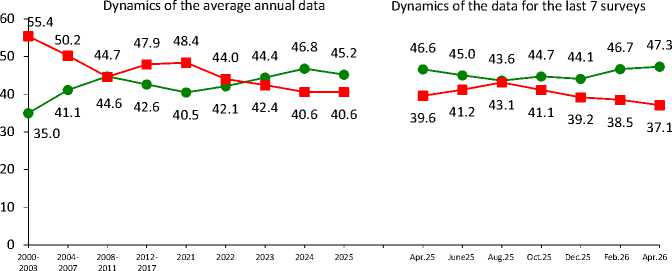
—•— Middle-income people — ■ — Poor and destitute
|
Response |
Dynamics (+/-), Apr. 2026 to |
|
|
Apr. 2025 |
Feb. 2026 |
|
|
Share of those considering themselves middle-income |
+1 |
+1 |
|
Share of those considering themselves poor and destitute |
-3 |
-1 |
Question wording: “Which category do you belong to, in your opinion?”
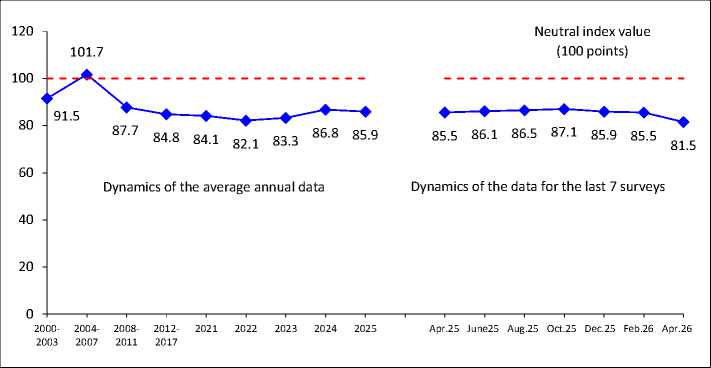
Between February and April 2026, the value of the Consumer Sentiment Index (CSI) decreased from 86 to 82 points.
The year-on-year dynamics also show a deterioration: the CSI indicator fell from 86 to 82 points.
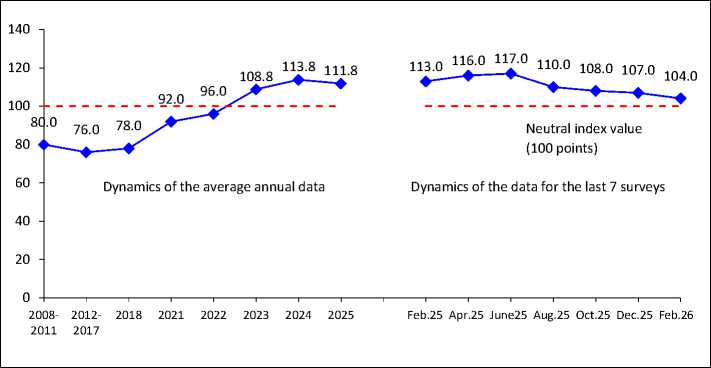
Consumer Sentiment Index (CSI, points; VolRC RAS data for the Vologda Region)
|
Response |
Dynamics (+/-), Apr. 2026 to |
|
|
Apr. 2025 |
Feb. 2026 |
|
|
Index value, points |
-4 |
-4 |
|
Response |
Dynamics (+/-), Feb. 2026 to |
|
|
Feb. 2025 |
Dec. 2025 |
|
|
Index value, points |
-9 |
-3 |
The index has been calculated since 2008.
The latest data are for February 2026.
Source: Levada Center* data. Available at:
Between February and April 2026, no significant changes in the dynamics of the share of positive social mood assessments are observed in the majority of socio-demographic population groups, with the exception of the top 20% income group, where the share of positive assessments declined by 4 p.p.
Over the year (from April 2025 to April 2026), the share of positive social mood assessments decreased in 5 of the 14 socio-demographic groups. The greatest decline is observed among young people under 30 (by 9 p.p.), the bottom 20% income group (by 6 p.p.), as well as people with secondary and incomplete secondary education (by 5 p.p.). At the same time, in the majority of groups (9 out of 14), the share of positive assessments remained unchanged.
Social mood in various social groups (response option “Excellent mood, normal, steady state”, % of respondents; VolRC RAS data)
|
Population group |
Dynamics of the average annual data |
Dynamics of the data for the last 7 surveys |
Dynamics (+/-), Apr. 2026 to |
||||||||||||||
|
2007 |
2012 |
2018 |
2021 |
2022 |
2023 |
2024 |
2025 |
Apr. 2025 |
June 2025 |
Aug. 2025 |
Oct. 2025 |
Dec. 2025 |
Feb. 2026 |
Apr. 2026 |
Apr. 2025 |
Feb. 2026 |
|
|
Gender |
|||||||||||||||||
|
Men |
65.9 |
69.1 |
72.8 |
65.7 |
66.8 |
65.5 |
66.5 |
70.7 |
68.8 |
71.6 |
72.1 |
68.2 |
73.3 |
69.1 |
71.9 |
+3 |
+3 |
|
Women |
61.7 |
65.8 |
69.8 |
67.4 |
67.9 |
65.7 |
70.9 |
72.3 |
73.1 |
72.2 |
73.5 |
73.1 |
73.1 |
70.1 |
68.7 |
-4 |
-1 |
|
Age |
|||||||||||||||||
|
Under 30 |
71.3 |
72.3 |
79.9 |
73.5 |
77.6 |
75.0 |
76.6 |
76.8 |
76.7 |
76.7 |
78.1 |
75.2 |
74.3 |
69.5 |
67.6 |
-9 |
-2 |
|
30–55 |
64.8 |
67.9 |
72.6 |
69.5 |
69.4 |
68.8 |
71.3 |
74.3 |
74.1 |
74.1 |
74.9 |
73.9 |
78.4 |
73.6 |
73.1 |
-1 |
-1 |
|
Over 55 |
54.8 |
62.1 |
65.2 |
60.5 |
61.1 |
58.2 |
63.3 |
66.5 |
65.8 |
67.6 |
68.6 |
65.9 |
66.6 |
64.9 |
67.5 |
+2 |
+3 |
|
Education |
|||||||||||||||||
|
Secondary and incomplete secondary |
58.4 |
57.2 |
64.8 |
62.1 |
64.6 |
62.0 |
64.6 |
67.2 |
65.6 |
68.4 |
70.3 |
68.4 |
66.1 |
60.6 |
60.4 |
-5 |
0 |
|
Secondary vocational |
64.6 |
66.7 |
72.1 |
66.7 |
68.3 |
66.1 |
70.3 |
73.6 |
74.8 |
74.1 |
73.6 |
71.4 |
75.6 |
71.6 |
74.7 |
0 |
+3 |
|
Higher and incomplete higher |
68.6 |
77.0 |
76.7 |
71.5 |
69.5 |
68.8 |
72.3 |
73.9 |
73.4 |
73.0 |
74.7 |
73.1 |
77.6 |
74.7 |
74.0 |
+1 |
-1 |
|
Income group |
|||||||||||||||||
|
Bottom 20% |
51.6 |
51.5 |
57.2 |
54.6 |
57.0 |
50.1 |
53.5 |
55.2 |
56.9 |
56.1 |
58.3 |
53.3 |
50.7 |
48.2 |
51.3 |
-6 |
+3 |
|
Middle 60% |
62.9 |
68.7 |
72.1 |
67.3 |
68.1 |
67.4 |
70.7 |
73.2 |
72.6 |
74.4 |
73.1 |
73.1 |
75.2 |
72.2 |
72.7 |
0 |
+1 |
|
Top 20% |
74.9 |
81.1 |
82.4 |
79.9 |
78.3 |
73.9 |
77.6 |
83.6 |
81.3 |
84.1 |
83.8 |
84.8 |
89.4 |
87.7 |
83.4 |
+2 |
-4 |
|
Territory |
|||||||||||||||||
|
Vologda |
63.1 |
73.6 |
71.0 |
60.3 |
59.8 |
59.6 |
66.0 |
70.2 |
68.6 |
69.5 |
72.9 |
71.4 |
71.9 |
68.1 |
68.8 |
0 |
+1 |
|
Cherepovets |
68.1 |
76.2 |
75.7 |
71.0 |
71.2 |
68.1 |
69.8 |
73.1 |
71.5 |
72.5 |
75.0 |
73.2 |
76.3 |
73.0 |
73.5 |
+2 |
+1 |
|
Districts |
61.6 |
59.8 |
68.6 |
67.8 |
69.5 |
67.7 |
70.2 |
71.6 |
72.7 |
73.1 |
71.6 |
69.3 |
72.2 |
68.7 |
69.0 |
-4 |
0 |
|
Region |
63.6 |
67.3 |
71.2 |
66.6 |
67.4 |
65.6 |
69.0 |
71.6 |
71.2 |
71.9 |
72.9 |
70.9 |
73.2 |
69.7 |
70.1 |
-1 |
0 |
|
Total number of groups: positive changes / no changes / negative changes |
14: 0 / 9 / 5 |
14: 0 / 13 / 1 |
|||||||||||||||
