
Qurta Rock Art: Cultural Exchange in the Mediterranean
Журнал: Archaeology, Ethnology & Anthropology of Eurasia @journal-aeae-en
Рубрика: Paleoenvironment, the stone age
Статья в выпуске: 3 т.53, 2025 года.
Бесплатный доступ
The discovery in the early 2000s of animal rock engravings near the village of Qurta in the Nile Valley (Upper Egypt) remains little discussed. This article focuses on the numerous stylistic links between these engravings and European Pleistocene figurations. These analogies allow us to date Qurta approximately to the end of the Last Glacial Maximum (between the end of Gravettian-Solutrean art and the beginning of Magdalenian art). This estimate is confirmed by OSL-dating obtained from a buried engraved panel from Qurta. The hypothesis as to European origin of the images is also reinforced by the presence of schematic female engravings identical to those scattered throughout Eurasia. The possibility of Mediterranean cultural exchange is considered. Several communication routes were possible. Taking into account the published documentation, we infer that the engravings at Qurta are less isolated than they appear and that rock engravings located on the Cyrenaican coast and in the Sinai could be the result of repeated contacts (including migrations) of people inhabiting the two shores of the Mediterranean.
Короткий адрес: https://sciup.org/145147544
IDS: 145147544 | DOI: 10.17746/1563-0110.2025.53.3.053-063
Текст научной статьи Qurta Rock Art: Cultural Exchange in the Mediterranean
In the early 2000s, around two hundred rock engravings were discovered (more accurately, rediscovered, as the engravings were first reported by a Canadian team in the early 1960s) in the Nile valley near the village of Qurta (about 30 km south of Edfu). The engravings were deeply incised into the cliffs of the sandstone massifs overlooking the Kom Ombo plain on the eastern bank of the Nile. Very different in both theme and style from the predynastic petroglyphs of the region, these engravings do, however, offer astonishing similarities with European Paleolithic art (Huyge et al., 2007; Otte, 2012, 2014). Most of the Qurta engravings depict animals (aurochs, hippos, gazelles, fish, birds, etc.), as well as a few anthropomorphic figures.
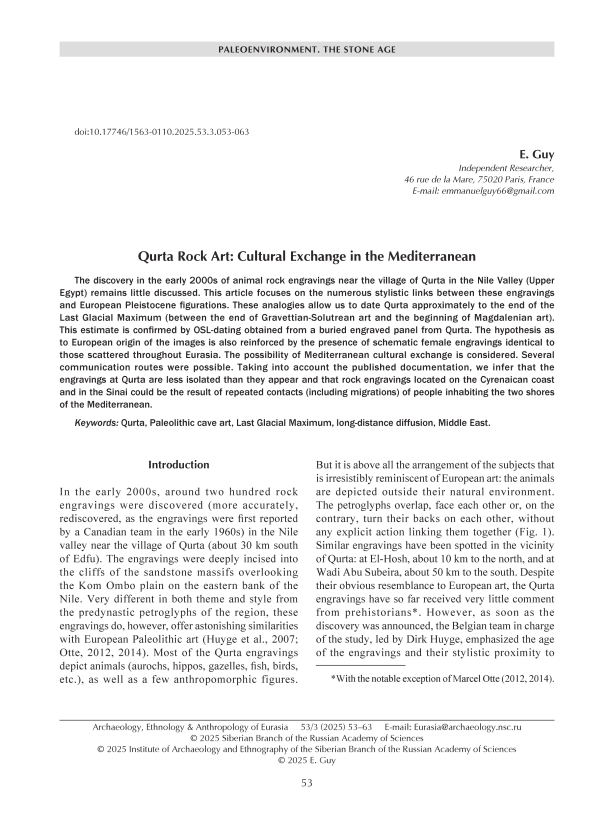
But it is above all the arrangement of the subjects that is irresistibly reminiscent of European art: the animals are depicted outside their natural environment. The petroglyphs overlap, face each other or, on the contrary, turn their backs on each other, without any explicit action linking them together (Fig. 1). Similar engravings have been spotted in the vicinity of Qurta: at El-Hosh, about 10 km to the north, and at Wadi Abu Subeira, about 50 km to the south. Despite their obvious resemblance to European art, the Qurta engravings have so far received very little comment from prehistorians*. However, as soon as the discovery was announced, the Belgian team in charge of the study, led by Dirk Huyge, emphasized the age of the engravings and their stylistic proximity to
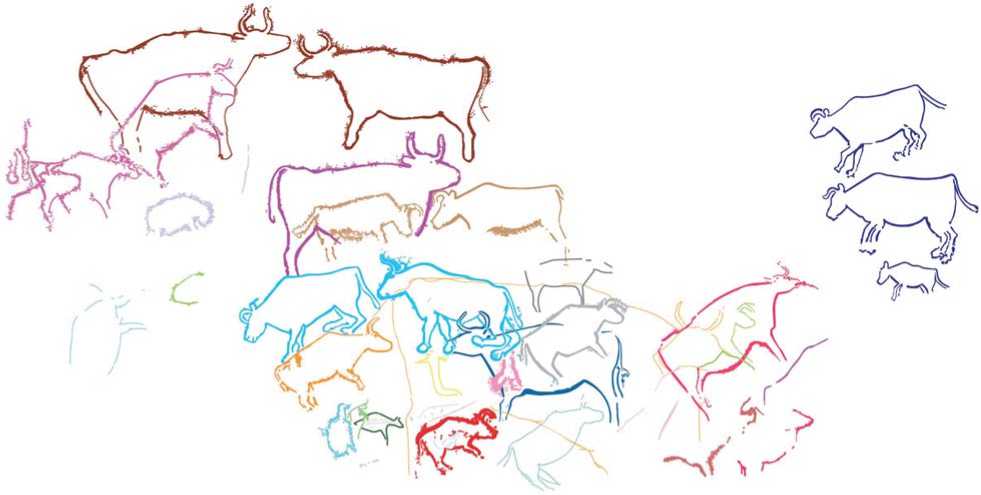
Fig. 1 . One of Qurta’s main engraved panels, with a total length of 4 m (after (Huyge, 2008)).
European cave art. The question of the links between the Qurta engravings and European art was revived a few years later by the dating of the engravings. OSL measurements carried out on a buried engraved panel gave a minimum age of deposition around 15,000 BP. Given the patina of the tracings, a chronological range between 19,000 and 17,000 BP was adopted (Huyge et al., 2011). Thus, all the Qurta engravings date back to the Paleolithic, and their age coincides with several occupations in the north of Egypt, including Wadi Kubbaniya located just 5 km from the Wadi Abu Subeira rock art site (Wendorf et al., 1988). Of course, the contemporaneity of Upper Egyptian engravings with European art is no guarantee of their European origin. Despite the legitimate mistrust that such distant comparisons might arouse, in this article we emphasize the formal and thematic arguments in favor of the spread of European artistic concepts to the Nile Valley and, more broadly, to other little-known sites in North Africa.
Common stylistic conventions
The stylistic links between the Qurta rock engravings and Western artistic concepts are particularly evident in European representations from around 20,000 BP, i.e. contemporary with the Egyptian engravings. In a number of works, we have endeavored to demonstrate the existence at this time of an artistic tradition present over a large part of southwestern Europe, from Andalusia to the Ardèche* (Guy, 2011, 2021). Initially marked by a strong schematic bias, this Gravetto-Solutrean tradition evolved over the millennia towards much more naturalistic forms, as witnessed at Lascaux (ca 18,000 BP) and other contemporary caves in the southwest of France (Gabillou, La Mouthe, Villars, Saint-Cirq, Roc-de-Sers, etc.). The style of Qurta’s engravings seems to us to be precisely at the hinge between the Gravetto-Solutrean representations of the Côa valley type and those of the later period in the above-mentioned caves, including Lascaux. So, we propose a closer look at these relationships.
Outlines still geometrically defined. The properties of the Gravetto-Solutrean stylistic tradition are based on three major stylistic assumptions. The first is the use of a single linear outline to represent the subjects. Even more significant is the fact that this linear outline is based on overtly geometric constructions, for example, arched belly lines, angular profiles, effects of curves and counter-curves, etc. One of these geometric constructions concerns the design of the belly and the front edge of the hind leg, systematically expressed as two perpendicularly juxtaposed arcs. Although this geometric pattern has been partially replaced by more descriptive lines on the Qurta engravings and later European representations, it is clearly present on several occasions (Fig. 2, I).
The geometric concept of outline also led, for example, to aurochs’ heads being drawn in an exaggeratedly rectangular shape. Here again, as will also be the case at Lascaux, the profiles of Qurta aurochs are less geometric than in the past, but some subjects still feature the same straight, elongated head characteristic of the Gravetto-Solutrean tradition. Another reason could explain the rarity of this convention at Qurta. In Gravetto-Solutrean art, the angular profile is usually reserved for cows only, bulls having a shorter, stockier head in accordance with their natural morphology (see the contrast between the profiles of the red cows in the Diverticule Axial and those of the bulls in the Grande Salle at Lascaux). The rarity of aurochs with rectangular heads at Qurta may be linked to the fact that the engravings depict mainly males and not females, as shown by the frequent indication of a penile sheath.
Absence of internal details . The second stylistic convention of European figurations from this period is their lack of interest in internal anatomical details. These are either entirely absent or treated in a particularly elliptical manner (a dot for the eye, a line for the mouth, no depiction of coats, etc.). One might imagine that this is determined by the technique used, deep engraving, which is not very conducive to detailed representation of subjects. However, the simultaneous existence of finely engraved but also painted or drawn Solutrean figures (La Tête du Lion, El Castillo,
La Pileta, Nerja, etc.), marked by the same absence of detail, suggests that this is indeed a stylistic convention. The same absence of internal information can be seen in the Qurta engravings. The coexistence of fairly subtle information, whose presence is limited to the outline, suggests that the artists deliberately neglected generic information (particularly coats) in favor of features that most directly characterize the species. In fact, the Qurta aurochs show the same interest in details that identify the species: pronounced rounding of the dewlap and bulging of the dorsal line to mark the relief of the loins and withers
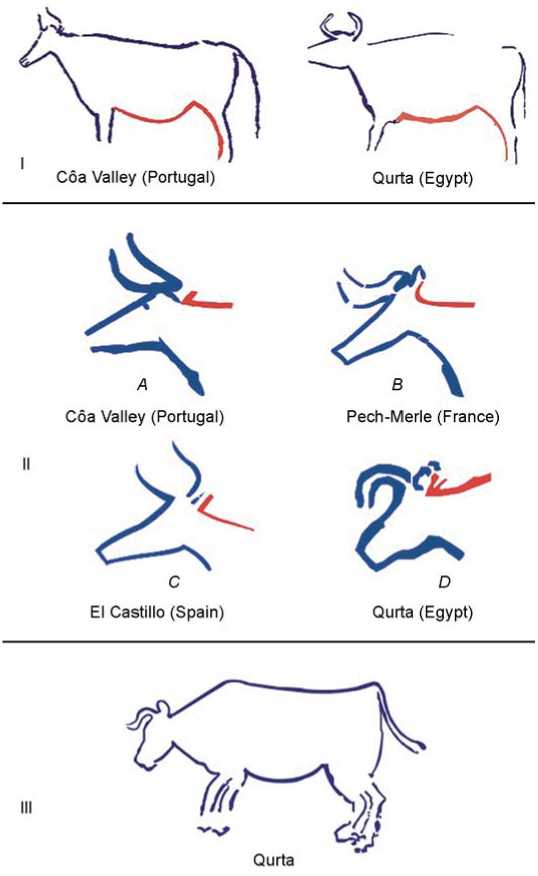
Fig. 2 . Same type of geometric contour design in the Qurta rock art and Gravetto-Solutrean tradition (I); same graphic shortcut used to draw the single ear of the Qurta’s aurochs and in the Gravetto-Solutrean art (II); example of ball-shaped representation of the auroch’s hoof (III).
(see Fig. 1). Note in passing the presence of another clue to probable kinship. In Gravetto-Solutrean art, the subjects’ single ear is most often expressed by a simple fold at the end of the cervical-dorsal outline, sometimes supplemented by a few lines that specify its shape (see Fig. 2, II, A–C ). The permanence of this convention in Lascaux is probably behind the ear “planted” on the nape of the neck so often noted by observers (Guy, 2011) (Fig. 3). The documents at our disposal do not allow for a totally exhaustive analysis, but it does seem that this same mode of representing the ear was also applied at Qurta (see Fig. 2, II, D ).
Fig. 3 . Conventional graphic shortcut used to draw aurochs’ ears in Lascaux.
Same representation of legs . The third convention specific to Gravetto-Solutrean figurations concerns the representation of legs, generally reduced to a single paw with no extremities on each train. This non-representation of legs no doubt stems from the same schematic approach that led the artists to focus on the most distinctive descriptive elements. The same treatment of legs can be found in many of Qurta’s engravings. There are, however, exceptions: some subjects have one leg with a tip, others two legs on each train, others are alternately endowed with one or two legs at the front or rear, depending on the case (see Fig. 1). We will come back to the possible meaning of these nuances later.
More advanced features
More descriptive outlines. While the Qurta rock art bears clear resemblances to Gravetto-Solutrean figurations, it also displays more advanced features that bring it closer to the later items from Lascaux and other contemporary sites. It is not impossible that there were at least two successive artistic periods at Qurta. In any case, it has been pointed out that the outlines were often less overtly geometric than on Gravetto-Solutrean figurations of the Côa Valley type. This greater descriptive preoccupation is also reflected in a greater interest in anatomical detail.
As briefly mentioned, the same panels contain single-leg subjects left open and others with complete, detailed legs (see Fig. 1). It is striking to observe the same type of variations in legs design on Gravetto-Solutrean representations (as is the case on the Frise noire of Pech-Merle). The more detailed drawing of the legs at Qurta is characterized by the interest in indicating the point of the hock and the hooves, which take the form of a ball at the end of the leg (see Fig. 2, III). In addition to the fact that Gravetto-Solutrean engravings show the same insistence on the anatomical elements mentioned, the ball-shaped hoof design obviously echoes a well-known convention in Lascaux representations. The analogy can even be taken a step further, since at Qurta, as at Lascaux, the ball-shaped hoofs are generally accompanied by the dewclaw.
Juxtaposed legs. At Qurta, the animals are represented with paired legs, always juxtaposed side by side. In our view, this misjudgment stems from a twodimensional conception of drawing that is characteristic of Gravetto-Solutrean art. Indeed, on all the examples of even* legs, they are systematically folded back onto the drawing plane like shadow puppets. This strictly two-dimensional representation is the consequence of the principle of outline linearity in force at the time. It prohibits any crossover between tracings and, by the same token, eliminates any possibility of rendering depth. This logic of linearity has the effect of systematically folding even legs onto the single plane of the drawing, as if they were seen from the front (Fig. 4, I, A, B). The same two-dimensional design concept is at work at Qurta: the legs (and, where applicable, the paired horns) are shown side by side on a body in profile (Fig. 4, I, D). What is different at Qurta as compared to Côa or Pech-Merle, and what brings this art closer to Lascaux, is the consideration of distinct planes. Whereas in Côa or Pech-Merle, the legs remain systematically fused together, the Qurta engravers take care to attach the leg intended for the background to the subject’s body, rather than linking it to the other leg; the outlines of the legs are not juxtaposed. However, at both Qurta and Lascaux (Fig. 4, I, C), the distancing effect remains incomplete. The leg supposedly in the background should be masked by the one preceding it, in accordance with optical vision. In the above cases, the two legs remain juxtaposed (Fig. 4, I, А, D), thus creating contradictory angles of view between the different elements of the figure (what Abbé Breuil called “twisted perspective”). It is not impossible that these constraints of threedimensional representation in a two-dimensional
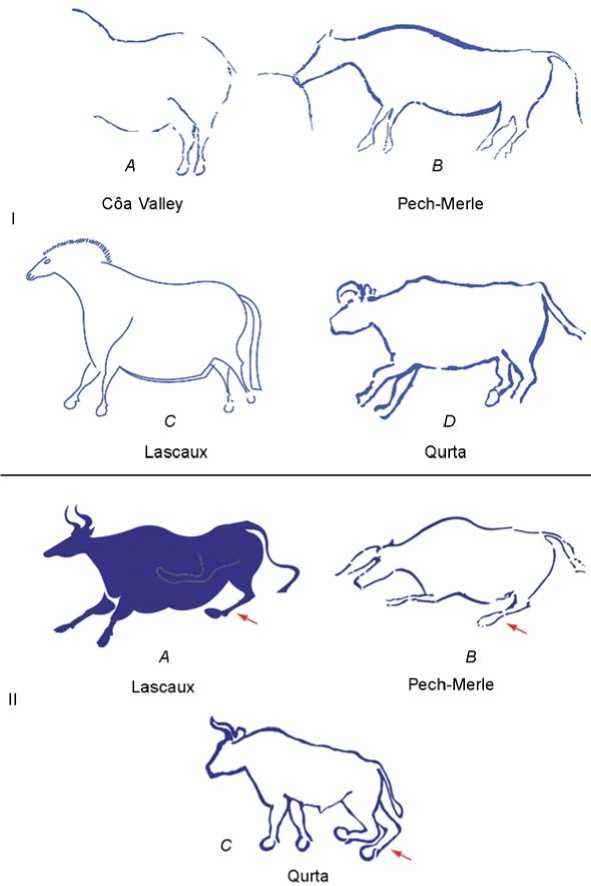
Fig. 4 . The same two-dimensional design of legs can be found on the Qurta engraved animals and on Gravetto-Solutrean representations (and up to Lascaux) (I); the same abnormal position of hind legs folded under the body can be seen in Qurta engravings and in European art of the Gravetto-Solutrean age (and up to Lascaux) (II).
conception of drawing are at the origin of the unusual variations in the number of legs (single leg, paired legs, single and paired legs on the same figure) present in Gravetto-Solutrean engraving art such as at Qurta. It is as if their authors, inexorably faced with the problem of frontality, alternated by default between a single leg or juxtaposed even legs. It is possible that the same difficulty affected the design of the horns, which varied between juxtaposition of even horns and translation of a single horn. In any case, as at Lascaux, the difficulty of recording legs in three dimensions is undoubtedly behind the doubling of the ventral line on certain Qurta animals, creating a depth effect by linking legs on “artificially” differentiated planes.
The same stereotyped movements
As we all know, the Lascaux artists deliberately left a blank space between the legs and the body to express perspective. The introduction at Lascaux of this three-dimensional process onwards probably freed up the expression of movement hitherto hampered by the old two-dimensional conception of drawing. At Lascaux and in contemporary sites, we can see the diversity of postures (walking, running, trotting, galloping, etc.) of the represented animals. While not reaching this level, probably due to the persistent difficulty of depicting legs on separate planes, some Qurta subjects are animated. As in the same period in Europe, the force of convention takes precedence over freedom of observation, and these movements retain a stereotyped appearance. For example, the placement of the front paws often follows the same animation pattern: the foreground paw is positioned in front of the background paw (see Fig. 1). One is spontaneously tempted to explain this strange position by simple individual clumsiness, despite the assertive and repeated nature of this placement. We can see that this position is comparable to that of the hind legs of the famous “jumping” (or falling) cow in Lascaux (see Fig. 4, I, С ). It can also be found on several engravings in the Lascaux Abside. Given many stylistic features they share, it seems unlikely that this unusual position of the hind legs is simply a coincidence. It is all the more true as one of the aurochs from the Frise noire at Pech-Merle has a rigorously similar position (see Fig. 4, II, В ), which seems to foreshadow the Lascaux and Qurta models.
Schematic female figures
The last but not least point of convergence of the Qurta and European art are female images. At Qurta, there are several schematic female figures (FFS) identical to the European Lalinde-Gönnersdorf model (also known as “headless women” in the words of G. Bosinski): same spindle-shaped silhouette without head or feet, same exaggeration of the buttocks (Fig. 5, A). The arrangement of the figures in single file at Qurta is in keeping with numerous European examples (Fig. 5, B). A coincidental convergence seems all the more improbable as these women’s silhouettes are completely reinterpreted in symbolic terms. From this point of view, they constitute one of the major arguments in favor of a common cultural origin between European art and the Qurta rock engravings.
In Europe, there was a marked resurgence of this symbol from the Upper and Final Magdalenian periods, but there are earlier cases. Similar forms can be found at Gravettian sites such as Cussac and Pech-Merle. Other morphologically similar examples are known from Villars, whose age is contemporary with Lascaux. Others have been identified in the Solutrean caves of Rochefort and Margot in Mayenne. They are also found in southern Spain, in Ardales (Andalusia) and on several engraved plates from the Parpalló region, including one from the Middle Solutrean and another from the Early Magdalenian.
How and when might these trans-Mediterranean contacts have occurred?
The above-mentioned common stylistic and thematic elements suggest a cultural link between Qurta and European art. If we accept the possibility that European artistic knowledge and the beliefs that underpin it could have been exported to Upper Egypt, it remains to be seen how and by what means. Were there migrations to the African continent? Or are they the result of repeated exchanges between groups in the Mediterranean basin? The age of the engravings coincides with the Last Glacial Maximum. This may well have encouraged intercontinental contacts. The 120-meter drop in sea level would also have reduced the Strait of Gibraltar to a width of 7 km at its narrowest point (instead of the present 14 km). Dotted with several intermediate islands, it would have been passable even for inexperienced navigators (Collina-Girard, 2005). Lower sea levels also made passage through the Siculo-Tunisian Strait more accessible.
If contact routes did exist, the apparent isolation of the Qurta engravings in the region is surprising. If trade took place on both sides of the Mediterranean at this time, why is there no trace of it around these supposed points of contact? A lack of archaeological research in the region may explain this absence, but post-glacial warming and the subsequent rise
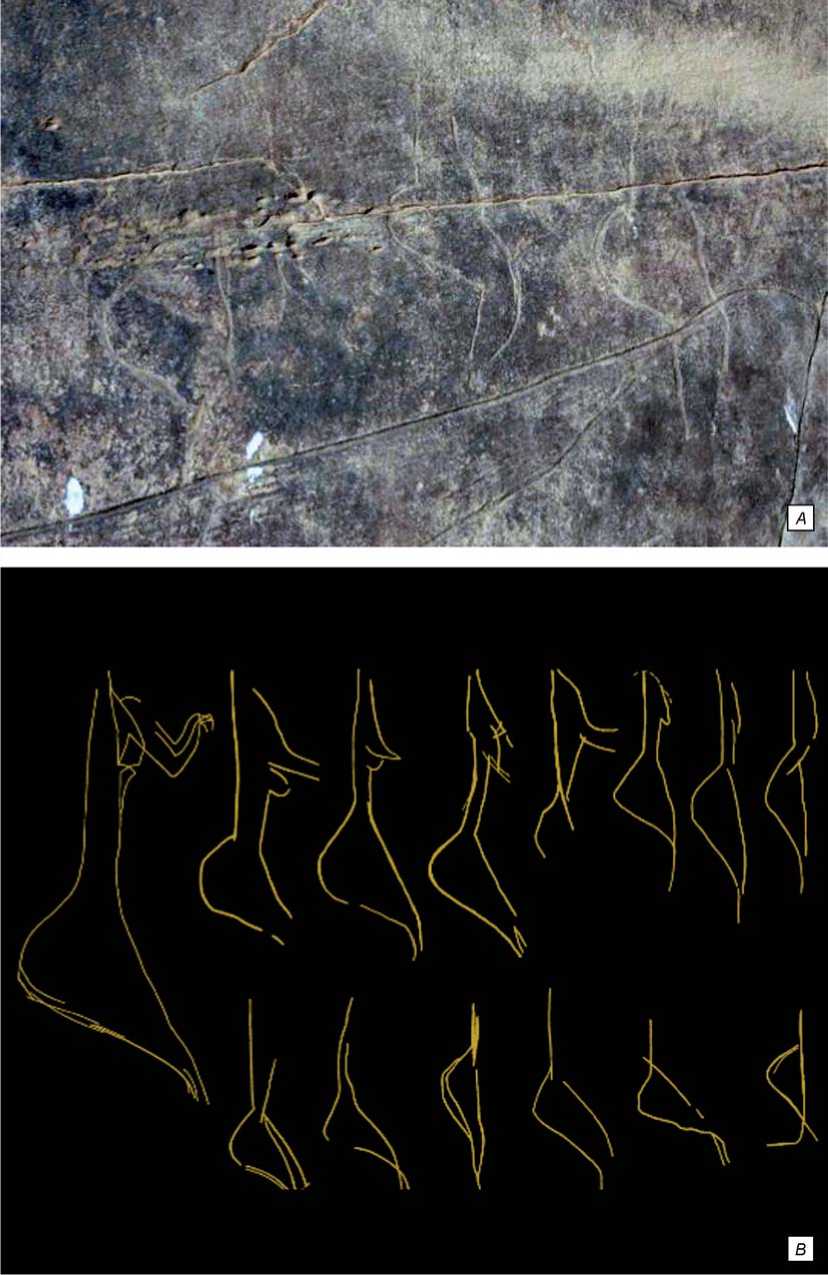
Fig. 5 . Engraved schematic female figures.
A – Qurta; B – Gönnersdorf (Germany) (after (Bosinski, 2011)).
in sea level must also be taken into consideration. If contemporary Qurta habitats existed on the North African coast at the time, they now lie at a depth of 100 meters. But are we really sure that the Qurta engravings are as isolated as we think? Could it be that we have overlooked possible artistic milestones linking Southern Europe to the Nile Valley?
Other underestimated artistic representations
The above scenario does not seem impossible. For example, Dirk Huyge points to the existence of deep engravings of very similar appearance in the Jebel Akhdar in Cyrenaica (North Africa) (Huyge et al., 2015). This is the case of the Kaf Eligren cave, near the town of Shahat, whose close proximity to European art was emphasized by Umberto Paradisi as early as the mid-1960s (1965). The Kaf Atjur cave (known as the Bird Cave) near the town of Tocra contains numerous deep engravings of birds and a few gazelles in a style similar to Kaf Eligren (Jelinek, 1982).
Difficult to access, the region’s mountain ranges have not been systematically prospected. In 2009, a Franco-Libyan team, while planning to visit the Kaf Atjur cave, discovered a second decorated site, the Kaf Tahr cave (Marini, de Faucamberge, Nasser Katab, 2010). Its walls bear deep engravings of birds, fish and gazelles (including several cases of animals of the same species in a confronted position). Here too, the style resembles that of two other previously discovered cavities. In northern Tripolitania, some engravings at Bir Miji also display stylistically European features (Jelinek, 2003), including unfinished aurochs with legs that are alternately paired and single.
The concentration of rock engravings potentially related to Qurta in northern Libya seems to lend credence to the hypothesis of contacts via the Sicilian Channel. This feeling is reinforced by the existence of numerous Sicilian engravings stylistically close to the North African examples. We know the predominant place of the auroch in southern Spain and southern Italy (Genovesi, Puntali, Niscemi, Addaura, Romito, Giovanna, etc.) (Tusa et al., 2013). In Puglia, the walls of the Romanelli cave are engraved with several representations of aurochs comparable to those at Qurta, and possible schematic female silhouettes have been reported (Mussi, De Marco, 2008). In the same region, a detached block from the ceiling of the Paglicci cave bears the remains of a painted horse’s hindquarters, whose single leg features ballshaped hoof identical in every way to those found on the Lascaux horses (Martini, 2012). The animal’s leg reproduces the same body-folding movement also seen at Pech-Merle, Lascaux, and Qurta (see Fig. 4, II).
The same particular translation of aurochs horns, present in Qurta as in Cyrenaica, is also frequently observed on Sicilian examples, consisting of two parallel sinuous lines forming a tube. This similarity does not, however, imply a passage through Sicily, as the same procedure is found on the Spanish Mediterranean coast (El Parpalló, La Pileta, etc.). Moreover, the findings of the region’s archaeological studies reveal that northern Libya is not the only region likely to offer links with Qurta and, more broadly, with Europe. At this stage of our research, we do not claim to be able to offer an exhaustive inventory of these possible connections, but similarities can be noted around Oran and Tiaret, and undoubtedly as far as Morocco. These extensions could point to the establishment of European figurative (and ritual) conceptions along the North African coast, echoing Paolo Graziosi’s prediction of the possible existence of a Euro-African artistic province (1968). This European cultural influence may have extended even further, to the Near East. An engraved shelter in north-central Sinai contains deeply incised representations of ibex, antelope or gazelle, horses, camels and a probable ostrich (Zboray, 2012). Here we find the main stylistic features observed at Qurta and in contemporary European art: description limited to a simple linear outline, legs without extremities, absence of internal details. While these features are still fairly general, the relationship goes further, as shown by the typically Gravetto-Solutrean convention, also found at Qurta, of expressing the belly and the front edge of the hind leg in two perpendicularly juxtaposed arcs. Even more striking, among the animals are two headless female figures with enlarged breasts and buttocks, very close to the European model and consequently to Qurta examples (Fig. 6).
In Saudi Arabia, close to the border with Jordan, the Kilwa site has yielded several sets of rock engravings. In 1938, Hans Rothert, a disciple of Leo Frobenius, endeavored to classify and date them. The earliest figurations show similarities with Qurta art (A. Zboray, pers. comm .). Further downstream, in central Arabia, several engraved sites reported by Emmanuel Anati also belong to the same Europeantype tradition (2015). Among these engravings is
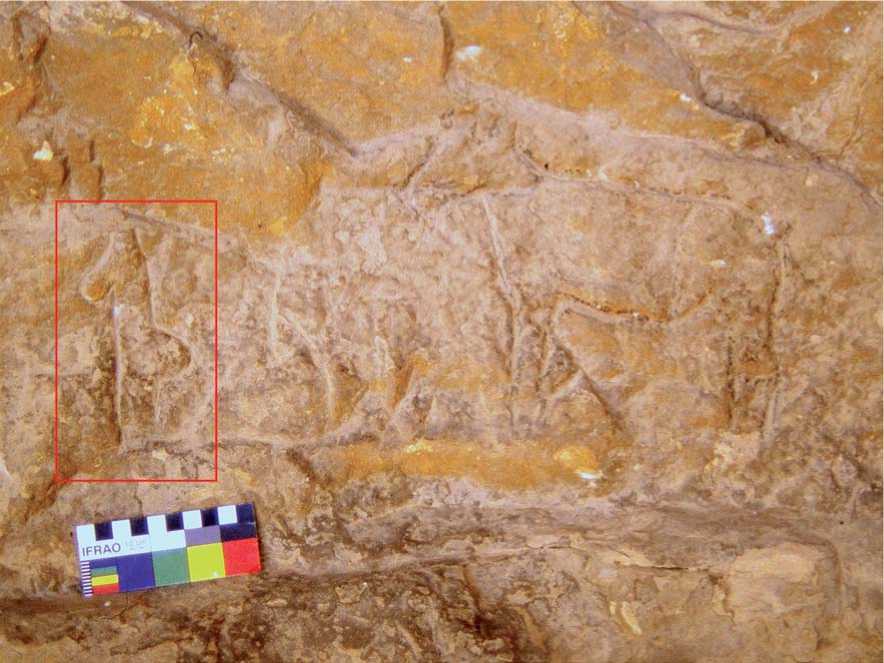
Fig. 6 . Animals and schematic female figures from an engraved shelter in Sinai. Photo © Andras Zboray.
a headless female figure comparable to those found in Sinai (Zboray, 2012).
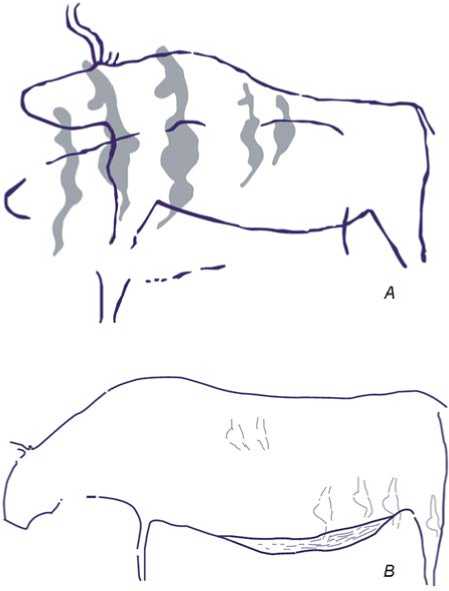
Without necessarily contradicting the possibility of exchanges via the Mediterranean, the spread of European symbols in the Middle East also opens up the possibility of contacts with Europe via the Caucasus. On the shores of the Caspian Sea, in Azerbaijan, certain Gobustan rock engravings are strongly reminiscent of European Gravetto-Solutrean art (Paradisi, 1965): horses or aurochs in line, single leg without extremity, geometrization of certain lines, single auroch horn in the shape of a tube, and, here again, friezes of headless female silhouettes associated with aurochs (Fig. 7), as is the case at Qurta, but also more often in Europe (Bosinski, 2011). Morphologically a little different from the European examples, these alignments of headless and legless women with marked sexual attributes undoubtedly echo the European model.
Fig. 7 . Engraved aurochs with associated schematic female figures from Gobustan ( A ) and Qurta ( B ).
Conclusions
To conclude this quick overview, the Qurta engravings do not seem to be as isolated as one might think. Of course, in the absence of any archaeological context or dating, and given that these images are most often located in areas inaccessible to any research, the existence of a historical link between certain North African figurations and European art will doubtless remain open to question for a long time to come. It should also be noted that these long-distance similarities do not belong to just any period of the Upper Paleolithic. From East to West and from North to South, these analogies all relate to the same artistic expression known in Europe approximately between 22,000 and 17,000 BP, which coincides more or less with the period of the Last Glacial Maximum. It is likely that this major climatic crisis led to major population movements, particularly towards the more hospitable southern regions. Another likely consequence of the cooling is a widening of social exchange networks in the face of difficult living conditions, as ethnology sometimes shows (Smith, 1992). It is therefore tempting to establish a link between the climatic crisis and this artistic transhumance, which has no known equivalent in the Upper Paleolithic.
In this respect, it should be remembered that Gravetto-Solutrean conventions appear to have circulated in Eurasia over considerable distances, not only in southwestern Europe (from Andalusia to the Ardèche), but also far to the east, as suggested by the recent discovery of a staked slab in the Hunsrück massif (Germany) (Welker, 2016), the aforementioned rock engravings in Azerbaijan, and even some rock engravings from the Kalgutinsky Rudnik site in the Altai (Molodin, Cheremesin, 2002; Cretin et al., 2018), whose latest chronological estimates indicate an age of around 20,000 BP (Deline et al., 2023). Recently, other petroglyphs (Baga-Oigur-5 site) clearly related to this same tradition (“Kalguty style”) were discovered on the right bank of the Baga-Oigur River, less than 50 km east of the Kalgutinsky Rudnik site (Molodin et al., 2024).
It is perhaps no coincidence, then, that the Paleolithic engravings found in North Africa and the Near East belong to an artistic tradition characterized by the extent of its territorial expansion on the Eurasian continent.
Acknowledgements
I’d like to thank András Zboray for sharing his photo of the Sinaï shelter and Lydia Zlotkina for her proofreading of the text and her wise advice.
