
Raman Spectroscopy Analysis of Pigments from the Boyary I Rock Art Site, Khakassia
Journal: Archaeology, Ethnology & Anthropology of Eurasia @journal-aeae-en
Section: The metal ages and medieval period
Article in issue: 2 т.53, 2025.
Free access
This article describes previously unknown paintings at the Boyary I rock art site, Republic of Khakassia. They are especially important because they were situated in the part of the panel where a missing ledge could have been located. The petroglyphs could indicate the time of its disappearance. Based on stylistic features, it is possible that they date to the Karasuk period (late 2nd to early 1st millennium BC). The article presents the results of Raman spectroscopy analysis of pigments detected in the paintings. The method involved their context assessment with regard to the rock surface and the white paint of recent inscriptions, the composition of ancient pigments, and searching for organic binder residue. The study covered panel 7 and the adjacent panels 8 and 9. The results are based on 103 spectra of various compositions. All three surfaces mainly consist of sandstone, the predominant constituents being albite, quartzite, and anatase, with occasional natural ferruginization. Modern white paint of two types—chalk (panel 7) and styrene acrylic (panel 9)—were detected. The red pigment used for the paintings in the right part of panel 7 consists of hematite. Calcium oxalate (whewellite) was found only where residues of pigments were located, suggesting that it resulted from the decomposition of the organic binder of the ancient paint.
Short address: https://sciup.org/145147491
IDS: 145147491 | DOI: 10.17746/1563-0110.2025.53.2.054-062
Text of the scientific article Raman Spectroscopy Analysis of Pigments from the Boyary I Rock Art Site, Khakassia
The chronology of the earliest rock art of the Minusinsk Basin has yet to be established. None of the three main hypotheses, i.e. the Late Upper Paleolithic, Neolithic, or Early Bronze Age, has yet been proven (Zotkina, Sutugin, 2023: 60).
Panel 7 at the Boyary I site is one of the largest surfaces with earliest petroglyphs in a multilayered composition (Fig. 1, 1, 2). Over sixty images on the panel include zoomorphic representations (mainly bulls) made in the archaic manner typical of the earliest rock art. Some of them are covered by later petroglyphs, for example, by the figures of the Okunev bull-“izykhs” and Tagar anthropomorphic characters (Fig. 1, 3). Such a stratigraphic context is very promising for making the relative dating of the earliest representations (Zotkina et al., 2021).
The geological context of panel 7 is just as significant. There is a slab (Fig. 1, 2 ) directly below the panel, lower on the slope, which, judging by the orientation of the rock layers and current location, used to be part of the ledge above panel 7. The slab was probably situated on the right side of the rock art surface, where a relatively thick calcite film was observed. This probably suggests that some images were made after the ledge was lost. This article focuses on the right side of panel 7.
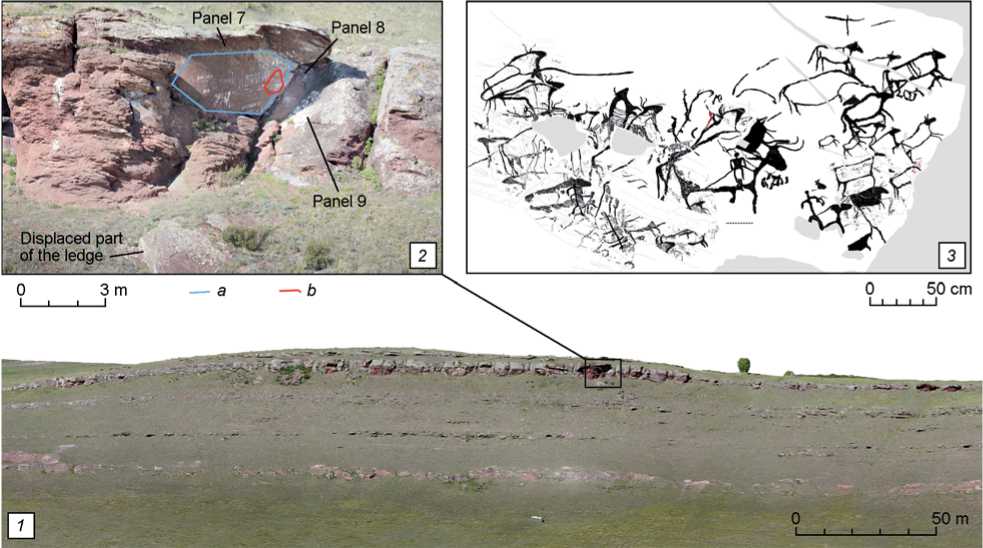
Fig. 1 . The Boyary I site.
1 – general view from the southwest; 2 – central section with panels 7–9; 3 – trace-drawing of relief images on panel 7 (author I.D. Rusakova). a – palimpsest boundary; b – boundary of the ancient paint distribution.
During fieldwork on this section of the panel, very faint, almost imperceptible spots of red mineral pigment were discovered. Photographs of the rock surface were processed and made it possible to see the outlines of the images. This article provides Raman spectroscopy analysis of the paint of these images.
Material and methods
The Boyary I site, or the Troitskaya rock art site, is located just 500 meters from the northwestern outskirts of the village of Troitskoye, in the Bogradsky District of the Republic of Khakassia, on a rock outcrop. The site is part of the Boyary–Abakano-Perevoz rock art complex located on the spurs of the Boyary Range (between the villages of Troitskoye and Abakano-Perevoz) (Fig. 1, 1 ). It was discovered in 1983 by N.V. Leontiev and N.A. Bokovenko, and received the name of Boyary I. In 1999, it was explored by I.D. Rusakova (2001: 18–20). The site yielded petroglyphs of different periods, from the earliest to the Early Iron Age images. Starting in 2021, the Minusinsk Rock Art Research Team from the Institute of Archaeology and Ethnography of the
SB RAS began studying the Boyary I site (Zotkina et al., 2021).
In 2023, the central section of the site—panels 7–9, with the most abundant images (Fig. 1, 1 , 2 )— was studied. The largest rock art surface of the site is panel 7 (4.5 × 3.4 m). It is lenticular, convex, exposed to the southeast, protected by a small rocky ledge, and is heavily damaged by geological processes and modern anthropogenic impact (covered with visitors’ inscriptions). Over sixty petroglyphs of various periods are known on panel 7. Some of them intersect, forming a sophisticated palimpsest (Fig. 1, 3 ). The adjacent panels 8 and 9 contain carved zoomorphic representations, also damaged by visitors’ inscriptions. These surfaces were analyzed to gain a general understanding of the context (substrate, modern paints).
Special attention has been recently paid to the stratigraphy of images on panel 7 (Ibid.: Fig. 2, 3). Residues of ancient red paint were found on its right part. Two non-figurative signs in the form of a cross and four stylized zoomorphic images made in a manner reminiscent of the Karasuk style (Fig. 2, B ) were discovered in the course of processing photographs from this area by DStrech color filtering. Before cleansing the surface of visitors’ inscriptions and making
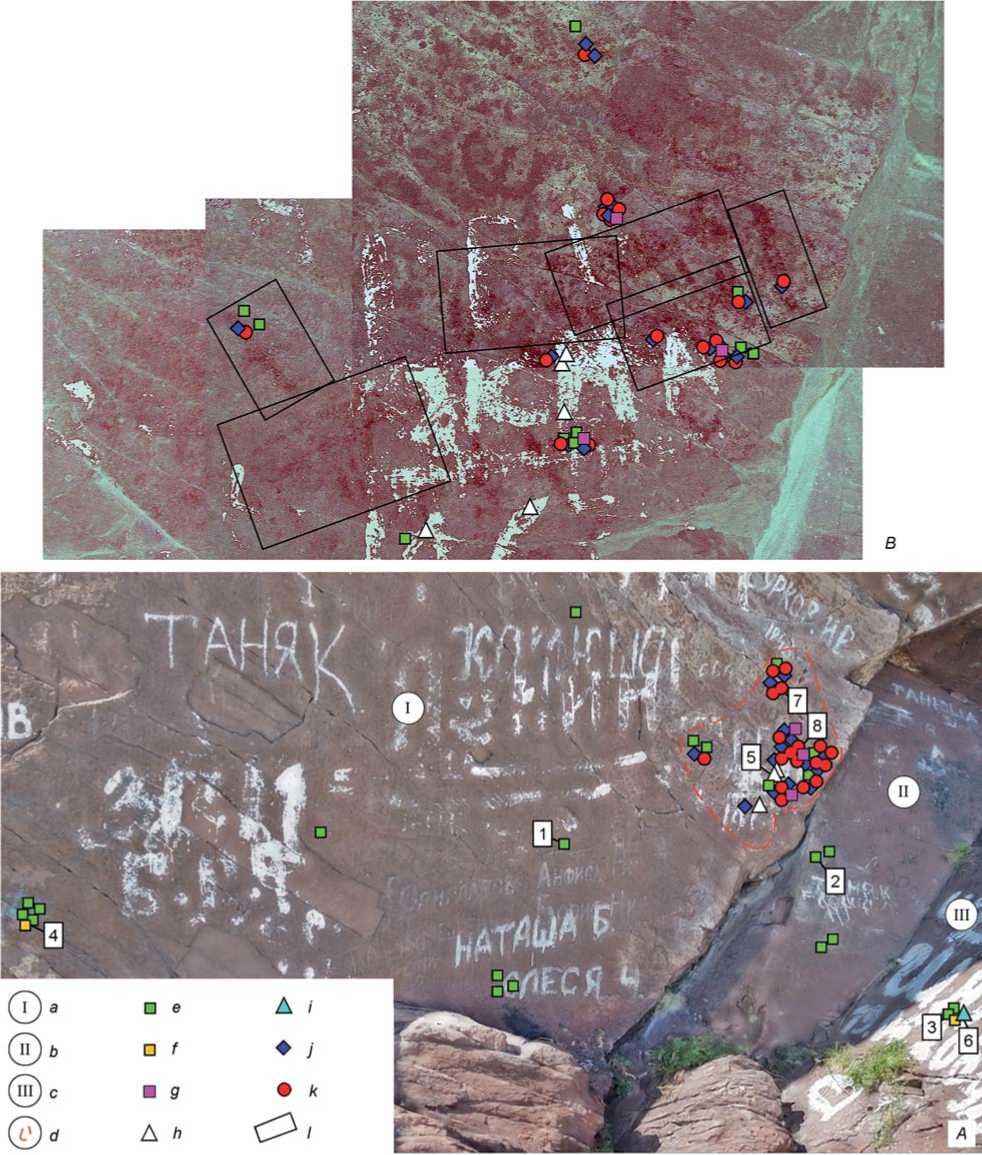
Fig. 2 . Location of spectral data collection points, with indication of the identified substances.
A – location of all spectral data collection points on panels 7–9; B – spectral data collection points on the section of panel 7 where painted images were detected (a series of photographs processed in the DStretch plugin). 1–8 – Raman spectral data collection points shown in Fig. 3. a–c – panels 7–9, respectively; d – ancient paint distribution boundaries; e – rock; f – ferruginization; g – calcite; h – chalk paint; i – acrylic-styrene paint; j – calcium oxalate; k – hematite; l – boundaries of identifiable painted images.
a complete record of the paintings, it was decided to make an analysis of the chemical composition of the ancient pigments in their intact condition.
Raman spectroscopy with a RaPort M532 portable rapid analyzer was used for this study. Measurements were made with a laser wavelength of 532 nm (radiation power 30 mW), focal length of 50– 75 mm, entrance slit of 20 μm, and spectral range of wavenumber readings 140–4000 cm-1. The device was controlled and spectra were analyzed by means of the EnSpectr Professional software. The spectra acquisition time was 53–120 sec, depending on the nature of the surface under study (usually 60 sec).
The study method involved making several series of analyses in different zones of panels 7–9 (Fig. 2, A ). Spectra beyond the ancient paint distribution were collected to establish the geochemical context and identify various contaminants. First, the current authors analyzed the zones without residues of paint, then the visitors’ inscriptions made with modern white paint, and finally, the right side of panel 7 with residues of ancient red pigment, partially intersecting with the carved images and modern inscriptions. The zone of ancient paint along the panel was localized using the DStretch plugin for processing color raster images (Gunn, Douglas, Whear, 2014).
Twenty-two zones up to 5 × 5 cm in size were studied in total, including 15 zones on panel 7, two on panel 8, and five on panel 9. The analysis was carried out at 3–10 points on each of them, depending on the complexity of the chemical composition. In the case of high luminescence or other interference, if the spectra were uninformative, up to three analyses were done at the same point with different device settings (changing laser exposure and spectra collection time) to obtain more accurate readings.
In total, 103 spectra of various rock surface zones were obtained, including those without residues of paint, with visitors’ inscriptions, and with residues of ancient pigment. The spectra were decoded by identifying specific peaks based on the published analyses of archaeological evidence using Raman spectroscopy.
The location of analysis points on the panels and distribution of identified evidence were recorded on a 3D model of the area with panels 7–9 (Fig. 2, A ). The model was generated with photogrammetry, using Agisoft Metashape software. Photographs were taken with the camera of the DJI Mavic Mini 2 drone (1/2.3-inch CMOS matrix, 12 MP, 35 mm lens, image size 4000 × 3000 pixels). Eighty-two images were used for the 8 × 5 m area.
Results
The spectra obtained were classified into three categories, reflecting the composition of the materials detected: substrate, modern paint, and ancient paint.
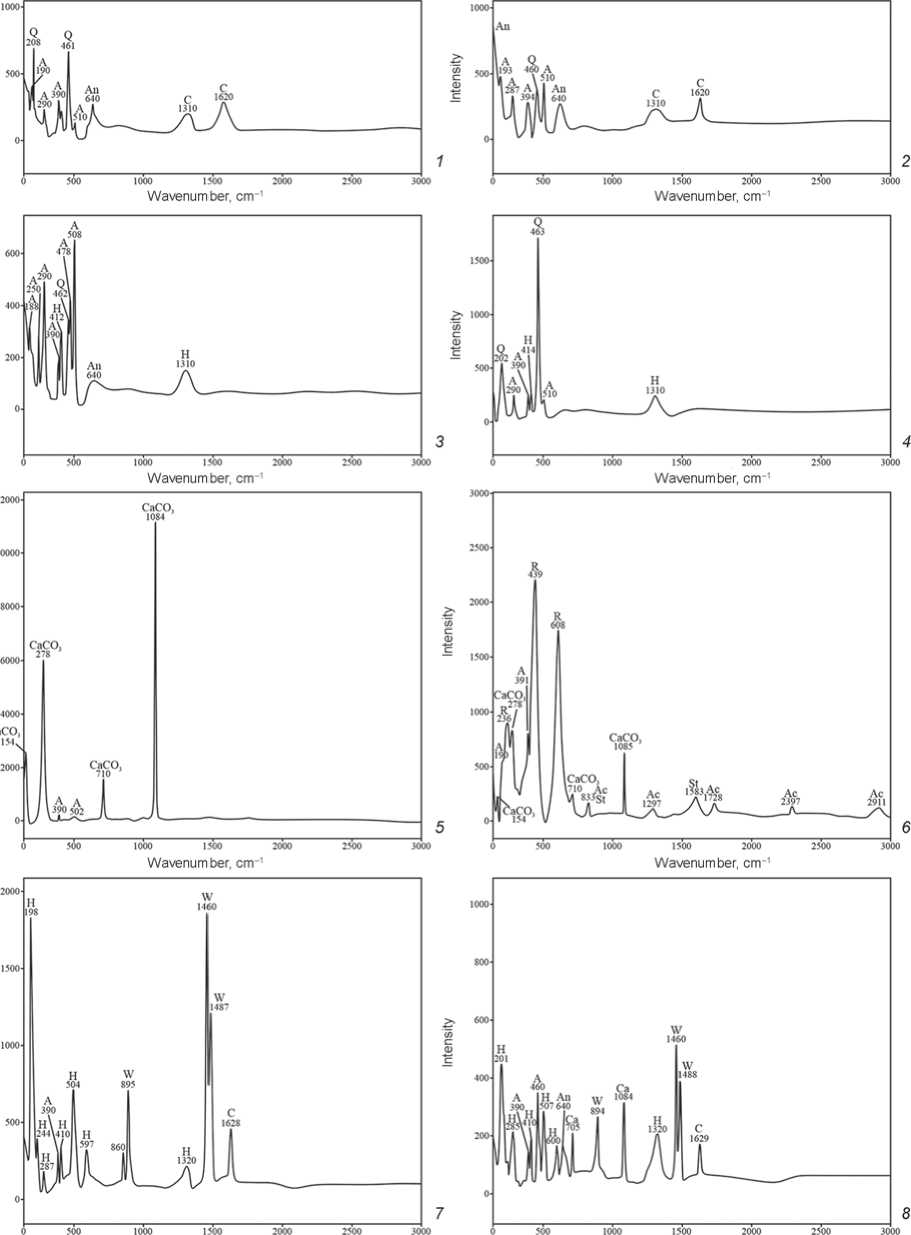
Substrate . The rock on which the panels with images were composed was found to be quite homogeneous. It contained albite, marked in the spectra by peaks at 188–193, 250, 287–290, 390–394, 478, and 508–510 cm-1, and quartz, marked by peaks at 202–208 and 460–463 cm-1 (Fig. 3, 1–4 ) (Freeman et al., 2008: Fig. 3; Pakhunov et al., 2014: 12; Berlanga et al., 2019: Fig. 3, 4). In addition, titanium dioxide in the anatase modification was detected, which is regularly found in the substrate of rocks. Its presence was established by peaks at 140 and 640 cm-1 (Freeman et al., 2008: Pl. 4, fig. 4; Pakhunov et al., 2014: 12; Wojcieszak, Wadley, 2019). Some spectra of the rock showed smooth elevations at 1310 and 1620 cm-1, marking individual inclusions of solid carbon compounds (Silaev et al., 2013).
Natural ferruginization in the form of inclusions of hematite (Fe2O3) was expressed in the spectra by individual peaks at 250, 412, 480, and 1310 cm-1 in the absence of a peak at 1620 cm-1 (Fig. 3, 3–4 ) (Froment, Tournie, Colomban, 2008: Fig. 2; Wojcieszak, Wadley, 2019: Fig. 3). As opposed to the Raman spectra of zones with ancient paint, the spectra of natural ferruginization included hematite peaks partially suppressed by luminescence or hidden by brighter peaks of rock-forming minerals (quartz, albite).
Calcium oxalate was detected only in two sections in the area of red paint distribution. Peaks at 1460 and 1480 cm-1 in the spectra indicated the monohydrate whewellite (Hernanz, Gavira-Vallejo, Ruiz-López, 2006: Fig. 7, 1059–1060).
Modern paint . Two types of white paint with very different compositions were discovered. The main component of one type of paint was calcium carbonate in the calcite phase (CaCO3), i.e. chalk (Fig. 3, 5 ). Its presence was revealed by peaks at 154, 278, 710, and 1084 cm-1 (Fido, Bell, 2006; Bonneau, Pearce, Pollard, 2012; Donnely et al., 2017). The other paint had a greater number of components (Fig. 3, 6 ). It was based on a styrene/acrylic copolymer (marked by peaks at 833, 1297, 1583, 2397, and 2911 cm-1) (Fremont, Verboven, Saverwyns, 2014: Fig. 3; Wiesinger et al., 2018). The main coloring agent was titanium dioxide in its crystalline modification, i.e. rutile (peaks at 236, 439, and 608 cm-1) (Noda,
Intensity О lntensity intensity intensity
Wavenumber, cm ’
Wavenumber, cm '
Fig. 3 . Typical Raman spectra of different sections of the rock surface.
1–4 – rock without residues of pigments; 5 , 6 – visitors’ inscriptions; 7 , 8 – ancient paint.
A – albite, Q – quartz, An – anatase, C – carbon compounds, CaCO3 – calcium carbonate, R – rutile, Ac – acrylic, St – styrene, H – hematite, W – whewellite, Ca – calcite.
Sala, 2000: Fig. 2; Fido, Bell, 2006). An additional ingredient was calcium carbonate in the calcite phase (probably indicating the presence of chalk, marked by peaks at 154, 278, 710, and 1085 cm-1) (Bonneau, Pearce, Pollard, 2012; Donnely et al., 2017).
Red paint . Spectra reflecting the presence of pigment were obtained from the right side of panel 7. In most cases, the results showed a mixed composition including hematite and calcium oxalate in the form of whewellite (Fig. 3, 7 ). Hematite is a mineral pigment (Fe2O3) marked by peaks at 198, 244, 287, 410, 504, 600, and 1320 cm-1 (Pakhunov et al., 2014: 11–12; Froment, Tournie, Colomban, 2008: Fig. 2; Smith, Bouchard, Lorblanchet, 1999: Fig. 5; Wojcieszak, Wadley, 2019: Fig. 2). The presence of calcium oxalate in the form of whewellite was indicated by peaks at 1460 and 1487 cm-1 (Hernanz, Gavira-Vallejo, Ruiz-López, 2006: Fig 7, 1059–1060). A peak at 1628 cm-1 was also identified, which is probably associated with solid carbon compounds (Silaev et al., 2013). It was established that the main area of panel 7 under study was partially covered with calcite film. This was indicated by distinctive calcite peaks at 705 and 1084 cm-1 in the spectra (Fig. 3, 8 ) (Donnely et al., 2017).
Localization of the identifi ed substances on the rock surface . The results of Raman spectroscopy were compared with locations of the spectral data points marked on the 3D model of the site section (see Fig. 2, A ). Data obtained from photographs processed in the DStretch plugin were also used, showing that the remains of ancient red paint were located on the right part of panel 7 (see Fig. 2, B ).
Spectra showing signs of calcium oxalate in the form of whewellite without admixture of hematite were obtained only in the immediate vicinity of residues of the ancient pigment. Mixed composition including hematite and calcium oxalate in the form of whewellite was detected only in the area of distribution of ancient red paint used for making the paintings. Residues of hematite and calcium oxalates were found under the calcite layer in the lower part of this image cluster.
The recent inscription in the lower right part of panel 7 (“ЖMA”, the time of its occurrence is unknown) was established to have been made with modern chalk-based paint. Paint of different composition, which contained titanium oxide and a styrene/acrylic copolymer, was discovered during the study of the inscription of 2009 on panel 9.
Discussion
After studying 22 sections of panels 7–9 at the Boyary I site and analyzing 103 spectra, data were obtained on various substances within the substrate and on its surface. The rock included feldspars (albite), quartz, titanium dioxide (anatase), inclusions of natural ferruginization, and individual particles of carbon compounds. This is typical of red-colored Devonian sandstone consisting of albite, quartz, micas, and containing iron oxides (Morozov et al., 2019; Wojcieszak, Wadley, 2019).
Two variants in the composition of the modern white paint of the visitors’ inscriptions were identified. One of them, based on chalk (its presence was marked by calcium carbonate in the calcite phase), is typical of chalk paint used in the 20th century. Another composition included titanium dioxide (rutile), calcium carbonate in the calcite phase (likely, chalk), and a styrene/acrylic polymer as a binder. These components demonstrate that a modern acrylic-styrene paint was used for making the inscription on panel 9, which was dated to 2009. The data on the composition of modern white paints contaminating the panels can be used in further restoration for selecting the best means for their removal from the rock surface.
Information on the composition of the substrate and modern paint made it possible to establish the context for further identification of pigments used for creating the rock paintings on panel 7. Stylized zoomorphic images and cross-shaped symbols were found in the right part of the rock art surface; however, the pigment was also detected in the form of different-sized spots outside these paintings.
Two animal figures can be clearly recognized, located one above the other and oriented with their heads to the right, with ears rendered in detail. They resemble Karasuk-style images typical of the Late Bronze Age (late 2nd to early 1st millennium BC) (Kovtun, 2001: 73–76, pl. 48, 49; Kovaleva, 2011: 32–36, fig. 12, 13). Recent inscriptions covering the paintings need be removed for complete recording and determination of exact boundaries of the latter, which is planned in the future. Analysis has revealed the presence of hematite in the ancient paint.
In the rock and portable art of the Minusinsk Basin, pigments were used in the Early Bronze Age and Final Early Iron Age. Most examples are known from the sites of the Okunev culture, where red and black pigments have been found (Sher, 1980: 122, 132; Esin et al., 2014). Burial materials of this culture show the use of red pigment (presumably ocher) for painting the walls of stone cists, outer surfaces of pottery, and faces of buried persons; black and red paints were also found on astragals (Polyakov, 2022: 95, 123, 174). The Kavkazskaya rock art site on the Tuba River is a good example of paintings from the late 1st millennium BC (Leontiev, Bokovenko, 1985). Numerous evidence of the use of red and black pigments appears in the materials of the Tashtyk culture, including burial masks and portable art (Gryaznov, 1971: 103–104; Vadetskaya, 1986: 133– 134). However, painted images were not known in the Late Bronze Age rock art of the Minusinsk Basin (Kovaleva, 2011: 18). The paintings on panel 7 of the Boyary I site represent the first example of such images.
Red paint of the Early Bronze Age and the Final Early Iron Age has been traditionally interpreted as ocher (Vadetskaya, 1980: 55, 59; Leontiev, Bokovenko, 1985: 87). N.V. Leontiev suggested that dry pigment or pigment diluted in water or serosanguinous fluid could have been used for the Okunev paintings (Leontiev, Kapelko, Esin, 2006: 14). G.A. Maksimenkov also suggested the use of fat as a binder (1980: 25). X-ray fluorescence analysis, conducted by a team of scholars headed by Y.N. Esin on individual samples of red and black paint from the Okunev sculptures, revealed that hematite or red ocher was used for the red pigment and charcoal for the black pigment (Esin et al., 2014: 87). Thus, the composition of red paint based on hematite was quite typical for different periods in the history of the Minusinsk Basin. However, there are few direct parallels, due to the small number of studies on the chemical composition of ancient pigments.
The current analysis revealed the presence of calcium oxalate in the ancient paint mainly in the form of monohydrate (whewellite). In the context of rock art studies, this substance is usually interpreted as a metabolic product of microorganisms living in the upper layers of the substrate (Iriarte et al., 2013: 1557, 1561; Hernanz, 2015: 15). Petroglyphs can be dated by calcium oxalate using the UMS method (Ruiz et al., 2012; Zotkina, Sutugin, 2023: 61–62). Bacterial activity results in a readily visible, fairly thick crust of calcium oxalate, typically gray-blue or black, on the rock surface (Hernanz, Gavira-Vallejo, Ruiz-López, 2006: 1058, 1062). However, if this substance is found exclusively in the area of ancient pigment distribution and does not form a thick crust, it can be interpreted as a decomposition product of the organic component of the ancient paint (Lofrumento et al.,
2012: 814–815; Rousaki et al., 2017). The available data, unfortunately, lack details concerning the type of binder.
No oxalate crust of the required thickness for radiocarbon dating of the images was found on panels 7–9 at Boyary I. Whewellite was discovered almost exclusively in the compositions mixed with hematite. Occasionally it was present on the surface without hematite, but only in the areas of ancient pigment distribution. Based on these data, it can be concluded that the paint used for making paintings on the right part of panel 7 included hematite and an unknown organic binder.
The work at the Boyary I site not only identified various substances in the composition of ancient and modern paints, but also tested the Raman spectroscopy methodology for studying painted images at open sites in the Minusinsk Basin. Given the specific characteristics of these sites, this methodology consists of the contextual study of the substrate, modern pollutants (paint), and mapping to ensure accurate interpretation of the origin of identified substances.
Conclusions
Panel 7 at the Boyary I site contains presumably Karasuk-style paintings. Their occurrence may mark the time when the ledge on the right side of the site was lost, which may justify revising the age of the carved images in the area.
Raman spectroscopy analysis of the paint composition has revealed the presence of hematite and decomposition products from an organic binder. The methodology tested during this study can be applied in future research of painted images at open rock art sites in the Minusinsk Basin and other regions.
Acknowledgments
This study was supported by the Russian Science Foundation, project No. 22-18-00070. The authors express their deep gratitude to E.V. Karpova, Senior Researcher at the Vorozhtsov Novosibirsk Institute of Organic Chemistry of the SB RAS, for her consultation, and thank the reviewer for constructive criticism which made it possible to significantly improve the text of the article. The study was carried out using scientific equipment of the Core Facilities Center “Cenozoic Geochronology” at the Institute of Archaeology and Ethnography of the SB RAS (Novosibirsk).
