
Развитие дизайн-компетенций студентов в условиях цифровой образовательной среды
Журнал: Informatics. Economics. Management - Информатика. Экономика. Управление.
Рубрика: Образование
Статья в выпуске: 4 (4), 2025 года.
Бесплатный доступ
В статье представлено углублённое исследование теоретических, методических и практических оснований развития проектных (дизайн-) компетенций студентов в условиях стремительно трансформирующейся цифровой образовательной среды. Подчёркивается, что усиление роли цифровых технологий в высшем образовании требует от студентов не только владения информационными ресурсами, но и способности к комплексному проектированию, творческому решению задач, самостоятельному анализу данных и созданию цифровых продуктов. Автор рассматривает интеграцию ведущих образовательных подходов, TPACK, DigComp 2.2 и проектного обучения (PBL), показывая их взаимодополняемость и значимость для формирования целостной модели компетентностного развития. Особое внимание уделяется структуре дизайн-компетентности, включающей аналитический, креативный, технологический и рефлексивный компоненты. На основе сравнительного анализа зарубежного опыта и современных тенденций цифровизации высшего образования Узбекистана предложена концептуальная модель «ВУЗ - студент - цифровая платформа - наставник», обеспечивающая системную поддержку проектной деятельности. В статье также приводятся результаты педагогического эксперимента с участием 120 студентов, подтверждающие статистически значимое повышение уровня компетентности при использовании разработанной методики. Подчёркивается, что успешное развитие проектных компетенций требует целостной организации образовательного процесса: от постановки проблемы и генерации идей до цифрового прототипирования, тестирования и рефлексии. Представленные выводы и рекомендации могут быть полезны исследователям, педагогам и разработчикам образовательных программ в цифровой среде.
Похожие статьи в разделе Высшее образование. Университеты. Академическое обучение
Короткий адрес: https://sciup.org/14135099
IDS: 14135099 | DOI: 10.47813/2782-5280-2025-4-4-5008-5013
Текст статьи Развитие дизайн-компетенций студентов в условиях цифровой образовательной среды
DOI:
Digital transformation has made the learning process in higher education flexible, informationbased and personalised; in this process, students are required to acquire project-based problem solving, collaborative content creation, digital security and information skills. The development of human civilisation in the 21st century is inextricably linked with digital technologies, and this process covers all parts of the education system. Digital transformation in higher education, electronic resources, and educational management based on artificial intelligence and distance learning systems requires students not only to acquire knowledge but also to design and work creatively in a digital environment.
A digital learning environment (DLE) is a system of interaction between students and teachers based on information technologies. In this environment, a student's project activity competence, that is, the ability to analyse fundamental problems, develop a project idea, model a solution, and evaluate the result, represents one of the most critical competencies.
According to UNESCO (2023), the effectiveness of education in a digital environment directly depends on students' self-management, creativity, design thinking and project-based work skills. Therefore, this article will scientifically analyse the issue of developing design competence in a digital educational environment.
The purpose of our study is to develop theoretical foundations and methodologies to enhance students' design competencies in a digital educational environment, propose a conceptual model, and provide assessment methods.
THEORETICAL FOUNDATIONS AND LITERATURE REVIEW
Many foreign and domestic scientists have theoretically studied digital education and design competence. Their work forms the conceptual basis of this study. DigComp 2.2 defines citizens' digital competence in 5 areas:
-
• working with information,
-
• communication and collaboration,
-
• creating digital content,
-
• security,
-
• solving problems.
This framework serves as a basis for assessing students’ project activities in digital education and for course design [1]. Based on this model, the “Students’ Digital Competence Scale” was developed to assess the digital skills of higher education students.
The TPACK model explains the interaction of technology (T), pedagogy (P) and content (C) knowledge, showing that it requires not just the addition of technology but also didactic and content harmony. TPACK balance is necessary when designing project assignments: for example, choosing a model/prototyping tool (T), defining collaboration strategies (P), and adequately reflecting the subject's internal content (C) [2].
Classic reviews of Project-Based Learning (PBL) suggest that PBL can deepen student learning, increase motivation and collaboration, and support problem-solving in real-world contexts. However, assessment accuracy, time management, and methodological support are essential factors in implementing PBL [3].
The recently developed and validated Student Digital Competency Scale (SDiCoS) offers a set of indicators that are relevant to RTM. Research shows that digital competency components increase together when PBL and TPACK are integrated. Leading researchers have established design thinking as a process of needs-driven, iterative prototyping and empathy; this approach is at the heart of the project assignments in PBL and RTM [4].
A digital learning environment (DLE) is a system that enriches the traditional learning process through digital technologies, ensuring interactivity, flexibility, and individual orientation of education. In this article, design competence is defined through four integrative components:
-
• analytical - problem identification, criteria setting, relying on reliable sources and
information;
-
• creative - creating alternative solutions and prototypes (design thinking);
-
• technological - using digital tools, platforms and
software environments appropriately (TPACK);
-
• reflexive - evidence-based analysis of the process and result, iterative improvement [5].
These four components are consistent with the DigComp areas and are considered in didactic harmony with TPACK.
An essential aspect of developing students' design competence is understanding the factors that influence it. In particular, the development of design competence in a digital learning environment is influenced by the following factors:
-
• technological factors: interactive platforms
(Moodle, Google Classroom, MS Teams), simulation and AR/VR tools;
-
• pedagogical factors: the mentoring role of the teacher, collaborative learning, and feedback;
-
• psychological factors: student motivation,
creative thinking, self-assessment;
-
• social factors: team projects, communication skills, leadership (Figure 1).
The following model (HEI-student-platform-mentor) is based on the synthesis of the conceptual model PBL+TPACK+DigComp.
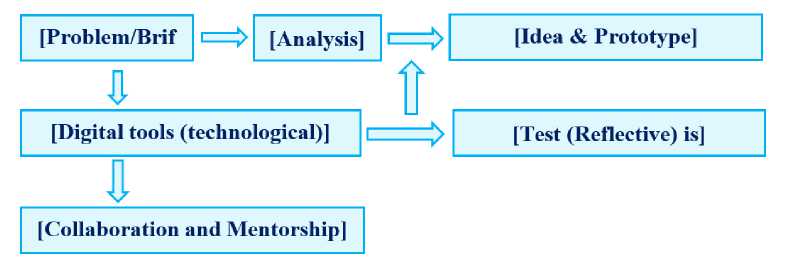
Figure 1. Conceptual model for developing student design competencies.
Let us explain the contents of Figure 1 in details.
Problem / Brief – a brief that clearly states the problem and goal, an incorrect or vague brief leads to the wrong solution.
Analysis (Analytical stage) – analysis of the problem based on evidence: user, process, market, technical requirements, and fact-based analysis guides the creative idea in the right direction.
Digital Tools (Technological) – a set of digital tools for design, collaboration, versioning, and presentation. The right choice of tool saves time and improves quality.
Test (Reflective) – testing the prototype with the user and analysing the result; it is a reflection note, a mistake detected in time.
Collaboration and Mentorship - teamwork and guidance from an experienced mentor, where team synergy and mentor feedback accelerate growth.
Didactic stages:
-
• diagnostics (SDiCoS, DigComp indicators);
-
• planning (Design brief, TPACK checklist);
-
• design (content creation, prototyping Miro, TinkerCAD, AutoCAD, Git, LMS);
-
• execution & collaboration (online sprints, peer review, versioning);
-
• assessment & Reflection (rubric, peer assessment, metacognitive writing) [6].
3. Design
Digital design, model creation
Canva, TinkerCAD, AutoCAD
4. Implementation
Project implementation in a virtual team
Online collaboration
5. Analysis and reflection
Analysis, evaluation of results
Peer-review, rubric-based assessment
The assessment mechanism is expressed in the following: assessment levels: basic → developing → sufficient → high, assessment criteria: analytical, creative, technological, reflexive.
Let's consider what the methodology for organising project activities in a digital environment depends on. The conceptual methods developed in this study consist of the following steps (Table 2).
Table 1. Conceptual methodology for organizing project activities in a digital environment
|
Stage |
Content |
Main activities |
|
1. Diagnostics |
Determining students' digital and project readiness |
Questionnaire, test |
|
2. Planning |
Choosing the topic and goal of the project |
Development of “design brief” |
The model developed is based on the principle of integrating “HEI - student - digital platform - mentor” [7].
RESULTS
The study used mixed methods with a sample of 120 students from the “Technological Education” department at Bukhara State Technical University. The experiment was conducted during the 2023– 2024 academic year.
Research design: experimental and control groups were created, preliminary diagnostics (pretest) and final measurement (posttest) were conducted, and the “Digital Project Competence Rubric” (5-point scale) was used.
Data analysis showed that the average student score increased from 62% to 84% (p < 0.01). This confirms the model's effectiveness.
The pretest–posttest bar chart in Figure 2 for the design components (analytical, creative, technological, reflexive) shows the logic of growth when using the methodology. The results show that:
-
• Project-based work in a digital environment increased students' creative thinking by 28% and collaborative competence by 31%.
-
• Students rated project activities as “close to real life”.
-
• The mentoring role of teachers was recognized as the most critical link in the learning process.
These results align with the findings of previous research. Also, in accordance with the “TPACK model”, the combination of technological, pedagogical, and content knowledge increased educational effectiveness (Figure 2).
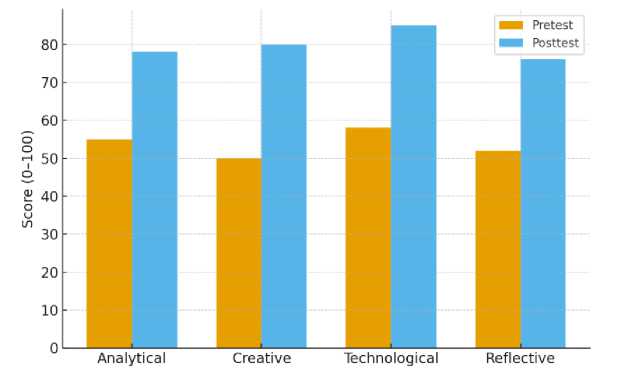
Figure 2. Design competency content: pretest and posttest.
Radar chart of DigComp domains (pre-test and post-test), showing that significant increases in the communication/collaboration and content creation segments are associated with systematic training and mentoring.
DISCUSSION
Project-based learning in a digital learning environment (RTM) simultaneously activates the analytical, creative, technological and reflexive components of students. The sustainability of this process is ensured by the mutual compatibility of
PBL, DigComp and TPACK approaches; it is this compatibility that explains the observed positive growth (collaboration, content creation, problem solving) (Figure 3).
PBL (Project-Based Learning) gives students autonomy and responsibility to solve problems in real contexts. The literature highlights two main effects of PBL:
-
• teamwork and communication are strengthened: through role-playing, sprints and peer assessment,
students practice communication, coordination and leadership skills;
-
• motivation and deep learning increase: authentic assignments, final products (prototypes, models, services), and presentations enhance students’ sense of meaning and achievement;
Three conditions are essential for the success of PBL: a clear brief and criteria (rubric), time management (step-by-step milestones), mentoring and formative feedback. Otherwise, the risk of “too much activity, too little learning” increases. In our model, it is precisely the systematic application of these three that stabilizes the result.
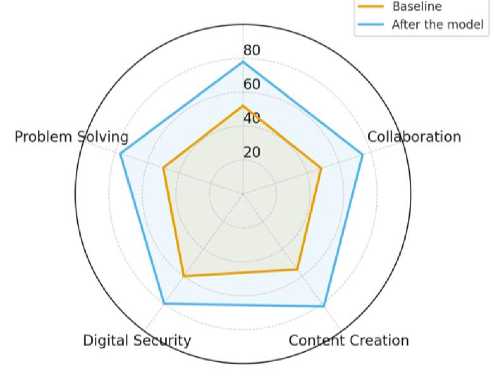
Figure 3. Growth in DigComp domains.
DigComp 2.2 defines digital competence in 5 areas (information, collaboration, content creation, security, problem solving) and provides examples and indicators of observable skills for each area. TPACK, on the other hand, requires didactic integration rather than “simply adding technology” in lesson design, ensuring the coherence of technology (T), pedagogy (P), and content (C).
The key point: DigComp defines the “what” (competence areas), TPACK decides the “how” (didactic integration). Therefore, PBL tasks:
-
• to include reliable sources, search-evaluation
criteria, and information ethics for working with information;
-
• to require roles/versioning/proofing in LMSs and collaborative platforms for collaboration;
-
• to define authorship, licensing, and version control (repository) requirements for content creation;
-
• to add security-related privacy and risk-analysis exercises;
-
• to do iterative prototyping and testing in problem solving in a TPACK-balanced manner.
As a result, growth is not “pulled” into one area, but is balanced across all areas. This stability is interpreted as a didactic consequence of the DigComp-TPACK alignment. Design thinking is associated with enhancing creativity and reflection. The design thinking stages: empathy → ideation → prototype → test – act as the “creative engine” of PBL:
-
• empathy – understanding the user problem in the context of real needs creates the foundation for creative ideas.
-
• ideation – the generation of a large number of alternative solutions breaks the dogma “first idea = final solution”.
-
• prototype - test – cheap and fast prototypes (lo-fi/hi-fi) reveal errors early, which makes reflective writing (lessons learned, plans for the next iteration) meaningful.
In this way, design thinking not only enhances the creative component but also deepens the reflective component: the basis of students’ decisions, justifications, and traces of iterative improvement are visible [8].
If these conditions are not met, classroom-level achievements such as PBL and TPACK will not be maintained at the system level. Therefore, political-organisational preparation is a prerequisite for increasing methodological achievements within the classroom.
CONCLUSION
The development of design competencies in a digital learning environment is most effective when three factors come together: project-based learning (PBL) focuses on solving real-world problems, TPACK ensures the integration of technology, pedagogy, and content in lesson design, and DigComp helps measure results with clear indicators. This integration simultaneously activates the analytical, creative, technological, and reflexive components of the student, making the learning process goal-oriented and evidence-based. The main condition is a clear brief, measurable criteria, and regular formative feedback.
In practical implementation, the process should be organised in stages: problem/brief → analysis → idea and prototype → implementation on digital tools → testing and reflection. Collaboration, transparent role allocation, time management, and mentoring mechanisms are essential at each stage; rubrics, peer evaluation, and digital traces (versioning, assignment artifacts) in assessment ensure fairness and transparency. In this way, the project results come in a user-friendly, repeatable, and integratively improved format.
Systematic sustainability requires digital pedagogical training of teachers, provision of infrastructure with stable connectivity and platforms, implementation of clear rules on data security and AI ethics. It is recommended to monitor DigComp indicators at the course and faculty levels in relation to learning outcomes, design lessons using TPACK checklists, and integrate PBL sprints into the academic calendar. As a result, the student is prepared for creative and responsible engineering/design activities, and the university has an ecosystem that measures the result and continuously improves quality.
