
Reminiscences of Traditional Prayer Rituals in Modern Udmurt Culture
Journal: Archaeology, Ethnology & Anthropology of Eurasia @journal-aeae-en
Section: Ethnology
Article in issue: 1 т.53, 2025.
Free access
Based on my fieldwork in 2018–2019, 2022–2023, late 19th to early 21st century studies by other experts, and internet resources, I explore the functioning of traditional prayer rituals in modern Udmurt culture. Current religious rites fall into three groups: continuing, renewed at ancient sanctuaries, and initiated elsewhere. Prayer rituals are continuing in several Southern Udmurt villages and meant to secure the communities’ wellbeing. They are a peculiar manifestation of Udmurt ethnic identity. Their deep meaning, however, is not always preserved, many elements are lost, and religious life in general is declining. Since the early 1990s, prayer rituals have been initiated at new places during festivals and holidays. They are thought to stimulate interest in Udmurt beliefs and rites and to propagate ethno-cultural codes outside Udmurtia. Under globalization and unification, the practicing of traditional rites preserves ethnic identity despite historical changes. Ceremonies with prayings contribute to the understanding and preserving ethno-cultural legacy.
Similar articles in the section Customs, manners, usage in private life
Short address: https://sciup.org/145147254
IDS: 145147254 | DOI: 10.17746/1563-0110.2025.53.1.137-144
Text of the scientific article Reminiscences of Traditional Prayer Rituals in Modern Udmurt Culture
Traditional beliefs of the Udmurts involve a system of cultic places and prayers, calendar and family rituals, as well as beliefs about deities and spirits. The main deities in the Udmurt pantheon were Inmar—god of the sky; Kyldysin—creator, patron of the earth and fertility; and Kuaz—deity of the atmosphere and weather phenomena. People appealed to them during ritual ceremonies with requests and thanksgiving prayers.
Three main categories of cultic places are associated with paying reverence to the patrons of tribes and family clans, masters of nature, and deceased ancestors. These are family, patronymic/clan, tribal/ territorial sanctuaries; sacred places for praying to the masters of forests, meadows, fields, springs, rivers, lakes, etc., as well as cemeteries and special areas for commemorative and propitiatory rituals. The specific aspect of the pre-Christian Udmurt sanctuaries was their connection with the natural environment.
The calendar rituals included up to two dozen agrarian prayer rituals aimed at obtaining good harvest and livestock increase, and ensuring happiness and well-being for the members of village communities. The main rituals were dedicated to the beginning of agricultural works in the spring ( Gyron poton , Akashka , “Easter” in the later version), end of sowing in the summer ( Gyron bydton / Gerber ), and thanksgiving prayers for completion of agricultural works in the fall (Ostrovsky, 1873: 22–24, 31–41; Pervukhin, 1888: Essay II, 1–138; Vladykin, 1994: 144–252; Shutova, 2001: 22–146; and others).
By the early 20th century, the Udmurt population was officially Orthodox. Pre-Christian views and
rituals retained their importance among unbaptized groups in the south of the present-day Udmurtia and adjacent regions, and in some places among the Christianized Northern and Central Udmurts. Nowadays, the majority of the Udmurt population is Orthodox, while the rest of the Udmurts do not associate themselves with any confession. Therefore, traditional religious beliefs and ritual actions have largely perished and lost their meaning of existence. However, in the late 20th–early 21st century, a number of elements of archaic beliefs have been systematically recreated in public and private life, museum practices, and in education and tourism. In this regard, we can speak about reminiscence of pre-Christian prayer rituals, when individual aspects of the integral complex of religious and mythological beliefs and cultic practices become reproduced for a shorter or longer periods.
This study presents new data on functioning of traditional Udmurt prayer rituals, establishes their preservation degree and role in the contemporary culture of Udmurtia using field ethnographic evidence (hereafter, FMA, field materials of the author), collected in 2018–2019 and in 2022–2023 from observing rituals, examining locations of old sanctuaries, and interviewing priests and participants in religious ceremonies. A comparative historical method was used, making it possible to determine the general trend in the development of traditional prayer rituals in the contemporary Udmurt culture.
Traditional prayer rituals in the contemporary Udmurt culture
Religious rituals performed nowadays can be divided into three groups: those continuing at old sanctuaries, those renewed at ancient cultic sites, and those initiated at new sites. These groups will be described using specific examples.
Continuing prayer rituals. Some Southern Udmurt villages have preserved traditional prayer rituals for ensuring well-being of the village community until today. For example, three old sanctuaries functioned since old times in the village of Kuzebaevo (Alnashsky District of the Udmurt Republic) in accordance with three social and cultic groups living there ( Lud-vyzhy , Bulda-vyzhy , and Budzyn-kua-vyzhy ): the sacred grove of Lud where people worshiped the master of nature Lud; sanctuary of Bulda/Buldavӧs dedicated to the territorial deity Bulda, and sacred building Great ( Budzyn ) Kuala where people prayed to clan deities.
There were also other, less important cultic places. During prayers, people addressed their requests to the deities Inmar, Kuaz, and Kyldysin, as well as family and clan patrons—the keeper of happiness in the family and clan Vorshud and the deity of sacred center of the clan territory Mudor (for more details, see (Vladykin, 1994: 149–151, 271–273; Shutova, 2001: 46–58; Siikala, Ulyashev, 2011: 293–299; Lintrop, 2022: 88–96, 225–228, 310–317)).
At present, many ritual elements in the village of Kuzebaevo are being reduced, partly because the number of residents is decreasing: old people are passing away, and youth people are leaving the village. Prayer rituals in the sacred grove Lud (male) are now held once a year (previously twice) at night during the St. Peter’s Day; a sheep is sacrificed (in 1994, four rams were slaughtered, while previously even more animals were sacrificed); only about ten participants gather for the ceremony. The large public sanctuary Bulda was abandoned seven or eight years ago, since there was no one to perform the prayer ritual. However, the sanctuary is visited privately in case of some special need. In the previous years, sheep, foals, and ducks were sacrificed there once every three years. Prayer rituals in the sanctuary of the Great ( Budzyn ) Kuala show the greatest stability. Members of 24 households participate in the ceremonies. They pray three times a year: on the Easter, during the St. Peter’s Day, and on the feast of Protection of the Mother of God (Pokrov). Usually, they sacrifice one or two ducks, and during the St. Peter’s Day up to five or six (in the 1990s up to thirty) ducks. Before collectivization, a heifer, bull, and foal were sacrificed in addition to ducks (FMA 2023; informant A.K. Karpov, born in 1962, the village of Kuzebaevo).
Until the mid-20th century, large public prayer rituals Buldavӧs were held in the village of Nizhniye Yurashi (Grakhovsky District of the Udmurt Republic) on the St. Peter’s Day. People sacrificed white lamb, ducks, and geese, and every 12 years a calf and foal. The ceremonies lasted for five days, first in the courtyard of the honorary chairman of the prayer Bulda- tӧro , then in a clearing surrounded by oak trees. The tӧro sat in the center; three vӧsyas priests walked around him. Residents of dozens of surrounding villages gathered for religious celebrations (for more details, see (Shutova, 2001: 82–87)).
Buldavӧs is a male sanctuary; therefore, in the past, mainly men prepared and performed the ritual. Nowadays, women also do some duties there, helping to cook porridge with meat. According to folklorist I.V. Pchelovodova, in 2015, the order of prayer ritual there remained the same, but many elements of the ritual were shortened, and musical instruments were not played. Crucial points of the ritual remained unchanged: people cooked ritual porridge with meat in cauldrons, addressed prayers to traditional deities, blessed food, had a meal, sacrificed coins in a small hole near a pine tree (previously under a linden or maple), and hung the brought gifts (white towels) on the tree branches (Pchelovodova, 2015: 109–111). In the late 20th to early 21st centuries, prayer rituals at this sanctuary were performed only sporadically owing to the lack of knowledgeable priests. “Knowledge of the course of the prayer ritual is a necessary component, since according to residents, ignorance provokes violation of tradition, which in turn leads to illness or death of people performing this prayer ritual...” (Ibid.: 110).
Notably, thanks to enthusiasm of the priests— adherents of ancestral customs and rituals—traditional prayer rituals are also performed in some other Udmurt villages (the village of Bagrash-Bigra in the Malopurginsky District, the village of Kuzyumovo in the Alnashsky District). However, there is a general trend towards gradual fading of religious activities owing to changes in the demographic situation in rural areas. Elderly carriers of traditions pass away, and young people do not adopt their practice of prayer rituals; they leave for the cities owing to the lack of jobs in villages.
Renewed prayers at the sites of old sanctuaries. The village sanctuary of the Great ( Bydzym ) Kuala existed near the village of Porvai (Igrinsky District of the Udmurt Republic) until 1942. It was abandoned after the death of the vӧsyas priest P.V. Emelyanov. In 1994, his grandson G.Y. Emelyanov resumed prayer rituals at the site of the sacred building. At first, the ritual was performed under a tree, and then a building was made. Religious ceremonies were performed three times a year. On the Easter ( Bydzym nunal ) and Pentecost ( Troycha ), Orthodox prayers and icons were used. On the Protection of the Mother of God, sacrifices were intended for the master of the forest Nyulesmurt. The rituals were supported by the village community, which believed that they helped in life.
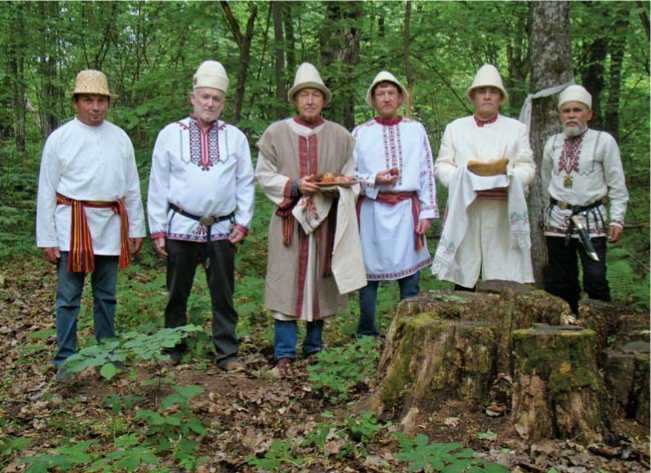
Fig. 1 . Udmurt and Mari priests at the stump of the sacred oak tree at the Bulda/ Ilma-Chara sanctuary, 2023. Photo by N.I. Shutova .
The prayer rituals stopped in 2014 after the death of G.Y. Emelyanov, since there was no one to perform the functions of the priest. Some of the older men who helped Emelyanov during the prayer rituals tried to continue this tradition, but failed (for more details, see (Shutova, 2018: 193–196, 208–212)), and the sanctuary became abandoned again.
In 2023, prayers were resumed at the public Udmurt-Mari sanctuary of Bulda/Ilma-chara near the villages of Varali, Udmurtskoye, and Mariyskoye Gondyrevo (Alnashsky District of the Udmurt Republic). In the clearing, a stump of a huge sacred oak tree has survived, where public religious ceremonies of receiving a new fire were performed in previous years (Fig. 1). At present, despite the fact that prayer rituals have long ceased, people remember this sanctuary. Someone from the residents of the adjacent villages tied six towels on the trees surrounding the stump of the sacred oak. In 2023, prayer rituals were performed in a clearing located next to the stump. The initiators of the ceremony were the Mari people of Udmurtia. They did not have their own priests left, so they invited kart priests from among the baptized Mari of the Mari El Republic and the Kirov Region, and unbaptized Mari of Tatarstan. The ceremony was initiated near a linden chosen as a sacred tree; a sheep was slaughtered, skinned, and porridge with meat was cooked in the village of Mariyskoye Gondyrevo. During the prayers, people appealed to main Mari deities. The ceremony was a mixture of elements from religious rituals of different local Mari groups. In the same clearing, the Udmurt priests performed a more modest prayer ritual near a lit fire. Holding wooden bowls with the brought food in their hands, they walked around the hearth three times in the direction of the sun while throwing small pieces of food into the fire and splashing a little of drinks. They appealed to the deities Inmar and Kyldysin. However, both the Udmurt and Mari priests forgot to mention the master of the sacred place Bulda (FMA 2023).
Surges of religious activity in reduced and transformed form happen in a number of villages depending on spiritual needs of the village community. They quickly fade away owing to the lack of sufficient social base and organizers who have the necessary skills. In connection with the development of tourism, reminiscences of such phenomena can be observed in the villages of Staraya Salya and Karamas-Pelga (Kiyasovsky District of the Udmurt Republic). Such rituals continue in the museum environment; they show the demand among tourists and undoubtedly are welcomed by the local village community.
Organization of prayers at new locations. Since the early 1990s, there have been cases of reproducing traditional prayer rituals in new places both for demonstration and promotion of the Udmurt ethnic religion and attracting tourists. Since 1993, the republican (now interregional) and city summer Gerber festivals dedicated to the completion of sowing and honoring agricultural workers have been held annually.
In the late 19th to early 20th centuries, Gerber (Udm. ‘after the plow’, that is after completion of sowing) or Gyron bydton (‘completion of plowing’) was celebrated for several days, up to a week. It included a set of archaic and Orthodox Christian rituals: alternate prayers in a family, patronymic (clan), or village-wide Kuala, at a district or territorial sanctuary; visits to other people, games and festivities for the youth, and sports competitions. The culmination of the festivities was the prayerful appeal to the supreme deities Inmar, Kuaz, and Kyldysin, as well as family and clan patrons and deceased ancestors with gratitude for successful completion of sowing and request to ensure good harvest, prosperity, and health for all members of the group. Then followed blessing of ritual porridge and joint meal (for more details, see (Ostrovsky, 1873: 38–39; Pervukhin, 1888: Essay II, 8, 21–25, 68–69, 76–77; Luppov, 1927: 94–101)). The feast was based on religious motives. Gerber (or Gyron bydton) performed mediating (interacting between the world of people and world of deities and deceased ancestors), consolidating
(visiting a related group at the level of patronymies and community), and communicative (facilitating exchange of information, development of common ideas, interests, moods, and attitudes) functions.
At present, the Gerber festival is predominantly secular. However, the sequence of actions and symbolism of the festival appropriate themes and imagery from the Udmurt mythology; prayer rituals are performed, and ritual porridge with meat is prepared and consecrated. Hereditary priests from the villages where this tradition has survived are invited to perform the prayer ritual. Initially, at the opening of the festival, an improvised appeal with prayers to old time deities was performed right on the stage. In recent years, religious ceremonies on the Gerber have become local. The priests are introduced at the official opening of the festival (Fig. 2). After that, they pray separately on a special area, cook porridge with meat, consecrate it (Fig. 3), and have a meal. Some of the consecrated porridge is added to the cauldrons intended for the other Gerber participants (FMA 2018, 2019; informants A.A. Razin, 1940–2019, the village of Kuzyumovo; N.T. Mikhailov, born in 1954, the village of Gord Namer). In 2023, the men chosen by the priests slaughtered a sheep (the priests themselves are not allowed to do this) early in the morning on a site near the forest and near the field designated for the festival, skinned it, and cut up the carcass. Then they cooked and consecrated the meat. Small portion of meat was left for the main cauldron with porridge for the priests. The rest of the meat was placed in twenty cauldrons intended for all Gerber participants. Other kinds of meat were added to these cauldrons with porridge in addition to the consecrated meat. After the prayer, the priests separately blessed the prepared porridge taken from one cauldron, and had a meal (FMA 2023; informant V.F. Botnikov, born in 1962, the village of Bagrash-Bigra). Notably, the location of Gerber festival changes every year. Hence, the site of the religious action is not reused and is not endowed with sacred properties.
Cultural and tourist park “Dondy Dor” (lit. ‘visiting Dondy’), dedicated to the legendary hero Dondy, was created in 2006 near the village of Adam (Glazovsky District of the Udmurt Republic). A series of seasonal events, recreating traditional festivals and rituals, are regularly organized there. These include the festival of winter spirits Vozhodyr (Christmastide, ritual period of time) and the ritual of Vozhopoton (the release of mythical harmful creatures vozho associated with deceased ancestors); spring competition Kuaka yumshan (“Crow Festival”); festival of summer
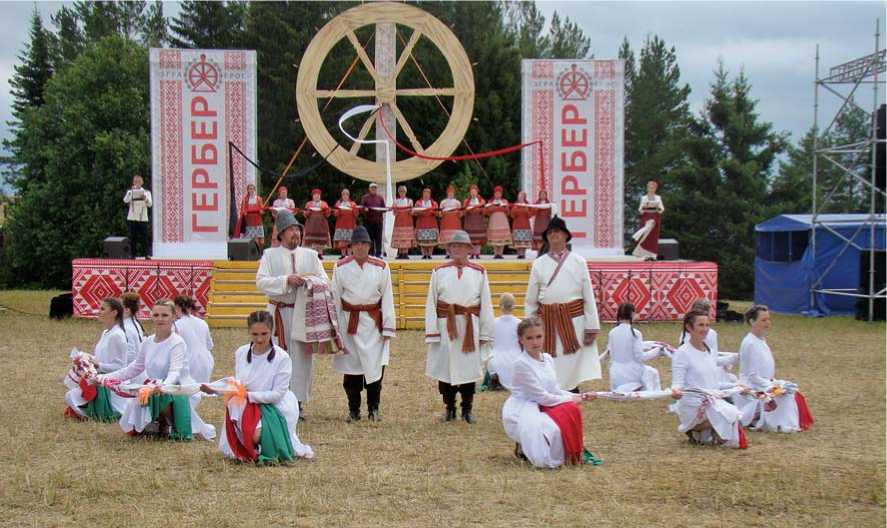
Fig. 2 . Performance of Udmurt priests at the opening of the interregional Gerber festival, 2019. Photo by N.I. Shutova .
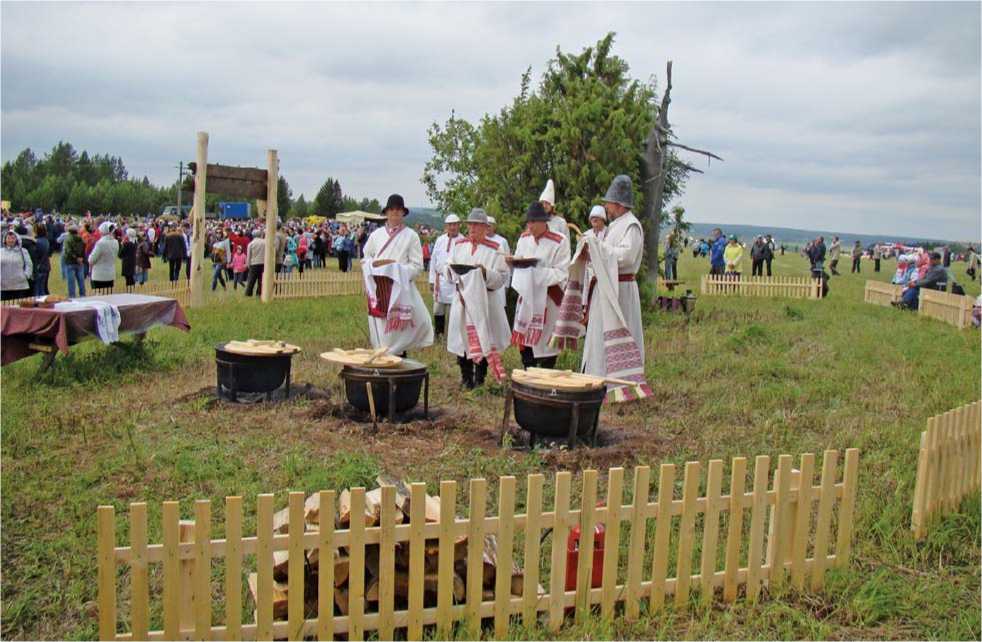
Fig. 3 . Prayer ritual of priests at the interregional Gerber festival, 2019. Photo by N.I. Shutova .
spirits Kuarsur (festival of grass and leaves; in a later version it merged with the Orthodox Pentecost), timed to coincide with the summer solstice, ethnic and art festival Tylo tolez (“Fire Moon”); and autumn harvest festival Vyl zhuk (“New Porridge”).
At the summer festival Kuarsur, spectators familiarize themselves with Udmurt mythology and spirits of the forest (Nyulesnyunya), water (Vukuzyo), and wind (Tolperi), who are in charge of natural phenomena and elements. In a ceremony, in a playful form, all participants, guided by the tӧro master of the ritual, ask for good harvest, favorable weather, and patronage in their undertakings (Tsentr kultury i turizma... (s.a.)). A certain mystical moment associated with these events is noteworthy. For example, organizers and participants of the ceremonies noticed that during the first events in the “Dondy Dor” Park, a white swan repeatedly circled above them and flew away. People took this as a sign of the blessing by the hero Dondy (FMA 2023; informant E.S. Nabokova, born in 1982, city of Glazov), since according to the legend, after his death he was turned by Inmar into white swan and assisted the Udmurts in their undertakings (Pervukhin, 1889: Essay IV, p. 10).
Interestingly, the foundation of the park began with the Vyl intye potyku ritual (lit., ‘exit, foundation of a new place’) performed in 2017. It included familiarization with the history of the village of Parzinsky Uchkhoz, near which Gubervӧs-2—large public sanctuary of the Northern Udmurts—used to function (abandoned in the mid-19th century). The main goal of the ceremony was praying at the sacred place near the revered pine tree. About 15– 20 people in ethnic outfits gathered. Local historians compiled the text of the prayer based on the examples collected and published by N.G. Pervukhin in the late 19th century (1888: Essay III, pp. 7–37). Afterwards, some soil was taken from this area and brought to the cultural and tourist park that was being created. With prayers, the soil from the sanctuary was poured near three fir trees that had unusual qualities (double trunks) and were therefore chosen as sacred (FMA 2023; informants T.K. Pozdeeva, born in 1953, the village of Parzinsky Uchkhoz; A.V. Bazhenova, born in 1957, the village of Korshunovo; E.N. Bazhenov, born in 1983, city of Glazov). This ritual symbolized consecration and enculturation of new space, i.e. the area of the “Dondy Dor” Park.
Sometimes, traditional prayers are initiated at a place that has a special history or shows some distinctive features. For example, people began to revere old pine tree Batyr puzhym (“Mighty Pine”) near the village of Chabishur (Uvinsky District of the Udmurt Republic). It is 375 years old and about 30 m high. Now this pine is listed as a site of natural heritage (inkuazlen sinpeletez) (Prirodniye pamyatniki... (s.a.)). This tree has a rich history. In 1918–1919, the famous Udmurt poet, educator, and public figure Kuzebay Gerd stopped his horse to rest under it and talked to local residents. Legends and history of the Tuklya clan are associated with this tree. Its representatives performed the Pokchi Mudor prayer rituals (pokchi ‘small’; mudor is the center of ancestral territory) near that pine tree, and addressed words of gratitude and their requests to the deity Inmar. The vӧsyas priest Vasily Tratkanov (1959–2018) from the village of Pekshur had a special relationship to that tree, which connected him with his childhood years. He regularly came to it with his mother. Under that pine tree, his uncle introduced to him Udmurt customs and traditions. Vasily and his friends swung on a swing that was tied to that tree in the 1960s and 1970s. In many ways, precisely Vasily Tratkanov contributed to the decision to give that pine the status of a sacred tree (Ezhbaev, 2014: 74–75). Since 2012, the Guzhdor (a celebration of the first thaw) spring festival of the first thawed patch has been initiated annually under the Chabishur pine. Three vӧsyas priests gather for prayer. One priest addresses the words of his prayer to Inmar, the second one to Kyldysin, and the third one to Kuaz. In the fall of 2023, the thanksgiving prayer of Vyl zhuk (lit., ‘new porridge’, that is, new things) was initiated there for the first time (FMA 2023; informant G.E. Sidorov, born in 1964, the village of Uzey-Tuklya). In recent years, visit to the revered tree has been included in tourist routes.
Interestingly, in the Ludorvai Architectural and Ethnographic Museum-Reserve, a sacred building Great ( Bydzym ) Kuala was erected in full accordance with a similar structure from the village of Varkled-Bodya (Agryzsky District of the Republic of Tatarstan). Varkled-Bodya priests were invited to the opening of the Kuala and consecrated it. In the eyes of the public and museum workers, after prayers were performed, this site and the Kuala received the status of the sacred shrine.
On the surface, it seems that religious ceremonies are reproduced during public festivities and in museums only to attract tourists. However, such rituals, although in reduced and even theatrical form, are undoubtedly recreated at the call of the hearts of the event organizers, with the desire to broadcast Udmurt values to the outside world.
Discussion
Traditional prayer rituals nowadays include the most important aspects of the ritual: preparation (purification before the ceremony, special clean clothes), cooking ritual food on a ritual fire, prayerful appeals to the gods, sacrificial offerings, and public meal. At first glance, these prayers are associated with realities of a general typological nature (the place is a forest clearing or a site where an old sanctuary used to be located, set of simple ritual food and sacrificial gifts; main order of actions, improvised texts of prayers). Their reproduction in the Udmurt environment is of a relatively abstract kind—modest offerings, shortened prayer ceremony, rare slaughter of animals and birds, and brevity of prayer texts.
Prayers that are read during rituals are composed by priests based on their personal and public needs and ideas. They also include examples of texts published in academic and popular literature, and adopted from old priests, spiritual mentors and inspirers. Among the Udmurts, such people were Professor of the Udmurt State University, People’s Artist of Udmurtia S.N. Vinogradov and Candidate of Philosophical Sciences and public figure A.A. Razin (FMA 2023; informants N.T. Mikhailov, born in 1954, the village of Gord Namer; V.F. Botnikov, born in 1962, the village of Bagrash-Bigra; A.P. Lekandrov, born in 1981, the village of Kuzyumovo; A.V. Bazhenova, born in 1957, the village of Korshunovo; E.N. Bazhenov, born in 1983, the city of Glazov).
In the late 20th century, religious ceremonies were performed in ordinary secular clothes (pants, shirts, jackets, caps or hats), with the exception of mandatory ethnic belts and sashes, as well as sacrificial towels. Nowadays, distinctive ethnic attributes of the contemporary Udmurt priests include picturesque outfits (robes, shirts, felt hats), which can be easily acquired thanks to active development of decorative and applied arts in Udmurtia since the beginning of the 21st century (Ligenko, Sidorova, 2022: 28–32).
Conclusions
This research (author’s observations, interviewing of priests and participants of prayer rituals) has revealed that many elements of rituals have become transformed and reduced. Active religious life of the village community is fading, since there are no continuers of priests’ work; old people pass away, and young people leave the village. The influence of the Orthodox Church has its impact, so the need for traditional prayers is disappearing. Nevertheless, there is a desire to turn to spiritual heritage of the ancestors in the life of the village community. People continue to reproduce ancient rituals that were performed by their fathers and grandfathers in memory of their departed relatives, which unites them with past generations, maintains spiritual connection with them, psychologically calms, and gives hope and confidence in the future.
All of the above indicates the preservation of a stable core of ancient beliefs about the world and about connection of man and society with nature and past generations in the contemporary Udmurt environment; these beliefs remain in demand even today. The need for rituals is caused by the conscious or unconscious belief that connection with the past will contribute to well-being and harmonization of life, and protect against misfortunes.
The vitality and reproduction of traditional prayer rituals, their revival in new places in the contemporary environment looks like manifestation of ethnic identity and desire to broadcast ethnic and cultural codes to the outside world. Organization of these rituals at festivals in the areas not associated with locations of old sanctuaries pursues multiple objectives. They include stimulating interest in the beliefs, rituals, and culture of the Udmurts, demonstrating the Udmurt identity, and attracting attention of representatives of other ethnic groups and tourists to it. The religious sacred content of the Gerber festivals and events initiated in the “Dondy Dor” Cultural and Tourist Park and other places currently plays only an accompanying role, developing in parallel with secular performances, games, and visitations of other people’s homes. As a historical and cultural phenomenon, these ceremonies acquire a universal human spiritual meaning.
