
Role of the Arctic Territories of Russia in Interaction with the Economic Systems of Circumpolar Countries
Journal: Arctic and North @arctic-and-north
Section: Social and economic development
Article in issue: 63, 2026.
Free access
This article contributes to the discussion of the socio-economic indicators of the Arctic territories of Russia and the Arctic territories of the circumpolar countries. Based on descriptive statistics, this article summarizes the results and highlights the role of the Arctic states in the entire Arctic region. The economic development of Arctic territories and their interaction in socio-economic and innovation-technology terms are analyzed. Climate change in the Arctic is expanding the possibilities for utilizing the Northern Sea Route and developing underground resources. Based on empirical findings, a number of recommendations are formulated for effective interaction between Russia’s Arctic territories and circumpolar countries. The paper analyses changes in the level of cooperation between Russia and Western countries, including the cessation of most major joint projects and restrictions on scientific research. It discusses alternative strategies for the region’s development, based on strengthening domestic capacity and cooperation with Eastern partners, such as China. Changes in the Arctic also affect the rest of the world through the Arctic’s role in the global climate system, its contribution to global sea-level rise, and its impact on weather conditions in the mid-latitudes. The study highlights the need to establish a broader set of economic, social and environmental indicators for the Arctic territories of circumpolar countries. Sustainable funding for public monitoring programs and scientific research in circumpolar countries would contribute to the development of research capacity and a more holistic approach to understanding the effective, environmentally sustainable development of the Arctic for all circumpolar countries and the world as a whole. These measures should be closely linked to circumpolar/international initiatives to ensure wider access to information and its effective use in Russia’s cooperation with circumpolar countries.
Short address: https://sciup.org/148333996
IDS: 148333996 | UDC: [332.14:330.47](985)(045) | DOI: 10.37482/issn2221-2698.2026.63.84
Text of the scientific article Role of the Arctic Territories of Russia in Interaction with the Economic Systems of Circumpolar Countries
DOI:
The aim of this study is to provide a comprehensive analysis and overview of the socioeconomic indicators of the Arctic territories of the circumpolar countries. The Arctic has historically been a region of strategic importance to Russia. This study examines the circumpolar countries from a socio-economic and innovation-technology perspective.
The international situation that has been developing since 2014 has had a significant impact on the nature of Russia’s relations with the West, including within the framework of the Arctic Council. Political confrontation and the imposition of a wide range of sanctions have led to a sharp decline in bilateral cooperation, which was previously characterized by intensity and
-
∗ © Krasulina О.Yu., 2026
This work is licensed under a CC BY-SA License
SOCIAL AND ECONOMIC DEVELOPMENT
Oksana Yu. Krasulina. Role of the Arctic Territories of Russia … productivity.
The remaining exceptions are of particular interest, as they demonstrate the potential for continued constructive interaction, for example, Russian-Finnish cooperation in the telecommunications sector and the participation of French companies in oil and gas sector projects.
At the same time, the question of how to maintain a balance between preserving national sovereignty and the need to integrate into international efforts to preserve and research the Arctic remains relevant. Modern economic theory divides countries into three groups: “core”, “semiperiphery”, and “periphery”. To identify these groups, let us examine generally accepted classifications and select the most notable ones in terms of innovation, technology, and socio-economic development.
Therefore, the core group of circumpolar countries, in which the above indicators are at a high or very high level, can be identified as follows: Canada, Denmark, Finland, the United States, Sweden, Norway and Iceland. For example, Sweden, alongside Norway, actively participates in the work of the WTO, the IMF, the OECD and other international economic organizations, and is one of the world’s most influential international financial centers. Finland ranks first in the world for the application of information technology and is recognized as one of the world leaders in innovation.
The economy consists of interconnected and interacting regions. The level of economic development, technology and culture within them varies depending on the movement from central to peripheral areas. According to various sources, the periphery is divided into:
-
• buffer peripheries, which are located between the large states forming the core and have historically experienced influence from multiple directions.
-
• outer peripheries – remote lands, typically peripheral coastal regions (e.g., Iceland).
-
• enclave peripheries, which are surrounded by foreign areas on all sides.
We will distinguish between the inner periphery, which is closely connected to the core and receives development impetus from it, and the outer periphery, on which the core exerts virtually no influence. According to our classification, the inner periphery, or semi-periphery, comprises developed countries not included in the “core” and all developing countries.
We will analyze the degree of income inequality in the groups of countries under study, i.e. the change in the Gini index in the Arctic regions of circumpolar countries from 2009 to 2021 (Table 1).
Table 1
Changes in the Gini index in the Arctic regions of circumpolar countries 1
|
Administrative-territorial entities |
Gini index (ratio) |
|
Russian Federation |
|
|
Arkhangelsk Oblast |
-0.005 |
|
Chukotka Autonomous Okrug |
-0.011 |
1 Source: calculated by the author. URL:
(accessed 10 May 2025).
|
Republic of Karelia |
-0.030 |
|
Khanty-Mansi Autonomous Okrug |
-0.032 |
|
Komi Republic |
-0.042 |
|
Murmansk Oblast |
-0.041 |
|
Republic of Sakha |
0.000 |
|
Yamalo-Nenets Autonomous Okrug |
-0.006 |
|
United States of America |
|
|
Alaska |
0.009 |
|
Canada |
|
|
North-West territories |
-0.005 |
|
Nunavut |
0.001 |
|
Yukon |
-0.006 |
|
Denmark |
|
|
Faroe Islands |
0.008 |
|
Greenland |
0.018 |
|
Norway |
|
|
Nordland |
0.015 |
|
Troms |
0.013 |
|
Finnmark |
0.022 |
|
Sweden |
|
|
Norrbotten |
0.014 |
|
Vasterbotten |
0.018 |
|
Finland |
|
|
Lapland |
0.000 |
|
Northern Ostrobothnia |
0.0014 |
|
Iceland 0.000 |
|
Thus, according to the Gini coefficient, circumpolar countries have the smallest income gap.
Data
The study is based on a comprehensive methodology that includes a historical analysis of events over the past decade, as well as a content analysis of publications and official statements from government agencies and organizations. Methods of comparative analysis and interpretation were used to examine data obtained from open sources and materials from international conferences.
Particular attention was also paid to studying public opinion and the scientific community’s reaction to current events through interviews and discussions with experts and specialists in the field of Arctic research.
The Arctic regions are rich in minerals and natural resources, but are characterized by a generally harsh climate. GDP, wage levels, population size, unemployment rates and other significant indicators for the Arctic territories of circumpolar countries were taken as key indicators.
An analysis of statistical data from the Arctic territories of circumpolar countries 2 illustrates the role of Arctic states in the entire Arctic region. Northern Finland and Arctic Norway generate smaller shares of national GDP than their share of the population. In Sweden, the Arctic shares of population and GDP are almost equal. For Canada and the United States, non-Arctic economies and populations are completely dominant.
The population in the Arctic regions of circumpolar countries remains relatively stable: Iceland’s population has grown by 9% due to social policies aimed at families with children; Canada has adopted these policies to boost its population; Alaska is showing a slowdown in population growth, while the Arctic territories of Sweden have experienced a 2% increase in population (for example, in Norrbotten, there has been marginal growth of 0.7%); Arctic Norway has a much lower population growth rate than Iceland. The Russian Arctic stands out as the largest territory; population growth is concentrated in the oil-rich areas of Khanty-Mansiysk (6%) and, to a much lesser extent, in the Republic of Sakha (Yakutia) and the Yamalo-Nenets Autonomous Okrug. Other Arctic regions experienced population declines of 2.7–6.7%. In Finland, only Northern Ostrobothnia experienced population growth, in contrast to a decline in Lapland.
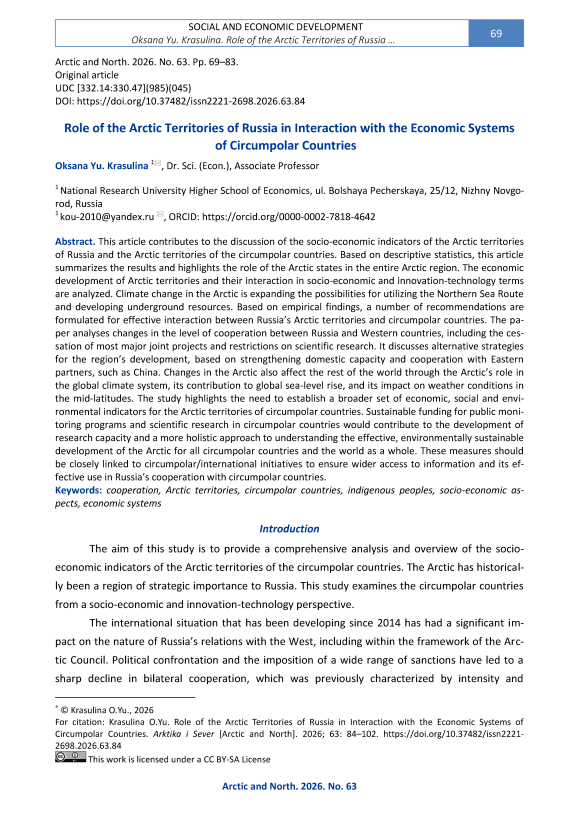
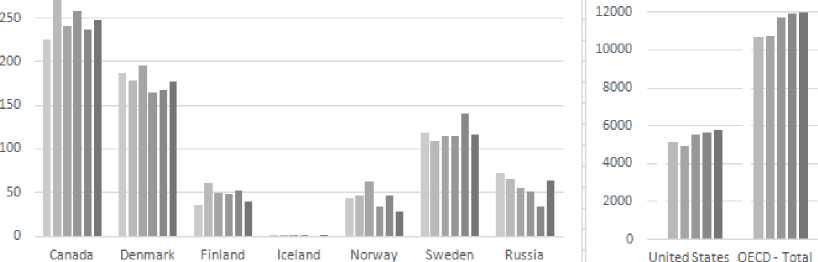
Modern technologies can make the Arctic region more comfortable and safe (O'Neill, Krieg-ler, Ebi et al., 2017). In the modern economy, innovation and development of new technologies are key drivers of economic and social development, both in individual regions and globally. The period since the beginning of the 21st century can be characterized by an explosive growth in the number and scale of technical developments and improvements in almost all sectors of the economy (Krasulina, 2022). One of the significant indicators of innovation activity in a country or region is patent activity. In the context of the Fourth Industrial Revolution, the authors consider it important (essential) to analyze statistics in this field in the circumpolar countries in comparison with the overall statistics of the countries belonging to the Organization for Economic Co-operation and Development (OECD). This organization identifies specific areas in the field of patenting, such as biotechnology, nanotechnology, and the environment 3. These vectors, as well as developments in artificial intelligence, are among the key areas for implementing the “Industry 4.0” concept. It is worth noting that statistics for the above-mentioned indicators vary considerably across Arctic countries (Figs. 1–3).
300 -------------------------- U 14000
2019 12020 12021 12022 12023 и 2024
Fig. 1. Patent applications filed under the Patent Cooperation Treaty in the field of biotechnology 4.
Iceland’s patent applications filed under the Patent Cooperation Treaty 7
|
2019 |
2020 |
2021 |
2022 |
2023 |
2024 |
|
|
Environmental technologies |
1 |
1 |
3,5 |
3 |
3.333 |
2 |
|
Nanotechnology |
0 |
0 |
0 |
0 |
0 |
0 |
|
Biotechnology |
2.2 |
0.85 |
2.167 |
2 |
0 |
2 |
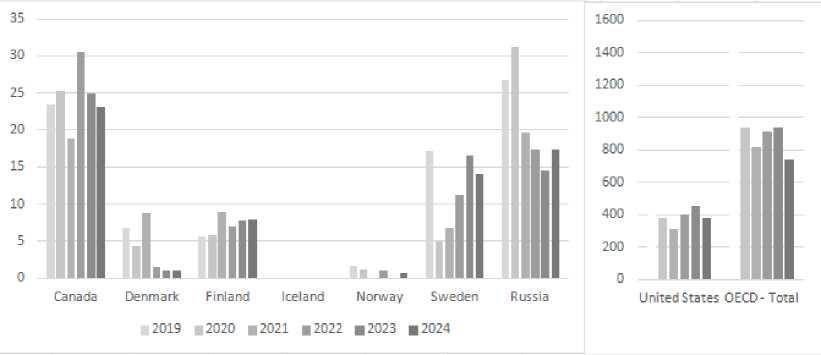
Fig. 2. Patent applications filed under the Patent Cooperation Treaty in the field of nanotechnology 5.
Fig. 3. Patent applications filed under the Patent Cooperation Treaty in the field of environmental technologies 6.
Statistics for these areas in Iceland are provided separately below (Table 2).
Table 2
Statistics on patent activity in areas related to artificial intelligence are presented in Table 3
Table 3
Patent applications filed under the Patent Cooperation Treaty in the field of AI technologies 8
|
2019 |
2020 |
2021 |
2022 |
2023 |
2024 |
|
|
Canada |
1.25 |
4.4 |
4.625 |
13.758 |
24.567 |
4 |
|
Denmark |
0 |
0 |
0 |
0 |
1.5 |
0 |
|
Finland |
0 |
0 |
1 |
1 |
2.5 |
1 |
|
Iceland |
0 |
0 |
0 |
0 |
0 |
0 |
|
Norway |
0 |
1 |
1 |
0 |
0 |
0.75 |
|
Sweden |
2.333 |
1.333 |
0 |
0 |
2 |
0.857 |
|
USA |
59.083 |
75.429 |
100.567 |
131.444 |
212.187 |
87.888 |
|
Russia |
1 |
2 |
1.625 |
5 |
1.2 |
1 |
|
OECD — Total |
221.2 |
225.2619 |
240.9 |
342.357 |
546.791 |
213.191 |
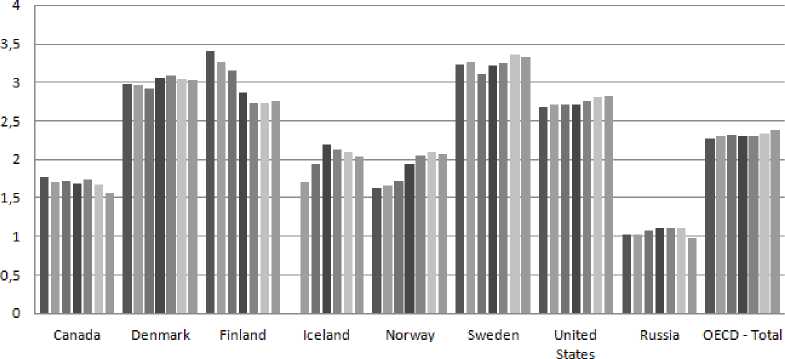
■ 2017 12013 12019 И2020 I 2021 1 2022 2023
Fig. 4. Gross domestic expenditure on R&D refers to the total domestic expenditure on R&D carried out within a country’s territory during a specific reporting period 9.
Modern technologies can significantly improve living conditions in the Arctic region (Usman, Jahanger, Makhdum et al., 2022.). Reliable communications and internet access play a central role in this transformation, allowing local populations to access remote services such as healthcare and education. A key point is that high-quality communications can stimulate the development of local businesses and help to implement new ideas and projects (Krasulina, Ros-sokhin, Anosova, 2021).
It is also important to note that uneven infrastructure development across the Arctic region creates additional challenges. In more remote and sparsely populated areas, such as the Russian Arctic, innovative solutions are needed to ensure connectivity. Satellite communications may be a viable option, although it has its limitations, such as high cost.
-
9 OECD Data Explorer. URL: https://stats.oecd.org (accessed 26 May 2025).
Overall, a comprehensive approach is required for the development and implementation of technologies in Arctic regions, which should include both infrastructural and socio-economic aspects.
Arctic territories require the implementation of unmanned aerial vehicle (UAV) technologies. Currently, UAVs can be fully automated: they are equipped with flight planning software for optimal coverage, an onboard autopilot for following a predetermined course, and sensors for capturing images while simultaneously collecting data from the onboard global navigation satellite system. Drones can also be used to provide emergency assistance (Steindal, Karlsson, Hermansen et al., 2021).
Building roads and railways in the north is difficult and expensive due to the challenges of transporting goods and technology. Furthermore, road construction damages the environment and disrupts the way of life of indigenous peoples. Biodiversity is declining and traditional nomadic ways of life are being destroyed. Living conditions in the Arctic region are quite harsh: low temperatures, pressure fluctuations, polar day and night, increased geomagnetic activity, and a lack of sunlight and vitamins. As a result, life expectancy in the north is shorter than in other regions. It takes the human body at least a year to acclimatize to Arctic conditions, putting people’s health at risk (Warchold, Pradhan, Kropp, 2021).
Cargo drones help to reduce the cost and delivery time of parcels from the mainland. Unmanned technologies are used for aerial photography and aerial surveillance; they enable mining companies to monitor site development and the integrity of pipelines. Environmental organizations can receive real-time information on fires; drones can assess the condition of icebergs and update weather forecasts.
The main drivers of Arctic development are natural resources, such as oil and gas fields, gold and diamond deposits, as well as numerous fishing grounds. In the context of global warming, sea ice is decreasing and the time required for sea voyages in the Arctic Ocean is increasing. The efficiency of such a route is estimated at a 20% reduction in cost and a two-week reduction in travel time. The Arctic is changing in ways and at a rate previously unobserved in recorded data. Recent shifts have occurred in components of the Arctic cryosphere, and further new extremes are expected (de Witt, Stefánsson, Valfells et al., 2021; Valfells, Larsen et al., 2022).
Regardless of the emissions scenario realized over the next few decades, by mid-century, the Arctic will have a significantly different environment than it has today (less snow and sea ice, melted permafrost). Ice caps slow the rise in atmospheric temperature, but the melting of Arctic glaciers, ice sheets, and ice caps will continue even under ambitious emission reduction scenarios. The predicted increase in summer air temperatures in the Arctic significantly threatens the irreversible destruction of Greenland ice. The Arctic is part of the global climate system and plays a regulating role as the main reservoir of cold for the global climate. Innovative technologies, monitoring, and forecasting should help to avoid a crisis (Kikkas, Krasulina, Skripnyuk et al., 2021).
The Arctic climate is changing faster than in other regions of the world, and the rapid melting of sea ice is making this region more accessible. Climate change and human activity can have a significant impact on Arctic ecosystems. Scientific research in the Arctic plays a vital role in assessing the potential impacts of human activity in the region and in predicting global climate change.
Arctic research is unique in its environmental, industrial and social aspects and is hardly comparable to any other region (Krasnopolskiy, 2020).
The International Arctic Science Committee (IASC), a non-governmental organization, supports and facilitates scientific research cooperation among all states involved in gaining knowledge about Arctic regions. IASC encourages and supports interdisciplinary research aimed at gaining greater knowledge and understanding of the Arctic region and its role in the Earth system. The main functions of IARC include: (a) providing objective, independent scientific advice on the Arctic and disseminating vital information; (b) safeguarding and providing access to scientific data relating to the Arctic; and (c) ensuring access by scientists in all geographic areas to information and to exchange of knowledge, materials, and other resources 10.
The economic development of the Arctic region reveals a fundamental imbalance. Raw materials are exported from the region, while inexpensive finished goods are supplied to its inhabitants. This makes the Arctic highly dependent on other regions and limits employment opportunities. Analyzing the positions of circumpolar countries in terms of industrial development, it can be concluded that Sweden is intensively developing the microelectronics market and ranks among the leaders. Finland is among the leaders in telecommunications manufacturing, as well as innovative copper smelting methods, and the design and construction of nuclear icebreakers; Norway — in the development of innovative oil production and refining equipment 11.
For the manufacturing sector to operate successfully in Arctic conditions, modern technologies are required that will enable Arctic deposits to be explored and exploited effectively without harming the region’s fragile environment (Nilsson, Larsen, 2020).
There is currently a great need for a well-reasoned scientific stance regarding the concerns of the public and the authorities about climate change in the Arctic. A multidisciplinary approach to research is required, where disciplines can complement one another and contribute to the development of effective policies. Access to knowledge should be ensured for all countries. Interdisciplinary work is the only way to understand the complex socio-ecological systems of the Arctic. The Arctic is not only an important and interesting region for research and science, but also a region where a significant body of knowledge has accumulated, of interest to the global scientific community. Today, the relevance of research into the region in Russia has not diminished, as over 80% of natural gas and a large percentage of oil reserves are produced in the Arctic. Furthermore, the Northern Sea Route is an important transport and trade corridor that requires constant maintenance. For this reason, despite sanctions, various crises, and poor technical condition of the ports, active development of the territories continues in the Arctic 12. The Arctic region contains around 10% of the world’s active reserves of nickel and platinum group metals. However, a significant proportion of the Arctic remains insufficiently explored. In this regard, joint research related to the development of deposits offers a wide scope for collaboration (Kankaanpää, Young, 2012).
The Arctic Ocean plays a vital role in global climate change. A continuous supply of Arctic data is essential. It is necessary to obtain data from the northernmost regions of the Arctic and to conduct monitoring at the highest latitudes in order to better predict future natural scenarios. Smart technologies offer enormous opportunities for research. The Arctic is the least explored region in the world, and research into its remote corners remains difficult. International research enables more efficient use of natural resources. Scientists require the effective implementation of the agreement on scientific activities in the Arctic, aimed at expanding access to remote regions.
-
Table 4
Share of R&D expenditures in GDP (%) 13
|
Country |
2013 |
2014 |
2015 |
2016 |
2017 |
2018 |
2019 |
2020 |
2021 |
2022 |
2023 |
|
Finland |
3.2 |
3.7 |
3.6 |
3.4 |
3.3 |
3.2 |
2.9 |
2.7 |
2.8 |
2.8 |
3.0 |
|
Norway |
.. |
1.6 |
1.6 |
1.6 |
1.7 |
1.7 |
1.9 |
2.0 |
2.1 |
2.2 |
2.2 |
|
Russia |
1.0 |
1.1 |
1.0 |
1.0 |
1.0 |
1.1 |
1.1 |
1.1 |
1.1 |
1.1 |
1.1 |
|
USA |
2.6 |
2.7 |
2.8 |
2.7 |
2.7 |
2.7 |
2.7 |
2.8 |
2.8 |
2.7 |
2.8 |
|
Sweden |
.. |
3.2 |
3.2 |
3.3 |
3.3 |
3.1 |
3.3 |
3.3 |
3.3 |
3.4 |
3.4 |
|
Denmark |
.. |
2.9 |
2.9 |
3.0 |
3.0 |
2.9 |
3.1 |
3.1 |
3.1 |
3.2 |
3.2 |
|
Canada |
1.9 |
1.8 |
1.8 |
1.8 |
1.7 |
1.7 |
1.7 |
1.7 |
1.6 |
1.6 |
1.6 |
|
Iceland |
2.6 |
.. |
2.4 |
.. |
1.7 |
1.9 |
2.1 |
2.0 |
2.1 |
2.2 |
2,2 |
The number of research staff is also an important indicator of the development of science and innovative technologies. In the Nordic countries, government policy places significant emphasis on measures to stimulate innovation, tax relief, and preferential financing for the development of innovative technologies and the production of high-tech goods. All these measures are aimed at improving the global competitiveness of manufacturing in the Nordic countries.
In Finland, Sweden and Denmark, the share of corporate funding for R&D is very high — 70%; in Norway, it is approximately 50%. The state allocates funds for research in key areas in accordance with the national economic development strategy. However, innovation policy in the Nordic countries is focused not so much on budget allocations as on measures that help companies effectively commercialize knowledge.
An innovative economy should be built on a highly skilled workforce. The Global Innovation Index (GII) is an evolving project that is based on its previous versions and incorporates newly available data for measuring innovation. The GII consists of two sub-indices: an innovation input sub-index and an innovation output sub-index, each structured around key factors. Seven main factors of production cover elements of the national economy that support innovative activity.
The GII collects data from over 30 sources, covering a wide range of innovation factors and outcomes, with a focus on hard data (Table 5).
-
Table 5
Global innovation index 14
|
Country |
Rank |
||||||||||||
|
2011 |
2012 |
2013 |
2014 |
2015 |
2016 |
2017 |
2018 |
2019 |
2020 |
2021 |
2022 |
2023 |
|
|
Finland |
13 |
13 |
13 |
7 |
5 |
4 |
6 |
4 |
6 |
5 |
8 |
7 |
6 |
|
Norway |
25 |
14 |
14 |
16 |
18 |
14 |
16 |
14 |
20 |
22 |
19 |
19 |
19 |
|
Russia |
64 |
68 |
68 |
64 |
56 |
51 |
62 |
49 |
48 |
43 |
45 |
46 |
46 |
|
USA |
1 |
1 |
5 |
6 |
7 |
10 |
5 |
6 |
5 |
4 |
4 |
6 |
3 |
|
Sweden |
3 |
3 |
2 |
3 |
2 |
2 |
2 |
3 |
3 |
2 |
2 |
3 |
2 |
|
Denmark |
11 |
8 |
8 |
5 |
6 |
7 |
9 |
8 |
10 |
8 |
6 |
8 |
7 |
|
Canada |
8 |
11 |
11 |
12 |
8 |
12 |
11 |
12 |
16 |
15 |
18 |
18 |
17 |
|
Iceland |
20 |
20 |
19 |
15 |
11 |
18 |
13 |
19 |
13 |
13 |
13 |
23 |
20 |
As a result, the Nordic countries (especially Sweden, the United States, and Finland) exemplify effective collaboration among all stakeholders on the path to innovation and development. Government agencies, businesses, and educational institutions participate in these processes. Conditions have been created to improve economic efficiency by introducing innovation into all sectors of the economy. An effective institutional infrastructure is being created, the main goal of which is to promote business knowledge and knowledge-intensive goods and services (Filina, 2021).
In the Arctic, science should outpace industrial development. The main challenges of industrial activity in the Russian Arctic are:
-
• slow process of introducing new technologies;
-
• corporations are not allowed to implement new technologies in the short term, as they are not incorporated into the regulatory framework. It takes a long time to apply scientific findings to production.
For the successful operation of the manufacturing sector in Arctic conditions, modern technologies are required to enable the effective exploration and exploitation of Arctic deposits without harming the region’s fragile ecology (Ringkjøb, Haugan, Nybø, 2020).
The primary geopolitical interest in the Arctic is maritime transport, with Russia and Canada having the most favorable geographical positions. The longest routes along the Arctic coast are operated by the Northern Sea Route and the Northwest Passage; each of these countries has the largest fleet of icebreakers and unique maritime experience of operating above the Arctic Circle (Pierre, Olivier, 2015).
The Northern Sea Route (NSR) is open to international shipping, but foreign partners are concerned about the high risks associated with insufficient navigational equipment on this route,
-
14 Global Innovation Index. 2021. URL: http://www.globalinnovationindex.org/content.aspx?page=GII-Home (accessed 10 May 2025).
and consequently, insurance companies do not cover this route. At present, the NSR is used primarily as a transport route for the Russian export corridor. To operate at full capacity, the NSR requires, first and foremost, replenishing and updating its icebreaker fleet (Cariou, Cheaitou, Faury, 2021).
The main objective of the legal dispute is to resolve ownership of territories in the circumpolar Arctic nations. The second objective is the legal demarcation of the Arctic Ocean between the Arctic nations.
Improvements in transport and efficient infrastructure not only eliminate barriers to transport traffic, but also improve access to facilities and reduce barriers to resource extraction and processing. This is essential for creating an international transport system and connecting remote Arctic regions. Experience shows that port efficiency will decline if the railway to the Arctic port is not expanded.
Without aviation support, the full development of the Arctic and Northern Sea Routes would be problematic. The most important task in developing the Arctic is to promote reliable and safe air transport and advance a logistics model for transporting people to remote locations (Christensen, Nielsen, Rich et al., 2020). Russia has the opportunity to transform the Northern Sea Route into an alternative to the Strait of Malacca and the Suez Canal. In addition to technical issues, certain legal challenges need to be resolved.
The development of air traffic has expanded the range of polar flights and reduced the cost of air travel between Eurasia and the United States. According to experts, for the Arctic (air) route to function effectively, aircraft should achieve a load factor of over 80%, and more than 60% of cargo should be delivered to an airport (and its surrounding area) that forms part of the route network and is expected to become a hub of commercial appeal. Nevertheless, experts believe that the current volume of traffic in the Arctic is insufficient to meet the required volume.
International cooperation in the Arctic shelf is developing intermittently. This is most evident in the initial stage of development and is related to the need to rapidly implement foreign technologies and develop a domestic workforce. In the next stage, foreign technology will be replaced by domestically produced ones. Most components of offshore projects are serviced by local small and medium-sized businesses. As the conditions for developing fields become increasingly complex and new industries need to emerge, international companies providing technology and expertise are re-entering this sector.
Foreign investors may hire other large companies to meet their workforce requirements with staff in various fields. A services and supply sector is developing to support offshore areas.
The potential for international cooperation in the Arctic offshore region includes not only direct oil and gas production on the shelf by large companies, but also outsourcing and subcontracting for these companies. For example, based on the Norwegian experience, the process of attracting foreign companies to develop hydrocarbon fields can be effectively used as a tool for
SOCIAL AND ECONOMIC DEVELOPMENT
Oksana Yu. Krasulina. Role of the Arctic Territories of Russia … solving other technical, economic, and social problems 15. At different stages of field development, cooperation takes on a multi-level form:
-
• The first stage involves consultations within working and expert groups, where roundtable discussions are organized with potential project leaders. To begin work, it is necessary to assess risks, secure legislative support and develop common skills;
-
• The second stage envisages general contingency measures for emergencies, coordination of work to assess the socio-economic impacts of the project, and the introduction of new technologies;
-
• During the third stage of production, environmental monitoring is carried out.
Another source of international cooperation in the development of the Russian Arctic shelf is a shared interest in hedging 16.A decline in international cooperation due to sanctions could significantly impact the Arctic.
The creation of alliances between major oil corporations and state-owned companies with extensive experience operating in harsh conditions and possessing new technologies is highly beneficial for Arctic development.
The primary aim of international cooperation in the development of the Arctic continental shelf is to achieve a synergistic effect, rather than to establish linear relationships, in order to foster diversification and create conditions for development. The economic, social, and environmental aspects of projects are taken into account in the context of sustainable development goals (Nilsson, Larsen, 2020). Through international cooperation, which involves the provision of unique technologies, know-how, experience, and knowledge, a new service industry can be created in the domestic market to ensure safe and efficient development.
Studying foreign experience in creating a new institutional environment includes establishing the best tax system based on the principle of social status. To overcome the obstacles faced by small and medium-sized enterprises in offshore activities, it is necessary to develop specific Arctic models.
Analysis has shown that, as a result of the imposition of sanctions, the international scientific community has faced serious obstacles in terms of collaboration on projects related to the research and protection of Arctic regions. The restrictions have affected access to equipment, funding and the exchange of information, jeopardizing long-term scientific missions and research expeditions.
Nevertheless, there are signs of adaptation to the new conditions. Russian scientists and researchers are actively seeking new approaches to ensuring the sustainability of regional projects. Strengthening ties with countries in the Asia-Pacific region, primarily with China, plays a key role, helping to compensate for the lack of international cooperation and ensure the progressive development of the Arctic region. Furthermore, significant efforts are being directed toward strengthening domestic infrastructure and creating domestically produced equivalents of necessary technologies and equipment. This strategy helps to reduce dependence on imports and to maintain the continuity of critical work despite the existing restrictions.
The findings outlined above highlight the complexity of the current state of Arctic cooperation. Although certain exceptions suggest potential for further progress, the overall trend points to a decline in the effectiveness of cooperation. Once Russia has overtaken Iran in terms of the number of sanctions imposed on it, Arctic policy could undergo a radical change. Over the past two years, the Arctic Council’s activities have been suspended: in March 2022, Western countries announced the termination of their participation in all the organization’s activities; since 2024, cooperation within the Arctic Council has been partially resumed 17.
In order to bridge this gap, new approaches and instruments should be developed to integrate national interests with collective efforts to protect and develop the Arctic.
Conclusion
Changing conditions in the Arctic region have become a focal point for countries and corporations, and both Arctic and non-Arctic states are pursuing policies in line with their national interests 18.
The Arctic is a unique natural region with enormous scientific and economic potential. Maintaining its stability and prosperity depends on the ability of all stakeholders to find common ground and develop effective models of interaction. This study aims to contribute to such a dialogue by providing the necessary factual data and conclusions for informed decision-making.
ArcticStat, a leading repository of socio-economic data, and other independent agencies do not cover the full range of economic, social and environmental indicators for the Arctic territories of circumpolar countries. Arctic statistical agencies and researchers still face many challenges in collecting economic, environmental and social statistics for Arctic regions:
-
• dialogue with statistical agencies of Arctic countries to expand statistical cooperation and build an institutional framework for providing statistical information on the economy, livelihoods, and environmental impacts in the Arctic;
-
• develop partnerships with indigenous peoples represented in the Arctic Council to strengthen shared understanding of the conditions of nature-based livelihoods and to better understand the role of wages and other forms of income in supporting indigenous economies;
-
• improve statistical indicators to gain a more comprehensive understanding of social conditions, well-being, and inequality in the Arctic regions of circumpolar countries. Continue to link sectoral data based on national accounts with environmental and climate data to facilitate comprehensive analysis aligned with the 2030 Agenda for Sustainable Development;
-
• focus on research on how climate change and biodiversity loss will impact Arctic economies and socio-economic conditions, generating statistical data, such as providing spatially referenced (gridded) data on population, capital assets, and environmental activities to make socio-economic data compatible with regional climate model outputs and ecosystem accounting;
-
• establishing statistical indicators for the livelihoods of indigenous peoples and local residents of the Arctic to document the importance of nature-based livelihoods to the economy, well-being, nutrition, and culture.
This list is not intended to be exhaustive, and there are certainly areas requiring further study. Taking into account the limited availability of economic statistics and analysis for the Arctic territories of circumpolar countries, it is necessary to establish a database for these territories.
Regarding economic development in the Arctic, it is necessary to continue studying scenarios for the exploitation and feasibility of the Northern Sea Route (NSR), as the potential for its use and actual transport capacity are currently expanding rapidly. Furthermore, the potential for the development of communications and fisheries should be examined, taking into account the need for their proper regulation.
