
Russian Arctic Tourism in the Era of Sanctions Pressure from the “Collective West”: A New Window of Opportunity for the Murmansk Oblast. Part I
Журнал: Arctic and North @arctic-and-north
Рубрика: Northern and arctic societies
Статья в выпуске: 64, 2026 года.
Бесплатный доступ
Western sanctions have affected the socio-economic development of Russia’s regions and contributed to a systemic transformation of the domestic tourism market. The response to the new, tense reality of international relations and the economy has been a large-scale restructuring of domestic national projects, including in the tourism sector, which has impacted the Arctic regions. The aim of the study was to identify competitive advantages, determine the prospects and key challenges for the development of Arctic tourism in Russia against the backdrop of sanctions pressure from the “collective West”, using the Murmansk Oblast (MO) as a case study. The article identifies the key problem of the MO’s socio-economic development as population outflow. At the same time, it assesses the development of the MO as a destination that is favorable and promising for the advancement of domestic, inbound and international Arctic tourism. Based on an analysis of data from Rosstat and Murmanskstat, the dynamics of tourist arrivals in a number of countries within the Baltic-Scandinavian macro-region (BSM), Russia and the MO have been determined. Problems and prospects for the development of inbound tourism under the sanctions pressure are outlined. The application of systemic and comprehensive approaches, as well as abstract-logical and statistical research methods, has led to the conclusion: due to the annually increasing inflow of tourists and the region’s strategic and socio-economic position, tourism should be regarded as an effective means of long-term, systematic, and cultural development for the Murmansk Oblast, supported by advanced technologies for the North and the protection of the Russian Federation’s national interests and strategic priorities. A proposal has been put forward for the cautious stabilization of international relations with Western countries on a bilateral basis, within the framework of official Arctic and tourism organizations. In order to enhance the competitiveness of the tourist product of the Murmansk Oblast, increase the share of tourism in the region’s GRP, and improve staffing levels in the tourism industry, it is recommended to create an international-level Arctic tourism research and educational campus on the basis of the Institute of Creative Industries and Entrepreneurship of Murmansk Arctic University (ICIE MAU) and to expand scientific cooperation with research institutes of the Russian Academy of Sciences and leading universities of Russia. The results of the study can be used in strategic planning of tourism in the Russian Arctic.
Короткий адрес: https://sciup.org/148334396
IDS: 148334396 | УДК: [338.48:327](470.21)(045) | DOI: 10.37482/issn2221-2698.2026.64.364
Текст научной статьи Russian Arctic Tourism in the Era of Sanctions Pressure from the “Collective West”: A New Window of Opportunity for the Murmansk Oblast. Part I
DOI:
IntroductionSpecifics of the development of Russia’s tourism industry
The tourism industry exerts both direct and indirect influence on the social, economic, and political development of territories at the macro, meso, and micro levels. Tourism possesses a significant multiplier effect and influences culture, traditions, lifestyle and the nation’s health. It determines the investment attractiveness of regions, transcends the administrative boundaries of the country’s constituent entities, fosters inter-regional and international links, creates integrated destinations, and shapes the tourism identity of regions, as well as socio-cultural and socioeconomic associations.
As in Soviet times, the Russian government attaches great importance to the tourism industry, the effective development of territories, including economically depressed and sparsely populated areas, and small towns, the creation and enhancement of existing tourism infrastructure, the improvement of local quality of life, the creation of jobs for tourism and hospitality sectors, and the expansion of health resort and sanatorium sectors to improve the nation’s health. At the federal and regional levels, conditions are being created to foster the development of small and medium-sized enterprises in the tourism and hospitality sectors, driven by a favorable socio-economic climate and the growing investment appeal of the regions, including the Arctic.
Constant changes in the structural hierarchy of executive authorities responsible for tourism over the past two decades have hindered effective long- and medium-term planning at the national level; meanwhile, at the regional level, administration teams responsible for tourism were unable to ensure coordinated and consistent work on the implementation of federal target programs (FTPs) for regional development, particularly in the early 2010s. Many regions demonstrated the ineffectiveness of these FTPs. Tourism was funded on a residual basis, which had an extremely negative impact on the implementation of federal plans.
The Western sanctions of 2014 intensified the pressure in 2022 and introduced adjustments following the start of the special military operation, preventing most Russian citizens from travelling abroad; this, however, helped domestic tourism to recover following the COVID-19 pandemic and simultaneously contributed to the systemic transformation of Russia’s domestic tourism market.
It is worth noting, that extractive, energy, and transport companies have made significant contributions to the sustainability of the Russian Arctic and the economic and tourism development of Arctic regions over the past 15 years. This policy was not dictated by sanctions pressure or any influence from Russia’s adversaries, but was driven by the need for leadership in the relevant market segments at the international level, as well as by the domestic need to create necessary and comfortable working conditions for employees, alongside environmental safety and the socio-economic sustainability of the local population — principles that are reflected in the mission statements of Russian industrial enterprises. For example, PJSC GMK Norilsk Nickel1, JSC Zarubezhneft, PJSC T Plus, PJSC Novatek, PJSC Rosneft Oil Company, PJSC Gazprom and PJSC Gazprom Neft are included, according to the Polar Index ranking, in the “A” category of companies demonstrating an active policy in the field of sustainable development 2 . Other Russian enterprises, including Rosatom, Alrosa, Rosmorport, Sovcomflot, Sibur, and Yamal LNG, also contribute to environmental and biodiversity conservation, improvements in local quality of life, scientific cooperation, and the development of business and industrial tourism. They achieve this by modernizing production facilities, reducing emissions, implementing environmentally neutral production practices, promoting renewable energy generation, and improving working conditions for their employees. The sanctions imposed by the West and the European Union (EU) on Russian Arctic businesses have underscored the need for companies to base their strategic planning on sustainable development independent of foreign partners and on self-sufficiency; these sanctions have also pointed toward new avenues for international cooperation and prompted a reevaluation of strategies for accessing sales markets.
A series of government decisions helped to restore domestic tourism figures to prepandemic levels relatively quickly (the tourism market had experienced a 40% decline) and to exceed them significantly. These measures provided businesses with tax incentives, offered investors and enthusiasts opportunities for investment and self-realization, and gave travelers access to genuine domestic tourism “with a human face” in the form of a progressive system of discounts and benefits (Timoshenko, 2022).
In 2024, V.V. Putin noted the dynamic development of tourist centers, including Karelia and the Russian North, and emphasized that the total number of annual domestic trips is set to increase to 140 million by 2030. Tourism’s contribution to Russia’s GDP is expected to double, reaching 5%3. At a meeting on the creation of federal year-round resorts held on March 28, 2024, the President noted that implementation of the updated “Tourism and Hospitality Industry” national project (hereinafter referred to as the National Project) should begin in early 2025. Furthermore, the development of tourism infrastructure across all national parks is to be completed by 2030 as part of the national project on the environment. The aim is to ensure the full and comprehensive development of tourism through the expansion of intra- and inter-regional transport links, including air transport, the modernization of the core road network and inland waterways, and the construction of new high-speed railways and motorways4.
On November 18, 2024, the Ministry of Economic Development announced the completion of the updated National Project 5. On November 25, 2024, a meeting of the Government Commission on the Development of Tourism in the Russian Federation was held, chaired by D.N. Chernyshenko. The key objectives of the updated National Project program include raising tourism’s share of national GDP to 5% by 2030 (compared to 2.8% in 2023), increasing the number of tourist trips to 140 million, and tripling the export of tourism services relative to 2023 levels (when it stood at 3.6 billion USD). Over 200 billion rubles have been allocated for the implementation of the National Project’s initiatives. In 2023, the number of trips within the Russian Federation reached 84 million (45 million in 2020). Approximately 92 million tourist trips were projected for 2024. An increase in investment in the tourism industry has been observed; in the first half of 2024, the sector attracted 377 billion rubles (60% more than in 2023). In December 2024, a competition for modular hotel projects — a critical initiative for the tourism sector — with 15 billion rubles allocated from the federal budget for the 2025–2027 period6.
According to E.V. Onishchenko, V.N. Sharafutdinov, and A.B. Krylovskiy, “the technological foundation of the national system for managing tourism development in the regions should be based on addressing the challenges associated with creating a tourism technology ecosystem, the basis of which is the formation of a digital ecosystem for the tourism sector of the economy, with the aim of modelling the key production ratios of regional tourism products and, ultimately, the parameters of the national tourism product” (Onishchenko, Sharafutdinov, Krylovsky, 2023). It can be argued that one of the most important decisions for the micro- and meso-levels of the tourism economy was the exemption from VAT of hotel accommodation services until 2027, as well as the President’s decision to extend the zero-rate VAT for hotels until 2030 and to exempt tour operators from VAT until 20277.
An important step towards strengthening the Arctic Zone of the Russian Federation (AZRFs), alleviating socio-economic tensions and improving the living environment was the approval in 2023 of the list of closed administrative-territorial formations (ZATO) and Arctic cities.
The European market is the most competitive of all macro-regions and has dominated in terms of absolute figures for tourist arrivals and exports of tourism services for many years. Arctic tourism in Russia, when compared with the tourism offerings of destinations in the Scandinavian region, the Baltic States and other Western countries, is still in its formative stages.
It has been established that the development of tourism in the AZRF requires a comprehensive approach aligned with state strategy, involving government authorities, public and scientific organizations, and the business community. Tourism is viewed as a tool for mitigating conflict potential and as an element of civilizational development in the North (Timoshenko, 2021).
It is anticipated that, in conjunction with updated federal Arctic legislation and strong, comprehensive state support for the Arctic (in particular, the tourism industry), the AZRF has every chance of competing with the leaders in Arctic tourism within 5–10 years. Achieving a major breakthrough requires expanding the network of local professionals and enhancing the factors that determine the growth of the AZRF’s investment appeal. It is essential to continue promoting the idea of travelling to and living in the North among the general public, while simultaneously fostering a culture of responsible tourism consumption. Efforts to attract foreign tourists and investors to the AZRF can leverage partnerships with countries that support Russia’s approach to Arctic development and the goals of sustainable development.
Characteristics of tourist flows between Finland, Norway, Sweden, and Russia
According to estimates by a research team from Peter the Great St. Petersburg Polytechnic University, presented in a comparative analysis of tourism development in the Murmansk Oblast and Norway, the Russian central government does not support the local tourism sector as effectively as the governments of Fennoscandia (Kikkas, Sosnina, Rubtsova, 2021). The competitive weakness of tourism in the Russian Arctic is currently evident when compared with other parts of the Arctic.
In order to assess Russia’s current competitiveness in Arctic tourism within domestic and international tourism markets, it is necessary to analyze the dynamics of tourist arrivals and tourist exchange between Arctic tourism destinations.
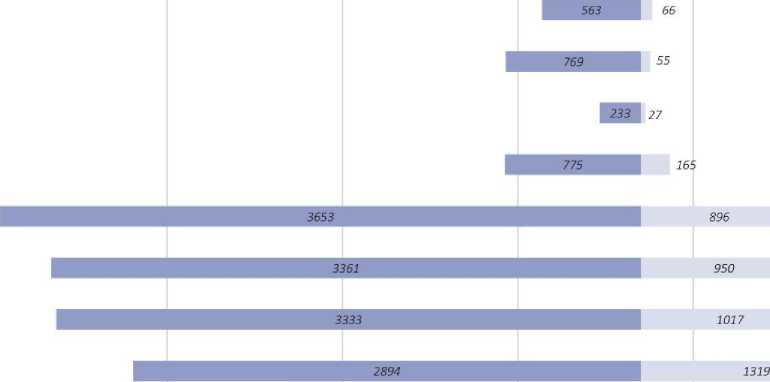
Finland and Norway are Russia’s European Arctic neighbors and share a land border with it. Sweden, which officially joined NATO on March 7, 2024, had long attracted tourists from Russia with its northern regions, the Arctic territories of Västerbotten and Norrbotten, as well as the cities of Kiruna and Luleå. Sweden, Finland, and Norway offer well-developed, organized ethnographic tourism products, making extensive use of elements of the rich Scandinavian culture and mythology; these features stimulate interest and generate high tourist demand amongst Russians. Figures 1 and 2 illustrate the dynamics of tourist flows between Norway, Sweden, Finland, and Russia from 2016 to 2023, presenting data on total inbound and outbound travel. The use of a tornado chart for both graphs has made it possible to highlight annual tourist arrival figures for individual countries, as well as to provide a clear visual representation of the total tourist flow for the period under review8.
ANNUAL TOURIST FLOW BETWEEN NORWAY, SWEDEN AND RUSSIA, 2016 TO 2023, THOUSANDS OF TRIPS
3 4
2 3
11 7 2 6
8 7
Number of tourist arrivals, thousand trips
Tourist flow from Norway to Russia
Tourist flow from Sweden to Russia
Tourist flow from Russia to Norway
Tourist flow from Russia to Sweden
Fig. 1. Tourist flow between Norway, Sweden, and Russia, 2016–20239.
Both graphs clearly show that outbound tourism from Russia to Arctic countries, such as Norway, Sweden and Finland, exceeds the number of tourists arriving in Russia from these countries. An analysis of the data presented leads to the conclusion that tourism to foreign Arctic destinations is quite popular among Russians, with a preference for countries bordering Russia, specifically Finland and Norway. The decline in the trend shown in the chart also demonstrates a sharp downturn in the tourism market and demand during the COVID-19 pandemic (2020–2022) compared to the pre-pandemic period; this decline persisted at low levels into the period coinciding with the start of the special military operation (SMO) in Ukraine.
Significant differences in the three sets of indicators for Finland, Norway, and Sweden are rooted in the historical international, diplomatic, and trade relations between the USSR/Russia and Finland. Due to the high level of competition between Finland and the Murmansk Oblast, driven by similar tourism offerings and various historical factors, this section of the study examines the current state of Finnish tourism in greater detail to assess development prospects for the Murmansk Oblast.
ANNUAL TOURIST FLOW BETWEEN FINLAND AND RUSSIA, 2016 TO 2023 THOUSANDS OF TRIPS
3700 2700 1700 700 300 1300
Number of tourist arrivals, thousand trips Tourist flow from Finland to Russia ■ Tourist flow from Russia to Finland
Fig. 2. Tourist flow between Finland and Russia, 2016–202310.
Bilateral tourism relations between Russia and Finland were strong and stable, largely due to their close proximity, shared history, economic ties, trade cooperation, and social factors. In 2009, Sari Lammensalo, Regional Director of the national tourism board Visit Finland in Russia, noted that Russia as a whole, and Moscow in particular, were Helsinki’s primary tourism market and emphasized the need to maintain effective marketing efforts within the Russian Federation11. During the 2010s, Finland was a highly popular destination for Russians due to several factors: easy transport accessibility; frequent business trips by entrepreneurs and experts from both countries; attractive cost of organizing group and individual ski trips and eco-tours (combining forest recreation and fishing) compared to Russia’s own Arctic regions; the established tradition of weekend rail trips from St. Petersburg; popularity of shopping tours to Finland and “gastronomic and alcohol-focused” tours by Finns to Russia; and the large number of cross-border family ties between Finnish and Russian citizens, which undoubtedly stimulated additional tourism driven by personal reasons.
A noticeable cooling of international and economic cooperation occurred in 2014 when Finland, as an EU member, joined the “collective West” in imposing economic and political sanctions on Russia in response to events in Crimea and the Donbas, to which Moscow responded similarly. However, the tourism sector remained virtually unaffected. Nevertheless, a further round of diplomatic and economic tension was linked to the start of the special military operation, when Helsinki suspended the issuance of tourist visas to Russians and restricted the entry of Russian tourists into the country from September 30, 2022, including via land borders. The national tourism board, Visit Finland, ceased its marketing activities in Russia. Finland, alongside other Baltic Sea countries, began supplying Ukraine with increasing amounts of arms and other military aid, simultaneously expanding its defense-industrial complex. The funding of the Finland-Russia Society was suspended in 2023. Russian residents in Finland have faced discrimination, including restrictions on access to tourist attractions during travel within the country12. However, Finland has begun to experience an acute shortage of Russian tourists. In total, the country lost approximately one million overnight stays by Russians, and the number of foreign tourist arrivals dropped by about one-fifth compared to 2019 levels. There was also a decline in visitors from Asian markets, most of whom used to fly to Helsinki via Russia. In the industry’s heyday, flights from Tokyo crossed Russian airspace and took about nine hours. By 2023, the journey from Tokyo to Helsinki had extended to 14 hours, significantly reducing the likelihood of repeat visits. According to estimates by Statistics Finland, the shortage amounted to around 1 billion euros in 2023, caused by a decline in inbound tourism (16.3 billion euros in 2019 compared with 15.3 billion euros in 2023). Business activity in eastern and south-eastern Finland has begun to decline due to the absence of its target market — tourists from Russia. Finnish tourism companies are attempting to refocus on European and North American tourists. For example, Finnair, whose strategy was previously based on Asia, has invested in the United States13.
On April 4, 2023, Finland officially joined NATO, thereby exacerbating geopolitical tensions in the Baltic Sea region. On May 1, 2023, the Russian Embassy in Helsinki noted that the foundation of what was once close and mutually beneficial bilateral cooperation between Russia and Finland had been almost completely destroyed14.
Following a two-year absence of Russian tourists, in the autumn of 2024, Finnish authorities decided to allocate around 7 million euros to develop the tourism industry and boost the competitiveness of businesses in the country’s eastern regions bordering Russia, with a view to restoring good-neighborly relations in the tourism sector15. Meanwhile, in October 2024, the Finnish authorities seized a stretch of beach owned by the Russian state and used as a holiday resort for diplomats (17.3 hectares of land and 3.5 hectares of marine waters). At least five other properties owned by Russians have been confiscated in Helsinki and the Åland Islands, including the Russian Centre for Science and Culture in Helsinki16. These actions tend to elicit surprise rather than a willingness to cooperate on matters of international diplomacy and the strengthening of good-neighborly ties. By comparison, on January 31, 2025, Finnish President Alexander Stubb signed a decree granting Ukraine the 27th package of military aid worth 198 million euros; the total value of military equipment already supplied by Finland to Ukraine stood at 2.5 billion euros by the end of January 202517.
Currently, the sharpest decline in international tourism to Finland has been recorded in the South Karelia region. Whereas in 2019, the region recorded over 230,000 overnight stays by foreign tourists, including Russians, by 2024, this figure had fallen to just over 30,000. Local companies are losing revenue generated by foreign visitors. In South Karelia, domestic and inbound international tourism generated over 35.5 million euros for regional tourism companies during 2019, a record year for the sector. For Helsinki, the decline in international tourism means a reduction of 9 million euros in the region’s tourism revenue. It is noted that domestic tourism is insufficient to sustain all tourism companies in Eastern Finland. According to Susanna Markkola, a project manager at the national tourism board Visit Finland, travel agencies in the Saimaa region are in a difficult position; many are experiencing challenges, and there have been cases of closures due to a lack of demand for their services18.
Compared to Finland, Norway had a higher “average spend” per visitor; nevertheless, Russian enthusiasts of sports, skiing, eco-tourism, extreme sports, and fishing sought unique experiences in the land of Vikings and trolls. This was facilitated by the active marketing and promotional efforts of the Norwegian tourism office, Visit Norway, in Moscow and St. Petersburg, the presence of the Norwegian Consulate General in Murmansk, good transport accessibility, and support at both the interstate and international expert levels within the framework of the relevant working groups of the Russian-Norwegian Intergovernmental Commission and tour operators specializing in Scandinavian destinations. According to a survey of tourists conducted in Norway in 2014, over 80% of Russian citizens visited the country for the purpose of enjoying the countryside. The second most popular reason was visiting natural attractions, discovering local cuisine and exploring local history. More than a third of the tourists surveyed were repeat visitors. Approximately 40% of Russian tourists traveled independently, while around 30% used the services of travel agencies19.
At the onset of the SMO and amidst intense sanctions pressure from Barents-Euro-Arctic region (BEAR) countries, the issue of blocking Russian activities in Svalbard became more acute; however, Russia’s economic and scientific presence on the archipelago is currently expanding and intensifying. In May 2024, Norway ceased issuing visas to Russian tourists. It is worth noting that Sweden did not resort to such a measure.
In 2025, the Baltic states and the “collective West” as a whole continued discrimination against Russian tourists, violating the fundamental principles of the 1985 Tourism Bill of Rights and
Tourist Code, specifically Articles 1, 2, 3, 4, 5, and others20. Latvia’s Minister of the Internal Affairs, Rihards Kozlovskis, called on European Union countries to follow Latvia’s example and ban the issuance of Schengen tourist visas to Russian citizens, citing a threat to the EU’s internal security. Speaking at a meeting of the Justice and Home Affairs Council of the European Union in Brussels, he stated that member states were “morally obliged to refuse such a service”21.
Irreversible processes are underway regarding cooperation within the Barents Euro-Arctic Council (BEAC), the Arctic Council, and the EU’s “Northern Dimension” initiative in the Barents-Euro-Arctic region. Since March 9, 2022, Nordic countries and the EU have suspended cooperation with Russia within the frameworks of the BEAC, the Arctic Council, and the EU’s “Northern Dimension”22. Russia, as an Arctic power, and the Murmansk Oblast, as one of the key Arctic regions, played a significant role in the international activities of these organizations aimed at the sustainable development of the entire Arctic. On March 27, 2025, Helsinki announced that Finland had terminated the agreement between Finland, Norway, Russia and Sweden on the establishment of an international Barents Secretariat for cooperation in the Barents/Euro-Arctic region, with effect from January 1, 2025 (entering into force on January 1, 2026), which also undermines cooperation in the field of tourism23.
In July 2025, NATO Secretary General Mark Rutte informed US President Donald Trump that several countries, including Denmark, Sweden, Finland, Canada, and Germany, were prepared to continue providing enhanced financial support to Kyiv. “Ukraine will be able to receive a truly huge amount of military equipment, both for air defense and missiles and ammunition,” he said, noting that the transfer of equipment from Europe to Ukraine would be carried out rapidly24.
In August, the Norwegian government issued a statement regarding the delivery of priority US military equipment to Ukraine via NATO; according to this plan, Sweden, Norway, and Denmark intend to jointly fund the latest “Prioritised Ukraine Requirement List” (PURL) initiative. The total value of the support package will amount to 500 million US dollars, with Oslo making a direct contribution of approximately 135 million US dollars (1.5 billion Norwegian kroner)25. On August 19, 2025, the foreign ministers of the Nordic countries and Canada issued a joint statement in
Nuuksio, Finland, regarding their support for Ukraine. The statement calls for the continuation and intensification of pressure on Russia’s military economy, the maintenance of existing restrictive measures, and the imposition of additional sanctions. “Russia poses a long-term threat to European security,” declared the foreign ministers of the Nordic Five (N5) — Finland, Sweden, Norway, Denmark, and Iceland — and Canada26.
Since the start of the SMO, Sweden has allocated approximately 83 billion Swedish kronor (7.4 billion euros or 8.6 billion US dollars) in military support to Ukraine27. Norway has provided Kyiv with nearly 141.6 billion Norwegian kroner (11.9 billion euros or 13.8 billion US dollars); furthermore, the parties in the Storting agreed to increase support for Ukraine by 50 billion Norwegian kroner in 2025. Norway’s total funding for Ukraine has thus been raised to 205 billion Norwegian kroner28. Finland’s military aid to Kyiv has amounted to approximately 2.7 billion euros, with humanitarian aid totaling around 1 billion euros29.
This large-scale funding and support for an adversary of Russia, compounded by sanctions pressure on Moscow, undermine the long-standing efforts of Russia and the countries of the Baltic-Scandinavian macro-region to establish good-neighborly relations and cooperation in the sphere of international political and economic interaction.
All the aforementioned factors underscore the undeniable urgency and critical importance of formulating new strategies and tactics for the domestic tourism sector at national and regional levels, and of developing effective practical measures and methodological solutions to replace tourist offerings from countries unfriendly to Russia with competitive domestic tourism products. The current economic and foreign policy situation suggests that, given appropriate standards of service, infrastructure, and pricing, as well as enhanced product quality, Russian Arctic destinations (among which the Murmansk Oblast is of great strategic and geopolitical importance) possess great potential to redirect the flow of Russians who previously travelled abroad for Arctic tourism towards Russian Fennoscandia, offering them a unique holiday experience and a rich array of competitive tourism products.
Legislative framework for tourism development in the Murmansk Oblast
The ambitious development goals for the AZRF are reflected in a series of government documents. The direction of socio-economic, tourism, and infrastructure development for the Murmansk Oblast, as an outpost of the AZRF and the Northern Sea Route (a vital transport artery), is evident in the implementation of the objectives set out in paragraph 20 of the Strategy for
Developing the Russian Arctic Zone and Ensuring National Security until 2035.
The Murmansk Oblast (hereinafter referred to as the MO) is located in the north-west of the European part of the Russian Federation and covers an area of 144,900 km². It spans approximately 550 km from west to east and 400 km from north to south. Almost the entire territory of the region lies north of the Arctic Circle and is situated on the Kola Peninsula. The region borders the Republic of Karelia to the south-west, and Norway and Finland to the west30. This location makes the region attractive for the development of tourism and active travel; at the same time, it necessitates strengthening its position by ensuring border security, maintaining constant vigilance against external pressures, and serving as an outpost of the Russian Federation.
In May 2020, the “Capital of the Arctic” Territory of Advanced Development (TAD “Capital of the Arctic”) was established. Paragraph 20 of the Strategy for Developing the Russian Arctic Zone and Ensuring National Security until 2035 is dedicated to the comprehensive infrastructure development of the Murmansk Oblast, with specific sub-paragraphs (a, g, h, and k) defining the tourism-oriented direction of the economy. In addition to federal legislation, a regional regulatory framework for the tourism and hospitality industry has been formed in the Murmansk Oblast, supported by strategically important regional government directives.
In 2021, the “Strategy for the Development of the Tourism and Recreation Cluster of the Murmansk Oblast for 2021–2025” (hereinafter referred to as the Strategy) was approved within the framework of the Murmansk Oblast’s Socio-Economic Development Strategy until 2020 and the Period up to 202531. The Strategy outlines the goals and objectives for developing the region’s tourism and recreation cluster (hereinafter referred to as the TRC MO), identifies key tourism development hubs and local sub-clusters, and analyzes target markets. The strategic goal for the development of the TRC MO is to develop the tourism industry in the Murmansk Oblast by enhancing its competitiveness32. The Strategy identifies the following target types of tourism: active nature tourism, which involves the use of the region’s natural resources; cultural and educational tourism; gastronomic tourism; health and wellness tourism; and industrial tourism.
Current state of the tourism market in the Murmansk Oblast
According to the development targets for the Murmansk Oblast’s tourism and recreation cluster, the projected total tourist flow for 2023 was 35,423 people (comprising 4,535 foreign and
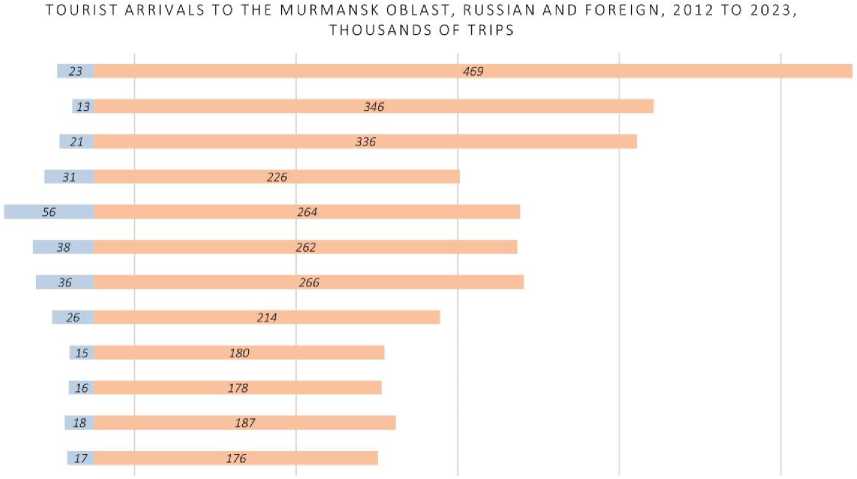
30,888 domestic tourists), with 144 collective accommodation facilities and a total volume of paid tourism and accommodation services amounting to 1,735.73 million rubles33. In fact, the value of paid services exceeded 5,996.00 million rubles as early as 2022. According to Rosstat data, the tourism volume in 2023 totaled 492,213 trips, comprising 469,275 trips by Russian citizens and 22,938 by foreign tourists. Following a sharp decline during the “COVID year” of 2020, the rate of domestic tourist arrivals in the Murmansk Oblast began to rise rapidly, whereas the rate of arrivals by foreign tourists in 2022 reached a 10-year minimum. The dynamics of inbound tourism to the Murmansk Oblast from 2012 to 2023 are illustrated in Fig. 3.
75 25 125 225 325 425
Number of tourist arrivals^ thousand trips Tourist arrivals (Foreign) Tourist arrivals (Russian)
Fig. 3. Inbound tourism flows to the Murmansk Oblast, 2012–2023 (thousands of arrivals)34.
It should be noted that the Strategy was adopted prior to the start of the SMO, at a time of intense competition from the Nordic countries and a large number of frequent and regular trips by Russians to visit relatives and friends residing in the countries of the Baltic-Nordic macro-region.
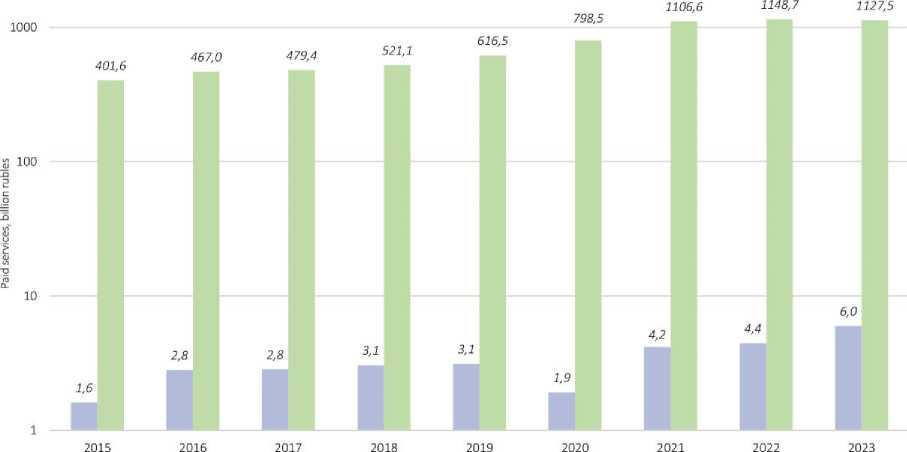
According to Rosstat data, in 2023, the value of paid tourism services in the MO amounted to approximately 6 billion rubles, which is 36.4% more than in 2022 (in 2020 — 1.9 billion rubles, in 2021 — 4.2 billion rubles, in 2022 — 4.4 billion rubles)35.
As of 1 December 2024, there were 70 tour operators specializing in inbound and
Ibid.
34 Compiled by the author
based
on
Rosstat data. Source:
URL:
; ; ; ;
;
; ;
; ;
(1); ;
; ;
(accessed 01 June 2025).
35 MO Tourism Committee. URL: (accessed 01 December 2024).
domestic tourism operating within the Murmansk Oblast.
According to expert studies, the primary visitors to the region are young people (aged 18– 34) from Moscow and St. Petersburg with average or above-average incomes. The main reasons for visiting are nature and wildlife (35%), friends and relatives (28%), and sightseeing (26%). The average trip duration is 12 days, and the average cost is 69,369 rubles36.
The cost of tours to the MO in 2025 for 5 days/4 nights with accommodation in a 3* hotel ranges from 70,000 to 220,000 rubles per person. Big data analysis revealed that 1.9 million search queries related to the “Northern Lights” category were made during the 2022–2023 season, rising to 2.4 million queries in 2023–2024. Thus, there has been a 25% increase in interest among Russians in viewing the aurora; tourists most frequently travel to the MO, the Arkhangelsk Oblast, the Komi Republic, Karelia, the Krasnoyarsk Krai, Yamal, and Yakutia for this purpose37.
The trends in GRP and the volume of paid tourism and hospitality services in the Murmansk Oblast are shown in Fig. 4. There has been a positive trend in the increase in tourism’s share of the region’s GRP, as well as a strengthening of its socio-economic position and influence on the region’s investment climate.
GROSS REGIONAL PRODUCT OF THE MURMANSK OBLAST, 20 12 TO 2023, BILLION RUBLES
Paid tourism services provided in the Murmansk Oblast (including services of collective accommodation facilities) Gross regional product of the Murmansk Oblast
Fig. 4. GRP and the volume of paid tourism and hospitality services in the MO (at basic prices, billion rubles)38.
The introduction of the national program for the development of tourism and the provision of state support in the form of subsidies, tax rates and other measures led to a positive trend in the growth of the number of collective accommodation facilities (CAFs) in the Murmansk Oblast.
In 2024, the total number of collective accommodation facilities in the MO, including generalpurpose and specialized entities such as hotels, holiday centers, campsites, health resorts, tourist centers, etc. reached 262 units39. By comparison, the corresponding figure for all types of CAFs in 2012 was 122 units. Thus, over the past 12 years, the Murmansk Oblast has doubled the number of accommodation facilities in the tourism and hospitality sector (Fig. 5).
When examining issues of socio-economic development in the Murmansk Oblast, experts highlight the following negative factors: labor market issues; healthcare challenges, including a lack of high-quality, accessible medical services; low educational quality; high consumer costs; low safety levels; and an insufficient number of cultural, leisure, and sports facilities (Samarina, Skufina, Serova, 2024). Addressing these issues could significantly improve the population’s quality of life and the quality of recreational services available to visitors to the Murmansk Oblast.
COLLECTIVE ACCOMMODATION FACILITIES IN THE MURMANSK OBLAST, 2012 TO 2024
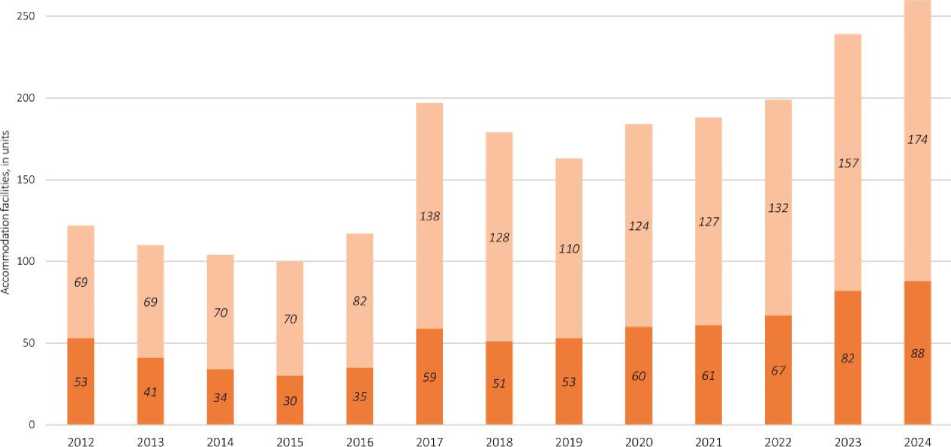
■ Specialised accommodation facilities Hotels and similar accommodation facilities
Fig. 5. Collective accommodation facilities in the Murmansk Oblast, 2012–2023 (units)40.
Currently, there is a pressing need to develop a concept for the growth of Arctic creative industries within the AZRF (Krasilnikov, 2024); without these industries, progressive and sustainable tourism development, in both its current and future contexts, is impossible. The effective implementation of state programs41 will make it possible to significantly improve the region’s comprehensive tourism infrastructure and strengthen its image as a tourist destination.
Tourism transport system of the Murmansk Oblast
The availability of rail, road, and air links makes the Port of Murmansk the leading multimodal Arctic hub (Vasekha, Yarotskaya, Nikiforova et al., 2022). In 2023, passenger traffic at the Murmansk International Airport named after Nicholas II — one of the most important air transport hubs in the Russian North and the largest airport north of the Arctic Circle — totaled 1.4 million people42. During the first ten months of 2024, passenger traffic reached 1.2 million people (a 3.9% increase over the 2023 figure); 2,599.865 tons of cargo and mail were transported (cargo turnover increased by 42.1% compared to 2023). The most popular destinations include Moscow, St. Petersburg, Arkhangelsk, Kazan, Kaliningrad, Sochi, and Cherepovets43. Belavia and Smartavia provide direct connections to Minsk44. Regular passenger services are operated by Nordwind Airlines, Pegas Fly, S7 Airlines, Smartavia, Aeroflot, Jetika LLC, Pobeda, Rossiya, and Severstal. Nordwind Airlines is actively expanding its network of direct and connecting flights to Kazan, Ufa, and other cities45. In 2024, passenger traffic totaled 1.5 million people, and four new terminal complexes were put into operation. A new terminal is being designed at Murmansk Airport; its architecture will reflect the Russian North and promote the region’s tourism image46.
In 2024, the Murmansk railway station, which serves approximately 310,000 passengers annually, marked its 70th anniversary47. The railway network covers a wide range of destinations, including St. Petersburg, Moscow, Smolensk, Pskov, Saratov, Novorossiysk, Adler, Anapa, and Sevastopol (served by JSC “RZD/FPC” and JSC “GSE”( Tavria)).
Russian Railways (RZD) is actively promoting Arctic tourism. From January 31 to September 2, 2024, the “To the Arctic on Father Frost’s Train” rail cruise operated. The Moscow — St. Petersburg — Petrozavodsk — Murmansk — Sortavala — Moscow route took 5 days and 6 nights48. In 2025, RZD was offering the 7-day “Russian North” rail cruise (launching on May 30, 2025). This round route from Moscow passes through Velikiy Ustyug, Arkhangelsk, Belomorsk, Murmansk (Teriberka), Petrozavodsk, Sortavala, and Vyborg, uniting key tourism gems of the Russian Arctic Zone49. A 5-day “To the Northern Lights” rail cruise through northern cities was scheduled to launch on October 31, 2025, linking Moscow, Petrozavodsk, Murmansk, Belomorsk,
NORTHERN AND ARCTIC SOCIETIES
Diana S. Timoshenko. Russian Arctic Tourism in the Era of Sanctions Pressure … and Vologda via a sightseeing route 50. Russian Railways (RZD) has also begun transporting passengers’ vehicles on the weekly train No. 92/91 (Moscow – Murmansk), with a capacity of up to four cars or 14 motorcycles 51; this expands opportunities for organizing car and motorcycle tourism in the Murmansk Oblast.
Serious obstacles to the interregional development of rail and air links in the Murmansk Oblast currently include enemy attacks and sabotage, the supply of long-range weapons by the enemy’s supporters, as well as the resulting disruptions to the regular timetables of trains travelling to Murmansk, and the functioning of departure and arrival airports. Since 2022, this situation has particularly affected the entire western part of Russia, characterized by drone and UAV attacks on civilian targets, the destruction of critical infrastructure, various acts of sabotage in Russia’s European regions, and terrorist acts perpetrated by Ukraine.
Transport services for residents and visitors of the Murmansk Region are provided by regular bus routes, suburban rail services, and the “Klavdiya Elanskaya” passenger ship52.
In 2025, for the period of July 22–29, the cost of 8-day cruises on the “Lenin” ship departing from St. Petersburg started at 115,320 rubles per person; however, the itinerary’s visit to Murmansk involved a train transfer from Svir53.
At the same time, high-latitude tourism and Arctic cruises are extremely expensive. The cost of the 12-day cruise “On an Icebreaker to the Top of the World” on the nuclear-powered icebreaker “50 Let Pobedy” (departing from Murmansk on July 2–14 and July 13–25, 2025) ranged from 3.2 million to 5 million rubles54. In July 2024, a 12-day tour in a “luxury” cabin cost 6.96 million rubles.
Financial support for the development of tourism infrastructure in the Murmansk Oblast
Between 2022 and 2024, a number of measures were introduced to support the tourism industry. In 2022, the regional government provided subsidies to tourism industry operators, as well as additional funding for the development of roadside services and eco-tourism, and for supporting public initiatives aimed at creating modular, non-capital accommodation facilities.
In 2023, the regional government issued a call for proposals from legal entities and individual entrepreneurs to subsidize a portion of the costs associated with investment projects for creating modular, non-capital accommodation facilities. Financial support was provided in the form of regional budget subsidies to domestic and inbound tourism operators in the Murmansk Oblast; a federal subsidy was also allocated for the purchase and installation of modular, non-
NORTHERN AND ARCTIC SOCIETIES
Diana S. Timoshenko. Russian Arctic Tourism in the Era of Sanctions Pressure … capital accommodation units as part of investment projects.
In 2024, as part of the implementation of the national project, a subsidy from the regional budget (ranging from 3 to 7 million rubles) was allocated to organizations involved in domestic and inbound tourism in the Murmansk Oblast, subject to a co-financing requirement where the project owner contributes at least 50% of the requested amount from their own funds. These funds are designated for specific purposes: developing the “Zapolyarny Kaleidoscope” and “From the Barents to the White Sea” national tourist routes, establishing camping facilities, and purchasing tourism equipment.
Conclusion
In summary, it is worth noting that for many years, the Russian Arctic lacked competitiveness in organizing high-quality leisure experiences, lagging behind its neighbors and the countries of the Baltic-Scandinavian macro-region (such as Finland, Norway, and Sweden).
Tourist destinations in the Baltic-Scandinavian macro-region possess a rich history of development, underpinned by long-term targeted investment at the micro, meso and macro levels. They are characterized by a high level of local professional expertise, well-developed tourism and hospitality infrastructure, and extensive experience in providing tourism services and training highly qualified personnel.
Tourism has the potential to make a significant contribution to changing the image of the Murmansk Oblast, shifting it away from its perception as merely a peripheral region and a supplier of raw materials.
Despite the active promotion of the Murmansk Oblast as a tourist destination and increased interest from potential consumers of Arctic tourism services, the region’s tourism industry — like that of other northern regions — continues to face key challenges: a shortage of skilled personnel, inconsistent standards of tourism and hospitality services, underdeveloped tourism infrastructure, and a lack of experience in providing high-quality service to both domestic and international travelers.
An analysis of economic indicators demonstrates an expansion of the potential Arctic tourism segment and growing interest in it within the domestic market; however, it does not indicate a clear willingness among citizens to incur high travel expenses. The number of accommodation facilities and tour operators working in the fields of domestic and inbound international tourism is growing in the Murmansk Oblast. The number of tourist arrivals by Russians and foreign visitors to the Russian Arctic is also showing steady growth. The share of tourism and related services in the gross regional product is increasing. The transparency of the tourism economy in the Arctic regions is improving.
Due to the current foreign policy situation and the sanctions imposed by neighboring European countries, consideration is being given to a measured and cautious approach to establishing ties and stabilizing international relations with northern neighbors, both on a bilateral basis and through official Arctic and tourism organizations. It is essential to make the most Arctic and North. 2026. No. 64
effective use of this opportune moment to develop domestic, inbound and international tourism in the Murmansk Oblast.
