
Sattar Buksh Cafe vs Starbucks Coffee Trademark Dispute of Pakistan
Journal: Trends in Intellectual Property Research @iprtrends
Section: Articles
Article in issue: 2 vol.3, 2025.
Free access
This study examines the trademark dispute between global coffee chain Starbucks and the Pakistani café Sattar Buksh. The matter, resolved without formal litigation, highlights the intricate relationship between trademark law, the concepts of dilution and parody, and the tension between brand protection and cultural expression. By adopting a parody-based strategy in its name and visual branding, Sattar Buksh attracted local market attention, ultimately prompting legal action from Starbucks. This research explores the positions of both parties, the applicable provisions of Pakistan’s Trademarks Ordinance, 2001, and the wider implications of such disputes for intellectual property rights in emerging economies.
Short address: https://sciup.org/170213667
IDS: 170213667 | DOI: 10.69971/tipr.3.2.2025.67
Text of the scientific article Sattar Buksh Cafe vs Starbucks Coffee Trademark Dispute of Pakistan
Trademark laws protect brand identity, consumer loyalty, and prevent market confusion. However, the application of these principles is challenging when encountering creative expressions that border on parody or satire. The Sattar Buksh v. Starbucks case in Pakistan is an interesting example of such a challenge .1
Starbucks Corporation, founded in 1971 in Seattle, Washington, is a globally recognized coffeehouse chain with thousands of branches worldwide. Its distinctive green siren logo and brand name are synonymous with coffee culture, representing significant intellectual property assets. Starbucks diligently protects its trademarks globally to preserve its brand image and prevent unauthorized exploitation. However, Starbucks has not yet opened any branch in Pakistan (AlArabiya 2016).
Citation: Samina Yaqoob. 2025. Sattar Buksh Café and Starbucks Coffee Trademark Dispute of Pakistan. Trends in Intellectual Property Research 3(2), 23-26.

Copyright: © 2025 by the authors. This article is licensed under a Creative Commons Attribution 4.0 International
License. To view a copy of this license, visit
Sattar Buksh café opened in Karachi, Pakistan, in 2013, by Rizwan Ahmed and Adnan Yousuf had a local, relatable, and humorous flavored brand. The cafe's initial logo visually resembled to the Starbucks siren, albeit modified whereby the siren was replaced with a man with a mustache. The twisted moustache, of logo reminds people of the famous Punjabi saying “ mooch naie tey kuch naie (without moustache, you are nothing)” (Anonymous 2013). Sattar Buksh had a green circular logo featuring the owner's face instead of the Starbucks siren, maintaining a similar design in terms of wavy lines and the circular band. This visual identity strategy achieved immediate recognition through widespread social media virality, leveraging the association with Starbucks while incorporating local cultural elements. The cafe's menu blended international coffee offerings with local foods, creating a hybrid identity that simultaneously alluded to and differentiated itself from its multinational inspiration.
This deliberate mimicry ignited a legal confrontation, highlighting the complexities of trademark enforcement in a global yet culturally diverse landscape. The dispute emerged as a litmus test for Pakistan's approach to trademark protection, parody defenses, and the accommodation of local cultural identity within global commerce. Shortly after Sattar Buksh's launch, Starbucks became aware of what it deemed trademark and copyright infringement. Starbucks issued a cease and desisted letter to Sattar Buksh, objecting to both the name and the visual similarity of the logo. Starbucks argued that "Sattar Buksh" and its original logo were deceptively similar to its registered trademarks, leading to a likelihood of consumer confusion regarding the origin of the services. The use of a similar mark by Sattar Buksh diluted its famous trademark's distinctiveness and tarnished its reputation. These concepts, known as dilution by blurring or dilution by tarnishment, protect well-known marks from unauthorized use that diminishes their uniqueness or harms their image.
Starbucks insisted its mark enjoyed the "highest degree of repute" required for dilution protection in Pakistan, comparing it to globally recognized brands like Coca-Cola, Google, and McDonald's (The Siasat Daily. 2017).
Sattar Buksh insisted their logo, despite superficial similarities, was distinctly different (e.g., mustached man versus siren, different fonts and colors). "Sattar Buksh" is a traditional Pakistani male name with a history far predating Starbucks, rendering the name itself unassailable .2 Sattar Buksh's defense centered on the argument of parody and the essential distinctiveness of their offering. The owners asserted their brand was a parody, designed to be humorous and satirical, not to deceive consumers. Parody in intellectual property law typically involves using a copyrighted work or trademark to comment on or critique the original work, without causing confusion. They argued that the deliberate modifications, especially the mustached man in the logo and the culturally specific name, were clear indicators of their independent identity. Their unique menu, blending international coffee house fare with local Pakistani dishes, further distinguished their services. The café interior is decorated with local crafts, including the famous Pakistani truck art. The dishes have names like “Topless Besharam Burger (shameless rich kid)” and ‘Jheenga La-La (skinny minnie)’ (Anonymous 2013).
Sattar Buksh avoided a lawsuit by voluntarily and adjusted its visual identity strategy by modifying its logo (removing green color and circular band elements) specifically altering the image of the mustached man to be less of a direct mimicry of the Starbucks siren and issued a disclaimer. The Facebook has this disclaimer as “We have nothing to do with any foreign franchise nor do we want to categorise ourselves as mere coffee experts. We’re ‘Jutts of all trades’ and we cater to everyone!”( Karmarkar 2013). For Starbucks, the primary goal was to halt direct visual imitation and prevent any potential association or brand dilution. For Sattar Buksh, the aim was to preserve its unique identity and popularity while complying sufficiently to avoid a full-blown legal battle. The publicity generated by the dispute itself, regardless of the precise legal outcome, significantly boosted Sattar Buksh's profile . They did not change name as per Sattar Buksh the name Sattar Buksh has been around for at least 500 years or more(Adil 2013). The three logos have been shown in Figure 1.
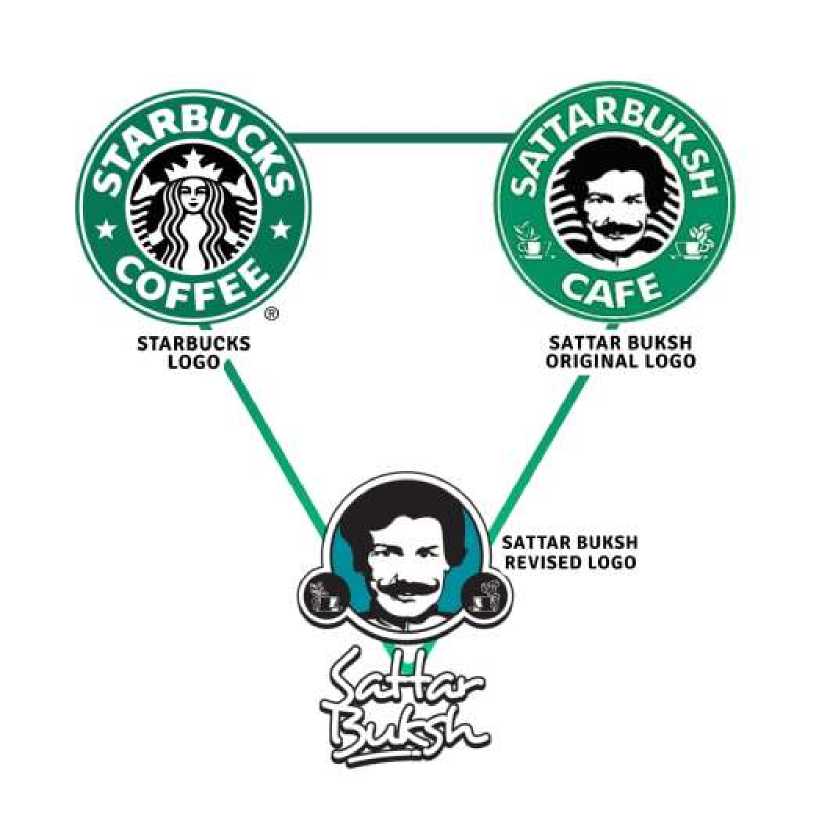
Figure 1. Starbucks Logo and Sattar Buksh logos (original and modified).
This outcome contrasted sharply with findings in other jurisdictions. Most notably in India, a similar case involving "Sardar-buksh Coffee" resulted in a forced renaming to "Sardarji-Bakhsh Coffee & Co." after Starbucks successfully established trademark infringement. The Delhi High Court applied stringent tests for deceptive similarity from the National Sewing Thread Co. Ltd. vs. James Chadwick and Bros case, emphasizing phonetic equivalence and visual resemblance regardless of cultural context. This disparity highlights how similar trademark disputes can yield varying results based on jurisdictions' approaches to parody and cultural context. Table 1 indicates difference between two cases (Sampathkumar 2021; Anonymous 2021).
Table 1. Different Outcomes of the Two Cases
|
Indicator |
Sattar Buksh (Pakistan) |
Sardar Buksh (India) |
|
Initial Logo |
Mustached man in similar circular format |
Turbaned leader with a Starbuckslike circular band |
|
Resolution |
Logo changed; name retained. No court case. |
Court-mandated name change to "Sardarji-Bakhsh" |
|
Legal Basis |
Cease-and-desist letter; parody defense (unrecognized). Acknowledged as a marketing tac- |
Trademark infringement under Indian law. |
|
Key Legal Criterion |
tic but unlikelihood of local consumer confusion |
Proof of deceptive similarity |
|
Stores Affected |
Continued operating as "Sattar Buksh" |
Existing stores allowed to continue, but new outlets renamed |
|
Global Attention |
Sparked debates on cultural expression vs. trademark rights. |
Set precedent for brand protection in India. |
The legal principles governing this dispute are primarily enshrined in the Pakistani Trademarks Ordinance, 2001 .3 Section 2(xiii) defines a "well-known mark," providing a higher degree of protection against dilution, even if there is no direct competition or likelihood of confusion. Section 40 outlines what constitutes trademark infringement, generally focusing on the unauthorized use of a mark that is identical or deceptively similar in relation to identical or similar goods or services, leading to a likelihood of confusion. Section 86(3) allows the owner of a well-known trademark to seek an injunction prohibiting the use of an identical or deceptively similar mark to its well-known trademark, even if the use is in relation to different goods or services, and where such use is likely to cause dilution of the distinctive quality of the well-known trademark. This is particularly relevant in dilution claims where direct confusion might not be the primary concern, but the weakening of the mark's unique identity is (Masood 2016).
Unlike copyright law, which includes limited fair dealing exceptions for criticism or review (Section 57, 1962 Copyright Ordinance )4, Pakistani trademark law does not contain an explicit parody defense. This legal gap creates significant uncertainty, forcing courts to evaluate parody cases through general trademark principles rather than specific statutory exceptions. The Sattar Buksh decision thus set important de facto precedents of transformative Use and consideration of local interpretation and meaning rather than strict global brand standardization (Masood 2016).
The Pakistani legal landscape also considers the "highest degree of repute" for a mark to qualify for dilution protection under Section 86(3). Factors for determining a well-known mark typically include the extent of its recognition in Pakistan or globally, the degree of its inherent or acquired distinctiveness, the duration and extent of its use and advertising, and the commercial value and exclusivity of its use and registration.
-
2. Conclusions
The Sattar Buksh trademark dispute in Pakistan is a pivotal moment in Pakistani intellectual property and especially trademark jurisprudence, demonstrating the intricate intersection of global brand protection and local cultural expression. The court's ruling in favor of the Pakistani cafe underscores the importance of contextual analysis in trademark infringement cases, particularly in markets with distinctive cultural identities and emerging IP frameworks. While the case exposed significant gaps in Pakistani legal protection against brand dilution and parody, it simultaneously validates cultural adaptation as a legitimate entrepreneurial strategy. As Pakistan continues to integrate into global commerce, developing balanced intellectual property frameworks that protect legitimate interests while fostering creative entrepreneurship remains essential. The Sattar Buksh case ultimately demonstrates that in emerging markets, cultural context can be as decisive as statutes in resolving trademark disputes—a lesson with global relevance as commerce increasingly transcends cultural boundaries.
