
Shell of Tritia nitida Sea Snail from a Neolithic Burial at the Ust-Aleyka-5 Flat Burial Ground, Barnaul Stretch of the Ob
Journal: Archaeology, Ethnology & Anthropology of Eurasia @journal-aeae-en
Section: Paleoenvironment, the stone age
Article in issue: 1 т.53, 2025.
Free access
We present the findings of a multidisciplinary study of burial 2 at Ust-Aleyka-5 on the Upper Ob. In 1982, an upright burial of a child with abundant funerary offerings (lithic artifacts, ornaments made of bones and teeth of mammals, shells of Unio bivalves) was unearthed. We focus on a find unique in the region—the shell of a sea snail Tritia nitida, a gastropod, which, at present, lives in the Mediterranean, Black, and Azov seas. The Raman spectroscopy analysis of a mineral pigment detected on the shell allowed us to identify it as red ocher. Similar traces were found on dropshaped pendants made of bone, antler or deer teeth, and on fossil shells of Unio aff. tumidus. On the basis of AMS analysis, burial 2 dates to the mid- or late 4th millennium BC. The T. nitida shell indicates ties (likely indirect ones) of the Barnaul stretch of the Ob to the Black Sea region.
Similar articles in the section Prehistory. Prehistoric remains, artefacts, antiquities
Short address: https://sciup.org/145147244
IDS: 145147244 | DOI: 10.17746/1563-0110.2025.53.1.044-052
Text of the scientific article Shell of Tritia nitida Sea Snail from a Neolithic Burial at the Ust-Aleyka-5 Flat Burial Ground, Barnaul Stretch of the Ob
The Ust-Aleyka-5 site is located in the village of Ust-Aleyka in the Kalmansky District of the Altai Territory (Fig. 1), on a promontory formed by the left side of the Aley River valley in its estuary zone. In 1982, Neolithic burial 2, a single upright burial of a young child with numerous accompanying goods (lithic artifacts and ornaments made of mollusk shells, antler or bone, and teeth of mammals), was discovered and studied at the site (Borodaev et al., 2022). The distinctive funerary rite and the unusual set of burial goods might have been associated with the physical characteristics of the deceased, who had macrocephaly syndrome,
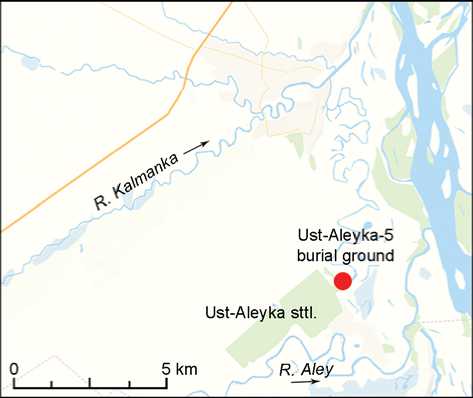
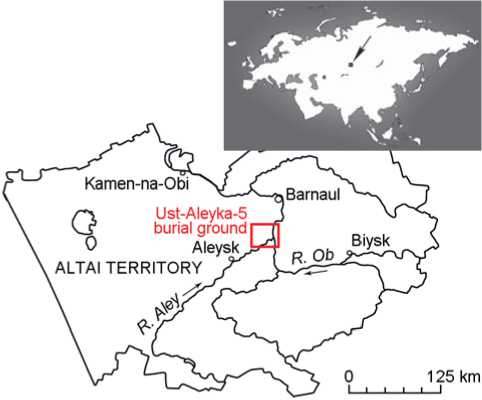
Fig. 1 . Location of the Ust-Aleyka-5 site.
probably caused by hydrocephalus (Ibid.). The burial requires thorough investigation and full publication of its evidence.
This article discusses the items of funerary offerings (sea-mollusk shell, stone tools including a burin, a primary medium flake, and a small flake) that were not reflected in the previous publication of the evidence from the site (Ibid.). The destiny of these items is associated with the circumstances of discovery of the Neolithic burial. When clearing down to the level of the sterile soil, the grave spot did not stand out in color, and differed from the surrounding loam only by its softer texture. The grave was discovered during the control excavation of virgin soil. Stone tools (burin, primary medium flake, and small ordinary flake), sea-mollusk shell, crown of sable tooth, and red-deer tooth a the hole for hanging were found in humified loam above the level of virgin soil. At this stage of study, there is no doubt that all these artifacts belonged to the upper part of the gravepit filling. There was no such confidence during the field studies. The pendant made of a red-deer tooth clearly belonged to the burial goods (there were many similar finds in the burial), while the attribution of the shell to the goods from burial 2 required additional arguments because of the peculiarity of the find. To provide these, a study was conducted using advanced methods of research.
When packing the evidence from Ust-Aleyka-5 burial 2, finds from the upper part of the grave-pit filling accidentally got into a bag with the child’s bones, and for a long time they were out of the main collection of artifacts transferred to the Altai Archaeology Museum at the Altai State University
(Ibid.). These items were discovered quite recently, during sorting out the anthropological evidence for the analysis of postcranial skeleton (Solodovnikov et al., 2024).
This article is aimed at introducing a unique find from the Stone Age of Siberia, i.e. the shell of a Tritia nitida sea snail, in the context of burial goods from an unusual Neolithic child’s burial in the Ust-Aleyka-5 burial ground.
Study methods
Macro- and microtraces of wear, as well as residues of pigment and organic matter on the surfaces of the artifacts were examined at low magnification using MBS-10 and Carl Zeiss stereoscopic microscopes (×8–56). More detailed microlevel (×100–500) study of the items was carried out using an Olympus BNM metallographic microscope. Macrophotographs were taken with a Canon EOS 5D Mark IV camera with Canon EF 100mm f/2.8L Macro IS USM lens using a tripod equipped with microscope head providing smooth manual focusing, and a Lumen-3 light source. The Helicon Focus software enhanced obtaining images of wear traces with focusing over the entire area of one frame.
Taxonomic affiliation of the mollusk shell was based on its morphological features (size, shape, aperture structure, surface texture). The group and species of the shell under study were identified using guides and handbooks on marine mollusks (Alekseev D.O., 2003; Kantor, Sysoev, 2006; Anistratenko V.V., Khaliman, Anistratenko O.Y., 2011).
To identify the substance inside the shell, determine the coloring pigment on its surface, and confirm the hypothesis that the shell belonged to sea mollusks, the molecular composition of substances (organic, coloring, and shell) was analyzed using Raman spectroscopy with the M532/785 microscope (“Spectr-M”) in the Laboratory of Digital Archaeology at the Institute of Archaeology and Ethnography SB RAS. The spectral range of the unit was 100– 4000 cm-1; the entrance slit was 20 μm. A laser with a wavelength of 532 nm was used for analyzing the shell’s surface and pigment (power 50 mW), and a laser with a wavelength of 785 nm was used for studying the dark substance in the shell’s aperture (power 250 mW).
Findings
The most distinctive and informative find among the evidence discovered in the upper part of the grave-pit filling is the shell of a sea mollusk of ovoid-conical shape, measuring 16.1 × 7.7 mm (Fig. 2, 1 ). Its walls are relatively thick; outer relief consists of radial rows of tubercles and depressions between them, which give the surface a cellular appearance. The aperture, with noticeably thickened edges and groove at the bottom, had a shape typical of buccinoid mollusks. It was established that the shell belonged to the marine gastropod Tritia nitida (Jeffreys, 1867).
The shell under study has largely lost its natural coating and typical color and partially lost its surface relief, most likely as a result of natural processes in the sea or during human use. This could not have happened during archaeological processing, since in that case neither traces of pigment on the surface (Fig. 2, 2) nor fragments of organic matter inside (Fig. 2, 3) would have been preserved.
Examination of the item using Raman spectroscopy (seven points analyzed) revealed a substance typical of marine mollusks on the surface of the shell (Fig. 3, 1 ). The shell is based on calcium carbonate (recorded in the spectrum by peaks at 149, 205, 275, 701, and 1082 cm-1). The presence of carotenoids is also observed (marked in the spectrum by peaks at 1132 and 1516 cm-1) (Withnall et al., 2003; Borodina, Nekhoroshev, Soldatov, 2008).
Spots of ocher pigment of reddish color are recorded on individual areas of the shell surface. They contrast with the natural color of the mollusk; the pigment is integrated into the surface and is evenly distributed in the depressions of the relief. Spots of bright brick-red pigment are located mainly on a small area of the outer surface of the shell (see Fig. 2, 1 , 2 ). At a magnification of ×40–200, these look like clusters of particles, which protrude above the surface of the shell at the point of maximum concentration. Particles of paint occur not only in the depressions of the relief, but also on radial tubercles; in fresh shells of this species they are white or beige. Individual small spots of dark red pigment are also present inside the shell in the immediate vicinity of the organic matter remains (see Fig. 2, 1 , 3 ).
The results of Raman spectroscopy indicate that the pigment (eight points analyzed) is based on hematite (Fig. 3, 2 ). The spectra show peaks that mark this natural mineral pigment (240, 410, 490, 600,
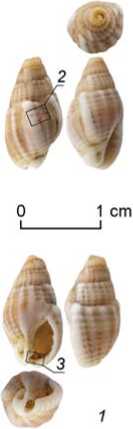
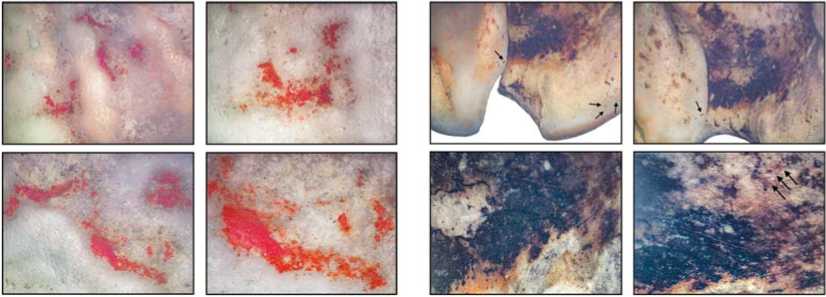
Fig. 2 . Tritia nitida shell from burial 2 at the Ust-Aleyka-5 burial ground ( 1 ), ocher spots on the its surface ( 2 ), traces of organic matter and ocher (arrows indicate trace residues of mineral pigment) ( 3 ).
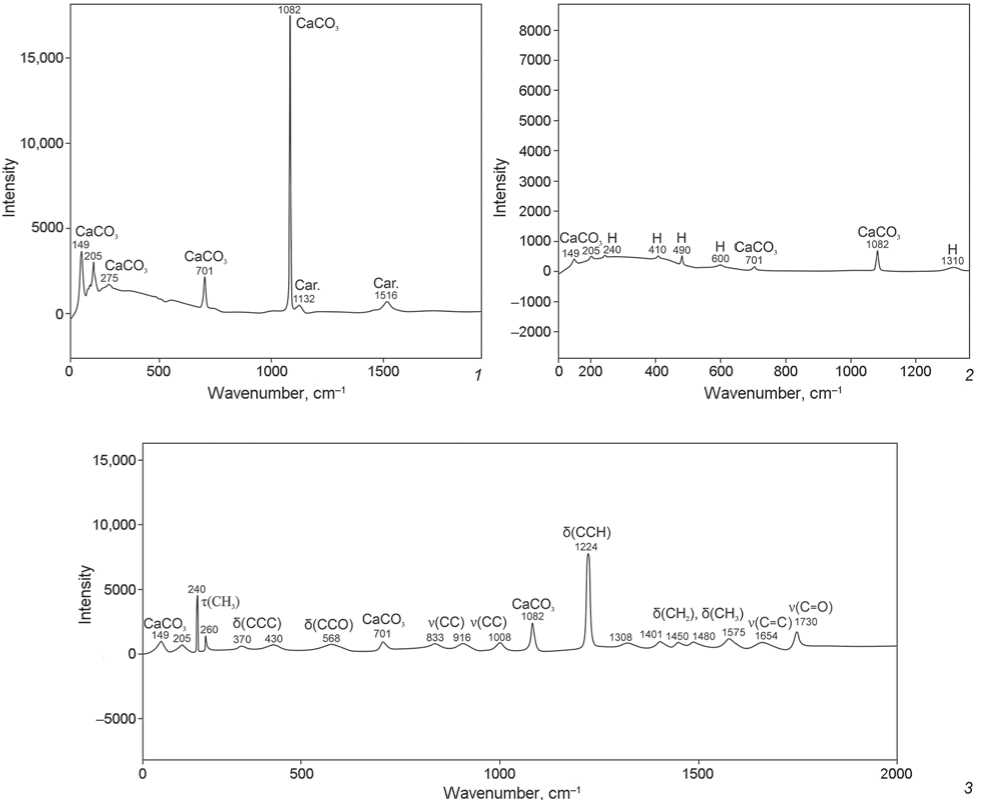
Fig. 3 . Raman spectra of samples from the surface of the mollusk shell: shell ( 1 ), red pigment ( 2 ), dark substance on the inner surface ( 3 ). CaCO3 is biogenic calcium carbonate in the crystalline form of aragonite; Car. – carotenoids; H – hematite; τ(CH3), δ(CCC), δ(CCO), ν(CC), δ(CCH), δ(CH2), δ(CH3), ν(C=C), ν(C=O) – compounds of organic adhesive substance.
and 1310 cm-1) (Wojcieszak, Wadley, 2019). Strong luminescence indicates the use of red ocher rather than pure hematite (Marucci et al., 2018: Fig. 2). In Neolithic and Chalcolithic burials of Northern Eurasia, ocher almost always served as such pigment. Although no traces of its use were found during the excavation of the burial, fragments of ocher were discovered on teardrop-shaped pendants made of antler or bone (Fig. 4, 1 ) during microscopic examination of the collection of goods from burial 2.
Pendants of irregular ellipsoid shape made from the fossil shell of the pearl mussel Unio aff. tumidus have already been the subject of a separate study (Borodaev et al., 2022). Subsequent microscopic examination revealed traces of ocher thereon (Fig. 4, 2). During the manufacture of the pendants, the inner surface of the shell became the face surface. Traces of ocher are usually clearly visible in the holes of the items or on their inner surfaces, which were processed using a fairly coarse abrasive, and its traces were not removed by subsequent smoothing or polishing. Ocher is best seen in microrelief of holes and traces of abrasive, but sometimes also appears on the outer surfaces of pendants.
Microscopic examination revealed traces of ocher on pendants made of red-deer teeth (Fig. 4, 3 , 4 ). Pigment, which also appeared in the form of a cluster of particles, is present on natural fractures of the tooth root, which were not modified during the grinding process (Fig. 4, 3 ). The pigment is less distinct inside the drilled holes and, over a significant
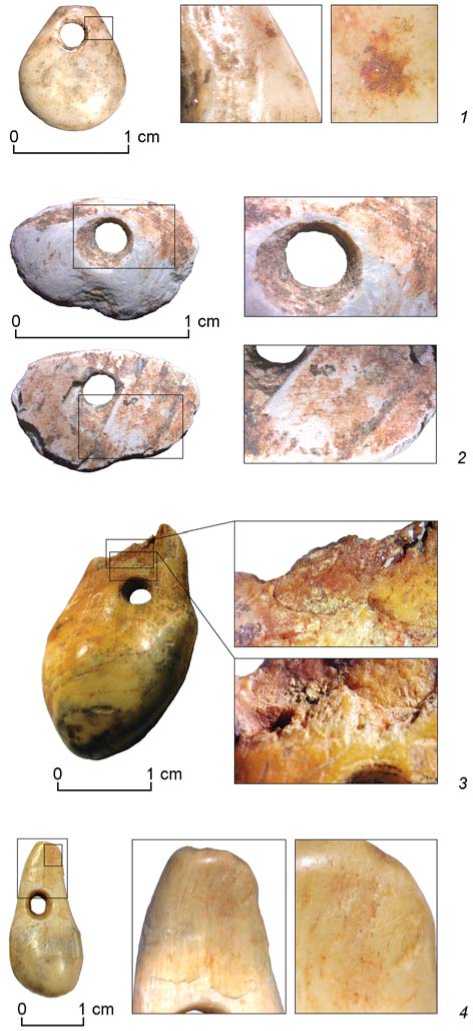
Fig. 4 . Finds from burial 2 at Ust-Aleyka-5.
1 – teardrop-shaped pendant made of antler or bone with traces of ocher (general view and fragment); 2 – mother-of-pearl pendant from a fossil shell of pearl mussel Unio aff. tumidus with traces of ocher (general view, interior side of the shell (outer side of the item) and exterior side of the shell (inner side of the item)); 3 , 4 – pendants made of red-deer teeth with traces of ocher (general view and fragments).
area, in the scratches that appeared during grinding of the tooth root (Fig. 4, 4 ). Unfortunately, the strongly polished surfaces of the teeth and their laboratory processing did not contribute to the good preservation of ocher traces.
A small piece of mineral pigment of irregular trapezoidal shape (Fig. 5, 1 ) was also found in burial 2. Scraping or grinding such stone produces powdery red ocher. All sides of the artifact were ground. Its concave surface was covered with numerous chaotically located scratches of varying depths of penetration, which were patinated. In some places, where the surface layer is damaged, it is clearly visible that the specimen under study is bright red inside (Fig. 5, 2 ). Pigment particles appearing on the shell of the Tritia nitida sea snail (see Fig. 2), teardropshaped pendants made of antler/bone (see Fig. 4, 1 ), mother-of-pearl pendants made of fossilized pearl mussel shells (see Fig. 4, 2), and pendants made of red-deer teeth (see Fig. 4, 3 , 4 ) from Ust-Aleyka-5 burial 2 are visually indistinguishable in color and structure.
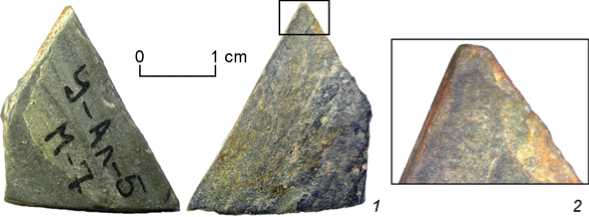
In the upper part of the grave-pit filling, a small greenish stone tablet of sub-triangular shape was also found (Fig. 6, 1 ). On one of its sharp corners, trace analysis has revealed marks of medium wear typical of a burin on hard material. The shape, size, and wear of the working edge, as well as traces of pigment on the working area detected by microscopic examination (Fig. 6, 2), suggest that the tool was
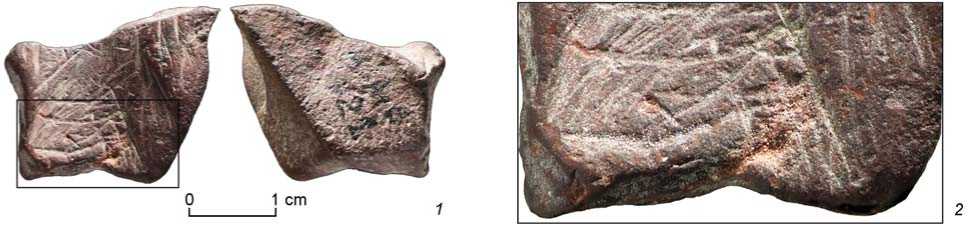
Fig. 5 . Fragment of a trapezoidal item made of hematite (?) from burial 2 at Ust-Aleyka-5.
1 – general view; 2 – area with traces of multidirectional scratches.
Fig. 6 . Burin from burial 2 at Ust-Aleyka-5.
1 – general view; 2 – fragment with traces of wear and ocher.
used for scraping off pigment from the hematite (?) fragment described above (see Fig. 5).
We can conclude that the shell of the Tritia nitida sea snail (see Fig. 2) and the burin (see Fig. 6) from the upper part of the grave-pit filling are undoubtedly a part of the funerary offerings in the Neolithic child burial 2 at the Ust-Aleyka-5 cemetery.
Discussion
The Tritia nitida sea snail and other closely related species of this genus are currently widespread on the Atlantic coast of Europe, and in the Mediterranean, Black and Azov seas. This taxon belongs to the family Nassariidae, order Bucciniformes, class gastropoda. Mollusks of this species have an ovate-conical shell with seven to eight slightly convex whorls separated by a fairly deep suture. The last whorl occupies slightly over a half of its entire height. On the surface of the shell, there are rows of radial and spiral folds, at the intersection of which protruding tubercles are located. The aperture is rounded-oval; its inner surface at the edge is usually slightly serrated. The height of the shell is up to 20–23 mm; the width is up to 10–15 mm (Fig. 7). The mollusks live on the bottom in the coastal zone. In the Black Sea basin, they occur along the entire coast (Anistratenko V.V., Khaliman, Anistratenko O.Y., 2011).
In Southern Europe, ornaments made of Tritia nitida shells have been found dating back to the Early Upper Paleolithic (Borić, Cristiani, 2019). It is difficult to provide a comprehensive overview of the Northern
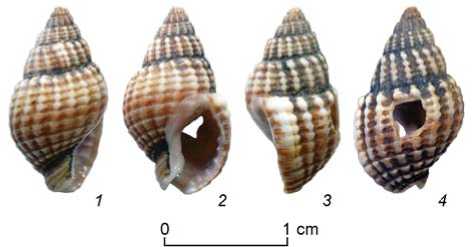
Fig. 7 . Modern shell of Tritia nitida . Black Sea, Sevastopol (from the collection of D.V. Kuzmenkin).
Mediterranean archaeological sites that contained tritium shells, and Tritia nitida in particular, since in the archaeological literature species definitions of shells used as ornaments are usually given without taking into account taxonomic and nomenclatural changes made in the mollusk systematics in the second half of the 20th–early 21st centuries (Kiyashko, Khlopachev, 2022: 108). For example, in the Western European literature, Tritia nitida is given as Nassarius reticulatus or N. reticulatus var. nitidus (Dupont, 2003: 50), while Cyclope neritea mollusks, which have a completely different shell shape, are considered tritiums (Borić, Cristiani, 2019: 223).
The published data suggest that the most common means of attaching the shells was holes in their walls (for the example, see Fig. 7, 2 , 4 ), which were formed naturally after the death of the mollusk or as a result of a deliberate blow (Ibid.: Fig. 2, 5, 6). Some of such holes show signs of “abrasion” from the thread (Mărgărit, Boroneanț, Bonsall, 2021). A fundamental question is how the shell of Tritia nitida could have been used. No holes nor grooves that could be interpreted as traces of attachment to clothing, headwear, or use as body ornaments can be visually identified on the shell in question. However, the remains of some substance are visible on the inner surface of the shell in the area of the columellar groove, even with the naked eye (see Fig. 2, 1 , 3 ). In modern empty shells of Tritia nitida , which can be collected on the seashore, traces of mollusk’s body are usually absent (see Fig. 7, 2 ).
Using Raman spectroscopy, we have established that the dark substance on the inner surface of the shell (14 points were examined) is of organic origin (see Fig. 3, 3). The obtained spectra demonstrate specific peak-markers of carbon compounds: τ(CH3) – 240, 260 cm-1; δ(CCC) – 370, 430; δ(CCO) – 568; ν(CC) – 833, 916, 1008; δ(CCH) – 1224; δ(CH2), δ(CH3) – 1308, 1401, 1450, 1480, 1575; ν(C=C) – 1654; ν(C=O) – 1730, which are part of the structures of organic adhesives (wax, wood resins) (Edwards, Falk, 1997; Brody, Edwards, Pollard, 2002). For the shell under discussion, these can be the remains of an adhesive used for attaching a cord or strap that was threaded through the columellar groove, and attached to the inside of the shell using a knot and glue. Simple actions with a knot tied at the end of a thread have shown that the shell could have been attached to the end of a strap or string (Fig. 8) and used as a pendant. The presence of the Tritia nitida shell above the child’s head suggests that it could have been a part of a headwear decoration.
In the fossil state, Tritia nitida and the morphologically close species are known from the Late Cenozoic (starting from the Miocene) deposits of Europe and Northwest Africa; they are numerous in the Pleistocene deposits of the Black Sea region (Ilyina, 1966: 138–140). Fossil representatives of this genus have not yet been known in Siberia or Central Asia. Taking into account the distribution (modern and geological) of mollusks of the Tritia genus, it can be assumed that the nearest region from which the shell of this mollusk could have reached the Upper Ob region is the Azov region or, more broadly, the Northern Black Sea region.
Individual shells of the Tritia genus have been found at archaeological sites far beyond their habitation area; for example, at the Upper Paleolithic (ca 15 ka BP) site of Yudinovo in the Bryansk Region. Numerous ornaments made from shells of sea mollusks of the Nucula , Cerastoderma , Steromphala , Cerithium, and Melarhaphe genera, which were most likely delivered from the Northwestern Black Sea region, were also found at that site (Kiyashko, Khlopachev, 2022). The distance from Yudinovo to the supposed shell collection sites is approximately 700 km in a straight line, and from the Black Sea region to the Upper Ob region it is more than four times greater.
The Tritia nitida shell is a single find unique for archaeological sites of the Altai and the entirety of Siberia. Shells of sea mollusks (including fossils) belong to a rare category of burial goods of the
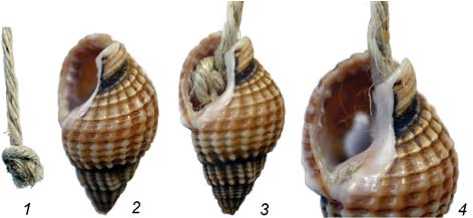
Fig. 8 . Reconstruction of the method of attachment through the columellar groove using a modern shell of Tritia nitida .
Neolithic and Chalcolithic cemeteries of the Altai (Kungurova, 2005; Kiryushin Y.F. et al., 2011; Kiryushin K.Y. et al., 2021).
Two AMS dates were obtained for teardrop-shaped pendants made of bone or antler: 5550 ± 25 BP (IGAN-5829) and 5219 ± 86 BP (NSKA-01941). The calendar-age intervals determined after calibration show a small spread for the first date (4445–4415, 4400–4380, 4375–4350 BC according to 1σ, and 4450–4340 BC according to 2σ) and significant spread for the second date (4230–4190, 4170–4090, 4080–3950 BC according to 1σ, and 4350–3800 BC according to 2σ).
The closest parallels to the teardrop-shaped pendants made of bone or antler, ornaments made of red-deer incisors, and lithic artifacts from burial 2 at Ust-Aleyka-5, appear among the evidence of the Solontsy-5 flat burial ground (northern foothills of the Altai) (Borodaev et al., 2022). Valves from Glycymeris sp . shells (marine bivalves) were found in burials at this cemetery (Kungurova, 2005: 33, 111, fig. 31, 4 ). Radiocarbon dates of 5485 ± 85 BP (SOAN-4627) and 5325 ± 45 BP (SOAN-4628) were obtained for burials 1 and 7 at Solontsy-5 (Ibid.: 57). The regions closest to the Altai with locations of fossil Glycymerides are the southern part of the Turgay Depression and the Aral Sea region (Kiryushin K.Y. et al., 2021).
The evidence from the Tuzovskiye Bugry-1 flat burial ground (Barnaul stretch of the Ob) includes ornaments made of fossil shells of Dentalium sea mollusks (Kiryushin Y.F. et al., 2011). They look like slightly curved tubes, tapering towards the front end, with porcelain-like surface. There are no known locations of these mollusks in the Altai Territory; moreover, there are not even the types of deposits in this region where they could occur. The closest locations of fossil Dentaliids to the Altai are in the Aral Sea region (Alekseev A.K., 1963).
Two AMS dates of 4649 ± 54 BP (GV-03584) and 4937 ± 56 BP (GV-03585) were established in the Center for Accelerator Mass Spectrometry of the Novosibirsk State University and the Novosibirsk Science Center (AMS Golden Valley) for the Tuzovskiye Bugry-1 burial ground using human bones from burial 33, where Dentalium mollusk shells were found. Using human bones from burial 35, where Cardiidae sp. mollusk shells were found, an AMS date of 4398 ± 57 BP (GV-03586) was obtained in the same Center.
Various shell ornaments appear among the evidence from the Sopka-2 burial ground (Baraba forest-steppe). Two pendants made of shell valves of Idionoma sp. and Anodonta sp. were found in the Early Metal Age burial complex (burial 643) (Molodin, 2001: 37, figs. 14, 35, 36). As V.I. Molodin noted, pendants made of shell valves of Idionoma sp. and Anodonta sp. clearly indicate “the direction of contacts and the origin of carriers of the culture associated with the Irtysh basin” (Ibid.). The evidence from the Early Metal Age burial complex (Ust-Tartas culture) includes over forty items made of mollusk shells of Corbicula tibetensis Prash., Anodonta sp., Idionoma sp., Glycymeris sp., Scaphopoda, of the Dentaliidae family (Ibid.: 102). According to Molodin, these finds testify to indirect connections between the inhabitants of Siberia and Central Asian territories; most likely, they were maintained thanks to the Ust-Narym and Botai communities, who lived in the modern Eastern and Northern Kazakhstan (Ibid.: 116).
Burial 2 at Ust-Aleyka-5 is the earliest among the Neolithic–Early Bronze Age burials in the southwestern Siberia, where shells of marine and fossil mollusks, as well as items made from these, were found. The shell of Tritia nitida clearly indicates connections between the population of the southwestern Siberia and those of the Azov region and Northern Black Sea region. At this stage of research, we cannot identify the carriers of the archaeological cultures who contributed to the movement of shells from the Northern Black Sea region to the south of Western Siberia.
Microscopic examination and analysis of substances using Raman spectroscopy has revealed traces of ocher on the shell of the Tritia nitida sea snail, ornaments made of Unio shells, teardrop-shaped pendants made of bone or antler, and pendants made of red-deer incisors. Ocher was so widely used in the burial practices of the Northern Eurasian population during the Mesolithic–Chalcolithic that there is no point in giving examples. As for the Final Mesolithic–Chalcolithic complexes in the Barnaul stretch of the Ob, ocher was found there only in burial 18 at the Firsovo XI flat burial ground, which has an AMS date of 9106 ± ± 80 BP (GV-02889) (Kiryushin K.Y. et al., 2021: 27). It suggests that the presence of ocher in Ust-Aleyka-5 burial 2 is another feature distinguishing it among the Neolithic–Chalcolithic burials of the Barnaul stretch of the Ob. However, traces of ocher were discovered only in the process of microscopic study of archaeological collections from the site. Possibly, a similar study of evidence from other burials of that period in the region may also reveal traces of ocher.
Notably, the microscopic study of archaeological collections from the Neolithic-Chalcolithic burials of the Altai, including use-wear analysis of artifacts, is an extremely promising area of research, which may provide rich information for historical reconstructions.
Conclusions
Our research unambiguously indicates that the shell of the Tritia nitida sea snail and the stone burin from the Ust-Aleyka-5 burial ground are part of the funerary offerings from burial 2.
The area closest to the Upper Ob region, whence the Tritia nitida shell could have been delivered, is the Azov region or (more broadly) the Northern Black Sea region.
The Tritia nitida shell testifies to ethnic and cultural contacts in the steppe belt of Northern Eurasia (from the Black Sea region to the Upper Ob region).
Microscopic examination has revealed traces of ocher use on the shell of Tritia nitida sea snail, ornaments made of Unio shell, teardrop-shaped bone or antler pendants, red-deer tooth pendants, and a burin. The use of ocher in the funerary rite of the population inhabiting the Barnaul stretch of the Ob has so far been recorded only in burial 18 at the Firsovo XI flat burial ground.
Acknowledgments
