
Socio-economic importance of organizing remote audit processes
Journal: Forum of Young Scientists @forum-nauka
Article in issue: 4 (116), 2026.
Free access
This article examines how audit firms can organize remote and hybrid audit processes without reducing audit quality or violating the requirements of the International Standards on Auditing. The study is based on comparative analysis, synthesis of professional guidance, review of regulatory sources, and interpretation of official statistics for Uzbekistan.
Short address: https://sciup.org/140316164
IDS: 140316164 | UDC: 657.6:004
Социально-экономическое значение организации процессов дистанционного аудита
В данной статье рассматривается, как аудиторские фирмы могут организовывать дистанционные и гибридные аудиторские процессы без снижения качества аудита и нарушения требований Международных стандартов аудита. Исследование основано на сравнительном анализе, обобщении профессиональных рекомендаций, обзоре нормативных источников и интерпретации официальной статистики по Узбекистану.
Text of the scientific article Socio-economic importance of organizing remote audit processes
The rapid diffusion of digital technologies is changing the organization of business processes, internal control, financial reporting, and assurance services. Audit firms are no exception. The pandemic period accelerated the use of remote communication, cloud platforms, and digital document exchange, but it also exposed the methodological and ethical limits of fully virtual audit work. Professional guidance issued during and after the COVID-19 period emphasized that remote working does not alter the auditor’s responsibility to obtain sufficient appropriate audit evidence and to maintain professional skepticism [4; 5]. For Uzbekistan, the issue has acquired strategic significance because national economic reforms increasingly rely on the digitalization of state administration, financial reporting, and public services [1; 2].
In this context, the organization of remote audit processes should be treated not as a temporary response to external shocks, but as an element of broader audit modernization. The challenge is to identify which audit procedures can be performed remotely without weakening evidence quality, which procedures require a physical presence, and how audit firms can combine both approaches in a cost-effective and secure manner. The practical relevance of this topic is reinforced by recent institutional changes in Uzbekistan’s audit system and by the expansion of the country’s digital infrastructure, which creates new opportunities for remote access to records, digital interaction with clients, and hybrid engagement planning.
Literature Review
The contemporary literature and professional guidance generally identify three clusters of issues in remote auditing. The first concerns efficiency gains. Remote auditing can reduce travel-related expenses, shorten the time required for routine evidence collection, and facilitate access to clients located in different regions. Professional bodies have also noted that remote techniques may improve scheduling flexibility and allow audit teams to work with digita evidence in a more structured way [5; 6].
The second cluster concerns audit quality and risk. International guidance stresses that the use of technology does not reduce the evidential threshold required by the ISAs. Instead, it requires the auditor to redesign procedures, consider alternative forms of evidence, and evaluate whether the evidence obtained remotely remains reliable, complete, and sufficient [4; 5]. High-risk areas—such as stock counts, site visits, physical inspection of fixed assets, and direct observation of operational controls—often remain poorly suited to a purely remote format.
The third cluster concerns organizational and behavioral effects. Remote work can improve flexibility, but it may also weaken supervision, complicate team learning, intensify cybersecurity risks, and blur the boundary between work time and rest time. For audit firms, this means that a purely technologica approach is insufficient. Remote audit requires updated workflows, forma evidence protocols, secure channels for exchanging information, and active partner-level quality review.
Research Methodology
The study applies general scientific and special analytical methods, including comparative analysis, classification, synthesis, deduction, and systematization of scientific and regulatory information. The empirica component is descriptive rather than econometric. It uses official indicators of Uzbekistan’s digital development to evaluate the institutional preconditions for the wider use of remote audit. The main sources include legislation of the Republic of Uzbekistan, guidance from international professional organizations, publications of the Chamber of Auditors of Uzbekistan, and official statistical datasets on the digital economy and internet infrastructure [1–10].
Methodologically, the article proceeds in four stages. First, it identifies the key benefits and constraints of remote auditing in the international literature. Second, it compares remote, on-site, and hybrid audit models. Third, it examines the digital readiness of Uzbekistan using selected official indicators. Fourth, it formulates an implementation framework for Uzbek audit firms that aligns technological feasibility with audit quality requirements.
Analysis and Discussion of Results
1. Why remote audit matters for audit firms
Remote audit is most effective where the engagement involves standardized documentation, repeated compliance procedures, digital accounting records, and geographically dispersed management communication. Under such conditions, the audit firm may achieve lower direct costs, shorter document turnaround time, and more flexible deployment of staff. These benefits are particularly valuable for medium-sized firms and for engagements in which part of the evidence already exists in digital form.
However, remote audit should not be interpreted as a universal substitute for traditional audit. Its economic effect depends on the quality of the client’s digital records, the reliability of internal controls, and the firm’s ability to standardize workflows. If the client lacks structured digital archives or if information security is weak, remote procedures may become more expensive and more risky than conventional fieldwork. Therefore, the relevant managerial choice is not between 'remote' and 'traditional' audit as mutually exclusive models, but between different combinations of remote and on-site procedures.
Table 1. Comparative characteristics of on-site, remote, and hybrid audit models
|
Criterion |
On-site audit |
Remote audit |
Hybrid audit |
|
Travel and logistics costs |
High |
Low |
Moderate |
|
Speed of routine document exchange |
Moderate |
High |
High |
|
Suitability for physical inspection |
High |
Low |
High |
|
Suitability for standard compliance testing |
Moderate |
High |
High |
|
Cybersecurity exposure |
Moderate |
High unless controlled |
Moderate to high |
|
Flexibility for scheduling |
Moderate |
High |
High |
|
Overall appropriateness |
Traditional environments |
Low-risk digital environments |
Most practical option |
Source: developed by the author on the basis of international audit guidance and the uploaded article.
2. International practices and the limits of full virtualization
International experience demonstrates that remote auditing is most successful when firms adopt a risk-based and technologically disciplined approach. Large audit networks expanded the use of digital collaboration platforms, cloud-based evidence exchange, and video-supported walkthroughs during the pandemic period. At the same time, professional organizations consistently warned against assuming that remote access automatically guarantees audit quality [4; 5].
A common conclusion of international practice is that hybrid audit is more sustainable than a fully remote model. Remote procedures are well suited to planning, analytical review, document inspection, client interviews, and selected control testing. By contrast, complex and high-risk procedures are still better performed on-site. This division of labor is especially important for firms operating in emerging markets, where the degree of digital maturity varies significantly across clients.
Table 2. Selected international practices and lessons for Uzbekistan
|
Practice |
Main insight |
Implication for Uzbek audit firms |
|
ICAEW remote audit guidance |
Remote techniques are acceptable only if sufficient appropriate evidence is still obtained. |
Firms should document alternative procedures and evidence quality tests. |
|
IAASB pandemic guidance |
Auditors may need enhanced or alternative procedures when normal access is constrained. |
Remote audit should be linked to formal risk reassessment. |
|
Big-firm hybrid practice |
Digital testing is efficient, but complex procedures still require physical verification. |
Hybrid planning should be the default model for high-risk engagements. |
|
Post-pandemic audit quality initiatives |
Training, supervision, and standardized workflows are essential for consistency. |
Investment in staff capability is as important as investment in technology. |
Source: compiled from ICAEW, IAASB, and professional practice materials [4– 6].
3. Digital readiness of Uzbekistan for remote auditing
The practical viability of remote audit depends on whether the surrounding digital ecosystem is sufficiently developed. In Uzbekistan, several official indicators point to a clear strengthening of this ecosystem. According to the National Statistics Committee, the total number of internet subscribers increased from 16.4 million in 2019 to 32.1 million in 2024, which represents almost a doubling over five years [8]. The same source shows that the share of ICT value added in GDP rose from 1.4% in 2019 to 2.4% in 2024 [7]. In parallel, the number of active organizations in the information and communication sector increased from 7,901 in 2020 to 10,551 in 2024 [9].
Additional evidence also points to progress in digital public administration. Government reporting indicates that by 2025 the Single Interactive Public Services Portal offered 800 services, had more than 12.5 million registered users, and delivered more than 39.4 million services during the first nine months of the year [10]. The World Bank reports that 89% of
Uzbekistan’s population used the internet in 2023 [11]. Taken together, these indicators suggest that the infrastructural conditions for remote and hybrid audit are substantially stronger today than they were before the pandemic.
Nevertheless, digital readiness at the macro level should not be confused with client-level readiness. Audit firms in Uzbekistan still face differences in the quality of digital records, cybersecurity discipline, electronic document management practices, and staff capability across industries and regions. Therefore, national statistics support the feasibility of remote audit, but they do not eliminate the need for selective implementation and strong quality safeguards.
Figure 1. Total internet subscribers in Uzbekistan, 2019-2024
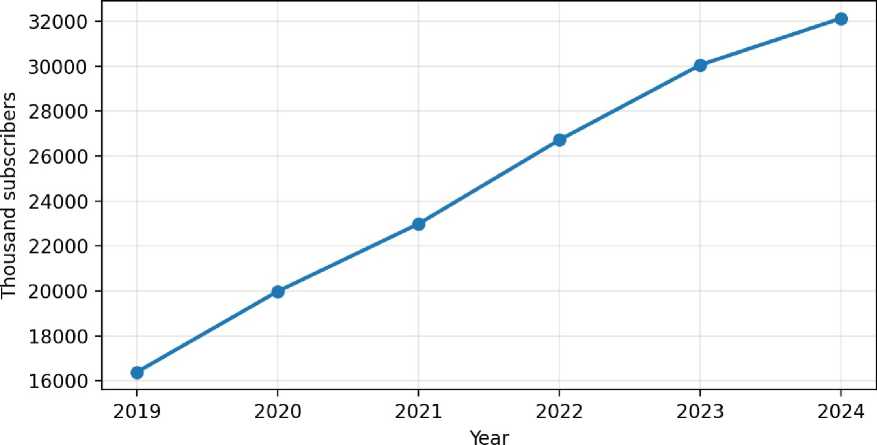
Source: National Statistics Committee of the Republic of Uzbekistan, dataset “Number of subscribers with Internet access, total (by region)” [8].
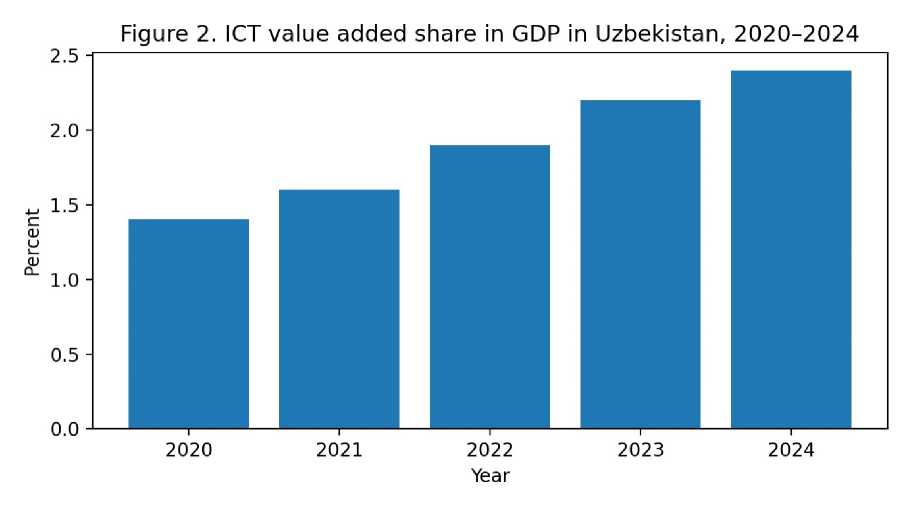
Source: National Statistics Committee of the Republic of Uzbekistan, dataset “Share of value added created in sector of information and communication technologies (ICT) in GDP (annual)” [7].
Table 3. Selected indicators of Uzbekistan’s digital environment relevant to remote auditing
|
Indicator |
Base year/value |
Latest year/value |
Interpretation for audit firms |
|
Total internet subscribers |
2019: 16,386.2 thousand |
2024: 32,138.6 thousand |
Wider digital connectivity supports remote evidence exchange. |
|
ICT value added in GDP |
2019: 1.4% |
2024: 2.4% |
Higher digital intensity strengthens the business case for technology-enabled audit. |
|
Active organizations in information and communication |
2020: 7,901 |
2024: 10,551 |
Expansion of the digital sector increases the supply of technology providers and skilled support. |
|
Users of the Single Portal |
2017: 60 services available |
2025: 800 services; 12.5+ million users |
Public sector digitalization helps normalize electronic interaction and identity verification. |
|
Individuals using the internet |
— |
2023: 89% of population |
A broad digital user base reduces barriers to client communication. |
Source: compiled from official statistics and government sources [7–11].
4. A proposed model for organizing remote audit processes in Uzbek audit firms
Based on the above analysis, the most suitable organizational solution for Uzbekistan is a hybrid model. Its logic is straightforward: routine, low-risk, and document-intensive procedures should be transferred to secure digital channels while high-risk and observation-based procedures should remain on-site. Such a model allows firms to capture efficiency gains without weakening audit reliability.
The model should begin with a client readiness assessment covering digital archives, accounting software, internal control maturity, cybersecurity practices, and the feasibility of video-supported walkthroughs. After acceptance the audit team should establish a protected digital workspace with controlled access, evidence naming rules, version control, and protocols for confidentiality
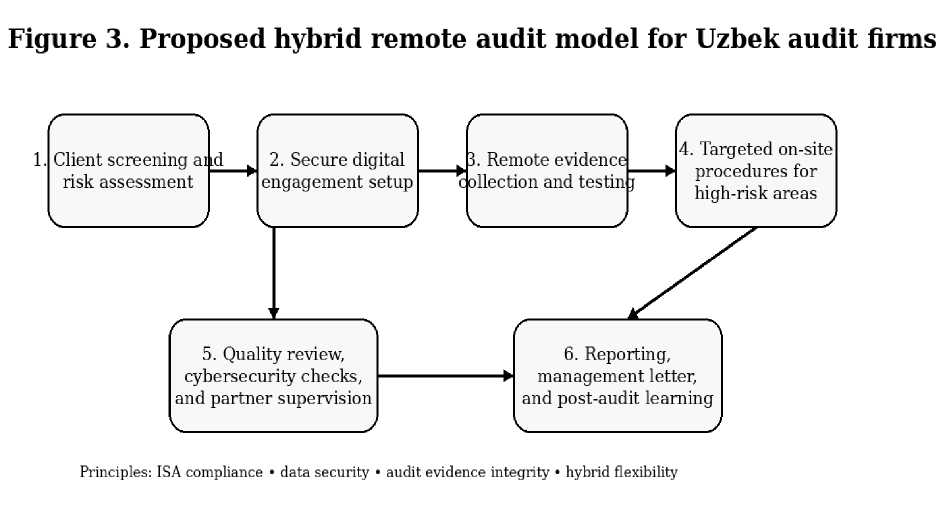
Source: developed by the author.
The main testing phase may then combine analytical procedures inspection of digital records, remote interviews, screen-sharing demonstrations and, where justified, targeted field visits. Finally, partner-level review should include not only technical audit issues but also data protection, completeness of digital evidence, and the appropriateness of any procedures replaced by remote alternatives.
Table 4. Practical roadmap for implementing remote and hybrid audit in Uzbek audit firms
|
Stage |
Key action |
Expected benefit |
Main control point |
|
1. Preparation |
Assess client digital readiness and classify engagement risk. |
Better selection of remote procedures. |
Partner approval of risk map. |
|
2. Infrastructure |
Introduce secure cloud folders, encrypted channels, and evidence protocols. |
Faster and safer information exchange. |
Access rights and cybersecurity review. |
|
3. Execution |
Use remote testing for routine areas and reserve fieldwork for high-risk procedures. |
Cost savings without loss of audit quality. |
Documentation of alternative procedures. |
|
4. Review |
Apply enhanced supervision and quality control over digital evidence. |
Consistency of judgments and compliance with ISAs. |
Second-level review of critical files. |
|
5. Development |
Train staff in digital tools, cyber hygiene, and remote communication. |
Sustainable improvement of audit capacity. |
Annual skills assessment. |
Source: developed by the author
Conclusion and Recommendations
The study shows that remote audit should not be viewed as a temporary or purely technical innovation. It is a new organizational format of audit work that requires methodological adaptation, digital infrastructure, and stronger internal quality controls. Its main advantages are lower travel costs, faster exchange of records, greater scheduling flexibility, and wider access to geographically dispersed clients. Its principal limitations concern evidence reliability in high-risk procedures, cybersecurity exposure, and the possibility of weaker team supervision.
For Uzbekistan, the development of remote and hybrid audit is realistic and timely. Official data confirm the expansion of internet connectivity, the rising economic role of the ICT sector, the growth of organizations in information and communication, and the rapid expansion of digital public services. These trends create a favorable environment for audit modernization. However, the evidence also suggests that the most effective path is not the full replacement of on-site audit, but the structured integration of remote and field procedures.
Accordingly, Uzbek audit firms should: (1) adopt hybrid engagement planning as a standard approach; (2) formalize secure digital evidence protocols; (3) strengthen cybersecurity and confidentiality controls; (4) expand staff training in remote methods and ISA-based alternative procedures; and (5) develop partner-level review mechanisms focused specifically on digital evidence quality. Implementation of these measures will increase the efficiency, resilience, and international compatibility of audit services in Uzbekistan.
