
Spatial Reasoning as a Predictor of Mathematical Performance: Evidence from a Gender-Based Analysis
Журнал: Интеграция образования @edumag-mrsu
Рубрика: Международный опыт интеграции образования
Статья в выпуске: 3 (124) т.30, 2026 года.
Бесплатный доступ
Introduction. Spatial reasoning is a critical cognitive factor supporting visualization, diagram interpretation, and mathematical problem-solving. However, its predictive contribution and gender-related patterns remain insufficiently understood among secondary school students. This study aims to examine the predictive relationship between spatial reasoning and mathematical performance and to investigate gender differences across both variables. Materials and Methods. A cross sectional survey design was employed involving 437 students selected from a population of 789 students at a public school in Jakarta. The study utilized two validated instruments: a spatial reasoning test and a mathematical performance test. Data analysis included simple linear regression to determine the extent to which spatial reasoning predicts mathematical performance, and an independent-samples t-test to analyze gender differences in both domains. Results. Spatial reasoning significantly predicted mathematical performance, indicating that students with stronger spatial reasoning tended to demonstrate better mathematical performance. A statistically significant gender difference was found in spatial reasoning, with male students obtaining higher scores than female students. In contrast, no statistically significant gender difference was found in mathematical performance. Overall, the findings show that spatial reasoning was significantly associated with mathematical performance, whereas gender differences were observed in spatial reasoning but not in mathematical performance. Conclusion. The findings indicate that spatial reasoning is a statistically significant but modest predictor of mathematical performance. The observed gender difference in spatial reasoning, together with the absence of a corresponding difference in mathematical performance, suggests that spatial reasoning should be supported through equitable instructional opportunities rather than interpreted as a fixed gender-related attribute.
Короткий адрес: https://sciup.org/147255145
IDS: 147255145 | УДК: 159.937.52:316.6 | DOI: 10.15507/1991-9468.26303.442-460
Пространственное мышление как предиктор математических результатов: итоги гендерного анализа
Введение. Пространственное мышление – важный когнитивный фактор, поддерживающий визуализацию и интерпретацию диаграмм, а также решение математических задач. Однако его предиктивный вклад и гендерно-ориентированные паттерны остаются малоизученными в научной литературе и недостаточно понятными среди учеников средней школы. Цель исследования – изучить прогностическую взаимосвязь между пространственным мышлением и математической успеваемостью, а также проанализировать гендерные различия по обеим переменным. Материалы и методы. Был реализован проект поперечного исследования, в котором приняли участие 437 учеников государственной школы в г. Джакарте. В исследовании использовались два проверенных инструмента: тест пространственного мышления и математический тест. Анализ данных включал простую линейную регрессию для определения степени, в которой пространственное мышление прогнозирует математические результаты, а также независимый t-тест для анализа гендерных различий в пространственном мышлении и математической успеваемости. Результаты исследования. Пространственное мышление выступает предиктором успешной успеваемости по математике: учащиеся с более развитым пространственным мышлением, как правило, демонстрировали лучшие результаты по данному предмету. Были выявлены статистически значимые гендерные различия в показателях пространственного мышления – юноши набрали более высокие баллы по сравнению с девушками. При этом статистически значимых гендерных различий в успеваемости по математике не обнаружено. Продемонстрировано, что пространственное мышление существенно связано с успеваемостью по математике, тогда как гендерные различия наблюдались в пространственном мышлении, но не в успеваемости по математике. Заключение. Пространственное мышление – статистически значимый, но умеренный предиктор математических результатов. Выявленное гендерное различие в пространственном мышлении наряду с отсутствием соответствующего различия в математических результатах свидетельствует о необходимости поддерживать развитие пространственного мышления посредством равных возможностей для обучения, а не рассматривать его как фиксированную характеристику, связанную с гендером. Материалы статьи важны для математического образования, особенно при разработке учебных заданий, способствующих развитию навыков пространственного мышления.
Текст научной статьи Spatial Reasoning as a Predictor of Mathematical Performance: Evidence from a Gender-Based Analysis
EDN:
Mathematical performance has become a fundamental determinant of students’ academic success and global competitiveness in the twenty-first century, as it underpins higher-order thinking skills such as critical reasoning, creativity, problem-solving, and logical decision-making [1; 2]. These competencies are widely recognized as essential learning outcomes in contemporary education systems and are strongly emphasized within international educational frameworks aimed at enhancing educational quality and equity1 [3]. Empirical evidence consistently demonstrates that students’ mathematical cognitive abilities significantly influence their capacity to understand, apply, and solve mathematical problems effectively, thereby serving as a key indicator of instructional effectiveness and overall educational quality2 [4; 5]. Despite the substantial body of research on students’ mathematical achievement, there remains a limited understanding of the specific cognitive mechanisms that predict mathematical performance across diverse educational contexts.
Mathematical performance refers to students’ successful engagement with mathematical tasks and problem-solving activities [6; 7]. Its variation reflects the interaction of multiple cognitive and affective processes [8; 9]. However, evidence from large-scale assessments consistently indicates that a substantial proportion of students continue to demonstrate low levels of mathematical reasoning and problemsolving ability. These findings suggest that students’ difficulties extend beyond procedural knowledge to include deeper cognitive processes required for effective mathematical reasoning. This persistent issue highlights a critical problem: while current assessments are effective in identifying performance gaps, they provide limited insight into the underlying cognitive predictors that explain why some students succeed in mathematics while others struggle.
On a broader scale, the international assessment known as Programme for International Student Assessment (PISA) is one of the studies that evaluates mathematical performance and has become a central international reference for monitoring recent trends in mathematical literacy and reasoning3 [10].
Recent empirical findings from PISA indicate that mathematical literacy extends beyond procedural competence and is fundamentally grounded in students’ mathematical reasoning and problem-solving abilities4. According to the OECD framework, mathematical literacy consists of two key components: mathematical reasoning and problem-solving.
In addition to international assessments, Indonesia has recently aligned its national assessment policy with the PISA framework through the Minimum Competency Assessment (Asesmen Kompetensi Minimum or AKM). One of the dimensions measured in AKM is numeracy, which refers to students’ ability to reason using mathematics to solve problems5. The AKM assessment involves three process dimensions: understanding, application, and reasoning. Recent empirical analyses suggest that these three dimensions collectively capture students’ mathematical problem-solving competence and closely parallel the constructs assessed in PISA [11].
Reviewing the dimensions measured in mathematical literacy in PISA and numeracy in AKM reveals that mathematical reasoning constitutes a shared and central core across both assessment systems. This convergence provides empirical justification for positioning reasoning as a critical indicator of students’ mathematical performance at both international and national levels.
Among the various forms of mathematical reasoning, recent empirical advances have increasingly highlighted spatial reasoning as a key cognitive component underlying students’ mathematical performance.
Spatial reasoning is the ability to recognize and manipulate the spatial properties of objects and the spatial relationships among multiple objects [12]. Spatial reasoning refers to the capacity to accurately perceive and mentally transform spatial representations, or in other words, the ability to visualize images [13–15]. Recent studies demonstrate that facilitating spatial reasoning in mathematics education enables students to bridge informal real-world contexts with formal mathematical concepts, particularly in problem-solving situations [16; 17].
Spatial reasoning ability has therefore received increasing empirical attention because it plays a vital role in students’ future academic success and career opportunities, especially in science, technology, engineering, and mathematics (STEM)-related fields [18]. Spatial reasoning skills can be effectively developed through geometry instruction, given the domain’s reliance on visual representations that enhance spatial awareness and relational thinking [19]. Longitudinal empirical evidence further suggests that spatial reasoning develops progressively over time and varies across individuals depending on age and experience, underscoring the importance of early and sustained instructional support6.
Research has shown a positive correlation between spatial reasoning and mathematical performance in PISA assessments. Reasoning is considered a key component of students’ mathematical performance [20; 21]. Specifically, students who score highly on spatial reasoning tests often demonstrate superior mathematical performance [5]. Spatial reasoning contributes to improving students’ mathematics achievement across various assessments, including PISA and Trends in International Mathematics and Science Study (TIMSS) [22]. Fitriyani et al. [23] also found that spatial reasoning has an influence on mathematical performance. This is consistent with the findings of T. Xu et al. [24], who also reported that spatial reasoning contributes to mathematical performance. Therefore, spatial reasoning can serve as a prominent predictor of students’ mathematical performance.
Other studies reinforce that the relationship between spatial reasoning and mathematical performance is predictive rather than causal. Spatial reasoning is considered one of the cognitive components that can predict students’ mathematical achievement due to its involvement in understanding geometric shapes, interpreting graphs, and visualizing mathematical patterns or relationships [25]. Instead, spatial reasoning acts as a supporting factor that enhances the ability to mentally represent mathematical information [26]. A longitudinal study by E.V. Laski et al. [27] showed that children with high spatial reasoning scores at the beginning of the school year tend to demonstrate more significant progress in mathematical performance by the end of the year, indicating the predictive potential of this cognitive aspect.
Another study by J. Wai et al. [28] also supports these findings by demonstrating that spatial ability during adolescence plays a role in predicting long-term academic achievement and careers in STEM fields. Therefore, understanding this relationship should be positioned within a predictive framework, serving as a means to estimate students’ mathematical performance and guide more targeted educational interventions.
Although numerous studies have reported a positive association between spatial reasoning and mathematical performance, existing research reveals several critical gaps that remain insufficiently addressed. First, a population gap is evident, as prior studies have predominantly focused on elementary school students or have examined junior high school students without adequately differentiating results across key demographic groups. For example, T. Xu et al. [24] limited their investigation to elementary students, while H. Fitriyani et al. [23] examined junior high school students but did not explicitly disaggregate findings by gender. Second, a methodological gap persists, given that many studies rely on general correlational designs without employing predictive analytical approaches that clarify the extent to which spatial reasoning explains variations in mathematical performance.
Third, an analytical gap can be identified, as limited attention has been given to simultaneously examining group-based differences, such as gender, alongside predictive relationships. Finally, a contextual gap remains, as empirical evidence from diverse educational contexts, particularly within lower secondary education systems aligned with national and international assessments, remains scarce. Collectively, these gaps underscore the need for more nuanced research that systematically examines the role of spatial reasoning in mathematical performance among junior high school students across demographic, methodological, analytical, and contextual dimensions.
The present study addresses these gaps by examining the predictive role of spatial reasoning in mathematical performance among secondary school students, with particular attention to gender differences. Specifically, this study aims to investigate the extent to which spatial reasoning predicts students’ mathematical performance and to examine gender differences in both spatial reasoning and mathematical performance.
Literature Review
Spatial reasoning constitutes a core component of mathematical cognition and functions as a foundational cognitive mechanism that supports how learners interpret, transform, and represent mathematical information across multiple representational forms [29]. It encompasses core processes such as mental rotation, spatial orientation, and visualisation, which enable students to engage meaningfully with diagrams, shapes, number lines, and multidimensional representations [12; 19]. From a theoretical perspective, spatial reasoning is grounded in cognitive theories of representation and transformation, which posit that mathematical understanding is built through the coordination of visual – spatial and symbolic processes. Developmental studies consistently show that spatial and mathematical thinking emerge early and develop in tandem, forming a conceptual basis for later mathematical learning and problem solving [17; 25]. In the primary years, spatial skills are implicated in geometry, measurement, fractions, and data interpretation, indicating that spatial reasoning operates as a cross-cutting cognitive resource rather than being limited to spatially explicit tasks [16; 30].
A meta-analysis by K. Atit et al. [31], synthesising findings from diverse populations, concluded that spatial skills demonstrate consistent and meaningful associations with mathematics achievement, with effect sizes that are modest yet stable. K.A. Gilligan et al. [13] further showed that spatial ability uniquely predicts mathematics performance in middle childhood even after controlling for verbal and non-verbal reasoning, suggesting that spatial reasoning contributes distinct explanatory power beyond general intelligence. T. Xu et al. [24] extended this evidence by demonstrating that spatial reasoning contributes to mathematics outcomes across content domains among Chinese students, highlighting that the spatial–mathematical relationship is robust across cultural contexts.
T. Lowrie and T. Logan [22] reported that multiple spatial reasoning constructs interact dynamically with mathematics understanding in elementary classrooms. Experimental work by T. Lowrie et al. [32] demonstrated improvements in both spatial reasoning and mathematical performance following targeted spatial visualisation training. M.M. Beck et al. [6] further showed that motor-enriched learning activities enhance mathematics outcomes, implying that embodied spatial experiences may reinforce deeper cognitive processing. S.A. Sorby and G.C. Panther [5] argued that improving spatial abilities has the potential to enhance students’ performance in large-scale international assessments such as PISA, thereby linking spatial reasoning to contemporary assessment frameworks.
G. Kurt et al. [19] found that middle school students tend to perform better on spatial orientation tasks than on visualisation tasks, suggesting uneven instructional emphasis across spatial domains. U. Hasanah et al. [18] similarly observed that spatial visualisation remains the most challenging dimension for primary students, raising questions about whether existing curricula sufficiently support this subskill. Within the Indonesian context, H. Fitriyani et al. [23] reported differentiated gains in spatial reasoning during online learning, while also confirming consistent associations with mathematics performance. These findings collectively suggest that not all spatial skills contribute equally to mathematical learning, underscoring the need for fine-grained measurement.
Internationally, PISA emphasises students’ capacity to formulate, employ, and interpret mathematics in real-world situations, foregrounding reasoning, modelling, and problem solving rather than procedural fluency alone7. S. Grey and P. Morris [10] further argue that mathematics learning in the twenty-first century engages creativity, reflection, and adaptive reasoning. In Indonesia, the AKM reflects these global perspectives by prioritising numeracy skills aligned with reasoning and everyday appli-cations8. Complementary evidence shows that mathematical reasoning and generalisation strongly influence students’ ability to respond flexibly to open-ended and nonroutine problems [21; 33].
Project-based learning, collaborative environments, and technology-supported instruction have been shown to enhance mathematical understanding and support twenty-first-century skills [2; 3]. Cognitive resources such as working memory and general intelligence also contribute to mathematical performance across primary and secondary levels [4]. A.M. Moore and M.H. Ashcraft [9] emphasised that mathematical task performance relies on multiple interacting cognitive processes, suggesting that spatial reasoning should be examined as one key predictor within a multidimensional cognitive system rather than as an isolated factor.
Numerous studies report that male students tend to outperform female students on certain spatial tasks, particularly mental rotation and complex transformations [28; 34]. However, meta-analytic evidence indicates that these differences are neither universal nor deterministic and are often moderated by sociocultural and instructional factors [31]. In many contexts, differences in spatial skills do not translate into substantial gaps in mathematics achievement [35]. S. Rodriguez et al. [36] further demonstrated that female students often experience higher mathematics anxiety and lower confidence despite comparable achievement levels, while S.L. Lukowski [8] showed that mathematics-specific anxiety can negatively affect performance. These findings point to a complex interaction between cognitive and affective factors that remains underexplored at the junior high school level.
Methodologically, addressing these complexities requires instruments that align theoretical constructs with empirical measurement. A. Ramful et al. [37] developed the Spatial Reasoning Instrument (SRI), which operationalises spatial reasoning through three stable subcomponents with acceptable reliability, providing a theoretically grounded tool for examining distinct spatial processes. S. Dündar et al. [38] constructed a multidimensional assessment of mathematical performance encompassing quantitative, qualitative, causal, spatial, and inductive–deductive reasoning, allowing researchers to capture mathematical performance as a multifaceted construct.
Taken together, recent literature suggests that spatial reasoning functions as a meaningful predictor of mathematical performance. The magnitude of its contribution varies according to age, task characteristics, instructional exposure, and sociocultural context. Evidence on gender differences remains mixed, reflecting ongoing theoretical tension regarding the interplay between cognitive, affective, and contextual factors. Against this backdrop, the present study addresses an urgent need to clarify how spatial reasoning predicts mathematical performance among junior high school students and whether these relationships differ by gender within the Indonesian context.
Despite advances in the field, several unresolved issues remain. First, findings vary across spatial subcomponents and mathematical domains, making it difficult to generalize a single spatial – mathematical relationship. Second, much of the available evidence derives from elementary-school or non-Indonesian samples, leaving lower-secondary contexts comparatively underrepresented. Third, findings regarding gender differences remain inconsistent and may depend on sociocultural, experiential, and instructional conditions. These unresolved issues justify examining the magnitude of the predictive association between spatial reasoning and mathematical performance, together with gender differences in both variables, among Indonesian junior high school students.
Materials and Methods
Research Design. This study employed a quantitative, cross-sectional correlational-predictive research design to examine the role of spatial reasoning in students’ mathematical performance and to investigate gender-based differences. This study used quantitative inferential statistics. The selected design is appropriate for the study’s objectives, which aim to identify predictive relationships between cognitive variables and to compare group differences without manipulating instructional conditions.
The correlational-predictive approach adopted in this study is grounded in quantitative research frameworks commonly used in educational psychology and mathematics education9. This approach allows for the examination of the extent to which spatial reasoning statistically predicts mathematical performance while accounting for naturally occurring individual differences, such as gender.
One major advantage of this design lies in its suitability for school-based research contexts, as it enables the investigation of cognitive predictors using authentic classroom data without disrupting regular instructional practices.
Previous empirical studies examining spatial reasoning and mathematical performance have successfully employed similar correlational or regression-based approaches, thereby supporting the methodological appropriateness of the chosen design. For instance, K. Atit et al. [31] synthesized correlational evidence across multiple contexts to establish stable associations between spatial skills and mathematics achievement, while K.A. Gilligan et al. [13] demonstrated the unique predictive contribution of spatial ability beyond general cognitive factors. These studies provide empirical justification for adopting a correlational, predictive design in the present research.
Participants and Sampling. The study involved 437 junior high school students selected from a total population of 789 students enrolled in a public secondary school in Jakarta. The participants were aged between 12 and 16 years, comprising 47.1% seventh-grade students and 52.9% eighthgrade students. In terms of gender distribution, female students accounted for 52.6% of the sample, while one participant did not report gender information.
A stratified random sampling technique was employed, with grade level serving as the stratification variable. This technique was chosen to ensure proportional representation of students from both seventh and eighth grades, thereby enhancing the generalizability of the findings within the school context. The sample size was determined based on population accessibility and statistical adequacy for regression and group comparison analyses, exceeding the minimum recommended sample size for correlational research.
Participants were categorised according to gender (male/female) and grade level (seventh/eighth grade) for analytical purposes. This categorisation aligns directly with the study objectives, which focus on examining predictive relationships and gender-based differences in spatial reasoning and mathematical performance.
Ethical considerations were carefully addressed throughout the participant selection process. Permission to conduct the study was obtained from the school administration. Parental consent and student assent were secured prior to data collection, and participation was entirely voluntary. Students were informed of the study’s purpose, assured of the confidentiality and anonymity of their responses, and given the right to withdraw at any stage without penalty.
Detailed demographic characteristics of the participants are presented in Table 1.
Procedure. Data collection was conducted during regular school hours using two standardised assessment instruments administered in a controlled classroom setting. The first instrument measured spatial reasoning, while the second assessed mathematical performance. No strict time limits were imposed, allowing students sufficient time to complete all items and reducing potential test anxiety effects.
T a b l e 1. Participant profile
|
Category |
Frequency |
% |
|
Gender Female |
230 |
52.6 |
|
Male |
207 |
47.4 |
|
Total |
437 |
100.0 |
|
Grade Grade 7 |
206 |
47.1 |
|
Grade 8 |
231 |
52.9 |
|
Total |
437 |
100.0 |
|
Age 12 years |
28 |
6.4 |
|
13 years |
180 |
41.2 |
|
14 years |
205 |
46.9 |
|
15 years |
22 |
5.0 |
|
16 years |
1 |
0.2 |
|
Missing Data |
1 |
0.2 |
|
Total |
437 |
100.0 |
Source : Compiled by the authors based on participant demographic data.
In addition to the assessments, participants provided demographic information, including gender and grade level. All responses were anonymised, coded, and prepared for statistical analysis.
Instruments. The spatial reasoning assessment was adapted from the SRI developed and validated by A. Ramful et al. [37]. It was obtained directly from the original authors through email correspondence. Its use in this study is for academic research purposes, and the original instrument will be submitted as supplementary material through the journal system for verification. The original instrument comprised 45 items representing three dimensions of spatial reasoning: mental rotation, spatial orientation, and spatial visualisation. Following factor analysis, 30 items were retained, with ten items per dimension. Although the reliability coefficients for individual subscales were moderate, the overall instrument demonstrated strong internal consistency (Cronbach’s α = 0.845), indicating satisfactory reliability for research purposes. Sample items representing the three measured constructs are presented in Figures 1–3.
The mathematical performance test was adapted from the instrument developed by S. Dündar et al. [38]. The development process began with a pool of 47 items. Following expert review, seven items were removed, resulting in 40 items. The pilot-testing and factor-analytic stages further reduced the instrument to 27 items. Confirmatory Factor Analysis (CFA) in the main study subsequently identified three items that did not adequately fit their intended factors, resulting in a final 24-item instrument representing five dimensions, as confirmed through administration to 448 eighth-grade students. Representative items from each dimension are presented in Table 2. The adapted instruments were supported by prior validation evidence and their internal consistency was re-examined using Cronbach’s alpha in the present sample. However, because the instruments were administered only once, test – retest reliability was not assessed.
Data Analysis. Data were analysed using quantitative inferential statistical techniques. Descriptive statistics were first computed to summarise students’ spatial reasoning and mathematical performance scores. Independent samples t-tests were conducted to examine gender-based differences in both spatial reasoning and mathematical performance. To investigate the predictive role of spatial reasoning, a simple linear regression analysis was performed, with mathematical performance as the dependent variable and spatial reasoning as the independent variable. All statistical analyses were conducted using SPSS software, with the significance level set at p < 0.05.
Ethical Considerations. In accordance with institutional and local research procedures for non-invasive school-based studies, formal ethics committee approval was not required for this study. Permission to conduct the research was obtained from the school administration prior to data collection.
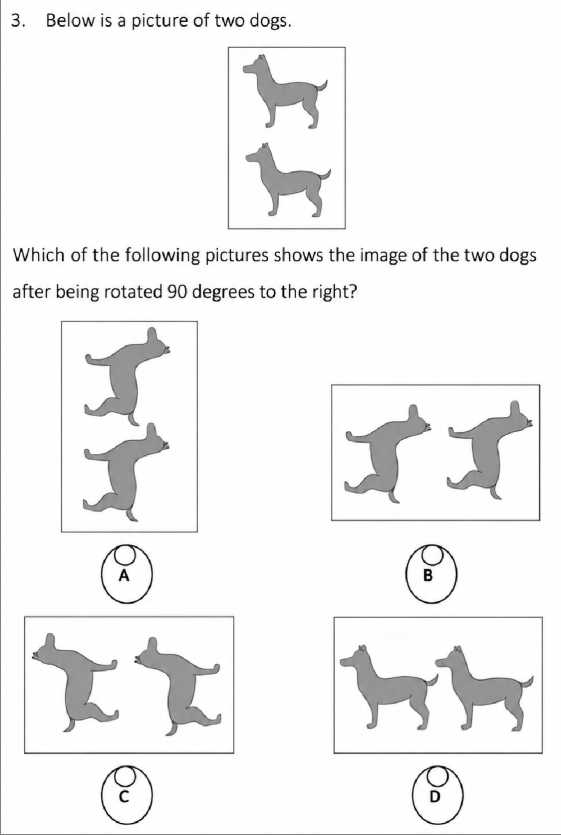
a)
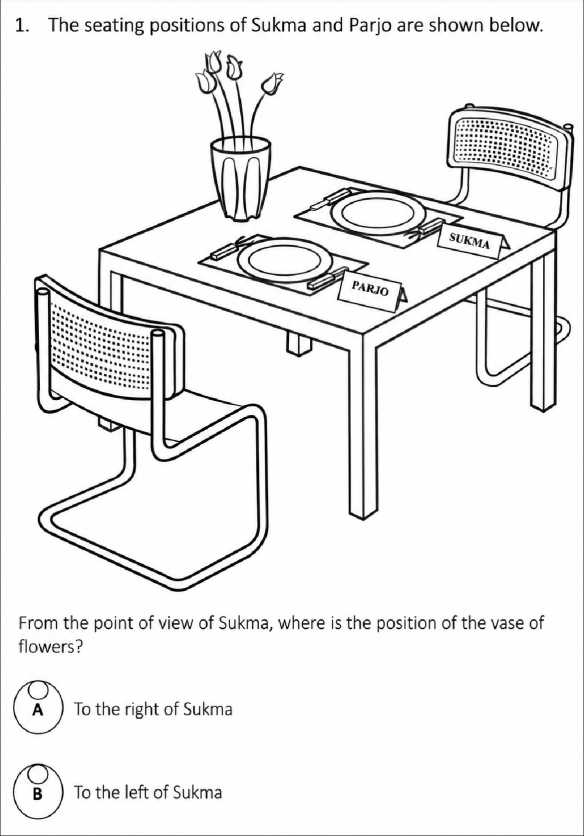
b)
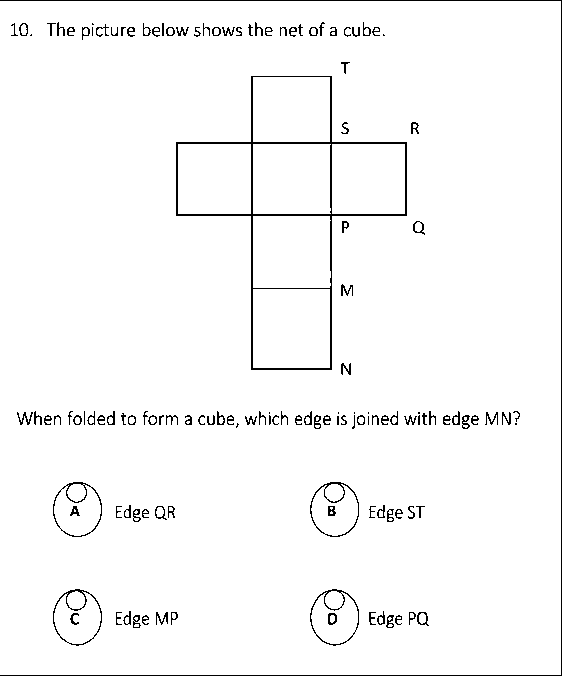
c)
Figure. Sample items of spatial ability from the SRI: a) mental rotation; b) spatial orientation; c) spatial visualisation
Source: Compiled by the authors based on data from a sources Ramful A., Lowrie T., Logan T. Measurement of Spatial Ability: Construction and Validation of the Spatial Reasoning Instrument for Middle School Students. Journal of Psychoeducational Assessment. 2017;35(7):709–727. [37]; Purnomo Y.W., Fadhilah F.N., Sumusiasih U, Rah-mawati R.D., Fitriya Y. The Role of Spatial Anxiety in the Relationship between Mathematics Anxiety and Spatial Reasoning. Journal on Efficiency and Responsibility in Education and Science. 2024;18(3):229–240. [39].
T a b l e 2. Sample of instrument items after face validity testing by experts
|
Construct Factor |
Question |
|
Quantitative Skills |
Consider the following sequence of numbers: 3, 7, 11, 15, ... These numbers can be generated by a formula n . What is the formula for n to continue the next numbers? A) 3 n B) 4 n C) 3 n –1 D) 4 n –1 E) 3 n +1 |
|
Qualitative Skills |
The following is a sequence of numbers made with a certain rule: 3 7 15 31 ? What number replaces the “?” sign? A) 24 B) 36 C) 45 D) 56 E) 63 |
|
Causal Skills |
Consider the figure below! The rectangle is divided into 3 parts. Each part will be painted with a different color. The available colors are red, yellow, and green. How many ways can each part of the rectangle be painted using the available colors? A) 3 B) 9 C) 6 D) 18 E) 12 |
|
Spatial Skills |
Below are the FRONT and RIGHT views of an arrangement of cubes. Which of the following choices represents the BACK view? FRONT RIGHT А) Ш В) Ь C) U D)Q_U E) 1 1 П |
|
Inductive and Deductive Skills |
In a race involving Adi, Jarwo, Bambang, and other runners: Adi finished 4th. There are 3 people between Jarwo and Adi. Bambang finished 2 places behind Jarwo. Based on the text, what place did Bambang finish? A) 3 B) 5 C) 7 D) 8 E) 10 |
Source: Adapted from Dündar S., Temel H., Gündüz N. Development of a Mathematical Ability Test: A Validity and Reliability Study. International Journal of Mathematical Education in Science and Technology. 2016;47(7):1061–1075. [38].
Written parental consent and student assent were obtained for all participants. Participation was voluntary, and students were informed of the study purpose, confidentiality procedures, anonymity of responses, and their right to withdraw at any time without penalty.
Results
Spatial Reasoning and Mathematical Performance Profile. Before conducting further analysis, it is important to understand the general profile of students’ spatial reasoning and mathematical performance.
The data include three factors of spatial reasoning: mental rotation, spatial orientation, and visualization, as well as overall spatial reasoning and mathematical performance. Each factor is analyzed based on the number of students, mean score, standard deviation, minimum and maximum values, and reliability (α). The profile data for spatial reasoning and mathematical performance are presented in Table 3.
The results indicate that within the spatial reasoning variables, the spatial orientation factor has the highest mean score of 7.176 with a standard deviation of 1.781.
C ^^^ j88888888j ИНТЕГРАЦИЯ ОБРАЗОВАНИЯ. Т. 30, № 3. 2026
T a b l e 3. Profile of spatial reasoning and mathematical performance
|
Factor |
Number of items |
Mean |
Standard Deviation |
Min |
Max |
α |
|
Mental rotation |
10 |
4.007 |
2.010 |
0 |
10 |
0.525 |
|
Spatial orientation |
10 |
7.176 |
1.781 |
2 |
10 |
0.536 |
|
Visualization |
10 |
3.476 |
1.786 |
0 |
8 |
0.446 |
|
Spatial reasoning (total) |
30 |
14.659 |
4.338 |
3 |
27 |
0.722 |
|
Mathematical performance |
24 |
7.982 |
3.001 |
1 |
18 |
0.524 |
Note : α – Cronbach’s alpha coefficients.
Source : Hereinafter in this article all tables were drawn up by the authors.
Meanwhile, the factor with the lowest mean score is visualization, with a mean of 3.476 and a standard deviation of 1.786. The mental rotation factor has a mean score of 4.007 with a standard deviation of 2.010. All three factors have Cronbach’s Alpha (α) values within the acceptable reliability range: 0.525 for mental rotation, 0.536 for spatial orientation, and 0.446 for visualization.
Overall, the average spatial reasoning score is 14.659 with a standard deviation of 4.338, and the Cronbach’s Alpha (α) value obtained is 0.722, indicating good reliability. Meanwhile, the mathematical performance variable has an average score of 7.982 with a standard deviation of 3.001. The Cronbach’s Alpha (α) value for this variable is 0.524, which is considered reliable.
The Influence of Spatial Reasoning in Predicting Mathematical Performance. The analysis used to determine the influence of spatial reasoning in predicting mathematical performance was a simple linear regression test. Before conducting this test, the regression assumptions including normality, linearity, and homoscedasticity were checked and met. Therefore, the simple linear regression test could be performed.
Based on the analysis, the significance value (sig.) is less than 0.05 and the calculated value ( F = 53.719) is greater than the critical F -value, indicating a significant positive relationship between spatial reasoning and mathematical performance. However, the correlation coefficient R = 0.332 shows a positive but low correlation between spatial reasoning and mathematical performance.
The value of 0.110 indicates that spatial reasoning accounts for a small but meaningful proportion of the variance in students’ mathematical performance, explaining approximately 11% of the total variability, while the remaining variation is attributable to other cognitive, instructional, and contextual factors. Although the magnitude of this effect is relatively modest, such effect sizes are common and theoretically meaningful in large-scale educational research, where learning outcomes are influenced by multiple interacting variables.
The adjusted R2 value of 0.108 suggests that the regression model demonstrates adequate stability and generalizability, indicating that the explanatory contribution of spatial reasoning remains consistent after accounting for sample size. Importantly, these findings should not be interpreted as indicating that spatial reasoning is a dominant or singular determinant of mathematical performance; rather, spatial reasoning functions as a supporting cognitive predictor that contributes alongside other factors [40].
Although the observed correlation is relatively small according to conventional benchmarks10, such effect sizes are common in educational research and remain meaningful when interpreted within multifactorial learning contexts.
Consistent with prior educational research, even small effect sizes can provide valuable insights into learning processes when they reflect stable and theoretically grounded relationships [31]. Following the examination of the overall model fit, the regression coefficients and associated statistics are presented in Table 4 to further clarify the predictive role of spatial reasoning in mathematical performance.
Based on the Table 4, the F value of 53.719 with a significance level of 0.000 (< 0.05) indicates that the regression model
formed between spatial reasoning as the independent variable and mathematical performance as the dependent variable is statistically significant. This finding allows us to conclude that spatial reasoning has a significant effect on mathematical performance. The sum of squares value of 431.741 reflects the amount of variation in mathematical performance explained by the spatial reasoning variable. Overall, these results strengthen the conclusion that spatial reasoning is a contributing factor to improving students’ mathematical performance.
Table 5 shows the contribution of spatial reasoning in predicting mathematical performance, which can be modelled by the regression equation. Based on the table, the estimated regression equation is Y = 4.619 + 0.229Xi, where b 0 = 4.619 and b 1 = 0.229. The constant coefficient b 0 = 4.619 indicates that when the spatial reasoning score is zero, the predicted mathematical performance score is 4.619. The regression coefficient b 1 = 0.229 indicates that each one-unit increase in spatial reasoning is predicted to increase mathematical performance by 0.229 units, assuming other factors remain constant. Furthermore, the significance value of 0.00 (< 0.05) indicates that spatial reasoning has a significant effect on mathematical performance. Considering the t-calculated value of 7.329 > t table value of 1.64836, it can be concluded that there is a linear relationship between spatial reasoning and mathematical performance.
Effect of Gender on Spatial Reasoning and Mathematical Performance.
The analysis to determine the effect of gender on spatial reasoning and mathematical performance was conducted using an Independent Sample T-Test, preceded by a homogeneity test as a prerequisite. The results of the homogeneity test are used to decide which row to interpret in the test output. Below are the analysis results for the variables spatial reasoning and mathematical performance.
This analysis aims to determine whether there is a difference in spatial reasoning between male and female students. The homogeneity test yielded a significance value of 0.000, indicating that the assumption of equal variances was violated ( p < 0.05). Under this condition, the t -test revealed a statistically significant difference in spatial reasoning between male and female students, t (403.702) = 3.402, p = 0.001.
Although this difference is statistically significant, effect size considerations indicate that the magnitude of the gender difference is relatively small. This suggests that gender explains only a limited proportion of variance in spatial reasoning performance and should therefore be interpreted as a modest group-level difference rather than a dominant or deterministic factor. Based on the mean scores, male students (M = 15.40) demonstrated slightly higher spatial reasoning performance than female students (M = 13.99).
From an educational perspective, this finding implies that gender-related differences in spatial reasoning are present but modest in practical terms and are likely influenced by a combination of instructional, experiential, and sociocultural factors.
T a b l e 4. ANOVA in simple linear regression
|
Model |
Sum of Squares df |
Mean Square |
F |
|
Regression |
431.741 1 |
431.741 |
53.719 |
|
Residual |
3496.113 435 |
8.037 |
– |
|
Total |
3927.854 436 |
– |
– |
|
Notes : In tables 5, 6: significance level – 0.000; F – F -statistic; df – degress of freedom. T a b l e 5. Simple linear regression coefficients |
|||
|
Model |
b SE |
β |
t |
|
Constant |
4.619 0.478 |
– |
9.656 |
|
Spatial Reasoning |
0.229 0.031 |
0.332 |
7.329 |
Notes : b – unstandardized regression coefficients; SE – standard error; β – standardized regression coefficients; t – t -statistic.
Consequently, spatial reasoning should be viewed as a developable cognitive skill for all students rather than as an attribute inherently determined by gender.
After analysing spatial reasoning, the next step was to test the mathematical performance variable. This aimed to determine whether there were differences in students’ mathematical performance based on gender. The significance value in the homogeneity test is 0.152, indicating that the male and female groups are homogeneous since the value is greater than 0.05. The t -test result shows a t-value of –0.039 with degrees of freedom ( df ) of 435 and a two-tailed significance value of 0.969. Since the significance value is greater than 0.05, it can be concluded that there is no significant difference in mathematical performance. Thus, gender is not a differentiating factor that influences the level of students’ mathematical performance.
In summary, spatial orientation showed the highest mean score among the spatial reasoning components, whereas visualization showed the lowest. Spatial reasoning significantly predicted mathematical performance and explained 11.0% of its variance. Male students obtained higher spatial reasoning scores than female students, whereas mathematical performance did not differ significantly by gender.
Discussion
Profile of Students’ Spatial Reasoning and Its Instructional Implications. The study shows that students’ spatial reasoning abilities tend to vary across the different factors measured. Spatial orientation had the highest mean score, while visualization had the lowest. This indicates that students are better at understanding directions and object positions than at imagining or manipulating objects visually. From a cognitive development perspective, this pattern is expected, as spatial orientation skills typically emerge earlier and are more closely tied to everyday navigational experiences, such as understanding directions, positions, and spatial relationships in familiar environments. In contrast, spatial visualization requires more advanced cognitive processes, including mental transformation, abstraction, and the manipulation of internal representations, which tend to develop later and require explicit cognitive support.
The relatively low performance on spatial visualization may also be linked to pedagogical and instructional factors. In many mathematics classrooms, spatial orientation is implicitly practiced through routine tasks such as reading diagrams, locating positions, and following directions, whereas spatial visualization is less frequently addressed through targeted instructional activities. Limited exposure to tasks that emphasize visualization, such as mental rotation exercises, dynamic geometric transformations, and visual modelling, may constrain students’ opportunities to develop this aspect of spatial reasoning. This finding aligns with previous research suggesting that spatial visualization is particularly sensitive to instructional design and benefits from explicit, sustained, and visually enriched learning experiences.
Spatial Reasoning as a Supporting Predictor of Mathematical Performance. The results of the simple linear regression analysis suggest that spatial reasoning is significantly associated with students’ mathematical performance and may contribute to explaining differences in achievement. In practical terms, students with stronger spatial reasoning tend to demonstrate better mathematical performance; however, the explanatory power of the model is modest ( R² = 0.110), indicating a small effect size. Accordingly, the observed relationship should be interpreted with caution, as spatial reasoning functions as a supporting predictor rather than a sole or dominant determinant of mathematical performance.
Mathematics achievement is likely shaped by the interaction of multiple cognitive, instructional, and contextual factors, including learning strategies, prior knowledge, motivation, affective variables such as mathematics anxiety, and classroom environments. Within this multifactorial context, spatial reasoning appears to play a complementary role in supporting mathematical learning. This interpretation is consistent with prior studies reporting positive but modest associations between spatial reasoning and mathematics performance [24; 32]. Importantly, these findings align with the broader literature suggesting that spatial reasoning contributes to mathematical understanding without operating as a dominant explanatory factor [34].
Gender Differences, Contextual Boundaries, and Future Research Directions. The analysis based on gender differences showed a significant distinction in spatial reasoning between male and female students, with male students outperforming female students. A similar group-level pattern was reported among Indonesian elementary students, where male students obtained higher spatial reasoning scores than female students, with a small standardized mean difference [39]. The convergence of findings across elementary and junior high school samples suggests that gender-related variation in spatial reasoning may persist across educational levels, although it should not be interpreted as biologically fixed or deterministic. However, this difference should be interpreted cautiously and not as evidence of inherent or biologically determined gender disparities.
Consistent with the statement that male students often demonstrate higher spatial reasoning performance; nevertheless, such differences are frequently shaped by learning experiences, instructional exposure, and training opportunities rather than fixed gender attributes11. In contrast, other studies report no significant gender effects on spatial reasoning [23; 31], indicating that gender-related patterns in spatial reasoning are context-dependent and sensitive to educational and sociocultural conditions.
Synthesizing these findings suggests that gender differences in spatial reasoning emerge from the interaction of multiple factors, including differential learning experiences, societal stereotypes, and classroom practices, rather than from deterministic biological causes. Importantly, the presence of gender differences in spatial reasoning does not necessarily translate into differences in mathematics performance. This interpretation is supported by the present findings, which show no significant gender difference in mathematics achievement.
This finding is consistent with A. Dowker and H. Sheridan [35], who stated that there is no gender difference in mathematics performance, although female students tend to hold more negative attitudes toward mathematics. Conversely, S. Mashuri and H. Yawan [41] revealed that gender does affect students’ mathematics performance, with male students outperforming female students due to social stereotypes, personal and spatial abilities, as well as physical advantages that may contribute to their mathematical skills. I. Smetacko-va [42] further argued that while male and female students perform equally in mathematics, the belief that males are superior in mathematics strengthens with age, particularly among male students. In addition, S. Rodriguez et al. [36] noted that female students tend to display less positive attitudes toward mathematics, lower motivation, poorer perceptions of mathematical competence, and higher levels of anxiety compared to their male counterparts.
It should be noted that this study was conducted in a single public secondary school in an urban area. Therefore, the findings should be interpreted within this institutional context and may not be directly generalizable to private or international school settings, which often differ in curricular orientation, instructional practices, and access to learning resources.
Future research is encouraged to explore the role of spatial reasoning across diverse school contexts, including private and international schools, and to employ longitudinal or intervention-based designs to further examine how instructional support for spatial reasoning influences mathematical performance over time.
Based on the findings of this study, spatial reasoning is significantly associated with students’ mathematical performance and may contribute to explaining differences in achievement. The regression analysis indicates that higher spatial reasoning scores tend to be accompanied by slightly higher mathematics performance; however, the magnitude of this relationship is modest. Accordingly, spatial reasoning should be interpreted as a supporting predictor rather than a dominant determinant of mathematical performance, with a substantial proportion of variance influenced by other cognitive, instructional, and contextual factors.
Regarding gender differences, the study found a significant difference in spatial reasoning, with male students demonstrating higher mean spatial reasoning scores than female students. This difference should not be interpreted as biologically deterministic but rather as potentially shaped by learning experiences, instructional exposure, and sociocultural influences. In contrast, no significant difference was found in mathematical performance between male and female students. These findings indicate that differences in spatial reasoning do not automatically translate into differences in mathematics achievement, suggesting that gender is not a differentiating factor in students’ mathematical performance.
From an educational perspective, these findings suggest that spatial reasoning should be intentionally integrated into mathematics instruction as a complementary component of learning rather than treated as an isolated skill. Given its role as a supporting predictor of mathematical performance, teachers are encouraged to incorporate visualizationrich tasks, diagram interpretation, and spatial modeling across mathematics topics, particularly to strengthen spatial visualization skills that appeared relatively weak in this study. Moreover, the absence of gender differences in mathematics performance underscores the importance of equitable instructional practices that provide all students with meaningful opportunities to engage in spatial learning experiences without reinforcing gender-based assumptions.
Future research is encouraged to examine additional cognitive, affective, and instructional factors influencing mathematical performance, as well as to investigate the impact of targeted spatial reasoning instruction through experimental and longitudinal designs involving larger and more diverse samples. Such approaches may provide deeper insights into the long-term role of spatial reasoning in mathematics learning.
Limitations and Future Research. Several limitations should be considered. First, the study used a cross-sectional design and simple linear regression; therefore, the observed relationship cannot be interpreted causally, and potentially relevant covariates such as grade level were not controlled in the regression model. Second, the relatively low internal consistency of several spatial reasoning subscales and the mathematical performance score may have limited measurement precision. Third, the mathematical performance instrument includes a spatial-skills dimension, creating some conceptual overlap with the spatial reasoning predictor. Finally, participants were drawn from a single public secondary school in an urban setting, limiting the direct generalizability of the findings to other educational contexts.
Conclusion
This study shows that spatial reasoning is a statistically significant but limited predictor of mathematical performance among Indonesian junior high school students, explaining 11.0% of the observed variance. Male students obtained higher spatial reasoning scores than female students, whereas mathematical performance did not differ significantly by gender. These findings suggest that spatial reasoning constitutes one component within a broader system of cognitive, instructional, and contextual influences on mathematics learning.
The study contributes empirical evidence from an Indonesian lower-secondary context by examining predictive and gender-related patterns within the same investigation. For practice, mathematics teachers and curriculum designers may use the findings to strengthen visualization, diagram interpretation, mental transformation, and spatial-modeling experiences while ensuring equal learning opportunities across gender groups. Future research should employ longitudinal or intervention-based designs, include more diverse school contexts, examine additional predictors and covariates, and further evaluate the psychometric performance of the instruments.
