
Specialties of Urine Structurization in Rats under Experimental Trichinellosis
Journal: Journal of Stress Physiology and Biochemistry @jspb
Article in issue: 3 т.22, 2026.
Free access
The aim of this work is investigation of dehydration structurization of rat urine at experimental modeling of trichinellosis. We used 30 rats, divided in 6 equal groups (control – without any exposures; 5 main groups with invasion of 100, 200, 500, 1000 and 2000 Trichinellas respectively). In 4 weeks after exposure rat urine was collected and analyzed with biocrystallomics methods. It was stated, that urine crystallogenic properties changes according to invasion intensity. The general trend of shifts in the crystallostasis of rat biological fluid in experimental trichinosis is the activation of crystal formation. It manifests itself in an increase in crystallizability and structural index in urine crystallograms, as well as crystallinity and tezigraphic index in teziograms with an increase in the number of introduced Trichinella larvae. In addition, the increased invasive load contributed to an increase in the degree of destruction of crystalloscopic and teziographic facias of rats and the expansion of the marginal zone in them.
Short address: https://sciup.org/143186166
IDS: 143186166
Text of the scientific article Specialties of Urine Structurization in Rats under Experimental Trichinellosis
Trichinellosis is systemic tissue helmintosis with prevalent invasion of Trichinella spiralis in muscles (Konstantiniva et al. , 1999; Repina et al. , 2009; Trukhachev et al. , 2005; Neghina et al. , 2012; Wakelin et al. , 2002). Now pathogenesis, life cycle, epidemiology and prophylaxis of this disease are shown in details (Konstantiniva et al. , 1999; MIkhailitsin et al. , 2004; Tolstoy, 2010; Appleton et al. , 2001; Ren et al. , 2011; Romarís et al. , 2001; Yang et al. , 2012). Different technologies of immunological diagnostics of investigated parasitosis are developed and used (Trukhachev et al. , 2005; Bruschi et al. , 2012; Nava-Castro et al. , 2011; Pastusiak, 2006). At other hand, some metabolic aspects of pathogenesis and specialties of biochemical response of microorganism are not described fully (Wakelin et al. , 2002; Wang et al. , 2012).
Early we fixed, that crystallogenic properties of animals’ biological fluids are clearly transformed at tissue helmintoses (Ashikhmin et al. , 2011; Martusevich et al. , 2020), but interaction between invasion intensity and strength of changes of biological substrates own and initiated crystallogenesis is not investigated. This question is very important for trichinellosis pathogenesis scrutiny. That is why the aim of this work is estimation result of dehydration structurization of rats’ urine at experimental trichinellosis with different dose of invasive agents.
MATERIALS AND METHODS or this experiment we used 30 rats, which were divided in six equal groups: control (intact) and five main groups. Animals of main groups were exposed by different number of trichinellas (100, 200, 500, 1000 и 2000 respectively) (Astafiev et al., 1989; Repina et al., 2009). In 4 weeks, rats urine was non-invasive collected and tested with biocrystallomics methods. Crystallogenic and initiated properties of biological fluids were estimated with special half-quantitive criterias (vizuometric technology) (Martusevich et al., 2007, 2020, 2022). Basic substance in tezigraphic test was 0.9% water solution of sodium chloride.
Dehydration result was fixed with digital camera and analyzed by morphological (characteristics of formed structures morphotypes) and quantitive (vizuometry) parameters (Martusevich et al., 2007, 2022). Main estimated parameters for crystalloscopy (own crystallization of biological fluids) are crystallizability (Cr), structure index (SI), clearity of the marginal zone (MZ) and facia destruction degree ( DD). or teziograms (cocrystallization of biological substrate and basic substance) they are tezigraphic index (TI), crystallinity (C), marginal zone clearity (MZ) and facia destruction degree ( DD). All parameters were estimated in numerical scores.
Statistical analysis of the data was performed with Statistica 6.0 program. Data were expressed as means ± SE, the Student’s t-test was used for detection of statistical difference.
RESULTS AND DISCUSSION
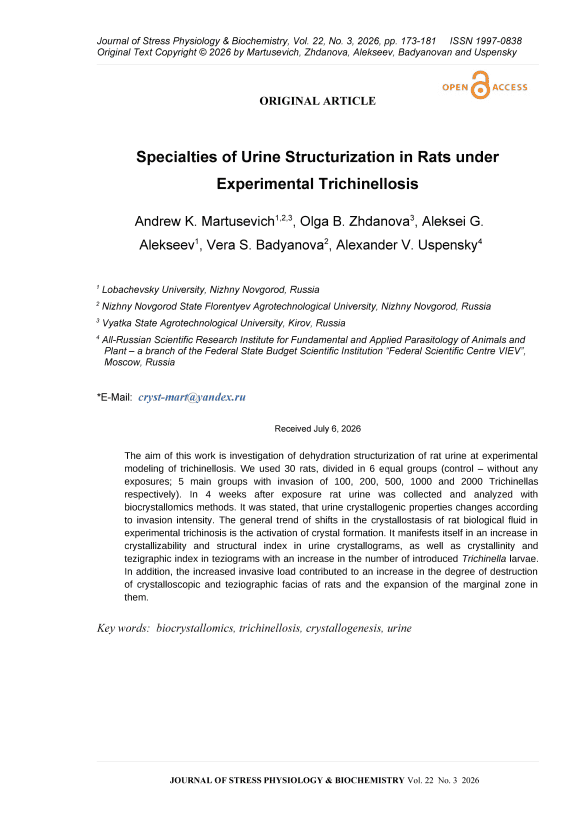
It was stated, that crystallogenic properties of rats’ urine are dependent from used dose of invasion agents, but this connection is not linear. Our data showed that invasion of minimal number of helminths leads to moderate activation of urine crystallogenesis. In this case crystallograms generally include monocrystals with single small dendrites and little amorphic bodies (fig. 1).
These changes may be an illustration of enzymetoxic phase of disease in modeled trichinellosis (Konstantiniva et al. , 1999). In addition, we observed minimal extension of marginal belt in crystalloscopic facias of rats’ urine. This tendency indirectly indicates on increasing of dispersion of proteins molecular weight spectrum. Early we demonstrated this sign associated with formed intoxication (Martusevich et al. , 2022). Pathological character of crystallograms transformation is additionally illustrated by clear increasing of facia destruction degree at 100 trichinellas invasion.
Principally another type of crystallogenic activity of urine was observed at invasion of 200 trichinellas per animal (fig. 2). In this case we founded signs of strong inhibition of biological substrate own structurization, realizing in hard reduction of crystallic and amorphic elements with full disappearing of polycrystals (dendrites). On our opinion, this fact may be associated with intoxication syndrome at modeled trichinellosis to specific crystalloscopic signs of inflammatory processes.
So, elevation of Trichinella’s dose leads to increasing of experimental helmintosis formation speed.
At other side, pathological changes of crystalloscopic picture are saved in minimal structurization too. We observed elevation of destruction degree of formed single crystals with prolonged enlarge of marginal belt. In our opinion, these modulations visualized effect of parasite metabolites on crytsallostasis of investigated biological substrate (Martusevich et al. , 2007).
At invermination with 500 T. spiralis larvas the crystallostasis of the urine shift to elevation of crystallogenic activity of biological substrate. This tendency is more intensive in comparison to minimal invasion (fig. 3). It is marked with complex of morphological changes of biological fluid, including enlargement and fragmentation of single crystals, its concentration and satiety by numerous fine monocrystal and amorphic bodies. These specialties indicated on predominance of inflammatory process to intoxication, because last one is characterized by crystallogenesis inhibition (Martusevich et al , 2007, 2020). In addition, increasing intensity of crystallostasis disorders confirmed weighting of metabolic violation in animal organism, associated with trichinellas invasion.
These changes of proper crystallogenesis of rats’ urine are supplied with elevation of elements destruction degree and enlargement of marginal zone of the facia. On our opinion, in underlined clarity of dismetabolic state at 500 larvas invasion.
Subsequent increasing of inverminated larvas number (1000 unit per rat) leads to principal different transformation of urine crystallogenic properties (fig. 4). In particular, we studied, that this dose of Trichinellas promoted the formation of mainly dendrite structures with numerous single crystals and amorphic bodies in urine crystallograms of investigated group of animals. In is important, that last given elements are fully generate the texture of dehydrated urine in the case of less intensive invasion. We supposed that this specialty may illustrate the presence of second (allergic) phase of pathological process in animals of this group. On literature data, this phase is associated with immune response activation and elevation of specific antibodies in blood plasma and urine, consequently (Appleton et al., 2001; Bruschi et al., 2012; Wakelin et al., 2002). These macromolecules forming the microenvironment for non-organic crystallogenic substances change the character of the urine crystalloscopic picture. On our opinion, they are complete with saline crystallohydrates for free water to generation of own hydrate cover. In case of prevalence of saline crystallohydrates over organic component of biological fluid we observe numerous polycrystalline (dendrite) elements in dehydrated facia (Martusevich et al., 2022). In addition, increasing of sum of urine protein induces to the enlargement of marginal zone. In crystallograms of investigated biological fluid of this group we fixed the high degree of structures destruction, which can indicate on saving of relative prevalence of mineral components over proteins in animals’ urine.
Use of maximal dose of helminth (2000 larvas per rat) caused analogical, but more intensive changes in compared with lesser dose of trichinellas (fig. 5). In this case urine facia included only dendrite elements (crestlike structures and its variants, first of all) with solitary small monocrystals. Taking into account of disease pathogenesis, this dynamics indicates to weighting of metabolic disorders in animals of investigated group at the expense of more active immune response with rapid elevation of immunoglobulines and circulating immune complexes in blood and urine (Bruschi et al , 2012; Wakelin et al , 2002). It leads to abrupt increasing of quantity of free water molecules, utilized to formation of hydrate cover for proteins. These physical and chemical processes determinate the appearance of numerous polycrystals with low destruction rate in urine crystalloscopic picture in contrast to facias of biological fluid of last animals group. Increasing of protein level in rats’ urine is realizing primary owing to globulines additionally supports by subsequent enlargement of marginal zone of dehydrated specimen in comparison of urine facias at 1000 T. spiralis larvas invasion.
Illustrated tendencies of qualitative transformation of rats’ urine crystallograms at use of different number of inverminated Trichinella larvas is fully confirmed with data of morphometric analysis (fig. 5). Particularly, dynamics of structure index and crystallizability in urine dried specimens reflecting the activity of own crystallization of biological fluid indicates the moderate elevation of urine crystallogenic potential at minimal number of Trichinellas invasion (100 larvas per rat). Increasing of inverminating dose stipulates the structurization inhibition under 200 larvas invasion and following elevation of crystallizability and structure index to maximal level (at 2000 trichinellas per animal).
Our data underline the nonlinear nature of interaction between invasion dose of Trichinellas and character of metabolic changes (according to transformations of urine own crystallogenesis), associated with it. On our opinion, this correlation reflects different phases of trichinellosis clinical course and its acceleration under increasing of inverminating dose of helminth.
At morphometric analysis of rats’ urine tezigrams we fixed similar, but less intensive changes of initiated crystallogenesis of biological fluid, associating with elevation of invasion dose (fig. 7). In this case main parameters are characterizing the initiating potential of biological substrata (teziographic index and crystallinity, which is analogic to crystallizability and structure index in crystalloscopic test, respectively) demonstrate transformations, combined with crystalloscopy indexes at different doses of Trichinellas (correlation coefficients for indicated parameters are 0.76 and 0.68, respectively; p<0.01). Changes of tezigrams facia destruction degree and marginal zone clearity are similar to observed in crystallograms of animals’ urine.
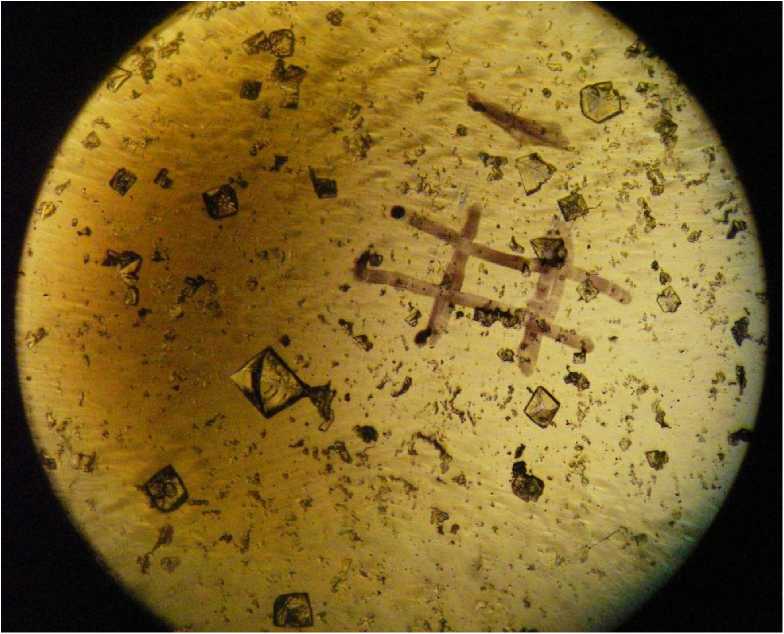
Figure 1. Result of own crystallization of rat urine at 100 trichinellas invasion (magn. х60)
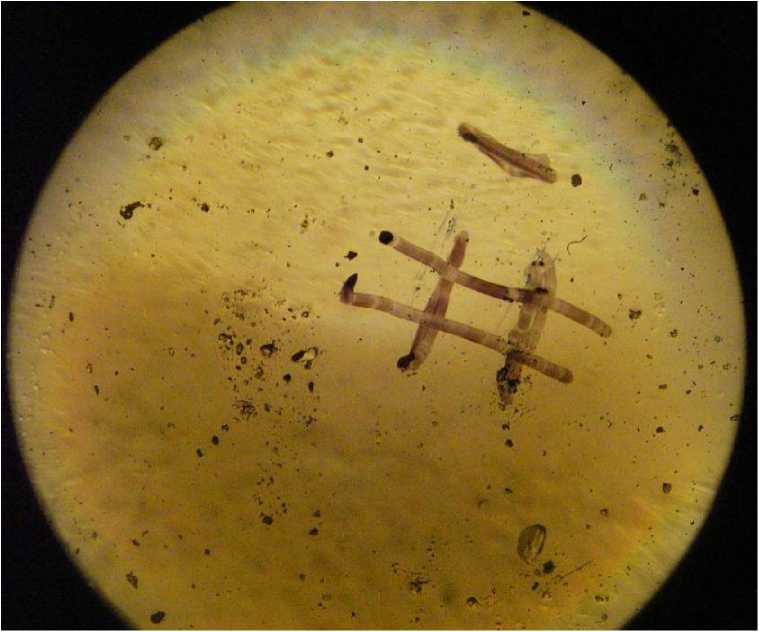
Figure 2. Result of own crystallization of rat urine at 200 trichinellas invasion (magn. х60)
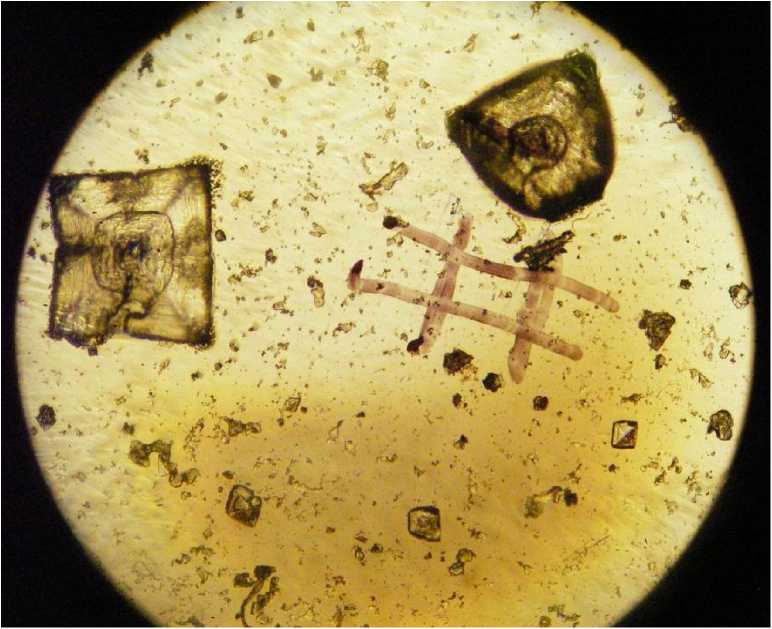
Figure 3. Own crystallization of rats’ urine at invermination with 500 T. spiralis larvas (magn. х60)
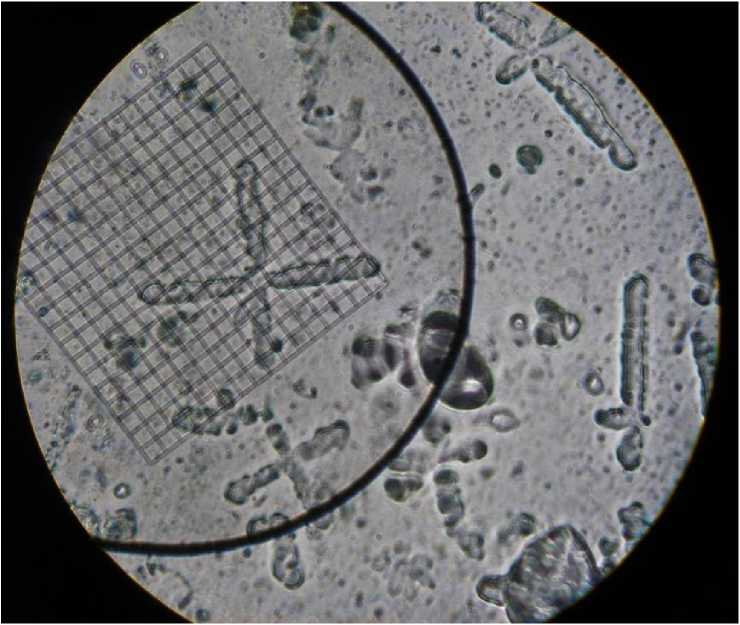
Figure 4. Crystallization of rats’ urine at invermination with 1000 T. spiralis larvas (magn. х60)
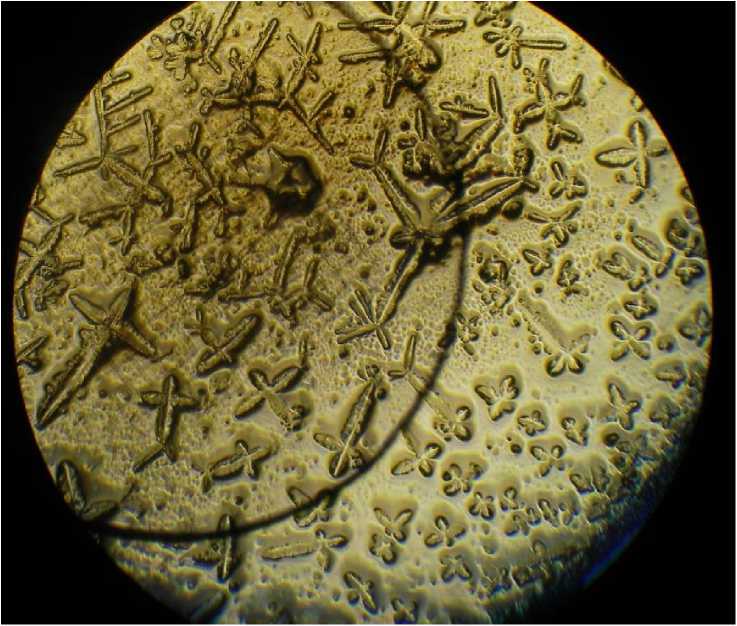
Figure 5. Rats’ urine crystallization at invermination with 2000 T. spiralis larvas (magn. х60)
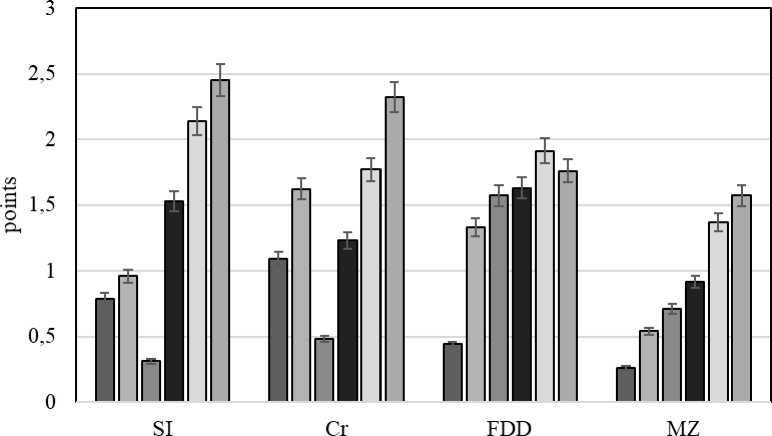
□ О П1ОО D200 Я5ОО П1000 □ 2000
Figure 6. Dynamics of morphometric parameters of crystallograms of rats’ urine in connection with invasion intensity (count of inverminated larvas is demonstrated on OX axis by different color gradient; SI – structure index, Cr – crystallizability, DD – facia destruction degree, Mz – clarity of marginal zone)
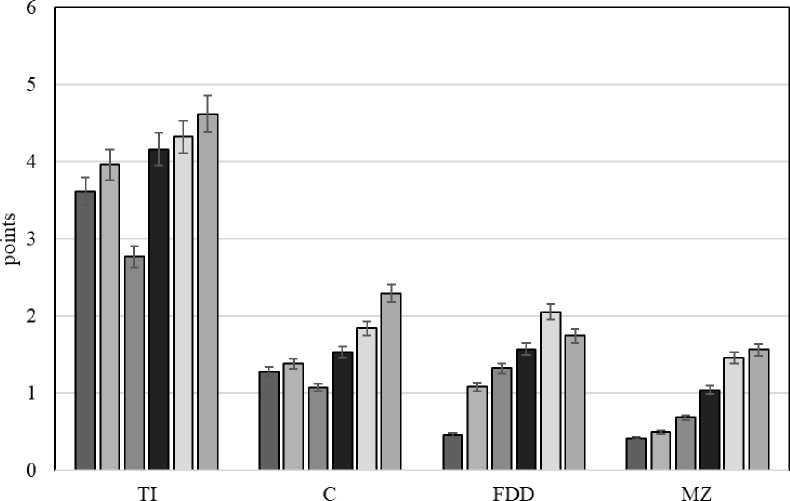
□ О П10О И2ОО 15 0 0 П1ООО П2000
Figure 7. Results of morphometric analysis of tezigrams of rats’ urine in connection with invasion intensity (count of inverminated larvas is demonstrated on OX axis by different color gradient; TI – tezigraphic index, C – crystallinity, DD – facia destruction degree, Mz – clarity of marginal zone)
CONCLUSIONS
Our data allow fixing, that investigation of crystallogenic properties and initiation potential of animals’ urine can be an indicator of presence and depth of metabolic disorders, associated with investigated parasitosis. The general trend of shifts in the crystallostasis of rat biological fluid in experimental trichinosis is the activation of crystal formation. It manifests itself in an increase in crystallizability and structure index in urine crystallograms, as well as crystallinity and tezigraphic index in tezigrams with an increase in the number of introduced Trichinella larvas. In addition, the increased invasive load contributed to an increase in the degree of destruction of crystalloscopic and tezigraphic facies of rats and the expansion of the marginal zone in them.
CONFLICTS OF INTEREST
All authors declare that they have no conflicts of interest.
