
Strengthening the Feed Base in Livestock Production Through Alternative Plants Rich in Nutritional Value
Journal: Bulletin of Science and Practice @bulletennauki
Section: Сельскохозяйственные науки
Article in issue: 5 т.12, 2026.
Free access
One of the priority directions of agriculture is the development of livestock farming. Within this development cycle, strengthening the feed base of cattle and small ruminants and improving quality indicators are among the most important issues. One of the main solutions is expanding the possibilities of using plants with a high-quality feed base. Conducting research in this direction is purposeful and necessary. Among alternative plants, research has been conducted for the first time under the conditions of the Nakhchivan Autonomous Republic on the plant maralfalfa (Pennisetum spp.), which is willingly consumed by animals both in fresh and dry forms. The aim of the research is to adapt the plant to the soil and climatic conditions of the republic, to study its resistance to biotic and abiotic factors as well as its quality indicators, and to apply it in the development of livestock farming. The research was carried out in 2024 at the experimental field of the Academic Hasan Aliyev Agricultural Scientific Research Institute.
Similar articles in the section Field crops and their production
Short address: https://sciup.org/14135661
IDS: 14135661 | UDC: 633.2.031.033 | DOI: 10.33619/2414-2948/126/46
Укрепление кормовой базы в животноводстве за счет альтернативных растений, богатых питательными веществами
Одним из приоритетных направлений сельского хозяйства является развитие животноводства. В этом цикле развития одним из важнейших нюансов является укрепление кормовых и качественных показателей крупного рогатого скота и мелкорогих животных. Одним из основных способов финансирования является увеличение использования растений, представляющих собой комплексное решение для кормления. Это целенаправленное исследование. Альтернативные растения маралфальфа (маральфа) - Pennisetum spp., которые с удовольствием поедаются животными как во влажных, так и в сухих условиях, впервые были изучены в Нахчыванской Автономной Республике. Целью исследования является повышение устойчивости растения к биотическим и абиотическим факторам, его качества и применения в развитии животноводства в соответствии с почвенно-климатическими условиями Республики. Научно-исследовательская работа в 2024 году проводилась в Научно-исследовательском институте сельского хозяйства им. Г. Алиева.
Text of the scientific article Strengthening the Feed Base in Livestock Production Through Alternative Plants Rich in Nutritional Value
Бюллетень науки и практики / Bulletin of Science and Practice
UDC 633. 2. 031.033
It is well-established that soil and climatic suitability are among the most critical factors in agricultural development. Consequently, determining the climates in which agricultural products remain sustainable is essential for both crop production and livestock development. Beyond the food chain, climate plays an irreplaceable role in livestock development across all species. Under the soil and climatic conditions of the autonomous republic, cultivating plants adapted to local environments to establish a high-quality feed base is a priority for optimizing livestock production. A shortage of nutritionally rich feed inevitably leads to reduced milk and meat yields. The foundation of a robust feed base includes the use of intensive cultivation technologies for forage crops, the expansion of cultivated areas, the improvement of forage diversity, the scientific study of introduced and local varieties, and the organized production of seeds [4].
Cultivated forage plants are vital not only for producing high-protein feed but also for improving agricultural land by adapting to the republic’s climate and increasing soil humus content. Therefore, expanding the cultivation of forage crops, particularly alternative species, and restoring feed potential within the autonomous republic is considered essential. Given the necessity of livestock development, research in this field carries significant scientific weight. The maralfalfa plant (Pennisetum sp.) has recently gained attention in the agricultural sector as a promising alternative forage crop. As a perennial plant, maralfalfa offers high biomass productivity and is highly suitable for use as roughage in livestock farming due to its significant silage yield.
Maralfalfa is particularly important for strengthening the feed base for cattle and small ruminants. When proper agrotechnical measures are applied—accounting for the plant's biological and physiological characteristics—high-quality green mass and hay can be produced, bolstering livestock and poultry production. Maralfalfa's green mass, haylage, hay, and grass meal are readily consumed by cattle and poultry alike. The green mass is rich in protein balanced with amino acids, micro- and macroelements, vitamins, and mineral salts essential for animal health. Its nutritional profile is robust, containing 18–18.7% protein, 12% carbohydrates, 35% dry matter, 52% crude fiber, 59% digestible fiber, 17.3% crude protein, 2.1% fat, and 13.5% ash.
During the early stages of development, maralfalfa has a high demand for light. Insufficient light negatively affects the plant’s growth. The duration of the vegetation period depends not only on the genetic characteristics of the variety but also on the environmental conditions of cultivation. Among external factors, meteorological conditions have a significant influence on the length of the vegetation period. Day length, along with other factors, noticeably affects both the total duration of the vegetation period and the intervals between its individual developmental phases.
The Nakhchivan Autonomous Republic differs significantly from other physical-geographical regions of Azerbaijan due to its sharply continental climate. The main climate-forming factors include abundant solar radiation, complex air circulation, and a diverse relief. The average annual sunshine duration reaches 2,800 hours in plains and low-mountain areas, and 2,400 hours in the middlemountain belt; such levels are unmatched elsewhere in the republic. The average annual air temperature varies between 12–14°C in the Araz plain, 5–8°C in the middle-mountain zone, and 1– 2°C in the high-mountain zone. The average temperature of the coldest month (January) drops to -3 to -6°C, -6 to -10°C, and -10 to -14°C respectively, while the average temperature of the hottest month (July) ranges from 24–28°C, 16–20°C, and 6–8°C. Summer months are characterized by high temperatures. The absolute maximum air temperature reaches 40–43°C in plains and low-mountain areas, 30–40°C in the middle-mountain zone, and 10–20°C in the high-mountain zone. Atmospheric precipitation is unevenly distributed across the Nakhchivan Autonomous Republic. Annual precipitation reaches up to 150 mm in plains and up to 400 mm in the high-mountain belt. The potential annual evaporation in the region varies between 1,200–1,400 mm in plains, 860–640 mm in middle-mountain areas, and 500–320 mm in high-mountain areas. [1-3].
Under such arid climatic conditions, implementing irrigation measures is essential for establishing a sustainable feed base. Currently, irrigated cultivation areas in the autonomous republic are expanding annually, enabling the production of high-quality agricultural yields. Materials and
Methodology: The main objective of the research was to test, promote, and implement maralfalfa, a high-quality alternative forage plant, under the natural climatic conditions of the Nakhchivan Autonomous Republic through experimental trials in farmer households. As research material, maralfalfa cuttings were obtained from the Agricultural Scientific Research Institute of the Ministry of Agriculture of the Republic of Azerbaijan and planted at the Sharur support station of the Academic Hasan Aliyev Nakhchivan Agricultural Scientific Research Institute. Experimental studies were conducted in accordance with standard methodological guidelines. Chemical analyses of the obtained product were carried out as follows: nitrogen and crude protein were determined by the Kjeldahl method; crude ash was determined by incinerating samples in an oven at 525°C for 10 hours; fiber composition (NDF and ADF—cellulose and lignin) was studied using the Van Soest method (1991) [7, 8] to evaluate feed quality; crude fat was determined by the AOAC (1990) method; and relative feed value (RFV) was calculated according to the formula of Van Dyke and Anderson [6] (Table 1).
Experimental Section: Increasing the feed base for livestock and obtaining high-quality productivity per unit area are among the important issues in agriculture. Maralfalfa, considered an alternative plant under study, is a perennial forage crop with high productivity and quality indicators that requires low labor and cost, ranking among the leading silage crops in the global market in terms of biomass production. In a single harvest, this plant produces more than 300 tons of fresh mass and 40–60 tons of dry mass, which is considered equivalent to the total biomass obtained annually from 1 hectare of alfalfa fields. During the vegetation period, the plant reaches a height of 3–4 meters and becomes excellent feed for small ruminants when it reaches a height of 1.5–2 meters. Maralfalfa cuttings obtained from the Agricultural Scientific Research Institute of Crop Production of the Ministry of Agriculture of Azerbaijan were planted for research purposes at the Institute’s Sharur Support Station (Dervishlar village) on 09.04.2024, using a 1×1 m planting scheme. During the vegetation period, 46% ammonium nitrate was applied to the research field. Regular phenological observations and biometric measurements were carried out, and agrotechnical measures were applied according to accepted practices, taking into account the biological characteristics of the plant. During the research period, the number of shoots per plant (28–34), the number of nodes per shoot (13–17), the number of leaves per shoot (15–20), and plant height (3–4 m) were observed (Figure).
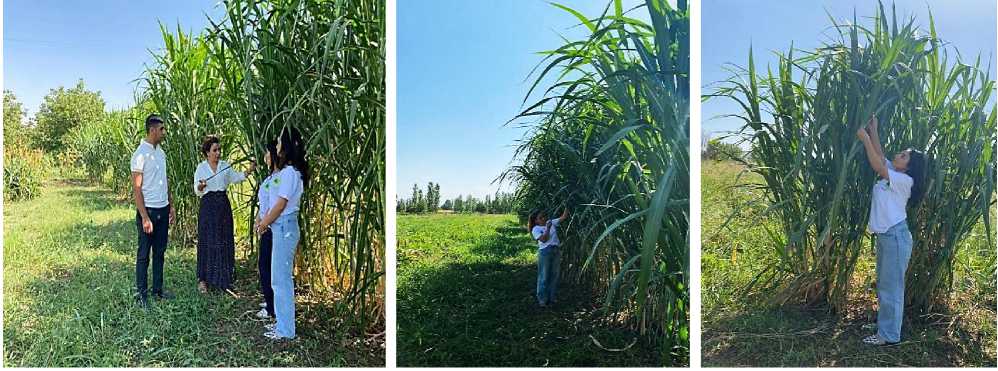
Figure. Study area
NDF and ADF are important in terms of high responsibility indicators in ruminant animals. Thus, the presence of a certain amount of NDF in the animal's diet for the process of rumination and rumen fermentation is mandatory (minimum 16‒25%). A low level of this enzyme will lead to a weak rumen process in the animal and a decrease in pH below 4, as well as an increase in the production of methane by microorganisms in the rumen.
It is a well-known fact that the process in this direction will lead to global warming. Based on the studies conducted by scientists, I would like to note that different harvesting times affect the high nutritional value of alfalfa silage (on average 60% NDF, 30% ADF) [5].
Table
QUALITY INDICATORS
|
Analysis parameters |
Result |
Unit of measure, % |
|
Protein |
8.2 |
% |
|
Crude ash |
12,17 |
% |
|
Crude fat |
2.09 |
% |
|
NDF |
68,57 |
% |
|
ADF |
59,48 |
% |
|
NYD |
60.92 |
Result of the study
Based on the conducted research, it can be concluded that the maralfalfa plant involved in the study is resistant to the soil and climatic conditions of the autonomous republic and demonstrates high productivity. Its quality indicators meet the required levels according to accepted standards.
