
Study of Metal Salts of Natural Petroleum Acids and their Compositions with Nitrated diesel fuel as Potential Cetane-improving Additives
Journal: Bulletin of Science and Practice @bulletennauki
Section: Технические науки
Article in issue: 9 т.12, 2026.
Free access
The ignition quality of diesel fuel critically influences engine combustion efficiency and exhaust emissions. This study evaluates organometallic salts synthesized from the 280–340 °C distillation fraction of natural petroleum acids (NPAs) and their binary compositions with nitrated diesel fuel as cetane-improving additives. Tests were conducted on a straight-run diesel fuel matrix with a baseline cetane number of 49.26 at treat rates of 60 ppm and 500 ppm. Two additive series were investigated: pure NPA metal salts (Zn, Mn, Ni, Fe, and Co) and their formulations combined with a nitrated diesel fuel component. Among uncompounded metal salts at 500 ppm, Ni, Zn, and Fe salts displayed exceptional potency, boosting the cetane number by 7.34, 7.24, and 7.14 units to reach peak values of 56.6, 56.5, and 56.4, respectively. Conversely, Mn and Co salts exhibited limited effectiveness. Incorporating nitrated diesel fuel generated a consistent synergistic enhancement across all transition metal species. At 500 ppm, the Zn salt composition achieved the highest overall cetane increase of 7.64 units (final cetane number 56.9), while Ni and Fe compositions reached 7.54 and 7.44. The findings highlight low-dose binary additives based on NPA metal salts and nitrated hydrocarbons as cost-effective, high-performance candidates for diesel quality upgrading.
Short address: https://sciup.org/14139023
IDS: 14139023 | UDC: 665.63:66.011 | DOI: 10.33619/2414-2948/130/27
Исследование солей металлов природных нефтяных кислот и их композиций с нитрованным дизельным топливом в качестве потенциальных цетаноповышающих присадок
Воспламенительные свойства дизельного топлива оказывают критическое влияние на эффективность сгорания в двигателе и экологические показатели выхлопных газов. В данной работе проведена оценка металлоорганических солей, синтезированных на основе узкой фракции 280–340 °C природных нефтяных кислот (ПНК), а также их бинарных композиций с нитрованным дизельным топливом в качестве цетаноповышающих присадок. Испытания проводились на образцах прямогонного дизельного топлива с исходным цетановым числом 49,26 при дозировках 60 ppm и 500 ppm. Были изучены две серии присадок: чистые соли металлов ПНК (Zn, Mn, Ni, Fe и Co) и их композиции с нитрованным компонентом дизельного топлива. Среди чистых солей металлов при дозировке 500 ppm наибольшую эффективность проявили соли Ni, Zn и Fe, увеличив цетановое число на 7,34; 7,24 и 7,14 единицы до максимальных значений 56,6; 56,5 и 56,4 соответственно. Напротив, соли Mn и Co продемонстрировали ограниченную эффективность. Введение нитрованного дизельного топлива вызвало устойчивый синергетический эффект для всех исследованных переходных металлов. При дозировке 500 ppm наибольший суммарный прирост цетанового числа — 7,64 единицы (конечное цетановое число 56,9) — показала композиция с солью Zn, в то время как композиции с Ni и Fe достигли прироста 7,54 и 7,44 единицы. Полученные результаты свидетельствуют о том, что малые дозировки бинарных присадок на основе солей металлов ПНК и нитрованных углеводородов являются экономически эффективными и высокорезультативными реагентами для повышения качества дизельного топлива.
Text of the scientific article Study of Metal Salts of Natural Petroleum Acids and their Compositions with Nitrated diesel fuel as Potential Cetane-improving Additives
Бюллетень науки и практики / Bulletin of Science and Practice
UDC 665.6.
The cetane number (CN) serves as a fundamental metric for quantifying the ignition delay and auto-ignition tendency of compression-ignition engine fuels. Fuel formulations with elevated cetane ratings yield shorter ignition delay periods, facilitating smooth pressure rise during combustion, reducing mechanical engine noise, and suppressing unburned hydrocarbon, carbon monoxide, and particulate matter emissions [1, 4].
As modern environmental regulations mandate stricter limits on sulfur and aromatic contents, straight-run and hydrotreated diesel blending streams often require chemical cetane improvers to meet market specifications [2, 4, 8].
Although alkyl nitrates—principally 2-ethylhexyl nitrate (2-EHN)—dominate current commercial additive packages, concerns regarding thermal instability, handling hazards, oxidative deposit formation during storage, and elevated nitrogen oxide emission potential motivate the exploration of alternative additive systems. Organometallic complexes derived from naturally occurring petroleum fractions, particularly naphthenic acids (natural petroleum acids, NPAs), offer a viable path toward sustainable fuel modification. NPAs consist of complex cycloaliphatic carboxylic acids isolated during petroleum refining. Their oil-soluble transition metal salts (naphthenates) demonstrate high catalytic activity during low-temperature hydrocarbon pre-ignition autoxidation [1, 8, 10].
This paper investigates the cetane-enhancing capabilities of transition metal salts (Zn, Mn, Ni, Fe, and Co) synthesized from the narrow 280–340°C distillation fraction of natural petroleum acids. Additionally, it examines the synergistic response obtained when combining these metal salts with a nitrated diesel fuel component at low (60 ppm) and moderate (500 ppm) treatment concentrations [1, 5].
Materials and Methods
The additives were grouped into two distinct categories based on chemical composition, using the 280–340 °C fraction of natural petroleum acids as the primary precursor:
Group 1 (Pure NPA Metal Salts): Prepared via direct neutralization of isolated 280–340°C NPAs with respective transition metal compounds:
Sample 11: Zn salt of NPA (280–340°C fraction)
Sample 12: Mn salt of NPA (280–340°C fraction)
Sample 13: Ni salt of NPA (280–340°C fraction)
Sample 14: Fe salt of NPA (280–340°C fraction)
Sample 15: Co salt of NPA (280–340°C fraction)
Group 2 (Metal Salt + Nitrated Diesel Fuel Compositions): Binary formulations produced by compounding the individual Group 1 metal salts with a pre-synthesized nitrated diesel fuel fraction:
Sample 32: Zn salt of NPA (280–340°C fraction) + Nitrated diesel fuel
Sample 33: Mn salt of NPA (280–340°C fraction) + Nitrated diesel fuel
Sample 34: Ni salt of NPA (280–340°C fraction) + Nitrated diesel fuel
Sample 35: Fe salt of NPA (280–340°C fraction) + Nitrated diesel fuel
Sample 36: Co salt of NPA (280–340°C fraction) + Nitrated diesel fuel
Each sample from Group 1 and Group 2 was blended into the baseline diesel fuel at dosages of 60 ppm and 500 ppm. Cetane ratings were measured under standardized engine test conditions, and cetane increments (ΔCN = CNtreated - 49.26) were calculated. [1, 7, 11].
Results and Discussion
The response of the base diesel fuel to pure NPA metal salts at treat rates of 60 ppm and 500 ppm is presented in Table 1 and illustrated in Figure 1.
At 60 ppm, the cetane response displayed wide variation depending on the specific transition metal, ranging from +0.64 to +5.24 units. The iron salt (Sample 14) recorded the highest initial activity with an increase of 5.24 units (final CN 54.5). The zinc salt (Sample 11) followed closely, providing a 4.94-unit enhancement (final CN 54.2), while the nickel salt (Sample 13) yielded a 4.44-unit increase (final CN 53.7). Conversely, manganese (Sample 12) and cobalt (Sample 15) salts exhibited limited activity at 60 ppm, elevating the cetane number by only 0.64 and 0.94 units, respectively. The pronounced difference of 4.60 units between Fe and Mn salts underlines strong structural selectivity governed by the metal center during early fuel autoxidation [3, 6].
Increasing concentration to 500 ppm boosted performance across all samples. The nickel salt (Sample 13) demonstrated the most substantial gain, achieving a cetane increment of 7.34 units (final CN 56.6). The zinc salt (Sample 11) and iron salt (Sample 14) maintained high efficacy, raising the cetane number by 7.24 (final CN 56.5) and 7.14 units (final CN 56.4), respectively. The cobalt salt (Sample 15) experienced a minor gain to +2.44 units (final CN 51.7), whereas the manganese salt (Sample 12) remained sluggish, yielding only a 1.34-unit increase (final CN 50.6) [2, 9].
Table 1
EFFECT OF NPA METAL SALTS (280–340°C FRACTION)
ON DIESEL FUEL CETANE NUMBER
|
№ |
Additive description |
Baseline cetane number |
Cetane Number (Additized) |
Cetane Increment (ΔCN) |
|
Dosag |
e: 60 ppm |
|||
|
1 |
Sample-11 |
49,26 |
54,2 |
4,94 |
|
2 |
Sample-12 |
49,26 |
49,9 |
0,64 |
|
3 |
Sample-13 |
49,26 |
53,7 |
4,44 |
|
4 |
Sample-14 |
49,26 |
54,5 |
5,24 |
|
5 |
Sample-15 |
49,26 |
50,2 |
0,94 |
|
Dosage: 500 ppm |
||||
|
1 |
Sample-11 |
49,26 |
56,5 |
7,24 |
|
2 |
Sample-12 |
49,26 |
50,6 |
1,34 |
|
3 |
Sample-13 |
49,26 |
56,6 |
7,34 |
|
4 |
Sample-14 |
49,26 |
56,4 |
7,14 |
|
5 |
Sample-15 |
49,26 |
51,7 |
2,44 |
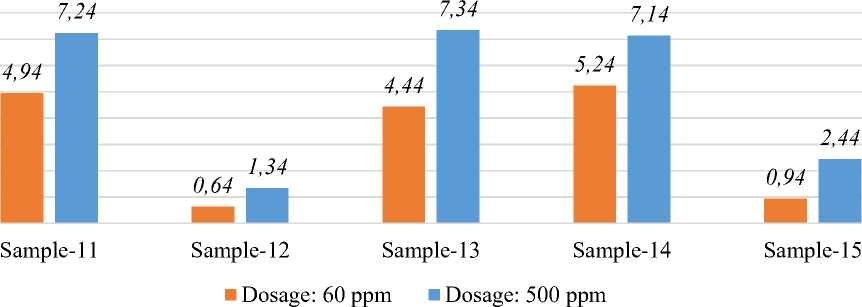
Figure 1. Cetane number increment (ACN) of diesel fuel treated with Group 1 NPA metal salts (Samples 11–15) at 60 ppm and 500 ppm dosages.
The evaluation of binary compositions containing NPA metal salts combined with nitrated diesel fuel is detailed in Table 2 and depicted in Figure 2.
Table 2
EFFECT OF NPA METAL SALT COMPOSITIONS
WITH NITRATED DIESEL FUEL ON DIESEL FUEL CETANE NUMBER
|
№ |
Additive description |
Baseline cetane number |
Cetane Number (Additized) |
Cetane Increment (ΔCN) |
|
Dosa |
e: 60 ppm |
|||
|
1 |
Sample-32 |
49,26 |
54,7 |
5,44 |
|
2 |
Sample-33 |
49,26 |
50,2 |
0,94 |
|
3 |
Sample-34 |
49,26 |
53,9 |
4,64 |
|
4 |
Sample-35 |
49,26 |
55,7 |
6,44 |
|
5 |
Sample-36 |
49,26 |
50,6 |
1,34 |
|
Dosage: 500 ppm |
||||
|
1 |
Sample-32 |
49,26 |
56,9 |
7,64 |
|
2 |
Sample-33 |
49,26 |
51,1 |
1,94 |
|
3 |
Sample-34 |
49,26 |
56,8 |
7,54 |
|
4 |
Sample-35 |
49,26 |
56,7 |
7,44 |
|
5 |
Sample-36 |
49,26 |
52,1 |
2,84 |
At a 60 ppm treat rate, the composite additives demonstrated improved overall performance compared to uncompounded salts. The iron-containing composition (Sample 35) led Group 2 with a 6.44-unit increase (final CN 55.7), followed by the zinc composition (Sample 32, +5.44 units, final CN 54.7) and the nickel composition (Sample 34, +4.64 units, final CN 53.9). Low-activity metals also showed modest gains: the cobalt composition (Sample 36) increased cetane by 1.34 units (final CN 50.6), and the manganese composition (Sample 33) yielded a 0.94-unit gain (final CN 50.2).
Elevating the dosage to 500 ppm pushed Group 2 formulations to maximum effectiveness. The zinc salt composition (Sample 32) achieved the highest cetane enhancement in the study, raising the cetane rating by 7.64 units to 56.9. Nickel (Sample 34) and iron (Sample 35) compositions reached final cetane ratings of 56.8 (+7.54 units) and 56.7 (+7.44 units). Cobalt (Sample 36) and manganese
(Sample 33) compositions attained cetane increases of 2.84 units (final CN 52.1) and 1.94 units (final CN 51.1), respectively.
As demonstrated in Figure 2, the presence of nitrated diesel fuel systematically enhances the cetane increment across all tested metals:
Zinc (Zn): +7.24 (pure salt) → +7.64 (composite)
Nickel (Ni): +7.34 (pure salt) → +7.54 (composite)
Iron (Fe): +7.14 (pure salt) → +7.44 (composite)
Cobalt (Co): +2.44 (pure salt) → +2.84 (composite)
Manganese (Mn): +1.34 (pure salt) → +1.94 (composite)
This cooperative behavior stems from a dual-stage radical initiation mechanism. Under engine compression conditions, the thermally unstable nitro groups within the nitrated hydrocarbon matrix undergo prompt homolytic cleavage, releasing alkoxy (RO∙) and nitrogen dioxide (NO2∙) radicals. These radicals initiate chain-branching hydroperoxidation of fuel hydrocarbons. Concurrently, the dissolved transition metal cations (especially Zn, Ni, and Fe) catalyze the rapid decomposition of intermediate alkyl hydroperoxides (ROOH), accelerating the onset of self-ignition and shortening ignition delay. Furthermore, blending with nitrated diesel fuel reduced performance variance across metal types compared to the pure salts, resulting in more consistent additive behavior [4, 7].
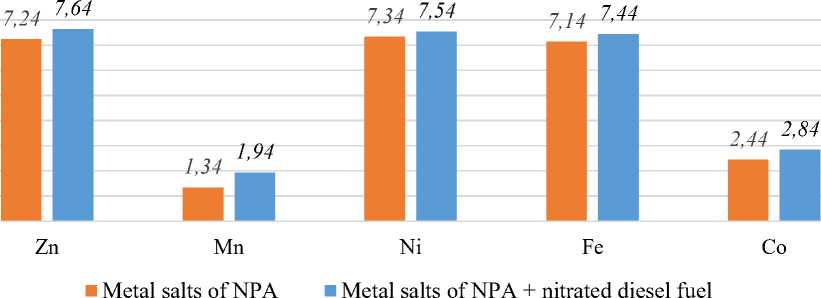
Figure 2. Comparative cetane number increment (ACN) at 500 ppm dosage between pure NPA metal salts (Group 1) and their binary compositions with nitrated diesel fuel (Group 2)
Conclusions
Organometallic salts synthesized from the 280–340 °C fraction of natural petroleum acids are effective cetane improver additives for straight-run diesel fuel, exhibiting pronounced metaldependent catalytic efficiency. Zinc, nickel, and iron salts function as highly active cetane enhancers, capable of raising the baseline fuel cetane number (49.26) by more than 7 units at 500 ppm concentration. Manganese and cobalt salts show substantially lower activity. Formulating NPA metal salts with nitrated diesel fuel produces a synergistic enhancement across all tested transition metals, contributing an additional 0.20 to 0.60 unit increase in cetane rating at 500 ppm. The composite additive containing Zn salt of 280–340 °C NPA and nitrated diesel fuel (Sample 32) demonstrated peak performance, elevating the diesel fuel cetane number from 49.26 to 56.9 (+7.64 units) at a treat rate of 500 ppm. Metal naphthenate-based formulations represent a promising, cost-effective alternative to conventional synthetic nitrate additives for modern diesel fuel upgrading.
Acknowledgements. The authors acknowledge the laboratory facilities and scientific support provided for the synthesis and physicochemical investigation of natural petroleum acid metal salts and nitrated diesel fuel compositions.
