
Study of Physio-Morphological and Biochemical Changes during Different Developmental Stages in Mungbean [Vigna radiata (L.) Wilczek] Under Natural Environmental Conditions
![Study of Physio-Morphological and Biochemical Changes during Different Developmental Stages in Mungbean [Vigna radiata (L.) Wilczek] Under Natural Environmental Conditions](/file/picture/143186154/study-of-physio-morphological-and-biochemical-changes-during-different.png "Study of Physio-Morphological and Biochemical Changes during Different Developmental Stages in Mungbean [Vigna radiata (L.) Wilczek] Under Natural Environmental Conditions")
Journal: Journal of Stress Physiology and Biochemistry @jspb
Article in issue: 3 т.22, 2026.
Free access
The experiments were conducted to determine the effect of ageing [different developmental stages (15days, 35days and 50 days)] as a stress on growth and biochemical parameters in Vigna radiata (L.) Wilczek (mungbean) plant. The plants were uprooted and collected for observations on the 15th day, 35th day and 55th day after sowing. In natural environmental condition the plant grows naturally and its morphological parameters like shoot length, root length, leaf area, fresh weight and dry weight increased throughout. Photosynthetic pigment like chlorophyll content increased throughout but the carotenoid content decreased in aged plant tissues. Antioxidant enzymes like peroxidase activity significantly increased but catalase activity decreased as plants get older. The protein content and osmoprotectant proline content get slightly decreased in 35 DAS plant. As the plant ages, it undergoes significant internal changes driven by stress and maturation.
Short address: https://sciup.org/143186154
IDS: 143186154
Text of the scientific article Study of Physio-Morphological and Biochemical Changes during Different Developmental Stages in Mungbean [Vigna radiata (L.) Wilczek] Under Natural Environmental Conditions
Plant stress refers to any external unfavourable conditions that affect or influence a plant’s metabolism, growth and development. Plants, being sessile (fixed in one place), must endure various environmental and biological stresses throughout their life cycle, from seed germination to maturity. These stressors are broadly categorized into abiotic (non-living) (drought, salinity, temperature, flooding etc.) and biotic (living) (Pathogens, herbivores and pests, nematodes, weeds etc.). Here, aging is also acts as a significant internal plant stress, characterized by developmental changes that increases internal oxidative stress within their cells and chloroplasts and trigger senescence (death of tissue).This internal “aging stress” often makes older plants less capable of handling additional environmental stress, as their resources are already occupied (Sen et al . 2014).
Ageing involves a genetically programmed process of degradation and resource relocation (senescence) that results in tissue deterioration. Aging processes are often regulated by hormonal changes, with antagonistic effects from hormones like cytokinins (which slow aging) and abscissic acid (which speeds it up). It determines how plants perceive environmental stressors, with age-related changes sometimes resulting in reduced growth or “negative growth” (shrinking) under stress conditions.
MATERIALS AND METHODS
25gm of healthy soaked mungbean [ Vigna radiata (L.) Wilczek] seeds were thoroughly washed and rinsed with distilled water 2-3 times. The seeds were sown in 15 pots filled with soil and vermicompost. Maximum 10 seeds were sown in every pot. The pots were divided into three groups with three replicas for each experiment: (i) 15 days old plant i.e. 15 days after sowing (DAS) (ii) 35 DAS (iii) 55 DAS. The plants were regularly watered. The plants were uprooted and collected for observations and experiment after 15 days, 35 days and 55 days after sowing.
After uprooting from the pots, the length of shoot and root was measured by a scale in centimeter unit. Leaf area was determined by sketching the outline of each leaf of a plant on a graph paper and estimating the area in sq. cm. After uprooting from the pots, fresh weight of shoot, root and leaves were measured by the help of a digital balance. Now those plant parts were placed in a petri dish and oven dried at 60°C for a few hours. Then the dry weight of each plant part was recorded.
Chlorophyll a, chlorophyll b and total chlorophyll content were calculated by the method of Arnon (1949); amount of carotenoid (carotene and xanthophyll) was estimated by the method of Kirk and Allen (1965); Protein content was estimated according to Lowry et al. (1951). Estimation of proline was done according to Bates et al. (1973); catalase enzyme activity was assayed by the method of Gasper and Lacoppe (1968) with slight modifications and peroxidase enzyme activity was assayed spectrophotometrically according to Chance and Maehly (1955) with slight modifications.
The results obtained in triplicates were subjected to analysis of variance (ANOVA) and S.E. (Standard Error) and C.D. (Critical Difference) at 5% and 1% levels calculated.
RESULTS AND DISCUSSION
In the current study, the effect of ageing as a stress on mungbean ( Vigna radiata L. Wilczek) plants was evaluated. All the morphological parameters like shoot and root length, leaf area, fresh and dry weight (tables 1 and 2) were increased with increase in the number of days of plant. Here the plant is growing under natural environmental conditions without any kind of applied stress. So the plant is growing significantly and it shows increase in its size of leaf, stem and root system (Sen and Mukherji 1998a).
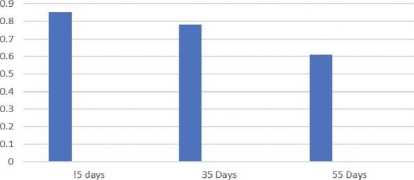
Kanojia et al. (2021) indicated primary metabolic processes as drivers of senescence. Photosynthetic pigments like chlorophyll content increased with increase in number of days (Figure 1) (Sen and Mukherji 1998b, 1999) but it was observed that the carotenoid content getting decreased with increase in the number of days (Sen and Mukherji 1998c) (Figure 2). Ebron et al. (2025) used mungbean leaves for developing non destructive chlorophyll estimation. Nakajima et al. (2017) studied chlorophyll, carotenoid and anthocyanin accumulation in mungbean seedlings under clinorotation. Vanekar et al. (2023) estimated chlorophyll content of mungbean treated with Amaranthus viridis while Kumar et al. (2020) studied chlorophyll a fluorescence kinetics of the same plant.
Carotenoid decrease with increasing number of days could be due to the activity of carotenoid cleavage oxygenases (CCOs) which cleave carotenoids to produce vital plant hormones like abscisic acid (ABA) and strigolactones. Beta-Carotene Oxygenase 2 (BCO2), a mitochondrial enzyme carries out cleavage of various carotenoids, a process essential for maintaining carotenoid homeostasis and protecting cells from oxidative damage. In addition to specific oxygenases, lipoxygenase and peroxidases enzymes also randomly degrade carotenoids during fruit formation. Yi-Shen et al . (2018) studied the nutritional, functional and bioactive properties of mungbean proteins and peptides. In this work proteins were found to be increased in 55DAS plants (figure 3).
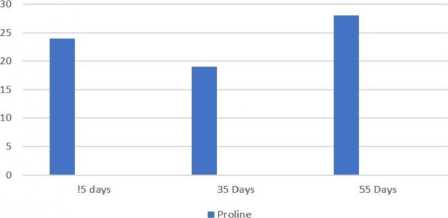
Proline is a low molecular weight osmoprotectant acting as cytoplasmic osmoticum that helps to preserve structural integrity and cellular osmotic potential within different compartments of the cell. Proline accumulation in plants is known to be a stress effect rather than a cause of stress tolerance (Uddin et al. 2013). Shruti and Jangde (2023) studied varietal responses of mungbean on chlorophyll and proline contents under stress. Higher accumulation of proline suggests that plants possess a better potential to maintain osmotic balance (Sen and Mukherji 1998d). In this study, proline content was found to be highest in 55 DAS plant (Figure 4). It suggests that, the proline content can increase significantly in aging or senescing plant tissues, though it behaves differently depending on specific plant part and environmental conditions. Parveen et al. (2021) studied the role of proline during plant senescence. The surge in proline is generally an adaptive response. Zhang and Becker (2015) studied the relationship between proline and signaling pathways during plant senescence. As plant cells age or face stressors (like nutrient deficiency) their water potential often decreases, triggering a buildup of stress hormones like ABA. This hormone activates the plant’s defense pathways, which ramps up proline biosynthesis to acts as an osmolyte to stabilize cell structures and prevent dehydration, fuel mitochondrial respiration and maintain energy production and also scavenge damaging free radicals and buffer cellular redox balance.
Chlorophyll Content
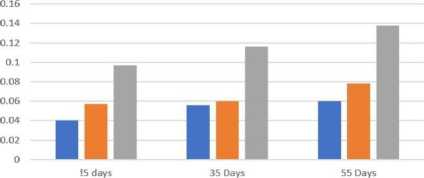
■ Chl A ■ Chi В ■ Total Chi
Carotenoid Content
SE= 1.58
CD = 9.19 (1%), 1.86 (5%)
-
Figure 1. Effect of ageing on chlorophyll content of mungbean leaves in mg/g fresh weight.
SE =0.289
CD=.49(1%), .09(5%)
-
Figure 2. Effect of ageing on carotenoid content of mungbean leaves in mg/g fresh weight.
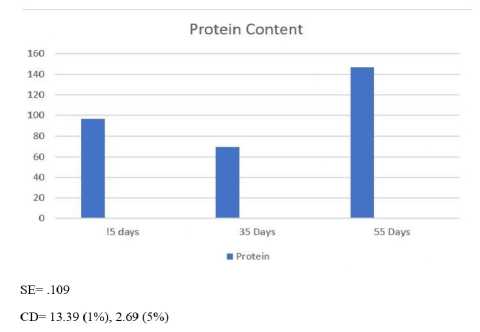
Figure 3. Effect of ageing on protein content of mungbean leaves in mg/g fresh weight.
Proline Content
S.E.=1.67
C.D.=47.37 (1%), 9.59 (5%)
Figure 4. Effect of ageing on proline content of mungbean leaves in mg/g fresh weight.
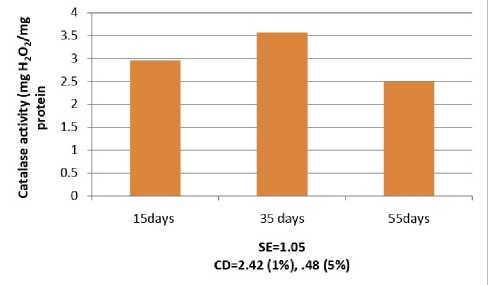
Figure 5. Effect of ageing on catalase enzyme activity of mungbean leaves.
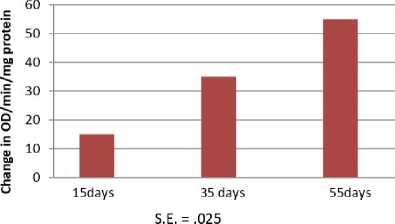
C.D. =.117(5%); .173 (1%)
Figure 6. Effect of ageing on peroxidase enzyme activity of mungbean leaves.
Table 1. Effect of ageing on shoot length, root length and leaf area of mungbean plant
|
Age of plants |
Shoot length |
Root length |
Leaf area |
|
15 days plant |
16 cm |
4.7 cm |
9.3 sq.cm |
|
35 days plant |
20 cm |
5.2 cm |
12 sq.cm |
|
55days plant |
27 cm |
5.7 cm |
26.2 sq.cm |
S.E. = .677
C.D.=.93 (5%), 1.35 (1%)
Table 2. Effect of ageing on fresh and dry weights of mungbean plants
|
Age of plants |
Fresh weight(gm) |
Dry weight (gm) |
|
15 days plant |
1.00 |
0.09 |
|
35 days plant |
1.00 |
0.15 |
|
55 days plant |
1.00 |
0.14 |
S.E.= 0.37
C.D.= 0.49(1%), 0.08 (5%)
During plant aging and associated stress, the balance between ROS production and detoxification shifts. This causes distinct opposing trends in enzyme activity, catalase levels typically decline, while peroxidase activity often spikes to handle the resulting oxidative damage (Sen 2016, 2020, 2023). Mishra et al . (2021) studied phytochemical constituents and antioxidant capacities in mungbean growing in different regions. Kumar and Khan (1983) studied the activities of catalase and peroxidase enzymes during senescence while Taggar et al . (2012) studied the fluctuations in the activities of catalase and peroxidase. Scialabba et al . (2002) studied the effect of senescence on peroxidase enzyme. Catalase activity generally exhibits a negative correlation with aging. As the plant ages, catalase levels drop at 55 DAS (Figure 5), making the cells more vulnerable to accumulating H 2 O 2 and oxidative stress. But the peroxidase activity frequently shows a positive correlation with age (Figure 6). As catalase activity drops, peroxidase levels increase, acting as a compensatory mechanism to combat stress-induced damage.
CONCLUSIONS
From these experiments, it can be concluded that age stress (developmental aging) and environmental stress (drought, salinity etc.) in plants are deeply interconnected (Das and Sen, 2025; Naskar and Sen, 2025). The primary conclusion is that aging progressively lowers a plant’s abiotic stress resilience. Instead of just causing damage, plants utilize this age-related decline as a programmed survival strategy to sacrifice older tissues and reallocate vital nutrients to younger, reproductive organs. As plant age, they lose their ability to efficiently detoxify reactive oxygen species (ROS) (Sen, 2016, 2020, 2023). This natural accumulation of oxidative stress means older leaves and mature plants are significantly less resilient to drought, salinity and extreme temperature compared to their younger counterparts. Integrative approaches combining physiological phenotyping, biochemical assays, and molecular analyses can unravel the adaptive mechanisms and facilitate the development of improved cultivars suited to varied stress environments (Patel et al ., 2024).
CONFLICTS OF INTEREST
All authors declare that they have no conflicts of interest.
