
Stylistic Parameters of Minusinsk Rock Art Style
Журнал: Archaeology, Ethnology & Anthropology of Eurasia @journal-aeae-en
Рубрика: Paleoenvironment, the stone age
Статья в выпуске: 3 т.53, 2025 года.
Бесплатный доступ
This study focuses on the formal typology of petroglyphs belonging to the Minusinsk tradition. While these are widely distributed, we analyze only zoomorphic images from the Minusinsk Basin, because the earliest rock art in Southern Siberia and Central Asia, we believe, refers to a definite chronological stage, whereas the Minusinsk Style is its regional manifestation associated with the local cultural tradition. The purpose of the study is to identify the specific features of the classic regional Minusinsk Style, distinguishing it from other manifestations of the earliest rock art, peripheral relative to it. We present the results of the stylistic analysis based on formal typological criteria mentioned by various specialists in Minusinsk zoomorphic images. Representations of animals fall in several groups in terms of species, and a set of characteristics has been proposed for each. Because they are highly variable both in the Minusinsk tradition and in the earliest rock art in general, criteria specific for the Minusinsk Style alone (fi rst-order criteria) have been separated from those relevant to other traditions (second-order criteria). The core of the classic Minusinsk Style is defined by a stable combination of formal typological features. Another group of the earliest petroglyphs is nominally described as peripheral, because it doesn’t show this combination.
Короткий адрес: https://sciup.org/145147545
IDS: 145147545 | DOI: 10.17746/1563-0110.2025.53.3.064-073
Текст научной статьи Stylistic Parameters of Minusinsk Rock Art Style
The Minusinsk rock art tradition was identified by N.L. Podolsky for the rock art of the Minusinsk Basin (1973: 270–272). Its area of distribution, once limited to the Middle Yenisei basin, has significantly expanded in recent decades, owing mainly to discoveries of a large number of Altai rock art sites (Kovtun, 2001: 90, pl. 93–95; Cheremisin, 2000; Matochkin, 2011; and others).
The age and cultural attribution of this rock art tradition remain controversial to this day. Researchers agree on one thing: this is the most archaic group of images in the rock art of Southern Siberia (Miklashevich, 2020). The early origin of this group of petroglyphs is suggested by the fact that they never overlap representations of other styles, while being themselves often overlapped by later ones. The repertoire of the Minusinsk rock art tradition includes presumably wild animals, mainly deer, but also bovid, horse, bear, boar, and others (Sher, 1980: 190; Sovetova, Miklashevich, 1999: 53). No images other than zoomorphic ones are known in the Middle Yenisei Minusinsk tradition.
The issues of age estimation and possible cultural affiliation of the images of this rock art style have been discussed in detail elsewhere (Podolsky, 1973; Sher, 1980: 190–193; Kovtun, 2001: 142–153; Rusakova, 2005; Esin, 2010; Sovetova, Miklashevich, 1999; Miklashevich, 2015, 2020; Zotkina et al., 2023). The proposed age estimations fall in the range between the Upper Paleolithic and the Early Bronze Age (Sher, 1980: 186–193; Podolsky, 1973: 275; Miklashevich, 2015: 67; Malikov et al., 2025); advocates of the latter hypothesis associate the Minusinsk Style with the Afanasyevo culture (Kovtun, 2001: 144–153; Rusakova, 2005: 215; Esin, 2010). However, the features of the style indicate its heterogeneity and a high degree of variability (Kovtun, 2001: 142–143; Miklashevich, 2015: 67).
In her recent publications, E.A. Miklashevich argued that the identification of the Minusinsk Style was made without due respect to its heterogeneity, the lack of evident standardization of the artistic execution, and a considerable amount of forms tending to the Angara style; she believed it was most reasonable to attribute this group of images to the earliest rock art in Southern Siberia and Central Asia (2015: 67; 2020). However, she did not identify any specific features indicating the stylistic characteristics of the group in question.
On the one hand, the high variability of the earliest images in such a large area makes it almost impossible to identify a set of specific formal typological features consistent to one another; and on the other hand, these images certainly demonstrate some common traits, probable markers of the period, rather than a narrow stylistic affiliation. We believe that the search for local features of rock art is quite promising, and support the thesis that “denial of classification of styles within the earliest rock art does not contribute to the resolution of the problem, but, on the contrary, complicates the situation” (Molodin et al., 2021: 202).
This study is aimed at the identification of features determining the conventionally classic images of the Minusinsk Style in the Middle Yenisei, which constitute the style core, and the so-called peripheral images. We rely on a formal typological approach to classifying zoomorphic images in terms of animal species, which makes it possible to systematize the typical features of the local Minusinsk rock art tradition and clarify our understanding of this subject. The proposed classification can be considered a basis for the relative dating of the earliest rock art of the Minusinsk Basin and adjacent regions.
Material and methods
The stylistic analysis, despite the existing alternative approaches to dating (see, e.g., (Aubry et al., 2007; Zotkina et al., 2014, 2020; Aubert et al., 2019; Atlas..., 2020)), still remains the leading technique of cultural-chronological attribution of images (Fortea et al., 2004; Le Brun, 2012; Domingo Sanz, Fiore, 2014; Bourdier, Pinçon, 2016; Ponomareva, Taçon, 2019; Molodin et al., 2019; Zotkina et al., 2023). An artist deliberately makes a certain choice or unconsciously follows a set of techniques existing in a specific cultural context. In both cases, the technique of rendering images is manifested through formal typological characteristics that mark the style (Domingo Sanz, Fiore, 2014: 7109). These are shape, size, content of images, interrelation of images (compositions and scenes), additions and overlaps, and positions of images in the natural and cultural context. Formal features are analyzed visually and described systematically, their repeatability is recorded; the findings provide grounds for identification of the style as a cultural phenomenon localized in time and space (Ibid.).
Formal typological analysis of zoomorphic images is based on the species’s exterior features in order to distinguish between the artistic technique of rendering details and the anatomic traits. A series of images should be examined in order to record the repeatability of formal features and thereby exclude their random occurrence, as well as to confirm the correctness of selected criteria (Guy, 2000: 416).
In order to avoid circular reasoning when analyzing figurative characteristics (chronological attribution of images by style features, and style by chronological affiliation), researchers consciously did not take into account direct and indirect data on the age of petroglyphs, and create classifications on the basis of noted formal features exclusively. According to morphological criteria, visual similarity of images at different sites is established; after that, the resulting classifications are compared with their age estimations (Fortea et al., 2004: 164). Such a sequence of analysis makes it possible to systematize rock art data, correlate them with specific archaeological cultures, and trace the dynamics of development and interaction of styles in rock art.
The area of dispersal of the Minusinsk Style images is quite large; we deliberately limited our study to the territory of the Minusinsk Basin. A similar study of the earliest petroglyphs in adjacent regions will provide data on region-specific features
and propose a classification of the earliest rock art of Southern Siberia and Central Asia.
A rather contradictory situation has arisen in the historiography of the Minusinsk rock art tradition: everybody acknowledges the existence of the Minusinsk Style in one form or another, but uses different, sometimes opposite criteria (see the next section) in identifying “Minusinsk” images. Some descriptions do not fully meet the requirements of formal typological analysis and often characterize the individual perception of petroglyphs by a researcher. Nevertheless, certain specific features occur repeatedly in many publications; these features can be considered the key characteristics of the Minusinsk Style.
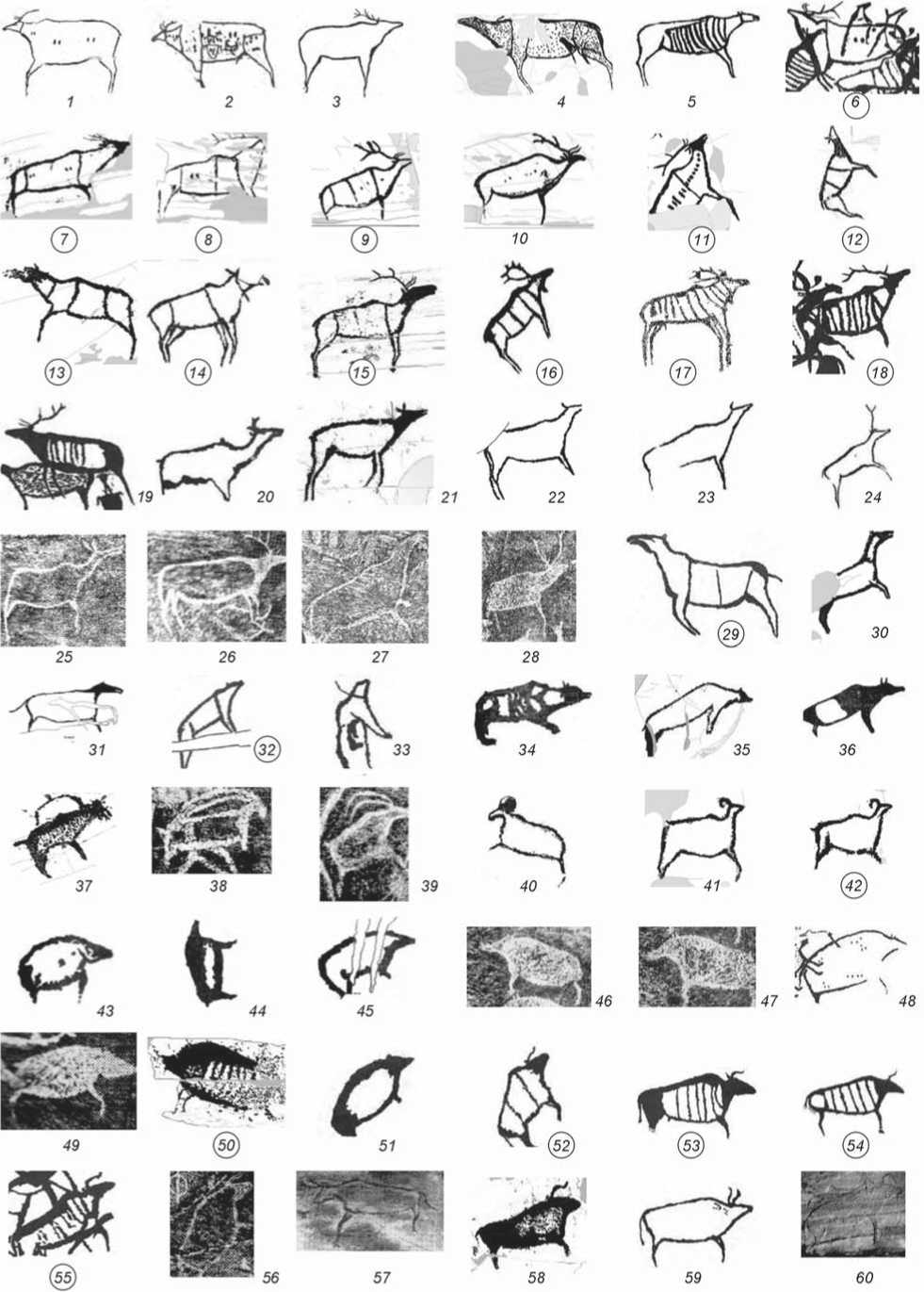
The present study is based on a sample of 60 images (Fig. 1) selected by visual characteristics of the Minusinsk figurative style ever mentioned by researchers, including subjective ones, which in some cases contradict each other as well as our own viewpoint on what determines the Minusinsk Style. The sample included petroglyphs from both large rock art sites, with more than one thousand images from various periods (Oglakhty – 24 images, Shalabolino – 20, Tepsey – 9), and smaller ones (Sukhanikha – 3, Georgievskaya – 2, Maidashy – 2). The criteria for formal typological analysis included only the features that were repeated more than once by various scholars and described specific features of the image, rather than the subjective perception of work of art. As a result, a set of stable morphological parameters inherent in the Minusinsk Style in the region under consideration has been identified.
The derived data were subjected to statistical analysis (Fig. 2). Each available feature was designated by figure one (1), and its absence by zero (0). At the first stage, an unconstrained seriation was carried out, which arranged the petroglyphs by availability of features—from two to eight (see the next section) (Kolobova et al., 2025). The second stage included a hierarchical cluster analysis using the single linkage clustering algorithm, combined with the Hamming metric, to classify images depending on the available features (variables). The Hamming distance metric, originally used for linguistic structures, is suitable for analyzing nominal data by the presence or absence of features. The third stage is a nonparametric correspondence analysis with designation of variables’ vectors. This is a method of visualizing contingency tables based on chi-square statistics. The result is a plot where the distance between points reflects the degree of difference between petroglyphs, depending on the variables used (Fig. 2). All calculations were performed using the PAST-3 program (Hammer, Harper, Ryan, 2001).
Criteria for the Minusinsk Style identification
The images were selected and included in the sample with respect to all the Minusinsk-style features mentioned by researchers. These are “static position of figures”, “strictly horizontal placement” (Podolsky, 1973: 270), “relatively large sizes of animal figures and their ‘realistic presentation’”, “markedly heavy outlines of the body with a comparatively small head” (Sher, 1980: 190–192), “certain schematic features combined with realistic manner” (Sovetova, Miklashevich, 1999: 53). “Some images suggest that the artisans used the principles of constructing orthogonal configurations” (Kovtun, 2001: 143). The following individual features of zoomorphic images were recorded: “narrow, almost pointed profile of the head”, “the head is shown with a straight line running from nose to ears; the mouth is not shown; line of the back is horizontal and straight; the body is rendered as a regular rectangle; short legs (shorter than the body height); the legs are vertical or slightly apart; straight, obliquely directed tail” (Podolsky, 1973: 270); “robust body, slightly pendulous belly,
Fig. 1. Images of the earliest rock art in the Minusinsk Basin.
1–3 , 6 , 8–10 , 13 , 18 , 19 , 24 , 29 , 30 , 33 , 35 , 40–42 , 51 , 53–55 , 59 – Oglakhty; 4 , 11 , 12 – Sukhanikha; 5 , 14 , 16 , 17 , 25 , 26 , 28 , 31 , 34 , 36–39 , 43–47 , 49 , 56 , 57 – Shalabolino; 7 , 15 , 20 , 21 , 32 , 48 , 50 , 52 , 58 – Tepsey; 22 , 23 – Georgievskaya; 27 , 60 – Maidashy. The encircled figures designate the images showing a large number of the Minusinsk Style features and belonging to its core.
1–3 , 6 , 18 , 19 , 33 , 51 , 53–55 , 59 – after: (Sher et al., 1994: Pl. 4, 12.6 ; 13, 36.1 ; 15, 39.1 ; 16, 45.11 , 45.20 ; 19, 53.2 ; 38, 91.5 , 91.9 , 92.14 ; 40, 95.9 , 41, 98.1 ; 43, 101.6 ); 4 , 8 , 11–13 , 27 , 30 , 35 , 60 – after: (Miklashevich, 2015: Fig. 2, 3, 4 , 3, 1 , 2 , 4, 1 , 5, 2 ); 5 , 25 , 26 , 28 , 31 , 34 , 36 , 38 , 39 , 43–47 , 49 , 56 , 57 – after: (Pyatkin, Martynov, 1985: Fig. 7, 27, 51, 69, 71, 73, 84, 107, 125; Tab. 10, 4 , 5 , 9 ; 12, 4 ; 14, 7 , 13 ; 27, 2 ); 7 , 15 , 21 , 50 , 58 – after: (Sovetova, Shishkina, Abolonkova, 2021, Catalogue: Fig. 16, 76, 110, 83, 60); 9 , 10 , 16 , 24 , 40 – after: (Miklashevich, 2020: Fig. 1, 1 , 2 , 4 , 7 , 16 ); 14 – after: (Sovetova, Miklashevich, 1999: Tab. 1, 2 ); 17 , 37 – authors’ trace-drawings; 20 , 32 , 48 , 52 – after: (Blednova et al., 1995: Pl. 4, 11.1 , 14.1 ; 5, 12.2 ; 64, 79.2 ); 22 , 23 – after: (Leontiev, Pankova, 2012: Fig. 3); 29 – after: (Sher, 1980: Fig. 88); 41 , 42 – after: (Miklashevich, 2022: Fig. 2).
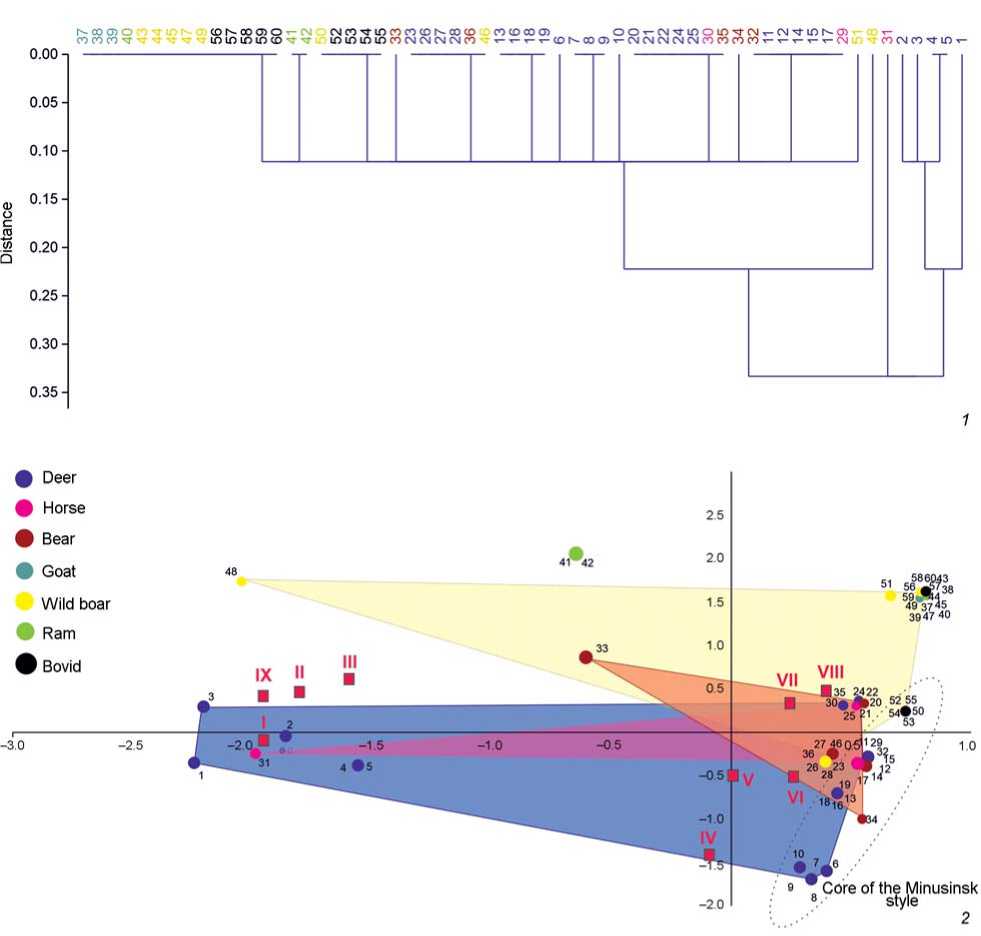
Fig. 2. Findings from the statistical analysis of the earliest rock art sample.
1 – dendrogram of hierarchical cluster analysis using the single linkage algorithm and the Hamming metric (colors of the numbers reflect the species affiliation according to the legend); 2 – correspondence analysis plot displaying similarity between petroglyphs based on attribute variance: I – strictly horizontal position; II – short straight neck; III – heavy outlines of the body; IV – body ornamentation; V – pointed profile; VI – body decoration; VII – “hanging legs”; VIII – slight or significant inclination of the animal’s body; IX – small head.
short straight neck, robust legs” (Sher, 1980: 192), “heavy body, small head with a muzzle extended forward”, seemingly “hanging legs” (Sovetova, Miklashevich, 1999: 53); the body may be ornamented with transverse stripes or “anatomical pattern”* (Kovtun, 2001: 143).
I.V. Kovtun was among the first who drew attention to the iconographic heterogeneity of the Minusinsk rock art tradition. He noted that some deer images were rendered with robust bodies and miniature heads, without special elaboration of necks, while other deer had graceful bodies with exaggerated long necks; representations of animals with bent or images demonstrate a greater number of the transverse lines (see Fig. 1, 8, 9, 16, 17).
straight front legs; those decorated with transverse stripes or anatomical patterns and those devoid of any ornamentation (Ibid.: 142–143).
The available numerous descriptions of the Minusinsk Style contain rather few formal typological features of images, and these are often repeated. The following features can be distinguished: “short straight neck” (Sher, 1980: 192) and “exaggerated long neck” (Kovtun, 2001: 143); “strictly horizontal position” (Podolsky, 1973: 270) and an inclined or almost vertical position of the animal’s body, often combined with an elegantly raised head. This latter feature we have introduced in our study based on the analysis of the sample of images (see Fig. 1, 6–30 , 32–60 ). This technique occurs also in other rock art traditions, for example, in the Angara style. Nevertheless, its repeatability in the petroglyphs under consideration suggests the emergence of this stylistic convention in the earliest rock art. The same is true for the ornamentation of an animal body with vertical lines, which has been noted in the rock art of the Minusinsk Basin and adjacent territories up until the Middle Ages.
Thus, the analysis of the derived sample of images was based on the following characteristics: 1) strictly horizontal position of the body*; 2) large size and heavy outlines of the body (the body height is equal to or exceeds the length of the legs); 3) small head (its height does not exceed the width of the neck) with a muzzle pulled forward; 4) short straight neck (its length does not exceed 1/5–1/6 of the body length); 5) transverse stripes or anatomical pattern distinguishing the shoulder blade and thigh on the body; 6) “hanging legs”; 7) inclined or almost vertical position** of the animal’s body, often in combination with an elegantly raised head; 8) two closely located dots in the front and/or back part of the body; 9) pointed profile of the head, often designated by two lines—lower lip and forehead (the angle between them is approximately 40°).
Results
The selected images do not comprise all the zoomorphic figures known in the Minusinsk Basin that could be attributed to the rock art tradition under consideration. However, this sample of 60 images provides the ground for detecting the trends of the Minusinsk Style in relation to each specific species of the depicted animals.
The most numerous group included the images of cervids (deer, elk, roe deer) ( n =28). The following elements were used to convey these images: 1) inclined or almost vertical position of the body; 2) transverse stripes or anatomical pattern on the body; 3) pointed profile of the head; 4) “hanging legs”; 5) two closely located dots in the front and/or back part of the body.
The other combination of features, including a strictly horizontal position of the animal, heavy outlines of the body, a short straight neck, and a small head with an elongated muzzle, together with some other traits, was recorded on five images of cervids (see Fig. 1, 1–5 ); apparently, these images can be distinguished into a separate group of the earliest petroglyphs of the Minusinsk Basin (see Fig. 2). They exhibit the greatest number of features under consideration: from six to seven combined in one image. Noteworthy is also a series of partial images mainly of deer, more rarely of bovids (Sovetova, Shishkina, Abolonkova, 2021, Catalogue: Fig. 4; Miklashevich, 2020: Fig. 1, 9 , 13 ; and others). Some of these images demonstrate the features characteristic of the Minusinsk rock art tradition: a pointed profile of the head, in combination with an elongated and slightly raised muzzle of the animal. No partial images of bear, boar, ram, and goat have been recorded. We believe that this finding deserves a special study.
The images of cavicornians are dominated by bovids ( n =9) (see Fig. 1, 52–60 ). The following conventions have been identified: 1) inclined or almost vertical position of the body; 2) decoration of the animal’s body with transverse stripes or anatomical patterns; 3) “hanging legs”. A few images of goats and rams ( n =6) show a slight inclination of the body and “hanging legs” (see Fig. 1, 37–42 ). Isolated ram images demonstrate the use of such conventions as heavy outlines of the body, decoration of the body with anatomical patterns, and pointed profile of the head (see Fig. 1, 41 , 42 ).
Five bear images have been identified (see Fig. 1, 32–36 ). They are characterized by the following features: 1) inclined or almost vertical position of the body; 2) anatomical patterns on the body; 3) pointed profile of the head; 4) “hanging legs”.
There are three horse images showing the features of the Minusinsk Style (see Fig. 1, 29–31), which undoubtedly include those from the sites of Oglakhty II (Sher, 1980: Fig. 88) and VI (Mikla-shevich, 2015: Fig. 2, 4). These images show the slight inclination of the animal’s body, decoration with anatomical patterns, and “hanging legs”. Other archaic horse images, which are often mentioned in publications in the context of the earliest rock art, do not show any formal typological features identified by specialists as typical of the Minusinsk Style.
Nine wild boar images have been recorded (see Fig. 1, 43–51 ). The conventions include an inclined or almost vertical position of the body, “hanging legs”, and transverse stripes on the body. The zoomorphic image at Ust-Tuba III (see Fig. 1, 48 ) (Blednova et al., 1995: Pl. 64, 79.2), combining the features of both a bovid and a wild boar, raises some doubts. However, the outline of the animal’s body suggests its identification as a boar.
The statistical analysis of the nominative data has shown that, regardless of the animals’ species, the following figurative features are most frequent: 1) “hanging legs” (59 figures); 2) an inclined or almost vertical position of the animal’s body (54); 3) a pointed profile of the head, often rendered by two lines—lower lip and forehead (37); 4) transverse stripes or anatomical patterns on the body (24).
Two closely located dots in the front and/or back part of the animal’s body are noted only on six images of deer-family members (see Fig. 1, 1 , 6–10 ). The deer images demonstrate the greatest variability and the maximum number of features mentioned in this paper.
The combination of such features as a strictly horizontal position, large size and heavy outlines of the body, a small head with the muzzle extended forward, and a short straight neck, is typical of the cervids figures (see Fig. 1, 1–5 ). Images of animals of other species, for example, wild boar (see Fig. 1, 48 ) or ram (see Fig. 1, 41–42 ), only rarely show some of these features. Decoration of the body with anatomical patterns or transverse lines is absent in the images of goats (see Fig. 1, 37–39 ) and very rarely occurs in those of ram (see Fig. 1, 42 ) and wild boar (see Fig. 1, 50 ).
Thus, all the analyzed petroglyphs (with the exception of a series of deer images, which demonstrate the largest number (six to seven) of the features under consideration (see Fig. 1, 1–5)) can be classified into two main groups (see Fig. 2). Group 1 is characterized by a combination of three to four most frequently encountered features from the list mentioned above, which suggests a considerable standardization of the stylistic manner. This set forms the core of the Minusinsk Style. It comprises images of animals of various species, the deer being the most frequent. Group 2 includes the figures that bear no more than two of the features under consideration, but sometimes exhibit other conventions that are not found in the classic Minusinsk Style (see, e.g., Fig. 1, 57). Various combinations of these conventions provide for the high variability of this group, which we define as the periphery of the Minusinsk Style or the images of the earliest rock art.
Discussion
The series of petroglyphs under study shows recurrent combinations of formal typological features mentioned above, regardless of the species of depicted animals. These have been noted in 21 figures (see Fig. 1, 6–9 , 11–19 , 29 , 32 , 42 , 50 , 52–55 ), which can be considered as a separate group within the earliest rock art of the Minusinsk Basin. This series of images obviously forms the core or classic Minusinsk Style, because they demonstrate a formal set of specific conventions rendering a stable combination of formal typological features. The images represent deer, horse, bear, ram, and bovid.
Notably, our findings do not suggest that other images, bearing three or even two of the four features under consideration, do not belong to the Minusinsk Style. The selected group of petroglyphs provides the characteristics of a stable set of recurrent formal typological features describing a certain established stylistic standard. However, it is very likely that the deviations from the selected set of features in some rock images that are rarely encountered or not included in the group of classic Minusinsk images (such as horse, ram, goat, and wild boar) are due to their species characteristics. For this reason, we have classified all the images by species. This approach seems promising for further analysis of the zoomorphic images of the earliest rock art of the Minusinsk Basin as a whole.
The listed formal typological features can be conventionally subdivided into two groups: the first-order features, characterizing the Minusinsk tradition only; and the second-order features, which are observed in other styles too. For example, the inclined position of the animal’s body is also typical of the Angara style, and the decoration of the body with transverse stripes is recorded in many rock art traditions. At the same time, the ornamentation of the front or back part of the body with two closely located dots is noted exclusively on the images of the Minusinsk Style. The combination of such features as “hanging legs” and transverse lines or anatomical patterns on the animal’s body is characteristic only of the Minusinsk tradition in the region under consideration. Thus, to determine the Minusinsk Style, the latter three features can be used as the first-order criteria, and all the others as the second-order criteria. This division allows us to identify those images that implicitly belong to the Minusinsk rock art tradition, even if they do not show all the formal typological features that make up the core of the style.
Since the Minusinsk Style correlates with the earliest rock images of the Minusinsk Basin, it is no wonder that many of its elements were broadly used in other rock art traditions. Currently, we could hardly assess the chronological affiliation of these images. It is difficult to determine when a particular convention appeared, whether it correlates specifically with the Minusinsk Style or with another group of the earliest images. However, the repeatability of the set of features forming the core of the style points to a deliberate choice of certain forms, a random combination of which is unlikely, and requires knowledge of the established artistic canon. This determines the Minusinsk Style as a cultural, rather than a chronological phenomenon.
At the same time, various combinations of the above formal typological features together with other conventions, including those atypical of the Minusinsk tradition, ensure a high variability of the visual characteristics of the earliest rock art as an epochal phenomenon. Thus, a considerably larger group of the earliest petroglyphs in the Minusinsk Basin is peripheral relative to the core of the Minusinsk Style. The earliest petroglyphs were a more global phenomenon, characterizing the chronological stage in the rock art of a vast territory of Southern Siberia and Central Asia. Moreover, this was the context that presumably created the environment for the development of the local Minusinsk Style in the Middle Yenisei.
Conclusions
Identification of formal typological features of zoomorphic images, taking into account animals’ species, the determination of first- and second-order features within a single rock art tradition, and the separation of the core and periphery of the style made it possible to systematize some of the earliest petroglyphs and to establish a group of images that can be confidently designated classic for the Minusinsk Style. This approach provides a way to solve the problem of classifying petroglyphs within the rock art tradition of a vast region. Since the classification by formal typological features should precede chronological constructions, it is this stage of the study that forms the basis for subsequent attribution of rock images of the Minusinsk tradition and the earliest rock art in the Minusinsk Basin and adjacent regions.
Acknowledgements
The collection of materials, formal typological analysis, and the article concept development were supported by the Russian Science Foundation, Project No. 22-18-00070 “The Earliest Figurative Stratum in the Chronology of Rock art of the Minusinsk Basin: Interdisciplinary Research of the Minusinsk Style” ; the statistical processing of the materials was carried out with the support of IAET SB RAS Project “The Application of Digital Technologies in the Analysis of Archaeological Data and the Reconstruction of the Ancient History” (FWZG-2025-0007). The authors express their deep gratitude to the reviewer for important comments that helped them to clarify the argumentation.
