
Subject matter and nature of labor disputes
Journal: Pravo - teorija i praksa @pravni-fakultet
Section: Articles
Article in issue: 1 vol.43, 2026.
Free access
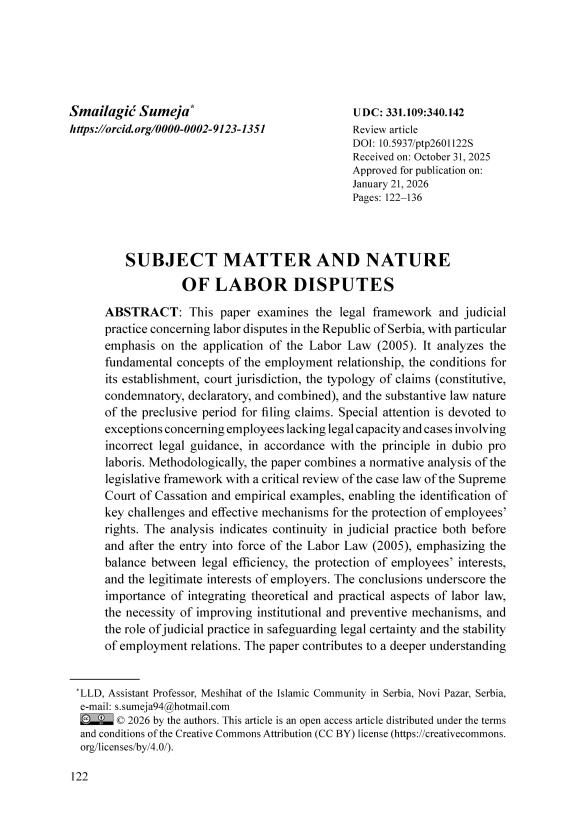
This paper examines the legal framework and judicial practice concerning labor disputes in the Republic of Serbia, with particular emphasis on the application of the Labor Law (2005). It analyzes the fundamental concepts of the employment relationship, the conditions for its establishment, court jurisdiction, the typology of claims (constitutive, condemnatory, declaratory, and combined), and the substantive law nature of the preclusive period for filing claims. Special attention is devoted to exceptions concerning employees lacking legal capacity and cases involving incorrect legal guidance, in accordance with the principle in dubio pro laboris. Methodologically, the paper combines a normative analysis of the legislative framework with a critical review of the case law of the Supreme Court of Cassation and empirical examples, enabling the identification of key challenges and effective mechanisms for the protection of employees’ rights. The analysis indicates continuity in judicial practice both before and after the entry into force of the Labor Law (2005), emphasizing the balance between legal efficiency, the protection of employees’ interests, and the legitimate interests of employers. The conclusions underscore the importance of integrating theoretical and practical aspects of labor law, the necessity of improving institutional and preventive mechanisms, and the role of judicial practice in safeguarding legal certainty and the stability of employment relations. The paper contributes to a deeper understanding of the complexity of labor disputes, the application of the principle of preclusion, and the effective protection of employees’ rights, providing a basis for enhancing legal practice and fostering a secure and stable working environment.
Similar articles in the section Theory and organization of work. Relations between business firms and employees
Short address: https://sciup.org/170211839
IDS: 170211839 | UDC: 331.109:340.142 | DOI: 10.5937/ptp2601122S
Предмет и карактер радног спора
Рад истражује правни оквир и судску праксу у области радних спорова у Републици Србији, са посебним освртом на примену Закона о раду (2005). Анализирани су основни појмови радног односа, услови заснивања, надлежност судова, типологија тужби (конститутивне, кондемнаторне, декларативне и комбинационе) и материјалноправни карактер преклузивног рока за подношење тужби. Посебна пажња посвећена је изузецима за неспособне запослене и случајевима погрешно издате правне поуке, у складу са принципом in dubio pro laboris. Методолошки, рад комбинује нормативну анализу законодавног оквира, критички преглед судске праксе Врховног касационог суда и емпиријске примере, омогућавајући идентификацију кључних изазова и ефективних механизама заштите права запослених. Анализа показује континуитет судске праксе пре и после ступања на снагу Закона о раду (2005), наглашавајући баланс између правне ефикасности, заштите интереса запослених и легитимних интереса послодаваца. Закључци истичу значај интеграције теоријских и практичних аспеката радног права, неопходност унапређења институционалних и превентивних механизама, те улогу судске праксе у очувању правне сигурности и стабилности радних односа. Рад доприноси разумевању комплексности радних спорова, примене принципа преклузије и ефективне заштите права запослених, пружајући основу за унапређење правне праксе и развој сигурног и стабилног радног окружења.
Text of the scientific article Subject matter and nature of labor disputes
The establishment of an employment relationship represents the concrete realization of the constitutionally guaranteed right to work, thereby fulfilling both the social and the individual purpose of labour (Simonović, 2020, p. 20).
General conditions include the minimum age and the ability to perform work, as certified by competent medical authorities, while specific conditions depend on the employer’s internal regulations and encompass professional qualifications, prior work experience, passing of examinations, specific skills, foreign language proficiency and information technology competencies. The Rulebook on the Organisation and Systematisation of Jobs prescribes in detail the organisation of workplaces, professional criteria and the number of employees required for the efficient performance of tasks.
Issues related to the establishment of employment relationships remain a central topic of labour law, as they enable effective legal and social regulation of employment relations, harmonised with international standards and national legislation.
2. The Concept and Significance of Labour Disputes
A labour dispute represents a legal mechanism for the protection of rights arising from an employment relationship and may be initiated by either the employee or the employer. When an action is brought by the employee, the proceedings are defined as a labour dispute , whereas an action initiated by the employer constitutes a dispute arising from an employment relationship . Although both are connected to employment relations, these concepts are not synonymous: a labour dispute encompasses exclusively claims brought by the employee against the employer, while a dispute arising from an employment relationship also includes claims brought by the employer against the employee (Reljanović & Misailović, 2021, p. 17).
The specific nature of these proceedings is reflected in their purpose— ensuring expedited and efficient resolution of disputes, thereby protecting the economic and social interests of both employees and employers. The Civil Procedure Act (CPA), Article 435, imposes an obligation on courts to give particular attention to the prompt resolution of disputes arising from employment relationships, reflecting the high social importance of labour rights and the stability of the labour system.
Judicial practice clearly underscores the necessity of distinguishing between a labor dispute and a broader civil action arising from an employment relationship. In this context, the Supreme Court of Serbia, in judgment Rev. 3524/96 of 11 November 1996, held that the active locus standi to initiate a labor dispute lies exclusively with the employee, whereas the employer may appear solely as the defendant in such proceedings, or, alternatively, as the claimant in a broader civil action arising from the employment relationship (Ivošević, 2009, pp. 280–281). This distinction enables the uniform application of procedural rules and ensures equality of the parties, in accordance with Article 36, paragraph 1 of the Constitution of the Republic of Serbia, which guarantees equal protection of rights before the courts. Contemporary legal scholarship emphasizes the necessity of harmonizing procedures in all civil actions arising from employment relationships to ensure that the protection of the rights of employees and employers is consistent and effective, while judicial practice becomes more predictable and transparent (Ivošević, 2011, pp. 450–458; Vukadinović, 2007, p. 158; Pavlović Nedeljković et al., 2017, p. 175).
This approach achieves a modern standard of procedural equality that meets the requirements of market-oriented employment relations and promotes legal certainty in labor matters.
3. Jurisdiction and Initiation of a Labour Dispute
A labour dispute constitutes a form of judicial protection of rights arising from employment, which is exercised in court proceedings. In accordance with Article 67 of the Constitution of the Republic of Serbia (2006), everyone is guaranteed the right to legal assistance under conditions prescribed by law. Article 195, paragraph 1 of the Labor Law specifies that a dispute is initiated against an employer’s decision “by which the employee’s right has been violated,” but only once the employee “becomes aware of the violation of the right.” This legal principle has also been confirmed in case law, as illustrated by the presuda Rev. no. 3524/96 of 11 November 1996, which stated that only the employee possesses active standing to initiate a labor dispute, whereas the employer cannot act as a plaintiff in such proceedings (Ivošević, 2012, p. 112).
The court emphasized: “Judicial protection can only be exercised by an employee whose employment right has been violated. Without a rights violation, there is no judicial protection. The plaintiff consented to the right by which his employment status was determined. Since his interest was thus satisfied, judicial protection became redundant. Consequently, the lower courts acted correctly in dismissing the lawsuit” (Ivošević, 2009, p. 281).
-
1. Jurisdiction of the Court in Labor Disputes. According to the provisions of Article 24 of the Law on the Organization of Courts, the competent court for deciding labor disputes is the basic court of first instance within the territory where the employee is located. The basic court of first instance adjudicates disputes concerning the establishment, existence, and termination of the employment relationship, as well as the rights, obligations, and responsibilities arising from the employment relationship, including compensation for damages suffered by the employee in the course of or in connection with work. This statutory provision enables a clear distinction of jurisdiction in labor disputes, ensures legal certainty, and precisely defines the procedural boundaries applicable to employment matters (Law on the Organization of Courts, 2023).
-
2. Initiation of Proceedings. – A labour dispute is initiated by filing a statement of claim (Jovanović, 2015, p. 359). Under Article 195, paragraph 1 of the Labour Act, a claim may be filed by an employee whose rights have been violated, as well as by a representative of the trade union to which the employee belongs. An employee whose right has been infringed is entitled to file a claim without any additional conditions, even if the employee is a minor. The claim may be filed personally or through an authorised representative. A trade union representative may file a claim only if expressly authorised by the employee. In this context, the representative acts as a procedural proxy who has acquired the status of a trade union representative in accordance with the statute of that organisation (Ivošević, 2007, p. 286).
-
3. Filing of the Claim and Time Limit. – Pursuant to Article 195, paragraph 2 of the Labour Act, the time limit for filing a claim in a labour dispute is 90 days from the date of adoption of the employer’s decision or from the moment the employee became aware of the violation of his or her rights. This period constitutes a mandatory temporal framework within which the claim must be lodged.
Depending on the nature of the claim, an action may be: constitutive – seeking the annulment of a decision, agreement, or other individual act; condemnatory – seeking an order for monetary performance (payment of wages, wage compensation, other earnings, or damages) or non-monetary performance (reinstatement, re-examination of a right, entry of service period into employment records, or delivery of employment documents); or declaratory – seeking the determination of a right (such as entitlement to annual leave, occupational safety protection, or rights arising from redundancy) or of a legal relationship.
The method of calculating this time limit depends on whether the violation of rights resulted from a specific decision of the employer or from a factual act. Where the violation arises from an employer’s decision, the time limit for filing a claim begins to run on the day the employee receives that decision. The period commences on the first day following receipt of the decision and expires upon the lapse of 90 days, unless the law provides otherwise. In this context, Articles 185, paragraphs 2 to 4, and Article 193, paragraph 2 of the Labour Act provide ipso iure that, if the employee refuses to accept service of the decision, the employer is obliged to draw up a written record of such refusal and post it on the notice board. Upon the expiry of eight days, service is deemed to have been effected.
Where the violation of rights stems from a concrete factual act of the employer, the time limit for filing a claim begins to run from the moment the employee becomes aware of the violation of his or her rights. In such cases, the time limit commences on the first day following the acquisition of knowledge and lasts 15 days, as prescribed by law.
The date of service of a decision is determined in accordance with the rules on service previously explained, which, if properly applied, leave no room for doubt or dispute. However, identifying the date on which the employee became aware of the violation of rights is not always straightforward. That date must be linked to the moment of full certainty as to the existence of the violation. This determination is easier when the infringement manifests through clear and tangible signs, such as preventing the employee from accessing the workplace or performing assigned duties. By contrast, in cases of non-obvious violations – such as omissions or failures to act – the moment at which awareness of the violation arises may be significantly more difficult to establish. In such situations, the court should apply the rule of in dubio pro laboris (in case of doubt, in favour of the employee), meaning that it should refrain from hastily concluding that a violation has occurred and instead await the point at which it becomes unequivocally clear that the employee’s rights have been infringed.
Furthermore, the rule requiring that a claim in a labour dispute be filed within 90 days from the date of service of the decision or from the moment of awareness of the violation constitutes a strict rule, with no apparent exceptions. Nevertheless, it may be argued that exceptions do exist with respect to monetary claims, for which Article 196 of the Labour Act prescribes a limitation period. That period amounts to three years from the date the obligation arose, and since it would be rendered meaningless if subordinated to a 90-day preclusive period, it follows that where a limitation period applies, a preclusive period does not. The time limit for filing a claim in a labour dispute is therefore a substantive-law preclusive time limit, and its expiration results in the loss of the right to judicial protection and the dismissal of the claim.
This point is underscored by the decision of the Supreme Court of Serbia, Rev. 3118/94 of 6 October 1994, which emphasized that only the employee has the right to judicial protection in a labor dispute and that the period for exercising this right constitutes a substantive preclusive (peremptory) period. The Court stated: “The period within which judicial protection may be sought constitutes a substantive preclusive period, and failure to act within this period results in the loss of the right to judicial protection. A claim filed after this period is untimely and must be dismissed. The loss of the right to bring a claim entails the loss of the right that the claim was intended to protect. This loss of rights is definitive and cannot be restored. Accordingly, the employer’s final decision becomes conclusive and binding.”
A court cannot adjudicate such a matter, as clearly indicated in the decision of the Supreme Court of Serbia, Rev. 1722/93 of 27 March 1993, which states: “By failing to act within the prescribed period, the plaintiff has lost the right to bring the claim, resulting in the court’s inability to issue a merits-based decision concerning the subject matter of the dispute. Given that the lost right to judicial protection cannot be restored, any statements in the appeal regarding the existence of a subjective right that was intended to be protected are irrelevant. Courts are not competent to rule on such a right” (Ivošević, 2007, p. 287).
This decision confirms that, once a claim is barred by preclusion, the court dismisses the action not only with respect to requests for annulment of the contested decision, but also regarding claims seeking restoration of the previous state, such as reinstatement to employment, payment of contributions, compensation for lost wages, and similar remedies. This clearly illustrates the principle of legal certainty and the irrevocability of rights after the expiration of a preclusive period, as well as the limitation of the court’s authority to cases in which the employee has timely exercised their rights. This is evidenced in the decision of the Supreme Court of Serbia, Rev. 416/95 of 14 February 1995, which emphasized: “When the subject matter of a labor dispute is a final decision, an untimely claim is dismissed with respect to all requests” (Ivošević, 2007, p. 287).
This position of the court confirms the substantive-law nature of the filing deadline, which decisively affects the method of its computation. Previously, missing the deadline resulted in the permanent loss of the right to file a claim, even if the last day fell on a Sunday or any other day when the court was not in session. However, the approach in practice has evolved, not due to amendments to the Labor Law, but following the adoption of new regulations in the Civil Procedure Code, which enabled a more balanced legal approach to the protection of employees’ rights.
According to Article 106, paragraph 5 of the Civil Procedure Code, it is expressly stipulated that if the last day of the deadline for filing a claim falls on a public holiday, Sunday, or any other day when the court does not operate, the deadline is extended and expires on the next working day. Although the filing deadline is strictly defined and cannot be arbitrarily extended or shortened, judicial practice in certain circumstances allows for a relativization of this rule, in order to protect employees from the harmful consequences of incorrectly issued legal instructions or the party’s inability to properly assess the situation. For instance, an employee who has filed a claim in accordance with guidance provided in a legal instruction, even if the formal deadline has expired, will not be subjected to preclusion.
This principle was confirmed in the decision of the Supreme Court of Serbia, case no. Rev. 4754/93, dated 19 January 1994, which stated: “The claimant filed the lawsuit after the expiration of the 15-day deadline because the legal instruction incorrectly indicated that the deadline for filing was 30 days from the date of delivery of the final decision. A party cannot bear harmful consequences due to errors in the legal instruction regarding the procedural remedy; therefore, the employee’s claim cannot be dismissed.”
A similar position was expressed in the Supreme Court of Serbia’s decision Rev. 4819/93, dated 26 January 1994: “A claim in a labor dispute is considered timely even if it reaches the competent court after the expiration of the deadline, provided that it was filed with an incompetent court prior to that deadline due to ignorance or an obvious mistake” (Ivošević, 2007, p. 288).
These judicial positions clearly confirm that the substantive-law deadline for filing a claim is relativized in situations where the employee acted in accordance with legal guidance or made an inadvertent procedural error, thereby ensuring the protection of the employee’s rights and legal certainty in labor disputes.
Preclusion does not affect employees who are incapable of understanding or managing their own actions. This principle was explicitly confirmed in the decision of the Supreme Court of Serbia, case no. Rev. 2517/92, dated 2 July 1992, which stated: “For a person who is incapable of understanding the significance of their actions and managing them, and if no guardian is appointed, the time limit for initiating proceedings to protect rights does not begin to run. Such a person is unable to perform any voluntary act, including receiving the decision, which would trigger the start and end of the preclusive period.”
A similar position was expressed in the decision of the Supreme Court of Serbia, case no. Rev. 26176/94, dated 8 June 1994: “The preclusive period for filing a claim in a labor dispute does not apply to a person who is incapable of reasoning, as such a person is unable to perform the voluntary act of receiving the decision that would trigger the start and end of that period” (Ivošević, 2007, p. 288).
Judicial practice also allows for the relativization of strict preclusion when the employee acts in accordance with erroneous legal guidance or submits a claim to a competent court even after the expiration of the deadline, as established in decisions Rev. 4754/93 and Rev. 4819/93.
In labor-related civil proceedings, the strictness of preclusive deadlines is mitigated for employees who are incapable of reasoning or who act in accordance with incorrect legal guidance. This principle is derived from the Law on Civil Procedure (2011 and subsequent amendments, Chapter XXIX, Articles 436–441), which governs labor dispute procedures, deadlines for filing claims, expedited dispute resolution, and exceptions for incapacitated individuals.
Such statutory and judicial practice enables a balance between the efficiency of judicial proceedings and the protection of employees’ rights, as well as predictability of court decisions, representing the foundation of the procedural understanding of the institution of preclusion in labor disputes, while maintaining its relevance within the contemporary normative framework.
4. Judicial Practice Following the Entry into Force of the Labour Law (2005)
Judicial practice established after the entry into force of the Labor Law in 2005 confirms the continuity of previously adopted procedural stances regarding the legal nature of the time limit for exercising judicial protection in labor disputes. In the decision of the Supreme Court of Cassation, Rev2 1816/10, it was emphasized that the deadline for filing a claim to protect rights arising from an employment relationship constitutes a substantive preclusive period. Failure to comply with this deadline results in the employee definitively losing the right to judicial protection, whereby the court is not authorized to examine the merits of the claim, but is obliged to dismiss the claim as untimely. This interpretation confirms the consistency of judicial practice in applying the institution of preclusion and contributes to ensuring legal certainty and predictability in the protection of rights arising from employment relationships.
At the same time, judicial practice maintains the protective function of labor law in situations where the employee acts in accordance with incorrectly provided legal guidance. Based on the principles of legal certainty and the protection of the weaker party in an employment relationship, the Supreme Court of Cassation, in decision Rev2 1451/12, held that an employee cannot bear detrimental consequences due to erroneous instructions regarding a legal remedy. Under such circumstances, a claim filed in accordance with incorrectly provided legal guidance is considered timely, even if it was formally submitted after the statutory deadline had expired. This stance confirms the consistent orientation of judicial practice toward the protection of employees’ rights and prevents lapses by the employer or the decision-making authority from resulting in the loss of the right to judicial protection.
With regard to determining the moment at which an employee becomes aware of a rights violation, contemporary judicial practice consistently applies the principle of protecting the weaker party in the employment relationship. In this context, the limitation period for filing a claim begins to run from the moment the employee became aware, or ought to have become aware, of the rights violation. The Supreme Court of Cassation, in decision Rev2 306/16, emphasizes that, when establishing this moment, any doubts must be interpreted in favor of the employee. This position reflects a general principle of labor law, often expressed in legal theory by the Latin maxim in dubio pro laboris (in case of doubt, in favor of the worker).
Such an approach confirms the enduring relevance of judicial practice and its adaptability to the contemporary normative framework.
5. Judgment
A judgment in a labour dispute substantively decides the merits of the claim, with the character of the judgment depending on the type of lawsuit filed.
Constitutive (transformative) judgment – This type of judgment annuls the individual act of the employer that is the subject of the dispute, thereby producing a transformative effect ( ex tunc ), i.e., all consequences of that act cease to exist (Stojanović & Matić, 2017, p. 136). The most frequent contentious situations in labour law concern decisions on the termination of an employment contract, cessation of employment due to completion of service, agreements on termination of employment, or decisions on suspension from work, in accordance with Article 179 of the Labour Law (2005). By annulling the individual act, a state is restored that did not previously exist, thus protecting the rights of the employee and ensuring legal certainty in the employment relationship.
Condemnatory judgment – This corresponds to a claim for an order of performance, whereby the court directs the employer to fulfil monetary or non-monetary obligations. Monetary obligations include payment of wages, compensation for lost wages, other earnings, or damages, while non-monetary obligations may include reinstatement of the employee, re-examination of rights or obligations, registration of work experience, or payment of social security contributions. All of these obligations require a request from the employee, as the court does not act ex officio (Article 108, Paragraph 2 of the Labour Law). The time limit for enforcement of the order in a labour dispute is eight days (Article 438 of the Law on Civil Procedure).
Declaratory judgment – This type of judgment is issued when the purpose of the lawsuit is to establish the existence of a right or legal relationship between the parties. Examples include the right to annual leave, part-time work, or rights within programs for resolving workforce reductions. It may also pertain to changing an employment relationship from fixed-term to indefinite-term (Stojanović & Matić, 2017, p. 138).
Judgment with a combined ruling – This applies when the claim consolidates multiple legal consequences, combining constitutive, condemnatory, and declaratory judgments in accordance with the claims submitted. The judgment becomes final ( res judicata ) when no further appeal is possible. At first instance, this occurs when the parties waive the right to appeal or miss the deadline for filing it. At the second instance, finality is achieved when the appellate court rejects the appeal and confirms the first-instance judgment.
Deadline for finalization of the dispute – Pursuant to Article 195, Paragraph 3 of the Labour Law, an individual labour dispute should reach finality within six months from the date of filing the claim. This provision is declarative in nature, as in practice, the duration of proceedings depends on the complexity of the case, fact-finding, and any appeals or revisions. Finalization may be postponed if the appellate court annuls the first-instance judgment or remands the case for retrial, as well as in the event of a revision (Reljanović & Misailović, 2021, pp. 83–85).
Enforcement of the judgment – A judgment in a labor dispute can be enforced only once it becomes final and binding. However, only condemnatory judgments, which order the fulfillment of monetary or nonmonetary obligations – such as payment of wages, compensation for damages, contributions to social security, reinstatement of the employee, or return of the employment record book – are enforceable. In contrast, constitutive and declaratory judgments are not enforceable, as their effect is realized upon the pronouncement of the judgment itself – annulment of a decision or establishment of a right operates ex tunc.
The substantive legal basis for compensation arises from Article 191 of the Labor Law, which provides for reinstatement to work, payment of compensation equivalent to lost wages, and payment of the corresponding social security contributions for the period during which the employee did not work (Simonović, 2017, p. 77).
Enforcement of a judgment in labor disputes is initiated after the expiration of the deadline for voluntary compliance. If the employer fails to comply with the final and enforceable decision, the employee may file a motion for compulsory enforcement in accordance with the Law on Enforcement and Security.1 The particularity of this procedure lies in the exclusive jurisdiction of the court over the reinstatement of the employee, whereby the court may impose monetary penalties to compel compliance, taking into account all relevant circumstances and the economic capacity of the employer.
6. Conclusion
Employment relationships form the foundation of the socio-economic order, integrating legal, economic, and social dimensions that shape the functionality of the modern labor system. Labor disputes arising from violations of these relationships require careful balancing between the protection of employees’ rights and the legitimate interests of employers, with efficiency and legal certainty remaining the primary objectives.
Through an analysis of the fundamental concepts of employment, the conditions for its establishment, and the typology of labor disputes, the study has demonstrated that labor law regulation is sophisticated, with clearly defined mechanisms for safeguarding employees’ rights through claims, court competencies, procedural deadlines, and the enforcement of judgments. Particular attention has been given to the practice of the Supreme Court, which, through the principle in dubio pro laboris and strict observance of limitation periods, enables a balanced approach and prevents arbitrary restrictions on employees’ rights.
Simultaneously, in cases involving factual conduct by employers, courts exercise full jurisdiction, thereby ensuring substantive justice and reinforcing the corrective function of labor law. Trends in modern legal systems favoring alternative dispute resolution mechanisms have proven effective in reducing the burden on courts and expediting proceedings. Nonetheless, judicial practice remains indispensable in complex cases, where impartial assessment and adjudication contribute to the maintenance of legal certainty and stability in employment relationships.
In light of the social and economic significance of stable employment relations, the continuous improvement of the legal and institutional framework is imperative. An efficient and equitable system for resolving labor disputes, combined with preventive mechanisms, constitutes a key prerequisite for long-term sustainability and economic development. Well-regulated and stable employment relations not only strengthen legal certainty and social cohesion but also enable the formation of a modern and competitive economic environment.
Conflict of Interest
The author declares no conflict of interest.
Funding
This research received no external funding.
Data availability statement
The original contributions presented in the study are included in the article and/or supplementary material. Further inquiries may be directed to the corresponding author(s).
Informed Consent for Participation in the Study / Institutional Review Board Statement
Not applicable.
Smailagić Sumeja
Mešihat Islamske zajednice u Srbiji, Novi Pazar, Srbija
