
The Earliest Petroglyphs of Rashaan-Khad, Mongolia: New Observations
Журнал: Archaeology, Ethnology & Anthropology of Eurasia @journal-aeae-en
Рубрика: Paleoenvironment, the stone age
Статья в выпуске: 3 т.53, 2025 года.
Бесплатный доступ
We present preliminary findings relating to the Rashaan-Khad (Arshan-Khad, Mongolia) petroglyph site studied by the Russian-Mongolian expedition in 2016 and 2023. Special attention is paid to petroglyphs that, in A.P. Okladnikov’s words, appear archaic and those that can with various degree of certainty be interpreted as representations of Late Pleistocene mammals such as woolly rhinoceros or mammoths. Okladnikov wrote that six petroglyphs stand out mostly by their large size, carved outlines, «primitivism», and robustness. Our study has revealed eight figures that could be interpreted as those of large Upper Paleolithic animals or archaic-looking ungulates, but one of the figures published by Okladnikov has not been found. We discuss the correlation of such images with wavy lines, groups of intertwined lines, and what can be seen as a representation of a «bear paw print». Despite the limited time for fieldwork, we were able to identify panels especially relevant to the chronology of the site, refine the trace-drawings, obtain new data on already known images, and detect new ones. Comparison of petroglyphs published by Okladnikov in the 1980s with 3D-models and curvature maps based on them demonstrated yet again the need for and efficiency of advanced digital documentation in the study of rock art and the re-documentation of already known sites.
Короткий адрес: https://sciup.org/145147543
IDS: 145147543 | DOI: 10.17746/1563-0110.2025.53.3.045-052
Текст научной статьи The Earliest Petroglyphs of Rashaan-Khad, Mongolia: New Observations
The petroglyph site of Rashaan-Khad (also known as Arshan-Khad or Arshaan-khad) is situated in the Khurkhyn Gol valley (Batshireet sum, Khentii aimag, Mongolia), on a low remnant rock massif at the eastern extremity of the spur of Dulyn Godzgor Mountain. The site has been known since 1942. It was studied by Mongolian archaeologist H. Perlee (1975) from 1960 on. Then the petroglyphs were
documented and examined by E.A. Novgorodova and A.P. Okladnikov, who partially published the collected materials (Nowgorodowa, 1980; Novgorodova, 1983, 1984: 16–18; 1989: 52–53; Okladnikov, 1981: 191–193; 1983; Okladnikov, Vasilievsky, 1982). A detailed review of past work can be found in our summary of longstanding debates around the attribution and relative chronology of the petroglyphs (Svoiskiy et al., 2021), and in a recent review of Mongolian rock-art studies (Ankhsanaa et al., 2023).
We started the field studies at Rashaan-Khad in 2016. Mapping of the site was conducted and a topographic base for further study was created. The first stage of the study resulted in the preliminary publication of several documented surfaces with petroglyphs (Svoiskiy et al., 2021). At the same time, we concluded that the information about the site was insufficient, and further fieldwork was required. This plan was implemented in autumn 2023*.
The present study is focused on the petroglyphs attributable to the earliest group. These are primarily representations of Upper Pleistocene animals and those similar in style and technique of rendering. At one time, A.P. Okladnikov wrote that six petroglyphs at this site stand out mostly by their large size, carved outlines, “primitivism”, and robustness. In sum, he defined these traits as “archaic appearance” (Okladnikov, 1981: 77–79). The species composition of the depicted animals serves as the main chronological marker that allows us to determine reliably the upper boundary for the earliest group of Rashaan-Khad petroglyphs. While it is not yet clear when mammoth theriofauna, specifically wooly mammoths ( Mammuthus primigenius ) and rhinoceros ( Coelodonta antiquitatis ), went extinct in Mongolia, available facts point to the disappearance of these animals in the adjacent regions about 23–20 ka BP in China and ca 11 ka BP in Southern Siberia (Stuart, Lister, 2012). The latest dates of wooly rhinoceros’ extinction (12–15 ka BP) were recorded in the Altai and Angara region (Garutt, Boeskorov, 2001), the earliest date (20 ka BP) in Eastern China (Burovsky, 2010).
Previous attempts at identifying animals were based on the chronology of styles, which was assessed by less than perfectly accurate trace-drawings. Our
*Fieldwork was conducted by Y.M. Svoiskiy, G. Amar-sanaa, D. Ulziibayar, and E.A. Galkina under the overall supervision of D. Uranchimeg and Y.M. Svoiskiy. E.V. Romanenko processed the collected data. Illustrations to this paper were made by D.M. Pavlov and A.N. Uralskaya.
principal objective was to obtain more reliable and detailed material for analysis. As a result, the group of the earliest Rashaan-Khad petroglyphs was somewhat enlarged. In this article, images from later periods (representations of a horse’s hoof, “bear paw print”, tamga-like signs, and others) are not considered, except in the cases where they were located on panels with animal figures of definitely “archaic appearance”.
Study methods
In 2016, fieldwork at Rashaan-Khad concentrated on mapping the site using aerial photographs from UAVs. The photographs were photogrammetrically processed, and orthophotoplans with 2 cm resolution were generated along with digital relief model, point clouds, and 3D polygonal models. In addition, we conducted selective documentation of panels with petroglyphs. In 2023, accurate documenting was a priority, and more sophisticated techniques, elaborated by our team since the initial experiments of 2016, were implemented. All relevant rock surfaces were scanned for petroglyphs, which were re-catalogued and re-mapped by direct differential GNSS measurements. There were found 32 panels bearing petroglyphs from different periods of time (from the Paleolithic to the ethnographically modern period) as well as Tibetan and Ancient Mongolian inscriptions made by pecking, abrading, and engraving or written with ocher and ink. In 2023, 25 of them were digitally recorded using photogrammetry and subjected to 3D-modeling. Five panels recorded with insufficient accuracy in 2016 were re-documented. The surfaces had not been cleaned of lichen before being photographed. The high resolution of modeling enabled us to use the Multi-Scale Integral Invariant algorithm (Mara, 2012), which made the images more “legible”*.
Main results
In 2016 and 2023, 28 panels with petroglyphs were documented and 3D polygonal models for them were created. The analysis of the collected data
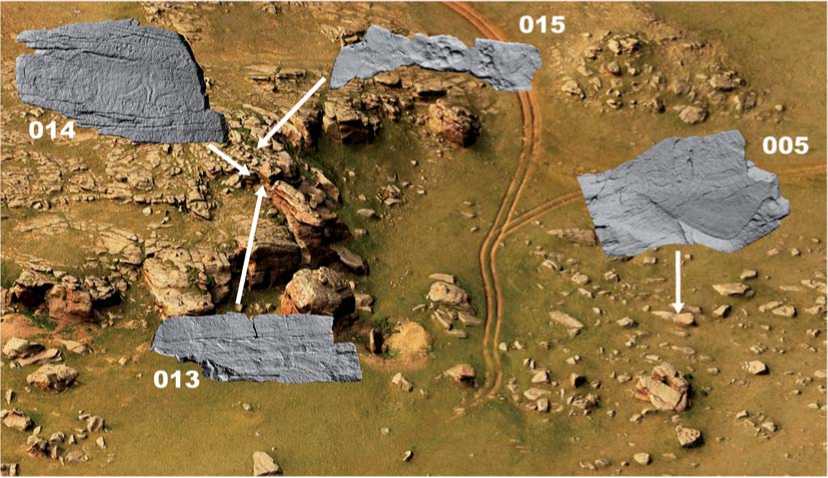
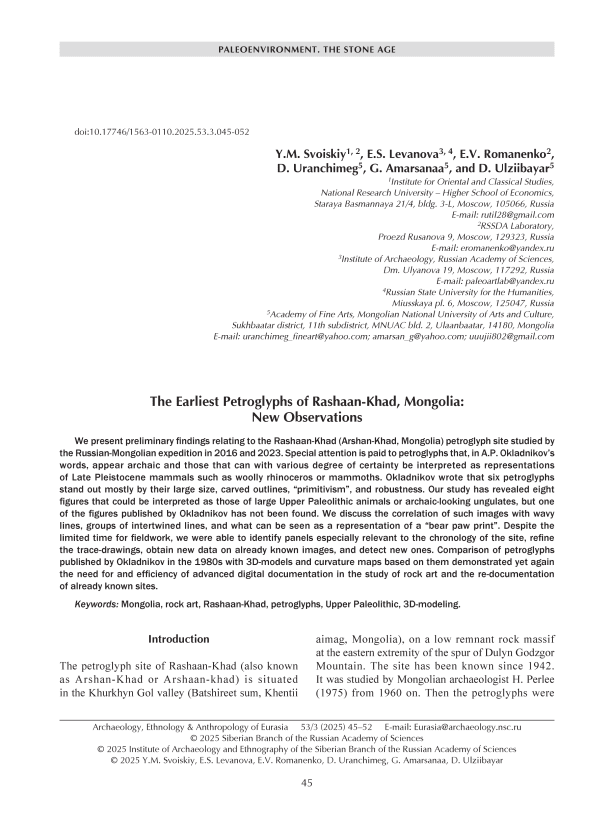
Fig. 1. Location of panels with representations of Late Pleistocene animals at Rashaan-Khad (numbers refer to 2023 materials; neither A.P. Okladnikov nor E.A. Novgorodova provided continuous numbering of panels with petroglyphs).
demonstrated that all the Rashaan-Khad petroglyphs published by A.P. Okladnikov, E.A. Nov-gorodova, D. Tseveendorj, and M.Y. Shishin (Okladnikov, 1981: 191–193; 1983; Novgorodova, 1983; 1984: 16–18; 1989: 52–53; Tseveendorj, 2012: 119–120, 356; Shishin, 2015) were localized at the site, with one sole exception: the image of a bovid reproduced in the monograph by Okladnikov (1981: 192, pl. 108, 4 ) was not detected. At the site, at least four panels with petroglyphs representing animals of “archaic appearance” (Fig. 1) were identified. These were interpreted as a horse, a bovid, a wooly rhinoceros, and, with a low probability, a mammoth. The representations of wooly rhinoceros and mammoth can only be Late Pleistocene, while those of horse and bovid can be both Late Pleistocene and Holocene. However, the style and technique of execution are so similar that with a high probability the images can be attributed to a single chronological period. Images on three of the mentioned panels (005, 013, 014) were previously published; and those on panel 015, found by student E.A. Galkina in 2023, remain unpublished.
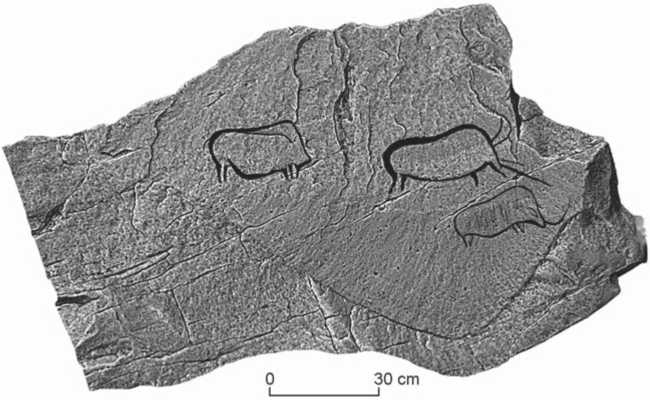
Fig. 2. Panel 005.
Panel 005 (Fig. 2)*. Images are located on the slickenside of a remnant of a firm, medium-grained, sandstone rock. The surface roughly faces south, has a positive slope, and lacks natural protection. Earlier, the stone was covered with lichen, which was removed during the study conducted there in the first half of the 2010s. Three figures of animals are executed
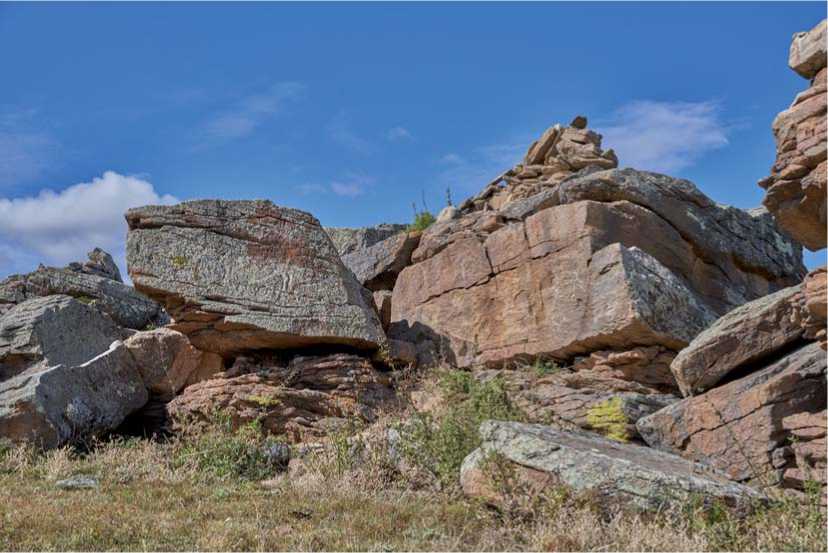
Fig. 3. Landscape context of panels 013 and 014. Photograph by Y.M. Svoiskiy.
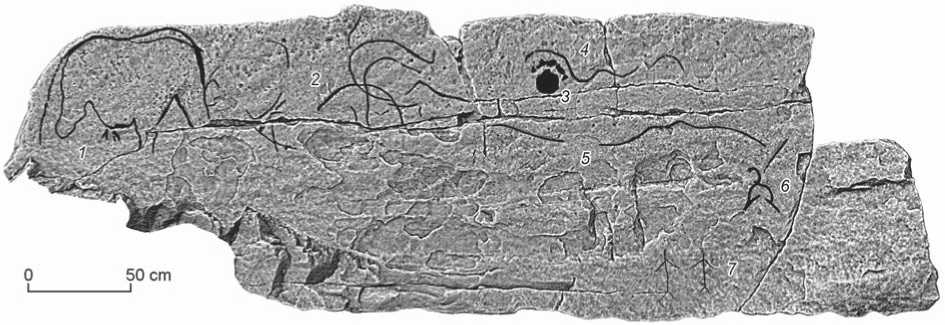
Fig. 4. Panel 013
by contour groove. Two of them represent wooly rhinoceros ( Coelodonta antiquitatis ) with a curved or straight horn and a hump on the back. These figures resemble Upper Paleolithic images of such animals. The upper left figure portrays a bovid (Fig. 2). These petroglyphs and animal species identification were previously published (Svoiskiy et al., 2021: 314, fig. 1). Analysis of the newly formed model of the panel provides for only minor clarification of their appearance.
We face an entirely different situation when examining the results of modeling and algorithmic visualization of panels 013 and 014. The comparison of these results with those previously published shows that digital methods provide a much more complete and detailed picture. Although panel 014 was documented without preliminary removal of lichen, traces of pecking were nearly as distinct there as on panel 013, where lichen was virtually absent. We present the observations below.
Panel 013 (Fig. 3, 4). Petroglyphs are located on a rock massif composed of large-grained sandstone without signs of displacement; lichens are absent. The surface is exposed to the south; it is almost vertical and has no natural protection from above. The best observation is in the morning hours. This panel is one of the few Rashaan-Khad surfaces oriented to the south, while most of them face rather the southeast. Images on panel 013 belong to two generations. The earlier ones (figure of a large herbivore stylistically similar to the representations on panels 005 and 014, and some others) were made by pecking (then possibly abraded). Apart from these, certain drawings in the bottom right part of the panel are done by thin polishing, which removed the superficial layer of rock with exogenous changes (“patina”) without affecting the rock itself. The panel is breached by several large cracks (with no displacement along them). Its lower part was damaged by desquamation (peeling of the rock cortex), which destroyed some images.
Comparison of the figures observable on the model with the most detailed trace-drawings (Okladnikov, 1981: 193, pl. 109, 1 ) shows some significant differences in their configuration. The most interesting is the image of a large animal in the upper left corner (Fig. 4, 1 ). It can be interpreted as a horse or a mammoth (owing to the partially preserved representation of a trunk or an upturned tusk; regrettably, since a part of the panel is missing, it is impossible to determine reliably if this line was the continuation of the figure).
In addition to the animal figure, within the panel, there can be seen an uninterpretable group of intertwined smooth lines (Fig. 4, 2) obviously linked by some general idea, a combination of a “bear paw print” (Fig. 4, 3) and a long circumflex wavy line (Fig. 4, 4), and a meandering line located below other figures (Fig. 4, 5). There are also a tamga-like sign (Fig. 4, 6) and a representation of two people holding hands (Fig. 4, 7) made in other technique and clearly much younger. Some figures present on Okladnikov’s trace-drawings (Fig. 5) are not confirmed by our observations. For example, in reality, one image (Fig. 5, a) is absent, while another one (Fig. 5, b) is a combination of a “bear paw print” with coarsely pecked toes (see Fig. 4, 3) and a long wavy line (see Fig. 4, 4). It should also be noted that in Olkadnikov’s publication, two anthropomorphic figures (see Fig. 4, 7) are grouped with a figure made on panel 030 located 40 m southeast (Ibid.: Pl. 109, 3).
Panel 014 (see Fig. 3, 6). Images are made on a dislocated block of coarse-grained sandstone, which lithologically differs from the rock bearing panel 013. The images were probably made at the time when the block was a part of a stable rock massif and was easy to access. At present, the surface is oriented towards the southeast; however, in the past, it faced the south or the east. After the drawings had been made, gravitational processes probably transported the block 1–3 m southeast (the vertical shift was up to 1.5 m) and turned the panel, which retained its vertical position. Gradual
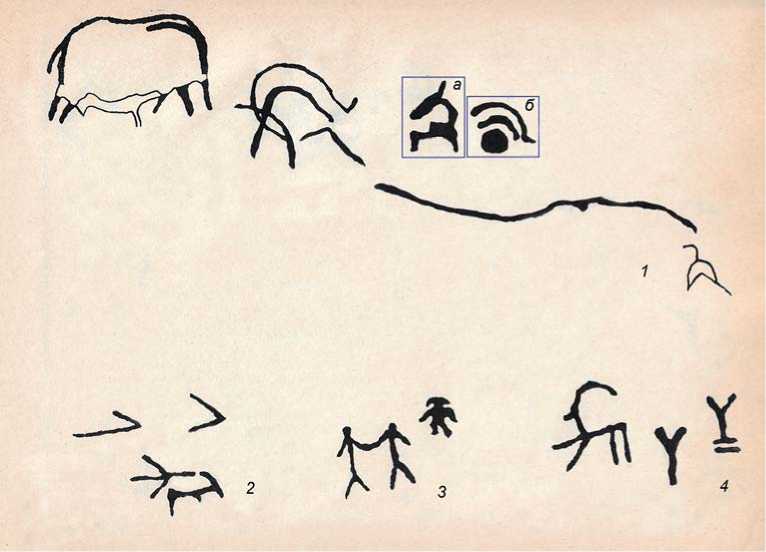
Fig. 5. Plate 109. Arshan-Khad (after (Okladnikov, 1981: 193))
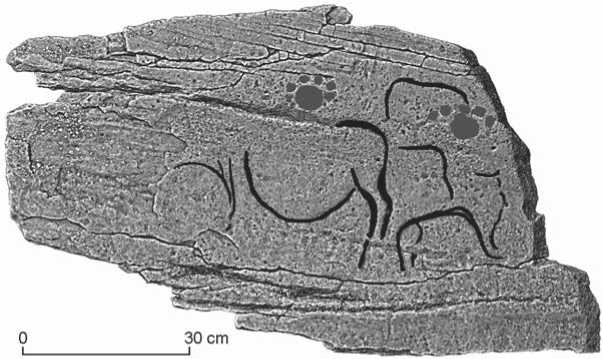
Fig. 6. Panel 014
destruction of rock in the base of the block may eventually lead to its collapse. The upper part of the panel had been subjected to cryogenic cracking even before the petroglyphs appeared (there are no traces of pecking here), while the left part was damaged later, whereby some petroglyphs were destroyed. The cause of the destruction was presumably a combination of cryogenic cracking and biogenic processes that made the outer layer of the stone weak. The panel is almost entirely covered with lichens of various species.
Comparison of the figures on the model with the most detailed published trace-drawings (Ibid.: 192, pl. 108, 7 ) has also demonstrated some significant differences. The largest representation of an animal looks somewhat different in reality. One “bear paw print” is shown as an indistinct figure; the other one lacks a “toe”. A contour in the upper right corner is close enough to reality; it can be interpreted as part of an animal figure. In addition, in the lower right corner, another contour is observed, which probably shows a partial figure of a wooly rhinoceros or, less likely, a mammoth.
Panel 015 (Fig. 7). Images are located on a subhorizontal surface of the rock massif located 5 m westnorth-west of the above-mentioned panels 013 and 014, near the top of the remnant. The surface is composed of poorly sorted coarsegrained sandstone. Some parts of the panel are modified by corrosion that caused the formation of deflation hollows. Apparently, some of them had existed before the petroglyphs appeared, and they may have drawn people’s attention to this surface. Most images are covered with lichens. Imagery on the surface includes a contour figure of an animal (Fig. 7, 1), which has some similarities with representations on panels 013, 014, and to a lesser degree on panel 005; a yet uninterpreted group of intertwined smooth and wavy lines obviously linked by some general idea (Fig. 7, 2); a less sophisticated group of lines, also uninterpreted (Fig. 7, 3); and a representation of a horse’s hoof, located on the periphery of other figures
(Fig. 7, 4 ). The latter shows rectilinear segments of the contour and, unlike other figures, is not smoothed by polishing. As a result, it looks more distinct than others.
The technique used for making petroglyphs on panels 005, 013, 014, and 015 has some elements in common. The figures were executed by smoothed contour lines pecked on stone and then abraded. The lines are grooves with smoothed edges. The maximum depth of the grooves reaches 10 mm, though in most cases it is 2–6 mm; their width varies from 7 to 35 mm. Figures on all the panels are mostly made in the same technique. The exceptions are images located in peripheral areas and possibly
30 cm
Fig. 7. Panel 015.
relating to later periods: the “horse’s hoof” on panel 015 (contour pecking without polishing) and the figures made by superficial abrasion in the right lower corner of panel 013.
In the context of the earliest animal images at Rashaan-Khad, a figure discovered in 2015 deserves a mention. It is located below and to the left of panel 005 and was interpreted as a “bovid-bison” (Shishin, 2015: 17). We documented and examined this panel (006) using the integral invariant algorithm. The study has shown that all outer contours of the figure coincide with natural cracks on the stone. No evidence of additional modification was found, except maybe for the “head” area, where a rounded depression is present on the surface; whether it is artificial is hard to say. In terms of general proportions, the figure has nothing in common with other representations at Rashaan-Khad. In our view, there is no reason to attribute it to animal figures or to petroglyphs in general.
Conclusions
At Rashaan-Khad, the total number of figures that may, with various degrees of certainty, be considered representations of large Upper Paleolithic mammals (wooly rhinoceros or mammoths) or archaic-looking images of ungulates amounts to eight: three on panels 005 and 014 each, and one on panels 013 and 015 each (one of the images described by A.P. Okladnikov has never been found). A certain correlation can be traced between these figures and wavy lines and groups of intertwined lines (panels 014 and 015) absent on other surfaces, as well as with the “bear paw print” observed on two of four panels. The latter element has not been encountered in any other associations at Rashaan-Khad (with the exception of panel 26, where at least five such representations can be observed, whereas any other images are absent). At the same time, the representation of a horse’s hoof made in the technique of deep relief pecking, fairly common at the site (11 panels of 32 examined), is not observed on the surfaces bearing figures of supposedly Pleistocene animals. The only image of this sort, located on panel 015, was made in a completely different technique and apparently belongs to a later period. “Double lines” associated with horse’s-hoof images are also absent on surfaces with figures of supposedly Pleistocene animals. These observations suggest that apart from representations of large animals, the group of earliest petroglyphs at Rashaan-Khad includes only wavy and intertwined lines, and possibly “bear paw prints”.
The methods applied allowed us to improve the database on the earliest petroglyphs at Rashaan-Khad substantially. The collation of the published tracedrawings with their prototypes observed on 3D-models and with curvature maps based on them provides yet another demonstration of the need for and efficiency of a comprehensive digital documentation of petroglyphs, including those already known and published before the introduction of digital techniques.
The study of Rashaan-Khad has not been completed, and a lengthier work is required, with a focus on cleaning petroglyphs of lichens and search for new surfaces with drawings. The remaining potential of this site is considerable, and the detection of new Stone Age petroglyphs is quite probable.
