
The Effect of Different Nitrate Concentrations on the In Vitro Growth and Development of Temperate Orchids
Journal: Journal of Stress Physiology and Biochemistry @jspb
Article in issue: 3 т.22, 2026.
Free access
Many orchid species of the temperate climate are threatened and declining without apparent reason. One of the drivers for the decline in orchid populations seems to be increased nitrate levels in soil, which affects the survival of both orchid seeds and mycorrhizal microflora, which normally improves the access of nutrients to orchid plants. When introducing orchids into in vitro culture, inorganic nitrogen sources used in nutrient media can directly inhibit germination, complicating the selection of an appropriate medium for the conservation of rare species. Some nutrient media are completely devoid of nitrates, replacing them with various organic nitrogen sources. Previous studies have shown that nitrates can directly inhibit the germination of sensitive species in vitro, making the selection of a suitable medium challenging in conservation practice for rare orchids. However, whether the inhibitory effect of nitrates on the further development of orchid seedlings is an adaptive trait that reduces post-germination mortality and influences their resilience and tuber formation remains unclear. The aim of the study was to determine the sensitivity to nitrates in vitro in seedlings of three species of tuberoid orchids, taking into account the characteristics of their growth under nitrate load and changes in the physiological state of seedlings using histological methods. It was found that elevated nitrate levels did not suppress orchid seedling survival, resulting in the highest rates of necrotic explants in Platanthera bifolia seedlings (44%), as well as in Dactilorhiza incarnata (35%) and D. fuchsii (27%), respectively. On the other hand, the differentiation of root tubers was influenced by an increased level of NO₃⁻ addition (50 mg L-1), which turned out to be the most effective in stimulating the tuberization with a simultaneous decrease in growth parameters and biomass in all studied orchid species. Longitudinal sections revealed numerous air chambers in the tuberoid aerenchyma, along with intense accumulation of starch granules in the vascular tissues. Based on the developmental characteristics of seedlings of three orchid species at elevated nitrate levels in vitro, it can be assumed that the high nitrate ion levels observed in soils of natural populations (130-840 mg Kg -1) may lead to a decrease in the number of germinating seedlings. Research focusing on the effects of nitrates could help create suitable nutrient conditions that mimic natural soil environments, ensuring the survival of rare orchid species outside their natural habitats.
Short address: https://sciup.org/143186164
IDS: 143186164
Text of the scientific article The Effect of Different Nitrate Concentrations on the In Vitro Growth and Development of Temperate Orchids
Terrestrial orchids are generally thought to grow in nutrient-poor soils (Swarts and Dixon, 2017); however, soil analyses in orchid habitats in Europe sometimes show relatively high nutrient levels, where nitrate concentrations range from 0.1 to 1.0 mg L-1 and even to 100 mg L-1 (Djordjevic et al ., 2016). In Russia previous studies have demonstrated that oligotrophic meadows on carbonate soils are also one of the most typical habitats of meadow-edge orchids (Efimov, 2023).
The medium composition is one of the most important factors governing the success of micropropagation. Among the medium components, nitrogen has been regarded as one of the key ingredients. The high levels of NO₃ ⁻ and NH 4 + often present in media suitable for tropical orchids in vitro culture inhibit the asymbiotic seed germination of most terrestrial orchid species (Rasmussen et al ., 2015). Cultivation media designed for terrestrial orchid species generally have low nitrate content, and some of them such as Malmgren medium lack nitrate (Malmgren, 1996). Since the symbiotic fungi naturally provide the orchid seeds with organic nitrogen inorganic nitrogen in the form of nitrate often limits seed germination and protocorm development in vitro, possibly due to low nitrate reductase activity as reported for Platanthera ciliaris (Anderson, 1996) and some other temperate orchids (Kauth et al ., 2008). In general, there is a lack of knowledge of orchid physiology with respect to the range of nutrient availability both in natural habitats and in tissue culture. The present study aimed to test the effects of different nitrogen concentrations for determination in vitro protocorms and seedlings growth sensitivity to nitrate for three terrestrial orchids of temperate climate.
MATERIALS AND METHODS
The soil samples and plant material were gathered from the territory situated along the left bank of the
Koynikha River (Iskitimskiy District, Novosibirsk Region, Russia), which is a unique habitat for 14 orchid species in the forest-steppe of Western Siberia (Dubynin et al ., 2021). The soil samples were collected near the growing orchid species at the depths of 0-10 and 10-20 cm and analyzed for nitrate ion content and the organic matter using methods described in (Nabieva and Smolentsev, 2025). The objects of the research were: Dactylorhiza fuchsii (Druce) Soó (Common name: Spotted Orchid), D. incarnata (L.) Soó (Common name: Early Marsh-Orchid) and Platanthera bifolia (Common name - Lesser Butterfly-Orchid). For each species 5-6 capsules containing unripen seeds were separated from a single specimen before dehiscence. To prepare seeds for gemination in vitro, we surface sterilized fruits in a sterile laminar flow hood by immersion in 1% sodium hypochlorite for fifteen minutes followed by soaking in 70% ethanol for 30 sec and rinsing three times in sterile distilled water. For asymbiotic seed germination, protocorm development and plantlet growth, modified Malmgren medium (Malmgren, 1996) comprising 90 mg L-1 KH 2 PO 4 , 90 mg L-1 Ca 3 PO 4 , 184 mg L-1 MgSO 4 ·7H 2 O, 5 g L-1 agar (Merck, Darmstadt, Germany), 12 g L-1 sucrose, and 1 g L-1 activated charcoal was used, while the addition of the organic constituents: coconut water (CW) - 100 ml L-1 and casein hydrolysate (CH) - 1 g L-1 was applied as the organic nitrogen sources modification.
The cultures were maintained at 23±2 °C and 16 h /8 h photoperiod after 2 months of germination period in dark conditions at the same temperature. Developing protocorms were subjected to the different treatments when NaNO3 was added to adjust NO₃⁻ concentrations (0, 5, 20, 50 mg L-1) in Malmgren medium. Nitrate concentrations applied here are quite small compared with those included in the medium for in vitro culture of different Dactylorhiza species used in the study of Dijk and Eck (1995) and practically more the same in comparison with the concentrations used in investigation of Figure et al. (2020), which were applied for seed germination of seven European terrestrial orchid species. After 40-60 days of culture under NO₃⁻ treatment, the growth characteristics such as protocorm fresh weight, shoot and root lengths of orchid seedlings and tuber anatomy were evaluated.
Anatomical study
The histological investigation was conducted based on the protocol described by Pausheva (1988). Firstly, an FAA fixation solution (63% ethanol, 5% acetic acid, and 1.85% formalin) was applied to fix 1–2 cm fragments of roots or tuberoids of in vitro -raised plantlets. which were then sectioned at 10 µm with microtome HV-325 Microm (Germany), stained with 0.05% toluidine blue for 1 min. The prepared samples were analyzed using the microscope Axioskop-40 equipped by camera AxioCam MRc5 with AxioVision 4.8 software for obtaining, images analysis (Carl Zeiss, Germany). The impact of NO₃ ⁻ on seedlings development was analyzed using stereomicroscope Stereo Discovery V 12 (Carl Zeiss, Germany).
Data analyses
The experiment consisted of four treatments (0, 5, 20, 50 mg L-1 NO₃⁻ concentrations), with three replications. To assess the influence of NO3- treatment on morphometric parameters two-way analysis of variance (ANOVA) in STATISTICA 8 software (StatSoft Inc., Tulsa, OK) was performed and for pairwise comparisons between the treatments. The differences between means were evaluated with post hoc comparisons using Duncan’s Multiple Range Test (DMRT) at a significance level of p <0.05.
RESULTS
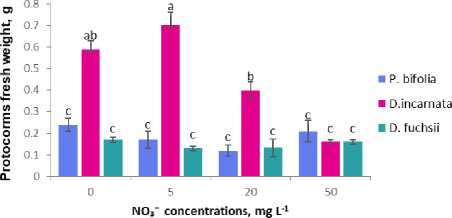
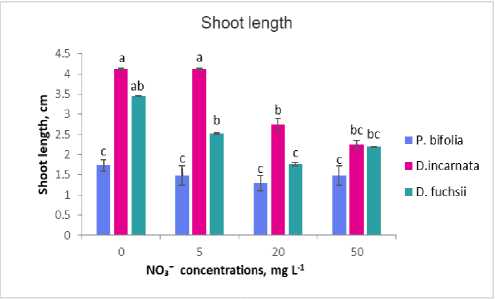
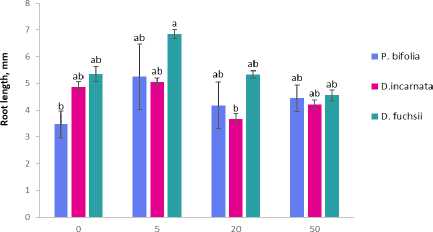
Asymbiotic in vitro orchid plantlet growth attributes were significantly ( p <0.05) impacted by the nitrate concentration and species identity. The orchid species exhibited different responses to the nitrate addition in culture media. Regarding the protocorms fresh weight, the NO₃ ⁻ treatmentat concentration of 5 mg L - 1 promoted the best growth only for D. incarnata , while the higher concentrations inhibited development of all orchid species studied. The same effect was revealed when 5 mg L - 1 NO₃ ⁻ favored only D. fuchsii root elongation, while at all other treatments the limited growth of both shoots and roots was observed in all species. Thus, the results revealed that for Dactylorhiza species the addition of nitrate in low concentration promoted the increasing of
D. incarnata fresh weight and enhancement of D. fuchsii roots proliferation. For the third species – P. bifolia, significant differences (p <0.05) were not detected for the all-growth characteristics studied among all the treatments including control treatment (Fig.1).
Interestingly, that the protocorms of D. incarnata exhibited the largest increase in fresh weight among other species after 40 days of cultivation under the same treatments (Fig. 1).
Moreover, it was noted that increasing the concentration of nitrate ion in the culture medium did not lead to higher protocorm mortality and with the addition of 50 mg L-1 NO₃⁻ the survival rates did not differ significantly from the control treatment for all orchid species (Table 1).
While higher concentration inhibited development of all orchid species studied, the tendency to the tuberoid formation was observed. With the addition of higher nitrate concentrations, the number of droppers that developed root tubers increased, while in the control treatment and under the nitrate lower concentrations (5 and 20 mg L-1), tuber formation was only at the initial stages (Fig. 2).
Histological analysis of in vitro grown seedlings showed that when the highest concentration of 50 mg L-1 NO₃⁻ was added to the medium, an increase in the number of starch-containing amyloplasts was observed in tuber tissues after 40 d of cultivation (Fig. 3).
It was found that 50 mg L-1 NO₃⁻ treatment facilitated the developmental alterations in protocorms of all species studied (Fig. 2): tubers initially formed after 40 d of P. bifolia seedlings cultivation revealed an intense accumulation of starch granules in the vascular cylinder and numerous air chambers in the aerenchyma of the tuber (Fig. 3).
The high nitrate levels, which was observed in soils of orchid natural populations (130-840 mg Kg -1) may lead to a decrease in the number of early age seedlings. In the studied soil samples the combination of high organic carbon and nitrogen contents was found, which indicates a significant accumulation of organic material in all orchid species habitats.
Table 1. The survival rates of three orchid species seedlings after 40 days of cultivation on Malmgren medium with the addition of different concentrations of nitrate - ion.
|
Species |
Concentration of nitrate, mg L-1* |
|||
|
0 |
5 |
20 |
50 |
|
|
Seedling’s survival, % |
||||
|
Dactylorhiza fuchsii |
73±2.5 a |
77±3.6 a |
68±4.2 a |
75±5.6 a |
|
Dactylorhiza incarnata |
65±3.8 b |
57±6.0 b |
53±4.5 b |
64±3.3 b |
|
Platanthera bifolia |
56±4.5 c |
48±3.7 c |
45±5.0 c |
53±2.9 c |
The data are presented as the means ± standard error (SE). Different letters within columns indicate significant differences according to Duncan’s multiple comparison test (p <0.05)
Figure 1. Changes in growth characteristics of seedlings of three orchid species after 40 days of cultivation on Malmgren medium with the addition of different concentrations of nitrate (mg L-1). The data are presented as the means ± standard error (SE). Different letters indicate significant differences according to Duncan’s multiple comparison test (p <0.05)
Protocorm's fresh weight
Root length
NO3" concentrations, mg L1
Species
Nitrate-ion concentrations, mgL-1 B (5) C (20)
A(0)
D (50)
Dactylorhiza fuchsii
Dactylorhiza incarnata
Platanthera bifolia
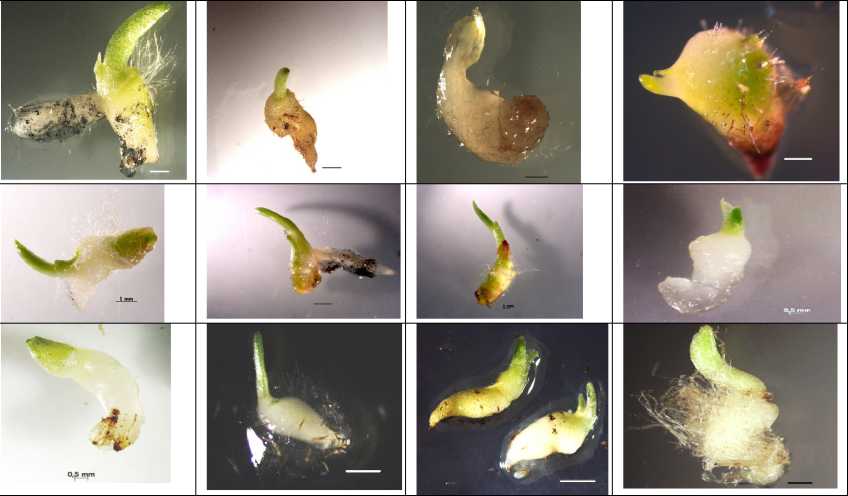
Figure 2. The comparative growth patterns characterized the protocorm and seedling development of three orchid species under different NO₃ ⁻ treatments after 40 days of cultivation on Malmgren medium; bars – 0.5 mm (1A; 1C; 1 D), –1.0 mm (1B; 2 B; 3B; 3C; 3D).
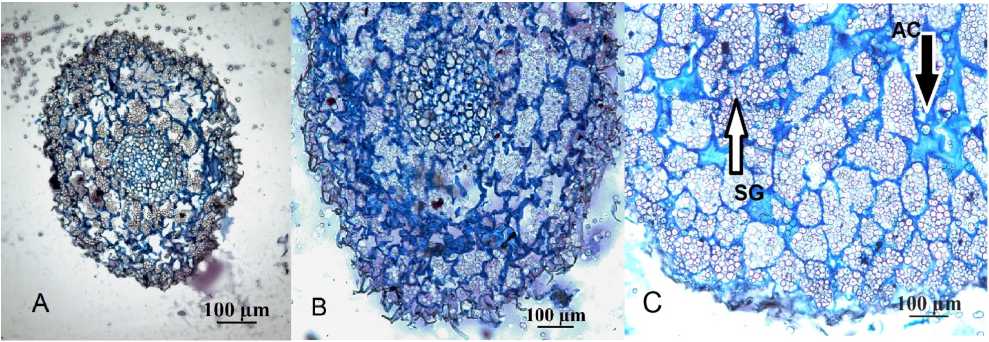
Figure 3. A transverse section of Platanthera bifolia roots and tuberoids, formed in Malmgren medium: (A) without NO₃ ⁻ addition; (B) supplemented with 20 mg L-1 NO₃ ⁻ ; (C) section of newly developed tuberoid, formed when seedlings were cultivated on the same medium with 50 mg L-1 NO₃ ⁻ addition; white arrow indicates the amyloplasts containing starch granules (SG) and black arrow indicates air chambers (AC) in tuber tissues. Bars – 100 µm.
DISCUSSION
Numerous factors characterizing the natural habitat of orchids influence their population sizes and distribution (Rassmussen et al., 2015). As follows from the study of Figure et al. (2020), the seed germination of some orchids of the temperate climate could be generally inhibited by nitrate in extremely low concentrations, while the other species demonstrated insensitiveness. The present study investigated whether application of low concentrations of NO₃⁻ resulted in reduced growth performance of early protocorms and seedling development in three tuberous orchids grown on the same Malmgren medium without an inorganic nitrogen source. Our results showed that accurate insight in how orchid species metabolize nitrogen sources at the different stages of their development will be necessary to reduce the negative effects of asymbiotic culture stress environment and reducing the vulnerability of young orchid seedlings.
The genus Dactylorhiza Neck. ex Nevski comprises two studied species occurring across of the temperate Northern Hemisphere: D. fuchsii and D. incarnata , all being partially mycoheterotrophic species (Vakhrameeva et al ., 2014). These highly polymorphic species with limited asexual reproduction (Nordström and Hedrén, 2009) are included among endangered plants in many regional red lists of Central Europe, Russia and Scandinavia.
Another object of study was a species less demanding in terms of nitrogen richness – P. bifolia , which grows on a wide variety of acidic and calcareous soils, often occupying forest edges, groves and meadows (Vakhrameeva et al ., 2014). It is a highly mycotrophic nectariferous species with high specificity demonstrated concerning its fungal symbiont, Rhizoctonia repens (Mamaev et al ., 2004). In addition to the fact that the mature seeds of D. incarnata and D. fuchsii often have low germination rates (Kulikov and Filippov, 1991), these nectarless species do not form a seed bank in the soil, since the seeds are not long-living (Pritchard and Seaton, 1993), but this fact was not explained.
In a study of three species of Dactylorhiza in vitro , Dijk and Eck (1995) observed that these species responded differently to increasing nitrogen concentrations, both in the nitrate and ammonium forms.
The present research revealed that both Dactylorhiza species were significantly ( p <0.05) impacted by concentrations of nitrate ion but their growth attributes were changed in the different ways. Although both Dactylorhiza species showed suppressed shoot and root growth, D. incarnata showed an increase in fresh weight under the same conditions with elevated nitrate levels. According to the results of Dijk and Eсk (1995), D. incarnata grows best at low nitrogen levels (7.5 mM), while the addition of the highest amount of
NO₃ ⁻ (60 mM) results in reduced protocorm yield and impaired growth performance. This concentration of NO₃ ⁻ seems to be toxic to the survival of this species, and no physiological effects were observed with its addition. Similarly, the growth suppression of Dactylorhiza species protocorms that we observed in the NO₃ ⁻ treatment experiment at concentrations of 5-50 mg/L (i.e., 20-200 times lower than in the study described above) is likely caused by nitrate signaling, as low nitrate utilization results in reduced growth rates after germination. Based on the results of this study, it can be suggested that, similar to natural conditions, the suppression of protocorm growth by nitrates in tissue culture may represent an adaptive trait that reduces seedling mortality after exposure to unfavorable environment or soil conditions. These results are partially consistent with the studies of Hinnen et al . (1989) and Tinoammini et al . (2024), in which the addition of NH₄ ⁺ or NO₃ ⁻ promoted shoot growth and inhibited root development of hybrid Phalaenopsis seedlings.
It is known that orchids from oligotrophic habitats are much more sensitive to nitrate than those of eutrophic habitats, which can be almost insensitive (Figura et al., 2020). When P. bifolia seedlings were grown asymbiotically, nitrate addition in the same concentration range as tested on the Dactylorhiza species did not affect their growth in this study. On the other hand, the occurrence of P. bifolia on poor soils, as evidenced by significantly lower NO₃⁻content in the studied soil samples (130 mg Kg-1 compared to 480 and 840 mg Kg-1 determined in the samples from D. incarnata and D. fuchsii habitats, respectively), may explain the efficiency of low nitrate concentration that can be used during the early growth stages of this species in vitro. We suppose that the asymbiotic NO₃⁻-responses of the studied species, due to the low nitrate concentrations applied in the in vitro study, are not sufficient to explain differences in orchid distribution, which could be determined by the diversity of the both mineral salts, biologically active compounds and symbiotic microbiota inherent to the orchis species in situ. Moreover, possibly due to the mycotrophic preferences of P. bifolia, pronounced differences in response to elevated NO₃⁻concentrations were observed compared to the studied Dactylorhiza species.
Tuberization in many terrestrial orchids represents the most important physiological process for reproduction and plantlets survival. The induction of in vitro tuberization has been reported by Stewart and Kane (2006) for Habenaria macroceratitis through photoperiodic control, while the early tuberization of H. bractescens was demonstrated by Medina et al . (2009) in the presence of cytokinin and sucrose. In the present study tuberization was initiated in all studied species by the addition of 50 mg L-1 NO₃ ⁻ to the growth medium. It is speculated that increased starch production, similar to that observed in the study by Lin and Xu (2004), allows orchid seedlings to survive under extreme conditions. Thus, the addition of NO₃ ⁻ at an extremely low concentration to the culture medium significantly affected the development phase of tuberous orchids in vitro , which contributes to the correct balance of endogenous growth regulators, determining the transition of the plant to better acclimatization upon planting. In vitro studies investigating the effects of NO₃ ⁻ on temperate orchid species may help develop cultivation protocols that more closely reflect natural soil conditions and improve seedling growth and survival of plantlets in asymbiotic culture.
CONCLUSIONS
To produce healthy and ready-to-reintroduce orchid plantlets and for the in vitro propagation of three temperate orchids concentration of NO₃ ⁻ in the growth medium should be reduced to 5 mg L - 1 during the growth stage of protocorm development and could be increased up to 50.
ACKNOWLEDGMENTS
The study was carried out with the financial support of the Ministry of Science and Higher Education of the Russian Federation within the framework of the state assignment (projects No. 126021617423-1 and 126032419121-2).
CONFLICTS OF INTEREST
All authors declare that they have no conflicts of interest.
