
The effect of physiological NO donor on the state of erythrocytes energy metabolism of rat under thermal trauma
Journal: Journal of Stress Physiology and Biochemistry @jspb
Article in issue: 2 т.22, 2026.
Free access
The aim of this work is estimation of action of dinitrosyl iron complexes (DNIC) on rats’ blood energy metabolism at combined thermal trauma. We studied 30 Wistar rats, divided into 3 groups: intact (n=10), control (n=10) and main (n=10) group. We modeled combined thermal trauma (skin burn + thermoinhalation injury) in animals of control and main groups. Rats of control group got a infusions of sodium chloride solution (n=10) every day. Rats of main group got infusions of DNIC in sodium chloride solution. In blood samples we studied activity of lactate dehydrogenase in direct and reverse reaction, lactate level and coefficients of substrate provision and energy reactions balance. It was stated that DNIC clearly normalized erythrocytes energy metabolism from third day after trauma.
Short address: https://sciup.org/143186142
IDS: 143186142
Text of the scientific article The effect of physiological NO donor on the state of erythrocytes energy metabolism of rat under thermal trauma
Currently, numerous positive effects of the naturally deposited form of nitric oxide, dinitrosyl iron complexes (DNIC), have been shown in relation to various biological systems (Vanin, 2000, 2009; de la Lande et al. , 2004; Shumaev et al. , 2008; Vanin et al. , 2009). Previously, we established in vitro the nature of the effect of DNIC on individual components of human blood metabolism, including energy metabolism, the state of pro- and antioxidant systems (Martusevich et al. , 2013a, 2013b), etc. At the same time, a comprehensive analysis of the effect of the considered nitric oxide donor on the blood condition during thermal trauma is not presented in the literature.
In this regard, the aim of the work was to study the activity of some oxidoreductases in the blood of animals with thermal trauma during the administration of DNIC.
MATERIALS AND METHODS
The study was conducted on 30 sexually mature male Wistar rats weighing 220-250 g. They were divided into 3 groups of equal numbers: intact (no manipulations were performed, only a single blood draw was performed), control (thermal trauma was reproduced and standard treatment was applied) and main (similar to the control with additional administration of an aqueous solution of DNIC).
The animals of the control and main groups were treated with a combined injury according to their own method, including a contact thermal burn of the skin of the back (an area of 20% of the body surface) in combination with thermal inhalation injury (Vorobyov et al. , 2009). Animal husbandry and experimental interventions were carried out in accordance with the order of the USSR Ministry of Health No. 775 dated 08/12/1977. The injury was inflicted under combined anesthesia ("zoletil" + "xylic acid"). The animals of the control group received daily intraperitoneal infusions of saline solution (3 ml) from the first day after modeling the thermal injury, and the wounds were treated with levomecol. The rats of the main group received daily intraperitoneal DNIC in saline solution (1: 9 (by volume) – a total of 3 ml; for 10 days), local treatment is similar to that carried out in the control group.
DNIC was synthesized according to the method of A.F. Vanin (Vanin, 2009; Borodulin et al. , 2013).
On the third and tenth days, blood samples were obtained from animals of both groups. The activity of lactate dehydrogenase (LDH) in direct (LDHdir) and reverse (LDHrev) reactions in erythrocyte hemolysate was studied using the G.A. Kochetov method (Kochetov, 1980). The lactate level in red blood cells was assessed using an automatic SuperGL Ambulance analyzer. Based on the obtained parameter values, integral indicators were calculated: the coefficient of substrate supply (CSS) and the balance of energy reactions (CERB) (Martusevich et al. , 2013a).
The results were processed using the Statistica 6.0 program. The normality of the distribution of parameter values was evaluated using the Shapiro-Wilk criterion. Taking into account the nature of the distribution of the trait, the Kraskal-Wallace H-test was used to assess the statistical significance of the differences. The data was presented in the M±m format. The differences were considered significant at a significance level of p<0.05. The true level of statistical significance of the differences in the average values of the indicators was calculated.
RESULTS AND DISCUSSION
It was found that the activity of erythrocyte LDH in the reverse reaction in rats during thermal trauma was significantly changed relative to animals of the intact group on the third and tenth days after the burn period (p<0.05). On the third day, LDHdir in animals of this group is moderately reduced, while on the tenth this trend is smoothed out (Fig. 1).
Systemic administration of DNC to animals with complex thermal damage significantly modified the activity of the enzyme in both direct and reverse reactions. In particular, the catalytic properties of erythrocyte LDHdir in rats of this group on the third day practically did not differ from those typical for intact animals, significantly exceeding the level of the control group (p<0.05). On the tenth day of the post-burn period, a marked increase in enzyme activity in the direct reaction was observed in animals of the main group, exceeding the values detected for animals of both the intact and control groups by 2.02 and 2.24 times, respectively (p<0.05). Taking into account the metabolic nature of this reaction, such dynamics of the indicator should, in our opinion, be regarded as the result of the positive effect of DNIC.
This conclusion is fully consistent with the nature of the effect of the studied compound on LDH activity in the reverse reaction: on the third day, it was only minimally increased relative to the level of intact animals (1.21 times; p<0.05), remaining significantly lower than the values recorded in animals of the control group (2.64 times; p<0.05). A similar pattern occurred on the tenth day of the post-burn period (by the time the experiment was completed). Thus, our studies suggested that the deposited form of nitric oxide under study prevents excessive activation of LDHrev, which potentiates the synthesis of lactate, a well-known molecular marker of hypoxia (Vanin, 2000; Koppaka et al. , 2012).
The result of assessing the level of lactate in erythrocytes in experimental groups of animals is shown in the diagram (Fig. 2). It was found that, similar to the changes in the catalytic properties of LDH, on the third day after the burn, there was a significant increase in lactate concentration in erythrocytes in animals of the control group relative to the level in intact rats (1.5 times; p<0.05), persisting by the end of the experiment (1.35 times on the tenth day; p<0.05). This dynamic confirms the shift of LDH activity towards the reverse reaction that occurs as a result of severe thermal injury.
A different picture is recorded in animals receiving DNC injections, in which normalization of the considered link of blood energy metabolism was noted at all times (Fig. 2). The dynamics of lactate concentration in erythrocytes in animals of the main group indirectly indicated an increase in the adaptive reserves of the studied component of the energy supply system under the action of the deposited form of nitric oxide.
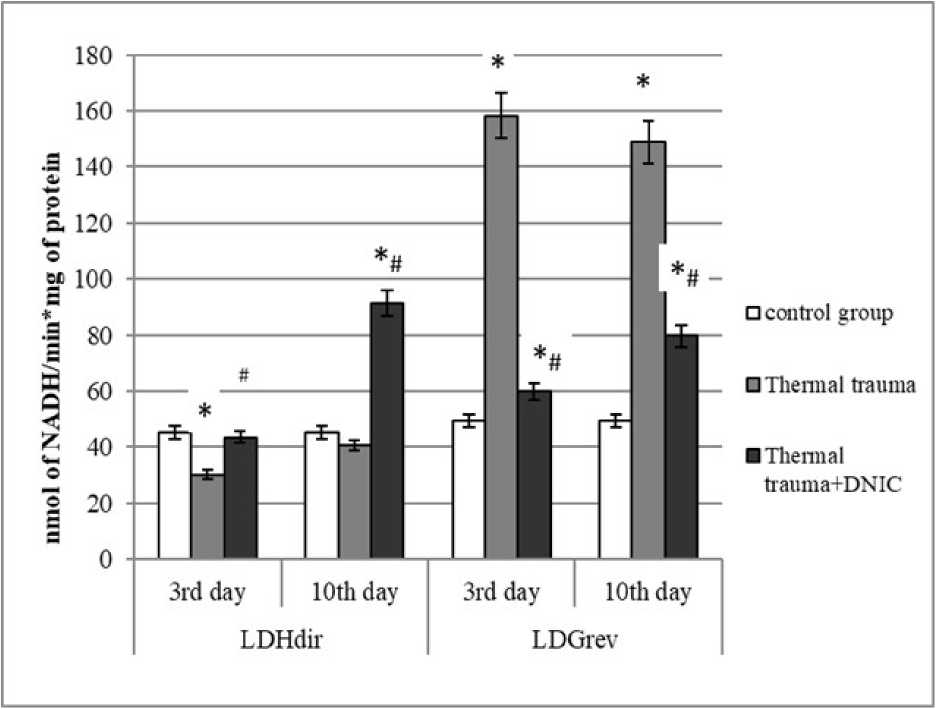
Figure 1. The activity of lactate dehydrogenase of erythrocytes is normal and in case of thermal injury, taking into account the introduction of DNC (LDHdir – LDH activity in the direct reaction; LDHrev – LDH activity in the reverse reaction; DNIC – dinitrosyl iron complexes; * - statistical significance of differences with the level of intact animals p<0.05; # - statistical significance of differences with the level of animals with thermal trauma p<0.05)
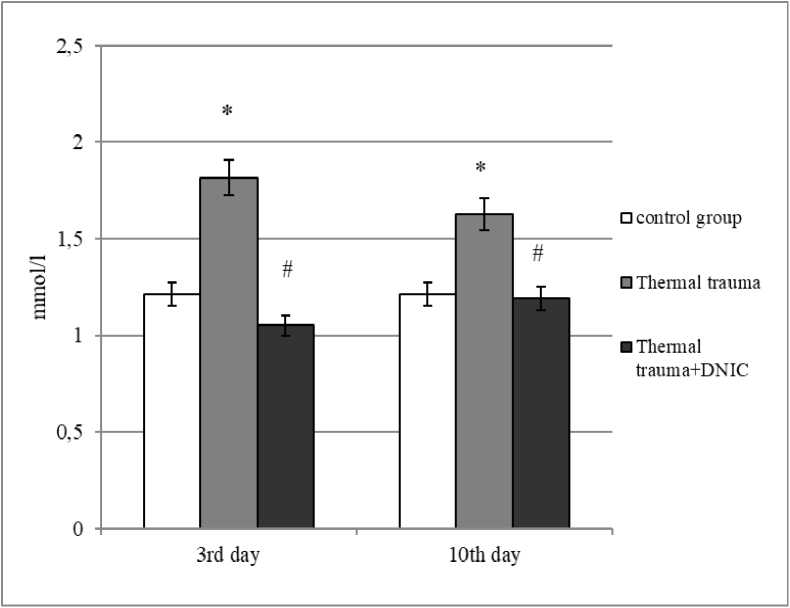
Figure 2. The level of lactate in erythrocytes is normal and in thermal injury, depending on the administration of DNIC (* -statistical significance of differences with the level in intact animals p<0.05; # - statistical significance of differences with the level in animals with combined thermal injury p<0.05)
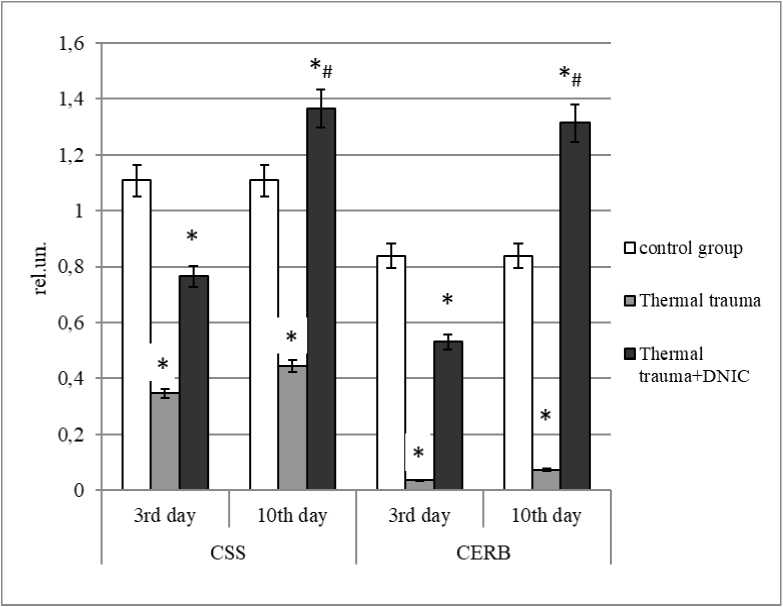
Figure 3. Derived coefficients of erythrocyte energy metabolism in normal and thermal injury, depending on the administration of DNIC (CSS – coefficient of substrate supply; CERB – coefficient of balance of energy reactions; * - statistical significance of differences with the level in intact animals p<0.05; # - statistical significance of differences with the level in animals with thermal injury p<0.05)
We also calculated additional parameters: the coefficients of substrate supply and the balance of energy reactions (Fig. 3). There was a marked shift in the LDH functioning mode with significant activation of the reverse reaction against the background of direct inhibition, observed in rats of the control group, which manifested itself in a sharp decrease in the level of CERB on the 3rd and 10th days of the post-burn period (by 23.1 and 11.2 times, respectively, p<0.05). This shift reflects the systemic metabolic maladaptation that develops in conditions of severe thermal injury. When administered to animals with combined thermal injury of DNIC on the 3rd day of treatment, only a moderate decrease in CERB was recorded (1.58 times; p<0.05), followed by its increase by the time the experiment was completed (1.57 times; p<0.05), which, in turn, indicated stimulation of energy metabolism.
A similar, but less indicative, dynamics was revealed with respect to the substrate supply coefficient: in animals of the control group, a significant decrease in CSS was recorded on both the third and tenth days (3.2 and 2.5 times, respectively; p<0.05), which indicated the conjugation of shifts in the catalytic activity of LDH and erythrocyte lactate concentration, as well as their decompensation in the conditions of modeling a combined burn injury. At the same time, the modulus of shifts of this coefficient during the course of infusion therapy with the inclusion of DNIC was significantly lower, and on day 3 there was a moderate decrease in the indicator (69% of the norm; p<0.05), followed by its marked increase (123% of the norm; p<0.05). This trend, in our opinion, indicates the protective, adaptogenic effect of the studied compound on the energy metabolism of red blood cells (Mayer & Beretta, 2008; Martusevich et al. , 2013).
CONCLUSION
In our experiment, we obtained data on the positive effect of dinitrosyl iron complexes on the metabolic parameters of the blood of animals with thermal trauma. It was found that DNIC stimulates the energy metabolism of erythrocytes in rats with thermal trauma due to the predominant activation of LDH in the direct reaction (by 102% versus +21% for the reverse reaction) and a decrease in the rate of increase in lactate levels.
CONFLICTS OF INTEREST
All authors declare that they have no conflicts of interest.
