
The global knowledge market: Features, evolution
Journal: Economic and Social Changes: Facts, Trends, Forecast @volnc-esc-en
Section: Theoretical and methodological issues
Article in issue: 2 т.19, 2026.
Free access
The early twenty-first century witnessed the emergence of new phenomena, among them an unprecedented intensification of formalization and regulation within scientific activity. To explain this development, the article introduces several useful concepts: knowledge as an ordered set of original ideas, models, and theories, their justifications and proofs, along with statistical and historical illustrations; and the knowledge market as the process of coupling the segments of knowledge supply (production) and demand (needs), as well as the acts of their purchase and sale at a given price. To deepen understanding of the global knowledge market's evolution, a three-sector model is proposed, comprising a knowledge core (fundamental, scientific knowledge), a periphery (auxiliary or secondary knowledge), and pseudo- or anti-knowledge (outdated, rejected, and erroneous knowledge). This structural model of the knowledge market enables a more focused examination of three global trends and their resulting phenomena: the first (the Great Castling) consists of the accelerated accumulation of knowledge to the point of transitioning from scarcity to surplus in the market; the second (the Great Inversion) entails the rising cost of knowledge production concurrent with a decline in its returns, such that the marginal cost of producing knowledge exceeds its marginal utility; and the third (the Great Erosion) signifies an increasing share of anti- and pseudo-knowledge within the total stock of knowledge. This corresponds to the development of crisis phenomena such as glut, unprofitability, and widespread defective output. It is precisely this crisis-ridden state of the market that has driven the evolutionary shift from the "knight of science" model (service model), in which past researchers were ready to make great sacrifices in the name of science, to the "bureaucrat and imitator" model (business model), in which today's researchers largely adapt to the bureaucratic demands of their organizations and skillfully simulate scientific activity. Overcoming the current crisis may be possible through "unloading" the market by "writing off" outdated and irrelevant cognitive products, which entails a transition from an additive paradigm of knowledge acquisition to a subtractive one.
Similar articles in the section Economics in general
Short address: https://sciup.org/147253861
IDS: 147253861 | UDC: 330 | DOI: 10.15838/esc.2026.2.104.2
Text of the scientific article The global knowledge market: Features, evolution
The article was prepared with the financial support of the Russian Science Foundation under the topic “A new paradigm for Russian science: Changing competitive conditions and the market orientation of scientific knowledge”, project No. 25-78-10068.
The early 21st century has witnessed the emergence of new phenomena whose influence is becoming increasingly palpable. Moreover, the key megatrends of recent decades possess an internal logic and close interconnections that are not always obvious to the outside observer. In particular, the scientific sphere has undergone a widespread transformation toward greater formalization and regulation against a backdrop of declining substantive productivity. We are effectively witnessing the rise of formatted science, where all scientific products are calibrated in form and content according to a specific template, deviation from which is either impermissible or undesirable. In parallel, there has been a catastrophic drop in demand for research, innovation, and fundamental discoveries due to their low applied returns, while the adequate assessment of researchers’ competencies has become more complex and increasingly gravitates toward formal metrics. This situation is provoking a protracted organizational crisis at all levels of the scientific system: universities, laboratories, and institutes. Despite awareness of the need for a global reform of the scientific and educational complex, efforts undertaken thus far remain fruitless. This is largely due to the absence of a systemic understanding of the ongoing changes from a unified methodological standpoint. The aim of the work is to propose a systemic perspective and establish a unified analytical foundation for understanding the nature of the crisis that has emerged in the knowledge market in general and within the scientific sphere in particular.
At the core of this new perspective lies the concept of the knowledge market, for its structure and evolution over the past half-century illuminate the essence of the problems confronting humanity. Simultaneously, understanding the specific features of the contemporary knowledge market makes it possible to outline the reforms necessary to overcome current difficulties – hence the rationale for the proposed approach. The novelty of the author’s approach lies in analytically linking elements of the knowledge market with established megatrends in science, economics, and politics.
The knowledge market: concept and structure
To grasp the challenges now facing the university and research sectors, it helps to look at the knowledge market, its structure, and its dynamics. Let us first define the concept of the knowledge market.
Broadly defined, the knowledge market encompasses the segments of knowledge extraction, creation, dissemination, and use, all operating as an integrated whole; at every stage and in every segment, knowledge is paid for (Antonets, 2018). Typically, the knowledge market also includes all relationships among its participants concerning the creation, exchange, and use of knowledge (Salikhov, Salikhova, 2015). In a simpler and more convenient formulation, one can speak of the segments of knowledge supply (production) and demand (needs), along with the acts of buying and selling knowledge at a given price.
If we wish to refine the concept, several points should be kept in mind. First, the knowledge market is by no means equivalent to the information market. Thus, here and further in the text, knowledge is understood as an ordered set of original ideas, models, and theories, together with their justifications, proofs, and the statistical data and historical examples that illustrate them. This applies to all types of knowledge – natural, technical, social, and humanistic. Knowledge is thus not abstract bits of information but concrete cognitive constructs resting on a solid logical and empirical foundation. For example, news items as such do not belong to the knowledge market, but media publications that explain (order and connect) various phenomena are full-fledged elements of it. Second, the supply of knowledge on this market consists of all cognitive products that meet the above criterion. Correspondingly, the demand for knowledge represents the totality of explicit requests from various economic agents for specialized and general knowledge.
Note that the discussion here concerns the global knowledge market – a planetary phenomenon. This does not, however, preclude the analysis of its individual regional or sectoral segments.
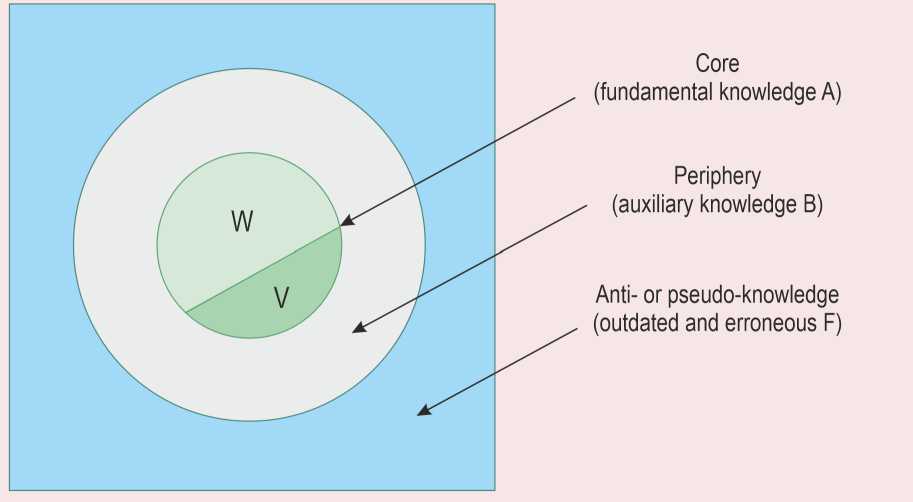
The knowledge market is clearly heterogeneous. For our purposes, however, a three-sector model will suffice ( Fig. 1 ). This model consists of a knowledge core (fundamental knowledge – A), made up of scientific facts and products (articles, reports, patents, monographs, etc.); a periphery (auxiliary or secondary knowledge – B), which takes the form of journalism, popular publications, some fiction, and media articles; and pseudo- or anti-knowledge (F), presented in the same forms as the previous segments. Pseudo- or anti-knowledge refers to
Figure 1. Structure of the knowledge market
Source: own compilation.
outdated or erroneous knowledge that is formally indistinguishable from genuine knowledge. These are, as a rule, alternative interpretations of events and phenomena whose justifications and proofs are either incorrect or falsified. Anti-knowledge can appear in many guises – from tendentious media articles to fabricated expert opinions, statistical data, and official government statements and documents (Kirdina-Chandler, 2017). It may arise from deliberate deception or unintentional error; the source of distortion varies, but the result is the same.
Anti-knowledge is often built on fakes, and the market for fakes has become a distinct phenomenon over the past decade. Today one can legitimately speak of a fake industry as a real sector of the economy (Stepanova, Manokhina, 2019). At the same time, anti-knowledge should not be confused with mismatches among elements of the knowledge market that stem from supply–demand divergences caused by cognitive distortions in participants’ expectations (Antonets, 2018). For instance, it has been shown that in the Novosibirsk Region, students’ preferences regarding fields of study remain stable, leading to a mismatch between enterprises’ workforce needs and the structure of labor supply (Anofrikov et al., 2018). This illustrates a straightforward imbalance in how the knowledge dissemination and use segments function. Such discrepancies can themselves feed the antiknowledge segment while simultaneously being generated by it.
A reasonable question arises: is it legitimate to treat the segment of pseudo- and anti-knowledge as a full-fledged element of the knowledge market?
In our view, the answer should be yes, since anti-and pseudo-knowledge (negative knowledge) are direct extensions of the knowledge core and periphery (positive knowledge). In effect, knowledge and anti-knowledge fuse into a single cognitive mass in which neither exists without the other, which is why they must be considered together. Moreover, at certain moments, elements of the core can migrate into the category of anti-knowledge, and vice versa. This structure of the knowledge market will serve as one of its defining features and will help explain certain cognitive and economic megatrends.
Despite its apparent simplicity, the concept of the knowledge market calls for a few clarifications. For instance, knowledge is not equivalent to “absorbed” information, because knowledge may be unclaimed and ignored yet remain knowledge – indicating simply a lack of demand for it. Nor is knowledge confined to scientific knowledge; there is today an enormous body of everyday knowledge (e.g., video tutorials on how to make repairs, build things, exercise, etc.; such clips usually explain why something should be done a certain way and not otherwise). An isolated fact (even a scientific one) that is not integrated into existing worldviews does not constitute knowledge; such cases are rare in science. Likewise, a scientific result consisting of an established fact together with an explanation of its significance for the phenomena under study is knowledge. It is especially important to note that the scientific sector and the broader scientific sphere rest on the market for scientific knowledge but are not reducible to it, as they involve institutional, material, and human resource provisions that lie beyond the scope of the knowledge market concept.
Notwithstanding the apparent triviality of the three-sector model of the knowledge market, it provides a highly convenient starting point for examining long-term global trends in science and the economy.
Additional features of the knowledge market
The three-sector model of the knowledge market can be further refined by dividing the knowledge core into two elements: active (applied) knowledge (V) and passive (fundamental) knowledge (W). Active knowledge constitutes a tiny fraction of all scientific knowledge that is actually used in the economy, whereas passive knowledge comprises all remaining knowledge required for the reproduction of scientific knowledge. The chief property of passive knowledge is its continual accumulation – indeed, far more rapidly than its active counterpart. This is only natural, since active knowledge is drawn from passive knowledge, and the passive portion never disappears but only grows. For example, if a particular mathematical model from economic theory is adopted in state regulation practice, the model itself remains preserved in the “archive” of the knowledge market.
The latter property captures the fact that passive knowledge expands faster than active knowledge, yet accumulation characterizes all knowledge. If A denotes the volume of core (scientific) knowledge, V the volume of active (practically used) knowledge, and W the volume of passive (self-sustaining) knowledge, then over time (t) the share of passive knowledge (k = V / W) should increase against the backdrop of an expanding total core volume: dk / dt > 0; dA / dt > 0; A = V + W. An analogy is helpful here: W and V play the roles of fixed and variable production costs, respectively. Consequently, even if the increment of active (applied) knowledge nullifies at certain stages, passive knowledge must not only continue to exist but also grow. For instance, if astrophysics yields no applied results for some period, research in its domain must nonetheless continue (otherwise the entire scientific field would begin to degrade). The outcome is a gradual increase in the share k, which is tantamount to a diminution of the efficacy of knowledge as such.
Another property of knowledge stems from the fact that, by its nature, it belongs to the category of informational cumulative processes, and the indicators that express it pertain to variables of stock rather than flow (Taranukha, 2023). In this sense, knowledge resembles capital, which tends toward unlimited accumulation. Indeed, knowledge in written form – characteristic of modern civilization – is rarely completely destroyed; as a result, it is preserved in one way or another and adds to humanity’s total fund of knowledge. For example, the philosophical treatises of Plato and Aristotle, the scientific works of I. Newton and G. Leibniz, and the novels of L.N. Tolstoy and F.M. Dostoevsky remain assets in the accumulated intellectual baggage of contemporary people. Unlike knowledge, ordinary goods, resources, and services are effectively “liquidated” in the process of consumption; even durable goods (buildings, structures, etc.) have a life cycle after which they are demolished or completely renewed (rebuilt). The processes of devaluation and obsolescence of knowledge do not negate the overarching trend toward its accumulation. The consequence is an excessive expansion of the knowledge market, accompanied by a diminished capacity of society to actively assimilate acquired cognitive achievements. A clear manifestation of this property is the growing importance of the knowledge market for the modern economy and the formation of the so-called knowledge society (Coughlan et al., 2010).
A third feature of the knowledge market is that, for a significant portion of it, the producer and the consumer coincide. For instance, scientific articles and monographs are not final products in the usual sense; rather, they act as a kind of semi-finished good that is subsequently studied and “processed” by researchers themselves. For scientific knowledge to be consumed by agents of the market economy, it must undergo additional – and typically substantial – refinement. This characteristic hinders the knowledge market from receiving clear signals from participants in the real economy, which in turn leads to the “production” of a large mass of dubious knowledge that cannot be demanded by the market and turns into a “thing in itself” – an unclaimed intrinsic value. Scientific phantoms thus emerge, awaiting a verdict of time on their ultimate status: alive or dead.
Thus, the very nature of knowledge provokes the endless expansion of its volume, with an accelerated accumulation of its passive component.
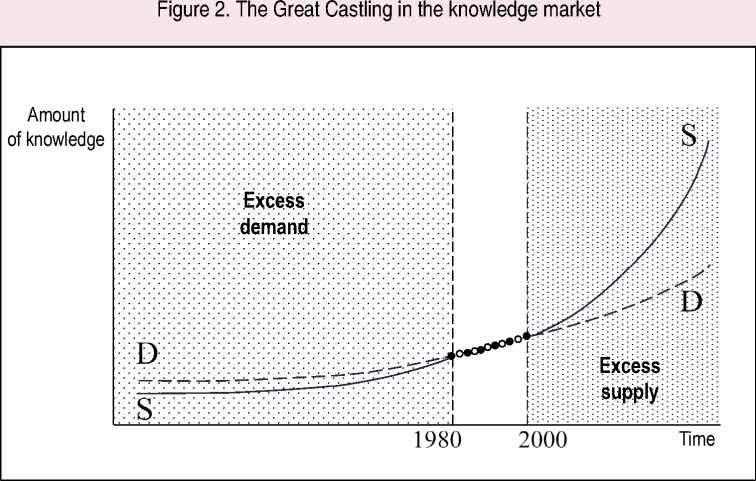
The first megatrend characteristic of the knowledge market is the accelerated accumulation of knowledge, culminating in a qualitative castling of market conditions – from scarcity to surplus. Let us unpack this thesis in greater detail.
At any given moment, any market can be characterized by the relative state of demand (D) and supply (S). When demand exceeds supply (D > S), scarcity prevails; in the opposite case (S > D), a surplus is observed; occasionally, market equilibrium (S = D) is reached. This dichotomy in market states carries enormous functional significance. To illustrate, recall that the economy of the USSR and other socialist countries was built on the principle of scarcity: on most goods and services markets, demand outstripped supply because prices were kept below their equilibrium levels to ensure affordability. In Western countries, by contrast, markets were typically glutted as supply exceeded demand, since prices were set above equilibrium. Thus, the difference between socialism and capitalism lay not only – and not so much – in different forms of ownership of the means of production, as Marx’s theory maintained, but in the differing states of their markets. It was precisely this divergence in market conditions that underpinned J. Kornai’s concept of the “economics of shortage” (Kornai, 1990), which became a methodological foundation for studying phenomena specific to different economic systems (Koryakovtsev, 2023). A pinnacle of such research is M. Weitzman’s theoretical model of the shortage syndrome, which examined manifestations such as queues and inventories (Weitzman, 1990).
The foregoing underscores just how different economic systems can be when their markets operate under different conditions. As for the knowledge market, its condition changed radically over the course of the 20th century, and this change predetermines one of the essential features of contemporary society. The cause of this castling was the long-term trend of knowledge accumulation, known in the literature as the exponential model or D. Price’s law: empirically, the number of researchers and the number of scientific publications doubles approximately every 10–15 years (Price, 1963). Price himself believed that at a certain stage this growth would stabilize and transition from exponential to logistic (Price, 1963). Later studies revealed considerable diversity in models of scientific growth and the absence of a single uniform pattern (Fernandez-Cano et al., 2004). Yet verification of Price’s law continues. For example, the most recent econometric calculations based on article counts from four databases – Dimensions (1670–2018), Microsoft Academic (1805–2018), Web of Science (1905–2018), and Scopus (1866– 2018) – show that the average annual growth rate of scientific output is 4.02%, with a doubling time of 16.8 years (Bornmann et al., 2021). Thus, the exponential growth of scientific knowledge persists.
Continuing this line of inquiry, let us consider another specific but telling example: the market for Russian economics journals. On April 11, 2019, the Russian Science Citation Index (RSCI) on the eLIBRARY.RU platform listed 1,281 such journals (Balatsky, Ekimova, 2019, p. 127), whereas by December 16, 2025, the number had risen to 1,859. Over roughly 6.5 years, the number of these journals grew by nearly half. Simple calculations show that the average annual growth rate in the number of Russian economics journals is 5.98%, and a doubling relative to 2019 will occur in about 12 years – i.e., by 2031. This offers yet another confirmation of the continued operation of Derek Price’s exponential rule. Naturally, some segments of the knowledge market grow faster than this “normative” rate, others slightly slower, but the essence of the problem remains unchanged.
It is precisely the operation of Price’s law, immanent to the information sphere, that has led to the overaccumulation of products in the knowledge market. A survey of Russian experts conducted by the author in 20251 revealed an almost complete consensus – not only regarding the very fact that a knowledge surplus has emerged, but also concerning the time period when this market reversal took place: the 1980–2000 interval. The experts believe that over the last two decades of the 20th century, the previously prevailing scarcity of knowledge was definitively replaced by a surplus (Fig. 2). In subsequent years, and especially in the 21st century, the surplus has grown rapidly. Here and below, we shall refer to the phenomenon of the transition from knowledge scarcity to surplus as the Great Castling. This term underscores the civilizational significance of the event, for it launched a qualitatively new phase of economic growth and development for the global system.
It should be noted that the idea of periodically emerging theoretical bubbles , where the demand for scientific knowledge falls short of its supply, has been voiced before (Balatsky, 2009). In earlier centuries, however, such phenomena were local and temporary, whereas today the Great Castling has become global and persistent. Its foundation lies in information technologies, which have rendered knowledge accessible to a degree unimaginable in previous eras.
Beyond the scientific core, the knowledge market includes peripheral knowledge, which has also expanded enormously in recent decades. According to available estimates, the modern individual receives and processes as much information in a month as a person in the 17th century did in an entire lifetime; the total volume
Source: own compilation.
of data on the planet doubles every two years – five to eight times faster than scientific knowledge. Moreover, according to estimates by the International Data Corporation (IDC), useful information accounts for only 35% of the total mass2. Thus, the segment of anti- and pseudo-knowledge is also expanding at an accelerated pace.
These figures speak for themselves: today, no single individual can possibly encompass the accumulated knowledge even within a narrow field. For example, the 1,859 Russian economics journals currently in existence lie beyond any human’s physical capacity – not only is it impossible to track their content, but the sheer number exceeds all reasonable bounds. To this mass must be added foreign periodicals and monographs, whose volume is even more staggering. No search engine can solve the substantive problems, for constructive knowledge is unevenly distributed across the vast body of scholarly literature, and locating it has become exceedingly difficult.
The fundamental impossibility of covering contemporary knowledge is most vividly illustrated by the relatively new literary genre of the scientific bestseller – books that address major scientific problems from a systemic perspective, grounded in original authorial ideas and supported by robust empirical evidence and historical illustrations. In Russia, the most notable foreign scientific bestsellers are systematically translated and published. Yet experience shows that this effort does not lead to broad acquaintance with the knowledge on offer; the overwhelming majority of domestic researchers simply bypass these books. The most striking example is Thomas Piketty’s sensational Capital in the Twenty-First Century (Piketty, 2016), which generated an enormous resonance worldwide. Suffice it to recall that a year after the book’s French publication, the journal Real-World Economics Review devoted a special issue to discussing its theses. One of the world’s most authoritative economics journals, the Journal of Political Economy, also joined the ensuing debate. The discussion took on a truly international character, engaging representatives from nearly every country. Against this backdrop, however, Russia experienced near-total intellectual silence: a few straightforward translations, the simplest reviews of foreign commentary, and a couple of extended critiques exhaust the treatment of Piketty’s themes (Balatsky, 2017; Lapin et al., 2020). A survey of Russian economists and political scientists conducted by the author regarding their familiarity with Piketty’s famous bestseller revealed that the vast majority of respondents were aware of the book, but not one of them had read it in full3. By way of justification, all respondents cited the colossal volume of the work and its overload with numerical material. Thus, even the most significant scientific events in the contemporary world often pass by the broader scholarly community unnoticed.
Anticipating the argument that such “deafness” on the part of the scientific community is not critical for science itself, let us offer another example: the three scientific bestsellers by Daron Acemoglu, James Robinson, and Simon Johnson (Acemoglu, Robinson, 2015; Acemoglu, Robinson, 2021; Acemoglu, Johnson, 2024). The situation with these books in Russia is only marginally better than with Piketty’s monograph: the number of specialists who have carefully studied all three works can be counted on the fingers of one hand. This state of affairs is hard to justify, given that these three authors received the Nobel Prize in Economics in 2024 for their body of work. Moreover, their three monographs have been subjected to careful analysis to identify the methods they used to achieve popularity within both the scientific community and the broader public (Maltsev, Shastitko, 2025). Nonetheless, the limitations of time and energy erect an insurmountable barrier to absorbing new knowledge. The number of even the most significant scientific bestsellers in the world is such that a contemporary researcher can get acquainted with them only selectively, thereby narrowing his or her overall worldview.
The Great Castling we have examined set in motion a range of new phenomena, among which we shall briefly note just three.
First, fundamental difficulties in the consumption of knowledge have arisen: it is impossible to cover all necessary knowledge due to the physical shortage of time and energy on the part of individuals; obtaining even the most essential and important information requires an inordinate amount of time. In other words, the new realities have imposed heightened demands on the cognitive abilities and skills of modern people – demands that cannot be met because of the biological and physiological limits of the human organism. On a planetary scale, the population is simply physically incapable of effectively “consuming” the accumulated knowledge.
Second, fundamental difficulties in the transfer of knowledge to other markets have emerged: it is hard to know what to do with the available knowledge; a large volume of general and highly specialized knowledge cannot be demanded by the market at all. One might say that the economy has not produced a sector whose capacity would be sufficient to absorb the full diversity of contemporary knowledge.
Third, new requirements have arisen for traditional activities (research, teaching, etc.) that negate old and well-established institutions (lectures, dissertations, articles, universities, institutes, libraries, etc.). The new digital realities have devalued the old organizational forms of working with knowledge, as well as the professions and activities associated with them.
Thus, the phenomenon of the Great Castling has generated new and highly significant challenges to which society has yet to find answers.
The second megatrend and the Great Inversion in the knowledge market
The second megatrend characteristic of the knowledge market is the gradual rise in the cost of producing knowledge, coupled with a simultaneous decline in its marginal utility. This trend eventually triggers a qualitative shift in the cost–benefit balance: the marginal cost of producing knowledge comes to exceed its marginal utility. Let us examine this thesis more closely.
According to elementary economic logic, producing knowledge is justified only as long as dC / dA < dU / dA, where A is the volume of scientific knowledge, C is the cost of producing it, and U is its utility. Put simply, the marginal utility of the knowledge produced must outweigh the marginal cost of producing it. Over at least the last hundred years, however, rising prosperity has driven up both the cost of researchers’ labor and the cost of research itself, while the returns to scientific work have steadily diminished. Consequently, another landmark transition has quietly occurred in the knowledge market: from the condition of full cost recovery (dC / dA < dU / dA) to the violation of this condition (dC / dA > dU / dA). For convenience, we shall call this shift the Great Inversion – a transition that has produced a profound cost–value imbalance in the sphere of knowledge production.
The Great Inversion rests on several “internal” evolutionary trends that have converged into the phenomenon described.
-
1. The increasing scale and cost of scientific laboratories. Until the 20th century, science remained largely the domain of creative individuals – independent researchers. In the 17th and 18th centuries, the era of Isaac Newton, cutting-
edge research on the refraction of light could be conducted using a home laboratory. Newton freely purchased the necessary components from local shops and assembled his equipment himself; he also personally constructed the innovative reflecting telescope of his day (Vavilov, 1989). Even by the mid-18th century, prominent scientists’ laboratories still resembled Faust’s study. In 1859, Hermann Helmholtz’s laboratory consisted of a small room for the professor with no separate space for his assistant and employed only four people; Ivan Sechenov’s personal laboratory at Saint Petersburg University occupied just two rooms on the lower floor of a courtyard wing (Antonets, 2018). As late as the early 20th century, the American experimental physicist Robert Wood could build advanced spectroscopes and diffraction gratings at his dacha and assemble a mercury telescope in a cowshed (Seabrook, 1985). From the mid-20th century onward, however, science became an exceedingly expensive enterprise, requiring enormous funding. From that point on, the marginal costs of producing scientific knowledge climbed steeply, culminating in the Great Inversion.
-
2. Rising welfare and the cost of scientific personnel. While the previous factor concerns the material infrastructure of science – premises and equipment – this aspect pertains to the cost of the labor force that produces scientific knowledge. This process is civilizational in nature and directly linked to two interrelated developments. First, all the planet’s resources have been appropriated by society and become part of it. Second, society’s continual consumption of these resources drives their depletion, scarcity, and rising cost. Both points warrant clarification.
-
3. Declining returns to scientific research. The logic of comprehending the world involves distinct stages. I.R. Shafarevich, for example, identified two phases in the development of the Western world: an early phase associated with the creation of science through the discovery of nature’s laws (spiritual comprehension), and a later phase characterized by the creation of technology through the application of already-known laws (practical applications of spiritual achievements) (Shafarevich, 2003, p. 421). The second phase entails generating two types of innovation: breakthrough innovations, which create new markets with high profitability, and sustaining innovations, which ensure the functioning and expansion of existing markets (Poskochinova, Petrov, 2024). It is reasonable to speak of successive streams of discoveries and of breakthrough and sustaining innovations. The general pattern here is that more global scientific results become rarer, while more modest ones become more frequent. There are grounds to believe that the era of major discoveries concluded by the mid-20th century; at the very least, the flow of significant breakthroughs and their scale has clearly diminished since then. Something similar is now observable with respect to breakthrough innovations. Thermonuclear weapons, nuclear power plants, the space industry, computer technologies, genetics, and cybernetics – all of which emerged in the second half of the 20th century – have no 21st-century analogues in terms of significance and scale. Thus, the market returns to research and development exhibit a clear tendency to shrink.
Society, by its nature, is an anti-entropic system capable of surviving under the most challenging conditions thanks to its ability to constantly seek out new resources to address emerging problems (Dzhemal, 2022, p. 55). In the contemporary globalized world, society has become absolutely omnipresent: even phenomena such as the sea, beaches, uninhabited islands, mountains, deserts, and oil have been transformed into social entities and acquired monetary valuations (Dzhemal, 2022, p. 58). There are no longer any ownerless, free, or cheap resources; all have been accounted for and priced. Yet the rising cost of natural resources goes hand in hand with the rising cost of human life. In the complex societies we all now inhabit, household expenses are very high, covering housing, cars, utilities, taxes, healthcare, education, and more. A direct result is the “rising cost” of children, who must be raised, entertained, kept healthy, and educated – typically for more than two decades, during which they bring the family no economic benefit. In simple societies, the cost of maintaining a household was low: food, basic shelter, rudimentary clothing, and a few other simple goods sufficed. Children participated in the family economy from an early age, which in 18th-century North America equated to an additional net household income of £100 (Galbraith, 2024). The rising cost of planetary resources, a process that effectively concluded in the 1970s with spikes in energy and food prices, interest rates, and tuition fees, removed children from the economic cycle, rendered them “unprofitable”, and precipitated a widespread demographic decline (Galbraith, 2024). A corollary is that the researcher has likewise become an extremely costly resource – one that, moreover, requires substantial investment in training and ongoing maintenance. Recouping such expenditures is becoming profoundly problematic amid a parallel decline in the returns to scientific labor.
A straightforward explanation for the low cost of research up to and including the 19th century lies in who performed it. Most scientific discoveries were made by amateur researchers drawn from the ranks of physicians and clergy – individuals sufficiently educated to engage in complex analytical work and sufficiently well-off not to fret constantly about survival. Their discoveries were, in a literal sense, free to society, as they were made in time free from primary occupations. By the 20th century, the conditions that had sustained this model were exhausted.
A concrete, if partial, illustration of the Great Inversion now underway can be found in Daron Acemoglu’s4 textbook on the theory of economic growth, published in Russian in two hefty volumes (Acemoglu, 2018a; 2018b). The first volume runs to 928 pages, the second to 736 – both in an enlarged, almost gigantic format. All 1,664 pages are crammed with endless formulas and graphs and demand a truly Herculean effort to master. Yet one can confidently assert that a person who studies this proposed theory of economic growth will not gain genuinely relevant knowledge about the process. Most likely, they will be unable to apply what they have learned either to understanding the world around them or, even less, to earning money. Let us unpack this.
By way of comparison: a century ago, far less material needed to be mastered to claim a place among the intellectual elite and exert noticeable influence on “high politics”. Consider J.M. Keynes. He did not overindulge in mathematical formulations. Yet on the basis of his fairly compact theory, he shaped an ideological vector for state regulation and became one of the wealthiest individuals of his era. Acemoglu’s textbook, in contrast, is internally contradictory. First, the theories it presents were generated primarily by representatives of the white race – a group that until recently demonstrated miracles of economic and technological development. Yet now, despite the existence of such a diverse analytical arsenal in this field, the white race is gradually vanishing from the planet due to demographic depopulation. Second, a similar logic applies to Western dominance: the West created modern technological civilization, but before our eyes it is ceding ground to Asia. Third, China’s economic rise over the past 40 years cannot be explained by the body of theories presented in Acemoglu’s book. All of this points to a fundamental flaw in these theories of economic growth and their dubious relevance. At a qualitative level, one can conclude that the marginal utility of such knowledge clearly fails to cover the marginal costs of acquiring it.
On one side of the scale, then, we have the available theories of economic growth, whose marginal utility is negligible if not zero. On the other side sits a wholly disproportionate sum of marginal costs. This situation is not unique within contemporary science; rather, it has become typical. The accumulation of even very extensive and sophisticated knowledge offers a person no guarantee of stable employment or decent earnings, nor does it provide a foundation for rendering meaningful public benefit.
The third megatrend and the Great Erosion in the knowledge market
The third megatrend characteristic of the knowledge market is a gradual increase in the share of anti- and pseudo-knowledge within the total stock of knowledge. As before, let us unpack this thesis in greater detail, drawing on concrete examples.
According to the concepts introduced earlier, a portion of the volume of scientific knowledge (A) migrates over time into the category of anti-or pseudo-knowledge (F), so that the share z = F / A → 1 (or dz / dA > 0, or dz / dt > 0). Paradoxical though it may seem, various sciences offer numerous illustrations of precisely this course of events.
The first example concerns the history of Ancient Rome and the death of Publius Cornelius Scipio Aemilianus (Scipio the Younger). Initially, unsubstantiated suspicions of murder were voiced; later, the version of a sudden and inexplicable death gained the upper hand. In our own time, T.A. Bobrovnikova conducted a historical investigation of this event. She not only proved the fact of Scipio’s murder but also identified its participants and perpetrators: he was strangled by Gaius Papirius Carbo, while his wife Sempronia – sister of the famous Gracchi brothers – administered a sleeping draught to Scipio and opened the door to the killer. Bobrovnikova also uncovered the reasons for the concealment of the truth: the victim’s friends and relatives were unwilling to publicize the married life of a great man of noble lineage (Bobrovnikova, 2001). Thus, after two millennia, the thesis of Scipio the Younger’s sudden and inexplicable death was refuted and moved from the category of knowledge into that of anti-knowledge. Tellingly, the Russian-language Wikipedia still presents alternative, largely absurd, and already disproven versions of Scipio Aemilianus’s death5, while the English-language encyclopedia conveys the outdated view that modern historians are inclined to believe he died of natural causes6.
As a counterargument to the example above, one might point out that the new knowledge is refining rather than fundamental: the commander’s death is a fact, while the manner of death – violent or natural – merely supplements that fact. Yet ancient history also offers fundamental refutations of old tenets. Consider the death of Mithridates VI Eupator of Pontus. Historians long held to an official version: following his defeat in a long war against Rome, Mithridates was surrounded in his palace and attempted to poison himself. The attempt failed owing to his acquired immunity to poisons, and he then asked his bodyguard Bituitus to kill him. Adrienne Mayor, however, has carried out a modern reconstruction of the event, according to which Mithridates staged a grandiose feigned death and himself fled to Scythia. Every element of the new version finds corroboration in the sources that have come down to us (Mayor, 2015). In this case, the very fact of Mithridates’ death is refuted: he lived out a long life in the Scythian steppes. Nevertheless, both the Russian- and English-language versions of Wikipedia continue to present the old account7.
Thus, knowledge and anti-knowledge coexist within the contemporary information space and generate divergent narratives. Characteristically, the old version of Mithridates’ death – with the preliminary poisoning of his daughters – has become firmly entrenched in numerous works of art: paintings, medieval miniatures and engravings, plays, dramas, novellas and novels, operas and librettos (Mayor, 2015). “Purging” the old notions and annulling the myth of the Pontic king’s murder accordingly proves highly problematic.
Economics, too, experiences a peculiar nullification of old knowledge. A vivid example is turnpike theory, which in its time became one of the mainstream directions of economic thought. This theory not only yielded the famous von Neumann ray (the turnpike) and numerous turnpike theorems (in strong, weak, semi-strong, and semi-weak forms, the theorem of the bent turnpike, and so forth) but also served as a framework for synthesizing diverse problems – for instance, by embedding Leontief’s input-output scheme into the model’s constraints. This approach made it possible to transform abstract mathematics into more substantive economic tasks, which in turn fueled expectations regarding the direction’s potential. Today, however, turnpike theory has been definitively rejected on the grounds that it never produced constructive results (Balatsky, 2025). The impression now is that turnpike theory never really existed, and that all its findings have joined the archive of pseudo-knowledge – cognitive products characterized by utter barrenness for real economic life.
Something similar is occurring across all sciences, including physics. Modern cosmology, for example, rests on the Big Bang theory, according to which the Universe came into being roughly 14 billion years ago as a result of the explosion of a singularity – an infinitely dense point of compressed matter. Yet astronomical observations convincingly demonstrate that cosmic superclusters do not fit this theory: data from the James Webb Space Telescope record mature galaxies at an epoch when they should not yet have formed. Roger Penrose of Oxford University, who won the Nobel Prize in Physics in 2020, puts forward an alternative cosmological theory in which the Big Bang was not the beginning but merely one link in a series of cyclical Big Bangs (Trosper, 2014). Moreover, Penrose provides a rigorously scientific version of this alternative theory8. The astrophysics community today finds itself at an impasse, neither acknowledging nor denying that the old cosmology, which took more than a century to build, is no longer a relevant cognitive construct.
Thus, at the root of the gradual obsolescence of knowledge and its migration from the active stock into the passive archive lies the very dynamism of the cognitive process itself. Over time, the share of the passive archive becomes unacceptably large, impeding the normal functioning of the knowledge market.
The crisis in the knowledge market: Characteristics and consequences
The three megatrends examined above have produced a fundamental realignment of forces within the knowledge market. The resulting situation meets all the criteria of a market crisis. Let us examine these manifestations more closely.
The first characteristic of the knowledge market (S > D) can, from an economic standpoint, be classified as chronic glut . Glut in markets for goods and services is, admittedly, typical of capitalist systems. In this case, however, the phenomenon has extended to knowledge itself, the production of which has outstripped society’s needs. This situation arises when the actual price in the knowledge market (P) proves higher than the product’s marginal utility; it is equivalent to P > dU / dA ( Tab. 1 ).
Table 1. Features of the megatrends of the knowledge market
|
Megatrend |
|||
|
No. |
Name |
Essence |
Market conditions |
|
1. |
The Great Castling |
Accelerated accumulation of knowledge and a shift in market conditions from scarcity to surplus |
S < D → S > D; P < dU / dA → P > dU / dA |
|
2. |
The Great Inversion |
Rising costs of knowledge production to the point where marginal cost exceeds marginal utility |
dC / dA < dU / dA → dC / dA > dU / dA |
|
3. |
The Great Erosion |
Increase in the share of anti- and pseudoknowledge within the total stock of knowledge |
dz / dA > 0 |
|
Source: own compilation. |
|||
The second characteristic of the knowledge market (dC / dA > dU / dA) can be interpreted economically as the unprofitability of knowledge production. Bankruptcies of firms and even entire industries are, again, typical of capitalism, but unprofitability in the production of knowledge is a relatively new phenomenon. An important point to stress is that in both cases the key variable is the product’s marginal utility. Consequently, market glut arises not from inflated actual prices but from a catastrophic decline in the marginal utility of knowledge. Similarly, the unprofitability of the knowledge market stems not from prohibitive marginal costs of production but, once again, from the extremely low marginal utility of knowledge. Both circumstances owe less to subjective factors than to the very specificity of the good itself – knowledge – and to its current stage of evolution.
The third characteristic of the knowledge market (dz / dA > 0) can be interpreted economically as the massive presence of defective goods on the market. The specificity of the knowledge market is that, over time, the share of defective output increases with no stable tendency toward reversal. As in the previous cases, the rise in defects is driven not by errors in the production of knowledge but by the very fact of its growing complexity and obsolescence – a fact that emerges at mature stages of market evolution.
The simultaneous presence of these three crisis manifestations enables us to diagnose a global crisis in the knowledge market – a crisis along all key dimensions.
The first two manifestations of the crisis are fairly fully captured by the following inequality.
P > dC/dA > dU/dA. (1)
The hierarchy of variables in inequality (1) is highly significant. It reveals a paradoxical situation in which potential unprofitability is masked by actual prices, and the bankruptcy of knowledge production is postponed indefinitely. This paradox has a perfectly natural explanation.
The point is that knowledge appears in two forms: as a private good and as a public good. As a private good, it can be directly transferred to a consumer who pays a corresponding price. As a public good, it is consumed by many people without specific payments by any given individual. A complete analogy with traditional private and public goods holds here. Getting a tooth treated is a private good; strolling in a park is a public good. The patient pays for the tooth; the municipality maintains the park. The same logic applies to knowledge, albeit in a modified form. Most knowledge, being a public good, is produced, paid for, and partly consumed by an institutional economic agent – the state (through universities, institutes, state foundations, etc.). In effect, the production of knowledge is financed from the state budget. This makes it possible to “deceive” the market by indirectly balancing the prices, costs, and outcomes of cognitive activity. Were it otherwise, the market for scientific knowledge would have gone bankrupt long ago.
This specificity of the knowledge market means that the crisis phenomena emerging within it can long remain unnoticed – or simply ignored. And that is precisely the situation we face today. This by no means implies that the authorities are making no attempt to address the problem. Yet their efforts follow the line of incremental adaptation of existing state and private institutions to changing conditions. This approach is entirely logical when the very production and consumption of knowledge takes place predominantly among institutional market participants. Such a regulatory paradigm has been most vividly embodied in the concept of successive generations of the university. The concept treats the university as a cognitive social institution that ensures the reproduction and development of thinking. Four generations of universities are now commonly distinguished: University 1.0 (scholastic, characteristic of the pre-industrial era); University 2.0 (research, corresponding to the industrial stage); University 3.0 (entrepreneurial, appropriate for the post-industrial era); and University 4.0 (cognitive, meeting the needs of the future) (Efimov, Lapteva, 2017; Efimov, Lapteva, 2024). Various theoretical constructs are employed to explore the specific features of these university generations: the pyramidal model of regional competitiveness, the diamond model of universities, the triple helix model, and so forth (Zuti, Lukovics, 2015).
Yet all of these categories largely obscure the real problems of the knowledge market. If we strip away the particulars, the thrust of the university generations concept is to place ever more obligations on universities for their own survival under mounting market challenges. In parallel, many types of professional activity are being regulated by creating institutional incentives for people to acquire appropriate education, thereby sustaining demand for the services of higher education institutions. By now, however, the artificiality of such approaches has become apparent. An aberration of the original conceptions of university study is taking place. In the universities of the past, students were not so much taught as they somehow taught themselves – each to the best of his or her ability and diligence (Vavilov, 1989). Universities even then served essentially as venues where talents of different ages could meet; all later ideas about special teaching methods are largely fabrications. A typical refutation of the “lofty” mission of universities is the fact that Isaac Newton, who taught at Cambridge University, was not highly rated by his students. His lectures struck them as boring and incomprehensible (Vavilov, 1989). Let us recall that the master often arrived to deliver a lecture to an empty hall. Newton would wait fifteen minutes and then go home (Vavilov, 1989). This is by no means an anecdote but a reality of the 17th and 18th centuries at Cambridge University, with I. Newton in the leading role. The example shows that already at that time the functions of research and teaching combined poorly. This very fact led Gottfried Leibniz (Newton’s contemporary) to advance the idea of an academy of sciences as a counterweight to universities. Today, Russia has adopted a university model in which staff must combine the competencies of researcher, teacher, publicist, and administrator – an impossibility in practice – while the crisis in the knowledge market persists in latent form.
Attempts to “compel” universities and institutes to engage actively with a market that de facto does not exist are leading to the bureaucratization of every element of the science and education system. One “innovation” of the new era is the concept of lifelong learning, according to which people must study throughout their entire lives. This stands in stark contrast to the situation just a century ago, when formalism in science was virtually absent. Consider some facts from the biography of N.V. Timofeev-Resovsky, one of the USSR’s foremost biologists and geneticists. He lost his secondary school certificate, did not sit the state examinations at university, and never received a diploma. Tellingly, many students at the time did the same. Having acquired the necessary knowledge and skills, they felt no need for a formal educational document (Granin, 2023). Despite lacking educational certificates, Timofeev-Resovsky worked successfully at leading universities and research institutes of the country and, from 1925, headed the Department of Genetics and Biophysics at the Institute for Brain Research in Germany. Remarkably, Germany accepted him unconditionally, even without any certificates of education or qualification. A letter of recommendation from his supervisor N.K. Koltsov, already considered a classic of modern biology, proved sufficient (Granin, 2023). Today, without a full set of educational certificates, even the most accomplished researcher cannot obtain employment.
The complexity of modern knowledge and its lack of demand have generated yet another requirement for researchers: publication activity. However, the mechanistic nature of this requirement, divorced from substantive considerations, has led to the proliferation of scientometric methods and indicators, the emergence of “predatory” practices in the scientific journal market, and the spread of “junk” publications. Sample studies have shown that since 2015 Russian economists have annually published at least 1,000 papers in “toxic” outlets. On average over the period 2010–2019, nearly every third economics publication with a Russian affiliation appeared in a “predatory” journal. In absolute number of “junk” papers published over that period, Russia was second only to India (Balatsky, Yurevich, 2021). Today, the writing of pseudo-scholarly articles with the aid of artificial intelligence is underway, definitively destroying the principles of scientific inquiry. These are all typical examples of how academic knowledge is transforming into anti- and pseudo-knowledge, while the knowledge market becomes glutted with “defective goods”.
All of this stands in opposition to the old model of the “knight of science”, when scientific research entailed genuine feats on the part of scholars. Suffice it to recall how Johannes Kepler discovered his three laws of planetary motion: after an exhausting day filled with teaching and casting horoscopes, he would steal precious hours of sleep at night for endless calculations (Lishevsky, 1986). Similarly, Ilya Mechnikov tested the effects of certain infectious diseases on himself. In 1881 he injected himself with the blood of a typhus patient, fell gravely ill, and barely recovered. In 1911 he organized and led an expedition to the Carpathian steppes – a hotbed of plague and tuberculosis – where he made a number of important discoveries9. These examples testify to the degeneration of the institutions for producing and transmitting knowledge. Before our very eyes, an evolutionary transition is taking place from the model of the “knight of science” – in which past researchers were prepared for great sacrifices in the name of science – to the model of the “bureaucrat and imitator”, in which contemporary researchers predominantly adapt to the bureaucratic demands of their organizations and skillfully simulate scientific activity. Previously, the “knight of science” model was termed the model of service, distinguished by the presence of so-called academic rent. The “bureaucrat and imitator” model, in turn, was treated as a business model, with its inherent exploitation of scale effects (Balatsky, 2014).
The crisis in the knowledge market: possibilities for overcoming it
All of the above allows us to diagnose a large-scale and, at the same time, deep crisis in the knowledge market. Yet the measures being taken by the authorities cannot resolve the problem that has arisen. They only slightly smooth over the accumulated contradictions and make it possible to defer their resolution into the future. There are grounds to believe that a genuine solution must rest on an entirely different methodological paradigm. In this connection, it is legitimate to ask not only how one might and should act in such a situation, but also how events might unfold more generally.
To better understand the situation, let us consider how a national economy copes with an ordinary crisis, with its characteristic problem of sales. Two fundamentally different lines of development are possible here. The first presupposes the emergence either of certain innovations in the markets, which give a new impulse to production, or of entirely new markets, the launch of which also jump-starts new production. Old commodity markets may persist or may disappear, but in any case the new markets must be more global, and their emergence must more than compensate for the disappearance of old product groups. The second line of development entails exiting a protracted dead end by means of wars and armed conflicts, in which old material values are destroyed, followed by a relaunch of production. In this case, old markets are “unloaded” through their physical destruction, and the production cycle is repeated from a lower base level. One way or another, we should expect something similar in the knowledge market as well, but with due account for its specific features.
Understanding the revolution that is brewing in the knowledge market will make it possible to relieve its overburdened archive and to effect a transition from an additive paradigm to a subtractive one. According to Nassim Taleb, additive knowledge is formed on the principle of adding the new to the existing old, whereas subtractive (differential) knowledge is created by subtracting from the existing stock that which is no longer relevant, while retaining what is essential (Taleb, 2012). “It is believed that intelligence is the ability to notice the significant (to detect regularities), but in a complexly organized world, intelligence lies in ignoring the insignificant (rejecting false regularities)” (Taleb, 2012, p. 207). It appears that until the 21st century, science successfully developed along the lines of additive knowledge, but a transition to a subtractive paradigm is now on the horizon. Accordingly, the future reformatting of the knowledge market will be bound up with a dialectical negation of many tenets of modern science, accompanied by a rewriting of existing achievements from the standpoint of new principles and propositions.
The anticipated qualitative transition in the development of science corresponds to the doctrine of complexity cycles. Its thrust is as follows. Over an extended period, the level of complexity of science rises together with an increase in its effectiveness (productivity) – manifested in the growth of both its explanatory (theoretical) and its recommendatory (applied) potential. Upon reaching a critical level of complexity, however, science loses its effectiveness, and a destructive accumulation of scientific baggage begins. At this stage of development, science finds itself in a state of systemic crisis, from which it sooner or later emerges by revising its methodology or paradigm. At that moment, the rewriting of science begins anew – in fresh terms and with the application of new methods and approaches. As a rule, the new model of science proves simpler than the previous version, while yielding results no worse, and often even better. The cycle then repeats until the next crisis of complexity, and so on (Balatsky, 2012).
One cannot fail to note the obvious analogy between the knowledge market and the capital market. In the case of the latter, a U-shaped trajectory in the dynamics of its global volume was observed over the 20th century: the process of capital accumulation experienced a marked trough over the historical interval 1914–1970, after which it again began to rise, reaching, in the second decade of the 21st century, roughly the level that had obtained at the beginning of the 20th century. Such retrospective dynamics are a direct consequence of the overaccumulation of capital by the early 20th century, which was eliminated through two world wars and policies of high taxation (Piketty, 2016). During that period, the growth of the capital stock led to a decline in its profitability, which in turn gave rise to business paralysis and the subsequent forcible redivision of the world through wars and the emergence of the socialist movement. Today, there is every reason to suppose that overaccumulation in the knowledge market may provoke similar tendencies in the global economic system.
In all likelihood, modern civilization will have to go through an extremely painful process of “writing off” and renewing accumulated knowledge. Meanwhile, institutional changes will adapt to the main trend. Most probably, under these conditions the format of academic degrees, titles, and positions will be substantially altered; the organizational model of universities and institutes, of curricula and professional requirements, and of scientific publications and scientific results will change. These questions, however, fall beyond the scope of the present article.
Conclusion: on the eve of global reforms
In an attempt to explain many phenomena in the cognitive sphere of the contemporary world, several useful concepts have been introduced: knowledge as an ordered set of original ideas, models, and theories, their justifications and proofs, and statistical and historical illustrations; and the knowledge market as the process of coupling the segments of knowledge supply (production) and demand (needs), as well as the acts of their purchase and sale at a specific price. To deepen understanding of the knowledge market’s evolution, a three-sector model has been proposed, consisting of a knowledge core (fundamental, scientific knowledge), a periphery (auxiliary or secondary knowledge), and pseudo- and anti-knowledge (outdated and erroneous knowledge).
An understanding of the evolution that the knowledge market has undergone over the past halfcentury is captured fairly fully by three global trends. The first megatrend – the Great Castling in the knowledge market – consists of the accelerated accumulation of knowledge to the point of a qualitative reversal of market conditions, i.e., the transition from scarcity to surplus. The second megatrend – the Great Inversion in the knowledge market – consists of the gradual rise in the cost of producing knowledge coupled with a simultaneous decline in its marginal returns, to the point of a qualitative shift in the cost–value balance, where the marginal cost of producing knowledge exceeds its marginal utility. The third megatrend – the Great Erosion in the knowledge market – consists of a gradual increase in the share of anti- and pseudoknowledge within the total stock of knowledge. This allows us to offer three characteristics of the contemporary knowledge market: glut, unprofitability, and widespread defective output. These characteristics permit a diagnosis of a global crisis in the knowledge market, which is precisely what renders many managerial reforms in the scientific sector ineffective and unpromising. It is this crisis-ridden state of the market, in fact, that has led to a gradual evolutionary transition from the service model of the “knight of science” – in which past researchers were prepared for great sacrifices in the name of science – to the business model of the “bureaucrat and imitator”, in which contemporary researchers predominantly adapt to the bureaucratic demands of their organizations and skillfully simulate scientific activity.
Empirical confirmation of the onset of the Great Castling is provided by Derek Price’s exponential rule and by expert surveys conducted by the author. The Great Inversion is illustrated by numerous examples from the history of scientific development, while the Great Erosion is illuminated through stylized examples from ancient history, economics, and physics, as well as by the concept of four generations of the university.
Interpreting the phenomena described in market terms makes it possible to argue that, in the foreseeable future, the knowledge market awaits a total “unloading” via the “writing off” of outdated and irrelevant cognitive products. Underlying the anticipated unloading of the knowledge market will be a transition from an additive paradigm of cognition to a subtractive one. The scientific research sector will slowly and painfully adapt to the new paradigm. As for the current measures for regulating the research sector, they rest on the old paradigm, which harks back to a state of scarcity in the knowledge market. These measures are, consequently, fundamentally inadequate in the face of present realities and are incapable of resolving the problems of the knowledge market.
