
The Influence of Magnetic Pulse Stimulation of Seeds on the Growth of Bread Wheat Triticum aestivum (L.) Seedlings under Osmotic Stress as a Factor in Enhancing Drought Resistance
Journal: Journal of Stress Physiology and Biochemistry @jspb
Article in issue: 3 т.22, 2026.
Free access
Under conditions of soil drought characteristic of the Middle Volga regional climate, enhancing the drought resistance of bread wheat Triticum aestivum (L.) represents a priority task. Seed magnetopriming using a short-term, high-intensity pulsed magnetic field is considered a promising method for developing plant resistance to osmotic stress. The aim of this study was to evaluate the effect of magnetic pulse seed treatment on the growth processes and drought resistance of bread wheat Triticum aestivum (L.) seedlings under osmotic stress conditions. Wheat seeds were exposed to a pulsed magnetic field at inductions of B=1.4-3.6 Т. The optimal regime was selected at B=2.2 T with the number of pulses ranging from n=1 to n=10, which promoted the stimulation of plant growth during the early stages of ontogeny. This experimentally selected regime of physical exposure was applied to enhance the adaptation of seedlings to osmotic stress induced by polyethylene glycol-4000 at concentrations of 5%, 10%, and 15%. It was established that preliminary magnetic pulse treatment of seeds stimulates root and shoot growth under osmotic stress conditions and contributes to a reduction in the generation rate of superoxide anion radicals in the roots of six-day-old seedlings. The obtained data indicate an increase in plant resistance indices to induced osmotic stress. Consequently, the application of the magnetopriming method via magnetic pulse seed treatment can contribute to mitigating oxidative stress under drought conditions. Further investigations into the mechanisms of plant adaptation to stress will focus on evaluating the activity of antioxidant enzymes (superoxide dismutase, catalase, peroxidase) and the content of low-molecular-weight antioxidants (phenolic compounds, proline, ascorbic acid, carotenoids).
Short address: https://sciup.org/143186160
IDS: 143186160
Text of the scientific article The Influence of Magnetic Pulse Stimulation of Seeds on the Growth of Bread Wheat Triticum aestivum (L.) Seedlings under Osmotic Stress as a Factor in Enhancing Drought Resistance
Agricultural production is invariably closely linked to the utilization of natural resources. Any use of natural resources must be combined with environmental protection measures to mitigate negative ecological impacts. Under conditions of agricultural production, one of the factors exerting a detrimental effect on the means of production is the application of large quantities of chemical agents. This leads to the contamination of water and soil resources and, consequently, to a decrease in both the quantity and quality of the resulting yield (Huang et al., 2025). Drought is a major factor leading to reduced yields in bread wheat Triticum aestivum (L.), as it disrupts normal plant growth and development. Osmotic stress arising from moisture deficit affects the crop across all stages of its life cycle, with seeds being the most vulnerable during the period from sowing to seedling emergence (Faryal et al., 2022) Cultivated plants can vary significantly in their drought tolerance depending on the variety, developmental stage, as well as the intensity and duration of stress exposure. In this regard, particular attention is paid to investigating the mechanisms of drought resistance in plant organisms induced by water regime disruptions (Roy et al., 2024; Sotchenko et al ., 2021; Töpfer et al., 2026).
Depending on the time of onset, drought can be classified as either spring or summer drought and can persist throughout the growing season. Spring wheat is frequently exposed to spring drought during the initial phase of ontogeny, specifically during the stages of germination and seedling establishment. Summer drought occurs when plants reach the jointing stage (booting) and continues into the heading stage (Avalbaev et al., 2025). The Middle Volga region is characterized by the development of mild to severe soil drought during the period from June to August. The resulting water deficit can lead to significant yield losses. Consequently, there is a critical need to develop methods that enhance plant adaptation to drought during the initial period of development.
Osmotic stress disrupts physiological processes (such as root and shoot length, biomass, grain number, and grain yield) and biochemical pathways in plants due to water deficit. This leads to a reduction in the photosynthetic rate, stomatal closure, and a decrease in photosynthetic pigment content (Hussain et al., 2023), as well as induces oxidative stress by elevating the generation of reactive oxygen species (ROS) (Al-Huqail et al., 2023; Su et al., 2023). Increased ROS generation affects vital components of plant cells, including proteins, nucleic acids, and lipids (Sahu et al., 2022; Ninkuu et al., 2025). As a consequence of oxidative stress, the membrane structure of plant cells is disrupted, the activity of membrane-bound enzymes is altered, and cell membrane permeability to ions increases, ultimately impacting nutrient transport (Su et al., 2025)
Seed magnetopriming is an environmentally safe method for improving the sowing qualities of crop seeds, enabling them to withstand adverse environmental factors. A low-intensity pulsed magnetic field (PMF) activates the antioxidant system, thereby neutralizing excessive amounts of ROS and preventing oxidative cell damage. Furthermore, exposure to a low-intensity PMF enhances the synthesis of secondary metabolites, promotes better nutrient assimilation, modulates calcium signaling, and increases photosynthetic efficiency by elevating the content of chlorophylls, carotenoids, and anthocyanins. Collectively, these effects sustain plant productivity under stress conditions (Su et al ., 2025; Hong et al., 2013). It is hypothesized that the influence of a low-intensity PMF on plant growth is mediated through various mechanisms, including the enhancement of cell division and elongation involving calcium signaling pathways, which can be activated by alterations in plasma membrane permeability (Maffei et al., 2014).
Presumably, magnetic fields interact with charged particles within the cell, thereby influencing the movement of calcium, potassium, and sodium ions. This induces alterations in the membrane electrical potential, which plays a critical role in cellular processes such as nutrient uptake and intracellular signaling. In turn, these modifications can promote plant growth and enhance resistance to stress factors. Existing literature data confirm the influence of a low-intensity PMF on the synthesis of phytohormones (auxins, gibberellins, and abscisic acid). Such shifts in phytohormone content affect cell elongation, seed germination, and stress adaptation (Abdulraheem et al. 2025).
Furthermore, exposure to a low-intensity PMF can affect gene expression, thereby influencing the synthesis of proteins involved in plant development under stress conditions (Abdulraheem et al. , 2025). A number of studies have shown that magnetic fields affect plant gene expression, inducing changes in the activity of genes involved in the regulation of metabolism, biosynthesis, and cellular stress response (Parmagnani et al. , 2022; Maffei et al. , 2025; Anand et al. , 2019; Kotnik et al. , 2015; Shabrangy et al. , 2025; Dhiman et al. , 2018; Mohammadi et al. , 2018; Shokrollahi et al. , 2018). Exposure to a static magnetic field (B=30 mT) stimulated the relative expression of the catalase gene and the iron transporter gene, resulting in an increased iron content in plants. This effect induced an upregulation of ferritin gene expression and ferritin accumulation, which contributes to plant tolerance against oxidative stress (Arosio et al. , 2009). Other studies have demonstrated higher α-amylase gene expression and total amylase activity in seeds treated with weak magnetic fields, which enhanced plant germination rate and germination energy (Findlay et al ., 1976; Das et al., 2014) Along with the activation of hydrolytic enzymes, the relative expression of genes involved in hydrogen peroxide production, such as amine oxidase (AO), superoxide dismutase (SOD1 and SOD9), and receptor for activated C kinase 1 homolog (ArcA2), was significantly upregulated in magnetic field-treated seeds (Saletnik et al., 2022).
In most cases, alterations in plant growth induced by a PMF are associated with low-intensity fields on the order of several tens or hundreds of mT, with exposure durations ranging from several minutes to several hours. The application of a high-intensity PMF paves the way for reducing seed treatment time and, consequently, lowering economic costs. However, the number of studies focusing on the effects of high-intensity PMFs on plants remains limited. To comprehensively understand their impact, further research is required to establish the interrelationships at the physiological, biochemical, and molecular levels. Such an understanding will facilitate the optimization of high-intensity PMF magnetopriming for agricultural and biotechnological purposes.
The aim of the research was to evaluate the effect of preliminary magnetic pulse treatment of Triticum aestivum (L.) seeds on the biometric and biochemical parameters of wheat seedlings to identify potential adaptive effects to osmotic stress.
MATERIALS AND METHODS
Plant Material
The objects of the study were the roots and seedlings of spring bread wheat Triticum aestivum (L.), cultivar Ekada 70. The Ekada 70 cultivar was developed using the individual selection method from a hybrid population obtained by crossing the cultivars Volzhanka, Hia 21677, and Lutescents 9. This cultivar belongs to the Volga forest-steppe agroecological group (Syukov et al., 2009).
Experimental Design and Evaluation of Seedling Morphometric Parameters
Seeds were treated using the MIU-BIO-5 apparatus (Samara Federal Research Scientific Center of the RAS, Russia) equipped with a multi-turn inductor at a discharge current frequency of f =15.7 kHz within a magnetic induction range of B =1.4-3.6 T with the number of pulses fixed at n =3. Prior to and following the PMF exposure, the bread wheat seeds were subject to the geomagnetic field (the Earth's static magnetic field, B ≈50 µT); all studied objects in the experiments were maintained under identical experimental conditions. Following the magnetic pulse treatment, the wheat seeds were germinated for three days in Petri dishes on tap water in the dark at a temperature of 22 ±2° C and a relative air humidity of 60%. On the third day, the wheat seedlings were transferred to a light rack under phytolamps with an illuminance of E v =9500 lx and a photosynthetic photon flux density PPFD=125 µ mol·m-2·s-1 under a 14-hour photoperiod. On the fourth day, the primary morphometric parameters, namely root and shoot length, were measured. During the first stage of the research, based on the analysis of morphometric parameters, the most effective regime of magnetic pulse exposure on seeds was selected, which corresponded to a magnetic field induction of B =2.2 T.
During the second stage of the experiment, seeds of the experimental groups were treated with a PMF at a magnetic induction of B =2.2 T with the number of pulses ranging from n =1 to n =10. The seeds were germinated under conditions identical to those of the first stage of the experiment. Following morphometric measurements, four-day-old seedlings with uniform root and shoot lengths were selected and transferred to polyethylene glycol (PEG-4000) solutions at concentrations of 5%, 10%, and 15%, corresponding to mild, moderate, and severe drought conditions, respectively. On the sixth day, the morphometric parameters of the seedlings were measured in three biological replicates with 10 samples each ( N =30). Root length, shoot length, and seedling biomass were evaluated. Root and shoot lengths were determined via digital image analysis using a 1-cm calibration template within the ImageJ software [version 1.54 g, W. Rasband (NIH), Public Domain license]. Seedling biomass was measured by weighing on an FA1204E analytical balance (Xing Yun, China) with a readability of 0.0001 g.
Evaluation of Seedling Drought Resistance via Morphometric Indices
To evaluate the resistance of wheat seedlings to PEG-4000-induced osmotic stress and the growth stimulation under the influence of a pulsed magnetic field at B=2.2 T, we utilized indices adapted from the heavy metal tolerance index (Wilkins et al., 1957). The indices were calculated as the ratio of a parameter under experimental conditions to the corresponding parameter in the control, expressed as a percentage (Fernandez, 1992; Jyothika et al ., 2026):
The seedling biomass alteration index was calculated using formula (1):
m
SM = s ∙ 100% , (1)
mc where SM is the seedling biomass alteration index;
m s is the seedling biomass under stress conditions following magnetopriming;
mc is the seedling biomass under control conditions without the action of a stress factor.
The root resistance index was calculated using formula (2):
RRI = Ls ∙ 100% (2)
Lc where RRI is the root resistance index;
Ls is the root length under stress conditions following magnetopriming;
Lc is the root length under control conditions without the action of a stress factor.
The shoot resistance index was calculated using formula (3):
SI= Ps ∙100% Pc
where SI is the shoot resistance index;
P s is the shoot length under stress conditions following magnetopriming;
Pc is the shoot length under control conditions without the action of a stress factor.
The root growth stimulation index was calculated using formula (4):
RSI= Ls ∙ 100% Lс
where RSI is the root growth stimulation index;
L s is the root length under stress conditions following magnetopriming;
Lс is the root length under stress conditions without magnetopriming.
The seedling tolerance index was calculated using formula (5):
pr
STI = s ∙ 100% , (5)
prc where STI is the seedling tolerance index;
pr s is the total seedling length under stress conditions following magnetopriming;
prc is the total seedling length under control conditions without the action of a stress factor.
Determination of Superoxide Anion Radical Generation Rate
The analysis of the superoxide anion radical (SAR) generation rate was performed using the acceptor method (Becket et al., 2004), which is based on the auto-oxidation reaction of adrenaline to adrenochrome mediated by the superoxide anion radical. For the analysis, root samples from six-day-old seedlings weighing 400 mg each were collected in three biological replicates. Aqueous extracts were prepared from the collected roots using chilled distilled water (4 °C). The resulting solutions were centrifuged using a CLn-16 centrifuge (Xiangzhi Centrifuge, China) at 5000× g . Then, 100 µ L of a 0.01% adrenaline solution (FSUE Moscow Endocrine Plant, Russia) was added to the supernatant, followed by incubation for 45 min under an illuminance of E v =6080 lx and a photosynthetic photon flux density PPFD=80 µ mol·m-2·s-1. The absorbance change of the resulting solutions was measured using an Altair KFK-300UV spectrophotometer (NPP Tagler LLC, Russia) against a blank sample at a wavelength of λ =480 nm . The SAR generation rate was calculated in µ mol·g-1FW·min-1 according to formula (6):
C=D∙V∙k, (6)m∙ε∙t where C is the superoxide anion radical generation rate (µmol·g-1FW·min-1);
D is the optical density (absorbance) at A 480 ;
-
V is the cuvette volume (mL);
k is the extract color coefficient (0.1 – 0.5);
-
m is the sample fresh weight (g);
-
t is the incubation time (min);
ε is the molar extinction coefficient of adrenochrome (4020 µ m-1·cm-1).
Mathematical computations based on the experimental data were performed using Excel (MS
Office 2019). Statistical analyses were conducted using the jamovi software (version 2.3.38). In the course of statistical processing, to assess the reliability of differences in morphometric indicators, the normality of the data distribution was preliminarily checked using the Shapiro-Wilk criterion and the homogeneity of the variances (Levene's criterion) was evaluated, since the distribution of the data obtained did not contradict the normal one, and the variances were homogeneous Further work used one-way analysis of variance (Fisher's ANOVA) followed by Tukey's post-hoc test. To assess the biochemical parameters, a check was performed on the normality of the distribution of the actual data using the Shapiro-Wilk criterion. It was revealed that the type of distribution of the obtained data differs from the normal one, therefore the nonparametric extended Mann-Whitney criterion (U-test) was used in further work. The observed differences were considered statistically significant at a significance level of p ≤0.05 The experimental data were screened for outliers, which were subsequently excluded from further analysis. The results are presented as mean values±standard error (M±SE).
RESULTS AND DISCUSSION
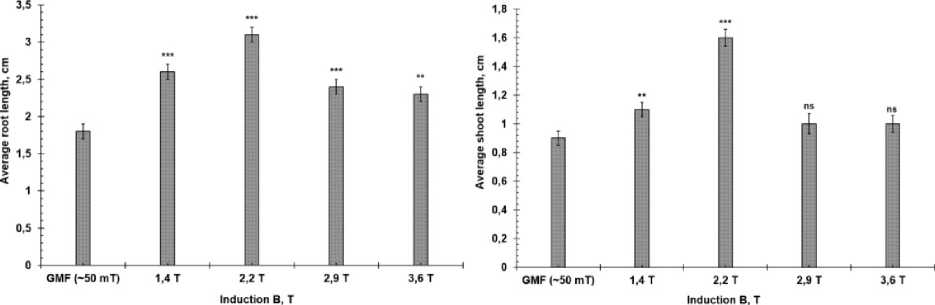
An analysis of the data presented in Figure 1 demonstrates the influence of a PMF with magnetic inductions ranging from B=1.4-3.6 T on the biometric parameters of three-day-old bread wheat seedlings.
Exposure of wheat seeds to a PMF at B=1.4 T resulted in a 44% increase in the root length of three-day-old seedlings. The maximum stimulatory effect on root length was observed at a magnetic induction of B=2.2 T, reaching 72%. A further increase in the PMF intensity to B = 2.9 T and B=3.6 T also stimulated root length by 33% and 28%, respectively, which was lower than the root length achieved at B=2.2 T. The stimulatory effect on shoot growth was noted only under the exposure regimes of B=1.4 T (by 22%) and B=2.2 T (by 78%). Magnetic pulse treatment of seeds at B=1.4-3.6 T contributed to an increase in total seedling length ranging from 22% to 74% on the third day of germination. Based on the conducted morphometric analysis, the PMF treatment regime at B=2.2 T was selected as the most effective for stimulating growth processes.
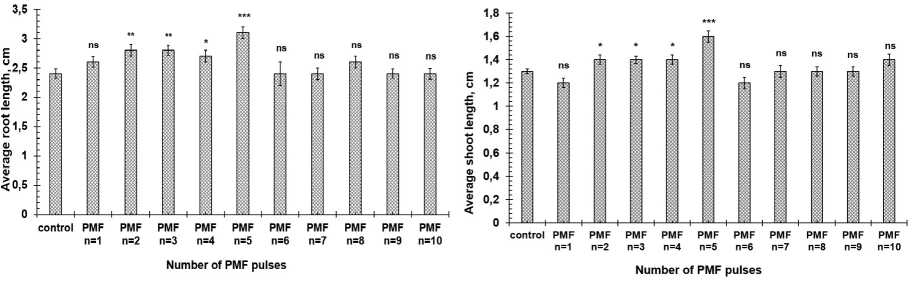
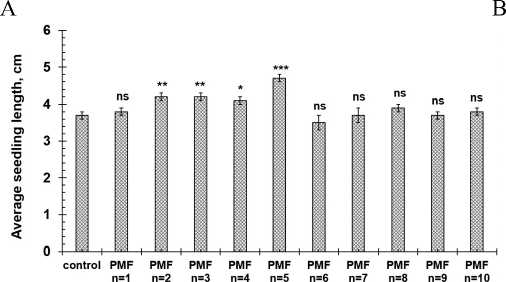
Figure 2 presents the morphometric parameters of three-day-old wheat seedlings grown from seeds treated with a PMF at B =2.2 T across a wide range of pulse numbers from n =1 to n =10.
The maximum stimulation of root growth by 29%, shoot growth by 23%, and seedling growth by 27% was observed under the exposure regime of n =5 pulses. The PMF treatment at pulse regimes of n =2 and n =3 contributed to an increase in root length by 17% and seedling length by 14%, with less pronounced positive deviations observed for shoot length. A stimulatory effect on root and seedling growth was also observed under the n =4 pulse regime, amounting to 13% and 11%, respectively, while less pronounced positive deviations were recorded for shoot length. Beginning with the treatment regime with the pulse number of n =6 to n=10 did not result in pronounced changes in roots, shoots, or seedlings.
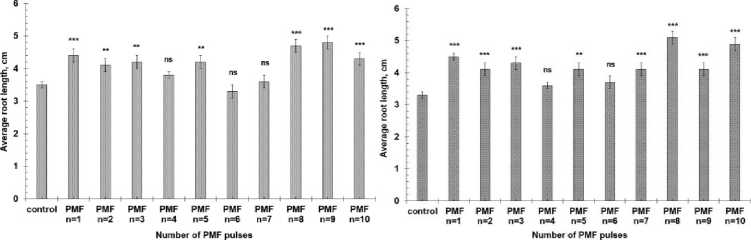
During the subsequent stage, soil drought conditions were simulated using PEG-4000 at concentrations ranging from 5% to 15%, followed by further wheat germination under these conditions alongside the evaluation of morphometric parameters; the results are presented in Figure 3.
Preliminary treatment of wheat seeds promoted the adaptation of six-day-old seedlings to PEG-4000-induced osmotic stress, which corresponded to mild, moderate, and severe drought conditions under the exposure regimes of n =5, n =9, and n =10. Root growth stimulation was observed across all drought levels: by 23–46% under mild drought, 26–43% under moderate drought, and 23–26% under severe drought, depending on the number of PMF treatment pulses. On the sixth day of germination under drought conditions, the PMF exposure on wheat seeds at an induction of B =2.2 T contributed to an increase in total shoot length under the same regimes ( n =5, n =9, n =10) by 29-41% under mild drought, 22-34% under moderate drought, and 12-29% under severe drought conditions (Figure 4).
Furthermore, under the PMF regimes of n=5, n=9, and n=10, a stimulatory effect on seedling growth was observed, amounting to 26-43% under mild drought, 1830% under moderate drought, and 18-26% under severe drought conditions (Figure 5).
Table 1 presents the values of morphometric indices characterizing the drought resistance of bread wheat Triticum aestivum (L.).
Under the PMF treatment regimes of n=5, n = 9, and n=10, the maximum increase in the root resistance index (RRI) was recorded, amounting to 21-46% under mild drought, 26-43% under moderate drought, and 25-27% under severe drought conditions. An increase in the root growth stimulation index (RSI) was observed across all PMF seed treatment regimes ( n =1-10) by 15-62% under mild drought and by 14-63% under moderate drought; however, under severe drought conditions, this increase occurred only at n ≥3, ranging from 17% to 35%. An increase in the shoot resistance index (SI) was noted for treatment regimes at n≥5 by 20-43% under mild drought, 10-35% under moderate drought, and 9-30% under severe drought. Under PMF treatment regimes at n ≥5, an elevation of the seedling tolerance index (STI) was recorded, with values increasing by 18-46% under mild drought, 18-39% under moderate drought, and 8-28% under severe drought conditions. Additionally, an increase in the seedling biomass alteration index (SM) was registered at n≥5, rising by 8-24% under simulated mild drought, 5-13% under moderate drought, and 421% under severe drought.
The maximum reduction in the SAR generation rate was observed under the same PMF treatment regimes that enhanced wheat growth processes. Under mild drought conditions, the SAR generation rate decreased by 31-43% at n =5, n = 9, and n =10; under moderate drought, it decreased by 33-51%; under severe drought, a reduction was noted only at n =5 and n =10 (by 51%) and at n =9 (by 57%) (Figure 6). Under other treatment regimes ( n =6-8) under drought conditions, a decrease in the SAR generation rate by 8-63% was also observed.
The maximum stimulation of growth processes during magnetopriming of wheat seeds with a PMF was established at B =2.2 T with a pulse number of n =5 on the third day in the absence of osmotic stress, showing an increase in three-day-old root length by 29%, shoot length by 23%, and total seedling length by 27%;
meanwhile, increasing the number of pulses to n ≥6 led to growth inhibition, indicating a dose-dependent effect The impact of drought on seeds pretreated with the PMF confirmed the adaptation of six-day-old plants to stress conditions under regimes with n≥5, depending on the drought severity and the pulse delivery mode. For practical application, the exposure regime of B =2.2 T at n =5 can be considered optimal, as the seeds of both three-day-old and six-day-old seedlings demonstrated enhanced growth parameters both in the absence of stress and across all drought variants, ranging from mild to severe.
The obtained data are consistent with findings on the magnetopriming of maize seeds using magnetic fields ( B =100 mT and B =150 mT for 10 min), where the treatment mitigated the negative impact of drought on plant growth by improving chlorophyll a content, as well as photochemical and non-photochemical quenching of fluorescence (Javed et al., 2011). Unlike most studies that utilize static magnetic fields with exposure durations ranging from several minutes to hours (Golshani et al., 2014; Mohammadi et al., 2020; Mridha et al., 2016), this work employs an alternating high-intensity PMF ( B >1 T) with a microsecond exposure time. This approach allows for a significant reduction in treatment duration and represents an economically promising method for enhancing seed adaptation to arid soil conditions.
The root system plays a vital role in the growth, development, and yield of cereal crops, and its development is crucial for wheat drought tolerance and nutrient use efficiency (Azeem et al., 2025). The application of magnetopriming to wheat seeds ensured the adaptation of seedlings at early developmental stages to osmotic stress induced by mild, moderate, and severe drought. Preliminary seed treatment with a PMF under the n =5, n = 9, and n =10 regimes stimulated root growth by 23-46%, shoot growth by 12-41%, and total seedling length by 18-43% depending on the stress level, compared to the non-PMF-treated control that was also subjected to stress. Under mild-to-severe drought conditions, an increase in the root resistance index (RRI) by 21-46% was noted under the n =5, n =9, and n =10 regimes, and the root growth stimulation index (RSI) reached 31-63%. Notably, the positive effect of the
PMF was manifested not only in the roots but also in the shoots, where an increase in the shoot mass index of up to 28% occurred under the n =5, n =9, and n =10 treatment regimes, depending on the stress level. Specifically, the shoot resistance index (SI) at n =5 reached 118% under 5% PEG, 99% under 10% PEG, and 92% under 15% PEG, while the seedling tolerance index (STI) reached 117%, 109%, and 104%, respectively. The increased values of the root growth stimulation index (RSI) suggest that the PMF not only mitigates the negative effects of stress but also enhances growth processes. The positive impact on the root system and the enhanced shoot growth are expected to improve nutrient use efficiency (Hussain et al., 2020) The preservation of high shoot resistance (SI) and seedling tolerance (STI) even under severe stress presumably indicates that the protective effect of the magnetic field is mediated by maintaining the functionality of the photosynthetic apparatus and reducing oxidative stress (Erez et al., 2024; Alikamanoglu et al., 2011).
One of the primary mechanisms underlying the damaging effect of drought is the generation of reactive oxygen species (ROS), particularly the superoxide anion radical (SAR). These are toxic molecules capable of inducing oxidative damage to proteins, DNA, and lipids (Miller et al., 2010) In the present study, PMF treatment ( n =5, n =9, and n =10) decreased the SAR generation rate in the roots of six-day-old seedlings by 31-43% under mild drought, 33-51% under moderate drought, and 51-57% under severe drought conditions. This demonstrates that magnetopriming of wheat seeds alleviates oxidative stress, which is consistent with prior findings (Chen et al., 2009) regarding drought exposure. The reduction in SAR levels is likely associated with the activation of antioxidant enzymes (such as superoxide dismutase, catalase, peroxidase, ascorbate peroxidase, and glutathione reductase) and a concurrent decrease in malondialdehyde levels in the treated plants (Chen et al., 2009; Şen et al., 2016).
It is known that calcium (Ca2⁺) is a signaling molecule that plays an important role in regulating key physiological processes in plants, including cell wall formation, osmotic regulation, cell division, and adaptation to biotic and abiotic stresses (Kataria et al., 2023). The use of a magnetic field increases the accumulation of Ca2⁺ in cellular organelles and cytoplasm, which correlates with accelerated plant growth and development, possibly due to its role in stress adaptation and leads to changes in the electrical conductivity of cell membranes (Belyavskaya et al., 2004). In addition, it has been shown that the magnetic field increases the concentration of Ca2⁺ in Actinidia deliciosa pollen (Betti et al., 2011). Studies prove that the magnetic field increases the accumulation of Ca2⁺ in the cytoplasm and cellular organelles, this effect may be associated with changes in the membrane potential (Grinberg et al., 2024), the permeability of cell membranes (Tota et al., 2024; Shibryaeva et al., 2024) under the action of a magnetic field. Thus, the magnetic field may be a promising tool for modulating calcium signaling in plants, which opens up new opportunities for increasing their stress resistance. However, for the practical application of this approach, additional studies of the molecular mechanisms of magnetic pulse action on higher plants are needed.
The obtained results demonstrate that the optimal PMF regimes ( B =2.2 T, n =5, n =9, and n =10) can be recommended for the magnetopriming of wheat seeds to enhance drought resistance during the early stages of plant development; notably, the n =5 exposure regime promotes growth processes both in the absence of stress and under osmotic stress conditions. The short exposure time in the microsecond pulse range represents a distinct advantage over prolonged exposure to static magnetic fields.
A
В
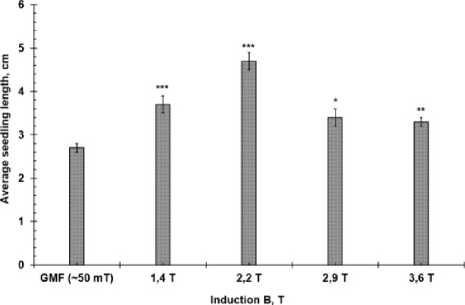
Figure 1. Mean length of three-day-old roots, shoots, and seedlings of bread wheat under the influence of a PMF at B=1.4-3.6 T (A-C). Data are presented as mean ± SE; ns: no significant difference; *: p≤0.05, **: p≤0.01, ***: p≤0.001 (Fisher's one-way analysis of variance (ANOVA) followed by Tukey's post-hoc test).
Number of PMF pulses
C
Figure . Mean length of three-day-old roots, shoots, and seedlings of bread wheat under the influence of a PMF at B=2.2 T and a pulse number ranging from n=1 to n=10 (A-C). Data are presented as mean ± SE; ns: no significant difference; *: p≤0.05, **: p≤0.01, ***: p≤0.001 (Fisher's one-way analysis of variance (ANOVA) followed by Tukey's post-hoc test).
A В
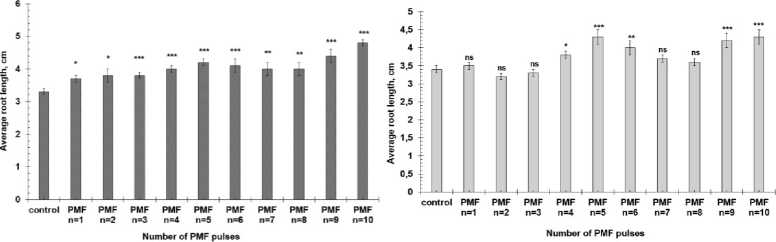
Figure 3. Mean root length of six-day-old bread wheat seedlings under the influence of a PMF at B=2.2 T and a pulse number ranging from n=1 to n=10 under stress conditions (A-0% PEG; B-5% PEG; C-10% PEG; D-15% PEG). Data are presented as mean ± SE; ns: no significant difference; *: p≤0.05, **: p≤0.01, ***: p≤0.001 (Fisher's one-way analysis of variance (ANOVA) followed by Tukey's post-hoc test).
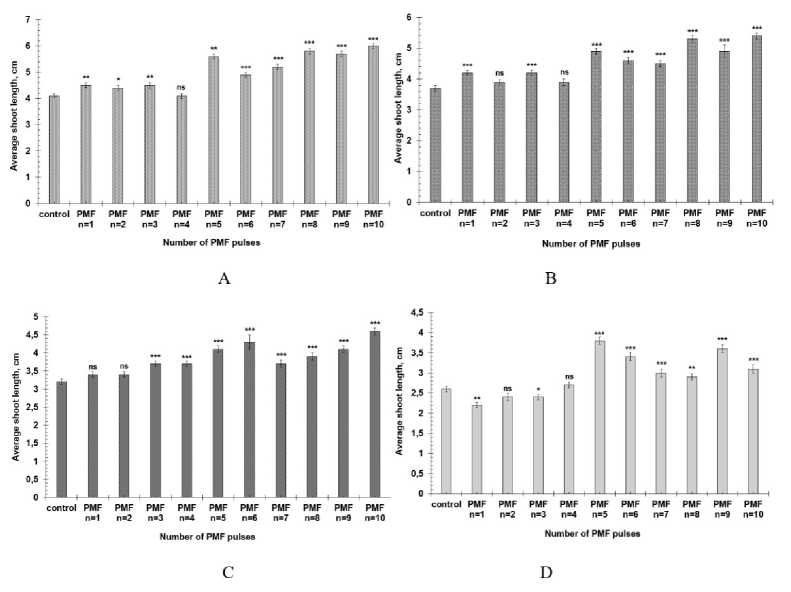
Figure 4. Mean shoot length of six-day-old bread wheat seedlings under the influence of a PMF at B=2.2 T and a pulse number ranging from n=1 to n = 10 under stress conditions (A-0% PEG; B-5% PEG; C-10% PEG; D-15% PEG). Data are presented as mean ± SE; ns: no significant difference; *: p≤0.05, **: p≤0.01, ***: p ≤0.001 (Fisher's one-way analysis of variance (ANOVA) followed by Tukey's post-hoc test).
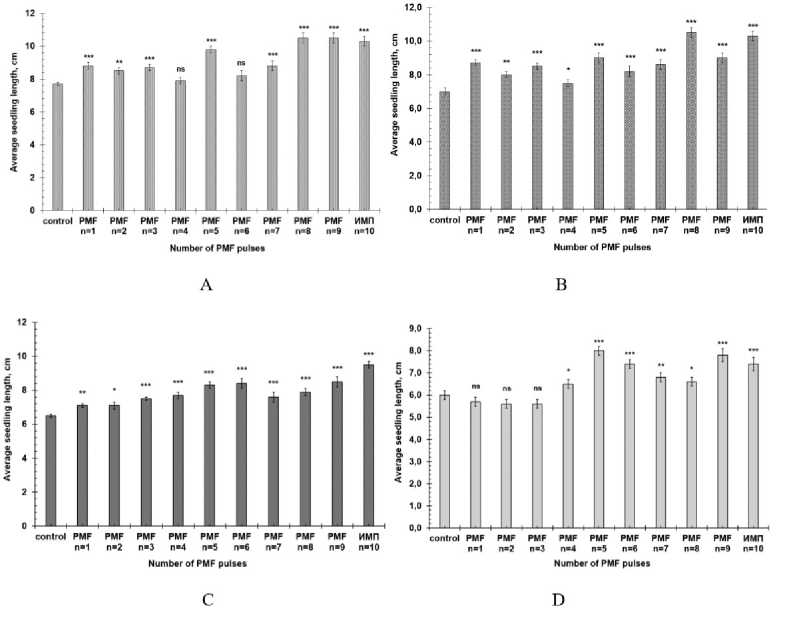
Figure 5. Mean length of six-day-old bread wheat seedlings under the influence of a PMF at B=2.2 T and a pulse number ranging from n = 1 to n = 10 under stress conditions (A-0% PEG; B-5% PEG; C-10% PEG; D-15% PEG). Data are presented as mean± SE; ns: no significant difference; *: p≤0.05, **: p≤0.01, ***: p≤0.001 (Fisher's one-way analysis of variance (ANOVA) followed by Tukey's post-hoc test).
Table 1. Morphometric indices of drought resistance in bread wheat Triticum aestivum (L.)
|
Variant |
Root Resistance Index (RRI), % |
Shoot Resistance Index (SRI), % |
Seedling Biomass Alteration Index (SM), % |
Root Growth Stimulation Index (RSI), % |
Seedling Tolerance Index (STI), % |
|
Control |
|||||
|
5% PEG |
95±5,0 |
89±3,0 |
91±3,0 |
100±0,0 |
91±3,0 |
|
10% PEG |
96±4,0 |
77±2,0 |
86±4,0 |
100±0,0 |
85±2,0 |
|
15% PEG |
98±4,0 |
62±2,0 |
72±2,0 |
100±0,0 |
78±2,0 |
|
Number of PMF pulses n =1 |
|||||
|
5% PEG |
129±5,0 *** |
102±3,0 ** |
103±4,0 * |
142±7,0 *** |
114±3,0 *** |
|
10% PEG |
106±4,0 ns |
82±2,0 ns |
86±3,0 ns |
114±5,0 ** |
93±3,0 * |
|
15% PEG |
99±4,0ns |
54±2,0 ** |
71±3,0 ns |
104±4,0 ns |
75±2,0 ns |
|
Number of PMF pulses n = |
|||||
|
5% PEG |
119±7,0 ** |
86±2,0 ns |
99±3,0 ns |
132±9,0 *** |
105±4,0 ** |
|
10% PEG |
109±6,0 ns |
75±2,0 ns |
92±3,0 ns |
130±12,0 * |
94±3,0 * |
|
15% PEG |
93±4,0 ns |
53±2,0 ** |
79±3,0 ns |
102±8,0 ns |
74±2,0 ns |
|
Number of PMF pulses n =3 |
|||||
|
5% PEG |
124±6,0 *** |
102±3,0 ** |
97±3,0 ns |
137±8,0 *** |
112±4,0 *** |
|
10% PEG |
110±4,0 * |
91±3,0 ns |
94±3,0 ns |
128±7,0 *** |
96±4,0 * |
|
15% PEG |
95±5,0 ns |
57±2,0 * |
74±3,0 ns |
107±10,0 ns |
74±3,0 ns |
|
Number of PMF pulses n =4 |
|||||
|
5% PEG |
103±4,0 ns |
95±3,0 ns |
94±4,0 ns |
115±5,0 ** |
98±3,0 ns |
|
10% PEG |
115±5,0 ** |
91±3,0 *** |
95±6,0 ns |
135±11,0 *** |
101±3,0 *** |
|
15% PEG |
109±4,0* |
66±2,0ns |
79±3,0* |
119±9,0* |
85±2,0* |
|
Number of PMF pulses n =5 |
|||||
|
5% PEG |
116±6,0 ** |
118±4,0 *** |
115±6,0 *** |
131±9,0 *** |
117±4,0 *** |
|
10% PEG |
122±5,0 *** |
99±3,0 *** |
99±5,0 * |
145±11,0 *** |
109±3,0 *** |
|
15% PEG |
123±6,0*** |
92±3,0*** |
93±5,0*** |
135±11,0** |
106±3,0*** |
|
Number of PMF pulses n =6 |
|||||
|
5% PEG |
104±6,0 ns |
112±4,0 *** |
100±5,0 ns |
119±9,0 * |
109±4,0 ** |
|
10% PEG |
118±6,0 ** |
104±4,0 *** |
93±4,0 ns |
140±12,0 *** |
111±5,0 *** |
|
15% PEG |
115±5,0** |
82±3,0*** |
85±4,0* |
128±11,0* |
97±4,0*** |
|
Number of PMF pulses n =7 |
|||||
|
5% PEG |
119±6,0 ** |
109±3,0 *** |
99±4,0 ns |
131±7,0 *** |
113±4,0 *** |
|
10% PEG |
112±5,0 * |
87±3,0 ** |
91±4,0 ns |
136±12,0 ** |
100±3,0 *** |
|
15% PEG |
107±5,0ns |
73±3,0*** |
79±3,0ns |
119±11,0ns |
89±4,0* |
|
Number of PMF pulses n =8 |
|||||
|
5% PEG |
148±7,0 *** |
128±4,0 *** |
109±4,0 ** |
162±8,0 *** |
137±4,0 *** |
|
10% PEG |
115±6,0 * |
94±3,0 *** |
92±4,0 ns |
134±12,0 ** |
103±3,0 *** |
|
15% PEG |
105±5,0ns |
71±2,0** |
76±3,0ns |
117±10,0ns |
86±3,0* |
|
Number of PMF pulses n =9 |
|||||
|
5% PEG |
118±7,0 ** |
119±4,0 *** |
103±5,0 ns |
131±9,0 *** |
118±5,0 *** |
|
10% PEG |
126±7,0 *** |
100±4,0 *** |
91±4,0 ns |
153±15,0 *** |
112±4,0 *** |
|
15% PEG |
125±7,0*** |
74±3,0*** |
84±3,0** |
134±10,0*** |
98±4,0*** |
|
Number of PMF pulses n =10 |
|||||
|
5% PEG |
141±7,0 *** |
132±4,0 *** |
109±5,0 ** |
157±9,0 *** |
136±4,0 *** |
|
10% PEG |
139±5,0 *** |
112±3,0 *** |
93±3,0 ns |
163±11,0 *** |
124±3,0 *** |
|
15% PEG |
125±7,0*** |
74±3,0*** |
84±3,0** |
134±10,0*** |
98±4,0*** |
Note : Data are presented as mean ±SE; ns : no significant difference; *: p ≤ 0.05, **: p ≤ 0.01, ***: p ≤ 0.001 (Fisher's oneway analysis of variance (ANOVA) followed by Tukey's post-hoc test).
CONCLUSIONS
In conclusion, it has been demonstrated that a high-intensity PMF (B=2.2 T) under the n=5, n=9, and n=10 regimes effectively alleviates oxidative stress during the early stages of ontogenesis, stimulates root and shoot growth, and enhances both the seedling biomass indices and the tolerance indices of wheat to osmotic stress. It is hypothesized that the observed effect is mediated by the activation of the antioxidant system and calcium-dependent signaling pathways, which promotes the establishment of a cross-adaptation state. The obtained results open up new prospects for implementing magnetopriming in agricultural practice as an environmentally friendly and economically viable method to enhance the stress tolerance of cereal crops under osmotic stress conditions.
FUNDING
The work was carried out by the staff of the Bioengineering Laboratory at the Samara Federal Research Center of the Russian Academy of Sciences (SamSC RAS) as part of the state assignment of the Ministry of Education and Science of the Russian Federation for SamSC RAS under the topic №FMRW-2025-0043.
CONFLICTS OF INTEREST
All authors declare that they have no conflicts of interest.
