
The Northwest Coast of North America as the Main Route from Beringia to the New World: The Evidence of Mythology
Journal: Archaeology, Ethnology & Anthropology of Eurasia @journal-aeae-en
Section: Ethnology
Article in issue: 2 т.53, 2025.
Free access
Data on the distribution of folklore and mythological motifs in the New World are analyzed. Their areas agree with the idea that early migrants moved along the Pacific coast of North America. The Columbian Plateau with the adjacent part of the coast could have been a hub whence people dispersed to the south, southeast, and east. The transfer of cultural elements along the Mackenzie Corridor is supported neither by the distribution of mythological episodes and images nor by archaeological evidence (the latter suggests an oppositely directed migration in the Terminal Pleistocene—from the main territory of the U.S. to Alaska). North American and South American narrative episodes and mythological motifs are separated by a huge geographic gap: Many migrant populations seem to have rapidly reached South America, leaving certain groups behind. While in America distribution areas of motifs follow recognizable patterns, in the Old World the same motifs are scattered from Europe to the Pacific, which may attest to the heterogeneity of the Beringian population immediately before the migration to the New World. Besides the main (early) episode of peopling, data on the areal distribution of motifs reveal three or four later episodes.
Short address: https://sciup.org/145147498
IDS: 145147498 | DOI: 10.17746/1563-0110.2025.53.2.115-125
Text of the scientific article The Northwest Coast of North America as the Main Route from Beringia to the New World: The Evidence of Mythology
By the early 2000s, the author of this article had processed the data reflecting the distribution of folklore and mythological motifs not only in the New World, but also in Eurasia (Berezkin, 2003)*. Thus, it became possible to identify narrative episodes common to the Altai-Sayan area and the Plains. It could be assumed that this was the trace of the people whose ancestral homeland was in the south of Siberia. After reaching Beringia, they moved further along the Yukon and Mackenzie valleys and came to the Plains.
The hypothesis was based on folklore and mythology. There was no archaeological evidence of north to south migration along the Mackenzie Corridor.
Over the next two decades, the scope of the processed evidence tripled, and information on dozens of traditions of Western Eurasia was included in the database. The results of analyzing ancient DNA based on the evidence from the sites in North Asia became available, indicating a boreal cultural continuum from the Atlantic to the Pacific Ocean, the remains of which still survived by the beginning of the peopling of the New World. This continuum began to disintegrate after the Last Glacial Maximum (LGM) and finally disappeared by the Middle Holocene as a result of the displacement of the ancient population of Eastern Siberia by populations from the Transbaikal region
and North China (Berezkin, 2022; Pitulko, 2022: 167). Their genetic lines go back to the people from Tianyuan Cave (ca 40 ka BP) (Wang et al., 2021).
This hypothesis did not address the circumstances for the emergence of Eurasian parallels in the folklore of the Native Americans who lived far from the Bering Sea coast. How exactly did such a set of motifs end up in the depths of the North American continent?
This article introduces some facts favoring the transfer of folklore and mythological motifs deep into the New World along the Pacific coast of North America. For over a quarter of a century of research, we were unable to discover chains of traditions containing identical motifs, which would stretch from the Bering Sea through the Subarctic to the Plains or the Midwest. The lines of communication either go along the Northwest Coast extending to the Plateau*, or begin in the Plateau area and follow therefrom to the south, east, and southeast. The most that can be said about the role of the Mackenzie Corridor is the impossibility of determining, for a number of motifs, whether these were transferred from Beringia to the south along the coast, or through the territories to the east of the Continental Divide. This category includes episodes and images that have not been discovered either in the Subarctic or within the Northwest Coast and Plateau, as well as those that are widespread in North America almost everywhere.
Although the possibility of a coastal route from Beringia after (and, in theory, also before) the LGM is now undisputed (Braje et al., 2017; Steffen, 2024), scholars also keep in mind the alternative route through the Mackenzie Corridor—albeit it was discovered later, which is reflected on the corresponding maps (Becerra-Valdivia, Higham, 2020; Froese et al., 2019; Potter et al., 2018). Only some geneticists point to the coastal route as the only possibility (Willerslev, Meltzer, 2021), while archaeological evidence testifies to an early migration along the Mackenzie and Yukon valleys not from north to south, but only in the opposite direction; that is, to the movement of the carriers of the Clovis tradition of making grooved arrowheads to Alaska (Vasiliev et al., 2015: 171–183).
In addition to the lack of archaeological evidence, there is also an indirect argument against the hypothesis on the significance of migration through the Mackenzie
*As a historical and cultural region, the Plateau includes the Columbia Plateau along with the adjacent Northwest Coast strip within Southern British Columbia and the states of Washington and Oregon. In historical times, mostly the Salish peoples lived there.
Corridor for peopling the New World. Although the narrow space between the Laurentide and Cordilleran ice sheets might have become ice-free relatively early, conditions for human habitation there were unfavorable until 13.5–12.7 ka BP (all dates calibrated) (Heintzman et al., 2016; Prates, Politis, Perez, 2020; Steffen, 2024). By that time, the Americas had already been populated. Even if we ignore suggestions about human penetration into the New World before the LGM (Davis, Madsen, 2020; Gruhn, 2023; Hoffecker et al., 2023), several sites in North and South America are definitively dated to between 16 and 14 ka BP (Halligan et al., 2016; Prates, Politis, Perez, 2020; Steffen, 2024; Waters et al., 2018; Williams et al., 2018). Early dates were also obtained for one of the sites of the so-called Western Stemmed tradition in the Plateau (Davis et al., 2022). This tradition is now believed to have appeared earlier than the Clovis tradition, although initially it was attributed at best to the very end of the Pleistocene (Beck, Jones, 2010; Smith et al., 2020).
In recent years, the author of this article operated mainly with average statistical data reflecting the frequency of occurrence of images and episodes in traditions (Berezkin, 2018a, b; 2016). This study will discuss specific motifs*. Currently, distribution patterns of 500 motifs, occurring exclusively in the New World, and another 205 motifs known both in the Old World and in America have been identified. The maps below show the distribution of over twenty motifs whose geographic ranges suggest migration along the Pacific coast. There are almost three times as many of them, but we cannot describe them all in a single article. As far as the remaining American motifs are concerned, these have been either found only in a few traditions or reflect not the migration routes of the Paleo-Indians, but later processes, up to the migration of the Athapaskans to the southwest of the United States, which occurred shortly before the beginning of contacts with Europeans.
Overview of the evidence
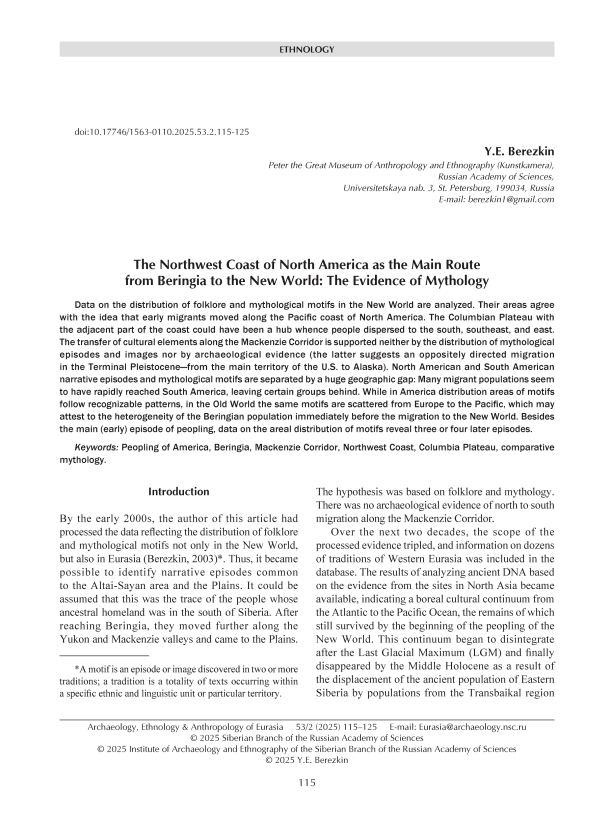
We should start with the pattern confirmed by the largest number of records—the dominance of the coyote as the main folklore trickster south of the Fraser River and the dominance of the raven north of the Columbia River (Fig. 1). Both tricksters appear in the traditions located in the area of contact and overlapping of these large geographic ranges, but more often this role is taken by other characters, such as the mink, blue jay, skunk, raccoon, owl, hawk, and even ice. Such a diversity of tricksters is not observed anywhere else in the world. The figure of the main zoomorphic trickster is a very important element of the tradition (cf. the European fox or hare and spider in Africa). It seems that the contact of two such powerful images within a small and most likely relatively densely populated (owing to fishing opportunities) territory led to a kind of shaking of stereotypes.
The Paleo-Indian trace can be best identified by the motifs that appear both in North and South America. Their distribution zones are most often separated by huge gaps, but precisely this distribution clearly indicates the transfer of plot episodes and mythological images in the early period. The discontinuity of the geographic range can only be explained by displacement of earlier groups of migrants by later groups. In the New World, the trickster-raven is typical exclusively of the north and northwest of North America. In Central and South America, there are no ravens or other vultures among the characters of this type. In the absence of South American parallels, it is difficult to establish the time when such an image appeared in the Bering Sea region—it could have spread both in the Pleistocene and in the Holocene. The same applies to some other motifs, such as “woman and dog: origin of humans” (K47a, Fig. 2). Its geographic range is similar to that of the tricksterraven. In the Old World, the motif of a woman and dog producing humans is typical of East Asia and Southeast Asia. In the American Arctic, it could not have appeared before the third millennium BC, when this territory first became populated. Along the Pacific coast, the distribution area of motif K47a extends far to the south. This motif undoubtedly got there earlier than to the Arctic, although it is impossible to suggest a specific dating.
The situation with the trickster-coyote is different as compared to the raven. Coyotes are not found in South America, but local representatives of the canine family play the same role in folklore in the Andes, Chaco, and Patagonia as the coyote does
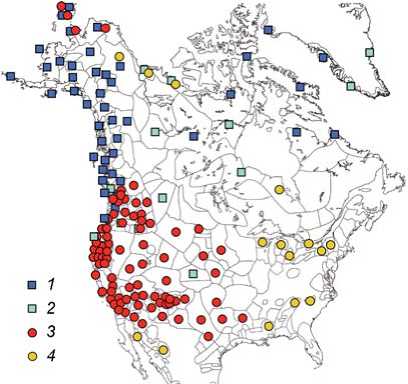
Fig. 1 . Areas of two main zoomorphic tricksters in North America.
1 – raven, multiple occurrences; 2 – the same, singular occurrences; 3 – coyote or fox (in the Arctic), multiple occurrences; 4 – the same, singular occurrences.
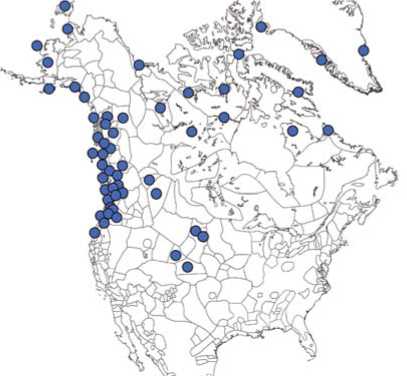
Fig. 2 . Distribution of the motif “woman and dog: origin of humans” (woman becomes intimate with a dog; her children grow as humans and usually become the ancestors of specific ethnic groups).
in North America. The authors of publications call these characters foxes. Significantly, in a number of cases, the corresponding narratives involving a coyote in the north and “fox” in the south include the same episodes (Fig. 3). This is a strong argument in favor of a historical connection between the trickster-coyote of the Native Americans and trickster-fox of Peru, Bolivia, Chile, Argentina, and Paraguay, and hence in favor of the spread of this image in the Paleo-Indian period.
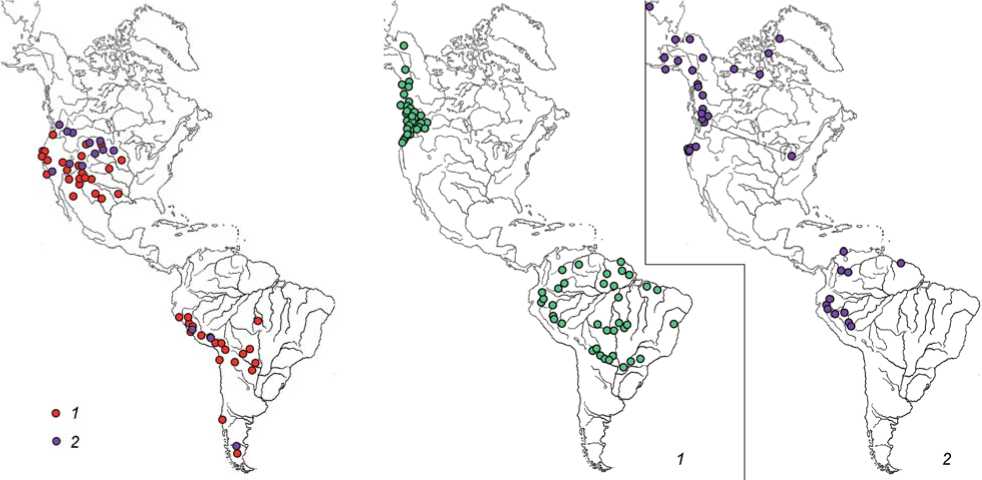
Fig. 3 . Distribution of particular trickster episodes involving coyote in North America and “fox” (local representative of the canine family) in South America.
1 – M30, “trickster falls” (person or creature who has no natural wings or can’t fly long distances rises into the air, but falls or, having lost its wings, stays where he can’t return from); 2 – L33b, “trickster provokes a rock” (person or creature invites someone who at first glance is unable to move (stump, boulder, fire) to race; this one begins to move, presses or burns the trickster, or runs away, taking away his property); L33c, “a boulder drowns the trickster” (the trickster and the boulder agree to race down the slope; the boulder is rolling faster and crushing the trickster); L33e, “gift blanket” (the trickster demands back or picks up a blanket belonging to a rock or other character (he usually gave this cape earlier).
Whether the folklore coyote is related to the Eurasian fox cannot be determined. The tricksterfox penetrated into the Western American Arctic (see Fig. 1), but this clearly resulted from the late contacts across the Bering Strait. Among the PaleoAsians, it competes with the raven, but in America it appears in only a few plots.
The disjointed geographic ranges of motifs (one part in the northwest of North America, and the other part in South America) are typical of the New World. The distinctive examples are “arrow chain” (J58, Fig. 4, 1 ), “C-section” (F49, Fig. 4, 2 ), “a bird carries away the antagonist” (J37, Fig. 5, 1 ), “a bonfire in the bowels of monsters” (L56, Fig. 5, 2 ), “crying baby” (K86, Fig. 5, 3 ), and “traveling transformer”
Fig. 4 . Areas of occurrence of motifs.
-
1 – “the arrow chain” (persons shoot arrows (darts) which hit each other’s end forming a chain (rope, ladder); usually, persons climb by this chain the upper world);
-
2 – “C-section” (the women had their bellies cut to remove the baby; someone explains how to give birth or makes childbirth possible). The arrow indicates the probable transfer of the motif from the Plateau to the Midwest during migration of the ancestors of the Algonquians.
(B28, Fig. 6, 1 )*. These motifs occur in Alaska, but are especially typical of the territory of the USA west of the Rocky Mountains, as well as South America. Very often, the North American area of distribution of episodes and images becomes abruptly interrupted in the south, and the boundary passes within the states of Washington, Oregon, or California. Its position was probably determined by where exactly the settling populations managed to gain a foothold so that their cultural heritage would not be subsequently erased by new waves of migrants. As for South America, the territories suitable for colonization were much larger there. Accordingly, the cultural heritage of various groups with greater probability could be preserved until the arrival of Europeans.
The transfer of the “C-section” motif from the geographic range of the Salish traditions to an Algonquian area, which was marked in Fig. 4, means that it most likely came to the Midwest not in the Paleo-Indian period, but much later. There are two
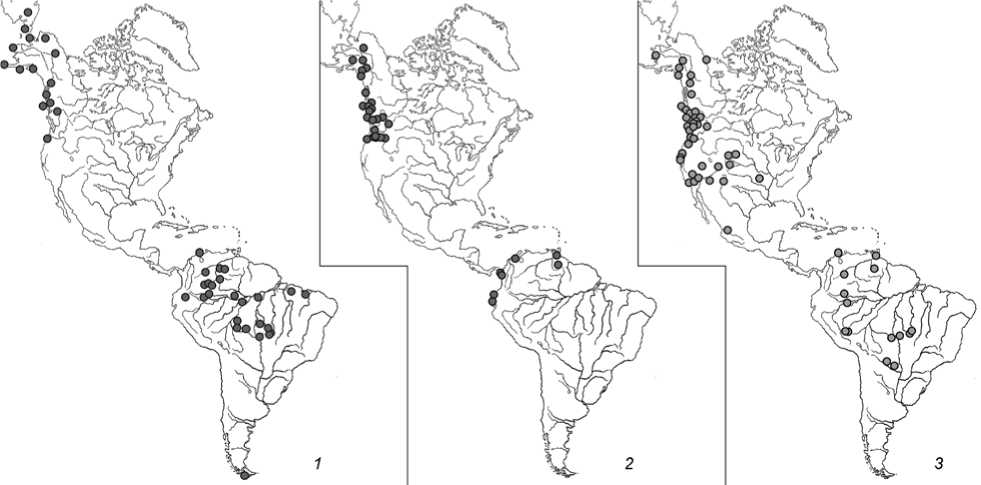
Fig. 5 . Areas of occurrence of motifs.
1 – “a bird carries away the antagonist” (having turned into a powerful bird or created one, the hero lifts into the air and carries his opponent away); 2 – “a fire in monster’s belly” (monster or a huge animal dies from a fire in its belly); 3 – “crying baby” (a small (usually capricious) child is ignored, kicked out of the house, thrown on the road, or given to another person for a while. As a result, an animal or spirit takes the baby away).
or three dozen episodes and images that link the traditions of the Salish people of the Northern Plateau and the adjacent coast of British Columbia with the traditions of the Algonquian people of the Great Lakes region and to a lesser extent the Northeast. These episodes and images are absent from the intermediate territories. The Algonquian languages are the main branch of the Algic languages, which also include two languages—Yurok and Wiyot—from the coast of Northern California. The only reasonable scenario is the dispersal of all representatives of the Algic family from the Plateau area. The time of such a migration cannot be precisely established, but archaeological and linguistic data make it possible to assume (cautiously) the late 4th–early 2nd millennium BC (Vasiliev et al., 2015: 401–421; Berezkin, 2010).
There are other variants of the distribution of motifs, reflecting further advance of migrants either west or east of the Continental Divide. The western chain of connections is not always disrupted by the Central American gap. An example of almost continuous distribution is the motif “do not point to a rainbow” (i45b, Fig. 6, 2 ). In the Old World, a similar prohibition is typical of the Indo-Pacific region of Asia, equatorial Africa, Europe, and its ancient African origin cannot be ruled out. In America, the motif has been found mainly in the Western United States,
Mesoamerica, and Northwest of South America, both in the Andes and in Amazonia.
The American geographic range of the “low sky” motif (B77, Fig. 7, 1 ) not only includes Mesoamerica, but also extends from Chukotka and Alaska to Brazil and Tierra del Fuego*. In the Old World, the topic of separation of the sky from earth is more widely known than in the New World and is typical of the cosmogonies of various regions. It is especially popular in the mythologies of the Indo-Pacific part of Asia, equatorial Africa, Balkans, Caucasus, and West Asia. In the absence of American data, the motif B77 could be possibly interpreted as an archetype inherent in people’s consciousness. The same applies to the motif “marriage of heaven and earth” (B2d, Fig. 7, 2 ), which in terms of its plot is related to the previous motif. However, in North America, both these motifs are not widespread or randomly distributed, but clearly gravitate toward the areas west of the Continental Divide, so it is inappropriate to speak about their ubiquity.
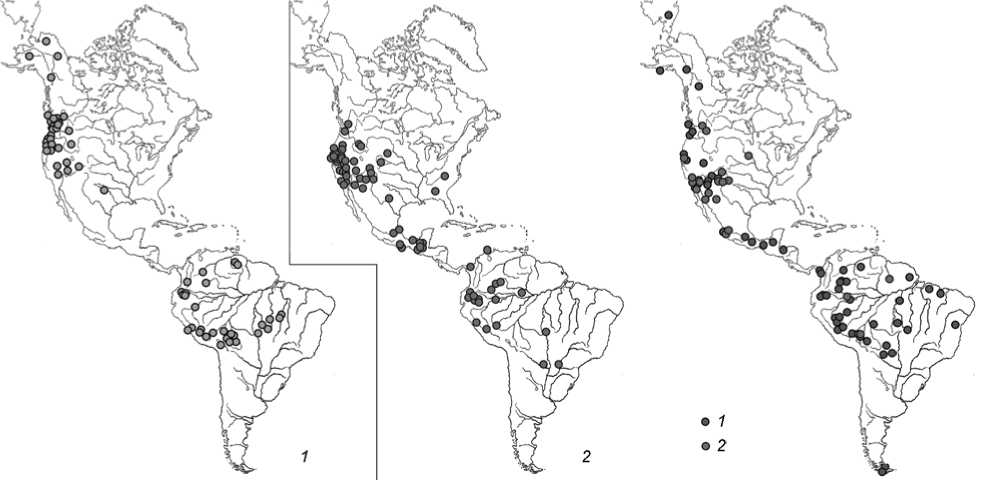
Fig. 6 . Areas of occurrence of motifs.
1 – “traveling transformer” (traveling from one area to another, the person consistently turns people into birds and animals, stones, sanctuaries, establishes cultural norms, determines biological features of living beings, peculiarities of the landscapes, etc.);
2 – “do not point to a rainbow” (the person pointing or gazing closely at the rainbow will become ill, or the finger pointing at it will rot or dry out).
Fig. 7 . Distribution of motifs.
1 – “low sky” (the sky was near the ground, then it rose); 2 – “marriage of heaven and earth” (Sky is considered a man and marries a woman Earth).
Two more cosmogonic motifs—“first sunrise” (A24) and “one-eyed luminaries” (B11b)—have similar geographic ranges and clearly reflect the movement of people from Beringia to South America through the territories to the west of the Continental Divide (Fig. 8). In the Old World, the former motif is almost unknown, while the latter occurs in Southeast Asia, among the non-Aryan peoples of Central India, and in the Balkans.
If we turn to the motifs that could have been transferred through the territories located not to the west, but to the east of the Continental Divide, a good example is “thunder vs dragon” (K41, Fig. 9, 1). In the Old World, this motif is rare outside of ancient Western Asia and the Aegean Sea region. It is most typical of North and Central America. In North America, the thunderbird usually serves as the embodiment of thunderstorm. In the Bering Sea region, the plot is the fight between such a bird and a whale. Since the motif is unknown in the mainland USA west of the Rocky Mountains, although it is common on the Northwestern Coast, it is logical to assume that upon reaching the south of the Plateau, its carriers continued to migrate not in the southern, but in the eastern direction. In North America, motif J25 (“babies hide and come back”, Fig. 9, 2) demonstrates the distribution pattern similar to K41. It is more common in South America and is typical of Guiana and the Amazon River basin. In Eurasia, this motif is known from Primorye, Kamchatka, and Taimyr to the Caucasus and Baltic Sea region (Berezkin, 2019). It has no parallels in Eastern Siberia and Alaska, so the Eurasian-American connections must go back to the Paleolithic.
The motif “cranes and pygmies” (K22, Fig. 10, 1 ) occurs in several areas east of the Continental Divide, and in the American Southwest, but is especially typical of the Northwest Coast, where precisely the local variants are most similar to the Ancient Greek variant (Berezkin, 2007b).
Another motif that spread across the Plains and not through California or the Great Basin is “sharp leg” (L9a, Fig. 10, 2 ). It has no parallels in Central America and Mexico, although this motif could only have reached South America through these regions, since migration through the Antilles has not been confirmed by archaeological data. Parallels in the Old World are rare, approximate, and geographically remote from America. The motif “the man joins wild animals” (B26) is also almost exclusively American. Its continuous geographical range extends from the Chukchi Peninsula to the Plateau, but the motif
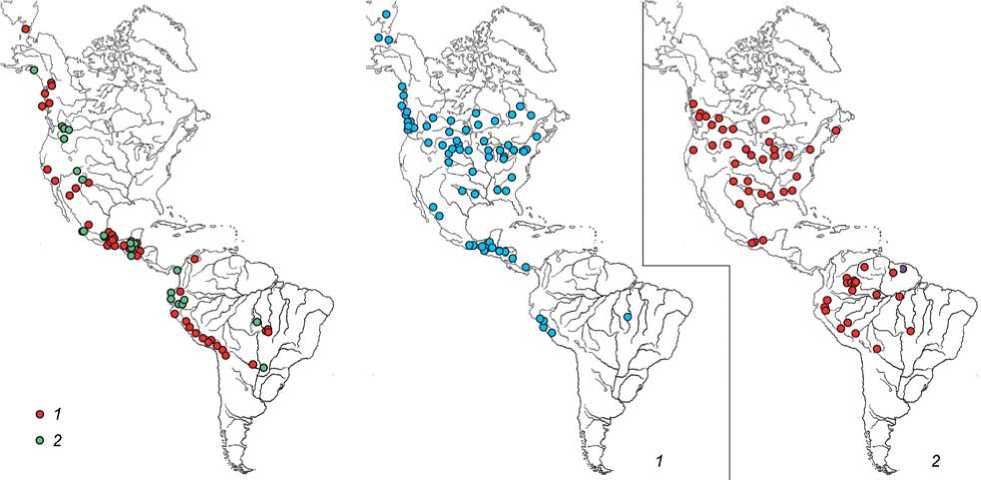
Fig. 8 . Distribution of motifs.
1 – “first sunrise” (the primeval ancestors live at dusk. When they are first exposed to the sun, they die, turn into animals, into spirits); 2 – “one-eyed luminaries” (the Sun or Moon is one-eyed; usually the second eye has been knocked out or sucked out, but sometimes the reason is not given; among the Munduruku people, the Sun of the rainy season has lost both of its eyes).
Fig. 9 . Areas of occurrence of motifs.
1 – “thunder vs dragon” (thunder or giant bird fights against a reptile, big water animal or other big and strong creature who lives in water or under the earth); 2 – “babies hide and come back” (heroes—one, two, or one out of two—while still babies or embryos, disappear or are thrown out, often into the water. To bring them back to the human world, they are lured or persuaded to come out, or are caught with difficulty).
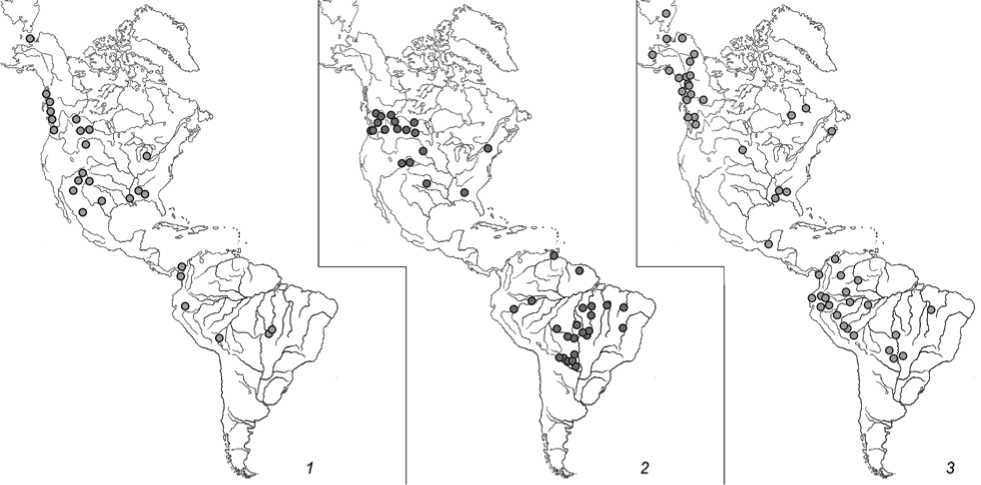
Fig. 10 . Distribution of motifs.
1 – “cranes and pygmies” (different from ordinary humans, inhabitants of a faraway country from time to time fight enemies of inhuman nature that attack them); 2 – “the sharp leg” (the person’s leg is maimed – intentionally or accidentally – or initially pointed. He uses sharpened bone as a piercing tool); 3 – “the man joins wild animals” (the person who follows wild animals turns into one of them or becomes their master, or he lives with animals that look like humans to him).
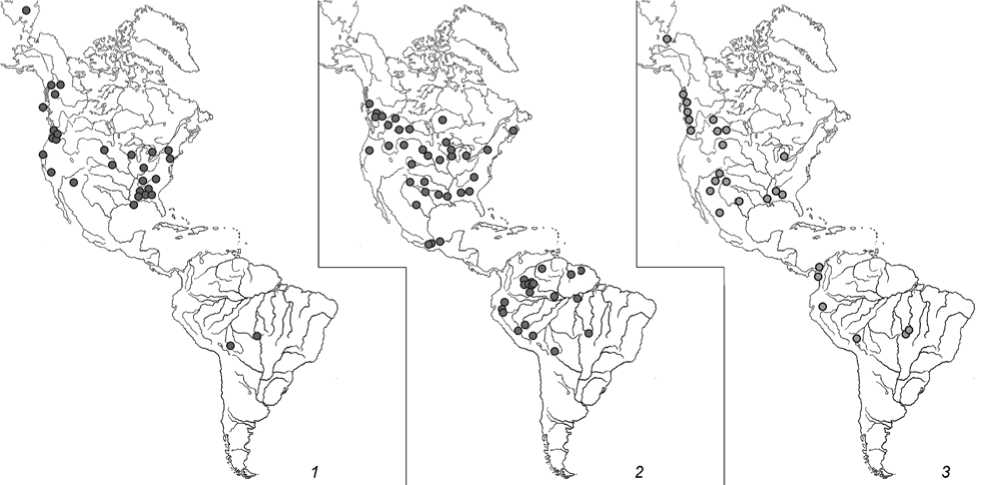
Fig. 11 . Areas of occurrence of motifs.
1 – “rising and falling sky” (the vault of heaven constantly hits the ground like the lid of a boiling pot); 2 – “girls in search of the marriage partner” (A girl or two sisters travel, usually in search of a proper marriage partner who lives far away or who has gone away. On their way or after reaching the place of destination, the girls get to some unpleasant suitors); 3 – “whose blood is sweeter” (An insect feeds on human blood or flesh. Dangerous person asks it, where it had sucked blood or whose blood is the most delicious. Usually the insect lies or is unable to answer; thanks to this, the dangerous person attacks certain plants or animals and not people).
has also been found to the east of the Continental Divide, in particular in the northeast and southeast of the United States. It also appeared among the Maya and in South America (Fig. 10, 3 ).
The motif “rising and falling sky” (i22a, Fig. 11, 1 ) is a variant of more general motif “objects in permanent movement” (Berezkin, 2024). In the Old World, this variant is typical of Siberia, and is known in the Philippines and Micronesia.
The motif “girls in search of the marriage partner” (J12, Fig. 11, 2 ) occurs both to the south and to the east of the Plateau, and has not been found in Central America. This is one of the most popular motifs in Native American mythology. In the Old World, it is absent from the Continental Eurasia, but is known from the regions of the Lower Amur–Primorye– Sakhalin–Hokkaido, in the east of Indonesia, in Micronesia, Melanesia, and Australia.
We should also mention the related motifs “whose blood is sweeter” (B50, Fig. 11, 3) and “mosquito and thunder” (B51). In America, the area of their occurrence stretches from Alaska to Oregon. The ancestors of the Algonquins (see the “C-section” motif above) most likely brought these motifs to the Midwest and Northeast. However, the presence of South American variants makes it possible to link their penetration into the New World not with the Algonquins, but with the Paleo-Indians. In Eurasia, these motifs have been found from France to Manchuria.
Discussion and results
There were several “bottlenecks” in America, through which migrants would pass. These were the arid zone on the border of the American Southwest and Mexico, and also the Isthmuses of Tehuantepec and Panama. The abrupt interruption of the geographical distribution of folklore and mythological motifs in the Plateau area (many ended there, and many began) can also be explained by the natural environment. After migrants to the New World reached this territory, they found themselves beyond the southern border of the glaciers and could subsequently spread in different directions. Accordingly, the Plateau area was a kind of hub for the populations settling in the New World. The natural environment to the south and east of the Plateau was different and more diverse than in the narrow corridor between the ocean and the mountain glaciers. This could not but lead to fairly rapid and multidirectional changes in culture and to ethno-linguistic fragmentation. The appearance and disappearance of folklore and mythological motifs on the maps of their modern distribution indicate the emergence, movement, and disappearance of human communities.
Although the paleogenetic evidence from North and South America indicates the common origin of all Native Americans and their separation from Siberian populations during the LGM (Potter et al., 2018), the data on the modern groups indicate the complexity of this process. For example, the analysis of the genome of the Blackfoot people (northern Plains, Alberta Province in Canada) indicates that their genetic ancestors separated from other Native American groups 18 ka BP, that is, apparently still in Asia (First Rider et al., 2024). Exclusive links with the Papuans and Andamanese were discovered in the gene pool of the inhabitants of Amazonia and the coast of Peru (Castro e Silva et al., 2021; Skoglund, Mallick, Bortolini, 2015; Vallini, Pagani, 2022: 236). No such genomes have been found in fossil samples, but all samples from South America date back to the Holocene (Willerslev, Meltzer, 2021), while the genomes of many Native American groups have not been analyzed. This suggests that the peopling of the New World should not be conceived as the movement of a homogeneous mass of migrants. Rather, it is more likely that groups of different origins, whose ancestral homelands were located in a vast territory from Central Asia to the Sea of Japan, were colonizing new territories. Contacting and mixing with each other, they reached Beringia, and then populated most of the Western Hemisphere.
The data on the distribution of motifs represented on the maps indicate the movement of carriers of traditions along the Northwest Coast with access to the Plateau. This also concerns the most famous motif of world mythology—“the world diver”, or more precisely, “the acquisition of the earth from the lower world” (C6d). We did not include it in the overview, since the pattern of its distribution in America has already been discussed in another article (Berezkin, 2007a), and in the future, we intend to revisit this topic.
In the cases when the ancestors of the Native Americans continued to move after reaching the Plateau region, they entered South America and settled in different regions. Although both the Northwest Coast and Mexico with Central America were “bottlenecks” on the route of migrants, the distribution patterns of motifs in these territories differed. On the Northwest Coast and Plateau, oral traditions are rich, while in Mexico and Central America they are poor even as compared to those of Llanos, Guiana, Northwestern Amazonia, Mato Grosso, and Chaco. For comparison, we present the number of motifs registered in our database for the best-studied traditions of these regions.
Northwest Coast and Plateau : Tlingit – 218, Haida – 206, Tsimshian – 171, Kwakiutl – 172, Carrier – 178, Thompson – 211, Shuswap – 202, Puget Sound Salish – 218, Chehalis and Cowlitz – 187, Western Sahaptin – 181, Upper Chinook – 212.
Mexico : Huichol – 75, Aztec – 75, Totonac and Tepehua – 121, Nahua of Puebla – 80, Chinantec and Mazatec – 114.
Central America (from the Isthmus of Tehuantepec to Panama) : Tzotzil – 111, Quiche – 93, Paya, Sumu, and Miskito – 59, Bribri and Cabecar – 79, Guna – 104.
Amazonia, Llanos, Guiana, Mato Grosso, Chaco : Sicuani – 188, Warao – 192, Napo and Canelo – 178, Barasana, Taiwano, and Macuna – 160, Paresi – 179, Toba – 152.
The richness of traditions in the American Northwest is also confirmed by the fact that there we can find motifs that have correspondences in almost all other historical and cultural areas of the New World, which is not the case for the traditions of Mexico and Central America. Apparently, after completion of the main, early stage of the New World’s peopling, the influx of new Asian migrants to the Northwest Coast became a rarity, while groups of Native Americans who had already been in North America most likely followed one after another through Central America, erasing the traces of their predecessors.
The described evidence does not categorically exclude the transfer of oral traditions from Beringia along the Mackenzie Corridor. In the monograph (Vasiliev et al., 2015: 388–400), we discussed the corresponding motifs in the entire section, keeping in mind the very distinctive narrative episodes among the Native Americans of the Plains and their Altai-Sayan parallels, which we discovered a quarter of a century ago. Since the movement of migrants along the Mackenzie Corridor was assumed by all scholars at that time, the motifs appearing mainly on the Plains were better suited for the role of those entering America in this way than others. However, already ten years ago it was clear that the Pleistocene complexes of Denali with wedge-shaped cores and microblades, and Nenana complexes with Chindadn points did not penetrate beyond Eastern Beringia, and the later material evidence from Alaska in the south and southeast also has no correspondences (Vasiliev et al., 2015: 161–171, 558–560). The motifs that connect the Plains with Western Eurasia are absent both from the Subarctic and (except for one case) from the Northwest Coast. This means that it is impossible to make a choice in favor of transferring these motifs along the coast or the Mackenzie Corridor on the basis of folklore and mythology.
Conclusions
Based on the above, the algorithm for peopling America appears sophisticated in details, but overall simple. In the early stages, migrants proceeded along the Pacific coast. The role of the Mackenzie Corridor was at best secondary. The colonization involved groups of different origins, which had gathered in Beringia. If we do not dwell on still mysterious connections between the east of South America and Melanesia, it is not possible to single out one or more areas in the Old World with which significant clusters of motifs recorded among the Native Americans would be exclusively associated. There are somewhat more parallels in the regions near the Pacific Ocean, but they are also scattered throughout continental Eurasia. This can be considered an argument in favor of the relative heterogeneity of the Beringian population before the ancestors of the Native Americans entered the more southern regions of the New World. Geneticists will be able to verify this assumption.
There were also later episodes in the peopling history of the New World, associated with the appearance of ancestors of the Eskimos and Aleuts, the Na-Dene and perhaps the Algonquins (and Iroquois?). However, we will not discuss these topics now.
Acknowledgments
