
The Ukok Plateau, an Archaeological Gem of the Altai: 35 Years Later
Journal: Archaeology, Ethnology & Anthropology of Eurasia @journal-aeae-en
Section: The metal ages and medieval period
Article in issue: 2 т.53, 2025.
Free access
The article brings together the most important results of work carried out by archaeologists from the Institute of Archaeology and Ethnography SB RAS on the Ukok Plateau in the southwestern part of the Altai Republic, Russia, over the past thirty years since the fi rst excavations by Natalia Polosmak. Over this period, a series of fundamental discoveries was made on the plateau, and the fi ndings were published in a number of monographs and articles. Regrettably, these publications have received little attention from experts and lay public amenable to scientifi c boom and to myths spread by hedge journalists, by the public craving for brouhaha, and sometimes even by professional archaeologists. This study highlights major excavation fi ndings, their scholarly interpretation and museumization of the Early Iron Age Pazyryk mounds, including rare ones with permafrost. These were interpreted with regard to the specifi c area of Central Asia, and to the entire timespan from its initial peopling in the Late Pleistocene to the recent centuries. The archaeologists’ role in the detection and description of over 400 sites on the plateau is assessed. Rock art galleries, especially the key site at Kalgutinsky Rudnik with the earliest petroglyphs among those known in the Russian and Mongolian Altai, are described. Protective measures regarding cultural legacy of the Ukok Plateau, its coverage by the media, and prevention of ecological harm by tourists are proposed to municipal authorities in the Republic of Altai.
Short address: https://sciup.org/145147489
IDS: 145147489 | DOI: 10.17746/1563-0110.2025.53.2.034-044
Text of the scientific article The Ukok Plateau, an Archaeological Gem of the Altai: 35 Years Later
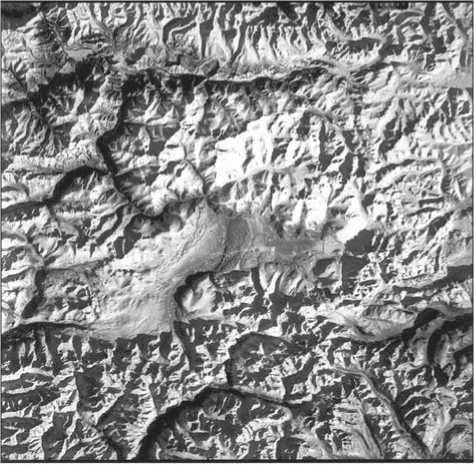
The Ukok Plateau is situated in the Russian part of the Altai Mountains. The plateau occupies a considerably large territory in the southwestern part of the Altai Republic, Russia, bordering Mongolia, China, and Kazakhstan (Fig. 1). The plateau elevation is 2000–2500 m above sea level. It fully justifies its name—“mountain with a flat top” (Molchanova, 1979: 324), framed by high and hard-to-reach cliffs. However, passable routes connect Ukok with the expanses of Central Asia in the south, with the Russian Altai in the north and east, and with the steppe regions of Kazakhstan in the west (Fig. 2). These passes are largely facilitated by the Bukhtarma and Ak-Alakha river systems, which originate on the plateau and connect it with the northern and western areas of the region (Sapozhnikov, 1949: 113–136; 283–296; 409–415) (Fig. 3).
The plateau is a typical high-mountain tundra environment with a harsh climate and fairly low temperatures even in summer. At the same time, owing to the vast pastures freed from snow by constant winds, the plateau provides favorable conditions for winter keeping and grazing of cattle. In addition, the abundance of wild animals in tundra and fish in the rivers and lakes has always attracted people to that area. Ukok was also actively used for roaming by migrating inhabitants of this Asian region at least until the late 20th century.
Owing to the above environmental conditions, people inhabited the plateau starting from the first human migration from the south in the Late Pleistocene up to the present time, as was established by the recent paleogeographical research (Deline et al., 2023). Such
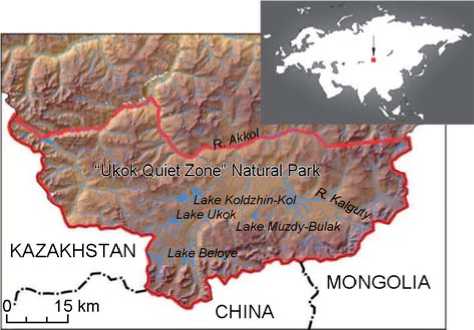
Fig. 1. Map of the southwestern Altai Mountains and the Ukok Plateau.
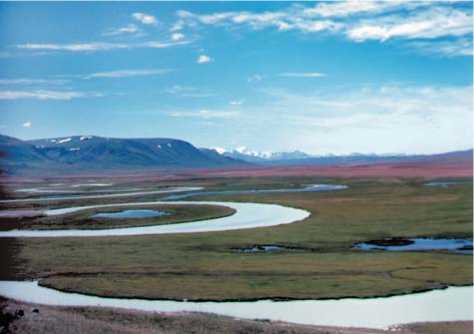
Fig. 3. The Ukok Plateau. View of the Ak-Alakha River Valley.
О 20 km
Fig. 2. View from space of the Ukok Plateau and surrounding mountains.
a long period of human habitation resulted in the emergence of various archaeological objects—rock art sites, stone steles, mound and flat-grave burial grounds, sanctuaries, megalithic constructions, and settlements.
Results of research on the Ukok Plateau
The first archaeological surveys on the plateau were carried out in the 1970s by V.D. Kubarev, a researcher at the Institute of History, Philology and Philosophy of the Siberian Branch of the USSR Academy of Sciences; he recorded several burial mound groups and rock art sites on the Ukok (Kubarev, 1980). It was he who advised N.V. Polosmak to conduct excavations of Early Iron Age burial mounds on the plateau aimed at discovering “frozen” archaeological complexes therein.
Thirty-five years ago, an archaeological team led by Natalia Polosmak, PhD in history at that time*, carried out the first large-scale excavations on the Ukok Plateau, which yielded excellent scientific results (Polosmak, 1991). This was the first frozen tomb of Ak-Alakha-1 of the Pazyryk culture. A unique set of grave goods made of various perishable organic materials dating to the 5th–4th centuries BC was recovered. This discovery launched archaeological research on the Ukok Plateau, which was carried out till the end of the 20th century and continues sporadically nowadays.
The main work was performed by two archaeological teams headed by N.V. Polosmak and V.I. Molodin**. By the present paper, I would like to recall the main scientific achievements gained on the Ukok Plateau. At present, this seems especially important to me, since after the discovery by Natalia
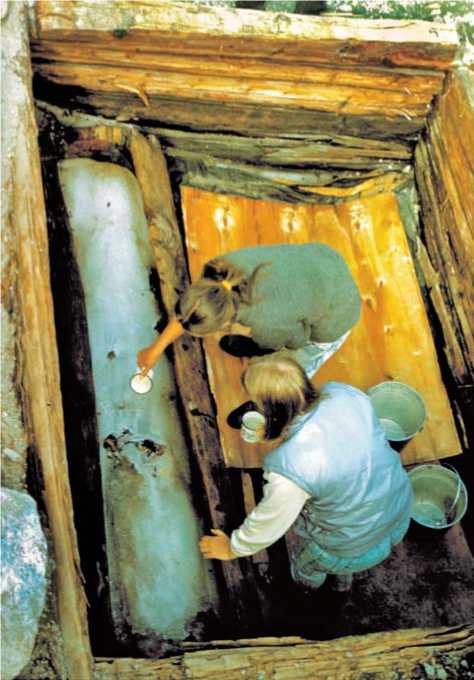
Fig. 4. Process of melting ice in the burial chamber of mound 1 at Ak-Alakha-3. N.V. Polosmak and E.V. Shumakova in the burial chamber.
Polosmak of the burial of a woman from the middle class of the Pazyryk society in a frozen tomb filled with ice (mound 1 at Ak-Alakha-3) (Polosmak, 1994a) (Fig. 4), followed by the multidisciplinary studies and several fundamental publications (Polosmak, 1996, 2000a, b), reporters of the yellow press and makers of modern myths put it on the map and floated an idea that this woman was the Altai princess, the progenitor of the Altai people, etc. In the wake of this nonsense, the real scientific achievements gained on Ukok were overshadowed. Unfortunately, this concerns not only an average person who is eager to get in touch with the myth and even participate in it, but also some members of the scientific community who, voluntarily or involuntarily, fuel the unhealthy focus in their ill-considered publications.
So, 35 years have passed since the start of excavations at Ukok. What are the main scientific data that have been derived from the artifacts collected in the course of the sophisticated field research?
Among the main tasks that were set for the two archaeological teams—and first of all for the team of Polosmak—was the study of burial sites of the Pazyryk culture dating to the Early Iron Age (6th–3rd centuries BC). Some of the tombs were frozen owing to the harsh climate, which provided a unique opportunity to study the whole ethnographic complexes, since the ice preserved the most sophisticated elements of burial practices, unique artifacts, often highly artistic (Fig. 5), made of wood (Fig. 6, 7), fabrics (Fig. 8, 9), leather, felt (Fig. 10, 11), horn (Fig. 12), and skins, as well as the remains of animal corpses (horses) and buried people. The involvement of specialists in the field of natural sciences, armed with modern equipment and methods, in the research made it possible to derive representative scientific information concerning both humans (e.g., paleogenetic data) and numerous items of material and spiritual culture, as well as the most complex methods of mummification (Fig. 13), embalming, tattooing (Fig. 14, 15) of deceased Pazyryk people.
Team 2 of the expedition was also engaged in the study of the Pazyryk records, and contributed a lot to the study of burial complexes on the Ukok Plateau (Molodin, 1997, 2000b; Polosmak, Molodin, 2000). In total, the two teams excavated 22 burial mounds of the Pazyryk culture, including six frozen burials. The large size and the specifics of funerary rite suggest that N.V. Polosmak excavated two
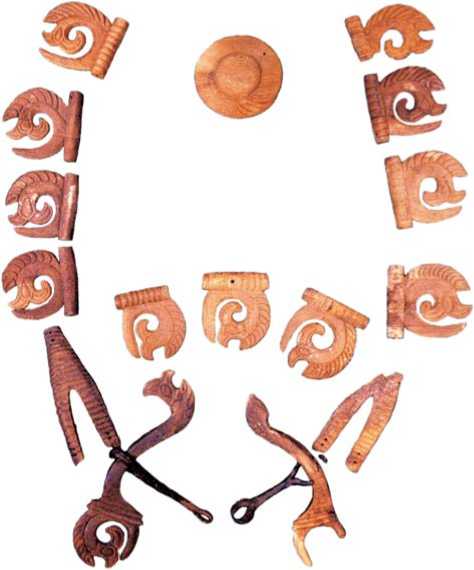
Fig. 5. Wooden decorations of horse harness. Mound 1, Ak-Alakha-3.
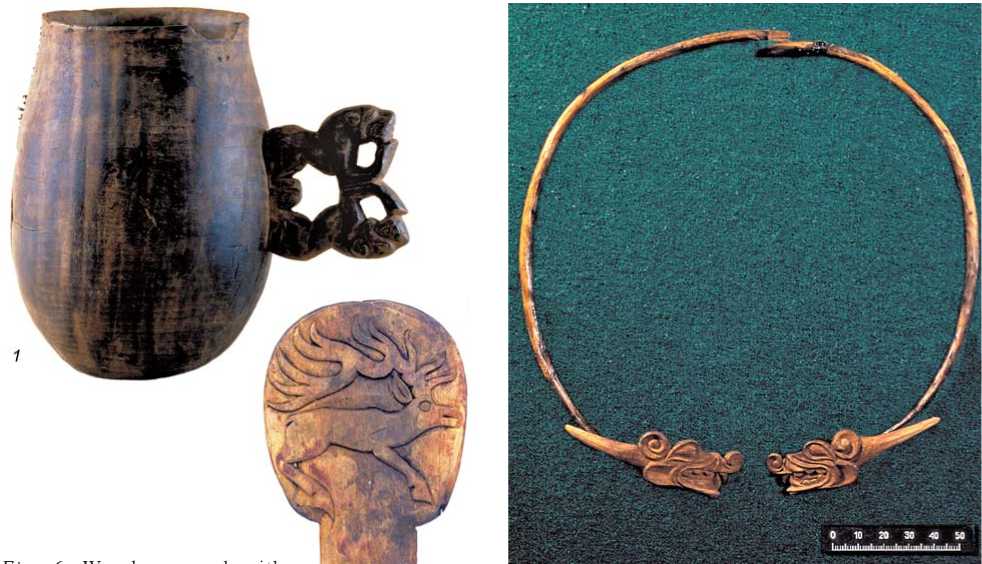
Fig. 6. Wooden vessel with a carved handle (1), and artistically decorated mirror base (2). Mound 1, Ak-Alakha-3.

Fig. 7. Wooden neck torque. Mound 3, Verkh-Kaldzhin II.
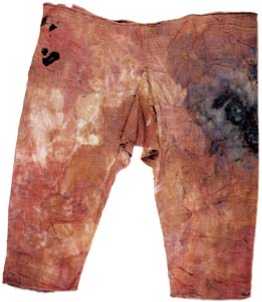
Fig. 8. Fabric trousers. Mound 3, Verkh-Kaldzhin II.
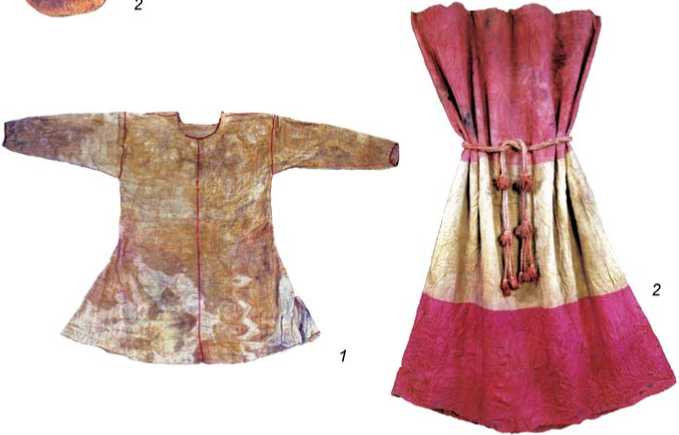
Fig. 9. Silk shirt ( 1 ) and wool skirt ( 2 ).
Mound 1, Ak-Alakha-3.
elite complexes (regrettably, these were not frozen and were heavily disturbed by looters). The findings were introduced in a number of publications, including summarizing monographic works (Polosmak, 1994b, 1997, 1999, 2001; Fenomen..., 2000; Naseleniye..., 2003; Tekstil..., 2006; Molodin, 2000a, c; Polosmak, Molodin, 2000, 2019; Polosmak, Barkova, 2005). In addition, the attempts were made to develop the methodology for studying “frozen” burial complexes
(Polosmak, Molodin, 2000; Molodin, 1996, 2000b; Fenomen..., 2000: 50–56).
Notably, the Siberian Branch of the Russian Academy of Sciences granted considerable financial support to scientific analyses of materials from the Pazyryk sites on the Ukok Plateau; the unique level of participation of various specialists in the multidisciplinary study still has no equal not only in Siberia but also in the Russian Federation as
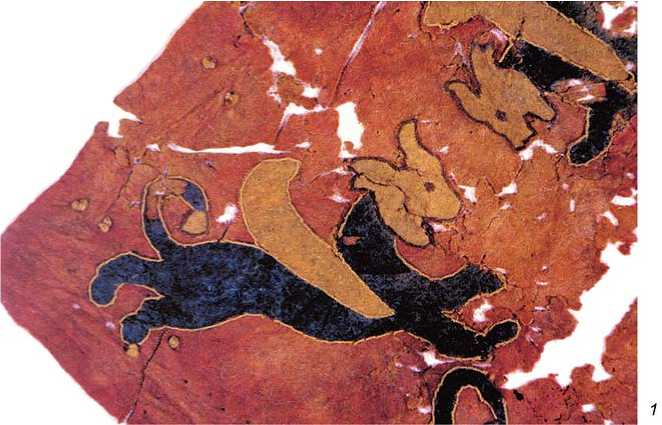
Fig. 10. Felt saddle covering ( 1 ) and stocking boots ( 2 ). Mound 1, Ak-Alakha-3.
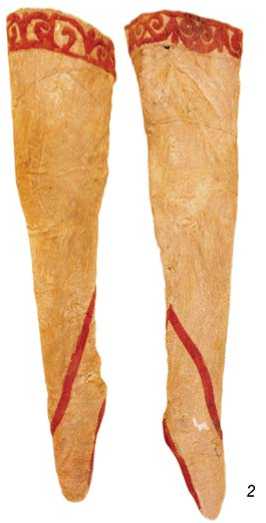
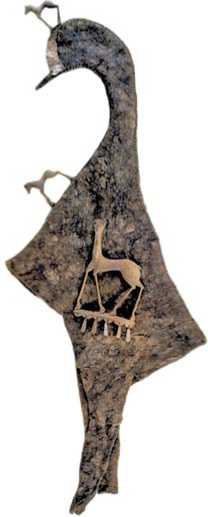
Fig. 11. Felt headdress with wooden decorations. Mound 3, Verkh-Kaldzhin II.
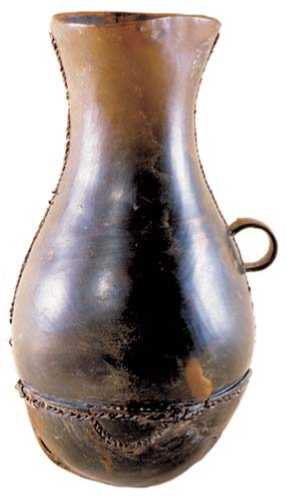
Fig. 12. Vessel made of horn.
Mound 1, Ak-Alakha-3.
a whole (see (Polosmak et al., 1997; Fenomen..., 2000; Naseleniye..., 2003; Tekstil..., 2006)). The Ukok findings served as the basis for establishing the dendrochronological classification of the Early Iron Age cultures of Southern Siberia (Sljusarenko, 2000); the issues of ancient techniques of wood processing in that period were considered (Mylnikov, 1999). In addition, for the first time, a comparative analysis of the Ukok and Xinjiang artifacts was carried out (Polosmak, 1998).
Currently, the derived data are well known by the scientific community; the information was presented in the summary publications listed above, as well as in the latest version of the “History of Siberia” (Polosmak, Molodin, 2019). The information is also available to the general public interested in the history of the Fatherland (see, e.g., (Molodin, 2000d)). Apparently, it is these works that should be the primary source for any historical and cultural constructions.
The second major line of scientific research on the Ukok Plateau became the issues of chronostratigraphic classification of ancient cultures in the Altai Mountains from the early peopling of the region until the late medieval period. This implied the search for new and insufficiently studied sites from various chronological periods in this region. The Ukok Plateau provided broad, essentially unique opportunities in this regard. Over several years (apart from the Early Iron Age complexes discussed above), sites aged to the terminal Upper Paleolithic, the Early and Middle Bronze Age, the Early Scythian and Xiongnu-Sarmatian periods, the Old Turkic and Mongolian epochs, and the recent centuries (ethnographically modern period) were discovered and studied in the plateau. Notably,
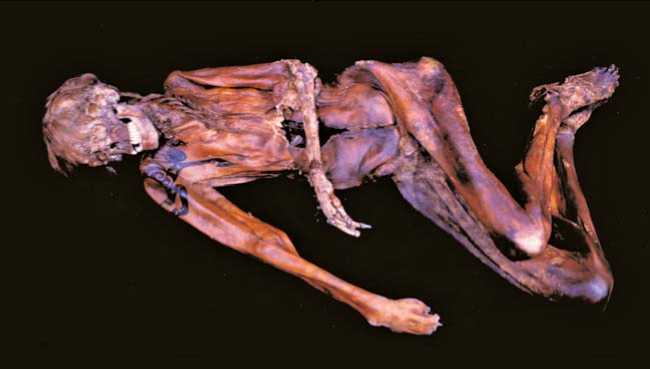
Fig. 13. Mummy of a man. Mound 3, Verkh-Kaldzhin II.
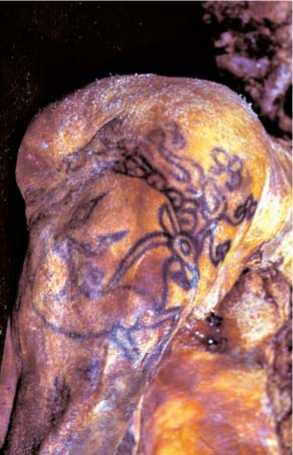
Fig. 14. Tattoo on the shoulder of a female mummy. Mound 1, Ak-Alakha-3.
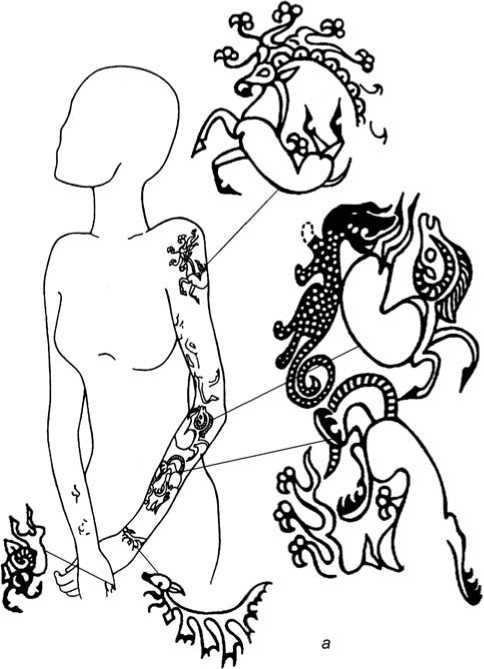
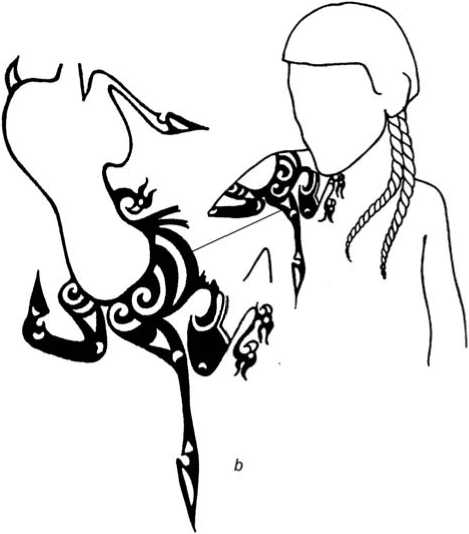
Fig. 15. Copies of tattoos of the mummies from mound 1 at Ak-Alakha-3 ( a ) and mound 3 at Verkh-Kaldzhin II ( b ).
many discovered sites are still unique for the Altai Mountains and adjacent areas of Central Asia.
A significant amount of derived data was accumulated and promptly introduced into scientific circulation (see (Drevniye kultury..., 1994; Polosmak, 1993, 2007; Molodin, Cheremisin, Novikov,
2004)); a chronological scheme of historical and cultural development in the region was developed (Molodin, 1995; Arkheologicheskiye pamyatniki..., 2004: 223), and it is in use today (Fig. 16). This periodization has not been disputed by anyone from the scientific community, and it should serve the
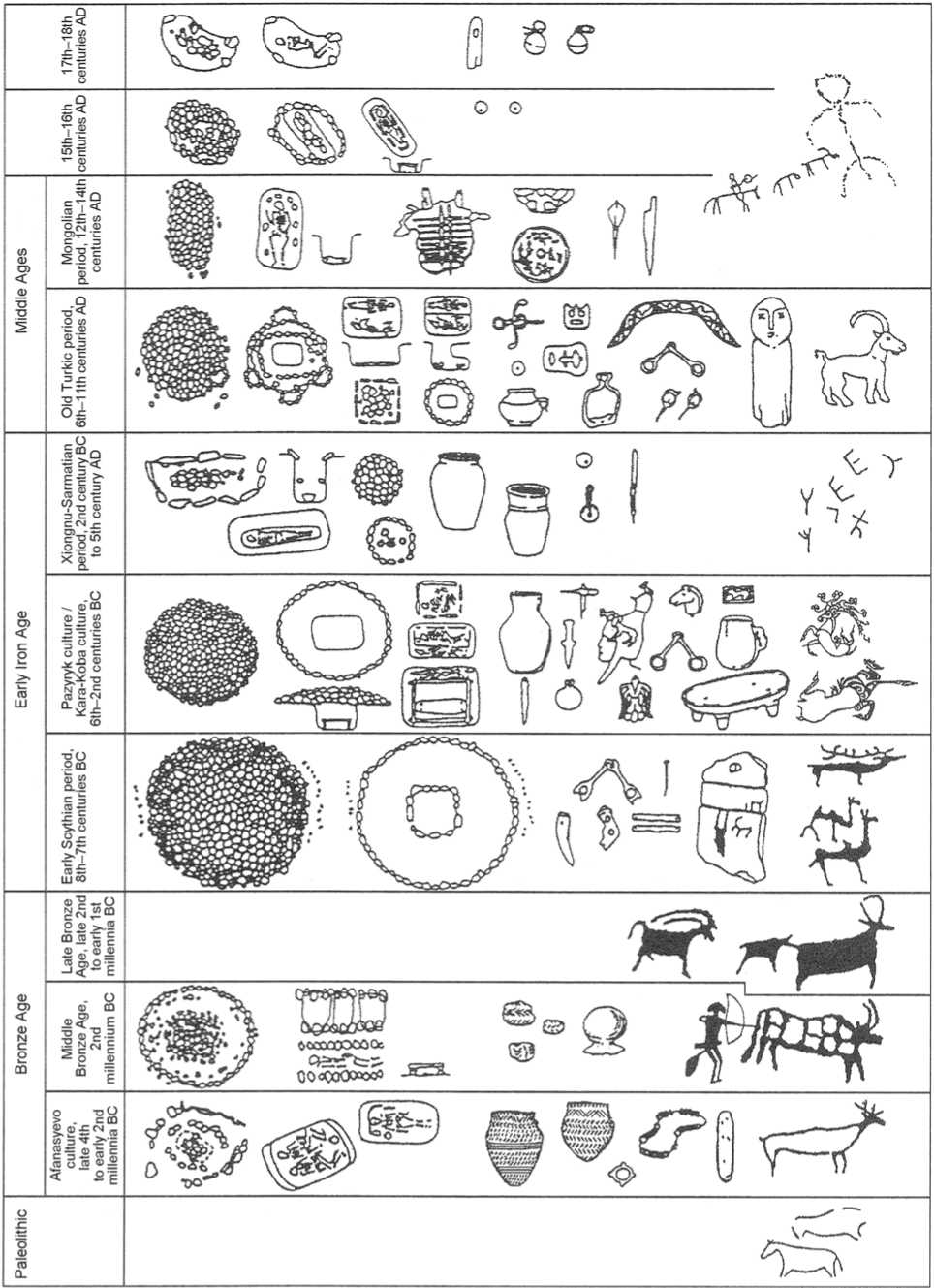
Fig. 16. Scheme of historical and cultural development of populations on the Ukok Plateau.
basis of any historical and cultural reconstructions.
In 1996, the government of the Altai Republic imposed a moratorium on archaeological excavations in the Kosh-Agachsky District and declared the Ukok Plateau a “Quiet Zone”; large-scale excavations were stopped and limited to geophysical projects at some burial complexes and studies of rock art sites. However, even during that period, several magnificent discoveries have been made at Ukok. This were primarily several burial grounds of the Pazyryk culture, probably containing frozen tombs, found using geophysical monitoring technique.
At the same time, the revealed scientific significance of the cultural heritage from the Ukok Plateau required accumulation of all currently available data on archaeological sites, with their description, spatial structure, and reference to a coordinate system. In the late 20th century, a project of construction of a highway and gas pipeline connecting Russia and China across the plateau was proposed; its implementation included rescue archaeologic surveys. Hence, a team led by Natalia Polosmak executed a sur-
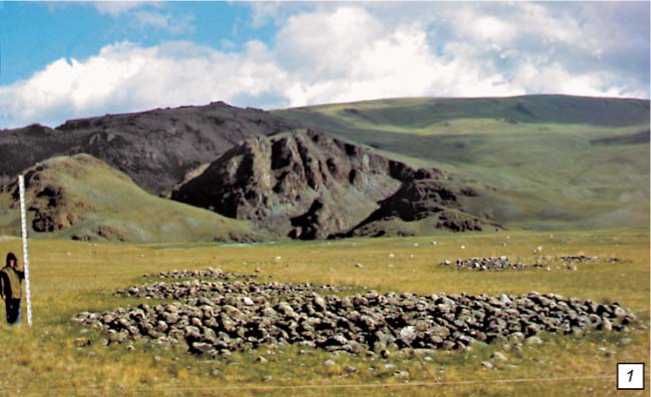
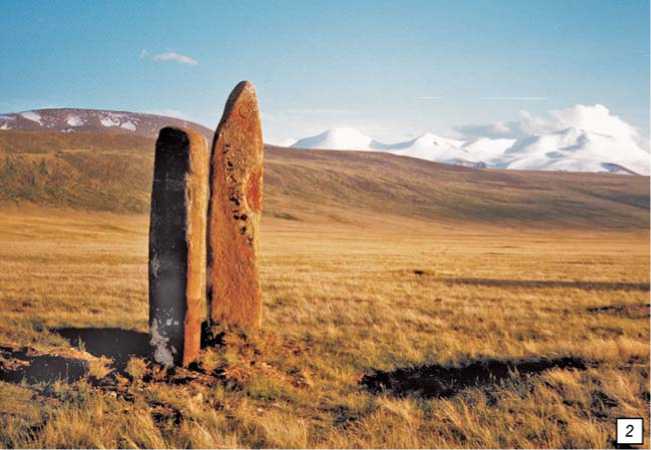
Fig. 17. Mound cemeteries ( 1 ) and deer stones ( 2 ) on the Ukok Plateau.
vey and mapped the discovered archaeological sites in the zone of highway and gas pipeline construction (owing to the lack of proper coordination, similar work was carried out by a group of archaeologists from the Gorno-Altaisk State University, headed by V.I. Soenov, who re-documented these sites (Soenov, 2001)). Particularly important were the surveys carried out in 2001 by the teams led by E.S. Bogdanov and D.V. Cheremisin, who determined the exact coordinates and got more accurate data on the spatial structure of most archaeological sites discovered on the plateau (Fig. 17).
The most important result of all the works was the collective monograph “Archaeological Sites of the Ukok Plateau (the Altai Mountains)” (2004), which included a comprehensive description of
405 archaeological sites, a historical and cultural essay presenting the materials found, as well as an exhaustive (for that period) list of references concerning the archaeology of Ukok. Of course, this does not mean that all sites have been uncovered on the plateau; new targeted studies of the region will certainly yield new findings, but even today the amount of sites and information discovered is impressive.
Another important result of archaeological research on the Ukok Plateau was the discovery and cataloguing (with subsequent interpretation) of rock art sites. Careful survey conducted by a special group headed by D.V. Cheremisin revealed dozens of clusters of boulders bearing rock images, as well as stone statues (Molodin, Cheremisin, Novikov, 2004) (Fig. 17, 2 ). In addition, several particularly significant petroglyph
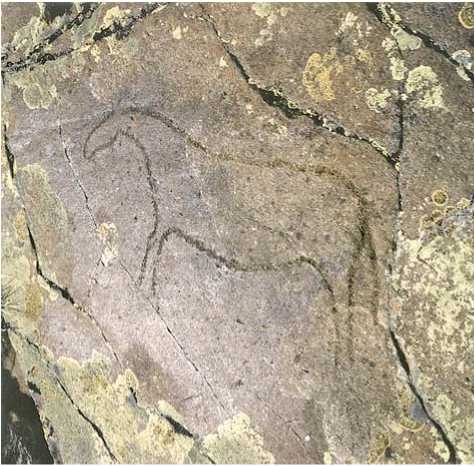
Fig. 18. The earliest “Kalgutinsky” image from the Ukok Plateau.
sites were discovered and subjected to special studies. This concerns the so-called Bertek rock art site of the Early Iron Age (Cheremisin, Slyusarenko, 1994), a remarkable boulder bearing a palimpsest of images discovered on the shore of Lake Muzdy-Bulak (Molodin, Cheremisin, 2002), and other sites. However, the most impressive site is Kalgutinsky Rudnik, where a set of images attributable to the earliest rock art period in this part of the Altai Mountains was recorded, analyzed, and published (Molodin, Cheremisin, 1999) (Fig. 18). Without a doubt, this discovery is one of the most important on the Ukok Plateau to date. Special studies of this remarkable site were continued by the Russian-French expedition; consequently, the “Kalgutinsky” style of rock images—the oldest one in this region of Central Asia today—was established after targeted research in the adjacent territory of the Mongolian Altai (Molodin et al., 2021). The rock art of the Ukok Plateau was described in a special article (Molodin, Cheremisin, 2007) (Fig. 19). Currently, a periodization of the petroglyphs of the Altai Mountains has been developed (Molodin et al., 2023).
These are the main scientific results of 35 years of archaeological research on the Ukok Plateau. The Ukok archaeology has been described in quite a large number of publications, but unfortunately it is not much in demand by a wide range of readers, especially non-professionals, which contributes to the flourishing of the myth-making of particular type.
Conclusions
Studies of archaeological materials from the Ukok Plateau continue today. For instance, recently, a tomographic study of the female mummy from the frozen tomb at the Ak-Alakha-3 burial ground has been carried out and provided new data on the woman’s ante-mortem diseases that probably caused her death (Letyagin et al., 2018).
The above review clearly shows that the Ukok Plateau is truly an archaeological gem of the Altai Mountains. However, excavations can be resumed here exclusively based on a balanced and thoughtful approach by both professionals and the authorities protecting the historical and cultural heritage of the Altai Republic. Obviously, only highly qualified specialists skilled in the latest multidisciplinary research techniques can be admitted to works on the Ukok Plateau. Furthermore, this approach implies the need in a set of equipment for conservation and restoration of invaluable artifacts, which with a high probability can be found in almost any archaeological site. At the same time, it is clear that the field and laboratory studies should be carried out by highly qualified specialists, and, unfortunately, there are not so many of them in our country today.
In addition, governmental authorities for the protection of historical and cultural heritage of the Altai Republic should take a thoughtful approach
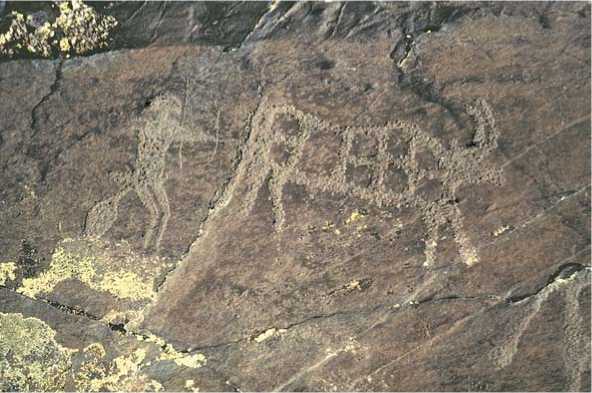
Fig. 19. Rock image at Kara-Chad X.
to embarking on tourism on the plateau, and prevent the admittance of private groups of people who do not have sufficient qualification (in all respects) and cause significant harm to both cultural sites and the environment of the plateau as a whole.
Acknowledgement
