
Transformation of Institutional Mechanisms and Structures in Managing the Development of the Arctic Territories in the Far East at a New Stage: The “Mesocluster” Approach
Journal: Arctic and North @arctic-and-north
Section: Social and economic development
Article in issue: 63, 2026.
Free access
The article presents the theoretical and methodological substantiations of the “mesocluster” approach to the implementation of institutional transformations in the management of the long-term development of the interregional complex of the Arctic and high-latitude transboundary territories of the Far East, aimed at integrating the mining specialization of this region. This approach is methodologically based on strategic planning theory and is expressed in the advanced formation of elements of an exogenous, system-integrating infrastructure of the territories under study. The study is also based on the postulates of the theories of spatial economics, infrastructure, inversion and cluster analysis, as well as scientific works in the field of problems of the Arctic and the North. The results of the study are the identified characteristics of the problems under investigation, the causes of which are mainly inversion (counter-directional) processes in the interaction of elements of the exogenous and endogenous infrastructures of the territories under study in the sphere of competitive and cooperative interrelationships within their extractive specialization sectors. In order to mitigate these processes, the following is substantiated in the work: on the basis of the integration of these industries and the creation of a special interregional economic formation in the Far North-East of the country, called a “mesocluster” here, it is necessary to develop and implement certain transformations in the existing institutional mechanisms in the system of state-regional management according to the “cluster” model, which should include all interested parties of the newly created integrated economic formation.
Short address: https://sciup.org/148333995
IDS: 148333995 | UDC: [332.1+338.2](985)(045) | DOI: 10.37482/issn2221-2698.2026.63.66
Text of the scientific article Transformation of Institutional Mechanisms and Structures in Managing the Development of the Arctic Territories in the Far East at a New Stage: The “Mesocluster” Approach
DOI:
The research is based on the results of the author’s previous work, summarized in the article (Krasnopolskiy, 2024).
Two groups of territories in the Far East were selected as regional objects of the research: (1) Arctic territories, the composition of which is specified in the new edition of the Law of the Russian Federation 1, namely: the districts of the Chukotka Autonomous Okrug and 13 Arctic uluses (districts) of the Republic of Sakha (Yakutia); (2) sub-Arctic high-latitude regions, bounded in the south by the 60th parallel, which, over a long historical period, have supported the socioeconomic development of the Arctic regions through established close infrastructural links; these include: the central regions of the Republic of Sakha (Yakutia) and the territory of the Magadan Oblast, including the city of Magadan (Krasnopolskiy, 2024).
Previous studies have identified the following key development challenges in the study areas:
-
• the formation of a new, more systemically integrated spatial and economic entity in this zone over a long period of time, based on natural processes in the development and distribution of economic potential in all federal subjects under consideration. Taking into account the natural and geographical conditions and socio-economic characteristics of its formation, this economic conglomerate can be called the “North-Eastern mesoregion”, which, in spatial terms, is the high-latitude component of the Far Eastern macroregion. Practical examples of its active development include the reconstruction of the well-known Kolyma highway between Yakutsk and Magadan, involving the construction of a bridge across the Lena River, the Kolyma - Omsukchan - Omolon - Anadyr highway under construction (with access roads to Bilibino, Pevek, Komsomolskoe and Egvekinot), the integration of energy supply systems and logistics schemes along the Northern Sea Route, river and land routes, etc. (Krasnopolskiy, 2023).
-
• the intensifying processes occurring in the extractive sectors of the territories under consideration, involving significant inverse (counter-vector) effects of exogenous (external) elements of the critical infrastructure of these territories on the overall final efficiency of the emerging mesoregion as a whole. Such processes primarily include competition and cooperation, the inversely opposing nature of which at the level of market business structures has a positive effect. However, at the state level, within a planned economy, these processes significantly reduce the effectiveness of interaction between the state and the regions due to the emergence of unproductive and excessive costs in the joint functioning of these territories and their governing bodies 2. This requires cer-
- tain adjustments to the organizational and managerial coordination of their further development;
-
• the planned major reforms in the system of state regulation of the development of the mineral resource base and in the spatial development strategy of the Russian Federation, including the Far Eastern macroregion. The most important issues here are: (a) the recently published “Strategy for the Development of the Mineral Resource Base of Russia until 2050” and its main objectives of significantly expanding resource potential, increasing the degree of processing and consumption of mineral raw materials within the country, entering international markets, and creating the necessary innovative and institutional infrastructure for the development and implementation of new technologies 3 ; (b) the new “Strategy for the Spatial Development of the Country until 2030 with a Forecast up to 2036” 4 , recently adopted by the Government of the Russian Federation, which aims to achieve a more consistent alignment of the spatial priorities of the country and its regions, taking into account new realities in both the national and international arenas.
Regarding the Far East, it is also important to consider the interview with A. Chekunkov, Head of the Ministry for the Development of the Russian Far East, in which he proposed a new approach to strategic forecasting for the development of the Far Eastern macroregion. Taking into account the significant differences between the sub-regions of the Far East in terms of natural and climatic conditions, economic characteristics and other parameters, A. Chekunkov considers it necessary to divide the macroregion into four territorial components. Among these, he identified the North Arctic sub-region, which includes permafrost areas: Yakutia, Magadan Oblast and Chukotka, which occupy almost 60% of the area and account for 15% of the population of the entire Far East 5 .
Undoubtedly, such an approach will influence both the formulation of strategic forecasts for the development of the identified sub-regions and the transformation of institutional mechanisms and structures 6 for the management of their future development.
Taking all of the above into account, the following hypothesis regarding these institutional transformations can be formulated:
Since the new strategic phase of the further development of the North Arctic territories of the Far East (the North-Eastern mesoregion) necessitates substantial reforms, primarily in the extractive sectors in which they specialize, to counteract the ongoing processes of inversion (counter-vector) action that are reducing their efficiency, there is currently an urgent need for a corrective reorganization of the institutional mechanisms operating here, which should be aimed primarily at the accelerated development of elements of the exogenous (external) critical infrastructure comprising the region's territories.
From a scientific and methodological perspective, this hypothesis is closely linked to the “mobilization” approach to the methodology of Northern studies, as presented in V.N. Lazhentsev’s article in the journal “Arctic and North”. This article emphasizes: “Therefore, the method of mobilization management becomes very relevant for the North of Russia, and especially for its Arctic zone. The scientific and practical aspects of the methodology of North-Arctic activities have a common methodological attitude: the transition from the position “the more the better” to the position “good quality is more important than large quantity”. Moreover, in the Arctic, the need for a transition “from the maximum necessary to the realistically possible” is increasingly realized” (Lazhentsev, 2024).
The hypothesis outlined above and its consistent implementation could have a significant multiplier effect on the development of the North-Eastern mesoregion as a whole, namely:
-
• increasing socio-economic efficiency across all parameters of its economic activity;
-
• strengthening its geostrategic stability as a territory of the country located in the transboundary Pacific sector of the global Arctic at the junction of the Eurasian and North American continents.
Theoretical and methodological approaches
The general conceptual theoretical and methodological approaches in the study are based on a synthesis of scientific methodology and the methods of spatial economic theories (Granberg, 2009; Minakir P.A., Isaev A.G., Demyanenko et al., 2020; Minakir, Demyanenko, 2014; Modern Problems, 2021), infrastructure (Bakhtin, Kosobutskaya, Dyadyun, 2020; Tarasova, 2020; Krasnopolskiy, 2023; Carlsson, Otto, Hall, 2013), cluster analysis (Porter, 2005; Bobrysheva, 2023; Bondarenko, 2016; Markushina, 2010), as well as the analysis of inversion processes (Balatsky, 2014; Sevostyanov, 2014; Steblyak, Lotkin, 2020). As regards the methods of complex economic research on the Arctic zone of the Russian Federation (AZRF), the experience in this area in our country was analyzed (Zhuravel, Timoshenko, 2020; Lazhentsev, 2021; Krasnopolskiy, 2021; Baker, 2021).
The study of the strategic planning methodology and the associated institutional reforms in the implementation of strategy programs was based on the principles of V.L. Kvint’s concept, as outlined in his monograph (Kvint, 2019). The focus was primarily on the general formulation of the essence of the concept of strategic planning. It was emphasized that strategy, at its core, is a system for identifying, formulating, and developing a doctrine that ensures long-term success only if it is consistently and fully implemented. One of the basic rules of strategic thinking formulated by the author was stated as follows: on long-term forecast time horizons, asymmetric strategies are always more effective than symmetric ones, the effectiveness of which is mainly evident in short-term forecasts (Krasnopolskiy, 2023).
This methodological conclusion is confirmed in the study described in this article by the following facts.
The author’s previous research on methodological issues in the formation of infrastructure for various levels of natural-economic entities, using its critical elements as an example 7, has shown that a special approach should be implemented when assessing its development prospectively. These assessments should be considered in close connection with concepts and processes of spatial analysis that manifest themselves in a particular economic system under study, such as chaos (disorder) and stability (order) . These concepts reflect the essence of two inverse (oppositely directed), yet mutually complementary models of economic system organization: hierarchical and heterarchical. The actions of endogenous (internal) and exogenous (external) elements of the spatial-economic system’s infrastructure have their own specific characteristics:
-
• endogenous elements are influenced by centripetal forces, directed primarily towards creating and maintaining order within the system and its economic equilibrium ;
-
• exogenous elements, affected by centrifugal forces, primarily influence the system’s openness, which creates opportunities for certain elements of chaos from the surrounding environment to interfere and bring the system into a state of disequilibrium (Krasno-polskiy, 2023)
How do these processes relate to V.L. Kvint’s guiding principle of strategic planning, mentioned above, which concerns the differentiation between the effects of symmetric and asymmetric strategies when assessing the long-term development of spatial systems?
Symmetric strategies for economic forecasting are usually associated with maintaining equilibrium states within the system throughout the entire period of its prospective development. In this case, the forecast is carried out in such a way as to ensure a stable state of symmetry and equilibrium in the system throughout the entire forecast period. In the case of economic systems, for example, these processes are aimed at maintaining the equilibrium of supply and demand, as this principle is paramount in the economy.
This approach is entirely justified from the economic perspective; it is the dominant approach in current practice regarding strategic assessments of the development of economic systems. It demonstrates that maintaining equilibrium within a system largely depends on the endogenous elements of its infrastructure, and these processes are associated with symmetric strategies in forecasting its development.
However, the theoretical postulates of synergetics and its applications to forecasting the development of the systems under study, including those of an economic nature, demonstrate that such an approach to their strategic planning over long-term time horizons is incorrect. In the long term, their continued successful development requires openness, the ability to maintain a state of disequilibrium by absorbing a certain amount of “chaos” from the external environment, which will enable them to adapt continuously to emerging changes in both the national and international arenas. In this case, the exogenous (external) infrastructure of the systems under study plays a leading role (Krasnopolskiy, 2023). This approach constitutes an asymmetric forecasting strategy, which will be more effective in creating a regime of continuous system adaptation to emerging crises in the external environment.
Based on these considerations, the author has adopted precisely this approach in the present study. For this reason, the hypothesis of this study includes the need to develop an institutional mechanism for managing the extractive industries of the emerging “mesocluster”, which should be aimed at the proactive and prioritized formation of elements of the exogenous (external) critical infrastructure of the territories of the region at the major stages of their strategic development. Such institutional mechanisms are currently in an undeveloped, embryonic state in the existing practice of state-regional spatial planning and management.
An example is the institutional structures for managing cluster economic entities of a higher spatial rank than traditional “microclusters”, which, as is well known, are formed by business partners within a single region or urban agglomeration. This refers to a new form of interregional integration of partners, which may range from large economic conglomerates to federal subjects within the framework of the emerging “mesocluster” — this higher-order spatial model (a “cluster of clusters”).
In our study, this model is proposed for the spatial integration of the specialized industries of the territories under investigation, which should collectively constitute a single economic entity. This is necessary to mitigate the unproductive contradictions and conflicts arising between these territories in terms of competition and cooperation within their extractive sector. These processes should be neutralized to significantly increase the overall efficiency of developing their mineral resource bases in the interests of the country.
The approach proposed in this study, for example, is fully consistent with the conclusions drawn by A. Klepach in his work on “breakthrough” technologies in the new organization of the country’s spatial development, in which he argues for the necessity of the following measures:
-
• “implementation of cluster policy (a supply-side economics tool aimed at developing strategic territories to maximize their contribution to the country’s economy in the medium and long term)”;
-
• “transition from competition for resources to interregional cooperation (this is achieved through restructuring budget policy, including the introduction of cluster transfers aimed at forming interregional value-added chains)” 8.
Using the methodology of cluster analysis, the author of the article reviewed a number of the above-mentioned scientific works, on the basis of which the core theoretical and methodological approaches to research in this field were identified. As noted in many works in this field, specific methods of cluster analysis were developed by the founder of this approach, the American economist M. Porter, who introduced the term “cluster” into scientific discourse. He defined an industrial cluster as a form of spatial organization of production, emphasizing that “a cluster is a group of geographically adjacent, interconnected companies (suppliers, manufacturers) and related organizations (educational institutions, government agencies, infrastructure companies) operating in a specific area and complementing each other” (Porter, 2005).
An important feature of cluster organization is that such type of economic structure is created on an informal basis; that is, the determining principle of its formation is the voluntary association of economic partners (in the case of this study, the northern Arctic territories). The focus of its activities specific in nature, namely, it is oriented primarily towards the realization of the joint goals and programs of the entire unified system as a whole, naturally based on the achievement of its partners’ specific individual goals. Its institutional mechanisms and structures, created on a contractual basis, are also aimed at this. This eliminates the need for large administrative bodies similar to those of official federal and regional organizations; they have the ability to quickly optimize and adjust their institutional mechanisms based on practical needs.
Practical experience shows that cluster models are, in most cases, created to establish consensus in the implementation of such interrelated processes as cooperation and competition. Intra-cluster competition between specialized industries, operating within reasonable limits in the business sphere at the regional microlevel, makes it possible to optimize the industrial structure of the mesocluster as a whole and of its constituent territories. The accelerated development of cooperative ties between them through the creation of an extensive network of critical and innovative infrastructure, the exchange of innovative methods in the field of new technologies, the use of labor force and specialists in their training, the formation of a sustainable system of support settlements, etc., enables the development of the mesocluster system itself as a single economic entity and ensures the flow of available financial resources into other related areas necessary for its strategic development.
Research results
Statistical data on the development of the industrial and production sector in the northern Arctic territories of the Far East, which make up the North-Eastern mesoregion, based on indicators for 2022, show that in mineral extraction — a leading sector of industrial production in the Far East — the North-Eastern mesoregion accounted for more than half (50.9%) of the entire Far Eastern macroregion 9. The Republic of Sakha (Yakutia) plays a leading role in this sector (49.0%), taking into account all types of minerals extracted in the region. The annual growth rate for this activity in the Republic is the highest among the regions of the Far Eastern Federal District 10. Overall, 88.2% of the Republic’s output was in some way linked to the extraction of mineral resources 11.
However, considering the Far Eastern North Arctic region as a whole, it is worth noting that the Republic’s high extraction potential can be significantly supplemented by neighboring territories that cooperate closely with it in this zone, namely the Chukotka Autonomous Okrug and the Magadan Oblast. These territories possess total reserves not only of resources identical and comparable in volume to those of Yakutia, but also of new types of resources that are urgently needed by the country’s national economy.
These territories also share a number of well-known negative factors typical of high-latitude regions: harsh natural and geographical conditions, limited geological exploration, constraints on proven reserves of raw materials that are not currently being developed, but have potential demand in national and international markets 12, underdeveloped transport and energy infrastructure, established system of supporting settlements 13, problems with a significant outflow of the migrant population due to short-sighted policies in providing labor resources in the regions’ specialized industries (for example, the shift work system) and others.
As for new types of resources that could be developed in this zone, confirmation of the great prospects for their potential extraction can be found in a recently published work (Pilyasov, Kotov, 2024), which provides strategic assessments of the future development of the mineral resource base of all territories directly related to the Arctic Zone of the Russian Federation, including
URL:
the Far East. It is clear that this study does not include the Magadan Oblast and the central regions of the Sakha Republic (Yakutia), as they are not located in the Arctic zone. However, their rich natural resource potential is well known, particularly in terms of precious metals.
As the authors emphasize, forecasts up to 2025 indicate that the traditional resource-based specialization of these territories will undergo significant changes in the coming years. These data are presented in more detail in the table, a copy of which (Table 1) is provided in the work (Pi-lyasov, Kotov, 2024):
Table 1 Development potential of the mineral resource base in the Arctic regions of the Far East with limited cargo delivery times (Pilyasov, Kotov, 2024)
|
Arctic regions with limited cargo delivery times |
Coastal/ Continental |
Mineral resources center, comments |
Projects |
|
Bilibinskiy District, Chukotka Autonomous Okrug |
Coastal |
West Chukchi seaport Pevek, Cape Green |
+ mining of copper, polymetals, ore gold (Peschanka, Klen, Kekura, etc.) |
|
Chaunskiy District (Pevek Urban District), Chukotka Autonomous Okrug |
Coastal |
West Chukchi seaport Pevek |
+ mining of gold (Pyrkakai stockworks) |
|
Olenekskiy Evenki National District, Republic of Sakha (Yakutia) |
Continental |
Tomtor-Ebelyakhskiy River ports of Khatanga, Yuryung-Khaya Diamond Province |
+ Tomtor deposit of rare earth metals |
|
Ust-Yanskiy District, Republic of Sakha (Yakutia) |
Coastal |
Deputatskiy River ports of Nizh-neyansk and Ust-Kuyga |
+ mining of placer gold and tin (Kyuchus-Kularskiy junction, Tirekhtyakh). The area is promising for discovering deposits of platinum, copper, uranium, and rare metals. |
|
Verkhoyanskiy District, Republic of Sakha (Yakutia) |
Continental |
Deputatskiy |
+ mining of ore silver (forecast) and gold, antimony |
|
Anabarskiy National (Dol-gano-Evenki) District, Republic of Sakha (Yakutia) |
Coastal |
Tomtor-Ebelyakhskiy River ports of Khatanga, Yuryung-Khaya Diamond Province |
+ oil and gas production at the West Anabar field, gasification |
The data presented above confirm that, from the perspective of the state’s interests, it seems appropriate to consider this economic zone — in terms of developing its extractive resource potential — as a single, higher-level territorial-production complex consisting of mutually complementary territories.
This approach should be used to create a specialized institutional structure for managing the development of their extractive industries. In this regard, it is necessary to conduct a sufficiently thorough review of the areas of specialization within these sectors with a focus on the formation of a single “mesocluster”, as discussed in this article. It is important to identify the optimal set of deposits in each territory, the development of which would ensure sufficient socio- economic efficiency at the current stage of development. At the same time, it is necessary to focus the assessment of the prospective development of these territories’ specialization industries on their deep cooperation, avoiding unnecessary and costly competition between them over the “securing” funds from various financial sources to locate extractive enterprises specifically within their areas. It is also necessary to identify areas for eliminating excessive expenditure across the entire economic management system in these territories, which reduces the economic efficiency of their economic activities.
As mentioned above, to achieve these objectives, the author proposes adopting a cluster approach, but at a higher hierarchical level, considering the entire system of industry specialization in the studied territories as a model of an interregional “mesocluster”. Previously, based on the scientific works analyzed by the author and mentioned above, the author systematized similar techniques and mechanisms for regulating the creation and functioning of typical clusters at the lower microlevels. The identified and systematized methods of the cluster approach can also be used to solve the problem of forming a cluster at a higher spatial and economic level in a given zone — a “mesocluster” (Krasnopolski, 2024).
The further solution to this problem depends on the institutional framework that should be established to successfully regulate the functioning of the mesocluster as a whole.
An analysis of scientific papers in this area shows that two types of cluster management companies (MCs) are typically created for these purposes: (1) with formal (open) membership (approximately 73% of the total) or (2) with legal entity status (27%)14. Since private business structures play a leading role at the initial levels of cluster formation, they are the primary beneficiaries of such agreements. In clusters formed at “higher levels” of economic structures, the public and private sectors jointly initiate their creation (Krasnopolski, 2024).
In any case, the management company’s primary function is to identify common interests and stimulate joint projects among cluster partners. According to data from previous years, the supervisory boards of cluster MCs included, on average: 61% representatives of the private sector, 14% —of the public sector, 16% — of science and education, 2% — of financial organizations and banks, and 7% — of non-profit organizations. The funding sources for the cluster MCs were divided into approximately 60% public funding and 40% private funding (mainly membership fees from partners). As the cluster’s sustainability grows, the share of membership fees in the management company’s budget falls, while the share of paid services increases 15.
According to the report “Cluster Policy in Russia: Achieving Global Competitiveness”, published in 2018 and containing an analysis of its implementation over the previous 10 years, the cluster approach proved highly effective, with key indicators of cluster development significantly exceeding the regional averages in the areas where they were located. This report also outlines the
Ibid.
key achievements of federal programs for pilot innovation clusters (including the project “Management System for Pilot Innovation Clusters in Russia”), leading clusters and industrial clusters 16.
These studies and other methodological materials that have appeared recently may be used as a tool for conducting research into the implementation of the “mesocluster” approach in the development of extractive industries in the North Arctic regions of the Far East, including the organization of a management company for the implementation of this project.
However, in this case, it is important to note a significant difference from the “primary” level clusters: in the case of a “mesocluster”, the managing company should focus its attention not on the market interests of individual business organizations and territories, but on the implementation of targeted state programs for the integrated development of this cluster to achieve the country’s national interests in this Arctic zone (Krasnopolski, 2024).
As regards this study, two forms can be used as an institutional mechanism for managing the creation and functioning of the proposed “mesocluster” of extractive industries in the North Arctic Far Eastern territories:
-
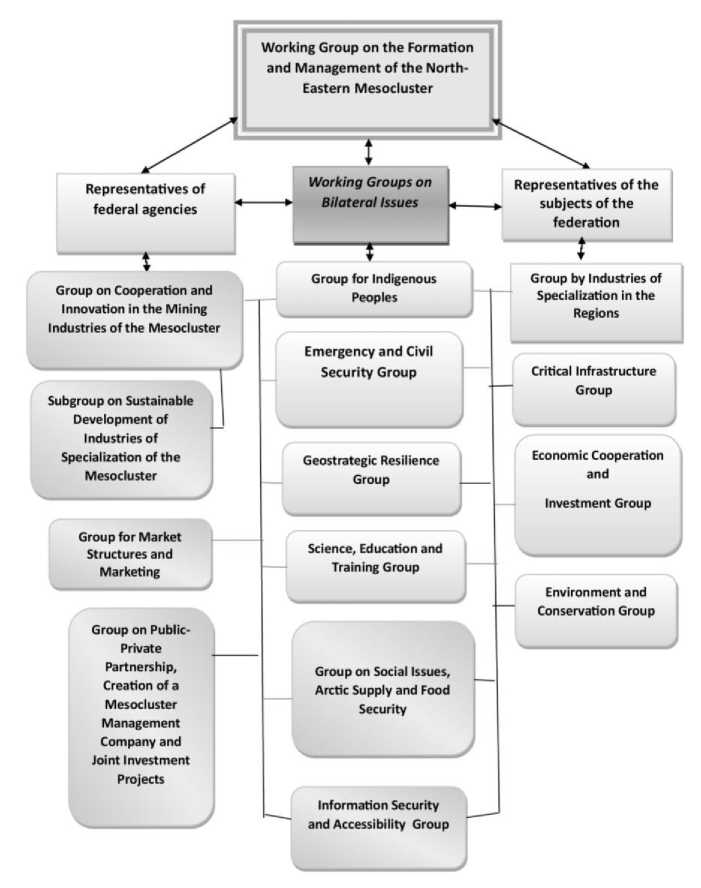
• At the initial stage of its formation, it is necessary to organize a temporary inter-regional and inter-sectoral group of representatives of federal and regional administrative bodies with the participation of scientific organizations. The purpose of this group is to conduct an in-depth interdisciplinary study of the main processes of the current and future development of these industries in close connection with the final indicators of the socioeconomic development of the territories under study (see Fig. 1);
-
• At the next stage, a permanent institutional state-regional structure based on the temporary group should be created to manage the mesocluster of extractive industries in the territories under study and to regulate the promising directions of its strategic development.
The temporary group should, as quickly as possible, address the most pressing issues facing these territories with the goal of mitigating the negative effects of emerging inversion (countervector) processes on the implementation of competitive and cooperative relationships in the newly formed integrated spatial-economic entity, primarily in its extractive industries.
Due to their institutional nature, the practical resolution of all these issues is most likely the responsibility of the Far East and Arctic Development Corporation, a joint-stock company established by government decree as the management company of the Arctic Zone of the Russian Federation 17.
Group on PublicPrivate
Partnership, Creation of a Mesocluster Management Company and
Joint Investment Projects
Emergency and Civil Security Group
Critical Infrastructure
Group
Group by Industries of Specialization in the Regions
Representatives of the subjects of the federation
Working Group on the Formation and Management of the NorthEastern Mesocluster
Group on Social Issues, Arctic Supply and Food Security
Subgroup on Sustainable Development of Industries of Specialization of the Mesocluster
t
Group on Cooperation and Innovation in the Mining Industries of the Mesocluster
Economic Cooperation and
Investment Group
Information Security and Accessibility Group
Representatives of federal agencies
Geostrategic Resilience Group
Science, Education and Training Group
Working Groups on Bilateral Issues
--------:---------
Group for Indigenous Peoples
Environment and Conservation Group
Group for Market Structures and Marketing
Fig. 1. Structure of the working group on the formation of a “mesocluster” in the northern Arctic territories of the Far East.
Conclusion
From a general theoretical perspective, the entire cycle of the author’s previous studies, which served as the information base for this work, as well as this study itself, were linked to the application of the postulates of spatial economics, infrastructure, and inversion and cluster analysis. These studies identified profound crises in the socio-economic and geostrategic development of the northern Arctic territories of the Far East at both the national and international levels (Kras-nopolskiy, 2023).
These crises have different economic origins, but the most significant of them at the current stage of development of these territories, according to the author, is the crisis in the direct and reverse (inversion) interactions within their extractive industries.
In terms of their significance, these industries act as leading forces not only within the systems of productive relations in the territories under study, but also effectively serve as structuring elements in spatial terms, shaping the formation and distribution of regional communities and their supporting settlements within this zone. The emerging contradictions in the development of
SOCIAL AND ECONOMIC DEVELOPMENT
Boris Kh. Krasnopolskiy. Transformation of Institutional Mechanisms and Structures … these sectors, particularly in the context of competitive and cooperative relationships (especially if these territories are considered as a single spatial-economic entity), lead to significant losses in their overall effectiveness in the interests of the state. However, the role of these territories is extremely significant not only at this stage of their development, but particularly in the long term, as, in addition to their great importance in terms of the country’s raw material potential, they border such major countries in the global Arctic as the USA (near abroad — the state of Alaska) and Canada (far abroad).
This article substantiates proposals for a possible resolution of the identified inversion contradictions based on the formation of an interregional infrastructure and innovation “mesocluster” for the extraction of mineral resources in the study areas, as well as the creation of a special temporary institutional structure — a joint working group — to regulate and manage these processes.
Its main goal is to consolidate the institutional functions involved in the management of these territories and their communities, including the entire system of methods, techniques and specific mechanisms, regulatory acts, etc., for the joint regulation of the spatial development of the newly emerging economic structure in the Far North-East of the country. This goal can be achieved through closer integration, primarily in the basic sectors of the extractive specialization of these territories, based on the accelerated development of exogenous (external) elements of their critical infrastructure.
The temporary working group may subsequently be transformed into a permanent institutional body, which will serve as a special state-regional planning commission for the North-Eastern mesoregion. This is a complex task: it will affect the current management functions of both state organizations and regional administrative bodies of the Republic of Sakha (Yakutia), the Chukotka Autonomous Okrug, and the Magadan Oblast. However, the implementation of such a planning approach in the strategic development of this region at the present stage is urgently needed, as has been justified above.
The proposals presented in this article, based on the results of the conducted research, can also be used in practical terms in the implementation of the Resolution of the IX International Scientific and Practical Conference “Far East and Arctic: Sustainable Development” (“Far East and Arctic - 2024”), which was held on March 5-6, 2024, in Moscow. One of the provisions of the resolution was as follows: “To introduce amendments into federal legislation governing the development of the Far East and Arctic regions of the Russian Federation aimed at eliminating excessive expenditure 18 that reduces the efficiency of economic activity in the Far Eastern and Arctic regions of Russia” 19.
