
Виртуальная личность англоязычного инфлюенсера: лингвокреативный аспект
Журнал: Вестник Волгоградского государственного университета. Серия 2: Языкознание @jvolsu-linguistics
Рубрика: Межкультурная коммуникация и сопоставительное изучение языков
Статья в выпуске: 5 т.24, 2025 года.
Бесплатный доступ
Исследование выполнено в русле актуального направления языкознания – интернет-лингвистики. Рассмотрены центральные элементы самопрезентации англоязычных инфлюенсеров на видеохостинге YouTube – самономинации и самоописания – с позиции лингвистической креативности данных языковых единиц. Проанализированы 100 веб-профилей влиятельных коммуникантов, содержащих двухфазные самономинации (в количестве 100 никнеймов и 100 наименований каналов) и самоописания (100 текстовых единиц). Установлено, что в самономинациях большинство инфлюенсеров отдает предпочтение своим реальным антропонимам, формируя окказионализмы в виде монокомпонентных образований из имени и фамилии, брендируя тем самым свое настоящее имя. Меньшее количество влиятельных пользователей указывают инновационные онимы, включающие соединение своего имени с какой-либо языковой единицей, или выбирают псевдоним, применяя словообразовательные возможности языка и блендинг, модифицируя идиоматические выражения. При самоописании лингвистическая креативность инфлюенсеров проявляется в вариации приветствия, призыва стать подписчиком канала, используя языковую игру, разные синтаксические формы предложения и паравербальные символы при предоставлении краткой информации о публикуемом контенте и интересах автора канала. Все это свидетельствует о стремлении лидеров мнений к развитиюсвоего инновационного бренда и завоеванию аудитории.
Похожие статьи в разделе Английский язык
Короткий адрес: https://sciup.org/149149756
IDS: 149149756 | УДК: 811.111:004.738.5 | DOI: 10.15688/jvolsu2.2025.5.8
English-Speaking Influencer's Virtual Personality: Linguocreative Aspect
The research is based on the modern direction of global language studies – Internet linguistics. The central elements of self-presentation of English-speaking influencers on the video sharing platform YouTube – self-nominations and self-descriptions – are considered from the perspective of their linguistic creativity. 100 web profiles of influential users, containing two-phase self-nominations (100 nicknames/handles and 100 channel names) and self-descriptions (100 text units) have been analysed. It has been stated that in self-nominations the majority of influencers prefer their real anthroponyms, creating occasionalisms in the form of monostructural formations from their first and last names, thereby branding their real name. Less influential users create innovative onyms by combining their name with some language unit or inventing a pseudonym through word formation, blending, modifying idiomatic expressions. Variations of linguistic creative manifestations are also observed within self-descriptions in the forms of greetings, calling to join the channel, providing brief information about the type of content, the user's interests in the form of word play, with various syntactic structures and paraverbal symbols. All these points indicate the leaders' efforts to create their own innovative brand and attract an audience.
Текст научной статьи Виртуальная личность англоязычного инфлюенсера: лингвокреативный аспект
DOI:
The Internet is ubiquitous today. Virtual communication not only provides simultaneous, convenient, and unhindered exchange of information between users within the Web but also brings changes to the language we speak every day. Our language expands its spheres, acquiring new forms as well as new utilitarian and pragmatic functions. The language of interaction has its own peculiarities and dynamics, which are clearly manifested when using online social services with a high communicative potential.
Among the multitude of social networking services being currently available, the platforms with dominant visual content prevail, where photo and video materials are in the centre of attention. However, verbal content complements the image seamlessly, and it is seen as the main means of establishing contact with the online audience [Timoshenko, 2018]. The academic community actively supports the interest in the language of social media. Linguists study various aspects of such web-services, considering lexical and stylistic, genre, grammatical, communicative and pragmatic characteristics [Chudinova, Polegoshko, 2021; Danilicheva, 2018; Kopylova, Ivanova, 2023; Reva, Mezhina, 2020]. An important and relevant facet of global linguistics, that is not fully disclosed, is the problem of people’s verbal self-presentation in the web-reality, and it definitely correlates with the anthropocentric and even the egocentric paradigm of modern research papers [Kazyaba, 2020].
In the context of pervasive digitalisation, the design of an optimal online prototype, its successful promotion, development and the implementation of full-fledged communicative activity on the Web get particular emphasis and scholarly value, especially when we focus on the influencers as the key, prominent and esteemed online personalities. In the era of general visualisation, only unconventional and innovative language usage, i.e. the ability for linguistic creativity as a significant tool of personal self-presentation, can help these influential users draw attention to their webpages.
Linguistic creativity has been studied and continues to be the object of research and academic interest of many domestic and foreign scholars [Dobrova, Melnikova, 2022; Fateeva, 2016; Fauconnier, Turner, 2002; Gay, 1980; Gerber, 2020; Gorbunova, 2005; Grigor’ev, 1979; Gridina, Pipko, 2012; Gridina, 2020; Ilyasova, 2020; Iriskhanova, 2009; Lakoff, Johnson, 2003; Literat, 2018; López Rúa, 2010; Nikitina, 2014; Nishpi, 2021; Renouf, 2007; Veale, Hao, 2008].
Creativity, in general, falls within the scope of research interests in the sphere of humanities – philosophy, psychology, sociology, culturology, pedagogy, art history, etc. Today, the concept of linguistic creativity is mentioned and reflected in the linguistic research field with an increasing frequency. This term turns out to be in the centre of researchers’ attention for a number of reasons: firstly, due to consideration of the human factor in language and interest in the creative realisation of linguistic personality; secondly, the interpretation of creativity within cognitive linguistics and the identification of creativity is viewed as a special type of thinking; thirdly, the constant deployment of space for the creative activity of native speakers – media and advertising discourse and the language of the Internet [Smirnova, 2021]. In addition, linguists query whether linguocreative manifestations in language are a sign of degradation and regression in the linguistic system or, on the contrary, contribute to the evolution of our everyday language. A growing number of once occasional formations is included in dictionaries and firmly established in the language, producing new meanings and contexts [Idrissi, 2019].
Nowadays, there is no unified definition of linguistic creativity. First and foremost, linguists predominantly define linguistic creativity through the hypernym ability or complex of abilities. L.M. Rylschikova talks about the use of readymade language material to produce some sort of novelty [Rylshchikova, 2016], while T.A. Gridina, T.V. Tyuleneva and T.B. Shilo remark on the design of completely new, non-trivial and unique language units through creative speech activity, most often associating this phenomenon with the result of the process of children’s and students’ language learning [Gridina, 2020; Shilo, 2018; Tyuleneva, 2012]. Furthermore, in some academic works attention is drawn to the correlation of linguistic creativity with the system of knowledge about language for the creation of new words, for which mastery of the language is seen as a necessary condition [Bazilevich, 2015]. A.V. Nagornaya and O.V. Sokolova speak about the influence of language creativity on effective communication, defining linguocreativity as the production of a new language unit to solve an existing communicative task, expressing the desired meaning as fully as possible [Nagornaya, 2019; Sokolova, 2020]. Linguists emphasise the revolutionary nature of the phenomenon under study, as linguistic creativity provides a basis for renewing the existing language. Moreover, many specialists define linguocreativity through the lens of the process, considering this phenomenon as a mechanism or an act of building language innovations [Zykova, 2017; Renouf, 2007; Stepanova, 2020]. And finally, in approaches to defining linguistic creativity, a number of researchers prefer to start not from the essence of its phenomenon but from the generating factors, conditions or circumstances, its discursive causality [Germasheva, 2016; Zykova, Kiose, 2020].
Linguocreative processes are characterised by the following specific features:
-
– deviance – language creativity compared to norms and correctness of verbal expression [Zykova, 2017];
-
– discoursivity – the acquisition of new meanings and qualities of language phenomena in different concepts and surroundings [Kshenovskaya, 2020];
-
– communicativeness – the fact of using the language innovation exclusively in the presence of the communicator’s intention and a clear aim to show an attitude to some phenomenon of reality through a new language formation [Nemkina, 2023];
-
– cognition – a certain way of thinking that allows creating something non-standard in the language [Kiose, 2020; Zolotarev, Privalova, 2020];
-
– evaluativity, expressiveness and metaphoricity – a group of features representing emotional, figurative and intense expression of the subject’s state of mind [Avdevnina, 2018; Shkvartsova, 2017].
Considering all the above, we can claim that linguistic creativity is the ability to create unique linguistic units with the aim of generating innovative formations or expanding existing meanings for the most accurate reflection of the reality, attracting attention and achieving the necessary effect in a particular communicative situation .
Linguistic creativity is multidimensional and complex. Much attention is currently paid by linguists to the analysis of the linguocreative component of online texts. The Internet opens up broad prospects for studying manifestations of linguocreative activity, which is becoming widespread. Linguistic creativity is considered to be situational, but alongside with that, it harmoniously fits into social contexts, as it is regularly encountered in everyday language. The Web is hybrid in terms of the correlation of oral and written texts – the user expresses themself by means of writing, without involving the speech apparatus, but simultaneously in various ways conveys their own intonation and “oralises” what is written. Linguistic means used by people in online communication represent the greatest value and significance, as it is through them that the identity of each user is manifested.
Linguistic creativity constitutes a core component of influencers’ verbal self-presentation on social media, enabling the negotiation of authenticity within commercialised digital spaces. At the moment a scholarly trend towards the analysis of verbal embodiment and strategies for constructing virtual personalities in social networking services has emerged. The users themselves are the creators of all content, setting the directions and developing online communicative platforms. They demonstrate and position their individuality, design and build their own holistic virtual image largely thanks to the conscious and creative application of necessary linguistic means. While the phenomenon of linguistic personality, which has emerged in linguistics, already has a relatively settled tradition and developed theory, it is the consideration of virtual linguistic personalities which is sporadic in linguistics. However, in marketing, for example, a versatile image of an online individual is always crucial, and increased attention is given to the fact that successful self-presentation and an elaborated online identity of the user are in direct ratio to both communicative and commercial success and demand [Kazyaba, Barmina, 2022].
Any modern social network is full of various users, and the central category among them is called influencers, or public opinion leaders. Referring to explanatory dictionaries, it is possible to identify the basic distinctive characteristics of influencers, namely, power (Dictionary), fame and influence on social media (Duden), loyal audience, high influential potential, advertising activity, getting financial advantage online (Macmillan). The role and importance of influencers in the process of online communication is difficult to overestimate, as in this case we are dealing with the stereotypes of human thinking. People tend to accept the statements and instructions of individuals who seem authoritative in any field without hesitation. Influencers’ virtual personalities require constant demonstration, elaboration, and objectification to be in all their glory.
Self-presentation, within the context of social networking services, acts as a significant determinant of potential online success. This phenomenon can be described as an online user’s strategic communicative activity, wherein they construct a virtual personality utilising both verbal and non-verbal capabilities of a multi-coded media text [Stakhovskaya, 2019]. Modern social networks assume various positions that allow for productive verbal self-presentation. The foundation for creating an online personality is formed by these tools, and it’s essential for any internet influencer to adeptly and consciously utilise them for progressing in their digital career. However, in this research we suggest focusing only on the pre-communicative level of selfpresentation, i.e. on self-nomination and selfdescription, since it is these elements of selfpositioning that are seen as central and basic along with visual data. Therefore, the aim of this article is to provide an analysis of linguistic creative tools within the key components of verbal selfpresentation of English-speaking influencers on YouTube.
Material and methods
This study examines the linguistic construction of influencers’ self-presentation through an analysis of self-nominations and selfdescriptions collected from the video-sharing platform YouTube in 2024. YouTube has been chosen due to its popularity and the value of visual data today. Additionally, the choice of the platform is based on the statistics: according to Buffer Marketing Library, this video-sharing service is in the 3rd place of the social media ranking, having 2.49 billion monthly active users (Buffer). On this social media a user’s pre-communicative identity consists of a handle (a nickname), a channel name and a self-description (see Fig. 1). We propose to identify, through a linguistic analysis, how public opinion leaders name and describe themselves and whether they produce occasionalisms and language innovations at this level of selfpresentation.
In order to conduct research, distinguish the specific features of self-presentation of Englishspeaking influencers and find the linguocreative means designed by them, 100 personal web pages of English-speaking users with an audience of subscribers of at least 100 thousand people were selected from YouTube, obtained by a random stratified sampling. Accounts of only those users who are native to and/or reside in the United Kingdom or the USA were selected by applying the “USA” and “UK” filters in the search bar. The selection of research material was additionally based on the ratings and analytics of the following media reviewers: StarNgage (StarNgage), HypeAuditor (HypeAuditor) and YouGov (YouGov). The presented volume of factual material – 100 influencers’ web pages – can be considered representative, as in the vast majority of cases, well-known media observers publish rankings of web celebrities, including the top 1 000 accounts. Based on empirical observations and relying on the practice of sociological and sociolinguistic research, which state and prove that even in conditions of an overly extensive population, 2% of units from the total number is sufficient for formulating conclusions and tracking specific features [Buchstaller, Khattab, 2014].
Self-nominations, as key elements in selfpositioning, have undergone various types of analysis, such as nominative, structural, and graphical. Part-of-speech, qualitative and quantitative, semantic, content-thematic, and graphical analyses were used in relation to selfdescriptions. In order to identify the trends in each aspect of self-presentation and their linguocreative potential, a quantitative count was conducted, and
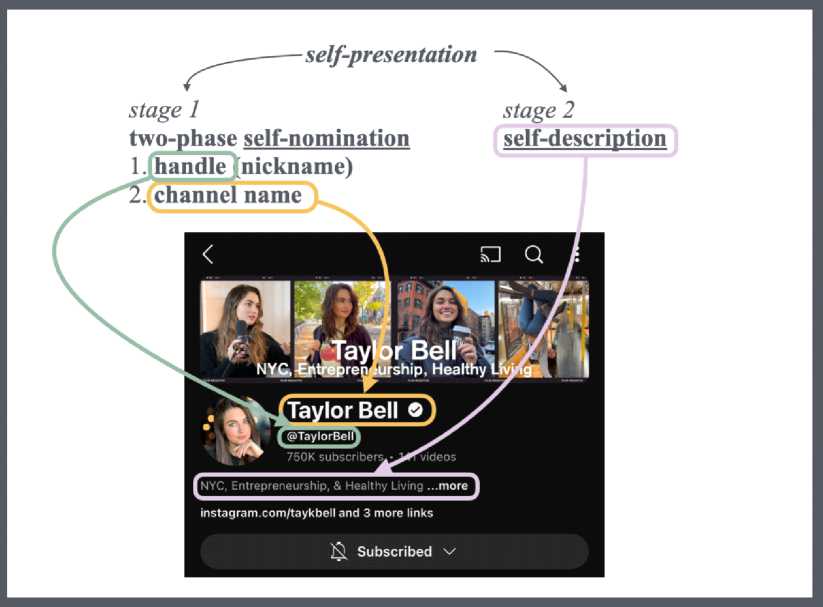
Fig. 1. Key self-presentation stages on YouTube
for presenting the results of observations, synthesis methods, generalization, and descriptive methods were used.
Results and discussion
A key feature of influencer self-presentation is the two-phase process of self-nomination, which is explored below using examples from Englishspeaking YouTube creators’ web pages. It is necessary to point out that some technical restrictions are imposed on the material we are studying. Thus, the nickname (@handle) must be unique and contain from 3 to 30 characters, including lowercase and uppercase letters, numbers, and underscores; periods, hyphens are also allowed. A handle provides identification potential on the social network, marking every single statement and publication of a user. The channel name, on the other hand, is free from such requirements; the character limit is only advisory.
Primarily, it is necessary to examine the nominative potential of English-speaking influencers’ handles and to identify the linguocreative characteristics within each nominative type. Handles/nicknames can be expressed by the user’s real name – these are autonyms; they may contain a real name in combination with another linguistic unit – mixed type handles; or they can represent new online names unrelated to the user’s real name – pseudonyms. The distribution of these nominative types within the research database can be observed in the diagram (see Fig. 2).
It was found out that English-speaking influencers prefer to use their real-life names in their nicknames (60% of 100 personal web pages under analysis). The linguistic creativity of opinion leaders who refuse anonymity is manifested in the writing of their first and last names together, thanks to which each of these influencers is perceived as an individual with a unique brand of their real monostructural composite. There are 57 webpages with such monostructural handles-autonyms, and they are laid out in different ways which are shown in Table 1.
Only 3 autonymous handles are two-component, i.e. have a graphical delimiter between the first name and last name: Dylan_Anderson , liam.porritt . So, influencers avoid the few available paraverbal means in their handles, as their absence at this level of nomination indicates maximum originality and uniqueness.
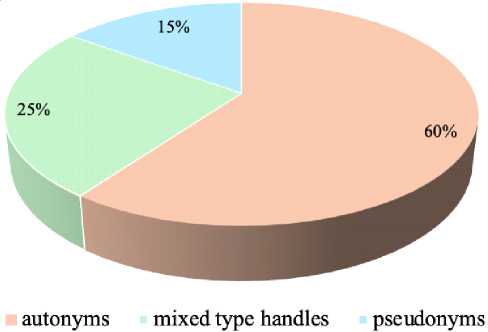
Fig. 2. The nominative potential of English-speaking influencers’ handles
Table 1. The composition of monostructural English-speaking influencers’ handles-autonyms
|
% |
Structure |
Example |
|
43 |
The combination of the first name and surname written in initial capital letters |
MaryAllyson Becca Watson TaylorBell DevinCarroll |
|
31 |
The same combination consisting entirely of lowercase letters |
alondradessy nathanieldrew allisonanderson scottykilmer |
|
10 |
The composition ‘name + name’ |
ErikaDiane HannahElise AlishaMarie |
|
10 |
Only the first name |
casey danny mikhaila |
|
6 |
The composition ‘name + surname,’ written with an initial capital letter |
Jaclynhill1 Freddielooo |
At the second phase of self-nomination, creating a channel name, 3 influencers fully duplicate their handle, whereas 48 opinion leaders copy their handle, modifying only the graphical design. Typically, the first and last names are separated by a space and written with initial capital letters: Brent Rivera (@brentrivera), Dan Rhodes (@danrhodes), Jeremy Lynch (@jeremylynch). 3 influencers complement their already known name with their real surname: CaseyNeistat (@casey), Mikhaila Peterson (@mikhaila). The other 3 users reveal their full surname: Em Sheldon (@Emshelx), Chris Williamson (@ChrisWillx). 2 influencers add some noun to their true anthroponym: Dhar Mann Studios (@DharMann). However, only 1 communicant chooses non-standard graphic design, adding emojis: ☆ELENA C. (@elenachee). So, the opinion leaders don’t tend to show their linguistic creativity at this self-nomination phase at all.
A monostructural creative composite formation in the handle has been registered as unanimous by 25% of 100 influencers (see Fig. 2); adding some language units to the real anthroponym they create an occasionalism – a handle of a mixed type. Their structural variations and frequency can be observed in Table 2.
All the demonstrated nicknames can be the specimens of linguistic creativity, as they are nonstandard and innovative in terms of the language. The handle zackdfilms contains an occasional participle zackd , which ends in - ( e ) d and is used as an adjective in the given example. Also, two creative interpretations can be noticed in terms of an idiomatic expression of the week (= one that has been chosen as the best in a particular
Table 2. The frequency of monostructural English-speaking influencers’ handles of a mixed type
|
% |
Structure |
Example |
|
36 |
Construct a nomination on the pattern of a simple sentence to convey some meta-message |
Its blitzzz Iam MoBo lena lifts Luke DidThat Vereena slayed thatssoo drea |
|
24 |
Declare their sphere of expertise through a noun |
nickbare fitness zackd films BradOwen Poker LanceStewart Vlogs |
|
12 |
Combine their name with an adjective |
Happy kelli Holy Schmidt Flawless Kevin |
|
8 |
Emphasize their uniqueness with a definite article, added to the real name |
the jessicakaylee TheOfficial LoganPaul |
|
8 |
Declare their specialization through an abbreviation |
Brianna YT Laur DIY |
|
8 |
Construct a nomination on the pattern of a word combination |
ben oftheweek mylifeas eva |
|
4 |
Represent an interesting example of word creation and blending through the connection of a noun with a proper name |
mark iplier |
week ) in the handle benoftheweek and of one widespread offensive exclamation based on the homophony, used to show that you think something is surprising, shocking, or impressive, inside the handle HolySchmidt . The following examples – thejessicakaylee , TheOfficialLoganPaul – are grammatically incorrect, but by having the definite article inside these handles the users express their absolute uniqueness. And also, we have the showcase of blending – markiplier : the onym Mark and the noun multiplier are combined inside this handle.
In this case, when forming their channel name, 7 influencers calque their nickname in the channel title, and 10 users introduce only slight graphic changes: LukeDidThat ( @LukeDidThat ), MyLifeAsEva ( @mylifeaseva ), Happy Kelli ( @happykelli ), BENOFTHEWEEK ( @benoftheweek ). 8 influential bloggers in the channel name on the video sharing platform leave only their own name, separating it from another linguistic unit: Lance Stewart ( @LanceStewartVlogs ), Brianna ( @BriannaYT ), vereena ( @vereenaslayed ), linh truong ( @withlovelinh ).
As it follows from Fig. 2, 15% of 100 influencers apply appellative self-nominations – they design their pseudonym in the handle, all of them are monostructural. These are occasional composites akin to word combinations and sentences the possible options are presented in Table 3. They vary greatly in terms of semantic content, most often indicating the key topic of the webpage.
All the depicted pseudonyms are creative in terms of their unified structure, containing multiple words in a single formation that has never existed before – their brand new onyms. We suggest taking a close look at some peculiar examples from the table above. The handle XpertThief appeared from the former interest of the user towards the computer game called Grand Theft Auto. He emphasised this fact in his pseudonym with the help of homophony in the first component Xpert , showing both his former obsession by the prefix ex- and his great playing skill in this adjective expert . The woman with the handle iHasCupquake breaks the existing grammar and spelling rules and designs an
Table 3. The frequency of monostructural English-speaking influencers’ handles-pseudonyms
|
% |
Structure |
Example |
|
60 |
The composites based on the sample of a word combination ‘attribute + noun’ |
SSSniperWolf FleetingFilms TheSunnyAdventurers XpertThief CuteGirlsHairstyles TheCottageFairy |
|
15 |
The composites based on the sample of a simple sentence |
iHasCupquake thatdudecancook |
|
13 |
Absolutely new onyms |
MrBeast swoozie |
|
12 |
Attributive composites |
3blue1brown fearfullycreated |
innovative lexical unit to highlight her singularity. The user with the handle swoozie has come up with his idea of this name with the help of the Nike clothing logo Swoosh , connected with the suffix -ie , typical of nouns, that show affection. This handle 3blue1brown is also unusual, as the influencer conveys in the pseudonym his appearance feature, namely his eye colour.
The channel names again coincide with these handles in 93% of cases. 7% reveal a real personal name and a surname: Mindy McKnight ( @CuteGirlsHairstyles ). From the point of view of paraverbalics, names with examples of iteration and capitalisation for visual highlighting of the constituents of innovative formations were identified in the database.
To sum up, English-speaking influencers on YouTube display various ways of linguistic creativity in their self-nominations. As for both handles and channel names, the majority of influential users combine their first and last names with different capitalisation styles and delimiters. Patterns of mixed-type handles include simple sentences, nouns indicating expertise, adjectives, definite articles, abbreviations, word combinations, and blending. In pseudonyms influencers reflect the topic of their web-content, designing occasional composites. Influencers often replicate their handles in their channel names with minor graphical adjustments. So, the influencers maintain a balance between creativity and recognisability, often favouring simplified and unified structures that enhance their brand identity while occasionally breaking grammatical norms to stand out.
In terms of self-descriptions of Englishspeaking influencers on YouTube some more creative language manifestations can be found, as this element of self-presentation is not technically limited by the observed social networking service. Each self-description is formatted at the influencer’s discretion, so there is no unified scheme of this self-presentational text. 93 influencers of 100 online-individuals in the database actively use their self-descriptions. Some influential users limit themselves to one sentence or slogan (8% of 93 influencers), while the majority of influencers write voluminous texts for a complete representation of what this virtual personality is, mentioning their real names, welcoming their target audience, giving information about their accomplishments, type of content, personal interests, important metadata, promising some positive impact of staying with them, being grateful to their followers, etc.
Inside self-descriptions we can notice a variety of greetings within this element of selfpresentation (47% of 93 self-descriptions). They are all aimed at winning over the audience and creating a friendly atmosphere on the channel. Alongside typical greetings (e.g. Hey Guys , ...; Hi friends , ...; WHATS UP?! I’m Jake Paul ), one can identify creative greetings that demonstrate an unusual approach to welcome the audience, for instance: Hello Muggle ; hi bestie ; Welcome to the life of Drea! ; Salutations! Welcome to my little country cottage.
Based on these examples, we can focus on the fact how the influencers try to stand out from the typical greeting cliches by making unconventional linguistic choices to attract attention to their channel and noticeably differentiate themselves from others, taking into account some paraverbal means (emojis, various letter cases), as well as non-standard ways of addressing other communicants (bestie, Muggle) and personifying their entire lives with the channel (welcome to the life of...). Influential users address the emotions of their potential followers, invite the others to join them and become a crucial part of their lives.
Some influencers design an original description of who they are, where they live and what they do on their channel for their audience. 52% of 93 influencers attract their followers’ attention to the sphere of their activity, interests and hobbies inside the short texts:
In these instances we can see linguistic creativity in the form of graduation technique ( from <...> to ... <...>), unusual descriptions of the content (e.g. meme-able garbage, crazy stories, unscripted moments ), graphical formatting with special symbols and capitalisation ( ~iNfLuEnCiNg~ ). All these sentences are aimed at drawing other users’ attention to the webpage and getting a brief overview of the personal preferences of these influential users.
93 English-speaking influencers (36% out of the total) reveal their metadata, namely age, social status, profession, location, as they are given in the statements below:
-
(7) 26 y/o pro boxer / musical artist ;
-
(8) Poker player in Las Vegas, NV ;
-
(9) I’m Michelle Reed, a 20-something figuring it out in Dallas, TX ;
-
(10) I’ve been a mechanic for 56 years and I’m here to share my knowledge with you!
-
(11) my wellness journey as a 20-something-year-old living in London ;
-
(12) Californian documenting my 20s in NYC ■^ .
Having this information helps people get acquainted with the influencer without looking through the media that is published on the page.
The most part of the influencers encourage their audience to subscribe to their channel (73% of 93 influential users), finding unconventional ways to express this communicative intention and revealing their linguocreative ability by using various syntactic structures: a) imperative statement, e.g., SUBSCRIBE FOR A COOKIE! ; FAHLO ME ; Subscribe to join the fam! ; Make sure you subscribe and share my videos! ; b) conditional statement: If you like to laugh, Subscribe to my channel! ; Don’t forget to comment, like and subscribe if you like any of my videos and I’d love to hear your video suggestions! ; c) question: Whatever you’re into I’m sure there’s something for you down in the briny deep of my video page. So why not dive in? Moreover, in the examples of calling to subscribe, metaphors, comparisons, as well as supplementary paraverbal units can be noticed: bloom with becca г' да ; Join me, Milla*, on the most fun adventures to be found on YouTube #; Creating and exposing some of the most mind-blowing videos on the web! Send me your recreations of my videos for a chance to be featured!
In terms of such sentences graphical features are noted (emojis, capitalisation), in this way the influencers create a foundation for our visual focus on their self-descriptions. Moreover, there are some peculiar and creative equivalents to the verb subscribe , such as dive in , stay a while , bloom , join the fam. The influencers urge the audience not just to click the button to receive notifications about their updates on the webpage but to fully immerse themselves in the world of this virtual personality and experience important moments together with them.
The research material pointed to the tendency among influencers to employ their selfdescription section as a welcoming note to prospective followers. Here, they succinctly present key aspects of their personality and invite others to subscribe to their channel. Opinion leaders typically do not hesitate to use paraverbal means: a multitude of emoticons (76% of 93 self- descriptions) serving an aesthetic function, accompanying and supporting the texts, cases of capitalisation (36% of 93 self-descriptions) – all these features make the self-description more creative, vivid and distinctive.
Thus, the research highlights a clear tendency among influencers to use their selfdescriptions as a welcoming note to prospective followers. They employ various linguistic means to make their self-descriptions more engaging and distinctive. These include graphical features, greeting variations, content descriptions, personal information, calls to subscribe. By employing these varied and creative linguistic techniques, influencers effectively capture attention, build a connection with their audience, and encourage engagement with their content.
Conclusion
The linguistic analysis of two-phase selfnominations revealed that, regarding the first phase (handles), there is a tendency for English-speaking opinion leaders towards de-anonymisation, as the vast majority denote their online page on YouTube with their actual anthroponym. Handles-autonyms are linguocreative in their structure, because the most part of influencers synthesise their name and surname inside a unified brand new proper name. Other models at the first phase of self-nomination are also popular, although they differ in the absence of templates and diversity. However, all of the mixed and pseudonymic handles in the database can be considered as true representations of linguistic creativity, as the influencers come up with innovative monostructural composites and occasionalisms, using word-building, blending and word play. At the moment of assigning a name to the channel, influencers prefer to either duplicate the handle or seldom reveal their true personality. We can claim the high linguocreative potential of the influencers’ self-nominations, as they build absolutely new language units to launch their brand, promote their uniqueness, create an authentic image and be identifiable in the virtual reality. Not only do they try to stand out from the numerous users, but they also personify themselves with the activity they carry out in the online environment.
The self-descriptions of influencers differ in content and structure, but at this second stage their mastery of language tools to attract attention and convey the key idea of who they are in a particular social network is declared. The influencers’ ability for linguistic creativity is clearly manifested through the spectacular examples of derivational and lexical language creativity, namely word play, unusual language formations, popularity of graphic means (symbols, emoticons, letter cases). This result can be explained by the desire of opinion leaders to greet and address their potential loyal followers, to gain the audience and to turn to the users’ emotions inside their self-descriptions in a non-standard and friendly manner.
