
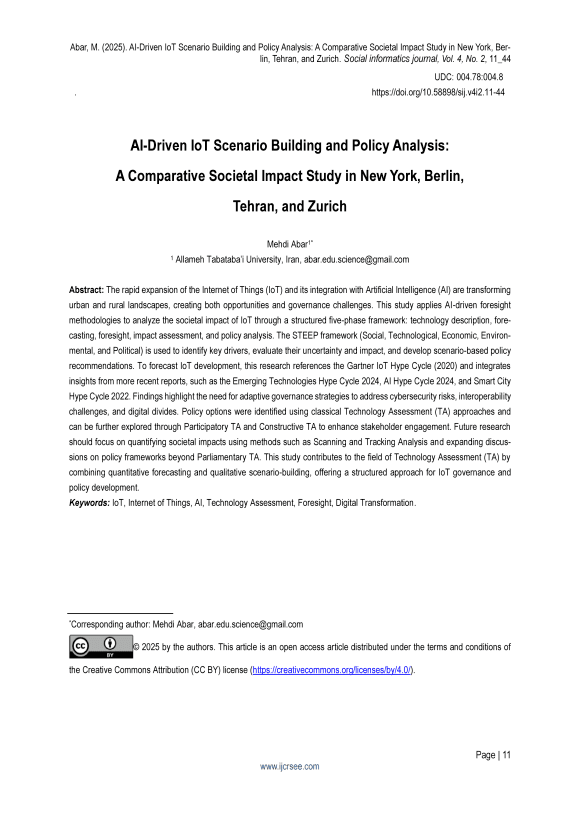
AI-Driven IoT Scenario Building and Policy Analysis: A Comparative Societal Impact Study in New York, Berlin, Tehran, and Zurich
Journal: Social Informatics Journal @socialinformaticsjournal
Article in issue: 2 vol.4, 2025.
Free access
The rapid expansion of the Internet of Things (IoT) and its integration with Artificial Intelligence (AI) are transforming urban and rural landscapes, creating both opportunities and governance challenges. This study applies AI-driven foresight methodologies to analyze the societal impact of IoT through a structured five-phase framework: technology description, forecasting, foresight, impact assessment, and policy analysis. The STEEP framework (Social, Technological, Economic, Environmental, and Political) is used to identify key drivers, evaluate their uncertainty and impact, and develop scenario-based policy recommendations. To forecast IoT development, this research references the Gartner IoT Hype Cycle (2020) and integrates insights from more recent reports, such as the Emerging Technologies Hype Cycle 2024, AI Hype Cycle 2024, and Smart City Hype Cycle 2022. Findings highlight the need for adaptive governance strategies to address cybersecurity risks, interoperability challenges, and digital divides. Policy options were identified using classical Technology Assessment (TA) approaches and can be further explored through Participatory TA and Constructive TA to enhance stakeholder engagement. Future research should focus on quantifying societal impacts using methods such as Scanning and Tracking Analysis and expanding discussions on policy frameworks beyond Parliamentary TA. This study contributes to the field of Technology Assessment (TA) by combining quantitative forecasting and qualitative scenario-building, offering a structured approach for IoT governance and policy development.
Similar articles in the section Computer communication. Computer networks
Short address: https://sciup.org/170211464
IDS: 170211464 | UDC: 004.78:004.8 | DOI: 10.58898/sij.v4i2.11-44
